
Team Extension: The Complete Guide to Scaling Engineering Capacity Without Hiring

Table of Contents+
- What Is Team Extension, and How Does It Differ from Staff Augmentation and Outsourcing?
- Why Does the DACH Region Need Team Extension Now?
- Extended Team or Dedicated Team: Which Model Fits Your Project?
- How Does Team Extension Integration Actually Work?
- Cost Savings, Speed Gains, and Measurable ROI
- How Do You Evaluate a Partner and Launch Team Extension?
- FAQs
- Research Sources
TL;DR
Team extension adds senior nearshore engineers to your DACH team in days, not months. See how the model, costs, and integration compare.
Team extension adds senior nearshore engineers to your DACH team in days, not months. See how the model, costs, and integration compare.
You know the signs before they show up in a status report. A senior backend role has been open for four months and the shortlist is still empty. Your strongest engineers are context-switching across three initiatives, the roadmap slips a sprint at a time, and every candidate who clears the technical screen wants more than budget allows — or takes another offer before you can move. If that pattern is what sent you looking into team extension, you're reading the symptoms of a structural capacity gap, not a run of bad luck.
The gap compounds quietly. Features that should ship this quarter drift into next year, competitors reach the market first, and half-funded work stalls because there simply aren't enough experienced hands to finish it. The reflexive answer — hire harder — collides with an 8-to-12-week recruitment cycle your timeline can't absorb. This guide maps the alternative: how experienced engineers can join your team in days, how the model differs from the ones it's often confused with, and how to run it without losing control of your own product.
What Is Team Extension, and How Does It Differ from Staff Augmentation and Outsourcing?
Team extension is a delivery model where vetted senior engineers from a nearshore partner join your existing development team, work inside your sprint cadence, and report to your Product Owner or Tech Lead. The partner handles recruitment, employment, payroll, and quality assurance, while you keep full technical direction and product accountability.
That last point is what sets the model apart. The engineers become part of your team: they use your tools, attend your daily standups and sprint ceremonies, and work to your Definition of Done. What the partner keeps is the operational scaffolding behind them — sourcing and vetting, HR and payroll, and its own quality layer. Extending your engineering team this way means adding people who behave like colleagues, not like an external unit you have to manage at arm's length.
Two adjacent models get conflated with it. Staff augmentation supplies individual contractors to fill named seats, without cohesive team integration or shared process ownership. Outsourcing hands an entire scope to a vendor that owns delivery end to end — you receive a result, not a team you direct. Team extension sits deliberately between the two: shared process, shared accountability, your direction. We unpack that boundary in our guide to staff augmentation vs. outsourcing.
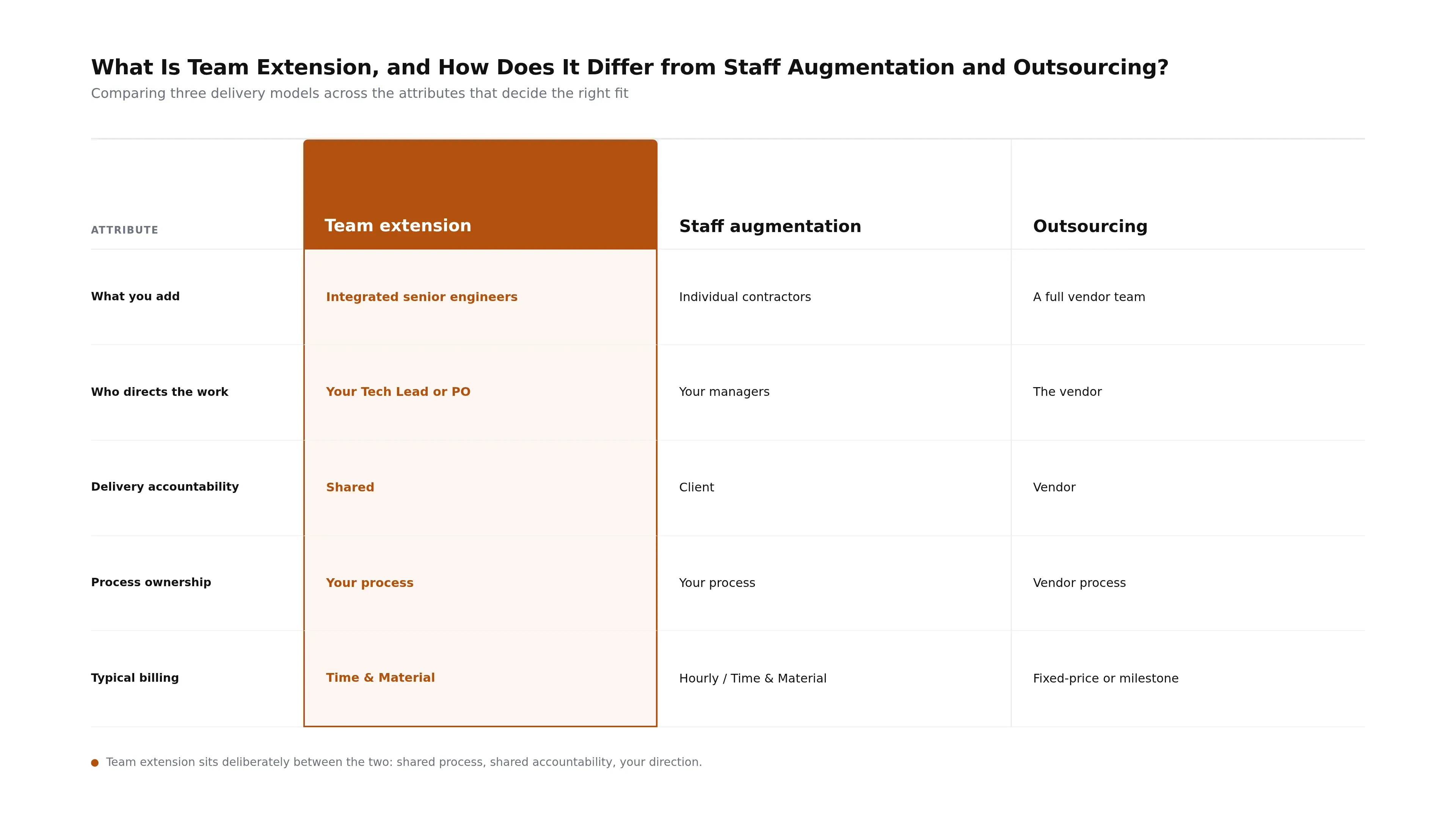
| Attribute | Team extension | Staff augmentation | Outsourcing |
|---|---|---|---|
| What you add | Integrated senior engineers | Individual contractors | A full vendor team |
| Who directs the work | Your Tech Lead or PO | Your managers | The vendor |
| Delivery accountability | Shared | Client | Vendor |
| Process ownership | Your process | Your process | Vendor process |
| Typical billing | Time & Material | Hourly / Time & Material | Fixed-price or milestone |
Framed this way, the decision isn't "in-house or external." It's whether you need seats filled, a scope taken off your plate, or capacity that plugs directly into the team and process you already run. Team extension answers the third case, and it's the one most capacity-constrained engineering leaders in the DACH region actually face.
See how enterprises modernize with one team.
Why Does the DACH Region Need Team Extension Now?
Germany, Austria, and Switzerland face a structural IT talent shortage, not a passing one. Central and Eastern Europe has absorbed two decades of worker migration to Western Europe that both enables and necessitates nearshore models — the exact labor-market force that makes team extension a viable answer for DACH enterprises rather than a compromise.
The supply side is what makes it work. Central Europe holds roughly 1.5 million developers; Poland alone accounts for about 600,000 programmers, with 80,000 or more STEM graduates entering the workforce every year. That pool is available at 30–50% below DACH domestic rates while operating in Central European Time — the same working day as Hamburg, Frankfurt, or Zurich.
Time-zone alignment is what separates nearshore development capacity from offshore. Standups happen live, code review turns around within the same day, and there's no overnight lag between a question and its answer. You get the cost advantage of a different labor market without surrendering the real-time collaboration that agile delivery depends on. Our deep dive on nearshore team extension and the DACH talent shortage lays out the market data in full.
This is why the model reads as a response to a structural constraint rather than a generic outsourcing option. The shortage isn't going to resolve on its own, domestic salaries keep climbing, and the recruitment funnel keeps narrowing. Nearshore capacity is the durable way to keep shipping through it.
Extended Team or Dedicated Team: Which Model Fits Your Project?
The choice comes down to what you're staffing. An extended team adds one to three senior engineers to your existing in-house team to close a specific capacity gap. A dedicated development team model stands up a self-contained group of four or more engineers to own a new product surface end to end, with its own internal structure.
Use the extended model when you already have a functioning team, a live codebase, and a Product Owner who can direct new engineers. You're adding horsepower to work that already has an architecture and a direction — the fastest path to relief when the bottleneck is simply too few experienced hands.
Reach for the dedicated model when the work is a distinct new surface that would otherwise compete with your core roadmap: a separate product, a greenfield platform, or a workstream that needs its own focus. Here the group runs as a cohesive unit against goals you set, rather than merging seat-by-seat into an existing team.
Across both, the seniority bar holds. These are engineers with a decade or more of experience who need context, not training — people who can read an unfamiliar codebase and contribute inside the first sprint. Why that experience level is non-negotiable is a subject in its own right, but the short version is that the model's speed depends on it.
How Does Team Extension Integration Actually Work?
Integration is a deliberate process, not a handoff. Onboarding typically begins within 14 business days and covers product context, the technology stack, team workflows, the Definition of Done, and clear ownership boundaries. The engineers then join your daily standups and sprint ceremonies and report to your Tech Lead exactly like any other team member.
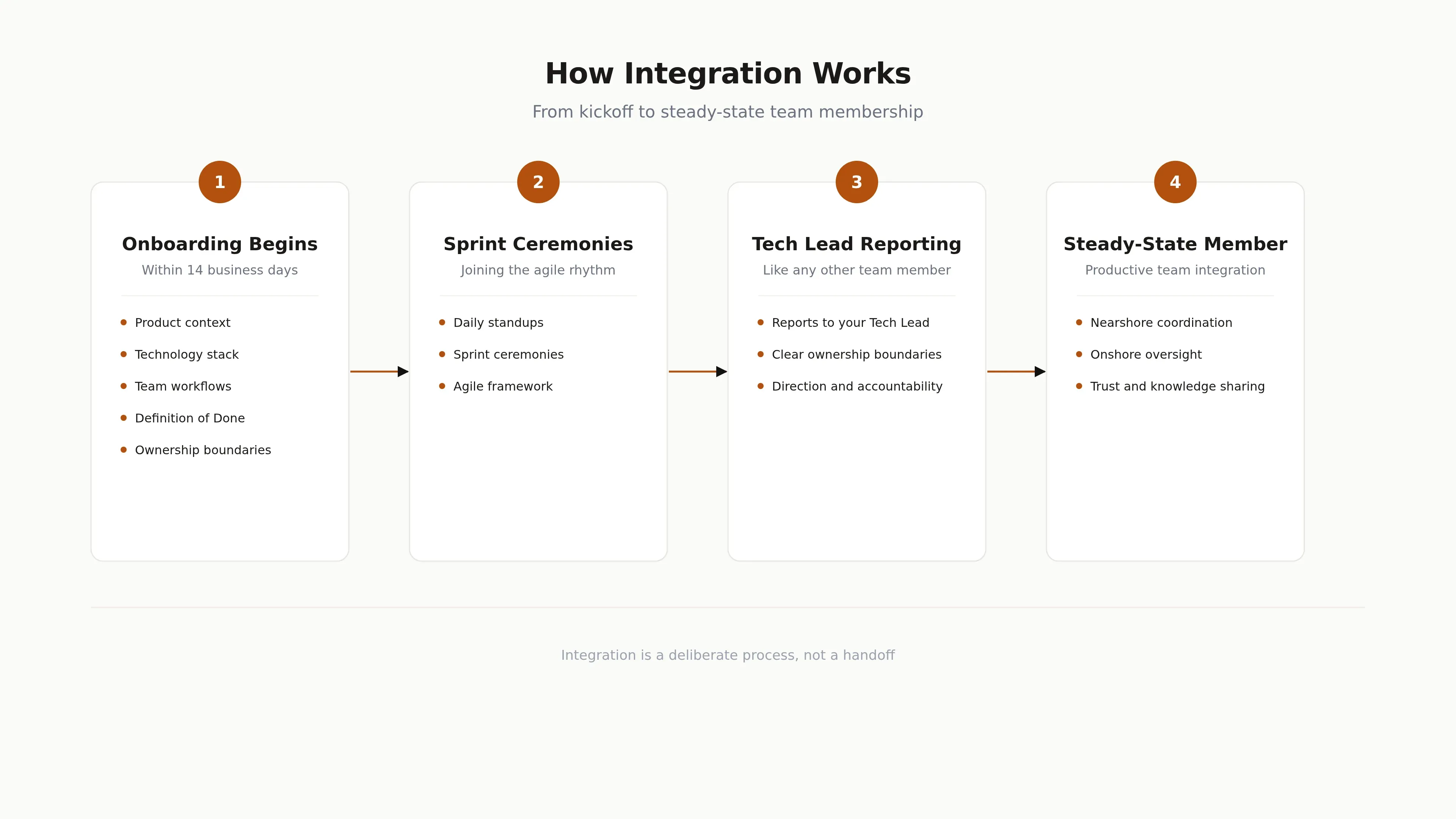
The onboarding design matters more than most teams expect. Research on remote onboarding shows that deliberately designed learning and team-building processes are essential — unstructured onboarding leads to frustration and turnover in knowledge-intensive organizations. Treating the first two weeks as real work, not paperwork, is what turns a capable engineer into a productive team member.
Structurally, this is a hybrid arrangement: your team supplies direction and oversight while the engineers work in coordination from the nearshore location. That pattern — onshore oversight integrated with offshore engineering inside an agile framework — has been shown to work in practice, and distributed teams reliably run agile sprints without a productivity penalty when the process is sound.
The connective tissue is trust. Trust and knowledge sharing sit at the center of virtual-team effectiveness, built through intentional onboarding and the right collaboration tools. In practice that means onboarding nearshore engineers into your agile team with the rigor you'd give a permanent hire, and setting clear ownership boundaries so everyone knows who decides what. Direction and accountability stay with you; the engineers plug into how you already work.
Cost Savings, Speed Gains, and Measurable ROI
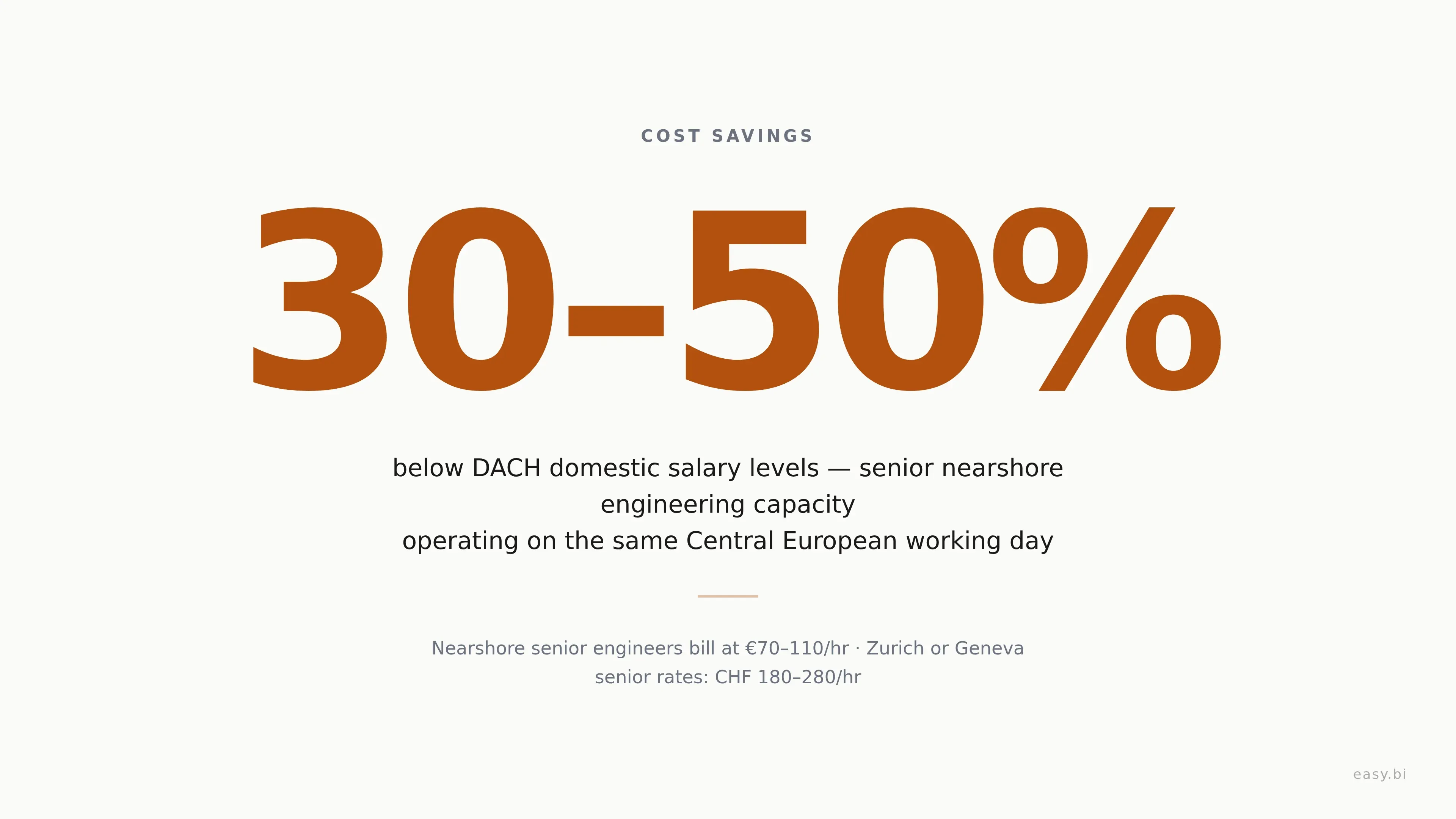
The economics are straightforward. Team extension delivers experienced capacity in days instead of an 8-to-12-week hiring cycle, at 30–50% below DACH domestic salary levels, and it removes the coordination overhead of juggling multiple vendors. The return shows up on two lines: faster time-to-revenue and a lower cost per unit of engineering delivered.
Speed is the first lever. A role that would sit open for two or three months is instead covered by an engineer productive inside your current sprint — the gap between deciding you need capacity and actually having it collapses from a quarter to a fortnight.
Cost is the second. Nearshore senior engineers bill in the range of €70–110 per hour, against Zurich or Geneva senior rates of CHF 180–280 — a difference that can reach CHF 80,000–150,000 over a typical 14-to-20-week engagement. We break the numbers down market by market in our comparison of nearshore developers versus hiring locally in DACH.
There's a third saving that rarely shows on a spreadsheet: avoided coordination cost. Splitting work across several specialist vendors means someone on your side spends their week reconciling interfaces, chasing status, and refereeing ownership disputes. A single extended team folds that overhead back into the work itself.
The billing structure reinforces the model. Engagements run on a Time & Material basis — hourly, daily, or monthly — with 30-day scaling notice and no minimum length, where a dedicated development team model usually asks for a four-month commitment. Why Time & Materials fits team extension comes down to shared accountability between you and the partner. This is precisely the model our own Team Extension service delivers — easy.bi embeds senior DACH-region engineers into existing teams on exactly these terms.
Siemens, Lekkerland, WeberHaus chose us
One integrated partner. Three core competencies. From insight to production, with no handover gaps.
Start with a Strategy CallHow Do You Evaluate a Partner and Launch Team Extension?
Choosing a team extension partner comes down to five criteria: proven technical capability, genuine engineer seniority, GDPR and data-residency compliance, time-zone alignment with your team, and a real track record of integration rather than staffing. Get these right and most of the execution risk disappears before onboarding even starts.
Knowing how to implement team extension well starts with the evaluation checklist:
- Technical capability — demonstrated depth in your stack, not a generic CV pool.
- Engineer seniority — 10+ years, the experience level the model depends on.
- Regulatory compliance — GDPR enforcement in Germany is split across a federal authority and 16 state-level ones, EU AI Act obligations are phasing in, and Swiss clients under the revised Federal Act on Data Protection expect data residency inside Switzerland.
- Time-zone alignment — Central European Time overlap for live collaboration.
- Integration experience — evidence the partner embeds engineers, rather than dropping off contractors.
Worker classification is a compliance line German and Swiss procurement teams increasingly verify: direct contractors engaged without an employer-of-record intermediary carry an 11.4% classification-dispute rate, against just 0.3% for EOR-backed providers. It's a quiet risk that's cheaper to check for than to unwind later.
The execution risks are predictable and therefore avoidable: unstructured onboarding, unclear ownership, and inadequate knowledge documentation. The last one bites after the engagement ends — structured process documentation and explicit knowledge-transfer processes preserve skill retention and keep what the extended team built from walking out the door. Before you sign anything, work through our team extension readiness checklist so your side of the integration is ready too.
Team extension isn't a workaround for hiring — it's a different instrument for a different problem. When the constraint is time and senior talent rather than budget alone, adding experienced engineers to your existing team in days beats waiting a quarter for a hire who still needs onboarding afterward. The model rewards teams that treat integration as genuine work: structured onboarding, clear ownership, and documented knowledge that outlives the engagement.
If you're staffing something larger, the same logic scales — see how team extension supports digital transformation programs with faster delivery at lower cost.
FAQs
How quickly can extended engineers start contributing?
Onboarding usually begins within 14 business days and covers product context, the tech stack, team workflows, and the Definition of Done. Because the model uses senior engineers with 10+ years of experience, they contribute inside the first sprint — but that speed depends on structured onboarding. Treat the first two weeks as deliberate integration, not paperwork, and productivity follows quickly.
What's the difference between team extension and a dedicated development team model?
Team extension adds one to three senior engineers into your existing team, where they report to your Tech Lead and follow your process. A dedicated development team model stands up a self-contained group of four or more engineers to own a separate product surface. Team extension typically runs on 30-day scaling notice with no minimum, while dedicated teams often require a four-month commitment.
Is team extension really cheaper than hiring locally in the DACH region?
Yes. Nearshore senior engineers bill at 30–50% below DACH domestic salary levels, roughly €70–110 per hour against Zurich or Geneva rates of CHF 180–280. Over a typical 14-to-20-week engagement that gap can reach CHF 80,000–150,000. The saving is amplified by speed: capacity arrives in days rather than after an 8-to-12-week hiring cycle, so revenue-generating work starts sooner.
How is knowledge retained after the extended engineers leave?
Through deliberate documentation. Mature engagements record architectural decisions, keep runbooks current, and run explicit knowledge-transfer processes so skills and context stay with your organization rather than leaving with the engineers. Structured process documentation is what preserves skill retention in distributed teams, and it's the single most overlooked execution risk. Build it into the Definition of Done from the first sprint.
Research Sources
Explore Other Topics
Ready to transform your business?
30-minute call with an engineering lead. No sales pitch - just honest answers about your project.
98% engineer retention · 14-day delivery sprints · No lock-in contracts
Related Reading

Nearshore Team Extension: Solving the DACH IT Talent Shortage
How nearshore team extension solves the DACH IT talent shortage—senior engineers in days, at 30–50% lower cost, done right.
Andrej Lovsin
Team Extension Readiness Checklist: 12 Questions to Ask Your Organization Before You Scale
Team extension preparation in 12 questions: score your technical, process, and leadership readiness before you embed external engineers.
Andrej Lovsin
Scaling From 2 to 20 Engineers in 6 Weeks (Without Losing Quality)
How to scale an engineering team from 2 to 20 in 6 weeks without losing code quality or delivery velocity. Onboarding frameworks, code review standards during growth, team topology at scale, and easy.bi's 4-country scaling model based on 100+ DACH projects.
Andrej Lovsin