
AI Strategy for Mid-Market: You Do Not Need a Data Science Team

Table of Contents+
- Why Does the "Hire Data Scientists First" Strategy Fail for Mid-Market?
- What Is the Alternative to Building a Data Science Team?
- What Are the 3 AI Opportunities Every Mid-Market Company Has?
- How Do You Build AI Literacy in an Existing Engineering Team?
- Why Should Mid-Market Companies Start with Business Problems, Not Technology?
- What Does a 12-Month AI Roadmap Look Like for Mid-Market?
- Frequently Asked Questions
- References
TL;DR
Mid-market companies (EUR 20M-500M) do not need data science teams to capture AI value. 90% of high-ROI use cases leverage pre-trained models through APIs, not custom training. This post maps the 3 AI opportunities every mid-market company has, the AI Impact Sprint model for rapid validation, and why AI-literate engineers plus a specialized partner outperform in-house data science hires.
Key Takeaways
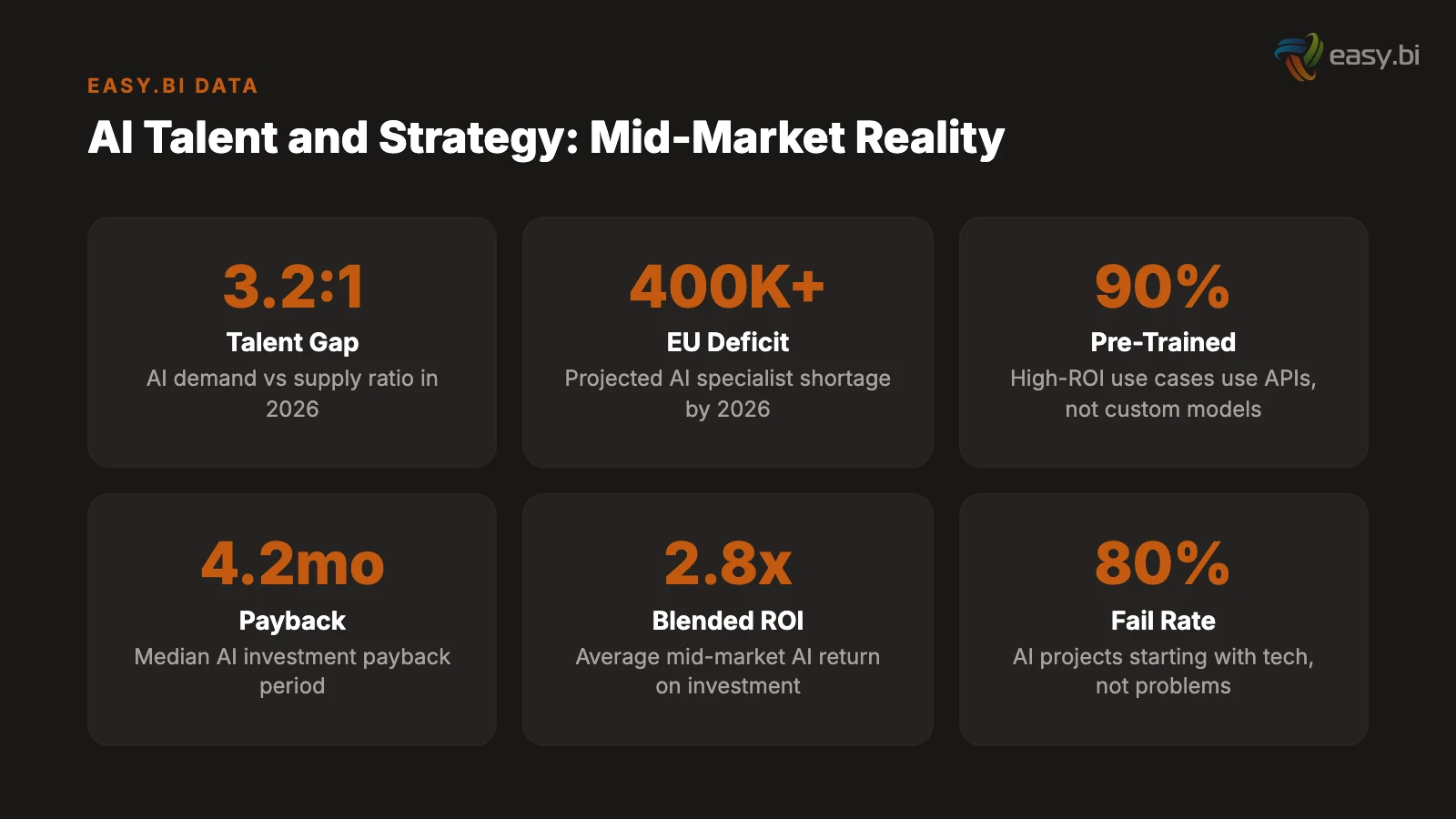
- •Mid-market companies (EUR 20M-500M revenue) do not need to hire data scientists to deploy AI effectively. Global AI talent demand outpaces supply 3.2-to-1 in 2026, and mid-market companies cannot win the hiring war against Big Tech - but they do not need to, because 90% of high-ROI AI use cases use pre-trained models, not custom-trained ones.
- •The AI Impact Sprint model - a structured 2-4 week engagement that identifies, validates, and prioritizes AI opportunities against business outcomes - delivers more value than 6 months of AI strategy consulting because it produces working prototypes, not slide decks.
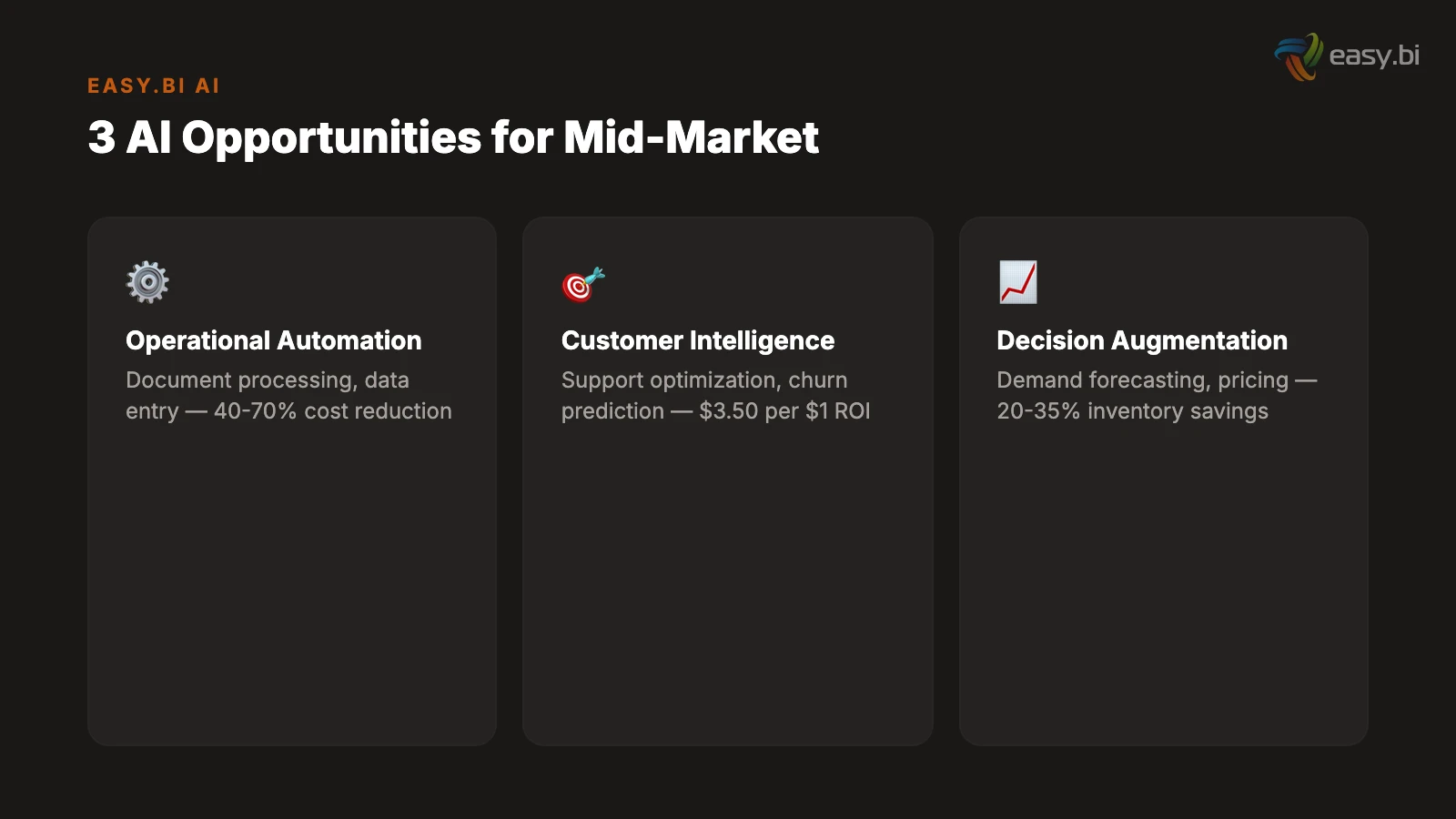
- •Every mid-market company has 3 AI opportunities hiding in plain sight: operational automation (document processing, data entry, reporting), customer intelligence (support optimization, churn prediction, personalization), and decision augmentation (demand forecasting, pricing optimization, resource allocation).
- •The European AI talent deficit will reach 400,000+ specialists by 2026, with Germany alone recording 137,000+ open IT roles. Mid-market companies competing for this talent lose - those partnering with specialized AI implementation teams win.
- •Starting with the business problem instead of the technology is the single strongest predictor of AI project success. Companies that begin with 'we should use AI' fail at 5x the rate of those that begin with 'we spend EUR 300,000 annually on manual process X.'
Mid-market companies (EUR 20M-500M) do not need data scientists to deploy AI. They need AI-literate engineers and the right implementation partner. A practical AI strategy framework with the 3 opportunities every mid-market company has.
A mid-market CEO in Munich told me last quarter: "We need to hire 3 data scientists to start our AI journey." I asked what business problem they would solve. Silence. Then: "We will figure that out once they are onboard."
This is the most expensive mistake mid-market companies make with AI. Not failed technology. Not bad data. Hiring specialists before identifying the problem they will solve.
Global AI talent demand outpaces supply by 3.2-to-1 in 2026.[1] Companies are posting over 1.6 million AI roles worldwide while only 518,000 qualified candidates exist to fill them. In Germany alone, there are over 137,000 open IT and software roles, with data scientists among the 3 hardest-to-fill positions.[1] The European Union faces a projected deficit of over 400,000 AI and data science specialists by 2026.[2]
Mid-market companies cannot win this hiring war. And here is the contrarian truth: they do not need to.
90% of high-ROI AI use cases for mid-market companies use pre-trained models accessed through APIs, not custom models trained from scratch. The skills required are software engineering with AI awareness, not data science. The strategic advantage comes from knowing which business problems AI can solve profitably, not from training models from scratch.
Why Does the "Hire Data Scientists First" Strategy Fail for Mid-Market?
The enterprise playbook for AI adoption goes like this: hire a Chief Data Officer, build a data science team of 5-10 people, create a data strategy, build a data platform, train custom models, and deploy them into production. Timeline: 18-24 months. Budget: EUR 2-5 million before the first model reaches production.
This playbook was designed for companies with 5,000+ employees, EUR 1B+ revenue, and millions of data points across dozens of business units. It does not translate to a company with 300 employees and EUR 80 million in revenue.
Here is what happens when mid-market companies follow the enterprise playbook:
Month 1-3: Recruiting. The data scientist role has 12 qualified applicants for every 100 open positions in North America and Europe.[1] Mid-market companies compete against Google, Microsoft, and hundreds of well-funded startups for the same candidates. Salary expectations for senior data scientists in the DACH market start at EUR 90,000-120,000. Most mid-market companies lose 2-3 months before making a hire.
Month 4-9: Onboarding and exploration. The data scientist spends 3-4 months understanding the business, accessing data systems, and building exploratory models. They discover that the data infrastructure is not ready for production ML (it never is at mid-market scale). They request a data engineering hire.
Month 10-15: Data engineering. A second hire builds data pipelines while the data scientist waits. The original business sponsor starts asking about ROI. There is no production model yet.
Month 16-24: First model in production. Maybe. 42% of companies abandoned most of their AI initiatives in 2025, up from 17% in 2024.[3] The data scientist is frustrated by limited infrastructure and leaves for a company with a bigger team. The cycle restarts.
68% of companies face a moderate to extreme AI talent shortage.[1] The talent gap disproportionately affects small and medium enterprises, which lack the resources to compete with large corporations for scarce expertise.[2] This is not a problem that gets better with time. It gets worse.
See how ebiCore accelerates development.
What Is the Alternative to Building a Data Science Team?
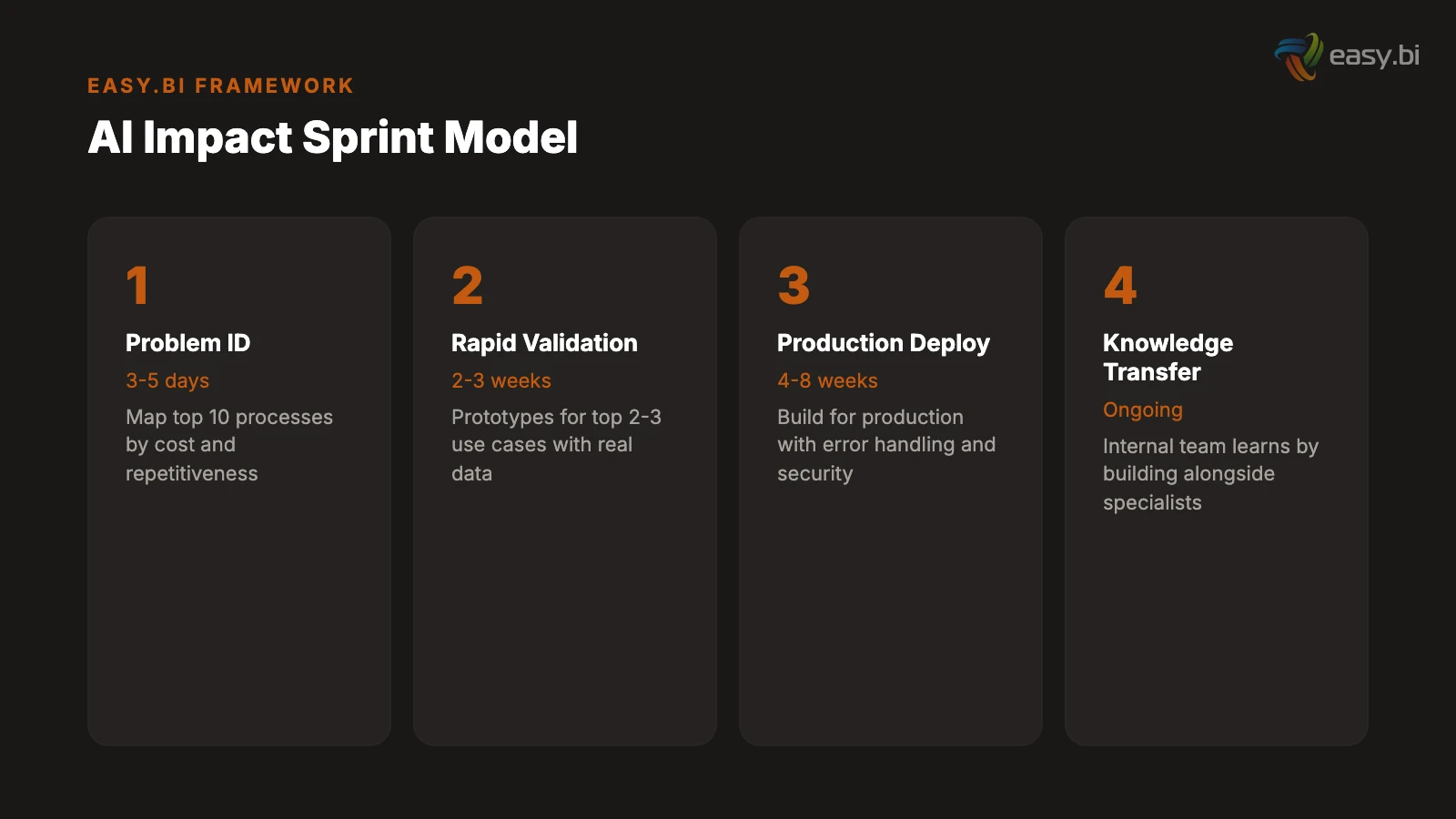
The alternative is a model I call the AI Impact Sprint - a structured approach that starts with business problems, uses pre-trained models, and leverages external AI implementation expertise for the specialized work while building internal AI literacy over time.
The AI Impact Sprint follows a 4-stage sequence:
Stage 1: Problem identification (3-5 days). Map the top 10 business processes by cost, volume, and repetitiveness. Identify 3-5 candidates where AI can reduce cost or increase throughput. Prioritize by expected ROI and implementation complexity. This is a business analysis exercise, not a technical one.
Stage 2: Rapid validation (2-3 weeks). Build working prototypes for the top 2-3 use cases using pre-trained models and APIs. No custom model training. No data warehouse project. Test each prototype against real data and measure performance against the current manual process. At the end of this stage, you have concrete evidence of what works and what does not.
Stage 3: Production deployment (4-8 weeks). Take the validated use case with the highest ROI and build it for production. This includes error handling, monitoring, security, and integration with existing systems. The output is a working AI system processing real business transactions.
Stage 4: Knowledge transfer and expansion (ongoing). Transfer operational knowledge to the internal engineering team. Document patterns, build internal prompt engineering capabilities, and create playbooks for the next use case. Each subsequent deployment gets faster because the team accumulates AI implementation experience.
The AI Impact Sprint model produces a working, revenue-generating AI system in 10-14 weeks. The enterprise "hire data scientists first" model produces a job posting, an onboarding plan, and a Jupyter notebook in the same timeframe. One generates ROI. The other generates cost.
The key insight: mid-market companies need AI-literate software engineers, not data scientists. Software engineers who understand API integration, data pipelines, and production systems can deploy 90% of high-ROI AI use cases when paired with a specialized AI implementation partner for the model-specific expertise.
What Are the 3 AI Opportunities Every Mid-Market Company Has?
After evaluating AI opportunities across dozens of mid-market enterprises (EUR 20M-500M revenue), three categories of opportunity appear in every single one. The specific applications differ by industry, but the categories are universal.
Opportunity 1: Operational Automation
Every mid-market company has processes where humans read data from one system, transform it, and enter it into another. Invoice processing. Order verification. Compliance reporting. Customer data entry. Employee onboarding paperwork.
These processes cost EUR 150,000-500,000 annually in direct labor for a typical mid-market company. AI-powered automation reduces this cost by 40-70%, with the highest returns in document processing (300-400% first-year ROI) and data entry automation (200-300% ROI).[4]
The implementation pattern: identify the highest-volume manual process, deploy an AI extraction and transformation pipeline, keep humans in the loop for exception handling, and gradually reduce human oversight as accuracy improves.
Opportunity 2: Customer Intelligence
Mid-market companies have customer data scattered across CRM, support systems, billing platforms, and marketing tools. This data contains patterns that humans cannot see at scale: which customers are likely to churn, which support interactions predict escalation, and which product combinations drive highest lifetime value.
AI-powered customer intelligence delivers measurable returns: companies using AI customer service tools see average returns of USD 3.50 for every USD 1 invested.[5] Support automation alone saves an estimated EUR 3.80 per interaction.[5] Churn prediction models, when properly implemented, reduce customer loss by 15-25%.
The implementation does not require custom model training. Pre-trained LLMs handle support automation through RAG pipelines. Churn prediction uses standard classification models available in cloud ML platforms (AWS SageMaker, Google Vertex AI) with your existing customer data.
Opportunity 3: Decision Augmentation
Mid-market executives make high-stakes decisions based on spreadsheets, experience, and intuition. Pricing decisions. Inventory allocation. Resource scheduling. Vendor selection. These decisions have EUR 100K-1M impact each, and humans make them with incomplete information because the data analysis takes too long to be timely.
AI-augmented decision-making does not replace human judgment. It provides the analysis that human judgment needs. Demand forecasting reduces inventory costs by 20-35%.[6] AI-optimized pricing increases margins by 2-8%. Resource allocation models reduce scheduling inefficiency by 15-25%.
The key word is "augmentation," not "automation." The AI surfaces insights, patterns, and predictions. The human makes the decision. This approach sidesteps the governance complexity of fully automated decision-making while capturing 80% of the value.
| Opportunity | Typical Annual Cost of Manual Process | AI-Driven Savings | Implementation Complexity | Time to ROI |
|---|---|---|---|---|
| Operational Automation | EUR 150,000-500,000 | 40-70% cost reduction | Low-Medium | 3-6 months |
| Customer Intelligence | EUR 200,000-600,000 (support + churn) | 20-40% efficiency gain | Medium | 4-8 months |
| Decision Augmentation | EUR 100,000-1,000,000 (decision quality) | 2-35% improvement by domain | Medium-High | 6-12 months |
How Do You Build AI Literacy in an Existing Engineering Team?
The talent you need is already in your building. Senior software engineers with experience in API integration, data pipelines, and production systems are 80% of the way to being effective AI implementers. The remaining 20% is AI-specific knowledge that can be acquired in weeks, not years.
The AI literacy curriculum for mid-market engineering teams covers 4 areas:
Prompt engineering (1-2 weeks): How to write effective prompts, build system instructions, implement few-shot learning, and structure inputs for consistent outputs. This is the highest-leverage AI skill for software engineers. A well-prompted API call to a pre-trained model solves 80% of mid-market AI use cases without any model training.
RAG architecture (2-3 weeks): How to build retrieval-augmented generation pipelines that connect LLMs to your business data. This includes document chunking, embedding generation, vector database management, and relevance scoring. RAG is the bridge between generic AI and business-specific AI.
AI system integration (2-3 weeks): How to deploy AI capabilities as production services. Error handling, latency optimization, cost management, observability, and security. These are software engineering skills applied to a new domain, not new skills entirely.
AI evaluation and monitoring (1-2 weeks): How to measure AI system quality in production. Accuracy metrics, hallucination detection, drift monitoring, and A/B testing for AI features. This ensures the team can maintain and improve AI systems after initial deployment.
Total training investment: 6-10 weeks of focused learning, ideally combined with a real project. The first AI implementation with an experienced partner doubles as a training program - your engineers learn by building alongside specialists, not by watching recorded courses.
This is why the AI Impact Sprint model works: it pairs your internal engineers with external AI expertise for the first implementation, transfers knowledge through hands-on collaboration, and leaves your team equipped to handle subsequent implementations with decreasing external support.
Why Should Mid-Market Companies Start with Business Problems, Not Technology?
2026 is the year of realizing that generative AI has a value-realization problem.[7] The technology works. The models are capable. The APIs are accessible. But only 39% of organizations report any measurable effect on enterprise-level EBIT from AI, and most of those say AI accounts for less than 5% of EBIT.[4]
The gap is not technology. It is problem selection.
Companies that start with "we should use AI" explore technology, build demos, and search for business applications. Companies that start with "we spend EUR 300,000 annually on manual invoice processing" identify a cost target, evaluate AI as one of several solutions, and deploy with clear success metrics.
The first approach has a failure rate above 80%.[3] The second has a success rate above 60%.[4] The only difference is the starting point.
From my perspective as CTO, the most successful mid-market AI deployments I have seen share three characteristics. They start with a process that costs real money today. They define success as a measurable cost reduction or throughput increase. And they treat AI as a tool in the engineering toolkit, not a strategy in the boardroom.
A specific approach to addressing the value-realization problem is to shift from implementing AI as a primarily individual-based approach (one employee using ChatGPT) to an enterprise-level one (a production system that automates a business process).[7] Mid-market companies are well-positioned for this shift because their organizational complexity is manageable - a single AI deployment can touch a significant portion of the business.
The European enterprise AI market was valued at USD 14.37 billion in 2025 and is growing to USD 19.22 billion in 2026.[2] This investment is being driven by companies that have identified specific business problems, not by companies exploring AI in the abstract.
Our AI framework cuts development time in half
ebiCore is our proprietary agentic AI framework that accelerates innovation and reduces cost.
Start with a Strategy CallWhat Does a 12-Month AI Roadmap Look Like for Mid-Market?
Quarter 1: Identify and validate. Run the AI Impact Sprint. Map business processes, identify the top 3 AI opportunities, and validate with working prototypes. Budget: EUR 30,000-50,000. Output: prioritized use cases with projected ROI and a production deployment plan.
Quarter 2: Deploy and measure. Build the first use case for production. Integrate with existing systems. Deploy to a subset of users or processes. Measure actual ROI against projections. Budget: EUR 60,000-120,000. Output: a production AI system generating measurable business value.
Quarter 3: Optimize and expand. Optimize the first deployment (cost reduction, accuracy improvement, coverage expansion). Begin validation of the second use case. Start internal team upskilling. Budget: EUR 40,000-80,000. Output: optimized first deployment plus validated second use case.
Quarter 4: Scale and internalize. Deploy the second use case. Transition operational ownership of the first deployment to the internal team. Build internal AI development playbooks. Begin scoping year-2 opportunities. Budget: EUR 60,000-100,000. Output: 2 production AI systems, internal team capable of basic AI maintenance.
Total year-1 investment: EUR 190,000-350,000. Expected annual savings from 2 deployed use cases: EUR 200,000-700,000. Payback period: 6-12 months.
This roadmap assumes no data science hires, no data warehouse project, and no 18-month strategy phase. It assumes a mid-market company with senior software engineers, a specific business problem, and the discipline to start small and scale based on evidence.
For the technical depth on specific AI use cases that drive these returns, read our analysis of AI use cases with proven ROI. For the engineering work required to take prototypes to production, see from GPT wrapper to production AI. And for the data foundation that makes all of this work, explore our guide on AI data readiness assessment.
If you are a mid-market company evaluating where AI fits in your business, explore our AI Impact Assessment. We identify your top 3 AI-powered efficiency gains with projected ROI - so you go to your board with a funded initiative, not a job posting for a data scientist.
Frequently Asked Questions
What skills does a mid-market company need internally to deploy AI?
Mid-market companies need software engineers who understand API integration, data pipelines, and system architecture. The AI-specific expertise - model selection, prompt engineering, RAG architecture - is most efficiently sourced through a specialized implementation partner for the first 2-3 use cases, then gradually internalized as the team builds experience through hands-on implementation.
How much should a mid-market company budget for its first AI initiative?
Budget EUR 30,000-50,000 for an AI Impact Sprint that identifies and validates the top 3 opportunities. Budget EUR 60,000-150,000 for the first production deployment. Total year-1 investment of EUR 100,000-200,000 is typical for companies that start with one focused use case and expand based on proven returns rather than projected ones.
What is the biggest mistake mid-market companies make with AI strategy?
Hiring a data scientist before identifying a business problem. The data scientist spends 6 months understanding the business, 3 months accessing and cleaning data, and 3 months building a model that may not address a real pain point. Starting with the business problem and working backward to the technical solution is 3-5x faster and substantially lower risk.
References
- [1] Second Talent (2026). "Top 50+ Global AI Talent Shortage Statistics 2026. secondtalent.com
- [2] Market Data Forecast (2025). "Europe Enterprise AI Market Report. marketdataforecast.com
- [3] Pertama Partners (2026). "AI Project Failure Rate 2026: 80% Fail. pertamapartners.com
- [4] McKinsey (2025). "The state of AI in 2025. mckinsey.com
- [5] Freshworks (2025). "How AI is unlocking ROI in customer service. freshworks.com
- [6] Net Solutions (2025). "AI in Retail Demand Forecasting. netsolutions.com
- [7] MIT Sloan Management Review (2026). "Five Trends in AI and Data Science for 2026. sloanreview.mit.edu
- [8] ManpowerGroup (2026). "Global Talent Shortage Reaches Turning Point. manpowergroup.com
Explore Other Topics
Ready to accelerate with AI?
30-minute call with an engineering lead. No sales pitch - just honest answers about your project.
98% engineer retention · 14-day delivery sprints · No lock-in contracts
Related Reading

AI Governance for Mid-Market: You Need Less Than You Think
Enterprise AI governance frameworks are overkill for mid-market companies. Learn what the EU AI Act actually requires, how risk classification works in practice, and a 90-day governance roadmap that covers data privacy with LLMs, model monitoring, and regulatory compliance without paralysis.
Andrej Lovsin
AI Data Readiness: The Assessment Your Team Skips (And Pays For Later)
A practical AI data readiness assessment framework for mid-market companies. Covers data quality checklists, infrastructure requirements, governance gaps, and the minimum viable data you actually need versus what vendors tell you.
Filip Kralj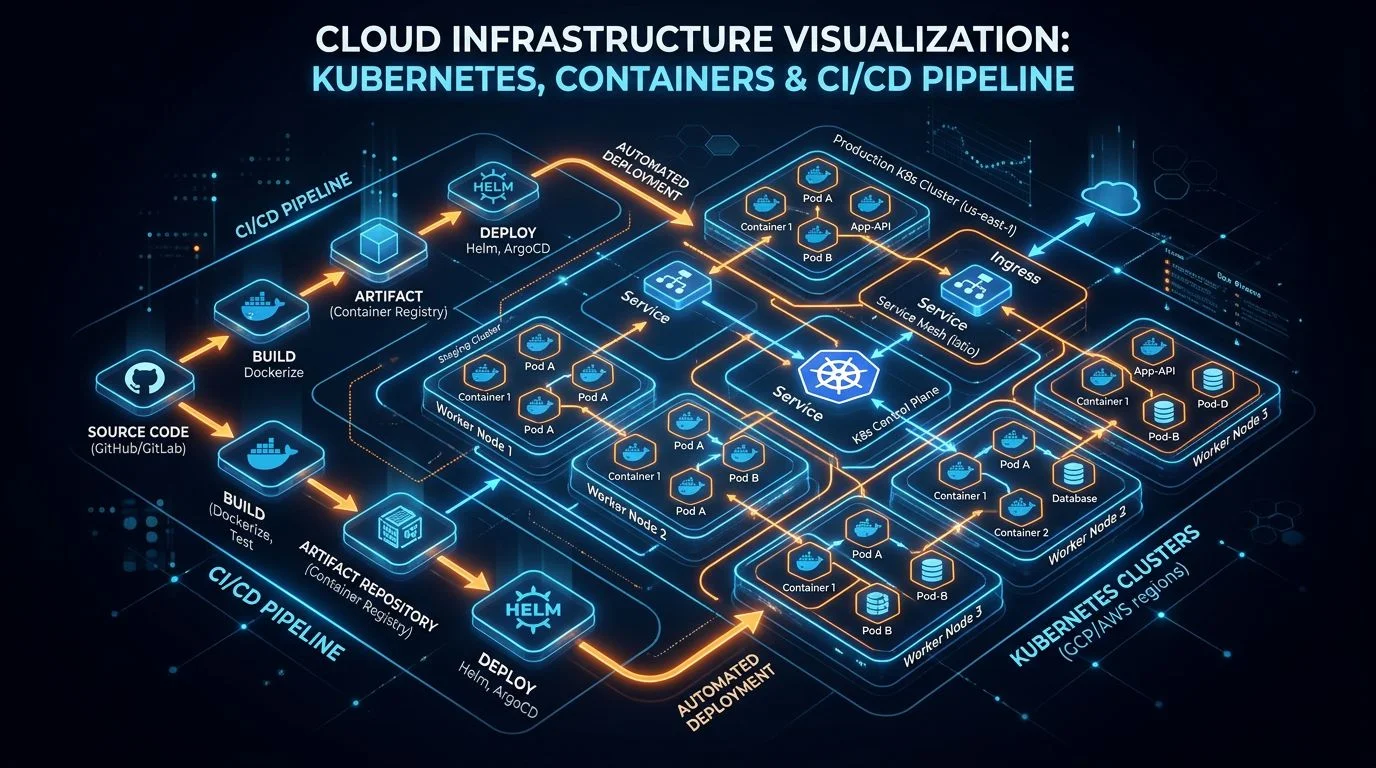
Cloud-Native From Day One: Kubernetes, Docker, and CI/CD for Mid-Market
Cloud-native architecture with Kubernetes, Docker, and CI/CD delivers 208x more frequent deployments and 2.6x higher profitability. Learn when mid-market companies need Kubernetes, when Docker Compose is enough, and how to build cloud-native infrastructure without enterprise-level budgets.
Filip Kralj