
Staff Augmentation vs. Outsourcing: When to Use Team Extension Instead

Table of Contents+
- Why Does Choosing the Right Delivery Model Matter?
- What Is Staff Augmentation and How Does It Work?
- Staff Augmentation: What Are the Pros and Cons?
- What Is Outsourcing and How Does It Work?
- Outsourcing: Advantages and Limitations
- Team Extension: Integration-Based Capacity With Accountability
- How Do the Three Models Compare Head-to-Head?
- Which Model Fits Your Situation?
- Common Questions About Choosing Your Delivery Model
- Research & Sources
TL;DR
Staff augmentation vs outsourcing is a false binary. See how team extension adds a third model: embedded senior engineers, shared accountability.
Staff augmentation vs outsourcing is a false binary. See how team extension adds a third model: embedded senior engineers, shared accountability.
When your internal team is overloaded and hiring a developer takes 8 to 12 weeks you don't have, three delivery models promise the same thing: engineering capacity, fast. Staff augmentation, outsourcing, and team extension all add hands to the work. But "staff augmentation vs outsourcing" is usually framed as a binary choice, and that framing hides how differently these models handle control, accountability, and knowledge.
Pick the wrong one and you inherit onboarding friction, lost context, or a vendor whose incentives quietly drift from yours—on a timeline you couldn't afford to slip in the first place. Here's how the three actually differ, and when each one wins.
Why Does Choosing the Right Delivery Model Matter?
Choosing the right delivery model matters because staff augmentation, outsourcing, and team extension differ on three axes that decide delivery success: who controls technical direction, who owns the outcome, and how much onboarding the model demands. Treating them as interchangeable is how capacity decisions quietly become delivery failures.
The pressure behind all three models is the same. Software hiring cycles routinely run 8 to 12 weeks, specialized stack expertise is scarce and expensive, and your existing team is already too loaded to absorb new work or train newcomers. Across the DACH region that squeeze is structural, not cyclical—Central and Eastern Europe face a persistent skilled-labor shortage driven by worker migration to Western Europe, which is exactly what makes nearshore delivery both necessary and viable.
Where the models diverge is in what you get for that capacity. One gives you extra hands under your direction. One gives you a finished deliverable you barely touch. One gives you embedded senior engineers who own outcomes alongside your team. If you want the full picture on the third, our complete guide to team extension goes deeper; this article focuses on choosing between all three.
See how enterprises modernize with one team.
What Is Staff Augmentation and How Does It Work?
Staff augmentation adds individual contractors or a small pool of external resources to your existing team, under your day-to-day management. You define the tasks, assign the work, and direct the effort; the staffing provider supplies the people and handles their contracts. The augmented resource plugs into your team and follows your lead.

Mechanically, the flow is straightforward. You specify the skills you need, the provider sources candidates from its bench or network, you interview and approve, and the contractor starts working inside your processes. Billing is typically hourly or daily against actual time worked, and the engagement scales up or down as your task list changes.
The defining characteristic is the "plugging in" model: augmented contractors are treated as interchangeable capacity slotted against specific tasks. They use your tools and take direction from your leads, but the provider's involvement usually ends at supplying the person. Everything about integration—context, code familiarity, team rhythm—is your team's job to transfer.
Staff Augmentation: What Are the Pros and Cons?
The staff augmentation vs outsourcing pros and cons debate usually starts here: augmentation wins on flexibility and control, and loses on integration. You get fast, low-commitment access to specific skills under your direction—but every contractor arrives as a blank slate your already-stretched team has to onboard, coordinate, and eventually watch walk out the door.
The advantages are real:
- Flexibility — scale specific skills up or down as the backlog shifts, without permanent headcount.
- Cost efficiency — pay only for time worked, with no long-term commitment.
- Direct control — you own task assignment and technical direction throughout.
The limitations are where projects stumble:
- Integration overhead and onboarding friction — every new contractor needs context your team has to supply.
- Knowledge loss — when the contract ends, the context the contractor built usually leaves with them.
- Seniority variability — bench contractors range widely in experience, and you may not find out until sprint two.
- No team cohesion — resources slotted against tasks rarely gel into a working unit.
- Time-zone misalignment — offshore contractors can sit far outside your working hours, stretching feedback loops.
What Is Outsourcing and How Does It Work?
Outsourcing hands an external vendor end-to-end ownership of a project. You define the requirements and the desired outcome, then the vendor takes over: it assembles the team, chooses the methods, manages delivery, runs its own QA, and hands back finished software. Your involvement shifts from managing people to managing a contract.
This is the core difference between staff augmentation and outsourcing: augmentation keeps delivery ownership with you, while outsourcing transfers it to the vendor. You're buying an outcome, not capacity. The vendor hires, sizes the team, sets the process, and carries accountability for shipping against the agreed specification.
In practice the engagement runs through defined deliverables and milestones. Requirements go in, the vendor works largely independently, and progress surfaces at review points rather than in your daily standup. The quality of the specification you write up front largely determines what comes back—because once work starts, your visibility into method and decisions is limited by design.
Outsourcing: Advantages and Limitations
Outsourcing's advantages and limitations mirror each other: the same hand-off that frees you from day-to-day oversight also cuts you out of technical decisions. It works when the scope is well-defined and self-contained, and it strains when requirements evolve, integration is tight, or the knowledge built during delivery needs to stay inside your organization.
The advantages:
- Focus — your team stays on core business while the vendor handles delivery.
- Risk transfer — the vendor owns delivery risk against the contract.
- Low oversight — no need to manage people day to day.
- Clear deliverables — you contract for defined, agreed outputs.
The limitations:
- Loss of technical control — architecture and implementation decisions sit with the vendor.
- Knowledge stays with the vendor — the team that learned your domain isn't yours to keep.
- Integration risk — software built in isolation can be hard to fold into your existing systems.
- Slow feedback loops — issues surface at milestones, not in daily work.
- Divergent incentives — the vendor optimizes for its contract, which may not match your outcome.
Team Extension: Integration-Based Capacity With Accountability
Team extension embeds senior engineers—typically with 10 or more years of experience—directly into your existing team. You keep technical direction and product accountability; the nearshore partner keeps HR, payroll, and quality assurance. The engineers join your sprints, follow your Definition of Done, and become productive within roughly one to two weeks.

Integration typically begins within about 14 business days, and onboarding is deliberate by design: it covers product context, the technology stack, team workflows, the Definition of Done, and clear ownership boundaries. That structure isn't optional polish—deliberate design of remote onboarding is what separates fast, durable ramp-up from the frustration and turnover that unstructured remote starts produce. Because these are experienced engineers, onboarding gives them context, not training.
Once embedded, the engineers work inside your cadence—daily standups, sprint ceremonies, your tools, reporting to your Product Owner or Tech Lead. This isn't a compromise on output: distributed agile teams can deliver measurable productivity gains when the practices are sound. Central European Time-zone alignment means the working day actually overlaps yours, which is a meaningful edge over offshore contracting and a core reason DACH teams weigh nearshore engineers against local hiring.
Billing follows Time & Material—hourly, daily, or monthly—which keeps the engagement aligned around shared accountability, and scaling works on 30-day notice with no minimum engagement length. This is what distinguishes team extension from staff augmentation, which supplies individual contractors rather than a cohesive, accountable team.
Siemens, Lekkerland, WeberHaus chose us
One integrated partner. Three core competencies. From insight to production, with no handover gaps.
Start with a Strategy CallHow Do the Three Models Compare Head-to-Head?
Head-to-head, the three models separate cleanly: staff augmentation wins on pure flexibility, outsourcing on hands-off delivery, and team extension on the combination of control, accountability, integration, and knowledge retention. No model is best at everything—each trades something away, and the right pick depends on which trade-off you can actually afford.
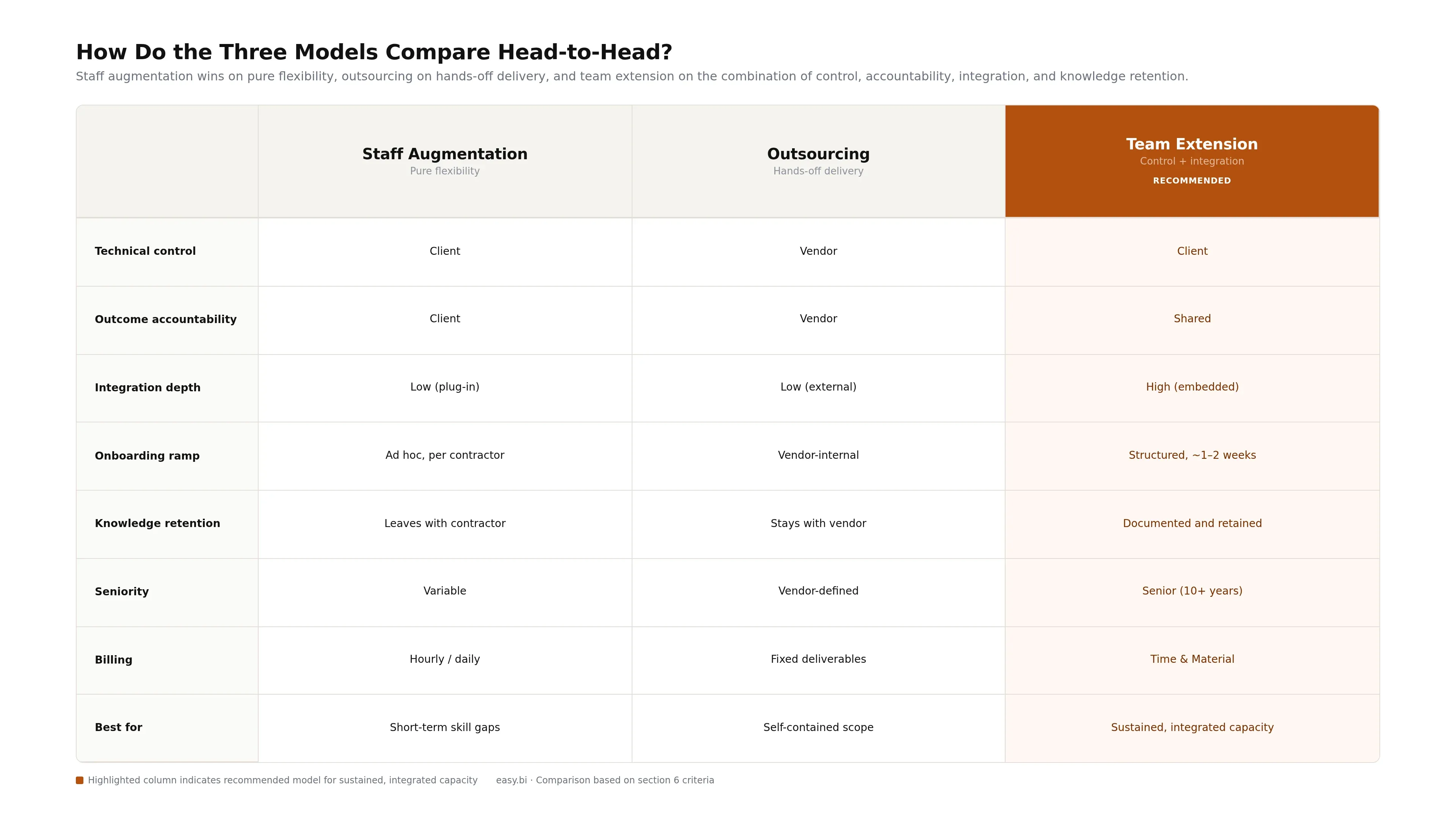
| Criterion | Staff Augmentation | Outsourcing | Team Extension |
|---|---|---|---|
| Technical control | Client | Vendor | Client |
| Outcome accountability | Client | Vendor | Shared |
| Integration depth | Low (plug-in) | Low (external) | High (embedded) |
| Onboarding ramp | Ad hoc, per contractor | Vendor-internal | Structured, ~1–2 weeks |
| Knowledge retention | Leaves with contractor | Stays with vendor | Documented and retained |
| Seniority | Variable | Vendor-defined | Senior (10+ years) |
| Billing | Hourly / daily | Fixed deliverables | Time & Material |
| Best for | Short-term skill gaps | Self-contained scope | Sustained, integrated capacity |
Control and accountability
Augmentation and team extension both keep technical direction with you, but they part ways on ownership: augmented contractors execute tasks, while embedded senior engineers share accountability for outcomes. Team extension versus outsourcing is the starkest contrast here—outsourcing moves both control and accountability to the vendor, which is efficient when you want distance and risky when you need a say.
Knowledge transfer and retention
This is where the gap is widest. Augmentation and outsourcing both leak institutional knowledge—one when the contractor leaves, the other because it never enters your walls to begin with. Team extension is built to keep it: mature implementations document architectural decisions and preserve runbooks, and structured knowledge-transfer processes are what sustain skill retention in distributed teams. That retention rests on trust and information sharing, which drive virtual team effectiveness and grow through intentional onboarding.
Cost and flexibility
All three beat local hiring on speed and rate, but the billing model shapes behavior. Augmentation and team extension both run on time-based billing that flexes with need; outsourcing locks to fixed deliverables. The billing choice is a decision in its own right—it's worth understanding how Time & Material and fixed-price contracts compare before you sign anything.
Which Model Fits Your Situation?
Match the model to your situation across six questions: how fast you need capacity, how deeply the work must integrate with your team, what seniority the problem demands, how much the knowledge matters afterward, how cost-sensitive you are, and whether you want to keep ownership. The answers usually point clearly to one model.
Use team extension when
You need senior engineers integrated into existing sprints, knowledge retention matters, you want to keep technical control, and the capacity need is sustained rather than a one-off task. This is the fit for DACH teams weighing nearshore economics against a structural talent shortage. easy.bi's team extension engagement embeds senior engineers on a Time & Material basis for exactly this scenario.
Use staff augmentation when
The need is a short-term, well-scoped skill gap, you have bench capacity to onboard and direct contractors, and long-term knowledge retention isn't the priority. It's the lightest-commitment option when raw speed and flexibility outrank integration.
Use outsourcing when
The project is self-contained, the specification is stable and complete, and you'd rather buy an outcome than manage people. Hybrid arrangements also work here—combining onshore oversight with offshore development can meet requirements within an agile framework when scope and security needs are clear up front.
Whichever model you choose, evaluate the partner deliberately. Structured vendor-selection frameworks weigh technical fit, integration capability, reliability, and organizational alignment—criteria that matter more than headline rate when the engagement runs for months.
The "staff augmentation vs outsourcing" question is really a three-way choice once team extension is on the table. Augmentation buys flexible hands under your control; outsourcing buys a finished outcome you don't manage; team extension buys embedded senior engineers who own results alongside your team and leave documented knowledge behind. Map your need—speed, integration, seniority, retention, cost, ownership—to the model that fits, and the decision stops feeling like a compromise.
If your team needs capacity without giving up control or context, team extension bridges the gap between augmentation's flexibility and outsourcing's accountability—senior engineers embedding into your existing sprints rather than working around them.
Common Questions About Choosing Your Delivery Model
What's the difference between staff augmentation and team extension?
Staff augmentation supplies individual contractors slotted against specific tasks, with integration left to your team. Team extension embeds senior engineers—typically 10-plus years of experience—as a cohesive, accountable part of your team, with structured onboarding and documented knowledge transfer. Augmentation optimizes for flexible, transactional capacity; team extension optimizes for integration, shared accountability, and knowledge that stays after the engagement ends.
How quickly can extended engineers become productive?
Integration typically begins within about 14 business days, and experienced engineers reach productivity within roughly one to two weeks of joining. The speed depends on deliberate onboarding covering product context, the technology stack, workflows, and the Definition of Done. Because team extension targets senior engineers who need context rather than training, structured onboarding—not a long ramp-up—is what makes early sprints productive.
When should you outsource instead of extending your team?
Outsource when the project is self-contained, the specification is stable and complete, and you'd rather buy a finished outcome than manage people day to day. Outsourcing transfers both control and accountability to the vendor, which suits distance but not tight integration or evolving requirements. If you need technical control, deep integration, or retained knowledge, team extension fits better than a full hand-off.
How is knowledge retained when working with nearshore engineers?
Knowledge is retained through structured documentation—architectural decision records, runbooks, and explicit knowledge-transfer processes—rather than left to chance. In distributed teams, deliberate documentation and information sharing sustain skill retention and protect against loss when people rotate. This is a defining advantage of team extension over both staff augmentation, where context leaves with the contractor, and outsourcing, where it never enters your organization.
Research & Sources
Explore Other Topics
Ready to transform your business?
30-minute call with an engineering lead. No sales pitch - just honest answers about your project.
98% engineer retention · 14-day delivery sprints · No lock-in contracts
Related Reading

How might software outsourcing revolutionize the sports and fitness sector?
Software outsourcing boosts sports industry efficiency, user experience, and growth through APIs, data analytics, and digital communities.
Andrej Lovsin
Staffing Digital Transformation Programs: How Team Extension Enables Faster Delivery and Lower Costs
Staffing digital transformation with team extension: embed senior engineers in days, cut costs 30–50%, keep velocity across phases.
Andrej Lovsin
Nearshore Team Extension: Solving the DACH IT Talent Shortage
How nearshore team extension solves the DACH IT talent shortage—senior engineers in days, at 30–50% lower cost, done right.
Andrej Lovsin