
How to Onboard Nearshore Engineers Into Your Agile Team

Table of Contents+
- What Do You Need Before a Nearshore Engineer's Day One?
- Week 1: How Do You Build Technical Context and Ship a First Contribution?
- Week 2: Integrating Into Your Agile Rituals and Team Workflows
- Weeks 3–4: Building Autonomy and Codebase Ownership
- Which Onboarding Mistakes Derail the Timeline?
- How Do You Measure Onboarding Success?
- Frequently Asked Questions
- Sources & Further Reading
TL;DR
Learn how to onboard nearshore engineers in 7–14 days with a week-by-week system for tool access, first PRs, agile ceremonies, and success metrics.
Learn how to onboard nearshore engineers in 7–14 days with a week-by-week system for tool access, first PRs, agile ceremonies, and success metrics.
Picture the outcome you're actually after: a senior nearshore engineer committing production code inside your sprint, joining standup with context, and reviewing pull requests like a teammate who has been on the team for a year — all within two weeks of signing. That is what good looks like, and knowing how to onboard nearshore engineers is the difference between reaching it and stalling out.
The gap between where most teams start and that end state is wider than it looks. Drop an experienced engineer into a repository with no documentation, no tool access, and a vague ticket, and you don't get a fast contributor — you get a highly paid observer waiting for someone to unblock them. Unstructured remote onboarding doesn't just delay the first commit; it breeds the frustration that drives early turnover in knowledge-intensive teams. This guide closes that gap with a week-by-week system that turns capacity you've contracted into capacity you can actually ship with. It assumes you've already decided team extension is the right way to scale engineering capacity; from here, the work is execution.
What Do You Need Before a Nearshore Engineer's Day One?
Before day one, prepare five things: provisioned tool and repository access, current onboarding documentation, an assigned onboarding buddy, pre-scheduled team introductions, and a written Definition of Done. Nearshore developer onboarding stalls most often on missing access and absent documentation — resolve both before the engineer logs in, not after.
What to have ready before day one
- Accounts and access: repository, CI/CD, ticketing, chat, and cloud consoles
- Living documentation: an architecture overview, READMEs, runbooks, and Architecture Decision Records (ADRs)
- A named onboarding buddy drawn from your in-house team
- Calendar invites for introductions and the first few standups
- A written Definition of Done and explicit ownership boundaries
Access is the classic bottleneck. A senior engineer who spends day two chasing a repository invite or a VPN credential is a senior engineer you're paying to wait. Provision every account before the start date so that logging in is the first thing the engineer does, not the last thing IT gets around to. Because integration under an easy.bi team extension engagement typically begins within about 14 business days of signing, that window is exactly when access provisioning should happen — in parallel with the paperwork, not after it.
Documentation is the second bottleneck, and it pays off long after week one. Structured process documentation and explicit knowledge-transfer processes are what secure skill retention and sustain a distributed team's advantage over time — a point research on distributed knowledge processes makes directly. Treat your architecture overview, runbooks, and ADRs as onboarding infrastructure, not afterthoughts. If they don't exist yet, writing them for the new engineer improves them for everyone.
Assign an onboarding buddy before day one and tell that person it's a real responsibility, not a courtesy. The buddy answers the small questions that would otherwise pile into a senior engineer's inbox, and shortens the distance between "I'm blocked" and "I'm moving." Pair that with a written Definition of Done and clear ownership boundaries so the engineer knows what "finished" means and who owns which decision from the first ticket. If you haven't yet confirmed your organization is set up for this, the team extension readiness checklist is the right thing to run before onboarding begins.
See how enterprises modernize with one team.
Week 1: How Do You Build Technical Context and Ship a First Contribution?
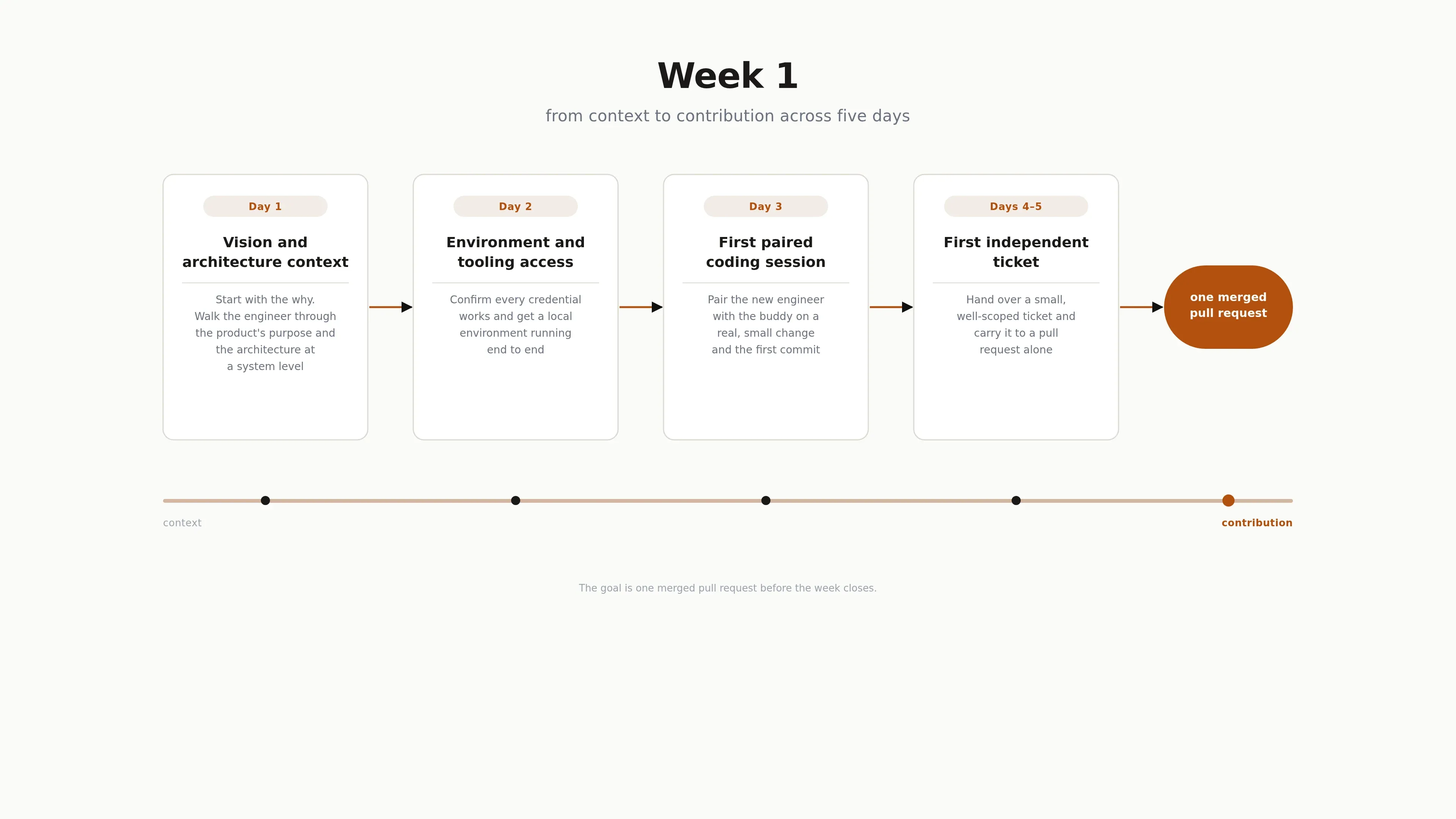
Week one moves the engineer from context to contribution across five days: architecture and product vision on day one, environment and access confirmation on day two, a paired coding session on day three, and a first independent ticket by days four and five. The goal is one merged pull request before the week closes.
This week only works when it's deliberately designed rather than improvised. Research on remote onboarding shows that intentionally designing the learning and team-building process is what accelerates productive integration and heads off the frustration that unstructured starts produce. Because team extension targets engineers with a decade or more of experience, your job is to transfer context, not to teach fundamentals — the seniority is precisely why experienced engineers make nearshoring work.
Day 1: Vision and architecture context.
Start with the why. Walk the engineer through the product's purpose, the users it serves, and the architecture at a system level — services, data flows, and the decisions captured in your ADRs. A senior engineer absorbs a system diagram far faster than a feature backlog, so lead with the shape of the whole before any single ticket.
Day 2: Environment and tooling access.
Confirm every credential works and get a local environment running end to end — build, tests, and a local run. This is where pre-boarding pays off: if access was provisioned in advance, day two is a checklist, not a scavenger hunt. Have the buddy on standby for the environment quirks that never make it into the README.
Day 3: First paired coding session.
Pair the new engineer with the buddy on a real, small change. Pairing transfers the unwritten conventions — branching, commit style, review norms, how the team actually works — faster than any document. It also produces the first commit without the pressure of solo delivery.
Days 4–5: First independent ticket.
Hand over a small, well-scoped ticket with unambiguous acceptance criteria and let the engineer carry it to a pull request alone. The target is one merged PR before the weekend. It doesn't need to be large; it needs to exercise the full path — code, review, CI, merge — so the engineer has walked the whole loop once.
If the first PR lands by day three rather than day five, that's a healthy signal, not a reason to pile on. Week one is about confirming the path works, not maximizing output.
Week 2: Integrating Into Your Agile Rituals and Team Workflows
Week two shifts the engineer from paired work to independent ticket ownership and full participation in your agile ceremonies — standups, planning, review, and retrospective. Code review now flows both ways, and relationships extend past the onboarding buddy. This is where agile team integration becomes real rather than nominal.

Full participation in sprint ceremonies
Bring the engineer into every ceremony as a participant, not an observer. Speaking in standup, estimating in planning, and raising items in retrospective are how a distributed teammate becomes part of the team's decision-making rather than a remote pair of hands. Central European Time overlap makes this practical: engineers from Central and Eastern European nearshore teams share working hours with DACH clients, so ceremonies happen live rather than across a handoff.
Independent delivery and two-way code review
By now the engineer should own tickets end to end and review others' pull requests as readily as their own. Two-way review is the tell that integration is working — it means the team trusts the newcomer's judgment and the newcomer understands the codebase well enough to critique it. Agile methods hold up well in distributed settings; empirical evaluation of distributed agile teams finds no inherent productivity penalty when the practices are followed properly.
Trust, and where ownership stops
Trust and knowledge sharing sit at the center of virtual team effectiveness, and they're built deliberately through intentional onboarding, the right collaboration platforms, and steady contact — as research on virtual team effectiveness confirms. This is also the moment to reconfirm ownership boundaries: the engineer takes daily technical direction from your Product Owner or Tech Lead while the nearshore partner keeps HR, payroll, and quality assurance. Getting those lines right is its own discipline — our guide to managing remote teams and setting ownership boundaries goes deeper than we can here.
Weeks 3–4: Building Autonomy and Codebase Ownership
By weeks three and four, the engineer takes on larger stories, joins architecture discussions, and owns a defined feature area. Structured engineer onboarding ends here: help-requests to senior teammates taper, productivity climbs toward team baseline, and the newest hire starts mentoring the next one. Autonomy is the milestone that closes the cycle.
Larger stories are the real test. A multi-ticket feature forces the engineer to make sequencing decisions, negotiate interfaces with other developers, and reason about the system rather than a single file. Pair this with a named feature-area ownership assignment so accountability is concrete: this person owns this surface, including its tests and its runbook entries.
Architecture participation matters for a reason beyond the immediate work. When engineers document decisions as ADRs and keep runbooks current, the knowledge stays with the team even as people rotate — the difference between mature team extension and transactional contractor sourcing. That documentation discipline is what makes the capacity durable rather than rented.
This is also where the model starts compounding. An engineer who has completed the cycle becomes the buddy for the next hire, and the onboarding system you built runs itself. That's the payoff behind easy.bi's custom software delivery: teams that reach full capacity inside the first sprint are what let complex platforms ship in under four months instead of stalling in ramp-up.
Which Onboarding Mistakes Derail the Timeline?
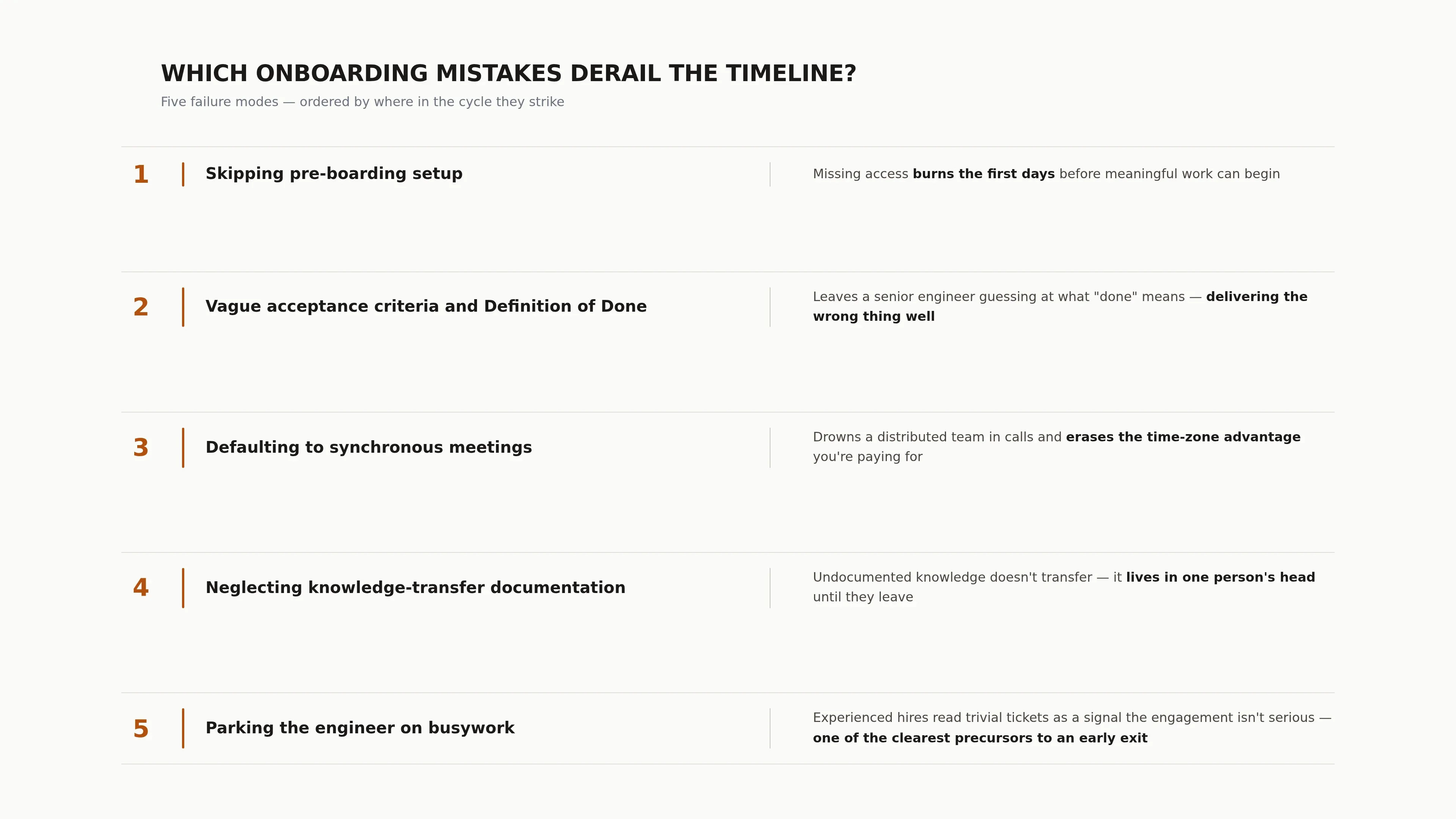
Five mistakes derail nearshore onboarding most often: skipping pre-boarding setup, leaving acceptance criteria and Definition of Done vague, defaulting to synchronous meetings instead of async-first communication, neglecting knowledge-transfer documentation, and parking the engineer on busywork instead of meaningful contribution. Each one is avoidable, and each compounds if left unaddressed.
Insufficient pre-boarding and vague expectations
The first two are the same failure at different stages: work you didn't do before day one. Missing access burns the first days; missing acceptance criteria and an unclear Definition of Done leave a senior engineer guessing at what "done" means and delivering the wrong thing well. Both are cheap to fix in advance and expensive to fix mid-sprint.
Synchronous overload and missing documentation
Defaulting to meetings for everything drowns a distributed team in calls and erases the time-zone advantage you're paying for. Lead with async — written updates, recorded walkthroughs, threaded decisions — and reserve synchronous time for ceremonies and genuine unblocking. Skipping documentation is the quieter version of the same mistake: undocumented knowledge doesn't transfer, it just lives in one person's head until they leave.
Delaying meaningful work
The most damaging mistake is holding an experienced engineer on trivial tickets past week one. Unstructured onboarding and a slow, low-trust start are precisely what a study of post-onboarding resignations ties to attrition in knowledge-intensive teams. Meaningful contribution early isn't a nice-to-have; it's a retention mechanism.
Siemens, Lekkerland, WeberHaus chose us
One integrated partner. Three core competencies. From insight to production, with no handover gaps.
Start with a Strategy CallHow Do You Measure Onboarding Success?
Measure onboarding health with objective signals per phase: time-to-first-PR (target three days), PR cycle time trending down and stabilizing, productivity as a percentage of team baseline, help-request load on senior engineers falling, and sprint carryover staying low. Empirical performance indicators, not gut feel, tell you whether integration is on track.
Distributed teams are measurable, and the right indicators materially improve how you manage performance — empirical work on distributed team management identifies the indicators that actually move team productivity. Pick a small set, baseline them against your co-located team, and read the trend rather than any single number.
| Phase | Leading indicator | Healthy signal |
|---|---|---|
| Pre-boarding | Access and docs readiness | All accounts live and docs current before day one |
| Week 1 | Time-to-first-PR | First merged PR by day three |
| Week 2 | PR cycle time and review flow | Cycle time stabilizing; review flowing both ways |
| Weeks 3–4 | Productivity vs. baseline and help-request load | Approaching team baseline; senior help-requests tapering |
Watch two signals especially. Help-request load on senior engineers should fall week over week — if it doesn't, context transfer stalled somewhere and the fix is usually documentation, not more meetings. Sprint carryover should stay low; a newcomer whose tickets routinely spill into the next sprint is either over-scoped or under-supported, and both are correctable early. Read together, these indicators tell you whether the 7–14 day cycle is working long before a quarterly review would.
Knowing how to onboard nearshore engineers comes down to one principle: treat the first two weeks as a designed system, not a formality. Prepare before day one, deliver context and a first pull request in week one, hand over ceremonies and independent work in week two, and confirm autonomy by week four. Do that, and contracted capacity becomes shipping capacity inside a single sprint.
We've refined this playbook across dozens of team extension engagements, and the pattern holds: experienced engineers, deliberate onboarding, and clear ownership boundaries turn nearshore capacity into velocity fast.
Frequently Asked Questions
How long does it take to onboard a nearshore engineer?
A structured onboarding cycle runs 7–14 days for experienced engineers. Week one delivers technical context and a first merged pull request, week two brings full agile ceremony participation and independent tickets, and weeks three and four build autonomy and feature ownership. The timeline depends on deliberate pre-boarding and meaningful early work — improvised starts take far longer and risk early turnover.
What's the difference between team extension and outsourcing?
Team extension embeds vetted senior engineers into your existing team, working in your sprint cadence and taking daily technical direction from your Product Owner or Tech Lead. You keep product accountability; the nearshore partner keeps HR, payroll, and quality assurance. Outsourcing hands the whole delivery to a vendor who owns the outcome. Team extension is integration into your team, not delegation away from it.
Why do onboarding programs target experienced engineers?
Because the model depends on transferring context, not teaching fundamentals. Engineers with a decade or more of experience can absorb an architecture walkthrough and ship a first pull request within days, provided onboarding is intentionally designed. Their seniority is what makes rapid productivity realistic; it also means the onboarding investment goes into context, documentation, and ownership clarity rather than skills training.
How do you measure whether onboarding is working?
Track objective indicators per phase: time-to-first-PR with a three-day target, PR cycle time trending down and stabilizing, productivity as a percentage of your team's baseline, falling help-request load on senior engineers, and low sprint carryover. Baseline each metric against your co-located team and read the trend rather than any single number. These signals surface stalls long before a quarterly review would.
Sources & Further Reading
Explore Other Topics
Ready to transform your business?
30-minute call with an engineering lead. No sales pitch - just honest answers about your project.
98% engineer retention · 14-day delivery sprints · No lock-in contracts
Related Reading

Nearshore Team Extension: Solving the DACH IT Talent Shortage
How nearshore team extension solves the DACH IT talent shortage—senior engineers in days, at 30–50% lower cost, done right.
Andrej Lovsin
Why Experienced Engineers Are Essential for Nearshoring: Breaking the Junior Developer Trap
Experienced engineers nearshoring works only with 10+ year seniors—here's why junior hires recreate the onboarding overhead the model removes.
Andrej Lovsin
Nearshore Software Developers vs. Hiring Locally in DACH: Cost, Speed, and Outcomes Compared
Nearshore software developers vs hiring locally in DACH: compare real 2026 cost, 7-14 day onboarding speed, and outcomes to pick the right capacity model.
Andrej Lovsin