
Time and Materials vs. Fixed-Price Contracts: Why T&M is the Right Choice for Team Extension

Table of Contents+
- Why Does the Contract Model Matter for Team Extension?
- How Does Time & Materials Put Integration First?
- What Are the Risks of Fixed-Price Contracts in Team Extension?
- Side-by-Side: T&M vs. Fixed-Price Across Five Integration Dimensions
- When Is Fixed-Price Actually the Right Call?
- How Do You Keep T&M Under Control Without Compromising Quality?
- Why Does Nearshore T&M Dominate the DACH Market?
- Common Questions
- Research & Sources
TL;DR
Time and materials vs fixed price for team extension: why T&M aligns incentives on quality while fixed-price rewards cost-cutting that erodes teams.
Time and materials vs fixed price for team extension: why T&M aligns incentives on quality while fixed-price rewards cost-cutting that erodes teams.
Bring senior engineers into your team to hit a deadline, and one contract decision colors the entire engagement: do you pay for time and materials, or lock the work into a fixed price? The choice between time and materials vs fixed price sets up two billing models that chase the same outcome — experienced developers producing inside your existing sprints — but they get there through opposite mechanics.
That difference is not academic. A fixed-price agreement and a T&M agreement can read almost identically on the statement of work, yet pull your extended engineers in opposite directions the moment reality diverges from the plan — and in team extension, it always does. Pick the model that fits, and integration compounds sprint over sprint. Pick the one that doesn't, and you pay for it in cut corners, thin onboarding, and knowledge that walks out the door when the contract ends. Here's how the two compare, and why the model you choose matters more than the rate you negotiate.
Why Does the Contract Model Matter for Team Extension?
The contract model matters because it sets your vendor's incentives before a single line of code is written. In team extension, where nearshore engineers embed in your team and share accountability with your tech lead, the billing structure quietly decides whether they optimize for your code quality or for their own margin.
Team extension is not outsourcing. In an outsourcing arrangement, the vendor owns delivery and hands you a finished result. In team extension, vetted senior engineers join your existing development team, work inside your sprint cadence, attend your standups, and report to your Product Owner or Tech Lead — while the nearshore partner keeps HR, payroll, and quality assurance. If you're still framing the model itself, our complete guide to team extension covers how it works end to end.
Three things ride on the contract model, and none of them is the budget line everyone watches first:
- Vendor incentives — whether the partner earns more by improving your software or by minimizing their own effort.
- Integration quality — whether embedded engineers get the deliberate onboarding that makes them productive, or get dropped into your backlog cold.
- Knowledge retention — whether architectural decisions and runbooks stay with your team, or leave when the engagement does.
Budget predictability is real, but it's the one dimension both models can be made to satisfy. The other three are where time and materials vs fixed price actually diverge — and where the wrong pick shows up as rework months after the invoice cleared.
See how enterprises modernize with one team.
How Does Time & Materials Put Integration First?
Time & Materials puts integration first because it pays the vendor for engineering effort actually delivered, not for hitting a frozen scope. That single mechanic aligns both sides on quality: onboarding, iteration, and documentation become billable work worth doing well, rather than overhead the vendor absorbs by cutting corners.
Incentive alignment in shared accountability
Contract theory backs the intuition. Research on software outsourcing contract design finds that when clients are highly sensitive to software quality — exactly the case when engineers are committing to your production codebase — time and materials arrangements produce stronger incentive alignment than fixed-price or performance-based alternatives. Because the client keeps daily technical direction under team extension, T&M mirrors how the model actually operates, a distinction worth mapping against staff augmentation and outsourcing.
Flexibility for scope discovery and iteration
Scope in real software work is discovered, not declared. T&M supports the time and materials contract flexibility agile teams need: requirements shift sprint to sprint, and changes get absorbed as normal work rather than triggering a renegotiation. Team scaling happens with 30-day notice and zero minimum engagement length, against the four-month minimums typical of dedicated-team models. Distributed agile teams post measurable productivity gains when the process adapts around them.
Investment in quality onboarding without cost pressure
The model targets engineers with 10+ years of experience who need context, not training — and giving them that context is deliberate work. Onboarding design in distributed teams research shows unstructured remote onboarding leads to frustration and turnover in knowledge-intensive organizations. Under T&M, the first two weeks of onboarding — covering product context, the stack, workflows, and the Definition of Done — are funded as real work, so integration typically begins within 14 business days rather than being compressed to protect a margin.
Documentation and knowledge transfer as a contractual incentive
T&M makes knowledge transfer billable, so it actually happens. Mature engagements document architectural decisions as ADRs and preserve runbooks precisely because that effort is compensated. Knowledge transfer in distributed teams is critical to skill retention and long-term competitive advantage — and it is the first thing a cost-minimizing vendor drops when the price is fixed.
What Are the Risks of Fixed-Price Contracts in Team Extension?
Fixed-price contracts carry a structural risk in team extension: once the price is locked, every hour the vendor spends becomes a cost to minimize rather than value to maximize. That inverts the incentive team extension depends on, pushing partners to thin out onboarding, skip documentation, and defend scope instead of solving problems.
Cost-cutting pressure lands on onboarding first
When margin is fixed, onboarding is the softest target. It produces no shippable feature, so a fixed-price vendor is rewarded for compressing it — dropping a senior engineer into your backlog with minimal context and hoping the first sprint carries. That is the exact opposite of what the model needs, and it is one of the clearest fixed price contract risks software projects run into when the delivery structure assumes embedded, integrated engineers.
Corners cut in knowledge transfer and documentation
ADRs, runbooks, and internal documentation are unbillable overhead under a fixed price. So they get postponed, then skipped. The engagement ends, the engineers roll off, and the reasoning behind key architectural decisions leaves with them — leaving your team maintaining a system it never fully understood.
Why 'fixed scope' rarely survives first contact with reality
Fixed price assumes the scope is knowable upfront. In German-speaking markets, 60–80% of IT projects fail, and the failure is attributed primarily to unclear requirement specifications rather than to the custom-versus-standard choice — precisely the conditions a rigid fixed scope cannot absorb. Every mid-engagement discovery becomes a change-request negotiation, and each negotiation trades goodwill for a line item. Forrester's 2026 research reinforces the pattern: fixed pricing on this kind of engagement incentivizes quality reduction, which is why quality providers structure team extension as T&M in the first place.
Side-by-Side: T&M vs. Fixed-Price Across Five Integration Dimensions
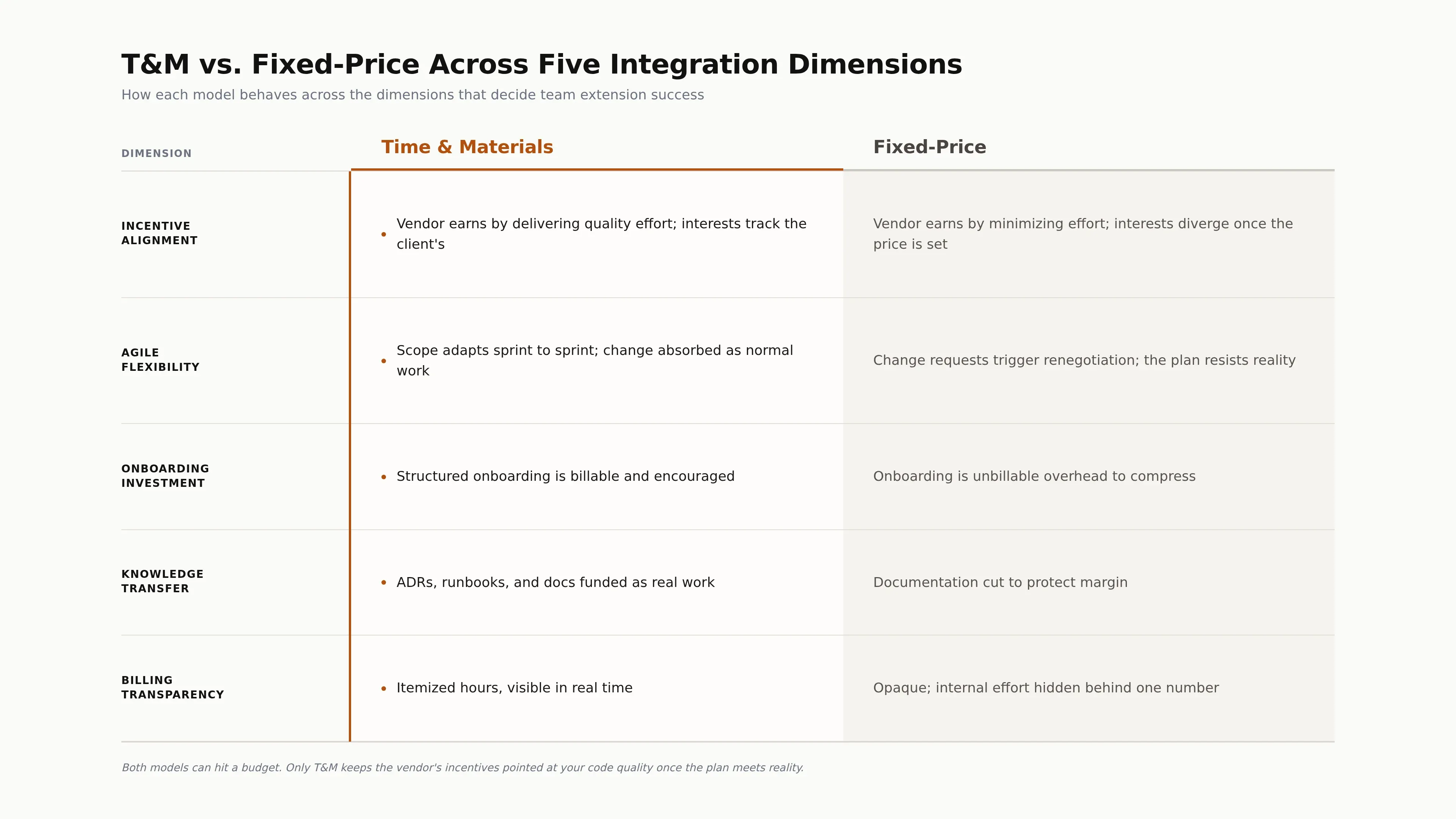
Across the dimensions that decide team extension success — incentive alignment, agile flexibility, onboarding investment, knowledge transfer, and billing transparency — Time & Materials and fixed-price contracts behave in measurably different ways. The table below maps each model against the five, so the tradeoff is visible at a glance rather than buried in contract language.
| Dimension | Time & Materials | Fixed-Price |
|---|---|---|
| Incentive alignment | Vendor earns by delivering quality effort; interests track the client's | Vendor earns by minimizing effort; interests diverge once the price is set |
| Agile flexibility | Scope adapts sprint to sprint; change absorbed as normal work | Change requests trigger renegotiation; the plan resists reality |
| Onboarding investment | Structured onboarding is billable and encouraged | Onboarding is unbillable overhead to compress |
| Knowledge transfer | ADRs, runbooks, and docs funded as real work | Documentation cut to protect margin |
| Billing transparency | Itemized hours, visible in real time | Opaque; internal effort hidden behind one number |
The pattern in any honest fixed price vs time and materials software development comparison is consistent: the fixed number buys apparent certainty on the one axis clients watch — the total — while quietly degrading the four axes that determine whether embedded engineers actually integrate. T&M trades that surface certainty for visibility and aligned incentives.
When Is Fixed-Price Actually the Right Call?
Fixed-price is the right call when the work is fully scoped, short-term, and unlikely to change — a defined compliance deliverable, a bounded migration, or a well-understood maintenance package where requirements are known before work starts. In those cases, a fixed number transfers delivery risk cleanly. Team extension is simply not one of those cases.
The distinction is what the contract is being asked to bound. For a discrete deliverable with stable requirements, you're buying an outcome, and pricing that outcome upfront is reasonable. For team extension, you're buying integrated engineering capacity that participates in an evolving product — and integration quality cannot be written into a fixed line item and guaranteed. You can specify a feature; you cannot specify "this engineer will onboard well, document their decisions, and earn the team's trust" and enforce it by contract.
Structure is what makes distributed delivery work, not the price mechanism. Hybrid onshore-offshore agile models perform well when onshore oversight and distributed development are deliberately combined — but the deliberateness is exactly the point. That intentional structuring is billable work under T&M and margin erosion under fixed-price. So even where a hybrid arrangement fits, the contract model still has to reward the integration, not penalize it.
Siemens, Lekkerland, WeberHaus chose us
One integrated partner. Three core competencies. From insight to production, with no handover gaps.
Start with a Strategy CallHow Do You Keep T&M Under Control Without Compromising Quality?
You keep T&M under control with structure, not a fixed cap: transparent itemized billing, monthly scope reviews, agreed cost guardrails, and performance metrics that measure delivered value rather than raw hours logged. Done this way, a T&M contract software team extension engagement gives you more visibility into where budget goes than a fixed price ever exposes.
Transparent, itemized billing
Insist on billing that itemizes hours against tickets, so every invoice is auditable against your own backlog. Transparency is the whole advantage of T&M — a partner reluctant to itemize is a signal, not a scheduling inconvenience. This is how easy.bi structures its T&M engagements: hours map to work you can see in your own tracker.
Monthly reviews and scope guardrails
Set a monthly rhythm to review burn against outcomes and agree a soft ceiling that triggers a conversation, not a hard stop mid-sprint. Guardrails give you the cost discipline of a budget without the incentive damage of a locked price. For a broader capacity program, these controls slot into a wider team extension playbook for digital transformation.
Measure value beyond hours, anchor on a Definition of Done
Track features shipped, sprint velocity, and defects avoided — not just hours. A clear, shared Definition of Done is your strongest guardrail against scope creep, because it makes "finished" objective. And the metric that matters most rarely appears on a timesheet: trust and knowledge sharing drive virtual team effectiveness, and both grow from intentional onboarding and the right collaboration platforms, not from squeezing hours.
Why Does Nearshore T&M Dominate the DACH Market?
Nearshore T&M dominates DACH team extension because the market's economics and its regulation both point to it. Central Europe's roughly 1.5 million developers work in the same time zone at 30–50% lower cost than German domestic rates, and German-speaking procurement functions increasingly verify billing and classification models before signing — which favors transparent, itemized T&M.
The talent math is the starting point. Poland alone fields around 600,000 programmers with 80,000-plus STEM graduates entering the workforce each year, all operating in Central European Time. That capacity closes the structural IT talent shortage across Germany, Austria, and Switzerland without the timezone lag of offshore delivery — and distributed agile teams post measurable productivity in this configuration, as distributed team performance research confirms.
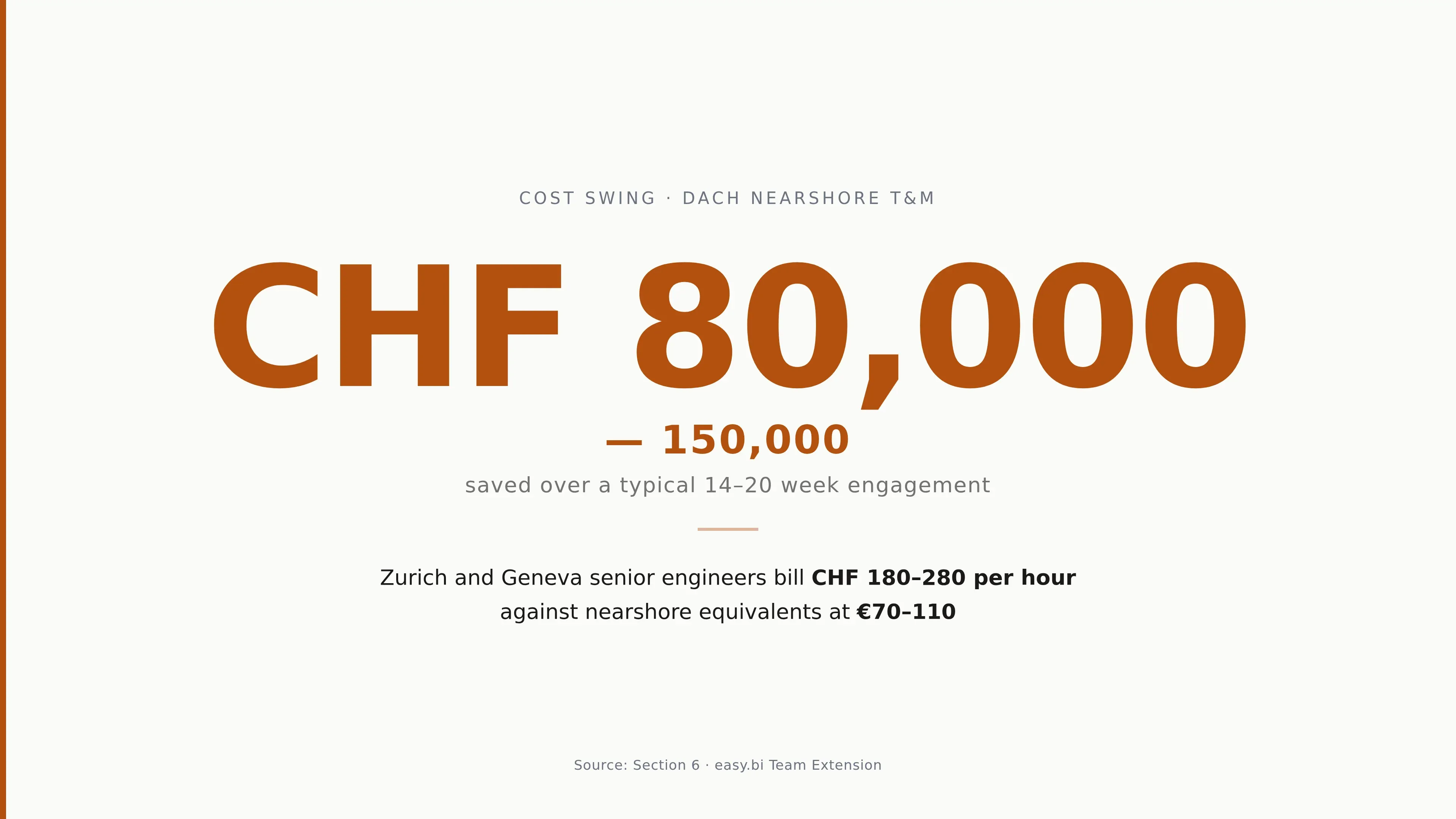
The cost differential is stark at the Swiss end of the market: Zurich and Geneva senior engineers bill CHF 180–280 per hour against nearshore equivalents at €70–110, a swing of CHF 80,000–150,000 over a typical 14–20 week engagement. That gap only holds up under scrutiny if the billing is transparent — which is where classification compliance enters. Forrester puts the classification-dispute rate at 11.4% for direct contractors without an employer-of-record intermediary, versus 0.3% with one, and Swiss and German procurement teams increasingly check for it before execution.
This is the model easy.bi's Team Extension engagements are built around: senior engineers from Central and Southeast European offices, embedded in your team, billed on T&M by default. It is not a pricing preference dressed up as principle — in DACH team extension, T&M is what the economics, the regulation, and the integration requirement all independently select for.
Strip away the contract language and the choice is simple: in team extension, the billing model is an incentive machine. Time & Materials points the vendor at your code quality, funds the onboarding and documentation that make embedded engineers productive, and adapts as the work reveals itself. Fixed-price points the vendor at its own margin the moment scope meets reality. Both can satisfy a budget; only one keeps the interests aligned after the plan changes.
So when you evaluate a nearshore partner, read the billing model as a signal. Fixed-price is a cost-control signal; T&M is a quality-alignment signal — and for engineers committing to your production systems, alignment is what you're actually buying. At easy.bi, the same T&M discipline underpins our custom platform work for exactly this reason. Insist on T&M as a structural requirement, then wrap it in transparent billing and clear guardrails — that combination, not a fixed number, is what protects both your budget and your codebase.
Common Questions
What is the difference between time and materials and fixed-price contracts?
Time and materials bills for the engineering effort actually delivered — hourly, daily, or monthly — while fixed-price sets one number for a defined scope agreed upfront. The practical difference is incentives: T&M rewards a vendor for delivering quality work, whereas fixed-price rewards minimizing effort once the price is locked. For evolving work like team extension, that incentive gap is decisive.
Why is T&M better than fixed-price for team extension?
T&M aligns vendor and client incentives around quality, which team extension depends on because embedded engineers share accountability with your own team. It funds structured onboarding, sprint-by-sprint flexibility, and documented knowledge transfer as billable work. Fixed-price treats those same activities as margin-eroding overhead, so a fixed-price vendor is pushed to compress exactly the integration work that makes team extension succeed.
When does a fixed-price contract make sense for software work?
Fixed-price makes sense for fully scoped, short-term work unlikely to change: a bounded compliance deliverable, a well-understood migration, or a defined maintenance package where requirements are clear before work starts. In those cases a fixed number transfers delivery risk cleanly. It fails for team extension because integration quality and knowledge transfer cannot be written into a fixed line item and guaranteed.
How do you control costs on a Time & Materials engagement?
Control T&M costs with structure rather than a hard cap: transparent itemized billing, monthly scope reviews, agreed cost guardrails, and a clear Definition of Done that prevents scope creep. Track value delivered — features shipped, sprint velocity, defects avoided — not just hours logged. Done well, T&M gives you more real-time visibility into where budget goes than a fixed price ever reveals.
Research & Sources
Explore Other Topics
Ready to transform your business?
30-minute call with an engineering lead. No sales pitch - just honest answers about your project.
98% engineer retention · 14-day delivery sprints · No lock-in contracts
Related Reading

Fixed-Price vs. Time-and-Materials: Which Model Will Not Blow Up
Honest comparison of fixed-price and T&M contracts for software. When each fails, hybrid models, and how to protect budgets with real data.
Christian Kaspar
How does real time data processing impact the media and publishing industry?
Real-time data revolutionizes media by boosting engagement, refining strategies, and fueling growth through advanced analytics and technology integration.
Filip Kralj
Why proper time tracking is so important for a company?
Boost productivity and gain valuable insights with time tracking, enhancing both personal and business efficiency for optimal performance.
Filip Kralj