
How to Manage Remote Teams: Setting Clear Ownership Boundaries for Extended Engineers

Table of Contents+
- Why Do Ownership Boundaries Matter in Distributed Teams?
- What Ownership Areas Should You Define?
- Which Frameworks Help You Define Clear Ownership?
- How Do You Implement Ownership Structures Step by Step?
- Common Mistakes When Setting Ownership Boundaries
- How Do You Measure Whether Your Ownership Structure Works?
- FAQ
- References
TL;DR
Learn how to manage remote teams by setting clear ownership boundaries for extended engineers—define, document, and measure who owns what.
Learn how to manage remote teams by setting clear ownership boundaries for extended engineers—define, document, and measure who owns what.
When an extended engineer misses a deadline or two developers ship the same fix twice, the easy explanation is distance. It rarely is. The real signal underneath most remote-team friction is ambiguity — nobody was clear on who owned the decision, the feature, or the code path in question. The miles aren't the problem; the unwritten org chart is.
That reframe changes how to manage remote teams entirely. The question stops being "how do we bridge the distance?" and becomes "who is accountable for what?" Get that wrong and every engineer you add multiplies coordination cost instead of capacity: decisions stall in your inbox, work gets redone, and the context your new hires need never leaves the heads of the people too busy to write it down. The tax compounds silently until velocity flatlines and your best senior hire is quietly waiting on someone else.
Why Do Ownership Boundaries Matter in Distributed Teams?
Ownership boundaries matter because in distributed teams, ambiguity — not distance — drives the delays, duplicated work, and knowledge silos leaders usually blame on remote work. When each engineer knows exactly which features, decisions, and code areas belong to them, coordination overhead drops sharply and extended contributors act without waiting for permission.
The mechanism underneath is trust. Research on virtual teams finds that trust and knowledge sharing sit at the center of remote team effectiveness, and both are built through intentional onboarding and clear collaboration structures rather than physical proximity. Ownership boundaries are what let a remote engineer trust that a decision is genuinely theirs to make — and let everyone else trust it will actually get made without a meeting.
The cost of skipping this shows up in retention, not just velocity. Studies of knowledge-intensive software organizations show that carefully designed models anchored in mentorship and organizational attachment sustain retention, while engineers dropped into ambiguity disengage and churn out. Before you refine any of this, it helps to understand the delivery model underneath it — our complete guide to team extension covers how embedded engineers actually integrate into an existing team.
Put plainly: capacity you can't coordinate isn't capacity. An extra senior engineer with no clear domain is a standing question in your standups, not a force multiplier — and answering that question every day is a cost you pay whether or not you notice it on the invoice.
See how enterprises modernize with one team.
What Ownership Areas Should You Define?
Define ownership across four areas: code and feature domains, decision-making authority, integration and dependency points, and support and escalation paths. Together these establish the remote team structure and responsibilities every distributed engineer needs on day one — the map of what they own, what they decide alone, and where their work touches everyone else's.
Code and feature domains. Assign each service, module, or feature area a named owner who reviews changes, holds the quality bar, and answers questions about it. "You own the checkout flow" is only useful when it also says which repositories, endpoints, and tests that includes. Domains can overlap at the edges, but every edge needs one person who breaks ties.
Decision-making authority. Separate the decisions an engineer makes alone from those that need a consult and those that need sign-off. A senior engineer who owns a service should choose its data model without a committee; changing a shared API contract is a consult, not a solo call. Spelling this out is what stops both decision paralysis and unilateral surprises.
Integration and dependency points. Name who owns each API contract, shared library, message queue, and cross-team handoff. These seams are where distributed work quietly breaks — two owners, or none, and the integration rots. One accountable owner per contract keeps the interfaces honest.
Support and escalation paths. Define who responds when something breaks and the exact route from on-call engineer to tech lead to product owner. In a distributed team spanning time zones, an unclear escalation path turns a ten-minute incident into an overnight one.
The larger the program, the less optional this becomes. When you scale several extended teams into one transformation effort, overlapping domains multiply fast — our team extension playbook for scaling engineering capacity shows how ownership maps hold up under that load rather than dissolving into a coordination mess.
Which Frameworks Help You Define Clear Ownership?
Three frameworks convert ownership from a conversation into a system: RACI for role clarity across tasks, the Directly Responsible Individual (DRI) model for single-point accountability, and code ownership files for automated review routing. Each answers a different question — who does the work, who is ultimately accountable, and who must approve changes to a given area of the codebase.
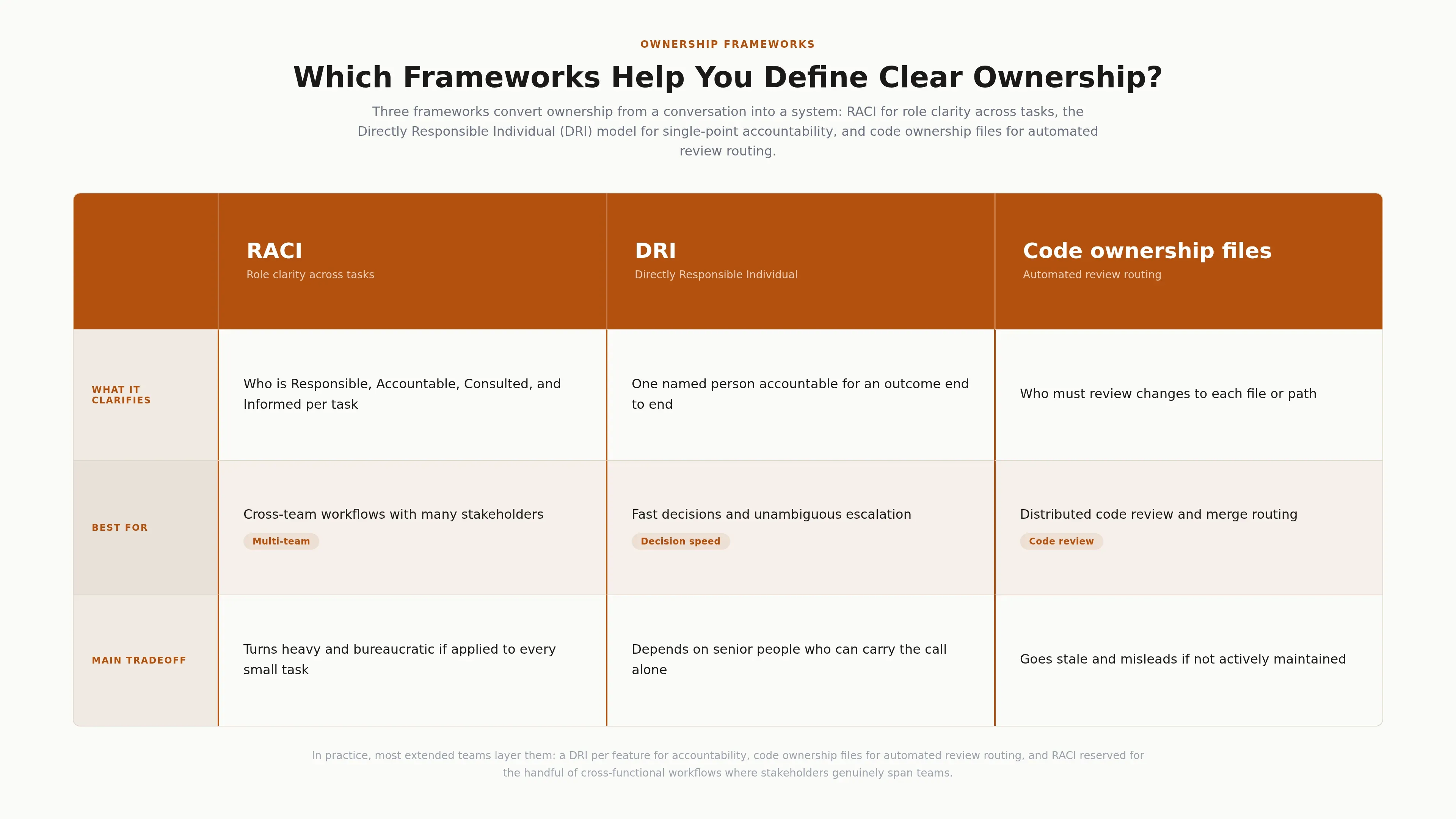
| Framework | What it clarifies | Best for | Main tradeoff |
|---|---|---|---|
| RACI | Who is Responsible, Accountable, Consulted, and Informed per task | Cross-team workflows with many stakeholders | Turns heavy and bureaucratic if applied to every small task |
| DRI | One named person accountable for an outcome end to end | Fast decisions and unambiguous escalation | Depends on senior people who can carry the call alone |
| Code ownership files | Who must review changes to each file or path | Distributed code review and merge routing | Goes stale and misleads if not actively maintained |
These frameworks aren't at odds with agile — they enable it. Evaluations of agile methods in distributed environments show that sprint accountability and ceremonies work remotely when responsibility is explicit. A DRI per epic gives standups, planning, and retrospectives a clear owner to report against instead of a vague "the team" that means no one.
In practice, most extended teams layer them: a DRI per feature for accountability, code ownership files for automated review routing, and RACI reserved for the handful of cross-functional workflows where stakeholders genuinely span teams. Don't RACI a bug fix. Chosen with restraint, this layering is the backbone of durable team management for distributed development.
How Do You Implement Ownership Structures Step by Step?
Implement ownership in four moves: define boundaries before engineers join, communicate them during onboarding, document decisions in shared systems, and refine them in retrospectives. The sequence matters — boundaries set after an engineer starts arrive as corrections, while boundaries set before they start arrive as context, which is exactly what an experienced senior engineer needs.
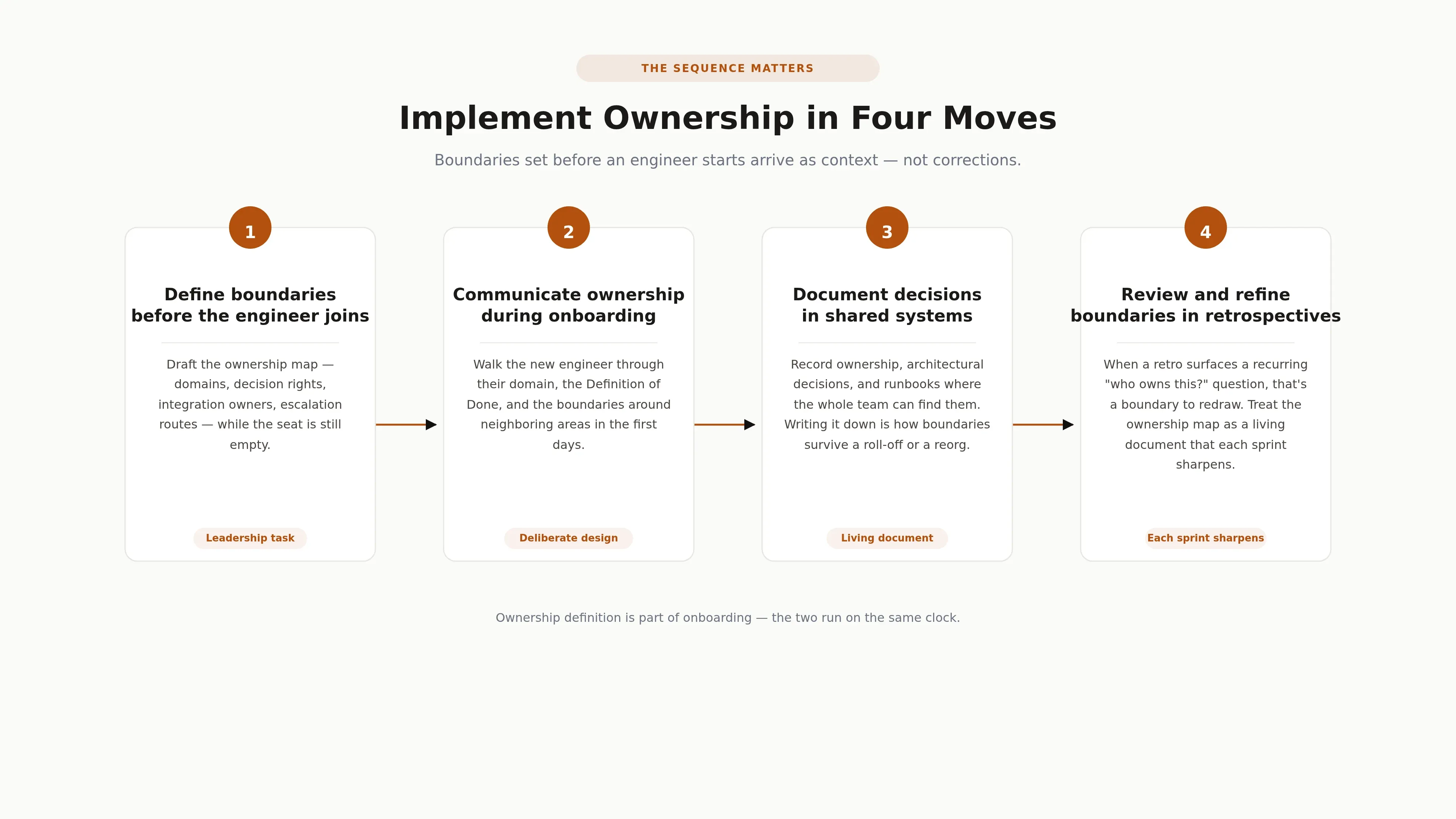
Define boundaries before the engineer joins. Draft the ownership map — domains, decision rights, integration owners, escalation routes — while the seat is still empty. This is a leadership task, not something to negotiate live in week one. Arriving to a defined domain lets a senior engineer start contributing instead of guessing where the edges are.
Communicate ownership during onboarding. Remote onboarding fails when it's improvised; research shows it requires deliberate design of learning and team-building processes. Walk the new engineer through their domain, the Definition of Done, and the boundaries around neighboring areas in the first days, not by osmosis over the first month.
Document decisions in shared systems. Record ownership, architectural decisions, and runbooks where the whole team can find them. In distributed product development, knowledge transformation and documentation mediate a team's ability to both execute and adapt — writing it down is how boundaries survive a roll-off or a reorg.
Review and refine boundaries in retrospectives. Ownership isn't set once. When a retro surfaces a recurring "who owns this?" question, that's a boundary to redraw. Treat the ownership map as a living document that each sprint sharpens.
Ownership definition is really part of onboarding, and the two run on the same clock — our guide to onboarding nearshore engineers in 7 to 14 days sequences them together. This is also where a structured model earns its keep: easy.bi's team extension engagements embed senior engineers directly into your sprint cadence and ownership map rather than parking them outside it as external contractors, so the boundaries you define are the boundaries they actually work inside.
Common Mistakes When Setting Ownership Boundaries
The most common mistakes are vague definitions, over-centralization, misaligned authority, and undocumented ownership. Each fails the same way: it forces a remote engineer to stop and ask, which reintroduces exactly the coordination delay boundaries were meant to remove. Avoiding them is mostly about being specific and writing things down before problems force the issue.
Vague definitions. "You own the frontend" isn't ownership — it's a shrug with a job title attached. Without named repositories, decision rights, and edges, the engineer still asks before every non-trivial move. Specificity is the whole point.
Over-centralization. Routing every decision through one lead feels safe and quietly throttles the team. The lead becomes the bottleneck, and the senior engineers you hired for judgment wait for permission they should already have.
Misaligned authority. Giving someone accountability for an outcome without the decision rights to reach it is a setup for failure. Accountability and authority have to land on the same person, or the boundary is fiction.
Undocumented ownership. Ownership that lives only in people's heads evaporates the moment someone rolls off. Structured process documentation underpins skill retention and continuity in global teams — an undocumented boundary isn't a boundary, it's a rumor.
Siemens, Lekkerland, WeberHaus chose us
One integrated partner. Three core competencies. From insight to production, with no handover gaps.
Start with a Strategy CallHow Do You Measure Whether Your Ownership Structure Works?
Measure ownership clarity with a handful of behavioral signals: decision velocity, time to first meaningful contribution, sprint velocity stability, knowledge-transfer quality, and retention. When boundaries are clear, decisions resolve quickly, new engineers ship inside their first sprint, and no single departure walks off with critical context. When boundaries are missing, every one of these degrades first.

Empirical work on distributed teams identifies specific indicators that predict performance and improve management, and the useful ones here are behavioral rather than vanity metrics — they measure whether people can act, not just how much they produce.
Decision velocity. How long from a decision being needed to it being made? Rising latency usually means authority is unclear or over-centralized.
Time to first meaningful contribution. A senior engineer entering a defined domain with real onboarding should ship something that matters within their first sprint. If it takes weeks, your boundaries are being discovered rather than communicated.
Knowledge-transfer quality. Can someone else pick up a domain from the documentation alone? If the answer is always "ask the owner," ownership has become a silo.
Retention and turnover. Engineers who understand what they own and why tend to stay. Rising churn among remote hires is often an ambiguity signal before it's a compensation one.
Watch these as a set, not in isolation. A team that documents obsessively but centralizes every decision will look organized and still move slowly — which is why decision velocity and knowledge-transfer quality only make sense read together.
The throughline for how to manage remote teams is unglamorous: distance is a solved problem, but ambiguity isn't. Define who owns each feature, decision, integration, and escalation before your engineers start; pick frameworks that turn that into a system; document it where the whole team can find it; and measure whether decisions actually move. These are the managing remote teams best practices that separate a coordinated distributed team from a scattered one — and they turn added headcount into shipped work instead of coordination overhead.
FAQ
How long before an extended engineer becomes productive?
With a defined ownership domain and structured onboarding, an experienced senior engineer can make a meaningful contribution within their first sprint. The prerequisite is deliberate onboarding, not raw talent alone—research consistently links productivity to how well context, boundaries, and the Definition of Done are communicated up front. Improvised onboarding, by contrast, stretches ramp-up into weeks and raises the risk of early turnover.
What's the difference between team extension and outsourcing?
In team extension, engineers join your existing team, work in your sprint cadence, and report to your product owner or tech lead—you keep all technical direction and product accountability. In outsourcing, the vendor owns delivery and hands back a result. Team extension is why ownership boundaries matter so much: because you retain direction, you also have to define who owns what inside the combined team clearly and early.
Who should own architecture decisions in an extended team?
Your technical leadership retains architecture direction; extended engineers contribute within it and own decisions inside their assigned domains. The practical move is to make the split explicit—which decisions a senior engineer makes alone, which require a consult, and which need sign-off—and to document significant architectural choices where the whole team can find them, so the reasoning survives even after individual engineers roll off the engagement.
How do you keep knowledge from leaving when an engineer rolls off?
Document as you go rather than at the end. Record ownership, architectural decisions, and operational runbooks in shared systems the whole team can access. Structured process documentation is what preserves skill and continuity in distributed teams—undocumented ownership evaporates the moment someone leaves. Treat documentation as part of each sprint's Definition of Done, not a separate handover task squeezed in during someone's final week.
References
Ready to transform your business?
30-minute call with an engineering lead. No sales pitch - just honest answers about your project.
98% engineer retention · 14-day delivery sprints · No lock-in contracts
Related Reading

Remote Engineering Teams That Work: Hamburg, Frankfurt, Ljubljana, Skopje
How easy.bi runs distributed engineering teams across Hamburg, Frankfurt, Ljubljana, and Skopje. Timezone alignment, async vs sync communication, cultural considerations across DACH and SEE, and 10 years of lessons from delivering 100+ projects with remote teams.
Andrej Lovsin
How to Manage Projects Most Efficiently?
Explore easy.bi's agile methodology for streamlined, rapid project outcomes, enhancing efficiency and effectiveness in project management.
Andrej Lovsin
Transforming human resource practices through project management; What are the possibilities?
Agile HR enhances teamwork, accelerates market entry, and optimizes results in finance and insurance, driving innovation and efficiency.
Andrej Lovsin