
Why Experienced Engineers Are Essential for Nearshoring: Breaking the Junior Developer Trap

Table of Contents+
- Why Do Junior Engineers Fail in Remote Team Extension?
- What Do Junior Engineers Actually Cost in Remote Onboarding?
- How Do Senior Engineers Multiply Output in Distributed Teams?
- Why Can Only Senior Engineers Sustain Knowledge Transfer?
- How Do You Evaluate a Nearshore Partner's Senior Engineers?
- Questions About Seniority and Team Extension
- References
TL;DR
Experienced engineers nearshoring works only with 10+ year seniors—here's why junior hires recreate the onboarding overhead the model removes.
Experienced engineers nearshoring works only with 10+ year seniors—here's why junior hires recreate the onboarding overhead the model removes.
Here is the most expensive mistake we see teams make with experienced engineers and nearshoring: they treat the model as a way to buy cheap capacity, then staff it with junior developers to stretch the budget further. The logic is seductive. If a nearshore engineer already costs 30–50% less than a domestic hire, why not go cheaper still and get two juniors for the price of one senior?
Because that is not how remote team extension works. The model's speed and its savings come from one specific thing — dropping experienced engineers into your existing team who need context, not training. The moment you swap in juniors, you reintroduce the exact overhead the model was designed to remove: weeks of senior-led mentorship, stalled sprints, and knowledge that never gets written down.
The cost of getting this wrong is not abstract. It shows up as the slipped timeline you were trying to protect, senior staff pulled off delivery to teach, and — when the ramp never resolves — the frustration and turnover that quietly unwind the whole engagement. This article explains the mechanism underneath that failure, and why seniority is the variable that actually decides whether nearshoring works.
Why Do Junior Engineers Fail in Remote Team Extension?
Junior engineers fail in remote team extension because the model's speed and cost advantages depend on people who need context, not training. Central Europe's lower rates apply to juniors and seniors alike, which tempts buyers toward the cheaper hire — but distributed work strips away the in-person mentorship a junior developer needs to become productive.
The math looks obvious on a spreadsheet. If engineers from Poland or the wider Central European talent pool cost less than DACH domestic rates, then a junior at the bottom of that range looks like the cheapest capacity you can buy. This is the trap. Team extension was never a discount-labor scheme — it embeds vetted engineers into your existing team, inside your sprint cadence, reporting to your product owner.
The temptation applies equally to juniors and seniors
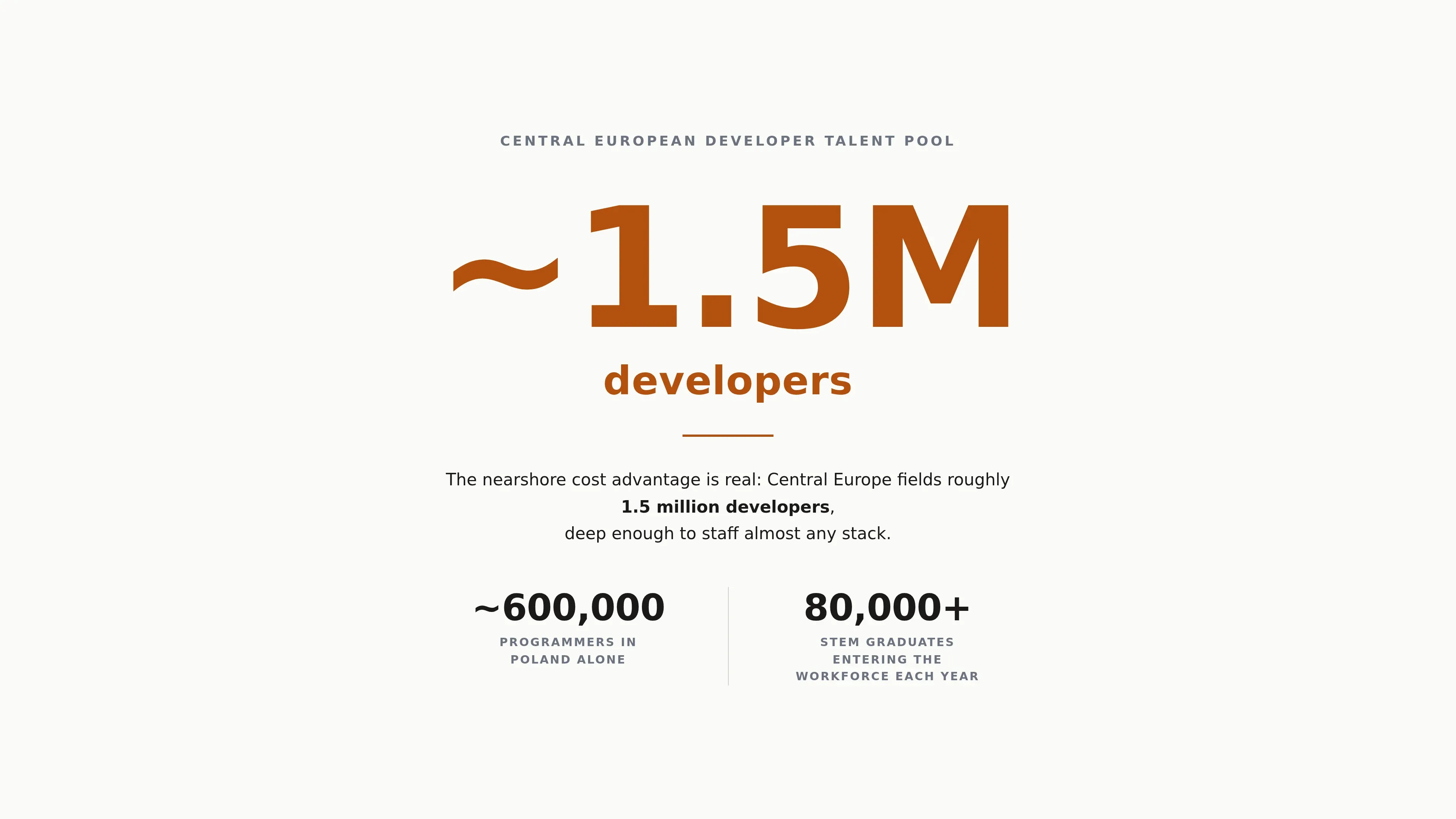
The nearshore cost advantage is real: Central Europe fields roughly 1.5 million developers, and Poland alone contributes around 600,000 programmers with more than 80,000 STEM graduates entering the workforce each year. That pool is deep enough to staff almost any stack. Because the rate reduction applies to every seniority band, buyers reason that stacking juniors simply multiplies the saving.
Remote settings remove what juniors depend on
A junior developer becomes productive by absorbing context from the people around them — a quick question across a desk, a whiteboard sketch, an overheard architecture debate. Remote work removes every one of those channels. What remains is the need for structured, senior-led guidance, which is precisely the overhead the model promises to eliminate. Choosing senior developers for nearshoring is therefore a technical decision, not a budget line — and the rest of this article walks through why.
See how enterprises modernize with one team.
What Do Junior Engineers Actually Cost in Remote Onboarding?
Junior engineers cost far more than their rate in remote onboarding, because distance turns onboarding into a deliberate, resource-heavy program rather than an ambient process. Without physical proximity or a dedicated mentor, junior developers in distributed teams ramp slowly, and the knowledge-transfer burden lands on your most senior people — the exact capacity you were trying to protect.
Onboarding-design research is blunt on this point: remote onboarding only works when the learning and team-building process is intentionally structured. When it is left to chance, the cost resurfaces as attrition. A study of remote onboarding challenges and retention at a large software organization found that models anchored in deliberate mentorship and organizational attachment were what sustained retention — and that their absence drove a wave of resignations.
The knowledge-transfer debt compounds
A junior hire in a distributed team does not carry a one-time onboarding cost. The gap runs for weeks or months as they repeatedly reach back to senior colleagues for context they cannot pick up ambiently. Every one of those interruptions is a senior engineer's hour spent teaching instead of shipping. Getting this right is why structured onboarding for nearshore engineers matters as much as who you hire.
Distance multiplies the overhead
In a co-located team, a struggling junior is visible and correctable within the hour. Across a distributed boundary, the same struggle stays hidden until a sprint slips. The overhead does not merely persist remotely — it compounds, because the feedback loops that would normally catch and close it are exactly the ones distance removes. That is the difference between an onboarding cost you can plan for and one that keeps billing you until the engagement fails.
How Do Senior Engineers Multiply Output in Distributed Teams?
Senior engineers multiply output in distributed teams because they solve problems autonomously, build trust quickly, and turn ambiguous requirements into working software without daily supervision. Where a junior consumes senior capacity, an experienced engineer generates it — closing decisions independently, sharing knowledge outward, and matching the sprint cadence from the first two-week cycle.

The evidence for what makes distributed teams work points squarely at senior traits. Research into virtual team trust and knowledge sharing finds that both play a central role in effectiveness, and that intentional onboarding and the right collaboration platforms are how organizations build them. Senior engineers arrive already fluent in those behaviors — they establish trust by delivering, and they share knowledge as a default habit rather than a prompted task.
Autonomy is the multiplier
An experienced engineer who hits an ambiguous requirement makes a reasoned call, documents it, and keeps moving. A junior escalates. In a co-located office that escalation is cheap; across distributed teams it stalls the whole thread until a time zone aligns. This is why experienced engineers in distributed teams behave as force multipliers rather than as additional headcount to supervise.
The agile evidence favors experience
Distributed agile is not the constraint people assume it is. Studies of distributed team agile performance show that agile practices can be implemented effectively across locations, with measurable productivity gains — but that outcome assumes team members who can run the ceremonies, own the Definition of Done, and self-organize under pressure. That is a description of seniority, not a description of headcount. Staff the same sprints with juniors and the ceremonies become status meetings about work that is stuck.
Why Can Only Senior Engineers Sustain Knowledge Transfer?
Only senior engineers reliably sustain knowledge transfer across distributed boundaries because they create documented knowledge rather than consume it. Project sustainability depends on turning individual understanding into organizational capability — writing the architecture decisions, runbooks, and process notes that outlast any single sprint. Juniors depend on that knowledge; experienced engineers are the ones who produce it.
Sustainability in a global team is not accidental — it is manufactured through explicit process. Work on knowledge transfer in distributed teams shows that structured documentation and deliberate transfer processes are what protect skill retention and preserve competitive advantage when work crosses organizational and geographic boundaries. The same research frames knowledge transformation — converting external knowledge into organizational capability — as the pivotal step, and that step is experience-dependent.
Documentation is a senior responsibility
Architecture Decision Records, runbooks, and process documentation are not clerical tasks you can hand to a junior. They demand the judgment to know which decisions matter, which failure modes to capture, and which context a future engineer will actually need. This is one of the clearest reasons why seniority matters in team extension: the artifacts that let the engagement outlast its contract only get written by people who have seen enough projects to know what is worth writing down.
The dependency runs one way
Junior engineers are net consumers of knowledge transfer; senior engineers are net producers. Staff a distributed team with juniors and no one is generating the documented capability the team needs to sustain itself — you have a room full of people waiting to be taught, and a body of institutional knowledge that walks out the door the moment anyone rolls off.
Siemens, Lekkerland, WeberHaus chose us
One integrated partner. Three core competencies. From insight to production, with no handover gaps.
Start with a Strategy CallHow Do You Evaluate a Nearshore Partner's Senior Engineers?
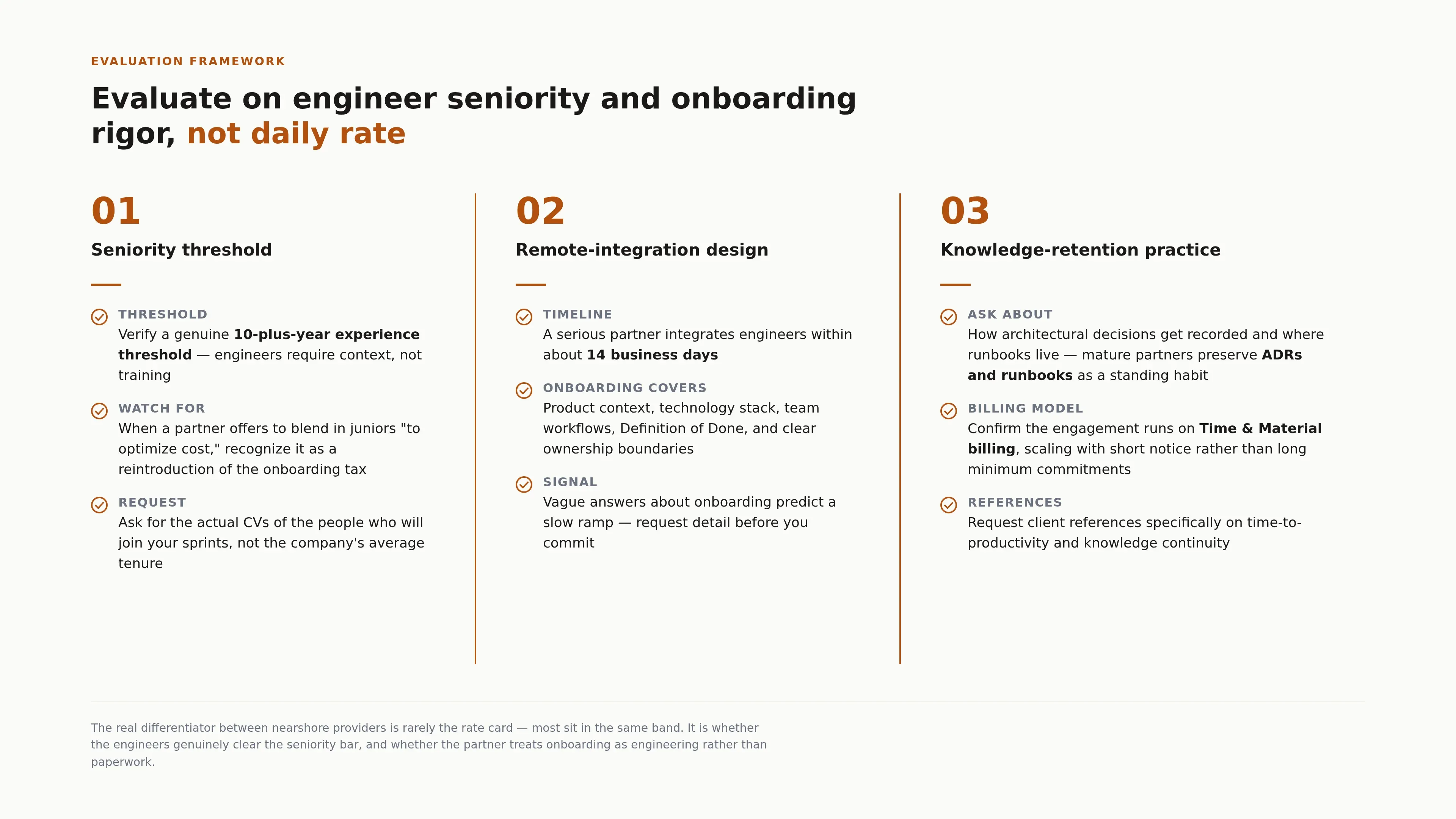
Evaluate a nearshore partner on engineer seniority and onboarding rigor, not daily rate. Verify a genuine 10-plus-year experience threshold, ask how the partner structures remote integration, and confirm that knowledge retention is a documented practice. Request client references specifically on time-to-productivity and knowledge continuity — the two signals that separate real seniority from resume inflation.
The real differentiator between nearshore providers is rarely the rate card — most sit in the same band. It is whether the engineers behind the proposal genuinely clear the seniority bar, and whether the partner treats onboarding as engineering rather than paperwork.
The 10-plus-year threshold and why it holds
Team extension targets engineers with roughly a decade or more of experience precisely because they require context, not training. When a partner offers to blend in juniors "to optimize cost," recognize it for what it is — a reintroduction of the onboarding tax the model exists to remove. Ask for the actual CVs of the people who will join your sprints, not the company's average tenure.
Does the partner design remote integration?
A serious partner integrates engineers within about 14 business days and can describe exactly what that onboarding covers: product context, the technology stack, team workflows, the Definition of Done, and clear ownership boundaries. Vague answers here predict a slow ramp. This is the level of detail a good team extension readiness checklist forces into the open before you commit.
Knowledge retention as a documented practice
Ask how architectural decisions get recorded and where runbooks live. Mature partners preserve ADRs and runbooks as a standing habit; transactional shops do not. Confirm the engagement runs on a flexible footing — Time & Material billing, scaling with short notice rather than long minimum commitments — so capacity tracks your project phases. At easy.bi, we build team extension around vetted senior engineers embedded directly in client sprints for exactly these reasons.
The junior developer trap is seductive because it starts from a true premise — nearshore engineering costs less — and draws a false conclusion: that cheaper engineers make the model cheaper still. They do the opposite. Remote team extension removes the ambient mentorship, proximity, and feedback loops that let junior developers grow, and hands the resulting burden back to your senior staff.
Experienced engineers are what make nearshoring deliver on its promise. They self-direct, they build trust across the distributed boundary, and they produce the documented knowledge that keeps a project sustainable after the engagement ends. That is why seniority is a technical prerequisite, not a line item to trim.
So when you evaluate a partner, look past the daily rate. Verify the seniority, interrogate the onboarding, and ask past clients how quickly the engineers reached productivity and whether the knowledge stayed behind. Those answers — not the price — tell you whether team extension will actually work.
Questions About Seniority and Team Extension
What is the minimum experience level for team extension engineers?
Team extension targets engineers with roughly ten or more years of experience. The threshold exists because the model depends on people who need context, not training — engineers who can self-direct, own the Definition of Done, and document decisions from the first sprint. Junior developers require mentorship that distributed settings cannot supply cheaply, which erases the model's core cost and speed advantages.
Why not save money by mixing junior and senior nearshore engineers?
Because juniors in a distributed team consume the senior capacity you are paying to protect. Remote settings remove the ambient mentorship, proximity, and quick feedback loops that let junior developers grow in an office. What remains is structured, senior-led onboarding that runs for weeks or months — the exact overhead team extension is meant to eliminate, now billed back to you as slipped sprints.
How fast can experienced nearshore engineers become productive?
Experienced engineers typically integrate within about 14 business days when the partner runs a deliberate onboarding program covering product context, the technology stack, team workflows, the Definition of Done, and ownership boundaries. Seniors reach productivity fast precisely because they absorb context rather than needing to be taught the craft. Ask a prospective partner for client references on real time-to-productivity to verify the claim.
What should I verify about a nearshore partner before signing?
Verify three things: that the specific engineers joining your sprints genuinely clear the ten-plus-year experience bar, that the partner runs a structured remote onboarding process rather than ad-hoc paperwork, and that knowledge retention is a documented habit — architecture decision records and runbooks kept as standard practice. Evaluate on seniority and onboarding rigor, not on the daily rate alone.
References
Ready to transform your business?
30-minute call with an engineering lead. No sales pitch - just honest answers about your project.
98% engineer retention · 14-day delivery sprints · No lock-in contracts
Related Reading

How to Onboard Nearshore Engineers Into Your Agile Team
Learn how to onboard nearshore engineers in 7–14 days with a week-by-week system for tool access, first PRs, agile ceremonies, and success metrics.
Andrej Lovsin
How to Manage Remote Teams: Setting Clear Ownership Boundaries for Extended Engineers
Learn how to manage remote teams by setting clear ownership boundaries for extended engineers—define, document, and measure who owns what.
Andrej Lovsin
Why Senior Engineers Leave - And How to Build Teams That Stay
Senior engineers leave over legacy tech, no ownership, and bad management. Learn how easy.bi maintains 98% retention across 50+ engineers and 4 countries.
Andrej Lovsin