
The Build vs. Buy Decision: How to Staff Enterprise Software Projects in 2026

Table of Contents+
- The Build vs. Buy Decision Has Changed
- Why Is the DACH Talent Market Forcing a Rethink?
- In-House vs. Nearshore vs. Offshore: A Realistic Comparison
- How Do You Evaluate a Development Partner Without Getting Burned?
- The Multi-Vendor Trap: Why Coordination Overhead Kills Projects
- Scaling Teams from 2 to 20 Engineers
- What Does Vendor Lock-In Actually Cost?
- Remote Team Management in 2026
- Why Does Retention Matter More Than Rates?
- Legacy Modernization: The Trigger Most Companies Ignore
- A Decision Framework for Build vs. Buy
- Making the Right Call for Your Organization
- References
TL;DR
The build vs. buy decision in 2026 depends on talent availability, team structure, and outcome accountability. Compare in-house, nearshore, and offshore models with DACH market data and a practical decision framework.
Key Takeaways
- •Germany's 149,000 IT specialist shortage makes pure in-house development unviable for most mid-market companies - the average time to fill an IT position is 7.1 months.
- •Nearshore partnerships in CEE deliver 35% faster project timelines than purely onshore models, at 40-50% lower hourly rates than German developers.
- •Multi-vendor setups cause 3.5x budget overruns on average. 57% of project failures trace directly to communication breakdowns between business and technology stakeholders.
- •Client retention rates separate good partners from great ones. The industry average is 72-78%. Teams that stay together accumulate domain knowledge that compounds over every sprint cycle.
- •Legacy modernization is the most common trigger for the build vs. buy decision. 89% of IT leaders say technical debt blocks innovation, and developers spend 41% of their time on maintenance.
The build vs. buy decision in 2026 depends on talent availability, team structure, and outcome accountability. Compare in-house, nearshore, and offshore models with DACH market data and a practical decision framework.
The build vs. buy decision in enterprise software is no longer binary.
In 2026, with 149,000 unfilled IT positions in Germany alone and senior developer salaries exceeding EUR 85,000, the real question is not whether to build or buy - it is how to structure your development capacity to ship faster without losing control over quality and outcomes.
This guide breaks down the staffing models, evaluation criteria, and hidden costs that determine whether your next enterprise software project succeeds or joins the 66% that fail. Every data point comes from published research, and every recommendation comes from delivering 100+ projects across the DACH region since 2015.
The Build vs. Buy Decision Has Changed
The traditional build vs. buy framework assumed two clean options: hire developers and build in-house, or purchase off-the-shelf software. That framing is outdated. Today's enterprise software projects exist on a spectrum of staffing models, each with distinct cost structures, risk profiles, and speed-to-value trajectories.
The shift happened because three forces converged simultaneously. First, the talent shortage in DACH reached structural proportions - 149,000 IT specialists missing in Germany, with the gap growing year over year [1]. Second, remote work normalization made distributed teams viable for enterprise-grade development.
Third, the rise of composable architectures means "buying" no longer means accepting a monolithic product. You can buy components and build the integration layer, creating hybrid approaches that didn't exist 5 years ago.
For CTOs and IT leaders at mid-market companies, this means the decision tree has more branches than ever. You can build in-house, staff with freelancers, engage a single development partner, coordinate multiple vendors, go offshore, go nearshore, or combine several models.
Each path carries different implications for speed, cost, quality, and long-term maintainability.
The companies that get this decision right share one trait: they evaluate staffing models based on outcomes delivered, not hours billed. They ask "How fast can we ship working software?" rather than "What's the lowest hourly rate?"
See how enterprises modernize with one team.
Why Is the DACH Talent Market Forcing a Rethink?
The DACH talent market has fundamentally altered the build vs. buy calculus. Hiring in-house is no longer just expensive - for many companies, it is practically impossible at the speed required to stay competitive.
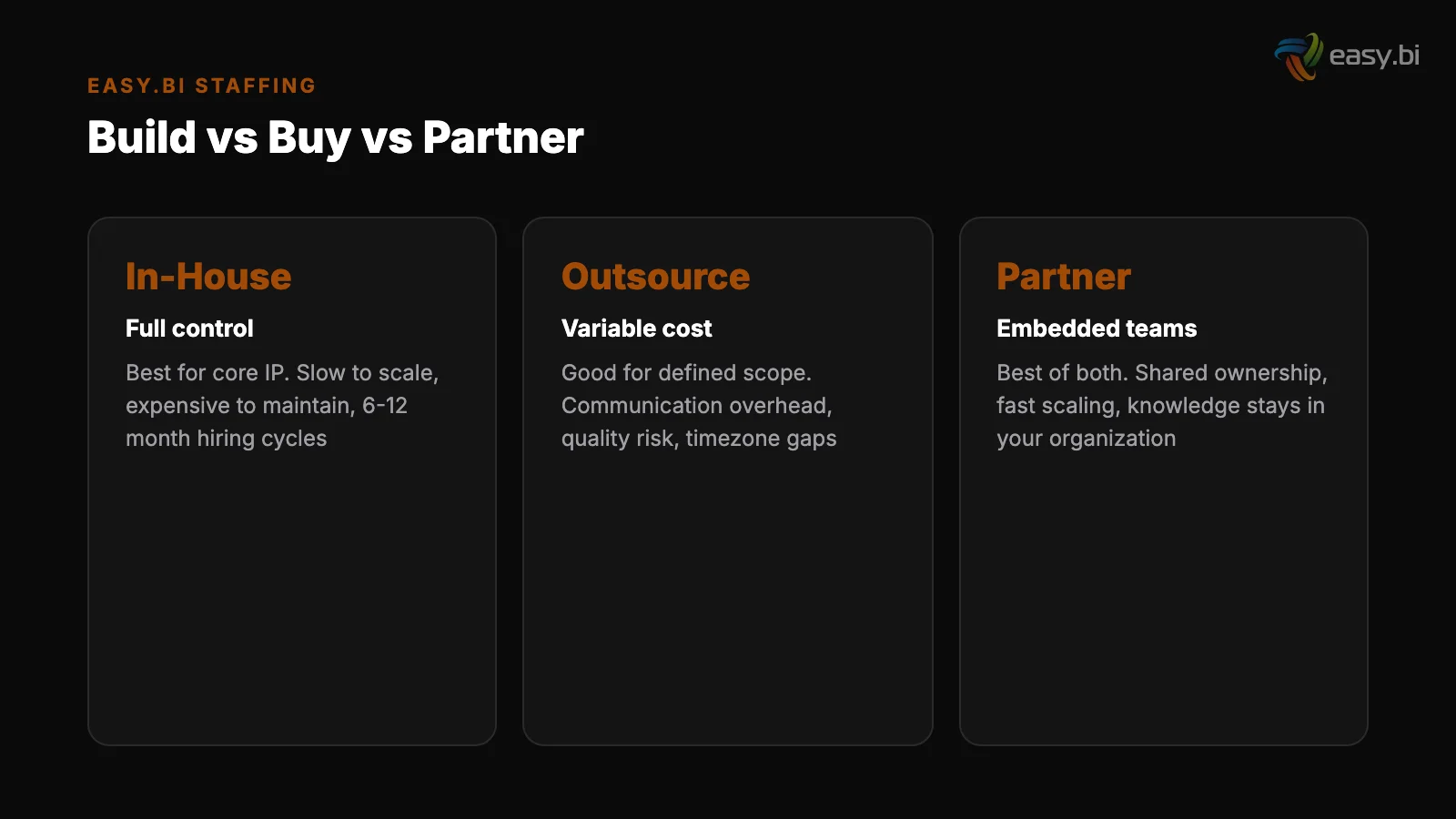
The numbers tell a stark story. Germany faces a shortage of 149,000 IT specialists, up from 137,000 the prior year [1]. The average time to fill an IT position in Germany is 7.1 months, compared to 4.2 months EU-wide [2].
Every unfilled vacancy costs an average of EUR 29,000 in lost productivity, recruitment fees, and onboarding overhead [3]. And 84% of German companies report that the talent shortage is directly limiting their digital transformation plans [4].
Senior developers in Germany earn EUR 72,000-85,000 per year. In Switzerland, that figure jumps to CHF 110,000-130,000. Even at these salary levels, 55% of German SMEs cannot fill IT vacancies within 6 months.
The average IT freelancer commands EUR 950 per day for senior roles - making freelancer-dependent projects extremely expensive to sustain.
This talent reality changes the build vs. buy equation fundamentally.
A CTO who decides to "build in-house" is not just choosing a staffing model - they are betting that they can recruit and retain engineers faster than their competitors in a market where everyone is fishing from the same shrinking pool.
84% of German companies report that the IT talent shortage is directly limiting their digital transformation plans. The question is no longer whether to use external development capacity, but how to structure it for maximum impact. [4]
The alternative is accessing talent pools outside Germany's overheated market. Slovenia, for example, employs over 30,000 IT professionals, 92% university-educated, with the highest English proficiency in CEE. Developer hourly rates in Slovenia average EUR 45-75, compared to EUR 90-150 for German developers [5].
That is not a quality trade-off - it is an arbitrage opportunity in a talent market that German companies can no longer afford to ignore.
In-House vs. Nearshore vs. Offshore: A Realistic Comparison
The three primary staffing models each carry distinct advantages and risks. For a detailed, data-driven comparison without the sales pitch, see In-House vs. Nearshore vs. Offshore: The Real Comparison (Not the Sales Pitch). The right choice depends on your project complexity, timeline, budget constraints, and appetite for management overhead.
Here is an honest comparison based on what we have observed across 100+ projects.
| Factor | In-House Team | Nearshore (CEE / EU) | Offshore (Asia / India) |
|---|---|---|---|
| Hourly cost | EUR 90-150 | EUR 45-85 | EUR 20-45 |
| Time to team assembly | 4-7 months | 2-4 weeks | 1-3 weeks |
| Time-zone overlap with DACH | Full | Full (same zone or +1h) | 3-4 hours |
| Cultural alignment | Native | High (EU shared business culture) | Moderate to low |
| GDPR compliance | Built-in | Built-in (EU data processing) | Requires additional contracts and controls |
| Communication overhead | Low | Low to moderate | High |
| Long-term knowledge retention | High (if retention works) | High (with dedicated teams) | Low (high turnover typical) |
| Scalability | Slow (recruiting bottleneck) | Fast (2 to 20 engineers in weeks) | Fast (large talent pools) |
In-house delivers maximum control and alignment. Your developers sit in your standups, absorb your culture, and understand your domain deeply. The downside: you are competing for the same 149,000 missing specialists as everyone else.
Building a team of 8 senior engineers in Germany can take 12-18 months and cost EUR 250,000+ in recruitment fees alone - before a single line of code is written.
In-house
Nearshore (CEE / EU) hits the sweet spot for most DACH mid-market companies. Same time zone, EU legal framework, cultural compatibility, and access to deep talent pools in countries like Slovenia, Poland, and the Czech Republic. 73% of German IT decision-makers already prefer CEE nearshore partners over offshore alternatives [6].
The CEE nearshore market for DACH clients grew 18% in 2024 alone.
Offshore works for well-defined, isolated workstreams with clear specifications. It breaks down for complex enterprise projects that require daily collaboration, shared context, and rapid iteration. The 5-7 hour time-zone gap means your morning standup happens at your offshore team's evening - or vice versa.
That gap compounds over months into communication debt that no project management tool can eliminate.
How Do You Evaluate a Development Partner Without Getting Burned?
Selecting a development partner is a high-stakes decision that most companies approach with the wrong criteria. For a practical checklist of what to ask, red flags to watch for, and why paid pilots beat RFPs, see How to Evaluate a Software Development Partner (Without Getting Burned).
RFPs with 200 questions, hour-long vendor presentations, and reference calls with hand-picked clients produce confidence - but not insight.
Here are the signals that actually predict partner quality, based on patterns we have seen across the DACH mid-market:
Ask about retention, not headcount
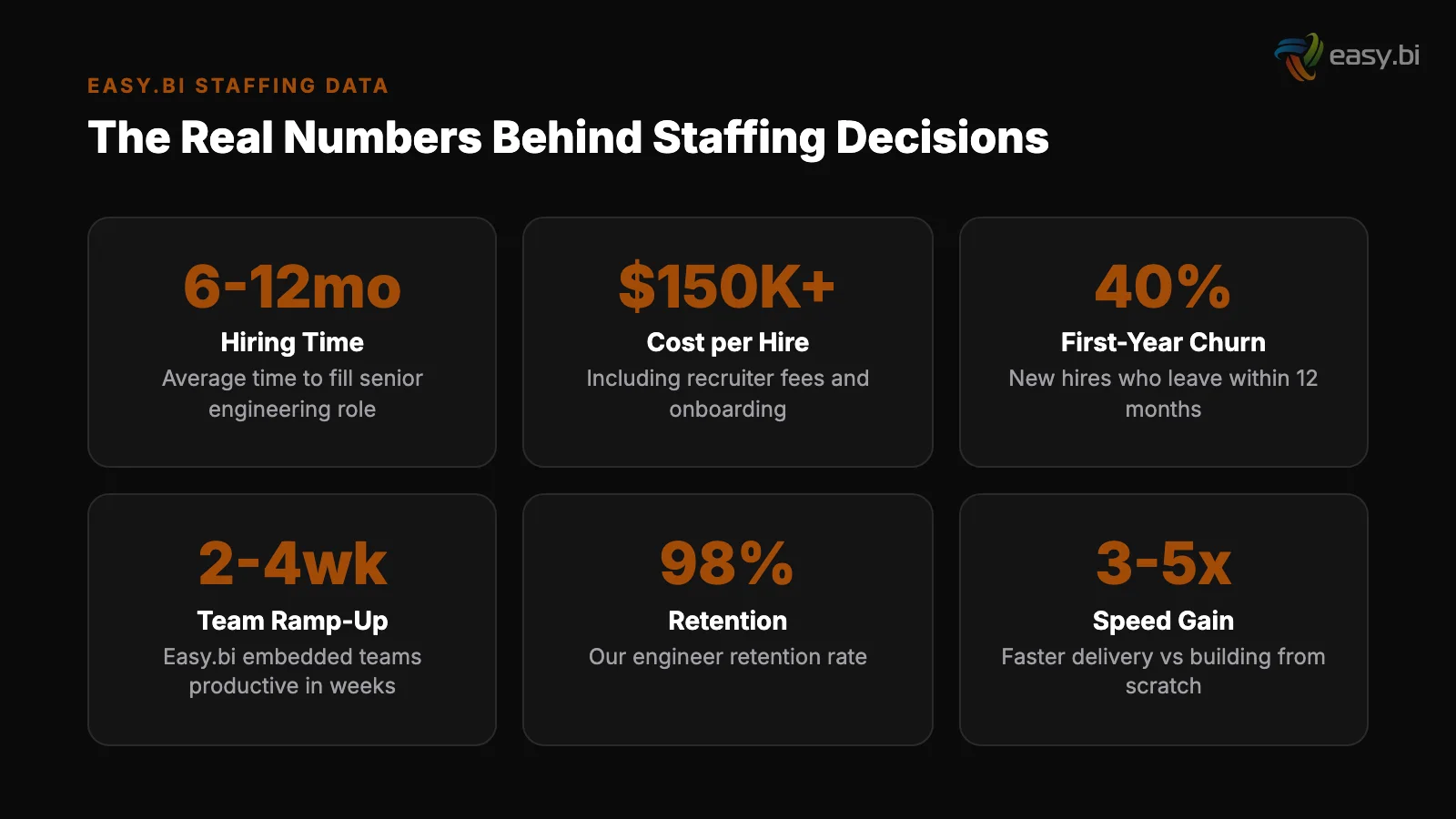
Ask about retention, not headcount. A partner with 50 engineers and 98% client retention is fundamentally different from one with 500 engineers and 60% retention. Retention means clients come back. It means teams stay together long enough to accumulate domain knowledge.
The industry average for IT outsourcing client retention is 72-78% [7]. Any partner significantly above that threshold is doing something the market cannot easily replicate.
Check delivery cadence, not methodology slides. Every agency claims to be "agile." Few can show you a production deployment from last week. Ask for deployment logs. Ask how many production releases happened in the last month.
Teams using 2-week sprint cycles deliver 40% more features per quarter than those using 4-week cycles. If a partner cannot show continuous delivery evidence, their agile claims are just marketing.
Check delivery cadence, not methodology slides
Demand to meet the actual team. The engineers who present in the sales process should be the engineers who build your product. Big consultancies are notorious for showing senior architects during the pitch and staffing junior bench warmers on the project.
Ask: "Will these specific people work on my project?" Get names. Get LinkedIn profiles. Get commitments in writing.
Evaluate business understanding, not just technical skills. Your partner needs to understand why you are building, not just what.
A technically brilliant team that builds the wrong product is worse than a technically average team that builds the right one. 57% of project failures trace to communication breakdowns between business and technology stakeholders [8].
The partner who asks "What business outcome does this feature serve?" before writing code is the one who will deliver value.
Run a paid pilot, not a free proof of concept. A 4-week paid engagement with a defined scope tells you more about a partner than 6 months of evaluation. You see real communication patterns, real code quality, real problem-solving under pressure. If the pilot works, scale up.
If it doesn't, you've lost 4 weeks and a small budget - not 12 months and your annual IT budget.
The Multi-Vendor Trap: Why Coordination Overhead Kills Projects
Splitting a project across multiple vendors is the most expensive mistake in enterprise software staffing. For a deep analysis of why coordination costs blow budgets, see The Multi-Vendor Trap: Why Coordination Costs Kill Your Budget. It feels like risk diversification. In practice, it concentrates risk at every integration point.
The pattern repeats across industries: one agency for UX, another for frontend, a third for backend and integrations, a fourth for DevOps and hosting. Each vendor is competent individually. Together, they produce coordination overhead that adds 40-60% to timelines and pushes budgets to 3.5x the original estimate.
Why does this happen? Because nobody owns the outcome end-to-end. When the frontend team says the API is too slow, and the backend team says the frontend is making too many calls, and the DevOps team says the infrastructure can handle both if they were built properly - who decides?
The client becomes the unwilling project manager, spending their time refereeing technical disputes instead of running their business.
57% of software project failures trace directly to communication breakdowns between stakeholders. Multi-vendor setups don't reduce this risk - they multiply it by the number of handoff points between teams. [8]
The math is straightforward. With 2 vendors, you have 1 coordination interface. With 3 vendors, you have 3 interfaces. With 4 vendors, you have 6 interfaces. Each interface is a potential failure point where assumptions diverge, timelines slip, and accountability disappears.
The alternative is a single partner with cross-functional capabilities. One team that handles architecture, frontend, backend, DevOps, and QA under one backlog, one project owner, and one definition of done. Cross-functional teams are 35% more productive than siloed teams working on the same type of project.
That productivity gap widens as project complexity increases.
At easy.bi, this is how we structure every engagement. Our 50+ engineers across Hamburg, Frankfurt, Ljubljana, and Skopje work as one integrated team - not as separate departments that hand off work to each other. One backlog. One sprint cadence. One team accountable for your business outcome.
Scaling Teams from 2 to 20 Engineers
Team scaling is where most staffing models break down. For a practical framework covering onboarding, architecture readiness, and team topology at scale, see Scaling From 2 to 20 Engineers in 6 Weeks (Without Losing Quality). Starting a project with 2-3 engineers is easy.
Scaling to 10-20 without losing velocity, culture, and code quality is the real test of a development partner.
Research shows that teams of 5-9 people deliver the highest productivity per person. Teams larger than 15 see 50% lower per-capita output [9].
This doesn't mean you can't have 20 engineers on a project - it means you need to structure them as multiple small teams, each with clear ownership over a bounded domain.
The scaling challenge has three dimensions:
Onboarding velocity
Onboarding velocity. Every new team member goes through a ramp-up period. For enterprise projects with complex domain logic, that period is 4-8 weeks before a new engineer reaches full productivity.
If you are scaling from 5 to 15 engineers simultaneously, you temporarily lose productivity as existing team members spend time onboarding new ones.
Architecture readiness. Your codebase must support parallel work. If 10 engineers are all committing to the same monolithic repository with tight coupling, merge conflicts and integration failures will eat your velocity gains. Microservices or modular monolith architectures enable team scaling. Tightly coupled codebases resist it.
Communication overhead. Brooks's Law holds: adding people to a late software project makes it later. The number of communication channels grows quadratically with team size. A team of 5 has 10 channels. A team of 15 has 105.
Managing this requires explicit team topologies, clear API contracts between teams, and disciplined sprint coordination.
Architecture readiness
The pattern that works: start with a core team of 3-5 senior engineers who establish the architecture, coding standards, and CI/CD pipeline. Scale by adding entire sub-teams of 3-4 engineers with their own domain ownership, not by adding individual engineers to an existing team.
Each sub-team gets a dedicated sprint backlog, their own deployment pipeline, and clear interfaces with other sub-teams.
easy.bi has scaled teams from 2 to 20 engineers across projects for clients like Siemens, Lekkerland, and WeberHaus. The key is that scaling happens within an existing organizational culture - our 50+ engineers across 4 countries already share coding standards, tools, and communication patterns.
Adding engineers to your project means adding people who have already worked together, not strangers assembling for the first time.

What Does Vendor Lock-In Actually Cost?
Vendor lock-in is the silent tax on every build vs. buy decision. It compounds over time, and most companies don't calculate its true cost until they try to switch providers - at which point the switching cost has become prohibitive.
Lock-in happens at four levels:
Knowledge lock-in
Knowledge lock-in. Your development partner accumulates domain knowledge, system context, and undocumented architectural decisions over months and years. When that partner leaves, the knowledge leaves with them. The replacement team spends 3-6 months just reaching the same understanding level, during which productivity drops 40-60%.
Code lock-in. Proprietary frameworks, custom build tools, and non-standard patterns make your codebase dependent on the specific team that wrote it. If your partner built your application on their proprietary framework, you cannot hire any developer to maintain it - you need developers who know that specific framework.
Process lock-in. Your workflows, deployment pipelines, and monitoring systems become intertwined with your partner's toolchain. Switching partners means rebuilding operational infrastructure that took months to configure.
Code lock-in
Contractual lock-in. IP ownership, source code escrow, and non-compete clauses can legally prevent you from moving your project to another provider.
The antidote to lock-in is transparency. Your partner should use open-source technologies and industry-standard frameworks (React, Angular, Symfony, Kubernetes - not proprietary forks). All code should be in your repository from day one. Documentation should be written for the next team, not just the current one.
And your contract should give you full IP ownership with no restrictions on engaging other providers.
At easy.bi, we build on open standards and commit all code to client-owned repositories. If a client decides to bring development in-house after 2 years, they have everything they need: documented code, standard frameworks, and CI/CD pipelines that any competent engineering team can operate.
Our 98% retention rate means clients rarely choose to leave - but they always have the freedom to.
Siemens, Lekkerland, WeberHaus chose us
One integrated partner. Three core competencies. From insight to production, with no handover gaps.
Start with a Strategy CallRemote Team Management in 2026
Managing distributed development teams is no longer a pandemic-era experiment. For lessons from 10 years of running distributed teams across Hamburg, Frankfurt, Ljubljana, and Skopje, see Remote Engineering Teams That Work: Hamburg, Frankfurt, Ljubljana, Skopje.
It is the operational default for enterprise software projects. 68% of German IT professionals work in hybrid or fully remote setups. The question is not whether to manage remote teams, but how to do it without losing alignment and velocity.
The companies that succeed with remote development teams invest in three areas:
Asynchronous communication infrastructure
Asynchronous communication infrastructure. When your team spans Hamburg and Ljubljana, not every conversation can happen in real time. Detailed written specifications, recorded architecture decision records (ADRs), and comprehensive PR descriptions replace the hallway conversations that onsite teams rely on.
This creates better documentation as a side effect - every decision is traceable.
Synchronous rituals that matter. Daily standups, sprint planning, and retrospectives happen on video with cameras on. These are the moments that build team cohesion and catch misalignment early. The key is keeping synchronous meetings short and high-signal.
A 15-minute standup with 8 people is more effective than a 60-minute status update with 20.
Synchronous rituals that matter
Shared tooling and observability. Every team member sees the same dashboards, the same CI/CD pipeline status, and the same production metrics. Shared observability eliminates the "it works on my machine" problem and gives distributed teams a single source of truth.
Time-zone alignment is a prerequisite, not a nice-to-have. This is the fundamental advantage of CEE nearshore over Asian offshore. Ljubljana is 0-1 hours from Frankfurt. That means full overlap for core working hours - your standup at 9:30 AM is your nearshore team's standup at 9:30 or 10:30 AM.
Compare that to a team in Bangalore, where 9:30 AM CET is 2:00 PM IST. By the time you need a quick decision at 4 PM, your offshore team has already logged off.
Why Does Retention Matter More Than Rates?
The most undervalued metric in partner selection is retention. For a transparent look at how easy.bi achieves 98% client retention when the industry average is 72-78%, see The 98% Retention Question: What We Do Differently. Both client retention and team retention matter.
Companies obsess over hourly rates while ignoring the factor that actually determines project success: whether the same people who start your project are the ones who finish it.
Here is why retention trumps rates. The software development industry has an average employee turnover rate of 13.2% [10]. The average tenure of an IT employee in Germany is 2.8 years. Every time a developer leaves your project, you lose 4-8 weeks of productivity during the replacement's ramp-up period.
On a 12-month project with a 5-person team, industry-average turnover means you will likely lose at least one team member - at a cost of 8-12% of total project productivity.
Now multiply that across a partner organization. If your development partner has high internal turnover, your project becomes a revolving door of engineers who spend their first month reading code they didn't write and their last month mentally checked out.
The "cheap" hourly rate becomes expensive when you are paying for 3 months of ramp-up time per year per developer slot.
Client retention tells you something even more important. When 98% of clients come back - as they do with easy.bi - it means the partner delivers outcomes worth repeating. It means the relationship survived the inevitable challenges that every software project encounters: scope changes, technical surprises, stakeholder shifts.
An outsourcing industry average of 72-78% [7] means 22-28% of clients choose not to return. That is a signal you should investigate before signing a contract.
Outsourcing partnerships lasting 3+ years deliver 25-30% more value than short-term engagements. This makes intuitive sense: a team that has worked on your domain for 3 years writes better code, faster, with fewer defects than a team encountering your business logic for the first time. Retention creates compound returns.
Turnover creates compound costs.
When evaluating partners, ask for their client retention rate and their internal team retention rate. If they cannot provide these numbers, that is your answer.
Legacy Modernization: The Trigger Most Companies Ignore
The build vs. buy decision rarely happens in a vacuum.
The most common trigger is a legacy system that has become a liability - too expensive to maintain, too fragile to extend, too slow to support new business requirements. 89% of IT leaders say technical debt impacts their ability to innovate [11].
The scale of the problem is staggering. Developers spend an average of 41% of their time on maintenance and technical debt rather than new feature development [12]. For a team of 10 engineers, that is 4 full-time equivalents doing nothing but keeping the lights on.
The cost of poor software quality in the US alone was $2.41 trillion in 2022, driven primarily by operational failures and accumulated technical debt.
Legacy modernization forces the build vs. buy question because you cannot modernize with the same team and tools that created the legacy in the first place. You need fresh architecture thinking, modern stack expertise, and enough capacity to maintain the old system while building the new one simultaneously.
Most in-house teams cannot do both - they are already at 100% capacity just maintaining the status quo.
This is where a nearshore development partner adds the most value. Your in-house team maintains domain knowledge and system context. The external team brings modern architecture expertise and additional capacity. Together, they execute a migration strategy that keeps the business running while systematically replacing legacy components.
We have seen this pattern at Lekkerland (SAP integration and S4/HANA migration) and WeberHaus (complete process digitization with offline capability). In both cases, the trigger was a legacy system that could not support the next phase of business growth.
And in both cases, the solution was not replacing the in-house team but augmenting it with specialists who could execute the modernization while the internal team maintained business continuity.
For a deeper analysis of legacy system costs, see our article on the true cost of legacy systems, which breaks down the financial impact of deferred modernization across the DACH mid-market.
A Decision Framework for Build vs. Buy
After 100+ projects delivered across DACH enterprises and mid-market companies, we have identified the factors that reliably predict which staffing model will deliver the best outcomes. Use this framework to evaluate your situation.
| Decision Factor | Favors In-House | Favors Nearshore Partner | Favors Offshore |
|---|---|---|---|
| Time to first delivery | 6+ months acceptable | Need results in 4-8 weeks | Well-defined specs, 8-12 weeks OK |
| Project complexity | Core IP, trade secrets | Complex, requires collaboration | Isolated, well-specified modules |
| Team size needed | 1-3 engineers | 3-20 engineers | 10+ engineers for parallel streams |
| Budget structure | Can absorb fixed salary costs | Variable cost, pay for output | Lowest hourly rate priority |
| Domain complexity | Deep, proprietary knowledge | Industry-standard with customization | Generic, repeatable patterns |
| GDPR requirements | Full control | EU data processing built-in | Additional legal framework needed |
| Scaling trajectory | Stable team size | Need to scale up or down rapidly | Large-scale parallel execution |
| Management capacity | Full internal PM capability | Partner provides PM and QA | Requires dedicated coordination layer |
Choose in-house when: You are building core IP that defines your competitive advantage, you have 12+ months before time-to-market pressure, and you can attract and retain senior engineers in the current DACH market.
This is rare, but it is the right choice for products where deep domain knowledge creates a moat.
Choose in-house when
Choose a nearshore partner when: You need to ship within 3-6 months, the project requires 5+ engineers working in close collaboration, GDPR compliance is non-negotiable, and you want one team accountable for outcomes rather than hours. This covers the majority of enterprise software projects in the DACH mid-market.
Choose offshore when: You have clearly specified, isolated workstreams that don't require daily DACH-time-zone collaboration. Mobile app development with a well-defined API layer is a classic offshore-suitable scope. Avoid offshore for projects that require understanding German business processes, regulatory compliance, or complex stakeholder management.
Choose a nearshore partner when
The hybrid approach: The most effective model for large-scale enterprise projects combines a small in-house core (2-3 architects who own the vision) with a nearshore delivery team (5-15 engineers who execute).
This model gives you domain control and delivery speed without the recruitment bottleneck. easy.bi operates in this hybrid model for clients like Siemens and REWE, where our team of 50+ engineers across 4 countries integrates directly into the client's engineering organization.
For context on why the best engineers leave in-house teams - and how that impacts your build vs. buy math - read our analysis of why senior engineers leave.
Making the Right Call for Your Organization
The build vs. buy decision comes down to a simple question: given your timeline, talent access, and project complexity, what staffing model will deliver working software fastest with the lowest total cost of ownership?
For most DACH mid-market companies in 2026, the answer is a nearshore development partnership with a single, integrated partner. The talent math alone makes this clear - you cannot hire 5 senior engineers in Germany in under 7 months. A nearshore partner can assemble that team in 2-4 weeks.
But the model only works if the partner operates as an extension of your team, not as an outsourced body shop.
The differentiators that matter: outcome accountability (not just billable hours), dedicated teams (not bench-rotated resources), proven retention (both client and team), and transparent engineering practices (your code, your repository, your IP).
easy.bi has built this model over 100+ projects since 2015. Our 50+ engineers across Hamburg, Frankfurt, Ljubljana, and Skopje deliver in 14-day sprint cycles using our Performance Scrum methodology.
Our 98% client retention rate means the team that starts your project stays with your project - accumulating domain knowledge that makes every sprint more productive than the last.
Whether you need to modernize a legacy system, scale your engineering capacity for a new product launch, or replace a multi-vendor setup that is bleeding budget, the first step is a conversation about your specific situation.
Not a sales pitch - a technical discussion about what staffing model fits your reality.
Explore our custom software development approach, or book an expert call to discuss your build vs. buy decision with an engineering leader, not a salesperson.
References
- [1] Bitkom (2024). "Germany faces a shortage of 149,000 IT specialists, up from 137,
- [2] Bundesagentur fur Arbeit (2024). arbeitsagentur.de
- [3] Bitkom (2023). "Average cost per IT vacancy in Germany is EUR 29,000 when factor bitkom.org
- [4] Bitkom (2024). "84% of German companies report that the IT talent shortage is li
- [5] Accelerance (2024). "Slovenian developer hourly rates average EUR 45-75, compare
- [6] Hays (2024). "73% of German IT decision-makers prefer nearshore partners in CEE hays.de
- [7] Deloitte (2024). "Outsourcing client retention rates average 72-78% across the I deloitte.com
- [8] PMI (2024). "57% of projects fail due to communication breakdown between busines pmi.org
- [9] QSM / Putnam Research (2023). qsm.com
- [10] LinkedIn / BLS (2024). linkedin.com
- [11] McKinsey (2024). "89% of IT leaders say technical debt impacts their ability to mckinsey.com
- [12] Stripe (2023). "The average developer spends 41% of their time on maintenance an
Explore Other Topics
Ready to transform your business?
30-minute call with an engineering lead. No sales pitch - just honest answers about your project.
98% engineer retention · 14-day delivery sprints · No lock-in contracts
Related Reading

How do custom software development services improve decision making capabilities?
Custom software enhances financial institutions' efficiency, decision-making, and security, maintaining competitiveness and regulatory compliance.
Enno Bassen
Build vs Buy Your E-Commerce Platform: The EUR Decision Framework
80% of mid-market retailers should buy. Use this EUR decision framework with real cost comparisons, scoring criteria, and case examples to make the right call.
Andrej Lovsin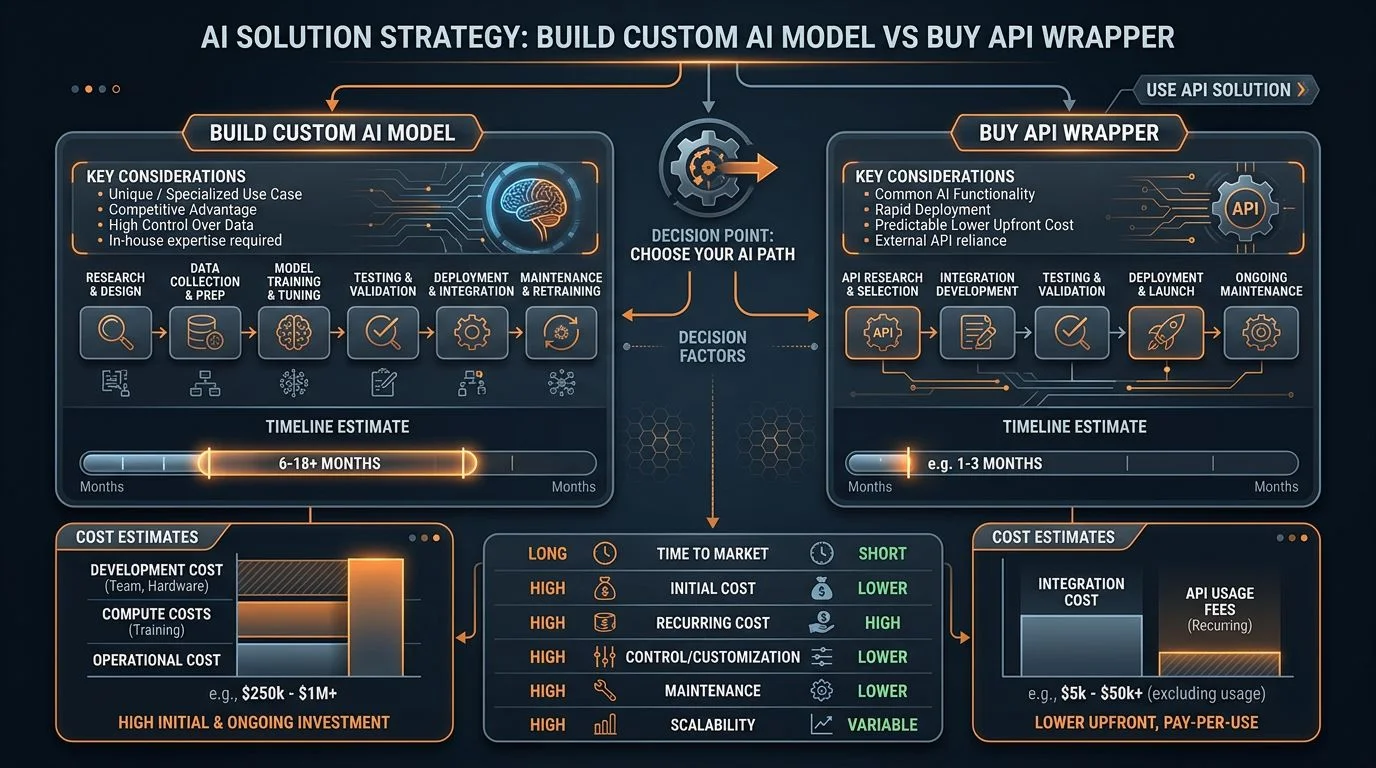
The AI Build vs. Buy Decision: Custom Models vs. API Wrappers
Custom models cost $100M+ to train from scratch. API wrappers ship in days. Learn when to build, buy, or combine - with cost comparisons, data privacy implications, and vendor lock-in strategies for enterprise AI.
Filip Kralj