
Staffing Digital Transformation Programs: How Team Extension Enables Faster Delivery and Lower Costs

Table of Contents+
- Why Does Staffing a Transformation Program Break Traditional Hiring?
- Why Does Team Extension Fit Multi-Phase Transformations?
- How Do You Architect a Hybrid Onshore-Offshore Team?
- What Should You Look For in a Team Extension Partner?
- How Do You Onboard Extended Engineers in 7–14 Days?
- Managing Distributed Teams Across Transformation Phases
- How Do You Preserve Knowledge Across Program Phases?
- Frequently Asked Questions About Staffing Transformation Programs With Team Extension
- Research & Sources
TL;DR
Staffing digital transformation with team extension: embed senior engineers in days, cut costs 30–50%, keep velocity across phases.
Staffing digital transformation with team extension: embed senior engineers in days, cut costs 30–50%, keep velocity across phases.
Every digital transformation program eventually hits the same fork: you need more engineering capacity than you have, and you have to decide how to get it. Do you open requisitions and recruit? Do you hand a phase to an outsourcing vendor? Or do you extend your own team with senior engineers who plug into your sprints?
The answer you pick sets the trajectory of the whole program. Staffing digital transformation the classical way — job postings, interview loops, notice periods — routinely burns 8 to 12 weeks per hire, and your timeline rarely has that slack. Choose an outsourcing vendor and you trade speed for control, handing delivery ownership to a team that doesn't know your business. This guide resolves the fork: when team extension is the right call, and how to run it across a multi-phase program.
Why Does Staffing a Transformation Program Break Traditional Hiring?
Traditional hiring breaks because transformation timelines and recruitment cycles run on incompatible clocks. Filling a specialized engineering role takes 8 to 12 weeks before onboarding even starts, while your existing team is already at capacity and can't absorb the work. The program can't wait for headcount that arrives a quarter late.
Digital transformation programs run in phases, and each phase surfaces demand for a different skill mix — a data engineer here, a Shopware specialist there, a DevOps lead for the cutover. Recruiting permanently for capacity that peaks and recedes leaves you either understaffed at the crunch or overstaffed afterward. And the supply side is working against you: structural labor shortages across Central and Eastern Europe, driven by worker migration toward Western Europe, have tightened the market for exactly the senior profiles transformation work needs.
The classical response — post the role, run the interviews, wait out the notice period — assumes you have a quarter to spare. Multi-phase programs rarely do. This is why scaling engineering capacity for enterprise projects has shifted away from headcount and toward embedded delivery models. If you're weighing whether your organization is ready to scale this way, our team extension readiness checklist walks through the questions worth answering before a program kicks off, and the complete guide to team extension covers the foundational model this playbook builds on.
See how enterprises modernize with one team.
Why Does Team Extension Fit Multi-Phase Transformations?
Team extension fits multi-phase transformations because it delivers senior engineers into your existing sprints without the overhead of a fresh hire or the control loss of outsourcing. Vetted engineers with a decade or more of experience join your cadence, take direction from your leads, and scale up or down as each phase demands.
The model works because distributed teams are genuinely productive under agile methodology when structured well — research on agile effectiveness in distributed environments shows measurable productivity gains over centralized setups. Extended engineers attend your standups, pull from your backlog, and ship against your Definition of Done. Integration typically begins within 14 business days, and because these are experienced engineers who need context rather than training, first-sprint contribution is realistic rather than aspirational.
Three attributes make it fit a program that stretches across phases: seniority, so onboarding is fast; flexible scaling on 30-day notice with no minimum engagement, so capacity tracks the phase; and Time & Material billing, so you pay for delivered work rather than a fixed scope negotiated before the requirements are clear. That contract choice matters enough that we cover it separately in our note on Time and Materials versus fixed-price contracts.
It helps to see where team extension sits against the alternatives:
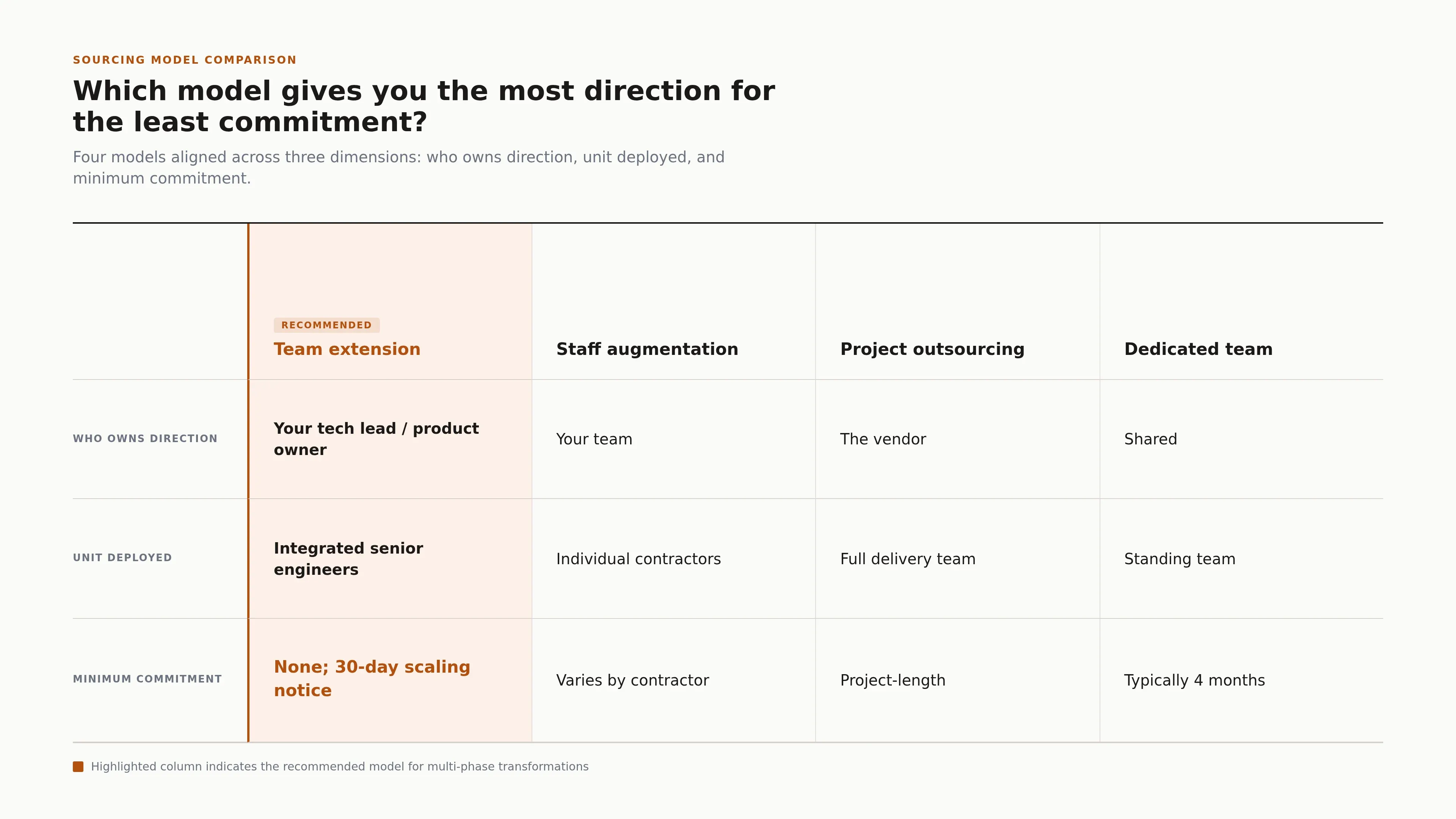
| Model | Who owns direction | Unit deployed | Minimum commitment |
|---|---|---|---|
| Team extension | Your tech lead / product owner | Integrated senior engineers | None; 30-day scaling notice |
| Staff augmentation | Your team | Individual contractors | Varies by contractor |
| Project outsourcing | The vendor | Full delivery team | Project-length |
| Dedicated team | Shared | Standing team | Typically 4 months |
easy.bi structures its Team Extension engagements exactly this way — senior engineers in the same time zone, embedded in your team on a Time & Material basis.
How Do You Architect a Hybrid Onshore-Offshore Team?
Architect a hybrid team by keeping a permanent onshore core that owns direction — product owners, architects, and tech leads — and adding extended engineers who own execution. The core holds product accountability and architectural authority; the extended engineers build against it. Clear ownership boundaries between the two layers are what keep the model coherent.
Onshore ownership and decision-making
The onshore core is where product decisions, architectural direction, and daily technical steering stay. This mirrors the onshore-offshore hybrid model in agile development, where an onshore team at the client site drives requirements while distributed engineers handle build-out. Your Product Owner or Tech Lead sets priorities; nothing about extension moves accountability offshore.
Offshore execution and technical depth
Extended engineers take that direction and turn it into shipped software, working from your backlog and your tooling. When a phase needs a full custom platform build rather than added hands, that execution layer pairs naturally with a delivery capability like easy.bi's Custom Solutions practice, which brings architecture and end-to-end delivery alongside the embedded engineers.
Ownership boundaries and accountability
The failure mode here is ambiguity about who decides what. Extended engineers report to your leads for technical direction, while the nearshore partner retains HR, payroll, and quality assurance — a split that has to be explicit from day one. We treat this in depth in our guide to setting clear ownership boundaries for extended engineers.
What Should You Look For in a Team Extension Partner?
Look for technical fit, engineer seniority, integration capability, reliability, and organizational alignment — the criteria multi-criteria vendor evaluation frameworks consistently surface. For team extension specifically, weight seniority and integration ability heavily, and verify how the partner handles worker classification, because misclassification is a real and quantifiable procurement risk you can measure.
Formal multi-criteria vendor selection frameworks such as AHP and ANP exist precisely because these criteria interact — a partner strong on technical fit but weak on integration will still stall your sprints. When you evaluate for a transformation program, translate each criterion into a concrete question:
- Seniority: Are the engineers genuinely 10+ years in, able to take context rather than needing training?
- Integration capability: Can they adopt your tools, ceremonies, and Definition of Done rather than imposing their own process?
- Reliability and alignment: Do they work in your time zone, and do their delivery values match yours?
- Compliance posture: How is worker classification handled?
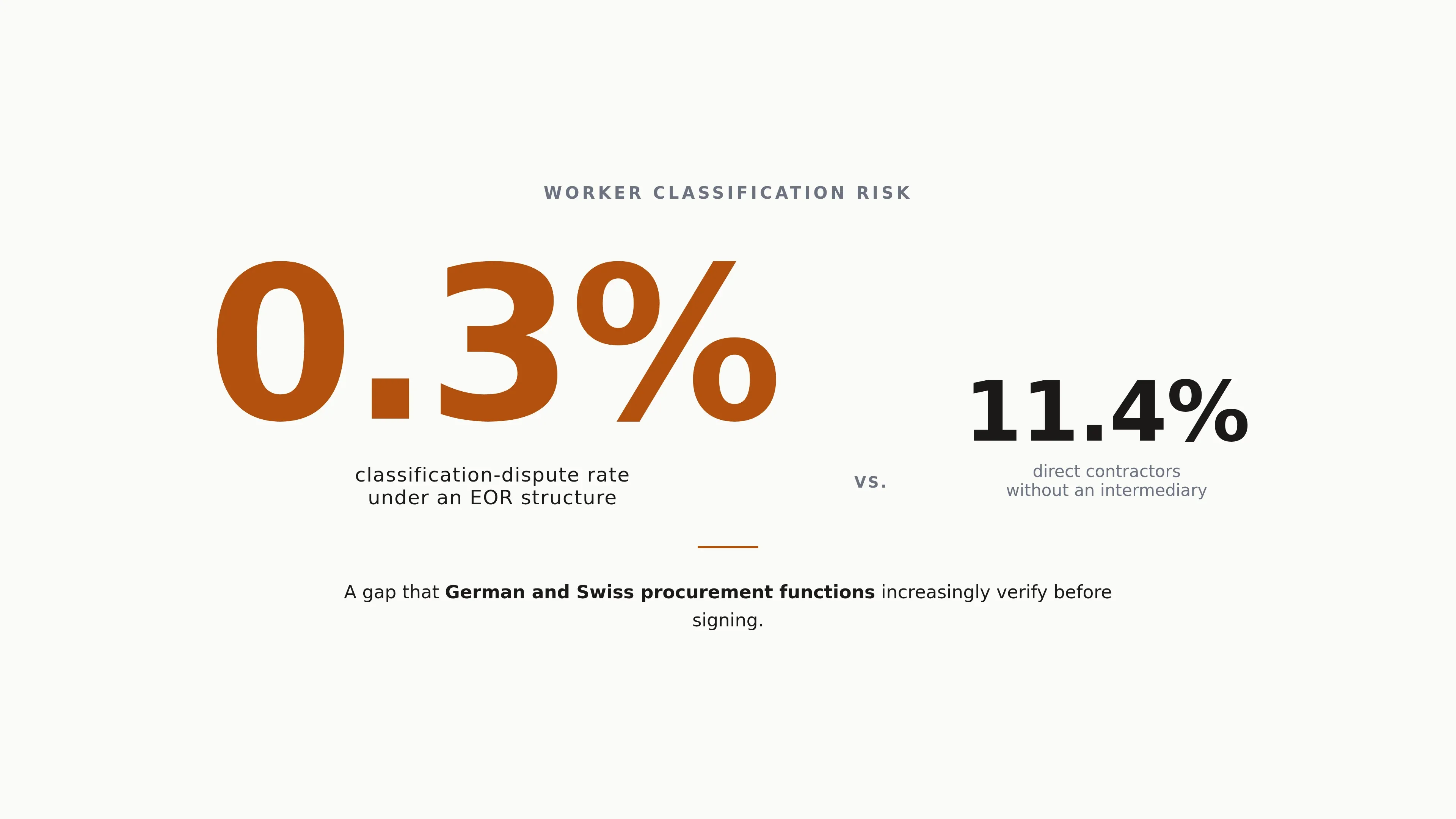
That last point carries measurable weight. Research cited across the nearshoring market puts the classification-dispute rate for direct contractors without an employer-of-record intermediary at 11.4%, versus 0.3% when an EOR structure is in place — a gap that German and Swiss procurement functions increasingly verify before signing. A partner like easy.bi that embeds senior, in-region engineers under a clear contractual structure removes most of that exposure before it reaches your legal team.
How Do You Onboard Extended Engineers in 7–14 Days?
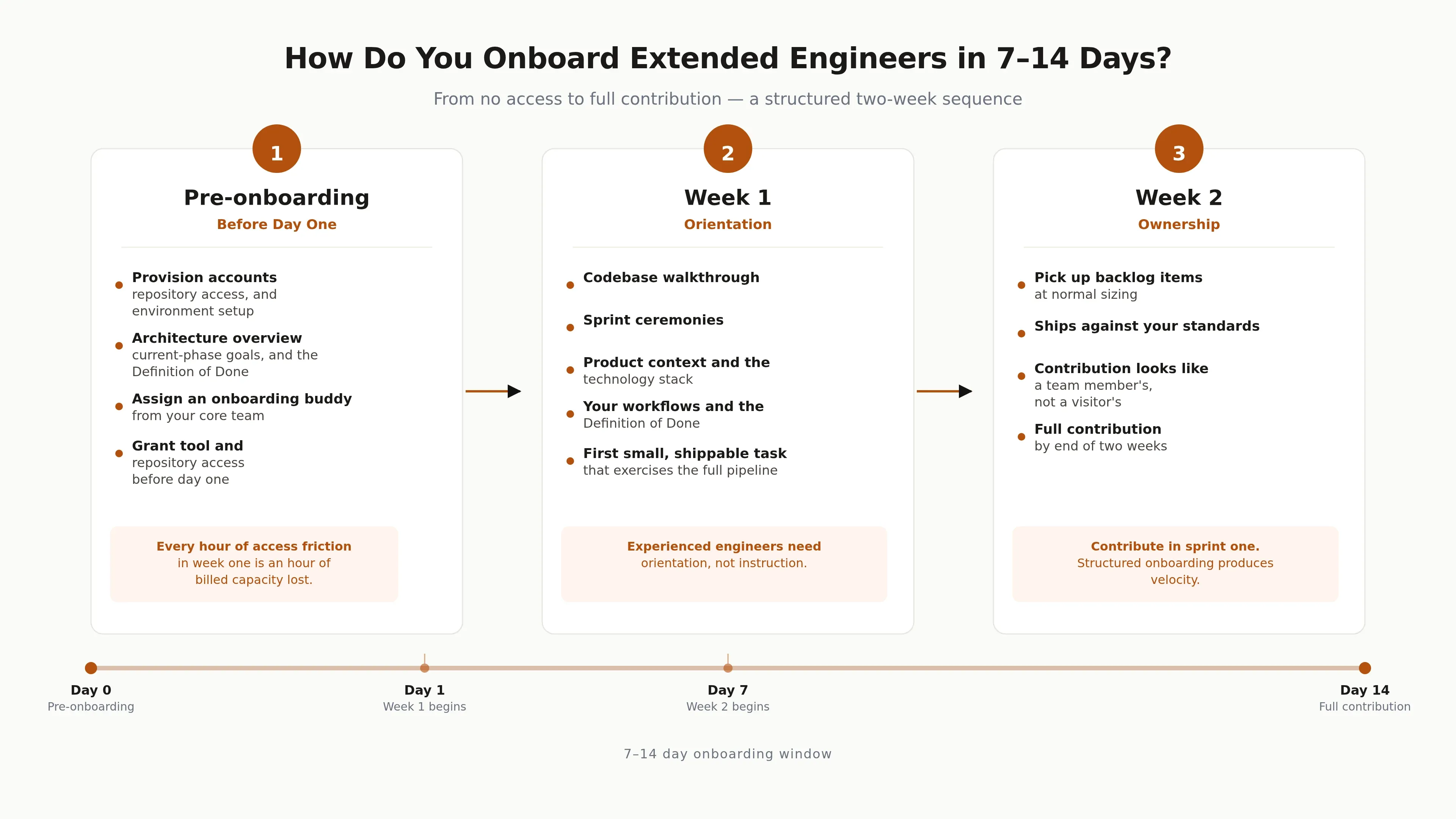
Onboard extended engineers in 7 to 14 days by front-loading the setup: grant tool and repository access before day one, assign an onboarding buddy from your core team, and structure the first two weeks around product context, the technology stack, your workflows, and the Definition of Done. Experienced engineers need orientation, not instruction.
Onboarding quality is not optional overhead — deliberate onboarding design in digital work settings is what separates engineers who contribute in sprint one from those who churn. Unstructured remote starts produce frustration and turnover; structured ones produce velocity. Design the two weeks explicitly.
Pre-onboarding: prepare before day one
Provision accounts, repository access, and environment setup before the engineer joins, and pull together a short context pack — architecture overview, current-phase goals, and the Definition of Done. Every hour of access friction in week one is an hour of billed capacity lost.
Week 1 and week 2 milestones
Week one targets orientation: the codebase walkthrough, the sprint ceremonies, and a first small, shippable task that exercises the full pipeline. Week two targets ownership: the engineer picks up backlog items at normal sizing and ships against your standards. By the end of the two weeks, contribution should look like a team member's, not a visitor's.
Siemens, Lekkerland, WeberHaus chose us
One integrated partner. Three core competencies. From insight to production, with no handover gaps.
Start with a Strategy CallManaging Distributed Teams Across Transformation Phases
Manage distributed teams across transformation phases by investing in trust, shared ceremonies, and clear performance indicators. Trust and knowledge sharing are the central drivers of virtual team effectiveness, so build them deliberately through consistent standups, transparent metrics, and same-time-zone overlap that lets collaboration happen in real time rather than over handoffs.
The evidence is direct: trust and knowledge sharing in virtual teams are what determine whether distributed work succeeds, and organizations can lift performance through intentional onboarding, training, and the right collaboration platforms. In a transformation program that runs across multiple phases, that trust compounds — engineers oriented well in phase one carry context into phase two.
Managing distributed software teams through transformation also means measuring the right things. Empirical work on distributed team performance indicators identifies signals that let you manage velocity and team health rather than guess at them — sprint throughput, cycle time, and review latency among them. Because extended engineers work in Central European Time alongside DACH clients, the daily overlap needed for standups and pairing is built in, not engineered around a twelve-hour gap.
As phases shift and the skill mix changes, revisit these indicators. A team that was healthy building the platform may need different signals — and different people — during the e-commerce cutover phase.
How Do You Preserve Knowledge Across Program Phases?
Preserve knowledge by documenting it as you go, not at handoff. Architecture Decision Records, runbooks, and process documentation turn what individual engineers know into institutional capability that survives team changes and phase transitions. Explicit knowledge-transfer processes are what keep capability in the organization when a given engineer rotates off.
This is where transformation programs either build lasting capability or leak it. Knowledge transformation and documentation in product development research shows that explicit documentation and structured transfer sustain skill retention and competitive advantage across distributed teams — and that undocumented knowledge quietly degrades the organization's ability to adapt.
Three artifacts do most of the work:
- Architecture Decision Records: capture why a choice was made, not just what was built, so the next phase's engineers inherit the reasoning.
- Runbooks: document how systems are operated and recovered, so operational knowledge doesn't live only in one engineer's head.
- Process documentation: record workflows and integration points so onboarding the next cohort stays a two-week exercise, not a two-month one.
Mature team extension treats this as standard practice rather than transactional contractor sourcing. The documentation an extended team produces is one of the durable assets the program leaves behind, independent of who wrote the code.
The fork this guide opened with — hire, outsource, or extend — resolves differently for every program, but for multi-phase digital transformation the case for team extension is strong: capacity in days rather than months, senior engineers who take direction from your leads, 30–50% lower cost than DACH domestic hiring, and knowledge that stays in the building through structured documentation.
The model only pays off when you run it deliberately — a permanent onshore core that owns direction, a rigorous 7-to-14-day onboarding path, distributed-team management grounded in trust and metrics, and documentation discipline that outlasts any single engineer. Get those right and you sustain delivery velocity across every phase of the program.
Frequently Asked Questions About Staffing Transformation Programs With Team Extension
How is team extension different from outsourcing or staff augmentation?
Team extension embeds senior engineers into your existing team, where they take daily technical direction from your leads and work within your sprint cadence, so you keep product accountability. Project outsourcing hands delivery ownership to the vendor, and staff augmentation supplies individual contractors rather than a cohesive, integrated team. The distinction matters most in transformation programs, where continuity and shared accountability across phases are non-negotiable.
How quickly can extended engineers become productive?
Integration typically begins within 14 business days, and productivity in the first sprint is realistic because the model targets engineers with 10 or more years of experience who need context rather than training. The key is a deliberate onboarding path: access provisioned before day one, and a structured first two weeks covering product context, the technology stack, and the Definition of Done. Unstructured onboarding, by contrast, produces frustration and turnover.
Why is Time & Material the standard billing model for team extension?
Team extension bills on a Time & Material basis (hourly, daily, or monthly) because engineers are integrated into your team and take direction from your leads rather than delivering a pre-scoped, fixed deliverable. Requirements in a multi-phase transformation evolve between phases, so paying for delivered work keeps the engagement aligned with actual priorities. It also supports flexible scaling on 30-day notice with no minimum engagement length.
What does team extension cost compared with hiring domestically in the DACH region?
Nearshore senior engineers typically bill €70–110 per hour, against Zurich and Geneva senior rates of CHF 180–280 per hour, a differential that can reach CHF 80,000–150,000 over a typical 14-to-20-week engagement. Overall, team extension runs 30–50% below DACH domestic labor rates while keeping Central European Time zone alignment, so the cost savings don't come at the expense of daily collaboration.
Research & Sources
Explore Other Topics
Ready to transform your business?
30-minute call with an engineering lead. No sales pitch - just honest answers about your project.
98% engineer retention · 14-day delivery sprints · No lock-in contracts
Related Reading

What is digital transformation?
Learn how to achieve digital transformation in your company to stay competitive.
Andrej Lovsin
6 digital transformation models you can choose from
Embrace digital transformation to enhance competitiveness by streamlining processes and operations, ensuring business agility and efficiency.
Andrej Lovsin
How to implement digital transformation to your company?
Digital transformation boosts competitiveness by streamlining processes and operations, ensuring businesses stay ahead in a digital-first market.
Andrej Lovsin