
Nearshore Team Extension: Solving the DACH IT Talent Shortage

Table of Contents+
- How big is the IT talent shortage in Germany and DACH?
- Why did nearshore team extension emerge as the strategic response?
- Do distributed teams actually deliver?
- What makes nearshore team extension work?
- Measurable Outcomes: Speed, Cost, and Sustained Performance
- When does nearshore team extension make sense for your organization?
- Questions About Nearshore Team Extension
- Sources and Further Reading
TL;DR
How nearshore team extension solves the DACH IT talent shortage—senior engineers in days, at 30–50% lower cost, done right.
How nearshore team extension solves the DACH IT talent shortage—senior engineers in days, at 30–50% lower cost, done right.
Right now, more than 100,000 tech roles sit unfilled in Germany, the average vacancy takes 7.1 months to close, and 85% of companies report an ongoing shortage of software talent. For any technology leader with a digital roadmap due this quarter, those figures collapse into one hard fact: the engineers you need to ship on time are not available in your local market. That gap is exactly why nearshore team extension has moved from a cost-saving experiment to a boardroom capacity strategy across the DACH region.
The temptation is to treat the shortage as a rough patch—post the role, wait a little longer, pay a little more. But the cost of that bet compounds fast: every month a project stalls for lack of capacity is a month of blocked digital transformation, deferred revenue, and internal teams stretched past the point where they can absorb the next hire. Understanding why the shortage is structural—not a hiring cycle that will correct itself—changes what you should do about it.
How big is the IT talent shortage in Germany and DACH?
The IT talent shortage in Germany runs deep: over 100,000 tech roles sit unfilled, 85% of companies report a shortage, and the average position takes 7.1 months to fill. Across the DACH region, this is a structural, two-decade trend driven by labor market shifts—not a temporary hiring dip that patience will resolve.
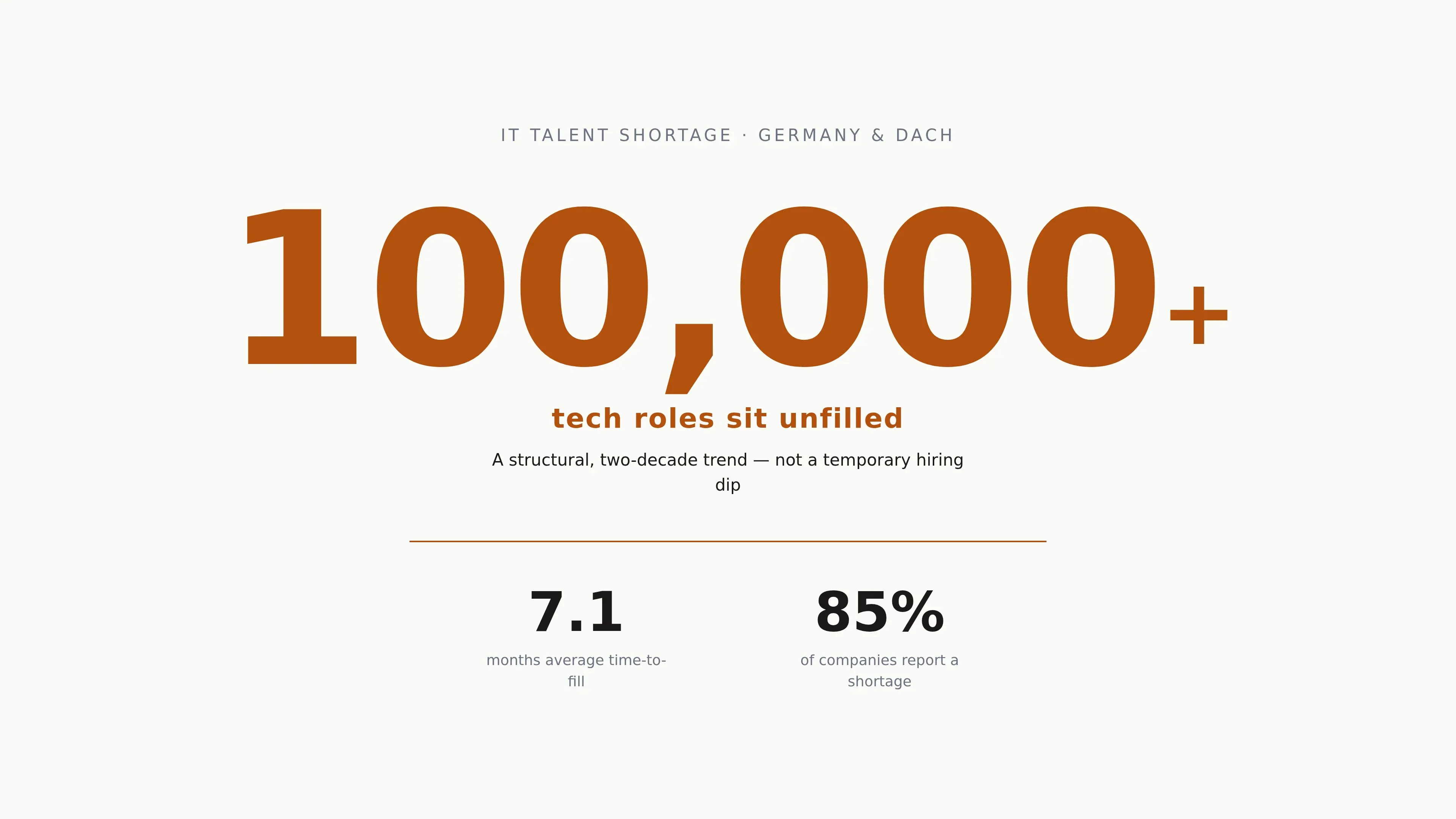
These numbers are not a blip on a hiring dashboard. Research on labor markets across Central and Eastern Europe documents shortages that have been building for two decades, driven primarily by the steady migration of skilled workers toward higher-wage Western European economies (DACH talent shortage scale and trends). The same forces that hollow out the talent pool at home are reshaping how DACH enterprises staff their engineering work.
Three structural forces compound the pressure, and none of them corrects on a hiring cycle:
- Migration of talent to Western Europe. Skilled engineers follow wages, and the flow has been consistent for years rather than seasonal.
- An aging workforce. Experienced engineers are retiring faster than domestic training pipelines replace them.
- Pandemic-accelerated digitalization. Demand for software engineering jumped sharply while the supply of engineers did not, widening a gap that was already open.
Consider what a 7.1-month average time-to-fill does to a project plan. A role opened in January is not productive until August—assuming the search succeeds on the first attempt, which the 85% shortage figure suggests it often will not. For a transformation program measured in quarters, that single vacancy can consume the entire timeline before a line of code ships.
The distinction matters for planning. A cyclical gap—the kind that opens in a hot market and closes in a downturn—rewards patience. A structural shortage punishes it: every quarter you wait for the market to loosen is a quarter your roadmap slips. If the model of embedding external engineers is new to you, our complete guide to team extension covers the fundamentals; here, the focus is on the DACH market forces that make it a necessity rather than an option.
See how enterprises modernize with one team.
Why did nearshore team extension emerge as the strategic response?
Nearshore team extension emerged because it resolves three constraints at once: traditional hiring takes 8–12 weeks your project timeline can't absorb, internal teams are already at capacity and can't serve as a recruiting source, and full outsourcing surrenders accountability. Embedding vetted senior engineers into your own team addresses all three simultaneously.
Start with the timeline math. When a project needs capacity now, an 8-to-12-week recruiting cycle is not a delay—it is a project risk. By the time a domestic hire signs, onboards, and reaches productivity, the window the capacity was meant to serve has often closed. Nearshore team extension compresses that to integration within roughly 14 business days, because the engineers are already senior and already available.
The second constraint is your own team. Overloaded internal engineers cannot double as a recruiting and mentoring pipeline; asking them to screen candidates while already at capacity simply moves the bottleneck. Team extension sidesteps this by bringing in experienced engineers who require context, not training.
The third is accountability. Classic project outsourcing hands the work to a vendor who owns delivery on their terms—and with it, control over quality, direction, and pace. Team extension keeps daily technical direction and product ownership with your leadership, while a nearshore partner such as easy.bi handles HR, payroll, and quality assurance behind the scenes.
Underneath all three sits the economics. Central Europe's roughly 1.5 million developers—including Poland's 600,000 programmers and the 80,000-plus STEM graduates entering the workforce each year—represent a deep, sustainable talent pool at 30–50% lower cost than DACH domestic rates, while operating in Central European Time. Those nearshore development benefits—cost, depth, and time-zone alignment—are what let the model resolve capacity pressure without the coordination tax of offshore arrangements. For a side-by-side on how the nearshore team extension cost profile compares with local recruitment, see our breakdown of nearshore team extension versus local hiring in DACH.
Do distributed teams actually deliver?
Yes—distributed teams deliver, and the research is clear about it. Empirical studies of agile software development in distributed projects show a measurably positive impact on team productivity compared with centralized approaches. The difference between high-performing and struggling distributed teams isn't location; it's deliberate onboarding, clear ownership, and documented process.

Agile methodologies hold up across distributed teams
The concern that distributed work weakens agile delivery does not survive contact with the evidence. An empirical study of agile testing in a distributed software development project found a highly positive impact on team productivity compared with centralized testing approaches (agile effectiveness in distributed environments). Standups, sprint planning, reviews, and retrospectives translate cleanly to distributed settings when the ceremonies are actually run.
Trust is the real performance driver
What separates a high-performing distributed team from a struggling one is rarely the technology. Research on virtual team effectiveness identifies trust and knowledge sharing as central drivers, and shows that organizations can lift performance deliberately through intentional onboarding, suitable training, and the right collaboration platforms (trust and knowledge sharing in virtual teams). Trust is not a personality trait you hope for; it is an outcome you design toward with transparent communication and shared ownership of results.
Time-zone overlap keeps collaboration synchronous
Distance is manageable; time difference is what breaks distributed teams. Because nearshore engineers in Central and Southeast Europe work in Central European Time, the working day overlaps almost entirely with DACH teams. That overlap is what makes real-time collaboration possible—same-day code review, live pairing, and standups that happen when everyone is actually online. It is also the single biggest practical advantage of managing distributed development teams nearshore rather than offshore.
What makes nearshore team extension work?
Nearshore team extension works when three things are deliberately engineered: structured onboarding, trust-building, and documented knowledge transfer. Skip any one and capacity leaks away—unstructured integration produces frustration, turnover, and wasted senior time. The engineers are ready; the difference between a productive engagement and a stalled one lives in how you bring them in.
Structured onboarding for senior engineers
The goal of onboarding here is context, not instruction. Team extension targets engineers with 10 or more years of experience—people who need to understand your product, stack, workflows, and Definition of Done, not to be taught how to build software. A deliberate 7-to-14-day onboarding covering exactly those areas is what gets a senior engineer to real contribution inside the first sprint.
The alternative is expensive. Research tracking resignations after remote onboarding at a large software organization found that carefully crafted, mentorship-anchored onboarding sustained retention, while ad-hoc integration drove frustration and departures in knowledge-intensive work (remote onboarding impact on retention and productivity). Every engineer who leaves takes their accumulated context with them.
Building trust and clear ownership
Trust follows structure. When ownership boundaries are explicit—who directs the work, who is accountable for what, how decisions get made—extended engineers integrate as team members rather than external contractors. Transparent communication and co-ownership of outcomes turn a group of individuals in different cities into one team working toward one Definition of Done.
Deliberate knowledge transfer
Capacity you can't retain isn't capacity—it's a rental. Mature engagements treat knowledge transfer as a first-class deliverable: documented architecture decisions, maintained runbooks, and process documentation that keep hard-won context inside the organization. Structured documentation and explicit transfer processes are what sustain skill retention and competitive advantage in distributed global teams (knowledge transfer and skill retention in distributed work). This is where easy.bi's structured discovery and documentation practices earn their keep on longer engagements.
Measurable Outcomes: Speed, Cost, and Sustained Performance
Success in nearshore team extension is measurable, not anecdotal. Track four indicators: time-to-full-productivity (target 2–3 weeks at 80–90% output), velocity gains from added capacity, cost savings of 30–50% versus local hiring, and retention across multi-sprint engagements. Defined metrics turn a staffing decision into a managed, accountable investment.
Time-to-full-productivity is the leading indicator. A senior engineer who reaches 80–90% output within two to three weeks confirms the onboarding worked; one still ramping at week six signals a context-transfer problem worth fixing immediately. Velocity gains then show whether the added capacity is translating into shipped work rather than coordination overhead.
Sustaining that performance across many sprints is its own discipline. Empirical work on distributed team management identifies specific performance indicators that enable better performance management and measurably improve productivity (distributed team performance indicators and management). Tracking the right signals—not just output, but retention and knowledge continuity—is what keeps a multi-sprint engagement healthy.
Cost savings are the most quoted number—30–50% below DACH domestic rates—but they only hold if productivity and retention hold. A cheap engineer who churns at month three, taking undocumented context with them, is more expensive than a domestic hire. This is why the metrics travel together: the nearshore team extension cost that matters is cost per productive engineer-week, not the headline hourly rate.
Siemens, Lekkerland, WeberHaus chose us
One integrated partner. Three core competencies. From insight to production, with no handover gaps.
Start with a Strategy CallWhen does nearshore team extension make sense for your organization?
Nearshore team extension makes sense when you have an urgent capacity gap, specific stack expertise you lack, established agile processes, and the ability to onboard someone well. It's the wrong tool when technical direction is unclear, processes are ad-hoc, or the work demands deep domain training only your organization can provide.
Run a quick self-assessment before you commit. The model fits when you can answer yes to most of these:
- Clear technical direction. A Product Owner or Tech Lead who can set daily direction and own outcomes.
- Established agile process. Sprints, ceremonies, and a real Definition of Done that a new engineer can plug into.
- Onboarding capability. Someone to run the 7-to-14-day context handoff—and documentation to hand off from.
- A genuine capacity or skills gap. Work that exists and is blocked on people, not on strategy.
It is the wrong choice in the mirror-image situations: no clear technical direction to plug engineers into, ad-hoc processes that give them nothing to integrate with, or a project whose value depends on domain knowledge so specific that transferring it would cost more than it saves. Naming those cases honestly is part of using the model well.
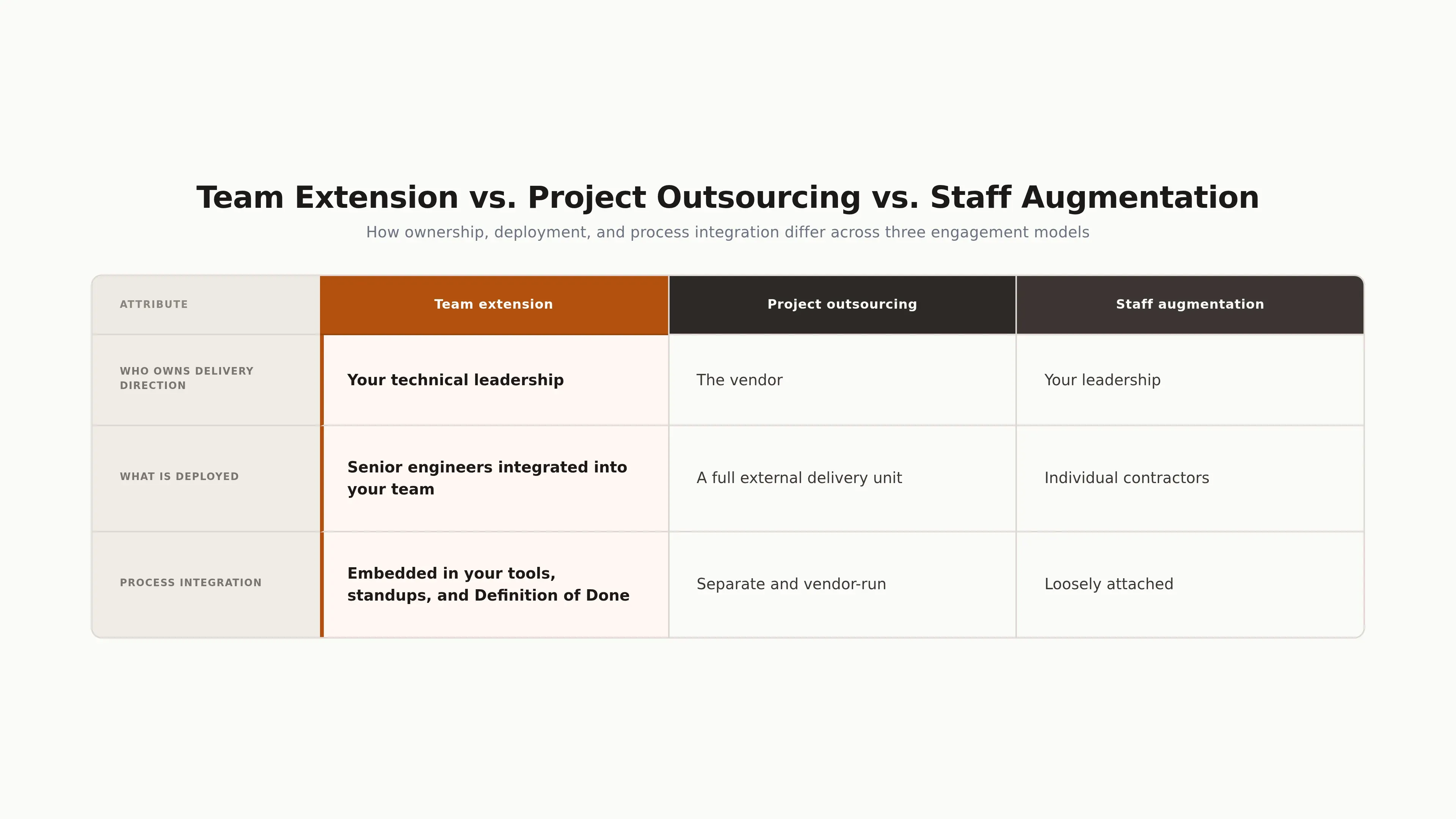
It also helps to be precise about what team extension is and isn't, because the label gets used loosely:
| Attribute | Team extension | Project outsourcing | Staff augmentation |
|---|---|---|---|
| Who owns delivery direction | Your technical leadership | The vendor | Your leadership |
| What is deployed | Senior engineers integrated into your team | A full external delivery unit | Individual contractors |
| Process integration | Embedded in your tools, standups, and Definition of Done | Separate and vendor-run | Loosely attached |
Where team extension shows its full value is inside larger programs. Enterprises running staffing for digital transformation programs face exactly the capacity constraints this article describes, and often pair extended engineering teams with dedicated build work such as custom software delivery to move a roadmap without waiting on the domestic hiring market.
The DACH IT talent shortage is not a storm to wait out—it is the weather. More than 100,000 unfilled roles, a 7.1-month average time-to-fill, and two decades of structural pressure mean the engineers your roadmap needs are unlikely to appear in your local market on your timeline. Nearshore team extension answers that reality directly: senior capacity in days, in your time zone, under your direction, at 30–50% lower cost—provided you bring structured onboarding, clear ownership, and documented knowledge transfer to the engagement.
The deciding factor is rarely the talent pool, which is deep and available. It is whether your organization is ready to integrate it well. Assess your onboarding capability, process clarity, and knowledge-transfer infrastructure honestly—those foundations, more than the contract, determine whether extended capacity turns into shipped software.
Questions About Nearshore Team Extension
What is the difference between nearshore team extension and outsourcing?
Nearshore team extension embeds vetted senior engineers directly into your existing team, where they use your tools, join your standups, and report to your Product Owner or Tech Lead—your leadership keeps daily technical direction and product accountability. Project outsourcing is different: the vendor owns delivery on their terms. Team extension also differs from staff augmentation, which supplies individual contractors rather than engineers integrated as a cohesive part of your team.
How much does nearshore team extension cost compared to hiring locally in DACH?
Nearshore team extension typically runs 30–50% below DACH domestic rates, because Central and Eastern European engineering talent is deep and less expensive while still operating in Central European Time. The more useful figure, though, is cost per productive engineer-week rather than the headline hourly rate: a senior engineer who reaches full productivity in two to three weeks and stays through the engagement is what makes the saving real.
How quickly can extended engineers become productive?
Integration typically begins within about 14 business days, and a well-onboarded senior engineer reaches 80–90% output within two to three weeks. That speed depends on structured onboarding: 7 to 14 days of deliberate context on your product, stack, workflows, and Definition of Done. The model targets engineers with 10 or more years of experience who need context, not training—so onboarding transfers knowledge rather than teaching fundamentals.
Do distributed teams really deliver as reliably as co-located ones?
Yes. Empirical research on agile software development in distributed projects shows measurably positive impacts on team productivity, and studies of virtual teams identify trust and knowledge sharing as the central drivers of effectiveness. The reliable performers aren't defined by location; they run their agile ceremonies properly, keep clear ownership boundaries, and document their processes. Central European Time-zone overlap with DACH teams makes day-to-day collaboration genuinely synchronous.
Sources and Further Reading
Explore Other Topics
Ready to transform your business?
30-minute call with an engineering lead. No sales pitch - just honest answers about your project.
98% engineer retention · 14-day delivery sprints · No lock-in contracts
Related Reading

Team Extension Readiness Checklist: 12 Questions to Ask Your Organization Before You Scale
Team extension preparation in 12 questions: score your technical, process, and leadership readiness before you embed external engineers.
Andrej Lovsin
Team Extension: The Complete Guide to Scaling Engineering Capacity Without Hiring
Team extension adds senior nearshore engineers to your DACH team in days, not months. See how the model, costs, and integration compare.
Andrej Lovsin
How to Onboard Nearshore Engineers Into Your Agile Team
Learn how to onboard nearshore engineers in 7–14 days with a week-by-week system for tool access, first PRs, agile ceremonies, and success metrics.
Andrej Lovsin