
Nearshore Software Developers vs. Hiring Locally in DACH: Cost, Speed, and Outcomes Compared

Table of Contents+
- Why Does Local Hiring in DACH Stall Software Projects?
- Total Cost Comparison: Nearshore vs. Local Hiring in 2026
- How Fast Can Each Model Deliver Productive Engineers?
- Can Distributed Teams Outperform Local Teams? What Research Shows
- When Should You Choose Nearshore, and When Should You Hire Locally?
- What Should You Look For in a Nearshore Team Extension Partner?
- Common Questions
- Research & Citations
TL;DR
Nearshore software developers vs hiring locally in DACH: compare real 2026 cost, 7-14 day onboarding speed, and outcomes to pick the right capacity model.
Nearshore software developers vs hiring locally in DACH: compare real 2026 cost, 7-14 day onboarding speed, and outcomes to pick the right capacity model.
When a project timeline outruns your engineering capacity, two options dominate the shortlist: bringing on nearshore software developers vs hiring locally in the DACH market. Both are recommended for the same goal — putting enough senior engineering hands on the work to ship on schedule. But they reach that goal along very different routes, and the route you pick shapes your cost, your calendar, and your control over the outcome.
That is where the tension bites. Choose local hiring and you may wait six to nine months for a seat to fill while the launch window closes; choose nearshore and you trade a familiar hiring process for a distributed one you have to integrate deliberately. Pick the wrong model for your situation and you do not just overpay — you lose a quarter or two of delivery you cannot get back. This comparison breaks down cost, speed, integration, and fit so you can match the model to the project instead of guessing.
Why Does Local Hiring in DACH Stall Software Projects?
Local hiring stalls DACH software projects because qualified engineers are not available fast enough. Germany alone carries more than 149,000 unfilled IT specialist roles, and filling an experienced senior developer seat averages six to nine months from job posting to first productive sprint — a bottleneck rooted in a region-wide talent shortage.
The shortage is not a German quirk. Across Central and Eastern Europe, sustained worker migration to Western Europe has thinned domestic talent pools, and the same pressure shapes recruitment in Austria and Switzerland. For German-speaking employers, that translates into premium salaries, drawn-out recruitment cycles, and competition for a candidate pool that every other digitalization project is chasing at the same time.
Three frictions compound the delay. Recruitment cycles for specialized stack expertise routinely exceed eight to twelve weeks before an offer is even signed. Internal teams are already overloaded, so they cannot double as a recruiting bench. And each external hire arrives with onboarding overhead that pushes real productivity further out. The result is an IT talent shortage that nearshore solutions address structurally, not just tactically — by widening the pool rather than fighting over the same scarce local candidates.
Switzerland sits at the sharp end of this. Senior engineer rates in Zurich and Geneva run high, so the wait costs more per week than in Germany or Austria. Wherever you sit in DACH, the underlying arithmetic is the same: every month a role stays open is a month of delivery the business does not get. If you are new to the alternative, our complete guide to scaling engineering capacity without hiring covers the fundamentals this comparison builds on.
See how enterprises modernize with one team.
Total Cost Comparison: Nearshore vs. Local Hiring in 2026
On a fully loaded basis, nearshore developer staffing costs 30-50% less than local DACH hiring. Nearshore senior engineers bill roughly €55-90 per hour against €95-145 for domestic hires — and that gap widens once recruiting fees, onboarding time, and ramp-up overhead enter the local column.
Hourly rate alone misleads because it ignores the one-time and hidden costs only the local path carries. A single senior recruitment can run €15,000-25,000 in agency fees before the engineer writes a line of code, and months of salary accrue during ramp-up. Nearshore team extension cost, by contrast, is transparent Time and Material — you pay for productive hours from the second week, not for a vacant recruitment cycle.
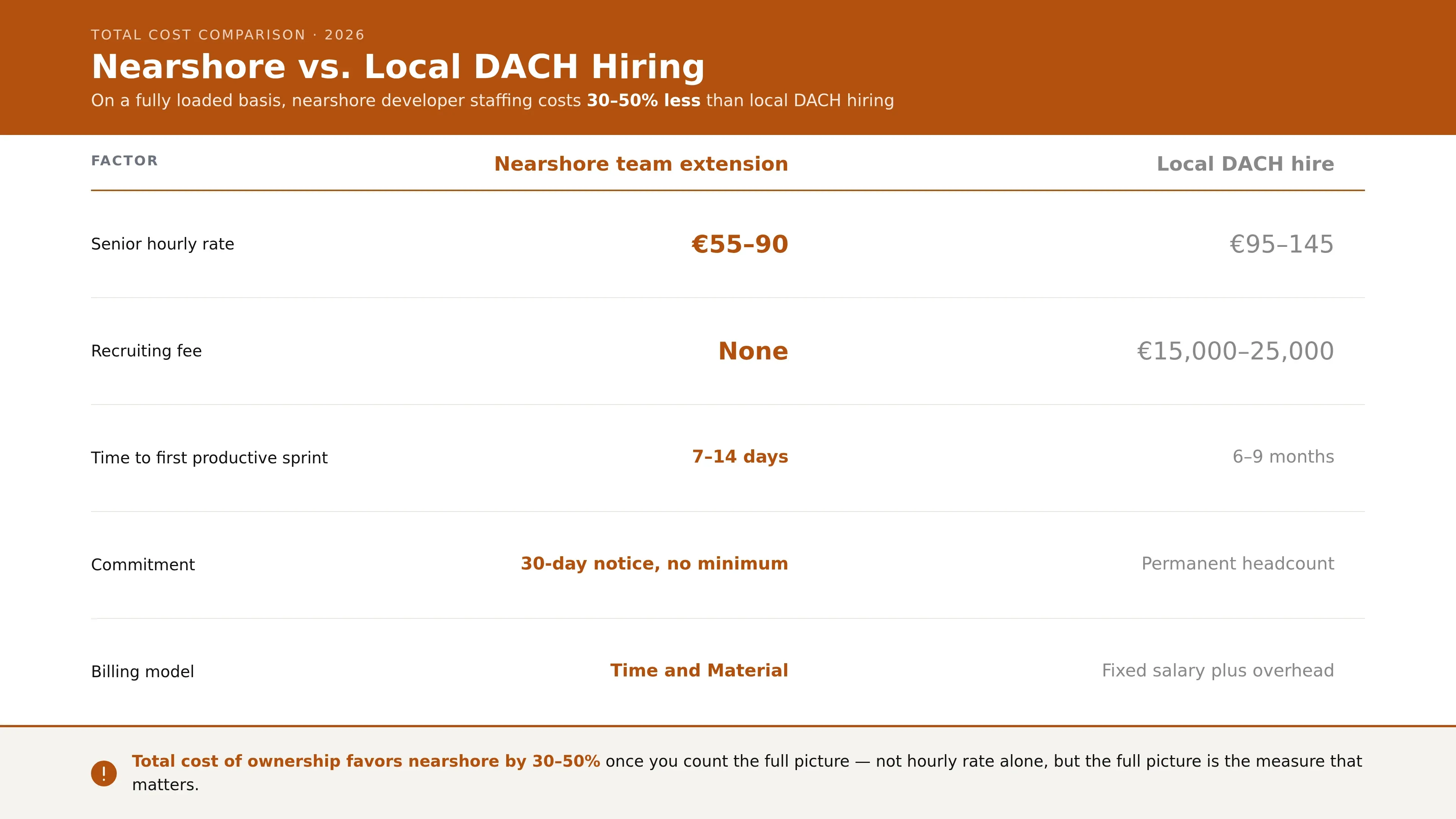
| Factor | Nearshore team extension | Local DACH hire |
|---|---|---|
| Senior hourly rate | €55-90 | €95-145 |
| Recruiting fee | None | €15,000-25,000 |
| Time to first productive sprint | 7-14 days | 6-9 months |
| Commitment | 30-day notice, no minimum | Permanent headcount |
| Billing model | Time and Material | Fixed salary plus overhead |
The commitment row matters as much as the rate. Permanent headcount is a fixed cost that stays on the books whether the project is peaking or winding down. Nearshore team extension scales with a 30-day notice and no minimum engagement length, so you flex capacity to the phase of work rather than carrying it year-round.
The takeaway is not that nearshore is always cheaper per hour — it is that total cost of ownership favors it by 30-50% once you count the full picture. That structural advantage is what makes the model the default answer to the DACH IT talent shortage, where domestic wage pressure shows no sign of easing.
How Fast Can Each Model Deliver Productive Engineers?
Nearshore team extension puts productive engineers on your sprint in 7-14 business days; local DACH hiring averages six to nine months from posting to first productive sprint. That gap is the difference between shipping this quarter and watching a launch window close while recruitment grinds through its stages.
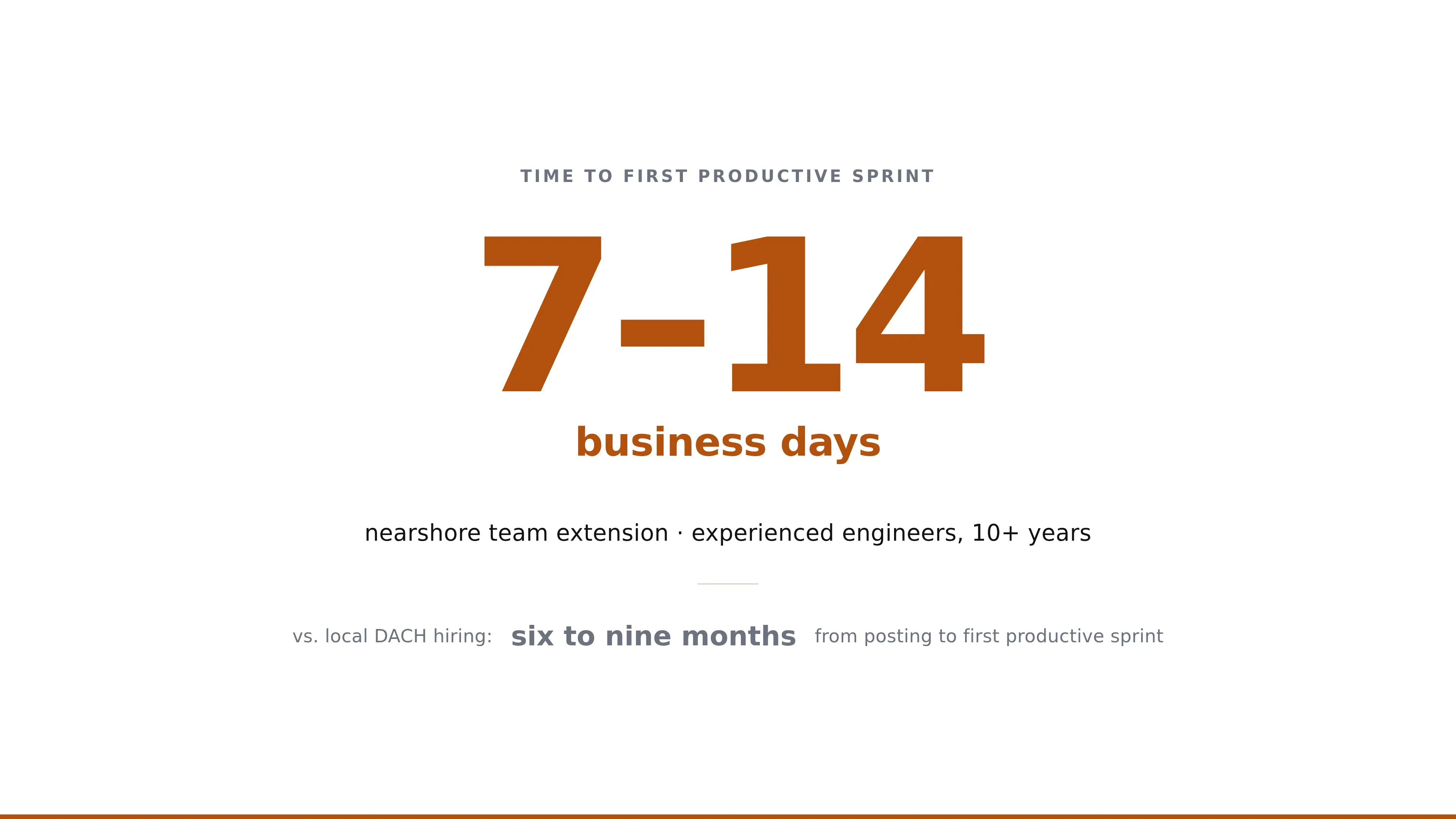
The speed comes from where the model starts. Team extension targets experienced engineers — typically 10+ years — who need context, not training. Structured onboarding in the first two weeks walks them through product context, the technology stack, team workflows, and a clear Definition of Done, so their first sprint is genuinely productive rather than exploratory. The onboarding is deliberate by design; that is what makes 7-14 days realistic rather than optimistic.
Time-zone alignment protects that speed day to day. Central and Eastern European teams operate in Central European Time, so standups, code reviews, and sprint ceremonies happen in real time rather than across an overnight lag. For developer staffing across nearshore Europe, that overlap is what keeps an embedded engineer functioning as a team member instead of a remote handoff you brief once a day.
Put the two timelines side by side and the competitive cost of waiting becomes concrete. Six to nine months of local recruitment is two or three full delivery quarters a nearshore team would already have shipped — and in a market where competitors are digitalizing on the same clock, that is time you rarely get to make back.
Can Distributed Teams Outperform Local Teams? What Research Shows
Distributed teams perform on par with co-located teams when onboarding is structured deliberately. Research on agile methods in distributed software projects reports positive productivity effects, and virtual-team studies find that trust and knowledge sharing — not physical proximity — are the real drivers of effectiveness.

The evidence is consistent. Empirical work on agile testing in distributed software development shows a positive impact on team productivity compared with centralized approaches, and studies of virtual team effectiveness place trust and knowledge sharing at the center of performance. Distance, in other words, is not the variable that decides output.
The variable that does decide it is onboarding. Unstructured remote onboarding leads to frustration and turnover in knowledge-intensive organizations, which is why deliberate onboarding design for distributed teams matters so much. Documented architecture decisions, preserved runbooks, and clear ownership boundaries turn an embedded engineer into a durable contributor rather than a transactional resource who leaves no trace behind.
Performance is also measurable. Distributed team management research identifies specific indicators that let you manage an embedded engineer's contribution as rigorously as a local hire's — velocity, review turnaround, and defect rates read the same regardless of where the engineer sits. When you are ready to bring people on, our walkthrough on onboarding nearshore engineers into your agile team turns these findings into a repeatable process.
When Should You Choose Nearshore, and When Should You Hire Locally?
Choose nearshore when speed matters, the budget is constrained, and specialized talent is scarce. Hire locally when you are building core intellectual property, team permanence is essential, or the work demands daily onsite presence. Most DACH enterprises land on a blend: nearshore for capacity, local for the strategic core.
Team extension vs hiring locally in DACH is not a binary loyalty test — it is a fit question. The two models answer different needs, and forcing one to do the other's job is where budgets and timelines slip.
Nearshore team extension fits when:
- A project timeline outruns your current capacity and you need senior hands within weeks.
- The budget rewards a 30-50% lower fully loaded cost.
- The stack expertise you need is scarce or premium-priced in the local market.
- You want phase-dependent scaling without permanent headcount, on a 30-day notice.
Local hiring fits when:
- The role sits on core, long-lived intellectual property you want held in-house permanently.
- The work requires constant onsite presence or deep, tacit domain immersion.
- The position is foundational to team culture rather than capacity-driven.
One distinction keeps the decision honest: team extension is not outsourcing. Your Product Owner or Tech Lead keeps daily technical direction and product accountability, while the partner handles HR, payroll, and quality assurance. That is the model easy.bi's Team Extension service is built around — senior engineers embedded in your existing sprints, working in your time zone, under your direction.
Siemens, Lekkerland, WeberHaus chose us
One integrated partner. Three core competencies. From insight to production, with no handover gaps.
Start with a Strategy CallWhat Should You Look For in a Nearshore Team Extension Partner?
Evaluate a nearshore partner on four criteria: engineer seniority (10+ years, context-ready), CET time-zone overlap, a documented EU compliance track record, and client retention as a proxy for engagement quality. These separate a genuine team-extension partner from transactional contractor sourcing that stops at filling a seat.
Structured vendor evaluation is not guesswork. Multi-criteria decision frameworks — AHP, Fuzzy AHP, ANP — formalize how to weigh technical fit, availability, reliability, integration capability, and organizational alignment against each other rather than defaulting to the lowest rate. Apply that same discipline to a staffing partner, and the cheapest option rarely comes out on top.
For DACH buyers, EU compliance is non-negotiable. Engineers hosted within the EU keep data handling inside the same regulatory perimeter under GDPR, with none of the data-transfer overhead an offshore arrangement introduces. Ask a prospective partner to show, not assert, its compliance track record — documented, auditable, and specific to the German-speaking market.
Seniority and retention do the rest of the filtering. Experienced engineers who need context rather than training are the ones productive in a first sprint, and a partner's client retention rate is the honest signal of whether its engagements actually deliver. easy.bi structures its work on exactly these terms — experienced engineers, CET alignment, and EU-hosted infrastructure — and the same principles apply if you decide to build a custom platform and need the engineering depth to execute it.
Nearshore software developers vs hiring locally is not a contest with a single winner — it is a fit decision. Nearshore team extension wins on speed and cost, delivering senior engineers in 7-14 days at 30-50% lower fully loaded cost. Local hiring wins on permanence and onsite depth for core IP. The strongest DACH programs use both deliberately: nearshore to accelerate capacity now, local to hold the strategic core.
The one factor that decides whether either model delivers is structured onboarding. The research is clear that distributed teams match co-located ones only when integration is designed on purpose — so whichever model you choose, invest in the first two weeks.
Common Questions
How much cheaper is nearshore team extension than hiring locally in DACH?
Nearshore team extension typically costs 30-50% less than local DACH hiring on a fully loaded basis. Senior engineers bill around €55-90 per hour versus €95-145 for domestic hires, and the gap widens once you add local recruiting fees of €15,000-25,000, months of ramp-up salary, and onboarding overhead. Time and Material billing means you pay for productive hours, not for a vacant recruitment cycle.
How quickly can nearshore developers start working on my project?
Nearshore team extension integrates experienced engineers within 7-14 business days, compared with six to nine months for a typical local DACH hire. The speed comes from targeting engineers with 10+ years of experience who need context rather than training, plus structured onboarding covering product context, the technology stack, team workflows, and a clear Definition of Done in the first two weeks.
Do distributed nearshore teams perform as well as local in-house teams?
Yes, when onboarding is structured. Research on agile methods in distributed software projects reports positive productivity effects, and virtual-team studies find that trust and knowledge sharing — not physical proximity — drive effectiveness. The deciding factor is deliberate onboarding design: unstructured remote onboarding causes frustration and turnover, while documented decisions and clear ownership boundaries let distributed engineers match co-located teams.
What is the difference between team extension and outsourcing?
Team extension embeds vetted senior engineers into your existing team, where they use your tools, attend your ceremonies, and report to your Product Owner or Tech Lead — your leadership keeps daily technical direction and product accountability. The nearshore partner handles HR, payroll, and quality assurance. Outsourcing, by contrast, hands the vendor ownership of delivery. Team extension keeps control in-house; outsourcing transfers it.
Research & Citations
Explore Other Topics
Ready to transform your business?
30-minute call with an engineering lead. No sales pitch - just honest answers about your project.
98% engineer retention · 14-day delivery sprints · No lock-in contracts
Related Reading

Nearshore Team Extension: Solving the DACH IT Talent Shortage
How nearshore team extension solves the DACH IT talent shortage—senior engineers in days, at 30–50% lower cost, done right.
Andrej Lovsin
How Can Software as a Service Transform Cost Management in IT Projects?
Explore SaaS benefits in IT cost management, offering flexibility, scalability, and transparency to enhance and optimize project strategies effectively.
Andrej Lovsin
How to Onboard Nearshore Engineers Into Your Agile Team
Learn how to onboard nearshore engineers in 7–14 days with a week-by-week system for tool access, first PRs, agile ceremonies, and success metrics.
Andrej Lovsin