
Building Custom Software That Doesn't Fail: A CTO's Framework

Table of Contents+
- Why Do 66% of Custom Software Projects Fail?
- The Discovery Phase: Where Winners Separate From Losers
- API-First, Cloud-Native: Architecture Decisions That Compound
- How Should You Choose Your Tech Stack?
- Performance Scrum: Delivery in 14-Day Cycles
- Managing Technical Debt Before It Manages You
- How Do You Avoid Vendor Lock-In?
- Team Structure: Small Squads, Big Results
- What Does a Successful Custom Software Project Look Like?
- The CTO's Pre-Build Checklist
- From Framework to Execution
- References
TL;DR
Two out of three custom software projects fail to meet their objectives - over budget, behind schedule, or delivering less value than planned.
Key Takeaways
- •66% of custom software projects fail or are challenged - the root cause is almost always poor discovery and unclear requirements, not bad code.
- •API-first, cloud-native architecture decisions made in week 1 compound over the life of a product. Companies that adopt API strategies grow revenue 38% faster.
- •14-day sprint cycles with working deployments deliver 40% more features per quarter than 4-week cycles and eliminate big-bang launch risk.
- •Technical debt consumes 41% of developer time on average. Teams that allocate 20% of sprint capacity to debt reduction maintain velocity long-term.
- •Small cross-functional teams of 5-9 people deliver the highest per-capita productivity. Larger teams see 50% lower output per person.
66% of custom software projects fail. This CTO's framework covers discovery, API-first architecture, tech stack selection, 14-day delivery cycles, and technical debt management to beat the odds.
Two out of three custom software projects fail to meet their objectives - over budget, behind schedule, or delivering less value than planned.
The difference between the 34% that succeed and the 66% that don't comes down to a repeatable framework: disciplined discovery, architecture decisions that reduce lock-in, a delivery cadence that forces transparency, and a team structure built for accountability.
This is not a theoretical exercise. After delivering 100+ custom software projects for companies like WeberHaus, Siemens, and Lekkerland, we have seen every failure pattern and every success pattern.
This article distills those patterns into a framework that any CTO can apply - whether you are building with an internal team or selecting an external development partner.
Why Do 66% of Custom Software Projects Fail?
Most custom software failures trace back to decisions made (or avoided) in the first 4 weeks.
The Standish Group CHAOS Report puts it clearly: only 34% of software projects are considered successful, while the rest exceed budget, miss deadlines, or deliver fewer features than promised.[1] The root causes are structural, not technical.
Large IT projects run 45% over budget and 7% over time, while delivering 56% less value than predicted.[2] That's not a rounding error. That's a systemic problem with how organizations approach custom software development.
The failure modes fall into predictable categories:
- Requirements amnesia: The discovery phase is rushed or skipped. Business rules that live in someone's head never get documented. Six months into development, the team discovers a critical workflow that invalidates the architecture.
- Architecture tourism: Teams choose technologies because they're trending on Hacker News, not because they solve the actual business problem. Microservices for a 3-person team. Kubernetes for an app that serves 500 users.
- Delivery theater: The team runs "agile" ceremonies - standups, retros, sprint reviews - but never ships working software to production. Twelve months pass before stakeholders see something real.
- Vendor roulette: One agency handles UX, another does backend, a third manages infrastructure. Nobody owns the outcome. Every integration point becomes a blame game.
Each of these patterns is preventable. The framework that follows addresses them in sequence.
See how we deliver 60% faster time-to-market with 40% lower TCO than off-the-shelf.
The Discovery Phase: Where Winners Separate From Losers
Projects with clear requirements upfront are 97% more likely to succeed than those without.[3] Discovery is not a bureaucratic formality. It is the single highest-leverage activity in the entire project lifecycle - the phase where you either set up success or encode failure into the project's DNA.
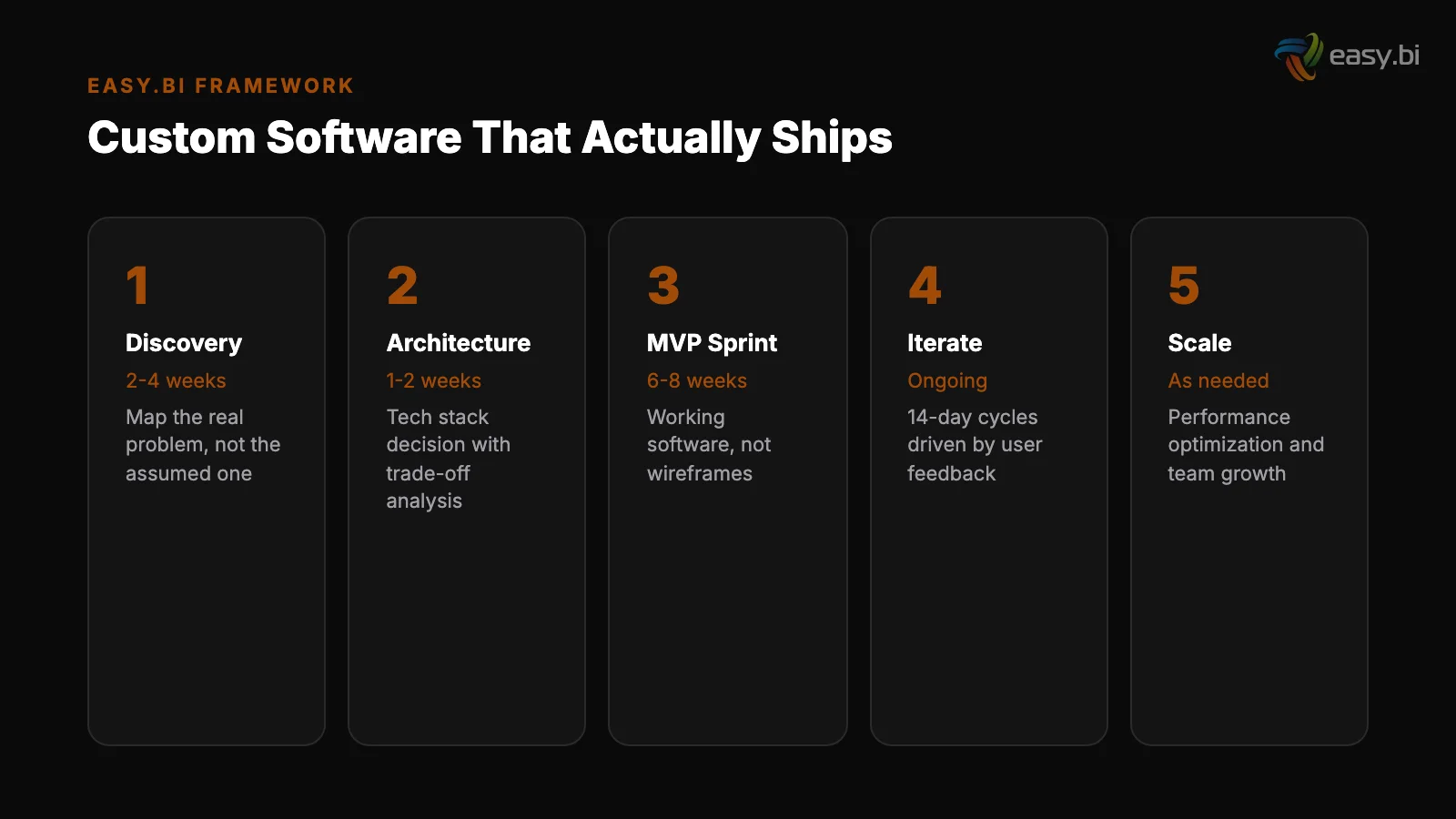
A proper discovery phase for custom software takes 2-4 weeks and produces four deliverables:
For a complete guide to running an effective discovery phase, see our dedicated article: The Discovery Phase That Saves You 6 Months.
1. Business process mapping
1. Business process mapping. Every workflow that the software needs to support, documented with inputs, outputs, decision points, and exception paths. This is where you find the 20% of business logic that will drive 80% of the complexity.
When we built the order processing system for WeberHaus, the discovery phase uncovered 47 distinct business rules around offline capability alone - rules that would have caused 3+ months of rework if discovered during development.
2. Integration inventory. A complete list of every system the software needs to communicate with: ERPs, CRMs, data warehouses, third-party APIs, legacy databases. For each integration, document the protocol (REST, SOAP, file transfer), data format, authentication method, and SLA requirements.
Lekkerland's SAP S/4HANA migration required mapping 23 integration endpoints before a single line of code was written.
3. Non-functional requirements. Performance targets, availability requirements, security constraints, compliance obligations (GDPR, industry-specific regulations), and scalability projections. These are the requirements that architects need to make infrastructure decisions. Skipping them is how you end up rebuilding the platform 18 months after launch.
2. Integration inventory
4. Success criteria in numbers. Not "improve efficiency" but "reduce order processing time from 12 minutes to 3 minutes." Not "better user experience" but "increase task completion rate from 62% to 85%." If you cannot define success in 3 measurable KPIs, you are not ready to build.
"57% of projects fail due to communication breakdown between business and technology stakeholders." - PMI Pulse of the Profession[4]
Discovery is also where you assess build vs. buy. Not every problem needs custom software. If 80% of your requirements match an off-the-shelf product, building custom is usually the wrong call.
Custom software is the right choice when your business logic is your competitive advantage - when the way you do things is fundamentally different from how your industry does them.
API-First, Cloud-Native: Architecture Decisions That Compound
Architecture decisions made in week 1 compound over the life of the product. API-first companies grow revenue 38% faster than those without an API strategy.[5] This is not coincidence - it's the compounding effect of decisions that enable flexibility versus decisions that encode rigidity.
Two architecture principles separate projects that scale from projects that stall:
API-first design
API-first design. Every capability of your system should be accessible through a well-documented API before you build a user interface. For a deeper technical treatment, see our article on API-First Architecture: Why Your Next Platform Should Start With the API.
This approach has three benefits: (1) your frontend and backend teams can work in parallel, cutting time-to-market; (2) every integration partner gets the same stable interface; (3) you can swap or rebuild the frontend without touching business logic.
When Siemens needed a unified UI library across multiple products, the API-first approach meant their Angular-based component library could serve any product team without backend changes.
Cloud-native by default. Cloud adoption in German enterprises reached 84% in 2024, with multi-cloud strategies growing 28% year-over-year.[6] Building for the cloud from day one - containerized services, infrastructure as code, horizontal scaling - means you avoid the costly "lift and shift" migration that hits teams who start on bare metal and outgrow it.
Cloud-native by default
Cloud-native does not mean "put everything in Kubernetes." It means designing your application as a set of loosely coupled services that can be deployed, scaled, and updated independently. For a mid-market application serving 10,000 users, that might mean 3-5 services running in Docker containers with a managed Kubernetes cluster.
For a smaller application, it might mean a well-structured monolith deployed to a container platform with room to extract services later.
| Architecture Decision | Short-Term Impact | Long-Term Impact (3+ Years) |
|---|---|---|
| API-first design | 10-15% more upfront design effort | 38% faster revenue growth, flexible integrations |
| Monolith-first (well-structured) | Fastest time-to-market for small teams | Extractable to services when scale demands it |
| Microservices from day 1 | 40% higher operational complexity | Best for large teams (20+) with clear domain boundaries |
| Infrastructure as Code | 2-3 days additional setup | 90% fewer configuration drift issues, reproducible environments |
| Containerization (Docker/K8s) | 1 week additional setup for CI/CD | Consistent dev/staging/prod environments, horizontal scaling |
The WeberHaus project demonstrates this compounding effect. The initial architecture - Angular frontend with Ionic for mobile, API-driven backend - was chosen specifically because WeberHaus needed full offline capability for construction site use.
That same API-first design later enabled integrations with their ERP system and third-party scheduling tools without modifying the core application.
How Should You Choose Your Tech Stack?
Tech stack selection is a business decision, not a technology beauty contest. The right stack balances four factors: team capability, ecosystem maturity, long-term maintainability, and hiring market depth. Picking the trending framework leads to abandoned projects. Picking the boring-but-proven stack leads to shipped products.
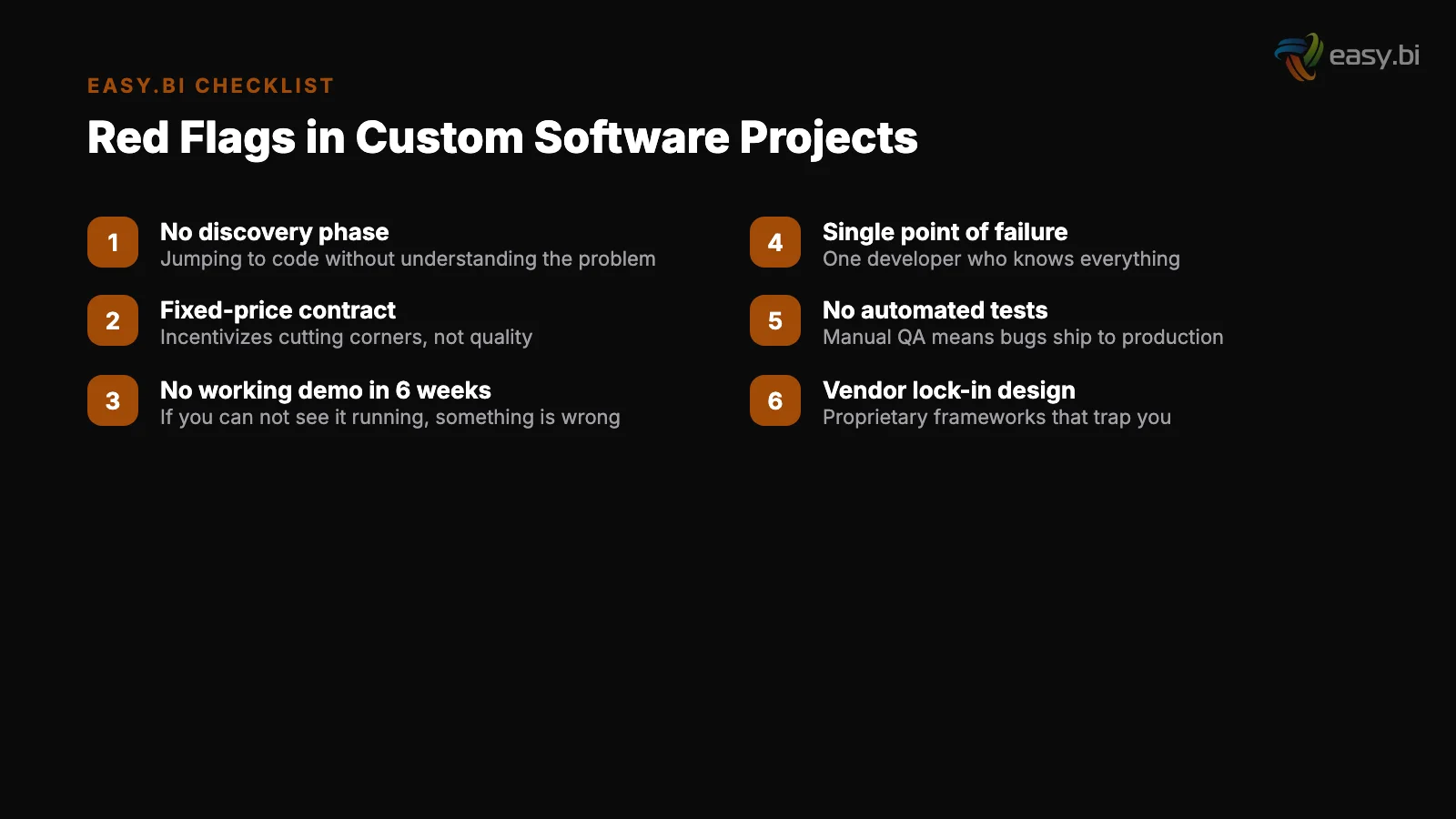
Here is a pragmatic breakdown based on project type:
Frontend: Angular for enterprise, React for product
Backend: PHP/Symfony or Python/Django for business applications. For a detailed case for PHP in enterprise contexts, see The Symfony Decision: When PHP Is the Right Enterprise Choice. PHP powers 77% of websites with known server-side languages.
Symfony, specifically, provides enterprise-grade structure: dependency injection, event-driven architecture, and a mature ecosystem of bundles for everything from PDF generation to message queuing. For data-heavy applications or those requiring ML capabilities, Python with Django or FastAPI is the stronger choice.
Java and Spring Boot remain the standard for high-throughput financial or transactional systems.
Frontend: Angular for enterprise, React for product. Angular's opinionated structure - built-in routing, state management, form handling, and testing utilities - makes it the right choice when you need consistency across a large team.
This is exactly why Siemens chose Angular for their unified UI library: when 50+ developers need to build components that look and behave the same way, Angular's conventions prevent the fragmentation that React's flexibility can produce.
React shines when you need faster iteration on consumer-facing products where design patterns change frequently.
CI/CD: Non-negotiable
Infrastructure: Kubernetes for scale, Docker Compose for simplicity. For a practical guide on cloud-native infrastructure for mid-market, see Cloud-Native From Day One: Kubernetes, Docker, and CI/CD for Mid-Market.
Kubernetes usage among professional developers reached 19% in 2023, up from 13% in 2021.[7] But Kubernetes adds operational overhead that small teams cannot afford.
If your team has fewer than 10 engineers and your application serves fewer than 100,000 users, Docker Compose with a managed container service (AWS ECS, Google Cloud Run) delivers 90% of the benefit at 20% of the operational cost.

CI/CD: Non-negotiable. Teams using CI/CD deploy 208x more frequently than those without.[8] Every custom software project should have automated build, test, and deployment pipelines from sprint 1. This is not a nice-to-have that you add later.
It is the foundation that makes everything else - code review, automated testing, incremental delivery - possible.
| Project Type | Recommended Backend | Recommended Frontend | Infrastructure |
|---|---|---|---|
| Business process automation | PHP/Symfony | Angular | Docker + managed K8s |
| Customer-facing product (SaaS) | Python/Django or Node.js | React + Next.js | Serverless + containers |
| Enterprise integration platform | Java/Spring Boot | Angular | Kubernetes |
| Data/ML application | Python/FastAPI | React | Kubernetes + GPU instances |
| Mobile-first application | PHP/Symfony or Node.js | Ionic (Angular) or React Native | Docker + CDN |
Performance Scrum: Delivery in 14-Day Cycles
Agile teams deliver software 60% faster and with 25% fewer defects than waterfall teams.
For a complete breakdown of how Performance Scrum works in practice, see Performance Scrum: How We Deliver Working Software Every 14 Days.[9] But "agile" as practiced by most organizations has become a cargo cult - standups without accountability, sprints without shippable increments, retrospectives without action items.
Performance Scrum is a methodology that restores the original promise: working software every 14 days, with measurable business outcomes.
Performance Scrum combines the governance structure of PRINCE2 with the delivery velocity of Scrum. Here is how it works in practice:
Work packages, not user stories
Work packages, not user stories. Every sprint delivers a defined work package - a self-contained unit of business value that can be demonstrated, tested, and deployed independently. Work packages have clear acceptance criteria, a defined scope, and a measurable outcome.
This eliminates the ambiguity of user stories that say "As a user, I want to..." without specifying what "done" actually looks like.
14-day sprints, not 3-week or 4-week. Projects using 2-week sprint cycles deliver 40% more features per quarter than those using 4-week cycles.[10] Shorter sprints force smaller scope per iteration, which reduces risk. If a sprint goes sideways, you lose 2 weeks, not 4.
The faster feedback loop means course corrections happen in weeks, not months.
Production deployments every sprint. Every 14-day sprint ends with working software deployed to a production-equivalent environment. Not a demo on a developer's laptop. Not a staging environment that nobody checks. Real, deployable software that stakeholders can use and evaluate.
This cadence creates a rhythm of accountability that no amount of status meetings can replicate.
14-day sprints, not 3-week or 4-week
Sprint retrospectives that produce action. Sprint retrospectives that lead to at least one process improvement per sprint increase team velocity by 18% over 6 months. The retrospective is not a complaint session. It produces exactly one improvement that gets implemented in the next sprint.
Over 12 months, that's 26 compounding improvements to the development process.
"The most expensive software is the software you never ship. Performance Scrum exists to make sure every 14 days, something real goes to production."
This methodology is how the REWE Group's digital operations ship updates every 2 weeks without disruption. It is how WeberHaus went from concept to 100% process digitization in under 4 months. The cadence creates discipline. The discipline creates predictability. The predictability creates trust between the engineering team and the business.
Managing Technical Debt Before It Manages You
The average developer spends 41% of their time on maintenance and technical debt rather than building new features.[11] That means for every 10 engineers on your team, 4 are effectively maintaining old decisions instead of creating new value.
Technical debt is the silent killer of custom software projects - it does not cause a dramatic failure, it causes a slow decline in delivery velocity until the team grinds to a halt.
89% of IT leaders say technical debt impacts their ability to innovate.[12] The question is not whether to manage technical debt, but how to manage it systematically.
The 20% rule
For a full guide on treating technical debt as a business decision rather than an engineering concern, see Technical Debt Is a Business Decision - Here's How to Make It.
A pragmatic approach to technical debt management:
The 20% rule. Allocate 20% of every sprint's capacity to technical debt reduction. Not as a separate "tech debt sprint" that gets cancelled when deadlines press. As a non-negotiable part of every single sprint.
This means in a 14-day sprint with 10 working days, 2 days are dedicated to paying down debt: refactoring, improving test coverage, updating dependencies, improving documentation.
Track debt like you track features. Every piece of technical debt gets a ticket in the backlog with an estimated cost of delay. "This authentication module uses a deprecated library" is not just a tech note - it's a security risk with a measurable blast radius if exploited.
When debt is quantified in business terms (risk, cost, velocity impact), it gets prioritized alongside features instead of perpetually deferred.
Track debt like you track features
Automate the safety net. Automated testing coverage exceeding 80% correlates with 40% fewer production incidents. Every new feature ships with automated tests. Every refactoring effort is protected by existing tests. CI/CD pipelines run the full test suite on every commit.
This creates the confidence to refactor aggressively without fear of breaking production.
Dependency hygiene. Set a monthly cadence for reviewing and updating third-party dependencies. The cost of updating a dependency that's 1 version behind is an hour. The cost of updating a dependency that's 3 years behind is a sprint. The cost of a security breach through an unpatched dependency is incalculable.
The Lekkerland SAP integration project illustrates this principle. The migration from legacy SAP modules to S/4HANA required continuous refactoring of integration adapters as the new platform evolved.
By dedicating a consistent portion of sprint capacity to these adaptations - rather than deferring them to a "later phase" - the team maintained delivery velocity throughout a 12-month engagement.
How Do You Avoid Vendor Lock-In?
Vendor lock-in is the hidden tax on custom software that compounds annually. For a deep dive into the lock-in patterns and escape strategies, see Why Your Vendor Built You a Cage (And How to Get Out).
Every proprietary API you depend on, every platform-specific feature you use, every vendor-controlled data format you adopt - these are decisions that trade short-term convenience for long-term dependency. The goal is not zero lock-in, which is impossible, but conscious lock-in where you understand the exit cost of every dependency.
Four strategies to minimize lock-in:
1. Own your data layer
1. Own your data layer. Your database, your schema, your data. Use standard formats (PostgreSQL, MySQL) over proprietary databases. Export capabilities should be a requirement for every SaaS dependency. If a vendor makes it hard to export your data, that's a red flag, not a feature.
2. Abstract vendor-specific code. Wrap every third-party service in an adapter layer. Your application talks to an "email service interface," not directly to SendGrid. Your payment processing goes through a "payment gateway adapter," not directly to Stripe's SDK.
This costs 1-2 days of additional development upfront and saves months if you need to switch providers.
2. Abstract vendor-specific code
3. Use open standards. REST over proprietary protocols. OpenID Connect over vendor-specific auth. Kubernetes over proprietary container orchestration. Docker images over VM snapshots. When you build on open standards, migration becomes a configuration change instead of a rewrite.
4. Negotiate exit clauses. Every vendor contract should include data portability guarantees, API access post-termination, and reasonable transition periods. If a vendor refuses to discuss exit terms, they are counting on lock-in as a retention strategy - not the quality of their product.
The WeberHaus order processing system was designed with explicit vendor independence. The Angular/Ionic frontend communicates through a standardized API layer that is agnostic to the backend implementation.
If the backend technology needs to change - from PHP to Java, from on-premise to cloud - the frontend and all mobile applications continue working without modification.
50+ custom projects. 99.9% uptime. 60% faster.
Senior-only engineering teams deliver production-grade platforms in under 4 months. No juniors on your project.
Start with a Strategy CallTeam Structure: Small Squads, Big Results
Teams of 5-9 people deliver the highest productivity per person. Teams larger than 15 see 50% lower per-capita output.[13] This is not opinion - it is a consistent finding across decades of software engineering research. Small teams communicate faster, make decisions faster, and ship faster.
Large teams spend more time coordinating than building.
The optimal team for a custom software project:
- 1 Project Owner: Owns the backlog, makes prioritization decisions, serves as the bridge between business stakeholders and the development team. Not a part-time role. Not the CTO "keeping an eye on things." A dedicated person whose sole focus is this project's success.
- 1 Solution Architect: Makes technology decisions, reviews code, ensures architectural consistency. On smaller projects, this role merges with the tech lead.
- 2-4 Engineers: Full-stack or specialized (frontend/backend), depending on project complexity. Every engineer writes code, reviews code, and deploys to production.
- 1 QA Engineer: Not an afterthought. Not someone who "also does testing." A dedicated quality engineer who writes automated tests, defines acceptance criteria, and catches defects before they reach production.
- 1 Customer Advocate: Manages client communication, tracks deliverables, handles escalations. This role prevents the engineers from being pulled into meetings and the client from feeling ignored.
Cross-functional teams are 35% more productive than siloed teams working on the same type of project. This structure ensures every discipline needed to ship working software - development, testing, project management, client communication - is embedded in the squad. No handovers. No waiting for another department.
Germany faces a shortage of 149,000 IT specialists.[14] This talent gap makes the team structure question not just about productivity but about feasibility. Many DACH enterprises simply cannot hire the 8-person cross-functional team they need.
This is where a nearshore development partner with an established team structure becomes a strategic advantage - you get the squad model without 7 months of recruiting.
What Does a Successful Custom Software Project Look Like?
Success in custom software is not "the code works." Success is measurable business impact delivered within agreed constraints. Three case studies illustrate what this looks like across different project types and industry contexts.
WeberHaus: 100% process digitization. For the full case study, see How WeberHaus Digitized 100% of Operations (With a Team of 4). WeberHaus needed to digitize their entire order processing workflow - from initial customer inquiry through construction scheduling to final handover.
The critical requirement: full offline capability, because construction sites have unreliable internet. The solution - an Angular frontend with Ionic for mobile, backed by an API-first architecture - was live within 4 months. Every field worker now processes orders digitally, even without connectivity.
Data syncs automatically when they return to coverage. The result: 100% process digitization across the organization, eliminating paper-based workflows that had persisted for decades.
WeberHaus: 100% process digitization
Siemens: unified UI library across products. Siemens faced a common enterprise challenge: dozens of product teams building interfaces independently, creating inconsistent user experiences and duplicating frontend effort. The solution was a shared Angular component library integrated with Storybook for documentation and Figma for design handoff.
This is an architecture decision as much as a design decision - by centralizing UI components with a well-defined API, every product team gets consistent behavior without sacrificing autonomy. The cost of maintaining legacy UI code across multiple products was the primary driver for this consolidation.
Lekkerland: SAP S/4HANA integration. Lekkerland's migration to SAP S/4HANA required a custom integration platform that could bridge legacy systems and the new ERP while both operated in parallel. This is the hardest type of custom software project: you are building on shifting foundations while keeping production systems running.
The 14-day sprint cadence was essential here - each sprint delivered a working integration adapter for a specific business process, allowing Lekkerland to migrate incrementally instead of attempting a big-bang cutover.
All three projects share common patterns: thorough discovery, API-first architecture, small dedicated teams, and 14-day delivery cycles. Different industries, different technologies, same framework. To explore how custom solutions apply to your specific business challenge, start with a discovery conversation.
The CTO's Pre-Build Checklist
Before you commit budget and headcount to a custom software project, answer these 12 questions. If you cannot answer "yes" to at least 10, you are not ready to build. Rushing past this checklist is how projects join the 66% failure rate.
- Can you define success in 3 numbers? Specific KPIs with baseline measurements and target values. "Faster" is not a KPI. "Order processing time from 12 minutes to 3 minutes" is.
- Have you mapped every business process the software touches? Including exception paths, edge cases, and the rules that live in one person's head.
- Do you have a complete integration inventory? Every system, protocol, data format, and authentication method documented.
- Is the architecture decision documented and justified? Not "we're going with microservices because everyone does." A documented rationale that maps architecture choices to business requirements.
- Can you ship incrementally? If your plan requires 6+ months before anything goes to production, redesign the plan.
- Is your team structured as a cross-functional squad? Development, QA, project management, and client communication in one team.
- Do you have a technical debt strategy? A specific allocation of sprint capacity (we recommend 20%) for ongoing debt reduction.
- Is your CI/CD pipeline ready? Automated build, test, and deployment from sprint 1. Not "we'll set it up later."
- Have you assessed vendor lock-in risk? For every dependency, what is the cost and timeline to switch?
- Is post-launch support budgeted? Plan for 20-30% of build budget for the first 3 months after launch.
- Do you have executive sponsorship? A named stakeholder with budget authority who is committed to removing blockers.
- Have you talked to teams who built similar software? Not vendor references. Teams who solved a similar business problem and can tell you what they would do differently.
From Framework to Execution
Custom software projects fail at a 66% rate industry-wide. That number drops dramatically when you apply a disciplined framework: invest in discovery before writing code, make architecture decisions that compound in your favor, deliver working software every 14 days, manage technical debt systematically, and build with small cross-functional teams.
The framework described here is not theoretical. It is the exact methodology that delivered WeberHaus's 100% process digitization, Siemens's unified UI library, and Lekkerland's SAP integration platform. Different industries, different technical requirements, same underlying discipline.
easy.bi has delivered 100+ projects with a 98% client retention rate. Our 50+ engineers work in 14-day sprint cycles using Performance Scrum. We don't build features - we deliver business outcomes.
Whether you need a full custom build, a second opinion on your architecture, or a team to execute alongside yours, the first step is a conversation with someone who has done this before.
References
- [1] Standish Group, "CHAOS Report 2020," standishgroup.com, 2023.
- [2] McKinsey / Oxford University, "Delivering large-scale IT projects on time, on bu mckinsey.com
- [3] Standish Group, "CHAOS Report 2020 - Requirements and Project Success," standish
- [4] PMI, "Pulse of the Profession 2024," , 2024. pmi.org
- [5] MuleSoft / Salesforce, "Connectivity Benchmark Report," , 2023. mulesoft.com
- [6] Bitkom, "Cloud Monitor 2024," bitkom.org, 2024.
- [7] Stack Overflow, "Developer Survey 2023," , 2023. stackoverflow.co
- [8] GitLab, "Developer Survey 2023," , 2023. gitlab.com
- [9] Standish Group, "CHAOS Report - Agile vs. Waterfall," standishgroup.
- [10] Scrum.org, "State of Scrum Report," , 2023. scrum.org
- [11] Stripe, "Developer Coefficient Report 2023," stripe.com, 2023.
- [12] McKinsey, "Technology Trends Outlook 2024," , 2024. mckinsey.com
- [13] QSM / Putnam Research, "Team Size and Productivity," , 2023. qsm.com
- [14] Bitkom, "Fachkräftemangel IT 2024," bitkom.org, 2024.
Explore Other Topics
Ready to build your custom platform?
30-minute call with an engineering lead. No sales pitch - just honest answers about your project.
98% engineer retention · 14-day delivery sprints · No lock-in contracts
Related Reading

What Does Custom Software Development Actually Cost in 2026?
Real cost breakdown for custom software in 2026. DACH vs. Eastern Europe vs. offshore rates, 5-year TCO, and EUR pricing by project type.
Christian Kaspar
What makes custom software development so crucial for today's supply chain industry?
Custom software boosts supply chain efficiency, drives innovation, and enhances financial stability, ensuring a competitive edge in logistics.
Andrej Lovsin
How do custom software development services improve decision making capabilities?
Custom software enhances financial institutions' efficiency, decision-making, and security, maintaining competitiveness and regulatory compliance.
Enno Bassen