
Team Extension Readiness Checklist: 12 Questions to Ask Your Organization Before You Scale

Table of Contents+
- What Does Team Extension Readiness Actually Mean?
- Technical and Infrastructure Readiness: 4 Questions to Ask
- Is Your Agile Process Ready for Embedded Engineers?
- Can Your Leadership Support Knowledge Transfer?
- What Does Your Readiness Score Mean?
- Your Next Steps: From Assessment to Action
- Frequently Asked Questions
- References & Sources
TL;DR
Team extension preparation in 12 questions: score your technical, process, and leadership readiness before you embed external engineers.
Team extension preparation in 12 questions: score your technical, process, and leadership readiness before you embed external engineers.
Your last engineering hire took eleven weeks to sign, your senior developers are booked past capacity, and a roadmap commitment now depends on people you haven't recruited yet. Any one of these signals, on its own, is survivable. It's the combination that turns team extension preparation from a nice-to-have into the thing standing between you and a slipped delivery.
The combination is the diagnostic: overloaded internal teams, a hiring cycle that can't keep pace, and a deadline that won't move. That's the moment leaders reach for embedded external engineers — and the moment the real risk appears.
The risk isn't the engineers. Vetted senior nearshore engineers are readily available and productive in their own right. The risk is that they land in an organization that can't absorb them: undocumented code, inconsistent sprints, a tech lead with no time to onboard anyone. When that happens the model underdelivers — not because the talent was weak, but because the environment wasn't ready. The friction shows up as slow ramp-up, constant interruptions to your existing team, and capacity you paid for but couldn't use.
This team extension readiness checklist is how you check before that happens. Twelve questions across three dimensions — technical, process, and leadership — that tell you whether your organization can turn external engineers into velocity, or whether they'll stall waiting on answers. Score each one honestly, then read the interpretation near the end.
What Does Team Extension Readiness Actually Mean?
Team extension readiness measures whether your organization can absorb external engineers — not whether you can afford them. It spans three dimensions: technical infrastructure, process clarity, and leadership capacity. Readiness across all three, more than engineer seniority alone, predicts whether embedded engineers reach productivity in their first sprints or stall in avoidable friction.
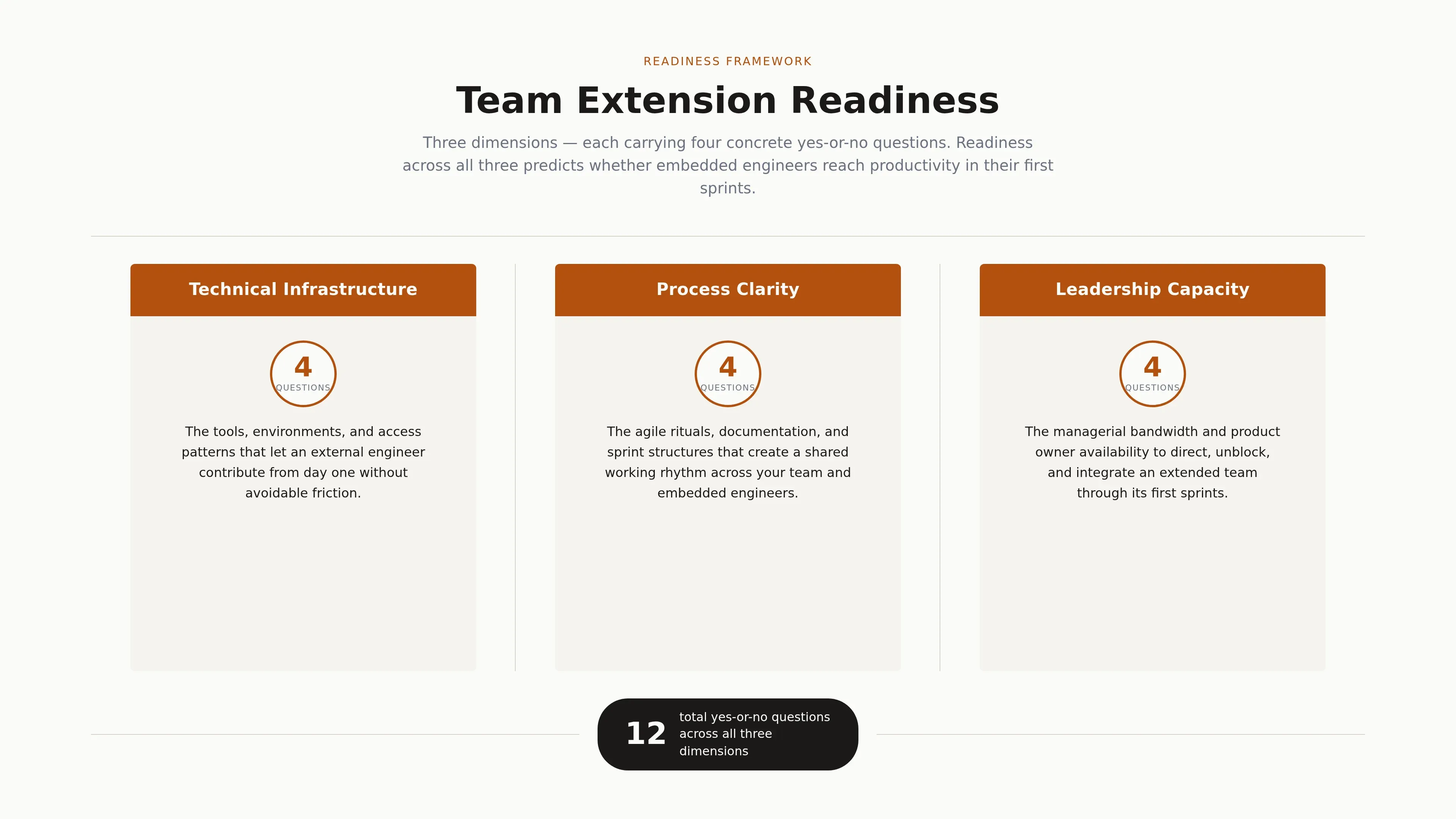
This distinction matters because the most common failure in team extension isn't a bad hire — it's a well-vetted senior engineer dropped into an environment that can't onboard them. If you're new to the model itself, our complete guide to team extension covers how embedded engineers integrate, report to your product owner, and work in your time zone. This checklist assumes that context and moves to the question underneath it: is your organization ready to receive them?
At easy.bi, we've watched readiness — not rate cards or résumés — decide whether the first sprint accelerates a roadmap or gets absorbed in onboarding overhead. The three dimensions below map to where that friction actually originates, and each carries four concrete yes-or-no questions. Twelve in total. Keep a running count of your yes answers as you go.
See how enterprises modernize with one team.
Technical and Infrastructure Readiness: 4 Questions to Ask
Technical readiness asks whether your codebase and infrastructure can onboard an engineer without a human bottleneck. Four questions matter most: how clearly code ownership is documented, whether architecture decisions are recorded, how automated your deployment pipeline is, and how complete your runbooks are. Each unanswered gap forces new engineers to interrupt your existing team for context.
1. Is code ownership and repository structure documented?
Extended engineers spend their first days reading code, not writing it. If your repository has a clear structure, consistent naming, a current README, and named owners per module, a senior engineer can navigate it independently. If ownership lives only in people's heads, every question becomes an interruption for your existing team — the exact overhead the model is meant to remove. Score a yes only if a newcomer could find who owns what without asking.
2. Do you record architecture decisions as ADRs?
Architecture Decision Records capture why your system looks the way it does — why this queue, that database, this service boundary. A senior engineer who can read your ADRs makes changes that fit your architecture instead of fighting it. Without them, external engineers either guess or re-litigate decisions you settled months ago. You don't need a perfect archive; you need the load-bearing decisions written down somewhere durable.
3. How automated is your CI/CD and testing pipeline?
If shipping code requires one specific person to run a manual sequence, every deploy is a bottleneck an external engineer can't clear alone. Automated CI/CD with tests that gate merges lets embedded engineers commit, verify, and ship inside your normal flow from their first sprint — not their fourth. Score a yes if a new engineer could deploy to staging on day one without a walkthrough.
4. Are your runbooks and operational knowledge captured?
Runbooks document how the system is operated: how to roll back, restore, rotate a key, respond to an alert. This operational knowledge is the hardest to transfer because it usually lives as tribal memory. Research on knowledge transfer and retention in distributed teams finds that explicit process documentation is what sustains skill retention and competitive advantage across dispersed groups. If your runbooks are current, an external engineer can operate safely; if not, they're one incident away from needing your on-call lead.
Is Your Agile Process Ready for Embedded Engineers?
Process readiness asks whether an external engineer can plug into your sprint rhythm and know what "done" means on day one. Four questions matter: whether your sprint cadence is consistent, whether your Definition of Done is explicit, whether your backlog tickets are self-contained, and whether your communication is documented for asynchronous, time-zone-spanning work.
5. Is your sprint cadence and ceremony structure consistent?
Team extension works by dropping engineers into your existing rhythm — daily standups, sprint planning, retrospectives on a predictable cadence. If your ceremonies happen consistently and start on time, an embedded engineer synchronizes in days. If sprints drift, get skipped, or change length ad hoc, there's no rhythm to join, and the external engineer improvises in a vacuum. Score a yes only if your last three sprints ran on the same schedule.
6. Is your Definition of Done explicit and shared?
A written Definition of Done tells an external engineer when a ticket is actually finished — tests written, docs updated, reviewed, deployed. Without it, "done" means whatever each person assumes, and embedded engineers ship work that gets bounced in review. Preparing your team for external engineers means making the implicit explicit: if your DoD only exists in your senior developers' habits, write it down first.
7. Are your backlog tickets self-contained and well-groomed?
Self-contained tickets are the unit of work an embedded engineer picks up without a meeting. A good ticket states the problem, the acceptance criteria, and the context needed to start. If your backlog is a list of one-line reminders that only make sense to whoever wrote them, external engineers can't pull work independently — they need a translator. Score a yes if a newcomer could start your top three backlog items unaided.
8. Is communication documented for asynchronous work?
Time-zone-aligned nearshore engineers still work asynchronously for part of the day. If decisions get made verbally and never written down, an engineer who was heads-down misses them. Teams ready for extension default to written decisions, threaded discussions, and documented context. This is also where trust forms: research on team effectiveness in a virtual environment finds that trust and knowledge sharing are central, and both depend on communication that leaves a durable trace.
These four questions scale with ambition. Adding one engineer to a stable team is forgiving; scaling capacity across a multi-team digital transformation program makes every process gap compound. And distributed agile isn't a compromise — empirical evaluations of distributed agile teams show they can match co-located productivity when the process scaffolding is real. These questions test whether that scaffolding exists before people arrive.
Can Your Leadership Support Knowledge Transfer?
Leadership readiness asks whether your technical leaders have the bandwidth to integrate new engineers, not merely direct them. Four questions matter: how much time your tech lead can protect for onboarding, whether an onboarding playbook exists, how transferred knowledge is retained, and whether your team culture is explicit enough for an outsider to read quickly.
9. Does your tech lead have protected onboarding bandwidth?
The single biggest predictor of a smooth start is a tech lead with protected time to onboard. Embedded senior engineers need context, not training — but context has to come from someone. If your lead is already at 110% and can't carve out real hours for the first two weeks, onboarding gets squeezed into gaps and stretches for a month. Score a yes only if someone senior has explicitly reserved onboarding time.
10. Do you have a structured onboarding playbook?
A structured onboarding playbook — product context, stack overview, workflows, Definition of Done, ownership boundaries — turns a chaotic first week into a repeatable one. This isn't optional polish: research on onboarding design shows that unstructured remote onboarding leads to frustration and turnover in knowledge-intensive organizations. A deliberate playbook is what lets a senior engineer reach productivity in days instead of weeks.
11. How do you retain the knowledge engineers build?
Knowledge transfer runs both ways: external engineers absorb your context, and they generate new knowledge you need to keep after they scale down. Mature teams capture this as ADRs and updated runbooks throughout the engagement, not in a rushed handover at the end. If your only retention mechanism is "ask the person who built it," you've created a dependency, not a capability. Score a yes if knowledge capture is already part of your Definition of Done.
12. Is your team culture explicit and legible?
Culture is the hardest thing for an outsider to read and the easiest to violate unknowingly. Explicit norms — how you disagree in reviews, how you escalate, how much autonomy an engineer has — let a newcomer integrate socially, not just technically. Preparing your team for external engineers includes writing down the unwritten rules. If your culture is "you just pick it up," an embedded engineer will pick up the wrong things first.
What Does Your Readiness Score Mean?
Count your yes answers. Fewer than six signals low readiness — fix foundations before extending. Six to nine is medium readiness — you can start while closing gaps in parallel. Ten to twelve is high readiness — you're positioned to make embedded engineers productive inside their first sprint rather than their third. Your total is a plan, not a grade.
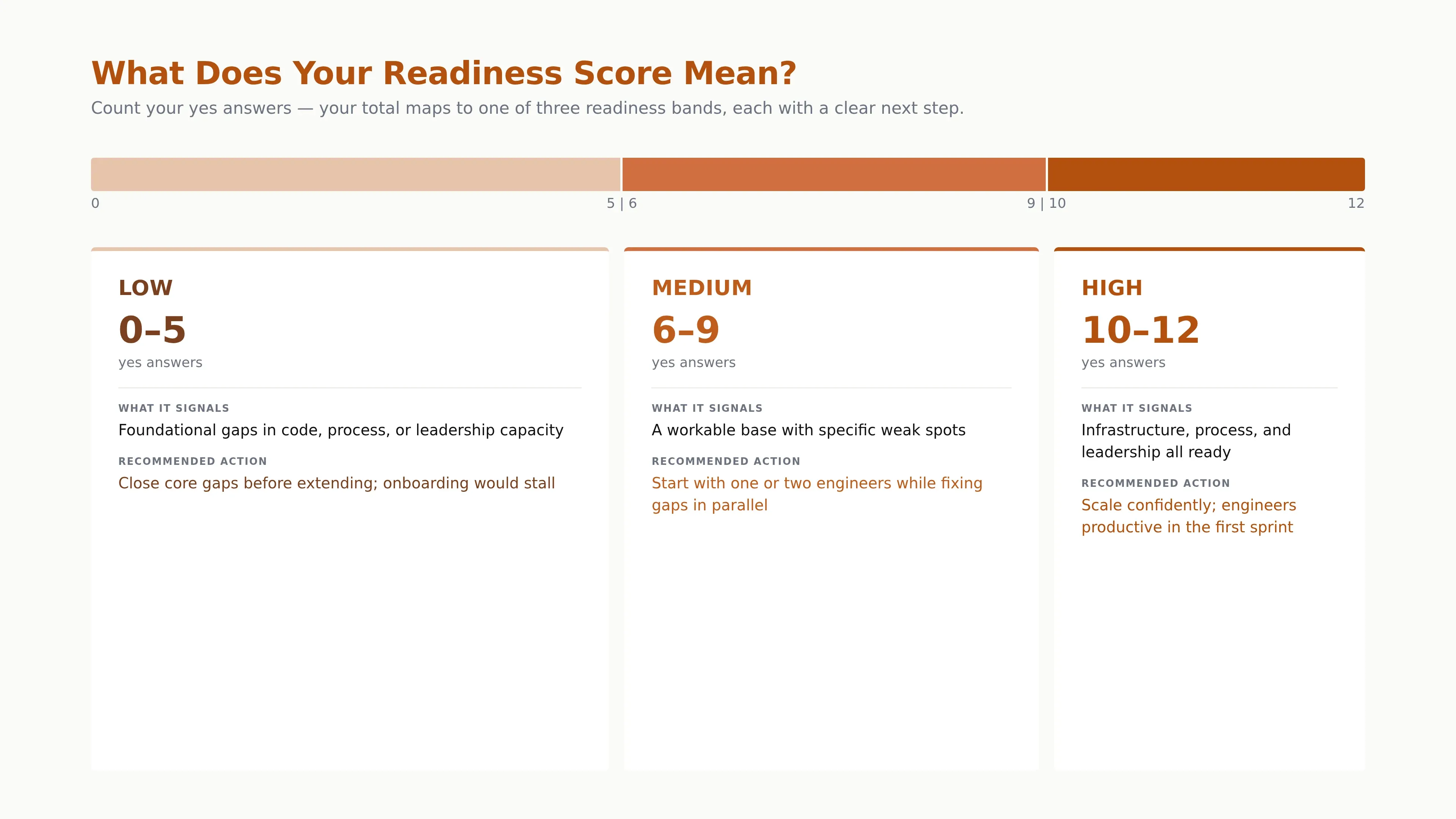
| Readiness band | Yes answers | What it signals | Recommended action |
|---|---|---|---|
| Low | 0–5 | Foundational gaps in code, process, or leadership capacity | Close core gaps before extending; onboarding would stall |
| Medium | 6–9 | A workable base with specific weak spots | Start with one or two engineers while fixing gaps in parallel |
| High | 10–12 | Infrastructure, process, and leadership all ready | Scale confidently; engineers productive in the first sprint |
A low score isn't a reason to abandon the idea — it's a map of what to fix. Most low scores cluster in one dimension: strong code but no process, or good process but no leadership bandwidth. Treat that concentration as good news, because a single-dimension gap closes faster than three shallow ones spread across the board.
Medium scores are the common case, and they reward a phased start. Bring in one or two engineers on your strongest team, use the engagement to pressure-test your weak spots, and expand once they hold. This isn't a one-time exercise, either — treat the twelve questions as a repeatable team readiness assessment you rerun before each new phase. Distributed teams don't run on hope: empirical indicators of distributed team performance show that tracking measurable readiness factors deliberately is what drives better outcomes.
Siemens, Lekkerland, WeberHaus chose us
One integrated partner. Three core competencies. From insight to production, with no handover gaps.
Start with a Strategy CallYour Next Steps: From Assessment to Action
Your next step depends on your score. High-readiness teams move straight to partner selection and structured onboarding. Teams with gaps follow a focused 30-to-60-day roadmap to close them first. Either way, team extension preparation isn't a blocker — it's what separates engineers who accelerate you from engineers who wait on you.
If your team is ready: move to onboarding
High-readiness teams should move fast — capacity is the whole point. The next step is structured onboarding: our walkthrough on onboarding nearshore engineers in 7–14 days shows how to convert readiness into first-sprint output. Integration typically begins within 14 business days when your playbook and pipelines are already in place, so the earlier you confirm readiness, the sooner the capacity lands.
If your team needs improvement: a 30–60 day roadmap
Rank your no answers by blast radius. An undocumented deploy process and an unavailable tech lead block everything, so fix those first; ADRs and runbooks can grow during the engagement. A realistic team extension implementation checklist for the improvement phase is short: document code ownership, write your Definition of Done, automate the deploy path, and protect tech-lead onboarding hours. Most teams close the critical set inside a sprint or two. If the checklist reveals that the platform itself lacks the architecture stability to onboard anyone, our custom software solutions can build that foundation before you extend.
Selecting a partner that understands readiness
Not every provider asks about your readiness — the good ones do. Structured vendor evaluation weighs technical fit, integration capability, reliability, and organizational alignment; multi-criteria vendor selection research formalizes exactly these dimensions. A partner who probes your infrastructure before quoting is signaling they measure success by your outcomes, not billable hours. At easy.bi, our Team Extension model embeds senior DACH-region engineers into your existing team on a Time-and-Materials basis, in your time zone — and readiness is where we start every engagement.
Twelve questions, three dimensions, one honest score. That's your readiness checklist — and the reason it matters is simple: the engineers you bring in are only as fast as the environment that receives them. Readiness is the one variable you fully control before anyone signs a contract, and it's the cheapest place to invest, because every gap you close pays off across every engagement that follows.
Whatever your number, you now know exactly what to do next: onboard if you're ready, or close a short list of gaps if you're not. Both roads lead to the same destination — external capacity that accelerates your roadmap instead of stalling on it.
Frequently Asked Questions
How is remote onboarding for extended engineers best structured?
Structure it deliberately. Effective remote onboarding designs learning and team-building on purpose — product context, stack overview, workflows, Definition of Done, and clear ownership boundaries — rather than leaving newcomers to absorb things ad hoc. Unstructured remote onboarding demonstrably leads to frustration and turnover in knowledge-intensive teams, while a documented playbook lets experienced engineers reach productivity in days instead of weeks.
What's the difference between team extension, outsourcing, and staff augmentation?
Team extension embeds vetted senior engineers into your existing team; they use your tools, attend your ceremonies, and report to your product owner, while the partner handles HR and payroll. Project outsourcing hands the vendor full delivery ownership. Staff augmentation supplies individual contractors rather than cohesive team integration. The distinction matters because only team extension keeps daily technical direction and product accountability with your own leadership.
How quickly can extended engineers become productive?
Integration typically begins within 14 business days, and senior engineers with a decade of experience need context rather than training — so first-sprint contribution is realistic when your onboarding is prepared. Productivity speed depends far more on your readiness than on the engineers themselves: with documented code, a clear Definition of Done, and protected tech-lead time, ramp-up is fast; without them, it stalls regardless of who you hire.
How do we retain the knowledge extended engineers build?
Capture it continuously, not at the end. Mature engagements document architectural decisions as ADRs and keep runbooks current throughout the work, so knowledge lives in durable artifacts rather than individual memory. Explicit process documentation is what sustains skill retention across distributed teams. Make knowledge capture part of your Definition of Done, and the capability stays with you long after the engineers scale down.
References & Sources
Explore Other Topics
Ready to transform your business?
30-minute call with an engineering lead. No sales pitch - just honest answers about your project.
98% engineer retention · 14-day delivery sprints · No lock-in contracts
Related Reading

Nearshore Team Extension: Solving the DACH IT Talent Shortage
How nearshore team extension solves the DACH IT talent shortage—senior engineers in days, at 30–50% lower cost, done right.
Andrej Lovsin
Team Extension: The Complete Guide to Scaling Engineering Capacity Without Hiring
Team extension adds senior nearshore engineers to your DACH team in days, not months. See how the model, costs, and integration compare.
Andrej Lovsin
How Can Team Leader Development Elevate Team Cohesion and Dynamics?
Enhance team leadership by mastering skills, dynamics, cohesion, and strategies for continuous improvement to drive success and productivity.
Filip Kralj