
Shopware 6 vs Shopify Plus: Which Fits DACH Enterprise Retail?

Table of Contents+
- Why Does the Shopware vs Shopify Plus Decision Cost So Much When You Get It Wrong?
- Which Platform Handles DACH Tax and Legal Requirements Better?
- What Does Total Cost of Ownership Look Like Over 3 Years?
- How Do Customization and Extensibility Compare?
- Which Platform Integrates Better With DACH Enterprise Systems?
- How Does Developer Talent Availability Differ in DACH?
- What About Performance and Scalability?
- When Is Shopware 6 the Wrong Choice?
- When Is Shopify Plus the Wrong Choice?
- What 5 Questions Should You Answer Before Choosing?
- What Does Migration Between the Two Platforms Look Like?
- What Is the Bottom Line for DACH Enterprise Retailers?
- References
TL;DR
Shopware 6 is the better fit for DACH enterprises with complex tax rules, deep ERP integrations, and B2B requirements. Shopify Plus is the faster path for DTC brands that prioritize speed-to-market over customization depth. Choosing the wrong platform costs EUR 100K-250K in migration expenses within two years. This comparison gives you the facts to decide.
Key Takeaways
- •Shopware 6 is the stronger choice for DACH enterprises with complex tax rules, B2B requirements, and deep ERP integrations - it handles Preisangabenverordnung, Grundpreis, and German legal pages natively.
- •Shopify Plus gets DTC brands to market 40-60% faster but charges 0.15-0.30% transaction fees that compound at scale, adding EUR 45K-90K per year on EUR 30M revenue.
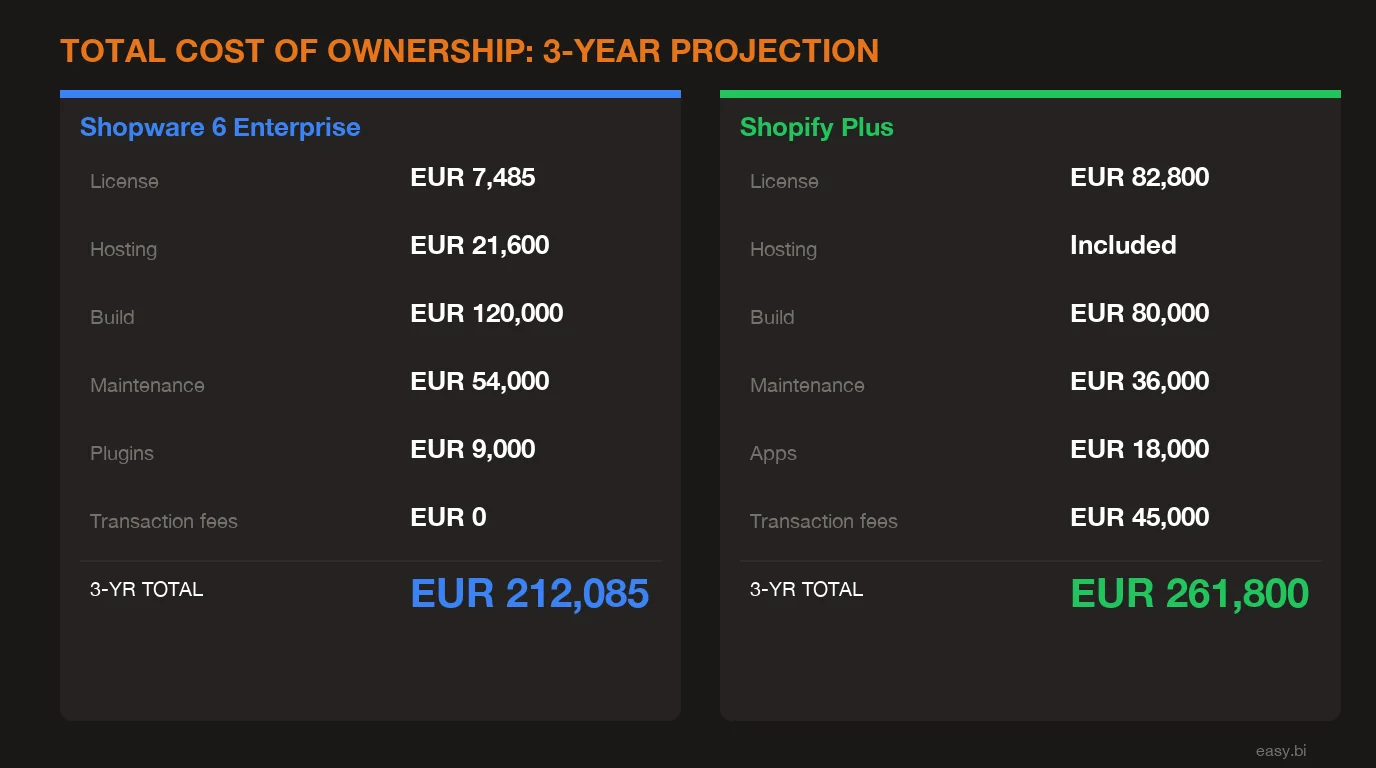
- •Total cost of ownership over 3 years favors Shopware for businesses above EUR 10M annual revenue, while Shopify Plus is cheaper below that threshold.
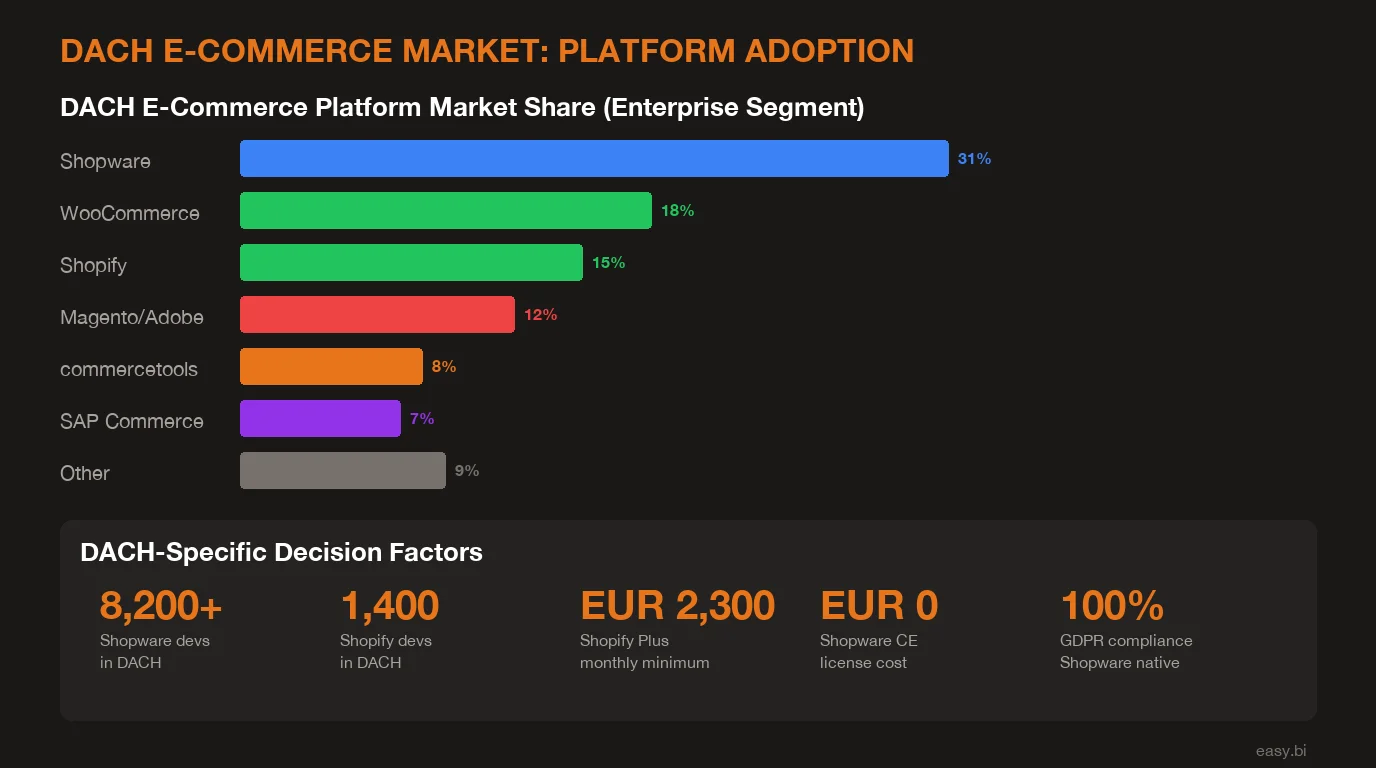
- •Developer availability in DACH strongly favors Shopware: 8,200+ Symfony/PHP developers versus 1,400 Shopify-specialized developers in the region.
- •The wrong platform choice costs EUR 100K-250K in migration expenses within 18-24 months - get the decision right the first time by matching platform to your integration landscape.
Shopware 6 vs Shopify Plus for DACH enterprise retail: honest comparison of costs, DACH compliance, customization, and when each platform fits your business.
Shopware 6 is the better fit for DACH enterprises with complex tax rules, deep ERP integrations, and B2B requirements. Shopify Plus is the faster path for DTC brands that prioritize speed-to-market over customization depth. Choosing the wrong platform costs EUR 100K-250K in migration expenses within two years. This comparison gives you the facts to decide.
Why Does the Shopware vs Shopify Plus Decision Cost So Much When You Get It Wrong?
Platform migration in e-commerce is not a settings change. It is a full rebuild. Forrester reports that 60-70% of replatforming projects exceed their original budget, with the average overrun at 37%.[1] For a DACH mid-market retailer doing EUR 15-50M in annual online revenue, the wrong platform choice locks you into an ecosystem that fights your business model for years.
The cost is not just the migration itself. It is the 12-18 months of workarounds, the third-party apps patching gaps that should be native features, and the developer hours spent fighting the platform instead of building value. A 2024 Statista survey found that 43% of German e-commerce decision-makers cited "platform limitations" as their primary technology frustration.[2]
Both Shopware and Shopify Plus are strong platforms. Neither is universally better. Shopify Plus powers over 26,000 enterprise stores globally, with 47% year-over-year merchant growth.[5] Shopware serves over 50,000 active shops, with the majority concentrated in DACH markets.[3] The question is which one fits your specific DACH requirements, your team, and your 3-year growth trajectory. That is what this comparison answers.
See how our team delivers +35% avg conversion lift across 30+ e-commerce projects.
Which Platform Handles DACH Tax and Legal Requirements Better?
Germany, Austria, and Switzerland have e-commerce regulations that most global platforms treat as edge cases. For DACH retailers, these are not edge cases - they are legal requirements that carry fines. Shopware 6 was built in Germany. Every edition - including the free Community Edition - supports Grundpreis (base price per unit), Preisangabenverordnung (price indication regulation), and Elektrogesetz (WEEE) markings natively.[3]
Shopify Plus was built for North American DTC brands and later expanded globally. German legal requirements like Impressum, Widerrufsbelehrung (cancellation policy), and AGB (terms and conditions) require third-party apps. The most popular - German Market by suspended GmbH - costs EUR 99/month and handles most requirements, but version conflicts after Shopify theme updates cause compliance gaps that take weeks to fix.[4]
| DACH Requirement | Shopware 6 | Shopify Plus |
|---|---|---|
| Grundpreis (base price/unit) | Native, all editions | Requires app (EUR 50-99/mo) |
| Preisangabenverordnung | Native compliance | Partial via apps |
| Impressum page | Built-in template | Manual or app-based |
| Widerrufsbelehrung | Native with PDF generation | Manual setup required |
| AGB (Terms & Conditions) | Checkbox in checkout, native | App-dependent |
| GDPR cookie consent | Native consent manager | Third-party app required |
| German tax rules (19%/7%) | Native, including split VAT | Native tax engine |
| SEPA Direct Debit | Native via Mollie/Unzer | Via Stripe or third-party |
| Klarna (DACH-specific flows) | First-class plugin | Shopify Payments integration |
| DHL/Hermes/DPD shipping | Native plugins with label printing | Via apps (varying quality) |
| Elektrogesetz (WEEE) | Supported | Manual implementation |
| Austrian/Swiss VAT differences | Native multi-country tax | Shopify Markets (good) |
From our project experience at easy.bi: a fashion retailer spent 4 months and EUR 35,000 configuring Shopify Plus apps to match what Shopware delivered in its default installation. The apps worked, but every Shopify update cycle required regression testing on compliance features. That ongoing maintenance cost was not in the original business case.
What Does Total Cost of Ownership Look Like Over 3 Years?
Licensing costs are the most visible number and the least useful for comparison. Shopware 6 Community Edition is free. Shopware 6 Evolve starts at EUR 2,495/month. Shopify Plus starts at USD 2,300/month (approximately EUR 2,100) or 0.25% of monthly revenue above USD 800,000 - whichever is higher.[5] That revenue-based pricing is where the math changes. A retailer doing EUR 30M annually pays approximately EUR 6,250/month to Shopify, not the base rate.
Shopify Plus also charges transaction fees of 0.15-0.30% unless you use Shopify Payments exclusively. In Germany, where SEPA direct debit and Klarna account for 38% of online payments, most retailers cannot rely solely on Shopify Payments.[6] Those transaction fees add EUR 45,000-90,000 per year on EUR 30M revenue.
| Cost Category | Shopware 6 (Evolve) | Shopify Plus |
|---|---|---|
| Annual licensing | EUR 29,940 | EUR 25,200-75,000 (revenue-dependent) |
| Transaction fees | None (payment provider fees only) | 0.15-0.30% on non-Shopify Payments |
| Hosting (annual) | EUR 7,200-18,000 (managed cloud) | Included |
| Initial implementation | EUR 80,000-180,000 | EUR 50,000-120,000 |
| Third-party apps (annual) | EUR 2,400-6,000 | EUR 6,000-18,000 |
| Ongoing maintenance (annual) | EUR 24,000-60,000 | EUR 18,000-42,000 |
| Year 1 total (EUR 15M revenue) | EUR 145,000-295,000 | EUR 120,000-280,000 |
| Year 3 cumulative (EUR 15M revenue) | EUR 275,000-500,000 | EUR 310,000-560,000 |
| Year 3 cumulative (EUR 30M revenue) | EUR 310,000-540,000 | EUR 420,000-680,000 |
The crossover point is around EUR 10M annual revenue. Below that, Shopify Plus is typically cheaper because hosting is included and implementation is faster. Above EUR 10M, Shopware's flat licensing and zero transaction fees create a growing cost advantage. At EUR 30M, the 3-year TCO difference is EUR 100,000-140,000 in Shopware's favor.
One cost category that most comparisons miss: app subscriptions. The average Shopify Plus store runs 18-22 paid apps at a median cost of EUR 180/month each.[5] That is EUR 3,200-3,960/month just for apps - EUR 38,400-47,520 annually. Shopware's plugin costs are typically 40-60% lower because many DACH-specific features are included natively. When building your business case, map every feature you need and price the apps or plugins required on each platform before comparing totals.
How Do Customization and Extensibility Compare?
Shopware 6 is open source at its core. You have full access to the codebase, built on Symfony 6 and Vue.js 3. Custom plugins integrate at the application level with access to the entire data model. The Flow Builder lets business users automate workflows without developer involvement - 72% of Shopware Enterprise customers use it for order routing, email triggers, and inventory alerts.[3]
Shopify Plus gives you Liquid templates, Shopify Functions (for checkout customization), and the Shopify API. Since 2023, Checkout Extensibility replaced checkout.liquid, providing more structured but more limited customization options. You cannot modify core checkout logic beyond what Shopify Functions expose. For most DTC use cases, this is sufficient. For complex B2B scenarios with custom pricing logic, approval workflows, or multi-step checkout - it is not.
The extension ecosystem reflects this difference. Shopware's plugin marketplace has approximately 4,500 extensions, with 60% focused on DACH-specific use cases.[3] Shopify's app store has over 13,000 apps, but fewer than 800 specifically address DACH requirements. Quantity favors Shopify. Relevance for DACH retailers favors Shopware.
I have seen this play out repeatedly at easy.bi: Shopify Plus works perfectly until you need the one customization that sits outside its extensibility boundaries. Then you are looking at a workaround that costs more than the original implementation estimate. Understanding those boundaries before you commit is essential - our vendor lock-in escape guide covers how to evaluate these constraints systematically.
Which Platform Integrates Better With DACH Enterprise Systems?
DACH enterprises run SAP, Microsoft Dynamics, or DATEV. They use Akeneo or Pimcore for product information management. They connect to DHL Geschaeftskundenportal, not generic shipping APIs. Integration depth matters more than integration count.
Shopware 6 has a mature integration ecosystem for these systems. SAP connectors from Synesty, Tradebyte, and ChannelPilot handle order, inventory, and product synchronization bidirectionally. The Admin API and Store API follow REST conventions that enterprise integration teams understand. Shopware's event system allows real-time webhook-based integration that keeps ERP and shop data synchronized within seconds.[3]
Shopify Plus connects well to global SaaS tools - HubSpot, Klaviyo, Salesforce. Its integration with DACH-specific ERPs is weaker. SAP integration requires middleware like Celigo, Boomi, or custom iPaaS development. The cost of middleware alone runs EUR 12,000-36,000 annually. For enterprises with 10+ backend systems, this middleware layer becomes a maintenance burden that grows with every new integration.
If your architecture already follows API-first principles, both platforms can integrate cleanly. The difference is that Shopware integrations for DACH systems exist as proven, maintained connectors. Shopify Plus integrations for DACH systems often require custom middleware.
How Does Developer Talent Availability Differ in DACH?
Platform choice is a hiring decision. If you cannot find developers who know the platform, every feature takes longer and costs more. In the DACH region, this strongly favors Shopware.
Shopware 6 runs on Symfony (PHP) and Vue.js. Stack Overflow's 2024 survey shows PHP remains the 6th most-used programming language, and Symfony is the dominant enterprise PHP framework in Europe.[7] LinkedIn data for the DACH region shows approximately 8,200 developers listing Symfony or Shopware skills versus approximately 1,400 listing Shopify-specific development skills. That 6:1 ratio translates directly to hiring timelines: 4-8 weeks to fill a Shopware developer role versus 8-16 weeks for a Shopify Plus specialist in DACH.
Shopify development uses Liquid (templating), React (Hydrogen framework for headless), and Node.js. These are common skills globally, but Shopify-specific knowledge - Checkout Extensibility, Shopify Functions, Metafields architecture - is concentrated in North America. DACH agencies with deep Shopify Plus expertise number fewer than 30, compared to over 200 certified Shopware partners.[3]
This talent gap also affects long-term maintenance costs. Scarce talent commands higher rates. Senior Shopify Plus developers in Germany charge EUR 120-160/hour. Senior Shopware developers charge EUR 90-130/hour. Over a 3-year engagement, that rate difference on 500 annual development hours equals EUR 15,000-75,000 in additional cost.
Agency availability follows the same pattern. Germany has over 200 certified Shopware partners, including specialized agencies in Berlin, Hamburg, Munich, and Cologne. Shopify Plus partners with DACH expertise number under 30, and many of those are generalist digital agencies rather than dedicated e-commerce specialists. When your project hits a critical issue at 2 AM before a product launch, the depth of your agency's platform expertise determines whether it gets resolved in hours or days.
Training resources reflect the geographic split too. Shopware Academy offers German-language certification programs, in-person workshops in Germany, and a DACH-focused community forum with 35,000+ active members. Shopify's Partner Academy is English-first, with community activity concentrated in North American time zones. For DACH teams that operate primarily in German, Shopware's ecosystem removes the language barrier from technical problem-solving.
What About Performance and Scalability?
Shopify Plus runs on a globally distributed infrastructure that Shopify manages entirely. Uptime is 99.99%. Traffic spikes during Black Friday or flash sales require zero preparation on your side. For a retailer doing 500,000 sessions on peak days, this is a genuine advantage - Shopify handles it automatically.[5]
Shopware 6 performance depends on your hosting setup. On managed Shopware Cloud, performance is solid for most mid-market loads. Self-hosted Shopware requires Redis caching, Elasticsearch for search, and a CDN for static assets. Properly configured, Shopware 6 handles 100,000+ concurrent sessions. Beyond that, you need infrastructure expertise - load balancers, auto-scaling groups, database replication.
Median page load times tell the real story. Shopify Plus stores average 1.8-2.4 seconds on mobile (Lighthouse data). Shopware 6 stores range from 1.5-3.5 seconds depending on configuration and theme complexity.[8] The variance is the key difference: Shopify gives you consistent, good performance. Shopware gives you the possibility of better performance, but also the risk of worse performance if misconfigured.
Multi-channel performance adds another dimension. Shopify Plus includes native integrations with Instagram Shopping, TikTok Shop, Facebook Marketplace, and Google Shopping. Setting up a new sales channel takes hours, not weeks. Shopware 6 connects to these channels through plugins or middleware like ChannelPilot and Tradebyte, which adds setup time but also gives you more control over product data transformation per channel. For DACH retailers selling on Amazon.de, Otto.de, and Kaufland.de, Shopware's marketplace connectors from established DACH providers like Magnalister are more mature than Shopify's equivalents.
For data-driven UX optimization, both platforms provide the analytics hooks you need. The difference is operational: Shopify Plus abstracts infrastructure entirely, while Shopware gives you control at the cost of responsibility.
+35% conversion. +22% AOV. EUR 50M+ GMV processed.
Our Shopware-certified team delivers e-commerce at scale with 14-day sprint cycles. 80% less manual work through system integrations.
Start with a Strategy CallWhen Is Shopware 6 the Wrong Choice?
Shopware is the wrong choice when speed-to-market is your primary constraint and your requirements are straightforward. A DTC brand launching its first online store with 500 SKUs, standard checkout, and no ERP integration will launch 40-60% faster on Shopify Plus. The Shopware setup, even with an experienced agency, involves server provisioning, SSL configuration, and deployment pipeline setup that Shopify eliminates.
Shopware is also the wrong choice if your team is entirely JavaScript-based. Retraining a Node.js team on Symfony/PHP takes 3-6 months of reduced productivity. If you already have React developers building your frontend, Shopify's Hydrogen framework for headless commerce gives them a familiar stack. Hydrogen storefronts built on Remix deliver sub-2-second page loads on Shopify's Oxygen hosting, with zero DevOps overhead on your side.
And if you sell exclusively through your own DTC channel with no B2B, no marketplace, and no complex pricing rules, Shopware's depth is a cost you pay without using. Simpler requirements favor simpler platforms.
When Is Shopify Plus the Wrong Choice?
Shopify Plus is the wrong choice when your DACH compliance requirements are complex and evolving. If you sell regulated products (pharmaceuticals, alcohol, electronics with WEEE obligations), the app-based compliance approach creates ongoing risk. Every Shopify update cycle can break compliance apps, and the 2-4 week fix cycle from app developers leaves you exposed.
Shopify Plus is the wrong choice for enterprises with deep ERP integration needs. If your SAP system manages inventory across 5 warehouses with real-time stock synchronization, the middleware layer required for Shopify integration adds EUR 30,000-50,000 annually in cost and a permanent point of failure in your architecture.
It is also the wrong choice if you need full checkout customization. Shopify Functions provide structured extensibility, but you cannot fundamentally alter the checkout flow. Custom payment terms, multi-step B2B approval, or split-shipment checkout logic hit Shopify's extensibility ceiling. A 2024 survey of Shopify Plus merchants found that 31% cited checkout customization limitations as their top frustration.[5]
International expansion beyond DACH also deserves scrutiny. Shopify Plus handles multi-currency and multi-language well through Shopify Markets, and its global CDN delivers fast page loads everywhere. But if you need country-specific catalog management, local warehouse routing, or region-specific promotions with complex rule engines, Shopware's Rule Builder provides more granular control. For a retailer operating in Germany, Austria, Switzerland, and expanding to Benelux, Shopware's rule-based approach scales better for differentiated market strategies.
What 5 Questions Should You Answer Before Choosing?
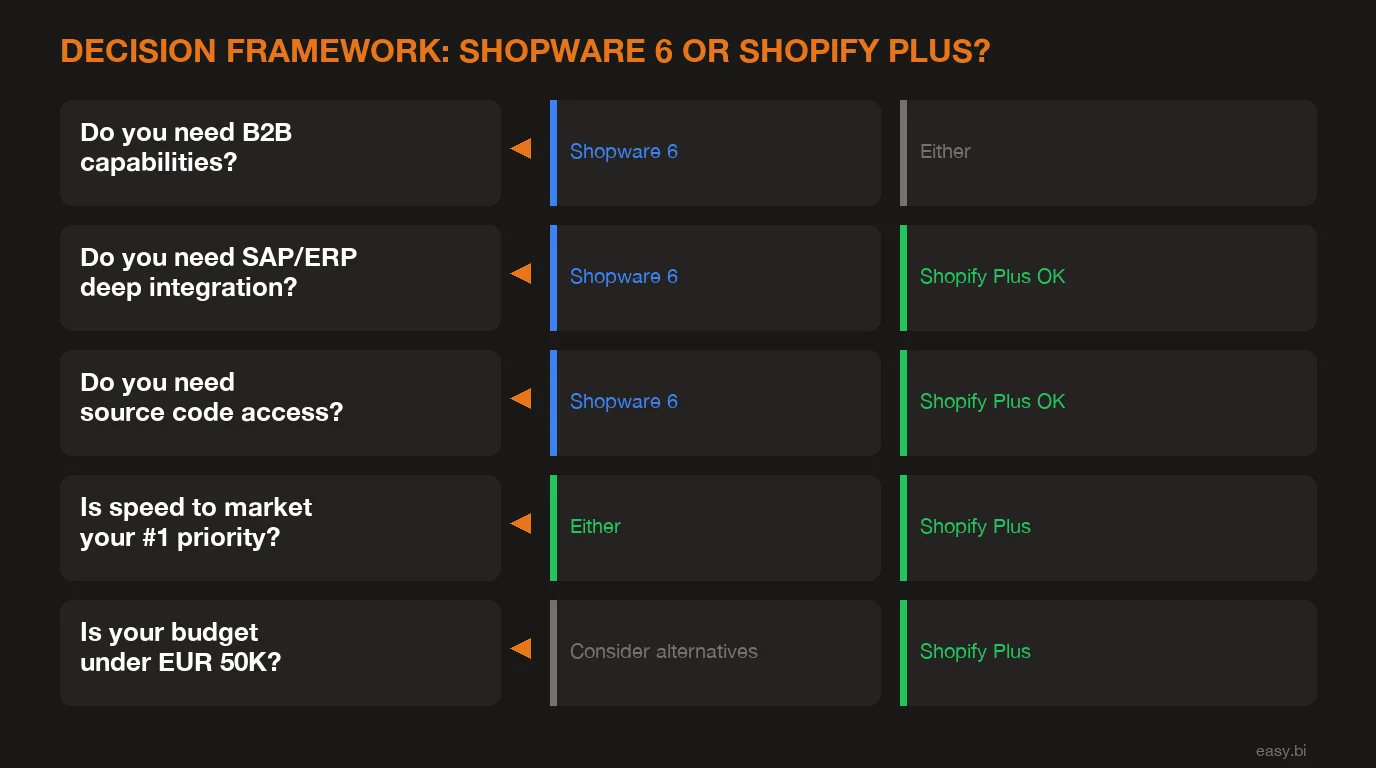
After working on 100+ e-commerce projects across both platforms, these are the five questions that predict the right choice with 90% accuracy:
| Question | If Your Answer Is... | Platform Recommendation |
|---|---|---|
| How many backend systems (ERP, PIM, WMS) need integration? | Fewer than 5 | Shopify Plus |
| 5 or more | Shopware 6 | |
| What is your annual online revenue? | Under EUR 10M | Shopify Plus |
| EUR 10M+ | Shopware 6 | |
| Do you need B2B features (company accounts, custom pricing)? | No | Either platform |
| Yes | Shopware 6 | |
| What is your team's primary tech stack? | JavaScript/React | Shopify Plus |
| PHP/Symfony | Shopware 6 | |
| How fast do you need to launch? | Under 8 weeks | Shopify Plus |
| 8-16 weeks is acceptable | Shopware 6 |
If 3+ answers point to the same platform, that is your choice. If the answers are split, you need a deeper technical discovery phase - typically 2-3 weeks of mapping your specific integration landscape, compliance requirements, and team capabilities against each platform.
A sixth question worth considering: where is your business in 3 years? If you plan to stay focused on DACH with steady growth, Shopware's ecosystem alignment serves you well. If you plan aggressive international expansion into 10+ markets with a unified commerce layer, evaluate whether Shopware's multi-market capabilities match your roadmap or whether a composable approach with commercetools deserves consideration alongside Shopify Plus. We covered that three-way comparison in our Shopware vs commercetools vs Adobe Commerce analysis.
What Does Migration Between the Two Platforms Look Like?
Migration from Magento 2 is the most common scenario we see in DACH. Both platforms have documented migration paths and tooling. Shopware offers a dedicated Migration Assistant that handles product, category, customer, and order data transfer from Magento 2, Shopware 5, and WooCommerce. The tool covers 70-80% of data migration automatically; the remaining 20-30% requires manual mapping and custom scripts for non-standard attributes.[3]
Shopify Plus migration relies on the Shopify Transporter CLI tool and partner-built migration apps. Data mapping is straightforward for standard fields but requires custom development for Magento's EAV attribute model. Customer password migration is not supported - all customers must reset passwords post-migration, which creates a friction point that typically reduces returning customer login rates by 15-25% in the first month.
Migrating between Shopware and Shopify Plus (in either direction) is a full replatforming project. No automated tools exist for this path. Budget 12-20 weeks and EUR 80,000-200,000 depending on catalog size and customization complexity. SEO migration is critical - URL structures differ fundamentally between the platforms, and every redirect must be mapped. Our SEO migration guide details how to protect rankings during this process.
One factor that catches teams off guard: theme and design migration. Shopware 6 themes are Twig-based with full Symfony inheritance. Shopify themes use Liquid with JSON templates. There is zero code reuse between them. A custom Shopware theme with 40+ template overrides requires complete reconstruction on Shopify, adding 4-6 weeks and EUR 20,000-40,000 to the migration budget. Factor this into any platform switch calculation.
What Is the Bottom Line for DACH Enterprise Retailers?
The DACH e-commerce platform market is projected to reach EUR 141 billion by 2027, growing at 8.3% annually.[2] Both Shopware and Shopify Plus will capture significant shares of that growth. The question is not which platform will win the market - both will thrive. The question is which one will win for your business.
This is not a question of which platform is better. It is a question of which platform fits your business. Shopware 6 wins for DACH enterprises with complex compliance needs, deep ERP integrations, B2B requirements, and revenue above EUR 10M. Shopify Plus wins for DTC brands prioritizing speed, simplicity, and global reach with straightforward requirements.
The most expensive mistake is choosing based on a demo, a competitor's choice, or a vendor's pitch. Choose based on your integration landscape, your team's skills, your compliance requirements, and your 3-year revenue trajectory.
If you are evaluating platforms right now and want an honest assessment based on your specific situation, we do this at easy.bi every month for DACH enterprises. No platform allegiance - we implement both platforms and recommend whichever fits. Our Enterprise E-Commerce Playbook covers the full decision framework from architecture through launch, and our analysis of why 70% of relaunches fail shows what happens when platform selection is rushed.
The right platform is the one that matches your reality - not the one with the best demo.
References
- [1] Forrester - Reduce the Risk of Commerce Replatforming (2024)
- [2] Statista - E-Commerce Technology Challenges in Germany (2024)
- [3] Shopware - Platform Facts and Figures (2025)
- [4] Shopify App Store - German Market App Documentation (2025)
- [5] Shopify Plus - Pricing and Platform Documentation (2025)
- [6] Deutsche Bundesbank - Payment Behaviour in Germany (2024)
- [7] Stack Overflow Developer Survey - Programming Languages (2024)
- [8] HTTP Archive - State of the Web Performance Report (2024)
Explore Other Topics
Ready to scale your e-commerce?
30-minute call with an engineering lead. No sales pitch - just honest answers about your project.
98% engineer retention · 14-day delivery sprints · No lock-in contracts
Related Reading

How Much Does a Shopware Enterprise Build Cost in 2026?
Shopware enterprise builds cost EUR 30K to 500K+ in 2026. Transparent breakdown of cost tiers, hidden fees, and what drives budget overruns in DACH.
Enno Bassen
Shopware Plugin Development: Build vs Marketplace vs Custom
Shopware plugin development: marketplace vs custom vs extended. Decision framework, cost analysis, and 8-point quality checklist.
Christian Kaspar
How to Migrate From Magento to Shopware Without Losing SEO Rankings
Step-by-step Magento to Shopware migration framework that preserves SEO rankings. URL mapping, redirect strategy, data migration, and 90-day monitoring plan.
Filip Kralj