
API-First Architecture: Why Your Next Platform Should Start With the API

Table of Contents+
- What Does API-First Actually Mean?
- Why Do API-First Platforms Scale Better?
- How Should You Design the API Contract?
- REST vs. GraphQL: Which Fits Your Use Case?
- What Are the Biggest API-First Mistakes?
- How Does API-First Connect to Composable Architecture?
- What Does an API-First Implementation Look Like in Practice?
- Where Should You Go From Here?
- References
TL;DR
API-first architecture means designing and building the API contract before any frontend, mobile app, or integration layer touches a line of code. Companies that adopt this approach grow revenue 38% faster than those without an API strategy .
Key Takeaways
- •API-first companies grow revenue 38% faster than those without an API strategy. The API is not a technical detail - it is the product itself, defining what your platform can do before a single screen is designed.
- •Designing the API contract before writing backend or frontend code eliminates the integration bottleneck that causes 57% of project failures: communication breakdowns between teams and stakeholders.
- •REST still dominates at 78% developer preference, but GraphQL grew to 28% adoption in 2023. Choose based on your use case: REST for resource-oriented CRUD, GraphQL for complex data aggregation across multiple domains.
- •Versioning, authentication, and rate limiting are not afterthoughts. They are architectural decisions that compound over every sprint cycle. Getting them wrong costs 6.5x more to fix in production than during design.
- •DACH enterprises spending EUR 1.2 million annually on custom software development gain the most from API-first: it enables composable architectures that 61% of German mid-market companies plan to adopt by 2026.
API-first architecture drives 38% faster revenue growth and cuts integration costs by half. Learn how to design, implement, and scale API-first platforms with practical patterns from 100+ enterprise projects in the DACH region.
API-first architecture means designing and building the API contract before any frontend, mobile app, or integration layer touches a line of code. Companies that adopt this approach grow revenue 38% faster than those without an API strategy [1].
The reason is straightforward: when the API defines what your platform can do, every consumer - web app, mobile app, third-party integration, internal tool - builds on the same stable foundation instead of duct-taping systems together after the fact.
This article breaks down how API-first architecture works in practice, when it makes sense (and when it does not), and how to implement it without turning your project into an over-engineered abstraction exercise.
Every recommendation comes from building custom platforms across the DACH mid-market, where integration complexity is the norm, not the exception.
What Does API-First Actually Mean?
API-first is a design philosophy, not a technology choice. It means that the API contract - the endpoints, data structures, authentication model, and error handling - is the first artifact your team produces. Before wireframes. Before database schemas. Before sprint planning for frontend features.
In traditional development, the API emerges as a byproduct of backend work. A developer builds a feature, exposes an endpoint, and the frontend team figures out how to consume it. This "code-first" approach creates APIs that reflect internal implementation details rather than business capabilities.
The result is tight coupling, inconsistent naming, and integration debt that compounds with every release.
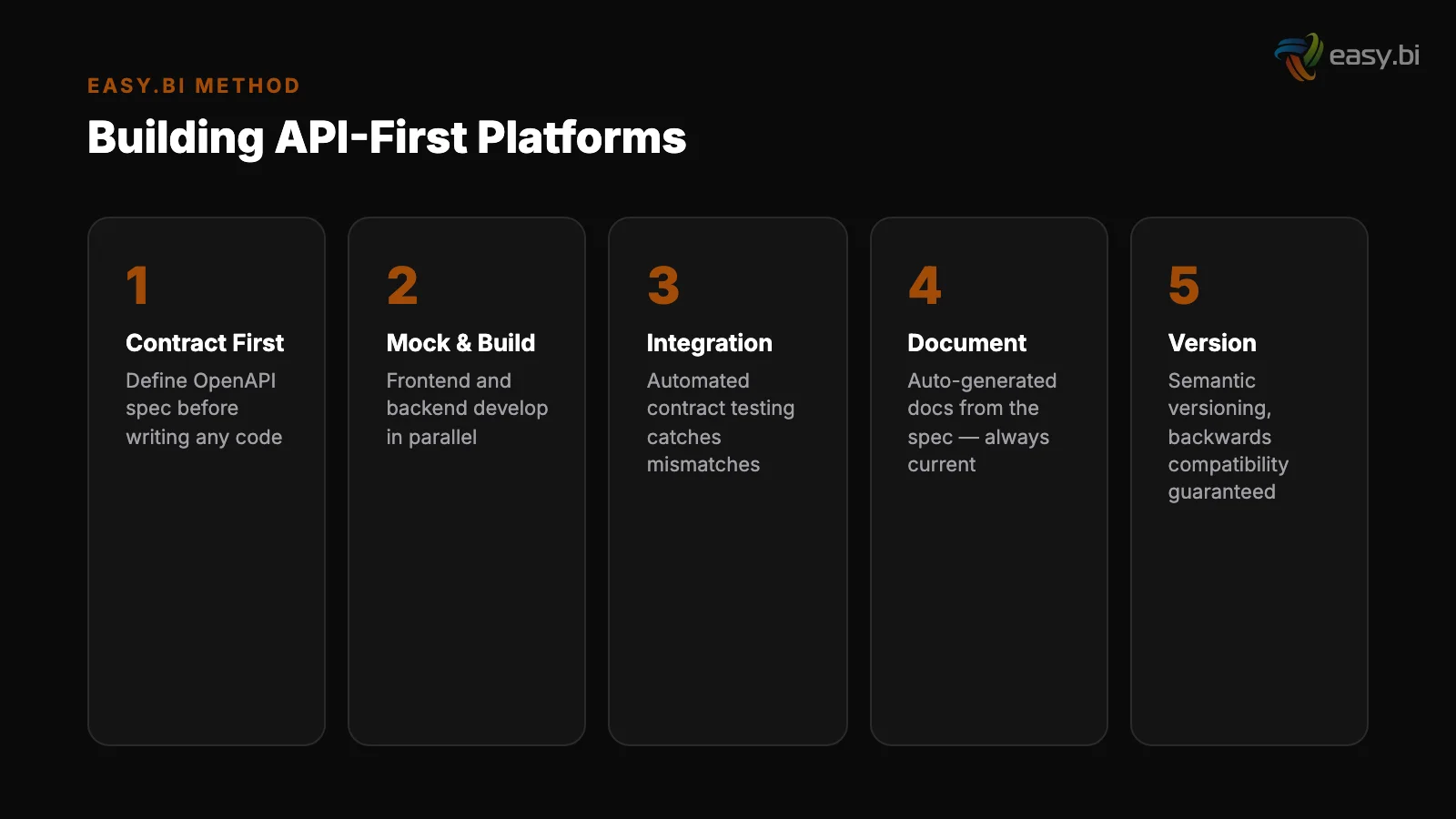
API-first flips this sequence. Your team writes an OpenAPI specification (or GraphQL schema) that describes every operation the platform supports. Frontend and backend teams then develop in parallel against that contract. Mobile teams can build against mock servers. Third-party partners can start integration work before your backend is complete.
The API contract becomes the single source of truth that aligns every team working on the platform.
This is not academic theory. 87.5% of engineering teams already use CI/CD pipelines [2]. API-first fits naturally into that workflow: the API spec becomes a versioned artifact in your repository, validated by automated tests on every commit, and deployed as documentation that stays in sync with the actual implementation.
See how we deliver 60% faster time-to-market with 40% lower TCO than off-the-shelf.
Why Do API-First Platforms Scale Better?
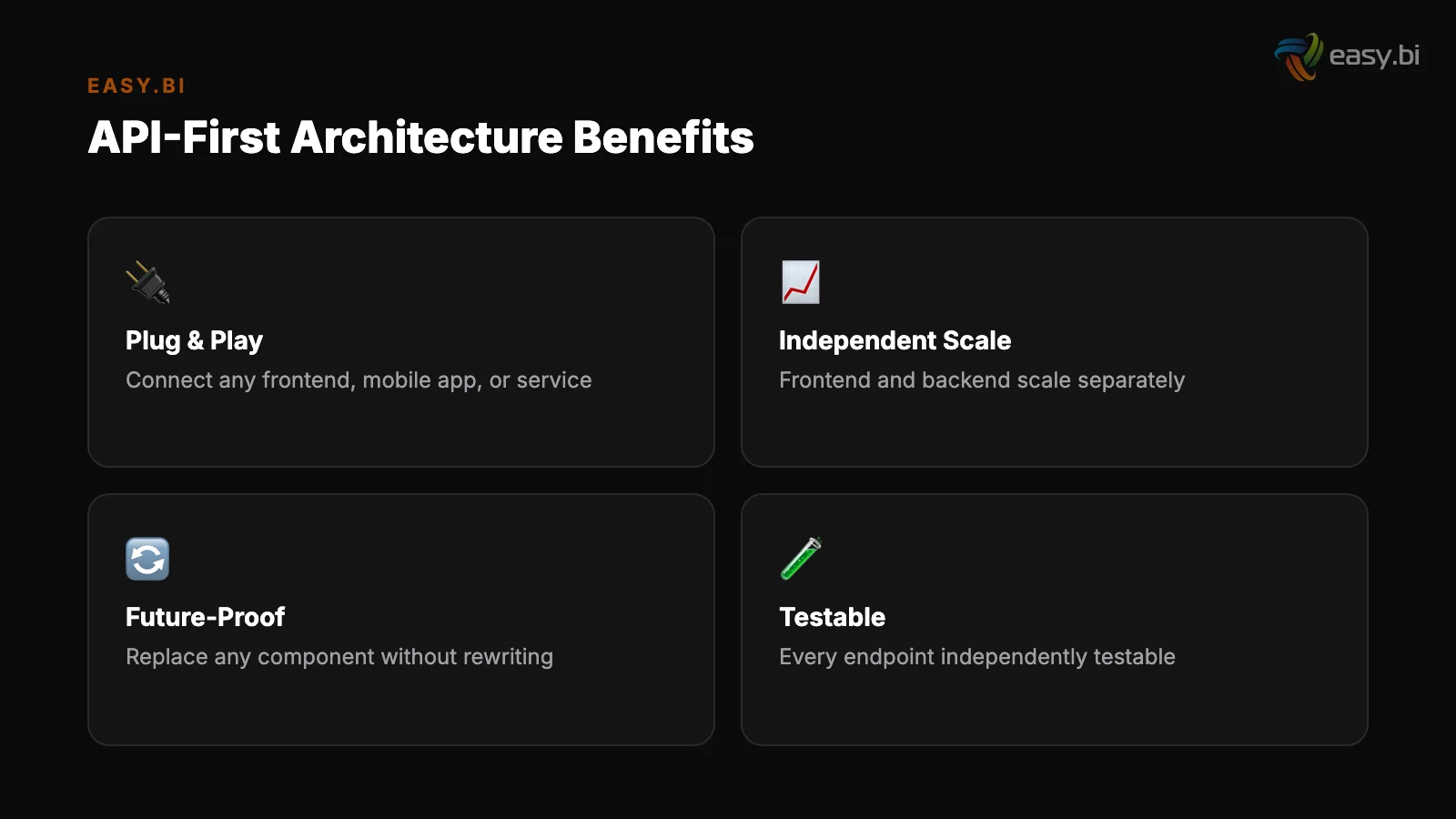
The scaling advantage of API-first architecture comes from separation of concerns at the system boundary level. When your API contract is stable and well-defined, you can change everything behind it - database, programming language, hosting provider - without breaking a single consumer.
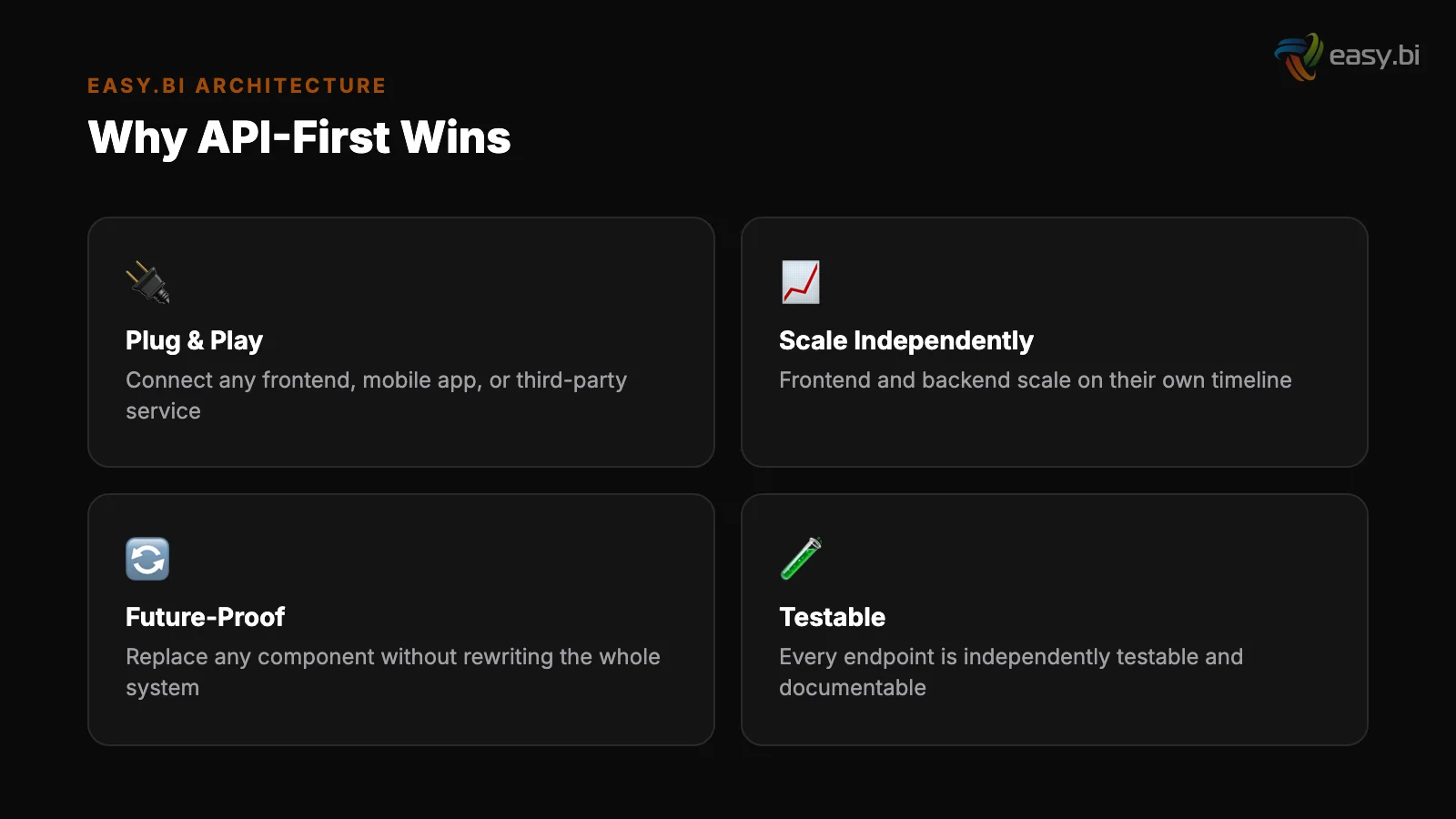
Consider a mid-market manufacturer running a custom order management platform. The initial version serves a web application used by sales teams. Six months later, the business needs a mobile app for field technicians. A year after that, a key customer wants direct API access for automated ordering.
With API-first architecture, the mobile app and customer integration consume the same API the web application uses. No new backend work. No custom integration layer. No duplicate business logic.
Without API-first, each new consumer requires its own backend modifications. The mobile team needs a different data format. The customer integration needs a different authentication model. Within 18 months, you have three parallel backend paths doing the same thing differently - and 3 times the maintenance burden.
API-first companies grow revenue 38% faster than companies without an API strategy. The compounding effect is clear: every new consumer channel builds on the same foundation instead of requiring a new integration project. [1]
The numbers behind this are concrete. Microservices architecture - which depends on well-defined APIs between services - increases deployment frequency by 75% [3]. Teams using CI/CD deploy 208x more frequently than those without [2].
These gains are only possible when services communicate through stable, versioned APIs rather than ad-hoc database queries or shared memory.
How Should You Design the API Contract?
The API contract is a business document disguised as a technical specification. Every endpoint represents a business capability. Every data structure reflects a domain concept. The best API contracts read like a description of what your business does, not how your database is organized.
Start with use cases, not entities.
Instead of designing a /users endpoint because you have a users table, ask: "What does a client need to accomplish?" A use case like "Submit an order for approval" maps to POST /orders with a status transition - not PATCH /orders/{id} with a raw status field that the consumer must know how to set correctly.
Resource-oriented design
Three design principles that survive real-world complexity:
Resource-oriented design. Name endpoints after business resources (orders, customers, invoices), not actions (processOrder, getCustomerData). Use HTTP methods to express intent: GET for reading, POST for creating, PUT for replacing, PATCH for partial updates, DELETE for removing.
This is not dogma - it is a convention that 78% of developers already understand [4].
Consistent error handling
Consistent error handling. Every error response should follow the same structure: an error code, a human-readable message, and a machine-readable detail object. Inconsistent error formats are the number one complaint from teams integrating with internal APIs. Define your error contract once, enforce it everywhere.
Pagination and filtering from day one. Every list endpoint will eventually need pagination. Adding it after launch breaks existing consumers. Design paginated responses from the start - cursor-based pagination for real-time data, offset-based for simple lists.
| Design Decision | API-First Approach | Code-First Approach | Impact |
|---|---|---|---|
| Contract definition | OpenAPI spec written first | Emerges from implementation | Parallel development vs. sequential |
| Frontend-backend sync | Mock servers from spec | Frontend waits for backend | 2-4 weeks faster per feature |
| Third-party integration | Partners build against docs | Partners wait for sandbox | Months faster partner onboarding |
| Breaking changes | Caught by contract tests | Caught in production | 6.5x cost difference per defect |
| Documentation | Auto-generated, always current | Manual, often outdated | Developer experience and adoption |
REST vs. GraphQL: Which Fits Your Use Case?
The REST vs. GraphQL debate generates more heat than light. Both are valid choices. The right one depends on your data access patterns, team skills, and consumer requirements.
REST works best for resource-oriented APIs with predictable access patterns. If your consumers mostly perform CRUD operations on well-defined entities - orders, products, customers - REST's simplicity is an advantage. 78% of developers prefer REST [4], which means onboarding new team members is faster.
REST also maps cleanly to HTTP caching, making it the default choice for high-traffic public APIs.
GraphQL shines when consumers need to aggregate data from multiple domains in a single request. A mobile app that displays an order with customer details, product images, and shipping status benefits from GraphQL's ability to fetch exactly the data it needs - no over-fetching, no under-fetching.
GraphQL adoption grew to 28% in 2023 [4], and it is especially strong in frontend-heavy applications with complex data requirements.
The hybrid approach works for most enterprise platforms. Use REST for your core business API - the one that third parties consume and that represents your stable domain model. Use GraphQL for internal frontend-backend communication where data aggregation flexibility matters more than caching simplicity.
One pattern to avoid: building a GraphQL gateway over poorly designed REST microservices. GraphQL does not fix bad API design - it just hides it behind a query language. Fix the underlying service boundaries first.
What Are the Biggest API-First Mistakes?
After 100+ platform projects, the mistakes repeat with remarkable consistency. They are not technical failures. They are organizational failures that manifest as technical debt.
Designing for the database, not the consumer. Your API should reflect business capabilities, not your data model. If your endpoint response mirrors your database table structure - including internal IDs, audit columns, and join table artifacts - you have coupled your consumers to your implementation.
The next database refactoring breaks every integration.
Designing for the database, not the consumer
Skipping versioning until it is too late. Your first API version will need to change. Accept this and implement versioning from the start. URL-based versioning (/v1/orders) is the simplest to implement and the easiest for consumers to understand. Header-based versioning is more elegant but harder to debug.
Pick one and commit to it before your first consumer goes to production.
Treating authentication as a sprint-2 task. OAuth 2.0, API keys, JWT tokens - the authentication model affects every endpoint and every consumer.
Designing it after the core API is built means retrofitting security into a system that was not designed for it. 60% of organizations experienced a software supply chain attack in 2023 [5]. API authentication is not optional, and it is not deferrable.
Skipping versioning until it is too late
Ignoring rate limiting and quotas. A single misbehaving consumer can bring down your entire platform if you do not have rate limiting.
Implement it at the API gateway level from day one - not after your first outage. 70% of production outages are caused by configuration changes or deployments [6], but traffic spikes from unthrottled API consumers are a close contender.
Over-engineering the abstraction layer. API-first does not mean building a generic platform that can do everything. It means building a focused API that does what your business needs. Every unnecessary abstraction adds complexity that your team must maintain.
The teams of 5-9 people who deliver the highest productivity [7] succeed because they build what matters and skip what does not.
50+ custom projects. 99.9% uptime. 60% faster.
Senior-only engineering teams deliver production-grade platforms in under 4 months. No juniors on your project.
Start with a Strategy CallHow Does API-First Connect to Composable Architecture?
API-first architecture is the prerequisite for composable commerce and composable enterprise platforms. You cannot compose systems that do not expose clean, stable APIs.
This is why 61% of German mid-market companies plan to adopt composable commerce architectures by 2026 [8] - and why API-first design is a business decision, not just a technical one.
Composable architecture means assembling your platform from best-of-breed components: a PIM for product data, a CMS for content, a payment service for transactions, a search engine for discovery. Each component communicates through APIs. The orchestration layer - your custom business logic - connects them.
This model eliminates the monolithic platform lock-in that plagued the previous generation of enterprise software. When your PIM vendor raises prices or your CMS cannot handle a new content type, you swap that component without rebuilding the entire platform.
But this flexibility only works if every component interface is a well-designed API that your orchestration layer can consume reliably.
For DACH enterprises spending an average of EUR 1.2 million annually on custom software development [9], API-first composable architecture maximizes the return on that investment.
Each component is independently upgradeable, each integration is testable in isolation, and the overall system evolves without the big-bang migration projects that 70% of digital transformations fail to deliver [10].
What Does an API-First Implementation Look Like in Practice?
An API-first implementation follows a specific sequence that differs from traditional development workflows. Here is the pattern that works across enterprise and mid-market projects.
Week 1-2: Domain modeling and contract design. The team - architects, frontend leads, product owners - maps business capabilities to API resources. The output is an OpenAPI 3.1 specification or GraphQL schema, committed to the repository and reviewed like code. No implementation yet. Just the contract.
Week 1-2: Domain modeling and contract design
Week 2-3: Mock servers and consumer development. Tools like Prism or WireMock generate mock servers from the API spec. Frontend teams start building against realistic mock data. Mobile teams do the same. Backend teams begin implementing the actual endpoints. Everyone works in parallel because the contract is stable.
Week 3-4: Contract testing and integration. As backend endpoints come online, contract tests verify that the implementation matches the spec. Any drift - a renamed field, a changed status code - is caught automatically. The mock servers are gradually replaced by real endpoints.
By the end of week 4, the first features are running end-to-end.
Week 2-3: Mock servers and consumer development
This 4-week cadence fits naturally into the 2-week sprint cycles that deliver 40% more features per quarter than 4-week cycles [11]. The API spec is the sprint deliverable in the first iteration. Working software is the deliverable in every iteration after that.
At easy.bi, this is how we structure every custom platform engagement. Our Performance Scrum methodology - Prince2-based, with structured work packages delivered in 14-day cycles - treats the API contract as the foundational work package. Everything else builds on it.
The result: complex digital projects live in under 4 months, with 50% faster time-to-value than multi-vendor setups where API design happens as an afterthought.
Where Should You Go From Here?
API-first architecture is not a trend. It is the engineering foundation that enables every other modern platform capability: composable architecture, multi-channel delivery, third-party ecosystems, and internal tool automation.
If your next platform project does not start with the API contract, it will end with integration debt that compounds over every release cycle.
The decision is especially clear for DACH mid-market companies navigating the talent shortage. With 149,000 unfilled IT positions in Germany [12], you cannot afford to waste engineering capacity on integration rework.
API-first design gets the architecture right from the start, so your team - whether in-house or nearshore - spends every sprint building features instead of fixing integrations.
For a deeper look at how custom software projects succeed or fail, read our pillar guide on building custom software that does not fail.
And if you are evaluating a platform build or modernization project, explore our custom solutions approach - or book an expert call to discuss your architecture with an engineer, not a salesperson.
References
- [1] MuleSoft / Salesforce (2023). mulesoft.com
- [2] GitLab (2023). "87.5% of respondents use CI/CD pipelines; teams using CI/CD depl gitlab.com
- [3] O'Reilly (2024). "Microservices architecture increases deployment frequency by 7 oreilly.com
- [4] Postman (2023). "78% of developers prefer REST APIs; GraphQL adoption grew to 28 postman.com
- [5] Sonatype (2023). "60% of organizations experienced a software supply chain attac sonatype.com
- [6] PagerDuty (2023). "70% of all production outages are caused by configuration cha pagerduty.com
- [7] QSM / Putnam Research (2023). qsm.com
- [8] Lunendonk / commercetools (2024).
- [9] Lunendonk Studie (2024). "German enterprises spend an average of EUR 1.
- [10] McKinsey (2023). "70% of digital transformations fail to reach their stated goal mckinsey.com
- [11] Scrum.org (2023). "Projects using 2-week sprint cycles deliver 40% more features scrum.org
- [12] Bitkom (2024). "Germany faces a shortage of 149,000 IT specialists." bitkom.
Explore Other Topics
Ready to build your custom platform?
30-minute call with an engineering lead. No sales pitch - just honest answers about your project.
98% engineer retention · 14-day delivery sprints · No lock-in contracts
Related Reading

How does IT architecture contribute to improving business efficiency?
Optimize business efficiency with SaaS, cloud tools, and APIs. Stay competitive with future-ready IT architecture.
Andrej Lovsin
How does IT architecture impact the fields of manufacturing and engineering?
Optimize manufacturing with IT architecture to boost efficiency, control costs, and drive innovation using APIs, data visualization, and cloud solutions.
Enno Bassen
When Does Off-the-Shelf Software Start Costing You More Than Custom?
Off-the-shelf software hides costs in customization fees, per-seat pricing, and workaround labor. Learn when custom becomes 40% cheaper.
Andrej Lovsin