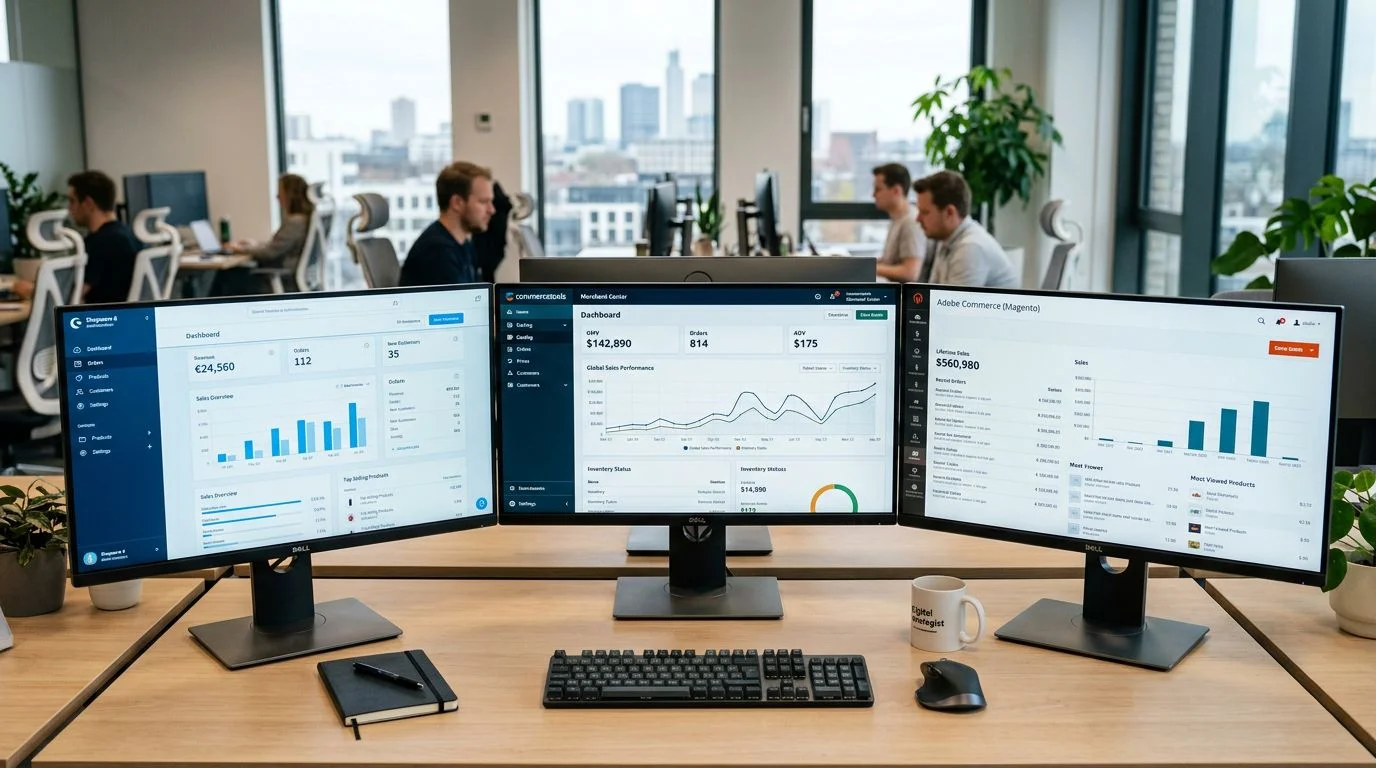
Shopware vs commercetools vs Adobe Commerce: An Honest Comparison

Table of Contents+
- Why Does Platform Choice Matter More Than You Think?
- Shopware 6: The DACH Mid-Market Standard
- commercetools: The Enterprise Composable Engine
- Adobe Commerce: The Legacy Enterprise Play
- How Do the Three Platforms Compare Side by Side?
- When Should You Choose Each Platform?
- What About the Hybrid Approach?
- How Do You Avoid the Most Common Platform Selection Mistakes?
- What Happens After You Choose?
- References
TL;DR
Shopware is the best fit for most DACH mid-market retailers. commercetools is the right pick when you need full composability at enterprise scale. Adobe Commerce makes sense only if you are already invested in the Adobe ecosystem. Every other answer is vendor marketing.
Key Takeaways
- •Shopware 6 is the strongest choice for DACH mid-market retailers with straightforward requirements and teams under 10 developers.
- •commercetools wins when you need a fully composable stack, have 15+ integrations, and can invest in frontend engineering.
- •Adobe Commerce suits enterprises already deep in the Adobe ecosystem but carries the highest total cost of ownership.
- •Platform selection should start with your integration landscape and team capabilities - not a feature checklist.
- •61% of German mid-market companies plan to adopt composable commerce architectures by 2026, but many are not ready for the operational complexity.
An honest comparison of Shopware, commercetools, and Adobe Commerce for DACH enterprises. Platform strengths, costs, integration complexity, and when each one fits.
Shopware is the best fit for most DACH mid-market retailers. commercetools is the right pick when you need full composability at enterprise scale. Adobe Commerce makes sense only if you are already invested in the Adobe ecosystem. Every other answer is vendor marketing.
After implementing all three platforms across 100+ e-commerce projects for companies like REWE, Fressnapf, and ZooRoyal, we have seen what each platform delivers in production - not in demos. This comparison is based on real project data, not feature matrices.
Why Does Platform Choice Matter More Than You Think?
Platform selection is the second most common reason e-commerce projects fail. Forrester reports a 60-70% failure rate for replatforming projects, and the wrong platform choice is a leading contributor.[1] The problem is not that any of these platforms are bad.
The problem is that each one fits a specific context, and choosing the wrong context-fit creates compounding technical debt from day one.
A mid-market retailer with 5,000 SKUs, 3 integrations, and a team of 4 developers has completely different needs than an enterprise with 200,000 SKUs, 20 backend systems, and a 30-person engineering org. Yet both end up in the same vendor demo, watching the same polished storefront, hearing the same promises.
The EUR 50K-100K that enterprises spend on platform evaluations often leads to the wrong choice because evaluations focus on features instead of fit. Features are table stakes. Fit depends on your integration landscape, your team's technical depth, and your 3-year scaling trajectory.
See how our team delivers +35% avg conversion lift across 30+ e-commerce projects.
Shopware 6: The DACH Mid-Market Standard
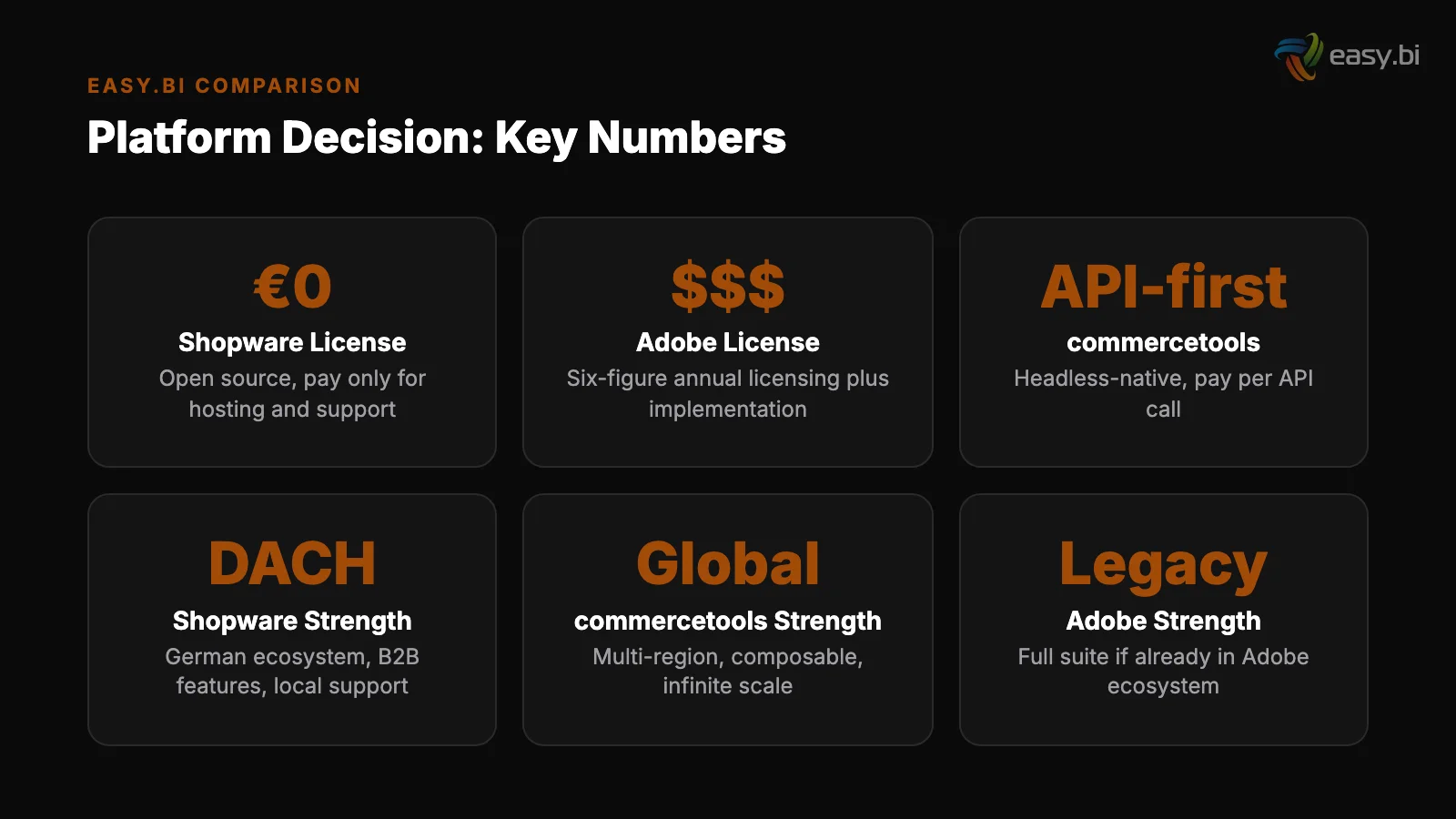
Shopware holds approximately 12-15% market share in the DACH e-commerce platform market, making it the leading European-origin platform in the region.[2] That market share exists for practical reasons. Shopware 6 is built on Symfony and Vue.js - a stack that DACH development teams know well. Documentation is available in German.
The community is DACH-centric. Local payment providers like Mollie, Unzer, and Heidelpay have first-class integrations.
Where Shopware 6 excels:
Where Shopware 6 excels
- Speed to market. A well-configured Shopware 6 shop can go live in 8-12 weeks for a mid-market retailer. The admin panel, product management, and basic SEO tools work out of the box.
- DACH ecosystem. Payment methods (Klarna, PayPal, invoice), shipping providers (DHL, DPD, Hermes), and tax rules for Germany, Austria, and Switzerland are available as maintained plugins.
- API-first option. Shopware 6 offers a headless mode via its Store API and Admin API. You can start monolithic and migrate to headless later without switching platforms.
- Lower entry cost. Licensing starts with a free Community Edition. The Professional and Enterprise editions add features like B2B, advanced search, and dedicated support.
Where Shopware 6 falls short:
- Complex multi-market setups. Managing 10+ sales channels with different currencies, languages, and product catalogs gets cumbersome. The data model was not designed for true multi-tenant enterprise scenarios.
- Plugin dependency. Heavy reliance on third-party plugins introduces maintenance risk. Every Shopware major update can break plugin compatibility.
- Enterprise scaling limits. Above 100,000 concurrent sessions, Shopware 6 requires significant infrastructure tuning and custom caching layers.
commercetools: The Enterprise Composable Engine
commercetools leads the headless commerce platform market with 21% share among enterprises adopting composable commerce.[3] It is not a shop system. It is a commerce API. You get product catalog management, pricing, cart, checkout, and order management as microservices.
Everything else - the frontend, the CMS, the search - you build or buy separately.
Where commercetools excels:
Where commercetools excels
- True composability. Every component is independent. Swap your search engine from Elasticsearch to Algolia without touching checkout. Replace your CMS without affecting product management. This modularity pays off at scale.
- Multi-market by design. commercetools handles multiple currencies, tax categories, shipping zones, and pricing strategies natively. Managing 15 country-specific storefronts from one instance is a core use case, not an edge case.
- Infinite scalability. The cloud-native architecture handles traffic spikes without manual intervention. Black Friday with 500,000 concurrent sessions requires no infrastructure changes on your side.
- API completeness. Over 300 API endpoints cover every commerce operation. GraphQL and REST. Webhooks for real-time event handling. The API surface is the most complete in the headless commerce space.
Where commercetools falls short:
- No frontend included. You must build or buy a storefront. That means a separate frontend team, a separate deployment pipeline, and a separate testing strategy. Budget EUR 150K-300K for the initial frontend build alone.
- Higher year-1 cost. The total cost of ownership for a headless stack is 20-40% higher in year 1 compared to monolithic platforms.[4] The savings come in years 2-3 through lower maintenance and faster feature delivery.
- Team requirements. You need senior engineers who understand distributed systems, API design, and frontend frameworks like React or Next.js. A team of WordPress developers will struggle.
Adobe Commerce: The Legacy Enterprise Play
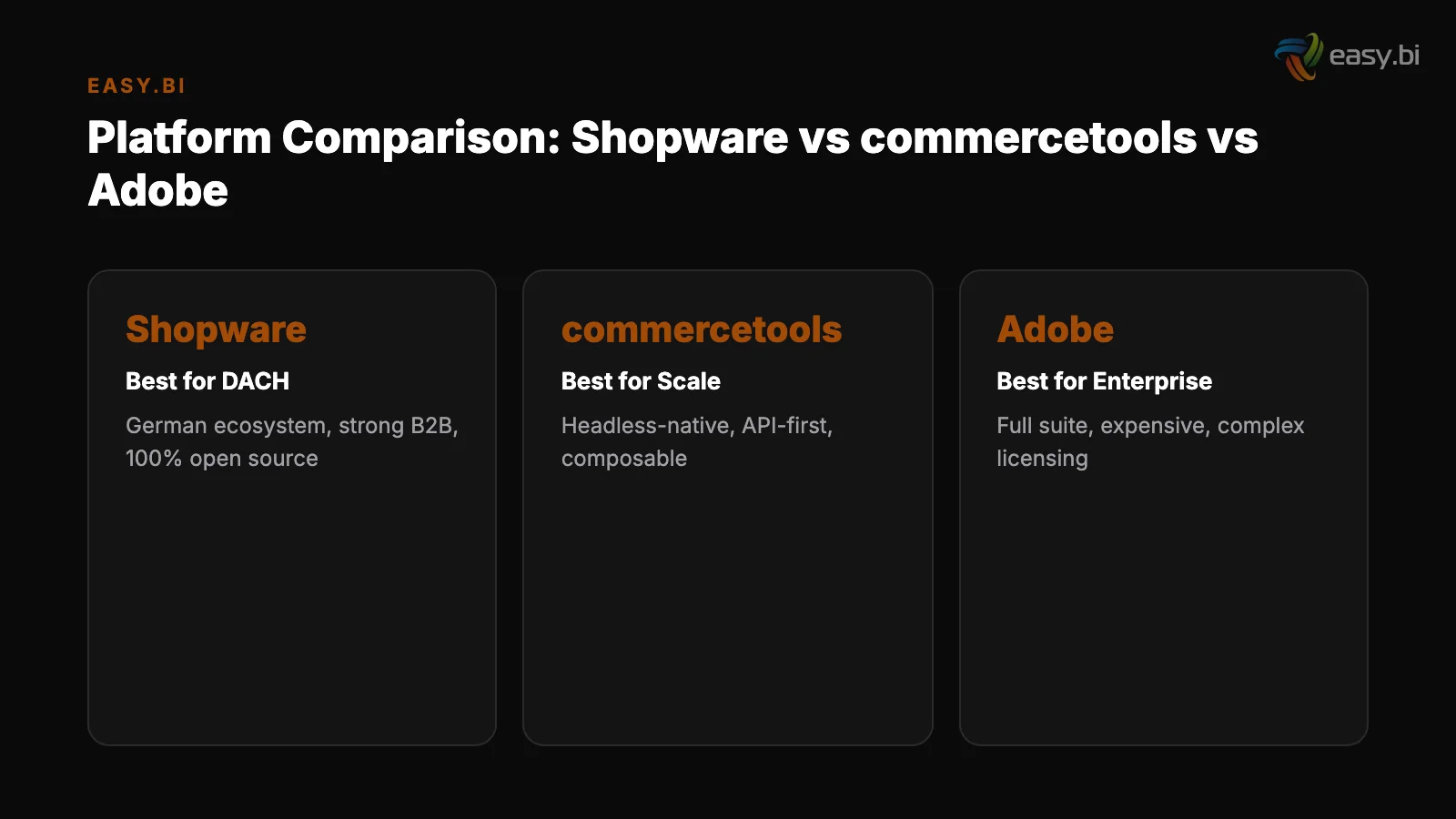
Adobe Commerce (formerly Magento 2) still powers 7.4% of all e-commerce sites globally.[5] Its market share is declining, but it remains entrenched in enterprises that use the broader Adobe Experience Cloud - Analytics, Target, Experience Manager, and Campaign.
Where Adobe Commerce excels:
Where Adobe Commerce excels
- Adobe ecosystem integration. If you run Adobe Analytics, Adobe Target for A/B testing, and Adobe Experience Manager for content, Adobe Commerce connects natively. No middleware, no custom integrations.
- B2B capabilities. Shared catalogs, company accounts, negotiated pricing, purchase order workflows, and requisition lists are built in. Most competitors require custom development for these features.
- Extension marketplace. Over 3,800 extensions on the Adobe Commerce Marketplace cover niche requirements from industry-specific tax calculations to complex product configurators.
Where Adobe Commerce falls short:
- Total cost of ownership. Adobe Commerce Cloud licensing starts at EUR 40,000/year for the base tier. Add hosting, implementation, and maintenance - expect EUR 200K-500K total for year 1 and EUR 100K-200K annually after that.
- Performance overhead. Adobe Commerce is a heavy application. Page load times require aggressive caching (Varnish, Redis, Elasticsearch) and CDN optimization. Out-of-the-box performance is poor compared to Shopware or commercetools.
- Complexity ceiling. Every customization adds technical debt faster than on other platforms. The PHP codebase with its dependency injection patterns and XML configuration makes even experienced developers slow.
How Do the Three Platforms Compare Side by Side?
Numbers tell the story better than marketing copy. Here is what we see across real projects:
| Factor | Shopware 6 | commercetools | Adobe Commerce |
|---|---|---|---|
| Best for | DACH mid-market, B2C | Enterprise, multi-market | Adobe ecosystem, B2B |
| Time to first launch | 8-12 weeks | 14-20 weeks | 16-24 weeks |
| Year 1 total cost (mid-market) | EUR 80K-200K | EUR 200K-450K | EUR 250K-500K |
| Year 3 TCO trend | Stable | 30% lower than year 1 | Rising (tech debt) |
| Team size needed | 3-6 developers | 6-15 developers | 5-12 developers |
| DACH ecosystem | Strong (native) | Good (via integrations) | Moderate |
| Headless capability | Optional (Store API) | Native (API-only) | Available (REST/GraphQL) |
| Multi-market support | Basic-to-good | Excellent | Good |
| Vendor lock-in risk | Low-medium | Low | High |
| B2B features | Limited (Enterprise Ed.) | Custom build needed | Strong (built-in) |
When Should You Choose Each Platform?
The decision tree is simpler than vendors want you to believe.
Choose Shopware 6 when:
- Your annual online revenue is EUR 5M-50M
- You operate primarily in DACH markets
- Your integration landscape has fewer than 10 backend systems
- Your team has 3-8 developers with PHP/Symfony experience
- You want to launch within 3 months
Choose commercetools when:
- You operate in 5+ countries with different pricing, tax, and fulfillment rules
- You have 15+ backend systems that need to integrate with commerce
- Your engineering team has 8+ developers with microservices experience
- You plan to build custom frontends for web, mobile, and in-store kiosks
- You are willing to invest more upfront for lower long-term TCO
Choose Adobe Commerce when:
- You already use Adobe Experience Cloud (Analytics, Target, AEM)
- You need complex B2B features out of the box
- Your team has Magento/Adobe Commerce expertise
- You need the extension marketplace for niche functionality
61% of German mid-market companies plan to adopt composable commerce architectures by 2026.[6] That does not mean 61% should. Composable commerce requires a level of engineering maturity that many organizations have not built yet.
+35% conversion. +22% AOV. EUR 50M+ GMV processed.
Our Shopware-certified team delivers e-commerce at scale with 14-day sprint cycles. 80% less manual work through system integrations.
Start with a Strategy CallWhat About the Hybrid Approach?
The cleanest answer is rarely one platform in isolation. We see the best results with hybrid architectures that match platform strength to business need.
Example: A DACH retailer expanding into 8 European markets started with Shopware 6 for their German and Austrian shops. When they needed multi-currency, multi-language, and multi-warehouse capabilities for Western Europe, they migrated the commerce engine to commercetools while keeping their existing Shopware admin workflows for the DACH operations team.
The right platform is the one that fits your current integration landscape and your team's capabilities - not the one with the longest feature list.
Another pattern: using Shopware 6 as the headless commerce backend (via its Store API) with a custom React frontend. This gives you the Shopware ecosystem for product management, order processing, and DACH-specific plugins while freeing the frontend team to build exactly the customer experience they want.
How Do You Avoid the Most Common Platform Selection Mistakes?
Three patterns kill platform decisions:
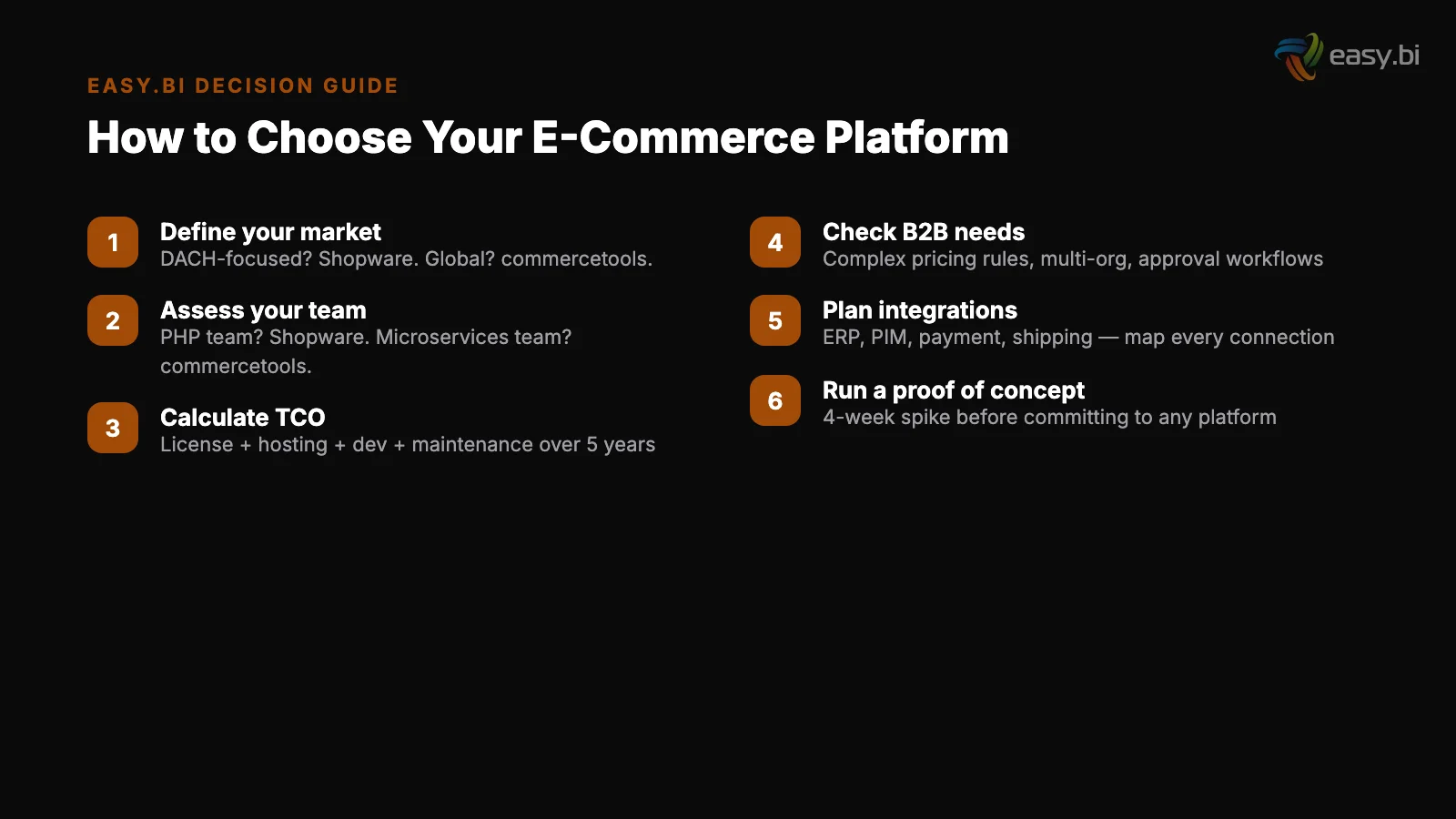
1. The demo trap. Every platform demos beautifully. Shopware shows a polished storefront in 20 minutes. commercetools shows lightning-fast API responses. Adobe Commerce shows a stunning B2B portal. None of these demos include your 15 legacy integrations, your complex pricing rules, or your team's actual skill level.
1. The demo trap
2. The feature checklist fallacy. Comparing 200 features in a spreadsheet tells you nothing about implementation quality. A platform might "support" multi-language, but implementing it for German, Austrian German, and Swiss German - with different VAT rules, payment preferences, and shipping providers - could take 6 months of custom work.
3. The reference bias. Vendor-provided reference customers had ideal conditions: clean data, simple integrations, experienced teams. Your reality - 12 legacy systems, 3 ERPs, incomplete product data - looks nothing like the reference case. Ask references what went wrong, not what went right.
The right evaluation process starts with a 2-week technical discovery: map every integration, document every business rule, assess your team's skills honestly. Then match those findings against platform capabilities.
This is the approach we use at easy.bi for every e-commerce project, and it prevents the most expensive mistake in e-commerce: choosing a platform that does not fit.
What Happens After You Choose?
Platform selection is step 2 of a longer process. If you have not read the full framework, start with our Enterprise E-Commerce Playbook. It covers architecture decisions, delivery methodology, SEO migration, and team structure end to end.
For the data behind platform migration failures, read Why 70% of E-Commerce Relaunches Fail. For a real-world example of enterprise e-commerce at scale, see E-Commerce at Scale: Lessons from REWE.
If you are currently evaluating platforms and want a second opinion based on your specific integration landscape, talk to someone who has implemented all three. No sales pitch. Just experience from 100+ projects.
References
- [1] Forrester - Reduce the Risk of Commerce Replatforming (2023)
- [2] EHI Retail Institute - E-Commerce Market Germany (2024)
- [3] Gartner - Digital Commerce Market Share (2023)
- [4] Forrester - Total Economic Impact of Composable Commerce (2023)
- [5] BuiltWith - E-Commerce Platform Trends (2024)
- [6] Lünendonk / commercetools - Composable Commerce in Germany (2024)
Ready to scale your e-commerce?
30-minute call with an engineering lead. No sales pitch - just honest answers about your project.
98% engineer retention · 14-day delivery sprints · No lock-in contracts
Related Reading

Shopware Plugin Development: Build vs Marketplace vs Custom
Shopware plugin development: marketplace vs custom vs extended. Decision framework, cost analysis, and 8-point quality checklist.
Christian Kaspar
How to Migrate From Magento to Shopware Without Losing SEO Rankings
Step-by-step Magento to Shopware migration framework that preserves SEO rankings. URL mapping, redirect strategy, data migration, and 90-day monitoring plan.
Filip Kralj
Shopware 6 vs Shopify Plus: Which Fits DACH Enterprise Retail?
Shopware 6 vs Shopify Plus for DACH enterprise retail: honest comparison of costs, DACH compliance, customization, and when each platform fits your business.
Enno Bassen