
Fixed-Price vs. Time-and-Materials: Which Model Will Not Blow Up

Table of Contents+
- Why Do Fixed-Price Software Projects Fail?
- Why Do Time-and-Materials Projects Blow Budgets?
- How Do the Two Models Compare Head to Head?
- What Does the Hybrid Model Look Like?
- How Do You Protect Your Budget in a T&M Engagement?
- When Should You Choose Fixed-Price?
- When Should You Choose Time-and-Materials?
- What Contract Clauses Protect Both Sides?
- What Does the Decision Matrix Look Like?
- What Mistakes Do DACH Companies Make When Choosing a Pricing Model?
- References
TL;DR
Fixed-price works for well-defined, stable scopes under EUR 100,000. Time-and-materials works for complex projects with evolving requirements. The best approach for most DACH mid-market companies is a hybrid: fixed-price discovery phase followed by time-and-materials sprints with weekly cost transparency and a monthly budget ceiling. The contract model matters less than the controls you put around it.
Key Takeaways
- •Fixed-price contracts carry higher failure risk on complex software because vendors protect margins by cutting quality - 9 out of 10 projects without proper controls experience budget overruns regardless of model.
- •Time-and-materials works for discovery and evolving requirements but needs weekly budget tracking, sprint-level cost caps, and a stop-loss threshold to prevent runaway spending.
- •Hybrid models - fixed sprint cost with flexible scope - give you the budget predictability of fixed-price with the adaptability of T&M, and 70% of agile projects already use a variant of this approach.
- •The contract model matters less than three controls: clear acceptance criteria per deliverable, weekly financial transparency, and a change request process with cost impact before approval.
- •For DACH mid-market companies, a phased approach works best: fixed-price discovery (EUR 15,000-40,000), then T&M sprints with a monthly cost ceiling.
Honest comparison of fixed-price and T&M contracts for software. When each fails, hybrid models, and how to protect budgets with real data.
You have been burned before. The fixed-price project that delivered half the features at double the timeline. Or the time-and-materials engagement where invoices kept climbing with no end in sight. Both models can fail spectacularly, but they fail for different reasons - and understanding those reasons is the key to choosing the right one.
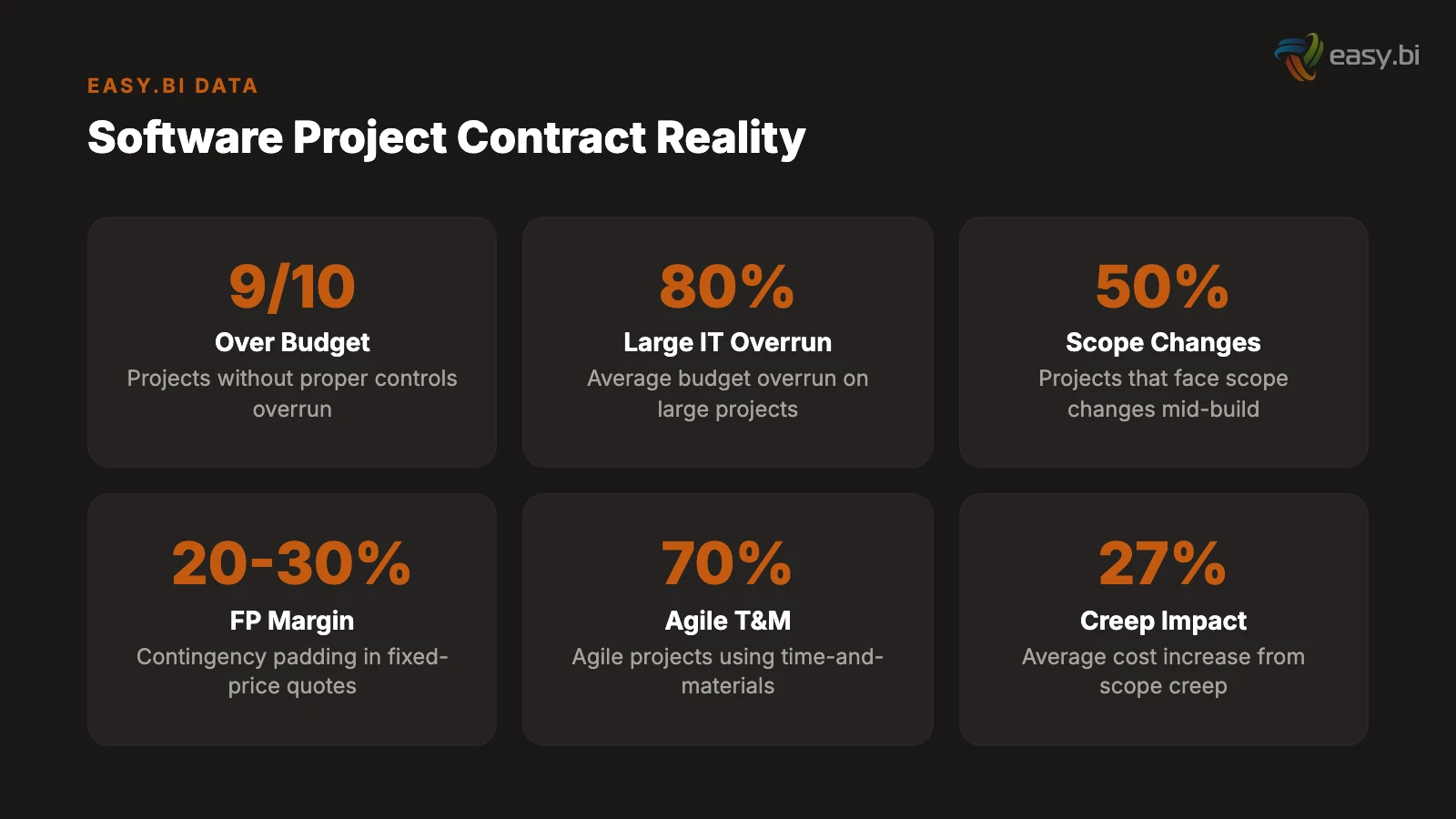
Nine out of 10 projects experience budget overruns without proper controls, and large IT projects commonly run 80% over budget.[1] The pricing model is not the primary cause of these overruns. The controls around the model are. This article breaks down when each model works, when each fails, and how a hybrid approach gives DACH mid-market companies the best of both worlds.
Why Do Fixed-Price Software Projects Fail?
Fixed-price contracts feel safe. A number on a contract. A scope document. A delivery date. The psychological comfort of knowing exactly what you will pay. But that comfort is an illusion for any project with technical uncertainty - which describes virtually every custom software project worth building.
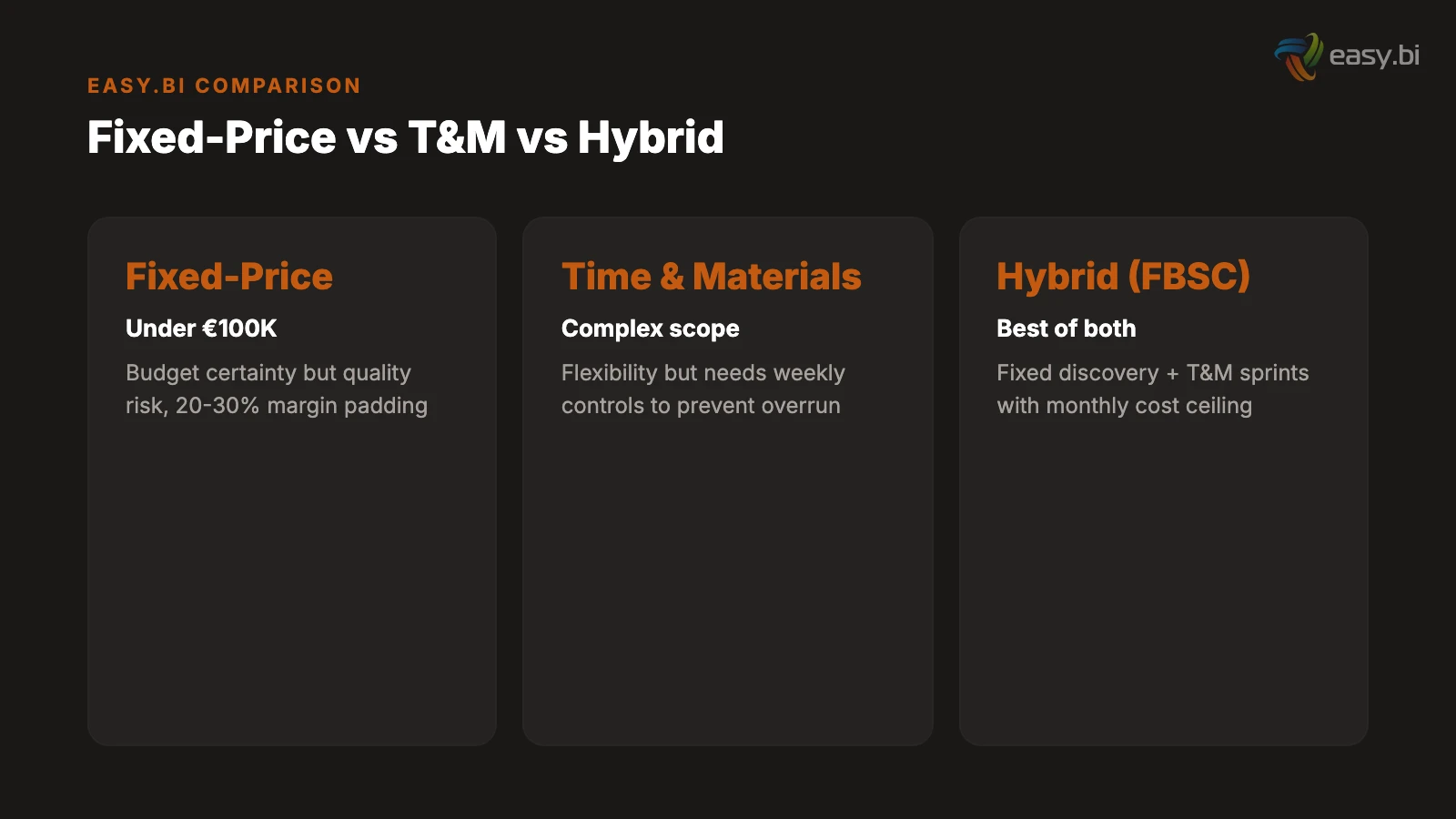
The mechanics of failure are straightforward. Vendors building against a fixed-price contract add a 20-30% contingency margin to cover unknowns.[2] You pay this margin whether the unknowns materialize or not. When the unknowns do materialize - and they always do on projects longer than 3 months - the vendor faces a choice: absorb the cost and lose money, or protect the margin by cutting quality.
Most vendors choose to protect the margin. With a fixed budget and timeline, quality becomes the only variable the vendor can control. This leads to less robust solutions, reduced testing, and shortcuts that create technical debt you will pay for in years 2 through 5.[3]
After 15 years of building backend systems, I have seen more projects fail from a fixed-price contract that incentivized corner-cutting than from any technical decision. The contract structure shapes behavior more than any code review process.
The Standish Group reports that nearly 50% of projects face scope changes during development.[4] In a fixed-price model, every scope change triggers a change request process: formal documentation, cost estimation, approval cycles, and schedule renegotiation. A change that would take 2 hours to implement takes 2 weeks to approve. The project slows to the speed of its contract administration.
Fixed-price also creates adversarial dynamics. The client wants more features. The vendor wants to deliver fewer features. Every ambiguity in the scope document becomes a negotiation. The relationship shifts from partnership to transaction, which is precisely the wrong dynamic for building complex software.
See how we deliver 60% faster time-to-market with 40% lower TCO than off-the-shelf.
Why Do Time-and-Materials Projects Blow Budgets?
Time-and-materials contracts solve the flexibility problem but create the accountability problem. Without a fixed price, there is no natural constraint on spending. The vendor bills for hours worked. If the project takes longer, the vendor earns more. This misalignment of incentives is the primary risk of T&M.
The failure mode is different from fixed-price but equally damaging. In T&M, projects do not fail through quality cuts - they fail through scope expansion. Every stakeholder request gets implemented because there is no financial constraint forcing prioritization. The project grows organically, costs accumulate monthly, and by the time the budget is exhausted, the core product is only 60% complete because 40% of the budget went to nice-to-have features.
Approximately 70% of agile projects use time-and-materials contracting.[3] This alignment with agile delivery is genuine - T&M contracts enable the iterative, adaptive approach that complex software requires. But agile without financial discipline is not agile. It is chaos with standups.
The specific risks of uncontrolled T&M:
- No budget ceiling. Without a contractual maximum, costs can exceed the original estimate by 50-100% before anyone raises an alarm.
- Velocity opacity. The client sees hours billed but cannot evaluate whether those hours produced proportional value. A sprint that costs EUR 25,000 delivers 10 features or 2 features - without visibility into velocity metrics, the client cannot tell the difference.
- Scope creep by accumulation. Individual requests seem small - "add this field," "change this workflow" - but they compound. PMI research shows 55% of projects experience scope creep, with an average cost impact of 27% above the original estimate.[5]
- Indefinite timelines. Without a fixed delivery date, projects can stretch indefinitely. The vendor has no financial incentive to finish, and the client has no contractual mechanism to enforce completion.
How Do the Two Models Compare Head to Head?
The comparison is not about which model is universally better. It is about which model fits your specific project characteristics. Here is a direct comparison across the dimensions that matter.
| Dimension | Fixed-Price | Time-and-Materials |
|---|---|---|
| Budget predictability | High (if scope holds) | Low (without controls) |
| Scope flexibility | Low - changes are costly and slow | High - changes are absorbed naturally |
| Vendor incentive alignment | Vendor minimizes effort to protect margin | Vendor has no incentive to finish |
| Quality risk | Higher - quality is the easiest cost to cut | Lower - no pressure to cut corners |
| Client involvement required | Low (hands-off after signing) | High (weekly review essential) |
| Best for project type | Well-defined, stable scope, under EUR 100K | Complex, evolving scope, discovery-heavy |
| Change request cost | 20-30% premium per change | Standard hourly rate |
| Risk of adversarial relationship | High - every ambiguity becomes a negotiation | Low - aligned on hours, not scope |
| Agile compatibility | Low - fixed scope contradicts iterative delivery | High - 70% of agile projects use T&M |
| Suited for DACH mid-market | Only for small, well-defined projects | Yes, with proper financial controls |
The fundamental tension: fixed-price gives you budget certainty at the cost of scope flexibility and quality. T&M gives you flexibility and quality at the cost of budget certainty. Neither model solves both problems simultaneously. That is why hybrid models exist.
What Does the Hybrid Model Look Like?
The hybrid approach combines fixed-price elements with T&M flexibility. Several variants exist, but the one that works best for DACH mid-market software projects is the "fixed sprint cost, flexible scope" model - sometimes called Fixed Budget, Scope Controlled (FBSC).[2]
Here is how it works in practice:
Phase 1: Fixed-price discovery. The initial discovery phase - business process mapping, integration inventory, architecture decisions, and sprint planning - is contracted at a fixed price. Typical cost: EUR 15,000-40,000 depending on project complexity. This phase produces a backlog, an architecture document, and a sprint-by-sprint delivery plan with cost estimates per sprint. For guidance on running this phase effectively, see our article on the discovery phase that saves you 6 months.
Phase 2: T&M sprints with a cost ceiling. Development sprints are billed on T&M, but with three controls:
- Sprint cost cap. Each two-week sprint has a maximum cost (typically EUR 20,000-40,000 depending on team size). The team commits to delivering the sprint backlog within this cap. If the sprint runs over, the team absorbs the first 10% overage and escalates anything beyond that.
- Monthly budget ceiling. A contractual maximum monthly spend prevents runaway costs. If the ceiling is EUR 60,000 per month and the team is trending above that, the project manager escalates before the overage occurs - not after.
- Quarterly review gates. Every quarter, the client and vendor review total spend against value delivered. This is the mechanism for course correction: adjust team size, reprioritize the backlog, or end the engagement if the value-to-cost ratio is unfavorable.
Phase 3: Fixed-price stabilization. The final phase - bug fixes, performance optimization, documentation, and handover - is contracted at a fixed price based on the known scope of work. By this point, the codebase is stable and well-understood, so fixed-price estimation is reliable.
This phased approach works because it matches the pricing model to the risk profile of each phase. Discovery has low uncertainty, so fixed-price is appropriate. Development has high uncertainty, so T&M with controls is appropriate. Stabilization has low uncertainty again, so fixed-price is appropriate.
How Do You Protect Your Budget in a T&M Engagement?
Budget protection in T&M requires active management - not contract clauses, not trust, not assumptions. Here are the five controls that prevent T&M from becoming an open-ended invoice stream.
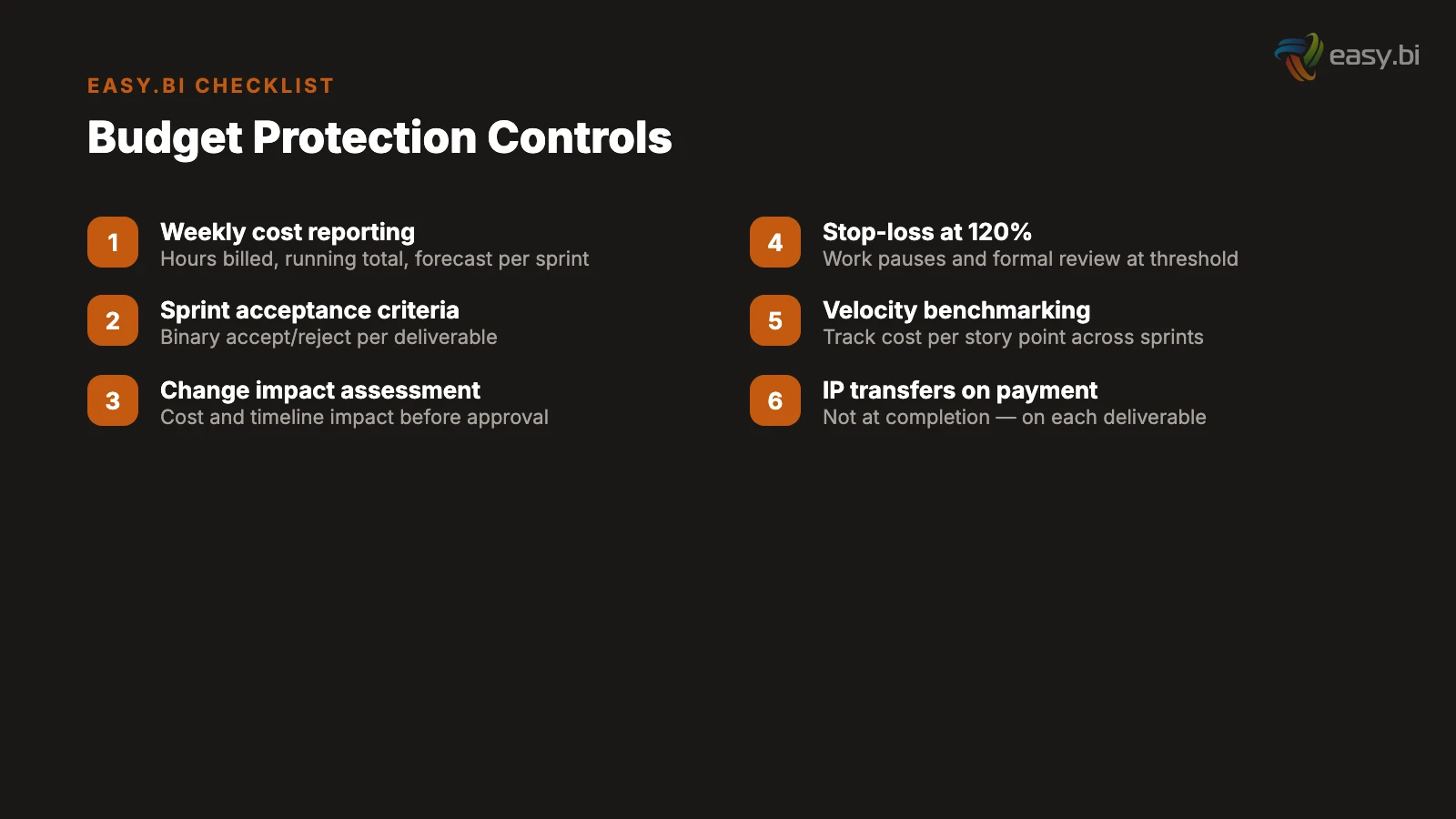
Control 1: Weekly cost reporting. Every Monday, the vendor provides a cost report showing: hours billed last week by team member, running total against the sprint budget, running total against the project budget, and a forecast of spend for the remaining sprints. This takes 30 minutes to produce and gives the client full financial visibility. If a vendor resists providing weekly cost reporting, that is a disqualifying red flag.
Control 2: Sprint-level acceptance criteria. Each sprint begins with a defined set of deliverables and acceptance criteria. At the end of the sprint, deliverables are accepted or rejected against those criteria. Rejected deliverables are reworked at the vendor's cost, not the client's. This creates accountability for output, not just input.
Control 3: Change impact assessment. Before any new requirement is added to the backlog, the vendor provides a cost and timeline impact assessment. The client sees exactly what the change will cost and what it will displace from the current plan. This transforms scope changes from invisible budget erosion into conscious trade-off decisions.
Control 4: Stop-loss threshold. Define a contractual threshold - typically 120% of the estimated total project cost - at which work pauses and a formal review occurs. This is the emergency brake. It ensures that even in the worst case, the project does not exceed 120% of budget without explicit approval from the client's executive sponsor.
Control 5: Velocity benchmarking. Track story points (or work packages) delivered per sprint and cost per story point. If cost per story point increases by more than 20% across 3 consecutive sprints, something is wrong - and you will catch it before it becomes a budget crisis.
When Should You Choose Fixed-Price?
Fixed-price is the right choice when five conditions are met simultaneously. If any one is missing, T&M or a hybrid model will deliver better outcomes.
Condition 1: The scope is fully defined and stable. Every feature, every integration, every business rule is documented and approved. The client commits to no changes during development. This is rare in practice but does occur for regulatory compliance projects, data migration projects, or rebuilds of existing systems where the requirements are already proven.
Condition 2: The project has fewer than three integrations. Each integration introduces uncertainty: API changes, data format mismatches, authentication complexity. Projects with more than three integrations almost always encounter surprises that break fixed-price estimates.
Condition 3: Total budget is under EUR 100,000. Fixed-price estimation accuracy degrades with project size. For projects under EUR 100,000, the vendor's contingency margin (20-30%) is manageable. For projects above EUR 250,000, that margin represents EUR 50,000-75,000 in padding that the client pays whether it is needed or not.
Condition 4: Timeline is under four months. Longer timelines mean more opportunity for requirements to change, team members to rotate, and external dependencies to shift. Fixed-price contracts older than four months almost always require renegotiation.
Condition 5: The technology is mature and well-understood. Building a CRUD application in Symfony with a PostgreSQL database? Fixed-price estimation is reliable. Building an AI-powered recommendation engine with a custom ML pipeline? No vendor can accurately estimate that at a fixed price. The estimation error will be absorbed by quality cuts.
50+ custom projects. 99.9% uptime. 60% faster.
Senior-only engineering teams deliver production-grade platforms in under 4 months. No juniors on your project.
Start with a Strategy CallWhen Should You Choose Time-and-Materials?
T&M is the right choice when the project involves genuine uncertainty - and you are willing to invest the management time to maintain financial discipline.
Discovery and prototyping phases. When you do not yet know what you are building, a fixed-price contract forces you to pretend you do. T&M lets you explore, prototype, test with users, and iterate without the overhead of change requests for every pivot.
Complex integration projects. Enterprise integrations with SAP, Salesforce, or legacy systems involve unpredictable complexity. A T&M model absorbs this uncertainty without forcing the vendor to pad estimates by 40-50% to account for the unknown.
Long-running product development. Products that evolve over 12-24 months need the flexibility to reprioritize based on user feedback, market changes, and business strategy shifts. A fixed-price contract for a 2-year product development is a fiction - the scope will change, and the contract will be renegotiated multiple times.
Team augmentation. When you need additional engineering capacity integrated into your existing team, T&M is the natural model. The work is directed by your product owner, follows your sprint cadence, and is evaluated by your quality standards. For a deeper look at how to structure external engineering partnerships, see our guide on evaluating a software development partner.
What Contract Clauses Protect Both Sides?
Regardless of pricing model, six contract clauses separate projects that succeed from projects that end in disputes.
1. Acceptance criteria per deliverable. Every work package, sprint, or milestone has documented acceptance criteria. Deliverables are "accepted" or "not accepted" - not "mostly done" or "needs a few tweaks." Binary acceptance prevents the ambiguity that causes 80% of contract disputes.
2. IP ownership transfer on payment. Intellectual property transfers to the client upon payment for each deliverable. Not at project completion. Not upon final payment. Upon payment for each delivered component. This protects the client if the engagement ends early and protects the vendor by ensuring payment before IP transfer.
3. Source code escrow or access. The client has access to the source code repository throughout development. If the vendor disappears, the client has the codebase. This is non-negotiable. Any vendor that restricts code access during development is creating artificial lock-in.
4. Warranty period with defined scope. A 3-6 month warranty period covering defects in delivered functionality. The warranty covers bugs - deviations from accepted requirements. It does not cover new features, changes in requirements, or issues caused by the client's modifications. Clear warranty scope prevents post-launch disputes.
5. Termination for convenience. Either party can terminate with 30 days notice. The client pays for work completed. The vendor delivers all code and documentation. This clause prevents both sides from being trapped in an engagement that is not working. It also reduces risk for the client, which paradoxically makes long-term engagements more likely.
6. Dispute resolution escalation. A defined escalation path: project manager discussion, executive sponsor discussion, mediation, then arbitration. Most disputes resolve at the first or second level when a formal escalation process exists. Without it, disputes go directly to lawyers, which is expensive and relationship-ending.
What Does the Decision Matrix Look Like?
Use this matrix to match your project characteristics to the right pricing model. Score each row, then follow the recommendation for the highest-scoring model.
| Project Characteristic | Points to Fixed-Price | Points to T&M | Points to Hybrid |
|---|---|---|---|
| Requirements are fully defined | Yes | - | - |
| Requirements will evolve during development | - | Yes | Yes |
| Budget under EUR 100,000 | Yes | - | - |
| Budget EUR 100,000-500,000 | - | - | Yes |
| Budget over EUR 500,000 | - | Yes | Yes |
| Timeline under 4 months | Yes | - | - |
| Timeline 4-12 months | - | - | Yes |
| Timeline over 12 months | - | Yes | - |
| Fewer than 3 integrations | Yes | - | - |
| 3 or more integrations | - | Yes | Yes |
| Client team available for weekly reviews | - | Yes | Yes |
| Client prefers hands-off engagement | Yes | - | - |
For most DACH mid-market software projects, the hybrid model scores highest. It provides the structure and budget controls that finance teams require, while preserving the flexibility that complex software projects demand. The key is not choosing the perfect model - it is implementing the right controls around whichever model you choose.
What Mistakes Do DACH Companies Make When Choosing a Pricing Model?
DACH procurement culture favors fixed-price contracts. German, Austrian, and Swiss companies are trained to negotiate a number, sign a contract, and hold the vendor accountable for delivery. This approach works for construction, manufacturing, and commodity procurement. It consistently fails for custom software because software development involves inherent uncertainty that fixed contracts cannot absorb.
Mistake 1: Choosing the model based on internal procurement rules rather than project characteristics. Many DACH enterprises require fixed-price contracts for any engagement above a certain threshold, regardless of the work being procured. This forces complex, uncertain software projects into a contract structure designed for predictable deliverables. The result: vendors pad estimates by 25-35% to absorb risk, and the client pays a premium for the illusion of certainty.
Mistake 2: Selecting the vendor with the lowest fixed-price bid. Fixed-price contracts inherently encourage selection based on the lowest bid rather than the highest capability.[3] The vendor who wins the bid is often the vendor who underestimated the complexity most aggressively - not the vendor best equipped to deliver. When that underestimation surfaces during development, the result is change requests, quality cuts, or a vendor asking to renegotiate terms.
Mistake 3: Treating T&M as a blank check. Companies that have been burned by fixed-price contracts sometimes swing to T&M without implementing any controls. The vendor bills monthly, the project manager approves invoices without scrutinizing velocity, and 12 months later the project has consumed 180% of the estimated budget with 70% of the features delivered. T&M requires active management. If the client does not have a product owner who reviews sprint output weekly, T&M will overrun.
Mistake 4: Switching models mid-project. Starting with fixed-price and switching to T&M when scope changes make the fixed price untenable is one of the most expensive transitions. The vendor re-estimates all remaining work at T&M rates (typically higher than the effective hourly rate embedded in the original fixed price), the client loses the budget certainty they were counting on, and the relationship trust erodes. Choose the right model upfront based on project characteristics, not on procurement defaults.
If you are evaluating pricing models for an upcoming project, our custom solutions team can walk you through the hybrid model structure and help you set up the financial controls that keep T&M engagements on track. For companies that have been burned by a fixed-price engagement, our article on building custom software that does not fail covers the full delivery framework that makes any pricing model work.
References
- [1] Acquaintsoft, "Eliminate Software Budget Overrun: 14 Facts and Statistics," , 20 acquaintsoft.com
- [2] Pragmatic Coders, "Which software development pricing model to choose? Fixed pri pragmaticcoders.com
- [3] BayTech Consulting, "Time and Materials vs. baytechconsulting.com
- [4] Pixeldust, "Fixed Fee or Time and Materials? How Pricing Models Predict Software pixeldust.net
- [5] PMI, "Pulse of the Profession - Scope Creep Research," , 2024. pmi.org
- [6] Atomic Object, "Fixed Price Software Development vs T&M vs Scope-Controlled," , atomicobject.com
- [7] Saigon Technology, "Fixed Price Software Development 2026: Comparison With Time saigontechnology.com
Explore Other Topics
Ready to build your custom platform?
30-minute call with an engineering lead. No sales pitch - just honest answers about your project.
98% engineer retention · 14-day delivery sprints · No lock-in contracts
Related Reading

Time and Materials vs. Fixed-Price Contracts: Why T&M is the Right Choice for Team Extension
Time and materials vs fixed price for team extension: why T&M aligns incentives on quality while fixed-price rewards cost-cutting that erodes teams.
Andrej Lovsin
How to Write a Software Requirements Document That Developers Actually Use
Traditional SRS documents fail 60% of the time. Learn the user story plus acceptance criteria format that developers actually use, with templates, common mistakes, and collaboration frameworks.
Christian Kaspar
How a German Manufacturer Cut Development Costs 40% by Switching Partners
Anonymized case study: a DACH manufacturer (300 employees) switched from a large consultancy to a mid-size partner, cutting development costs 40% and delivering 3x faster in 14-day sprints.
Andrej Lovsin