
Why Your Vendor Built You a Cage (And How to Get Out)

Table of Contents+
- How Does Vendor Lock-In Actually Work?
- The 5 Lock-In Patterns Every Enterprise Hits
- What Does Lock-In Cost You Beyond Licensing Fees?
- When Is Some Lock-In Acceptable?
- How Do Open Standards and API-First Architecture Break the Cage?
- What Does a Vendor Migration Actually Look Like?
- Building Future-Proof Systems From Day One
- References
TL;DR
In 10 years of building software for DACH enterprises, I have sat across the table from dozens of CTOs who described the same problem in different words: their technology vendor had become their technology jailer.
Key Takeaways
- •Vendor lock-in is not accidental - it is a deliberate business strategy. Proprietary data formats, closed APIs, custom scripting languages, and bundled pricing all serve the same purpose: making the cost of leaving higher than the cost of staying, regardless of whether the product still serves your needs.
- •The real cost of lock-in extends far beyond licensing. It includes opportunity cost (features you cannot build because the platform does not support them), talent cost (engineers who specialize in proprietary tools lose market value), and negotiation cost (your vendor knows you cannot leave, so every renewal becomes a price increase).
- •API-first architecture is the structural antidote to vendor lock-in. When every system communicates through documented, standard APIs, swapping one component for another becomes a integration project, not a migration crisis. API-first companies grow revenue 38% faster than those without an API strategy.
- •Some lock-in is acceptable when the value delivered justifies the switching cost. The question is not 'are we locked in' - every technology choice creates some dependency. The question is 'do we know the switching cost, and is it proportional to the value we receive?'
- •A vendor migration follows a predictable 4-phase pattern: audit (map all dependencies), design (architect the target state), migrate (move data and integrations incrementally), and decommission (turn off the old system only after the new one is proven). Rushing any phase multiplies risk.
Vendor lock-in costs DACH enterprises millions in switching costs, lost agility, and inflated licensing. Learn the 5 lock-in patterns, how to quantify the real cost, and practical strategies for escaping proprietary ecosystems using API-first architecture and open standards.
In 10 years of building software for DACH enterprises, I have sat across the table from dozens of CTOs who described the same problem in different words: their technology vendor had become their technology jailer.
The platform they chose 5 years ago to accelerate growth was now the primary obstacle to it. Licensing costs climbed every renewal. Feature requests disappeared into vendor roadmaps. Data sat in proprietary formats that no other system could read.
And every time they calculated the cost of switching, the number was large enough to justify staying one more year.
How Does Vendor Lock-In Actually Work?
Lock-in is not a bug in vendor business models - it is the central feature. Enterprise software vendors invest heavily in making their products indispensable, and the mechanics are well-documented. The pattern works because each layer of dependency reinforces the others.
First, the vendor provides genuine value. The platform solves a real problem, often faster than a custom-built alternative. The initial deployment succeeds. The team learns the tool. Business processes adapt to the platform's workflow. This is the legitimate phase - the product earns its place in your stack.
Then the dependencies compound. Your data lives in the vendor's format. Your team has invested hundreds of hours learning the vendor's proprietary configuration language. Your integrations depend on the vendor's API, which does not follow any open standard.
Your business processes have been reshaped to match the platform's assumptions rather than your actual needs.
By year 3, the switching cost exceeds the original implementation cost.
By year 5, it can exceed it by 3-5x. 62% of DACH enterprises use external IT service providers for at least part of their software development [1], and a significant portion of that spending goes toward maintaining or migrating vendor-locked systems.
The vendor knows this math. Every annual price increase is calibrated to be painful but cheaper than switching. This is rational business behavior on the vendor's part - but it is extractive behavior for the customer.
See how we deliver 60% faster time-to-market with 40% lower TCO than off-the-shelf.
The 5 Lock-In Patterns Every Enterprise Hits
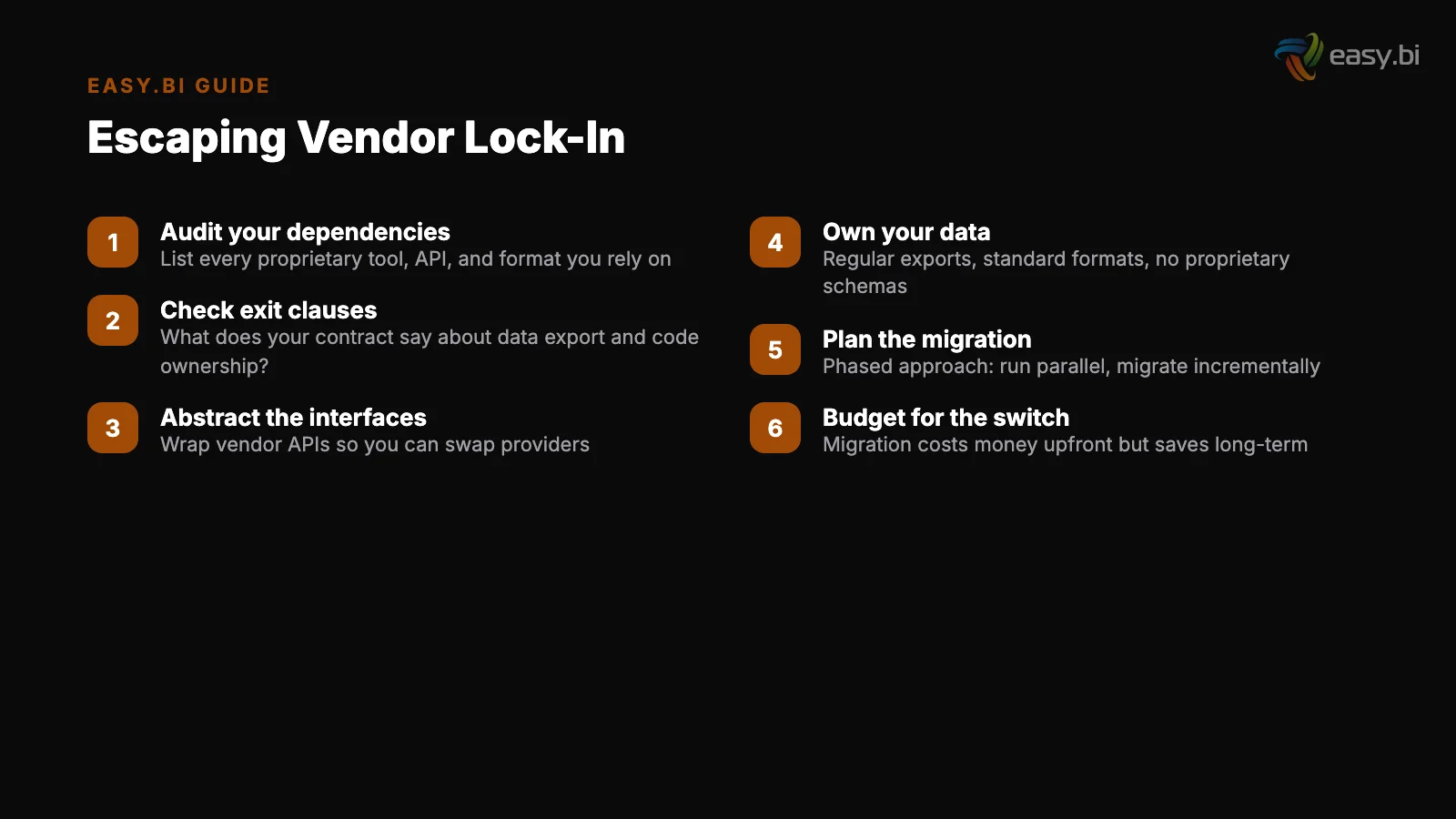
After helping dozens of organizations assess their vendor dependencies, I have identified 5 recurring patterns. Most enterprises experience at least 3 simultaneously.
| Pattern | How It Works | What It Costs You |
|---|---|---|
| Data Format Lock-In | Your data is stored in proprietary formats that cannot be exported to standard formats without loss | Migration requires expensive data transformation; some data may be unrecoverable |
| API Lock-In | Integrations depend on proprietary APIs with no equivalent in open standards | Every integration must be rebuilt from scratch during migration |
| Skill Lock-In | Your team has specialized in the vendor's proprietary tools, reducing their market portability | Hiring becomes vendor-specific; engineers lose career flexibility |
| Process Lock-In | Business workflows have been redesigned around the platform's assumptions | Migration requires process re-engineering, not just technology replacement |
| Contract Lock-In | Multi-year agreements, auto-renewal clauses, and volume commitments | Early termination penalties; data export fees; reduced negotiation leverage |
Data Format Lock-In is the most technically damaging. When your customer records, transaction history, and business logic live in a proprietary database schema with proprietary data types, extracting them is not a simple export.
I have seen migration projects where 20% of the total budget went to data transformation alone - converting vendor-specific formats into standard structures that the new system could consume.
Data Format Lock-In
API Lock-In is the most operationally disruptive. A mid-market enterprise typically has 15-30 integrations running through a central platform. If those integrations use proprietary connector protocols rather than standard REST or GraphQL endpoints, each one becomes a separate migration project.
API-first companies grow revenue 38% faster than companies that do not adopt an API strategy [2] - partly because they avoid this exact trap.
Skill Lock-In is the most insidious because it affects people, not systems. When your best engineers have spent 3 years mastering a proprietary scripting language that only one vendor uses, their skills become a sunk cost that makes switching psychologically difficult.
The team advocates for staying - not because the platform is the best choice, but because leaving would devalue their expertise.
What Does Lock-In Cost You Beyond Licensing Fees?
The license fee is the number everyone focuses on. It is also the smallest component of total lock-in cost. The real costs are harder to see but far larger.
Innovation opportunity cost: Every feature your roadmap cannot deliver because the vendor platform does not support it represents lost revenue or lost efficiency.
When a competitor ships a capability that your platform cannot replicate, the gap is not technical - it is strategic. 70% of digital transformations fail to reach their stated goals [3], and platform limitations are a frequently cited contributing factor.
Innovation opportunity cost
Negotiation asymmetry: When your vendor knows you cannot leave, every contract renewal becomes a price increase. The industry average cost overrun on software projects is 66% [4] - and that includes the premium organizations pay when they have no negotiating leverage with their vendors.
Talent market narrowing: Proprietary platforms shrink your hiring pool. Instead of hiring from the global population of engineers who know Python, JavaScript, or Java, you hire from the much smaller pool who know your vendor's specific ecosystem.
In a DACH market already facing a shortage of 149,000 IT specialists [5], narrowing your talent pool further is a strategic risk.
Negotiation asymmetry
Architectural rigidity: Vendor platforms impose architectural decisions that may conflict with your evolving needs. When your business requires real-time event processing and your platform is built for batch operations, you do not have an engineering problem - you have a vendor lock-in problem wearing an engineering disguise.
The most expensive software decision is not the one you make today - it is the one you made 5 years ago that you cannot reverse. Every year you delay addressing lock-in, the switching cost grows while the value delivered stays flat or declines.
When Is Some Lock-In Acceptable?
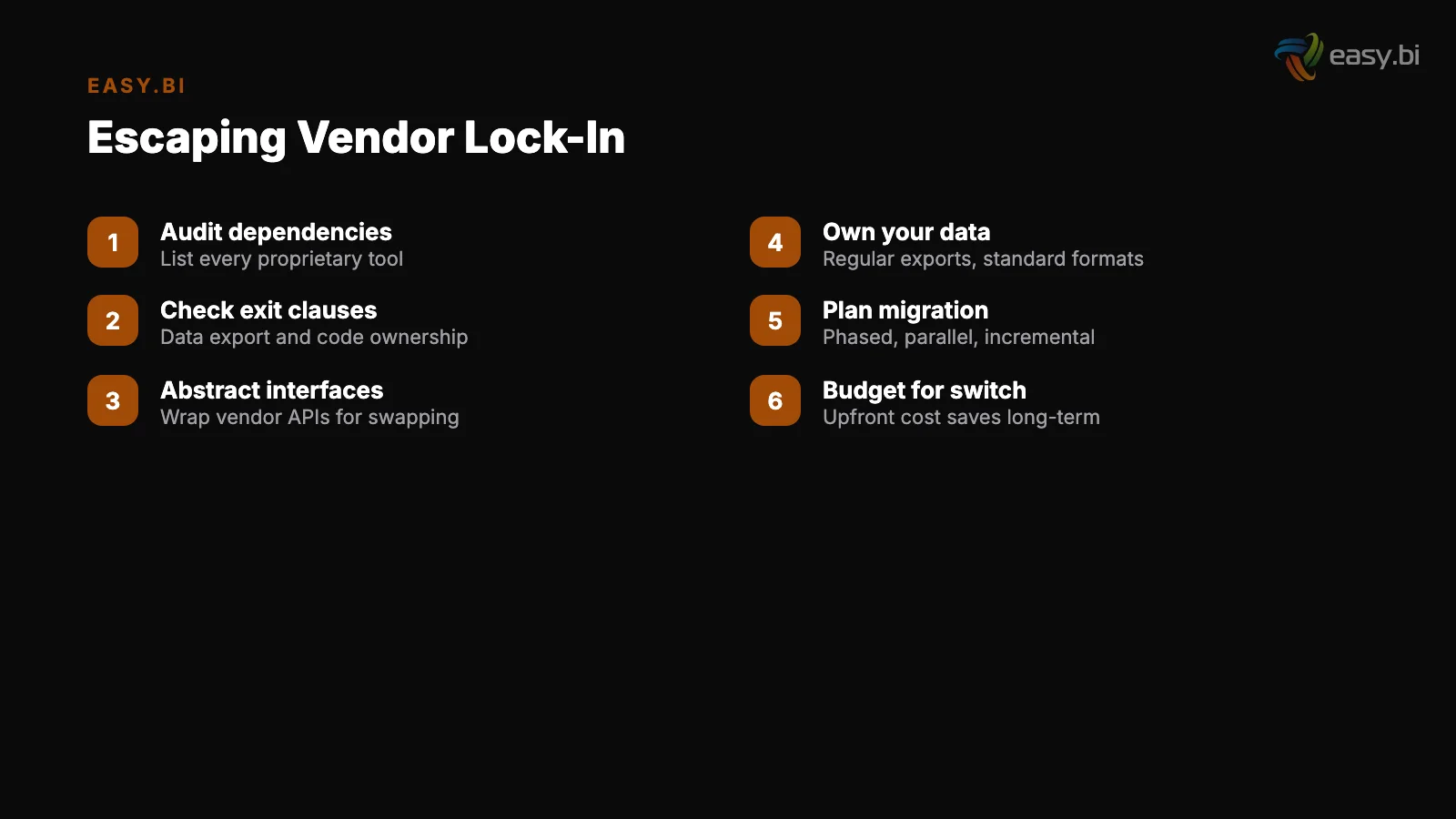
I want to be clear: not all vendor dependency is a problem. Zero lock-in is neither achievable nor desirable. Every technology choice creates some switching cost. The question is whether the switching cost is proportional to the value received.
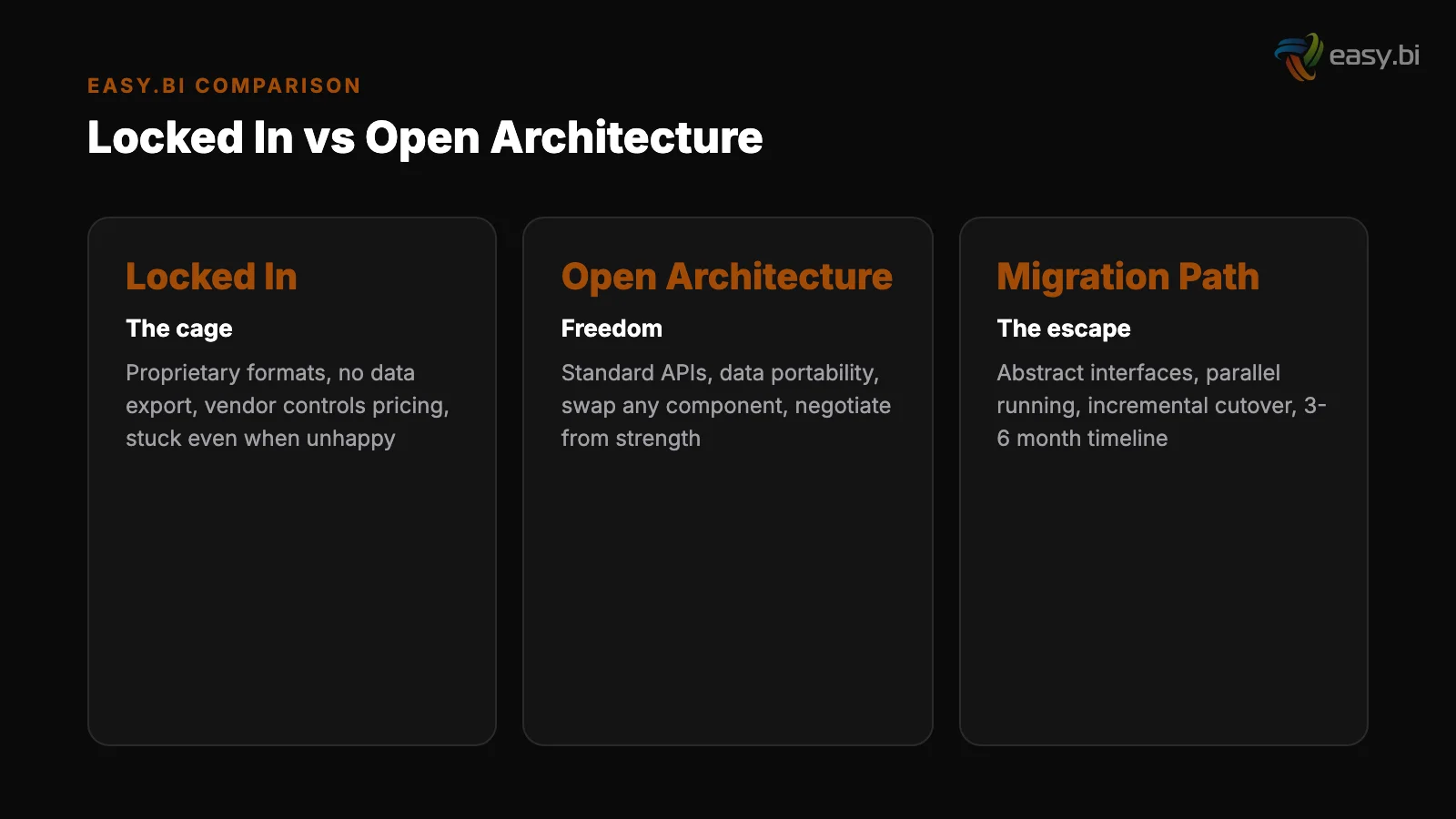
Lock-in is acceptable when:
- The vendor delivers genuine, measurable value that exceeds the total cost of ownership including switching costs. If your Shopware implementation drives 30% of company revenue and the platform continues to evolve in alignment with your needs, the dependency is a feature, not a bug.
- The switching cost is known and tracked. You have estimated what it would cost to migrate, and you review that estimate annually. The danger is not dependency itself - it is unquantified dependency where the switching cost is a mystery until you actually try to leave.
- Contractual protections exist. Your contract includes data portability clauses, API stability guarantees, and reasonable termination terms. These do not eliminate lock-in, but they cap its maximum cost.
- Alternatives exist and are viable. If 3 competing platforms could replace yours within 6 months, your lock-in risk is lower than if you are using the only platform in the market that supports your specific workflow.
Lock-in becomes unacceptable when the vendor relationship shifts from partnership to extraction - when prices rise without corresponding value increases, when the vendor's roadmap diverges from your needs, or when your engineers spend more time working around platform limitations than building on platform capabilities.
How Do Open Standards and API-First Architecture Break the Cage?
The structural defense against lock-in is architecture that separates your business logic from any single vendor's implementation. API-first architecture and adherence to open standards make this separation possible at every layer of the stack.
API-first means every component communicates through documented, versioned, standards-based APIs. Your data layer exposes data through REST or GraphQL endpoints that any client can consume. Your business logic runs in services that communicate through standard protocols. Your integrations use published API specifications that multiple vendors can implement.
Open standards at the data layer
When every interface is standardized, swapping one component becomes an integration project scoped to that component's API surface - not a full system migration. Your payment provider's REST API can be replaced with any other provider that implements the same API contract.
Your data warehouse can switch from one cloud provider to another because the data is stored in open formats (Parquet, JSON, PostgreSQL) rather than proprietary structures.
Open standards at the data layer are equally important. PostgreSQL instead of proprietary databases. Parquet or CSV for data interchange. OpenAPI for API documentation. OAuth 2.0 for authentication. Each standard choice is one fewer proprietary dependency - one fewer cage bar.
Infrastructure as Code
Infrastructure as Code reduces cloud provider lock-in.
When your infrastructure is defined in Terraform or Pulumi rather than a provider-specific console, migrating between cloud providers becomes a code change rather than a re-architecture. 89% of IT leaders say technical debt impacts their ability to innovate [6] - and vendor-locked infrastructure is one of the most expensive forms of technical debt.
The practical implication: every architectural decision should include a "switching cost assessment." Before adopting a vendor component, estimate the cost of replacing it in 3 years.
If that cost is disproportionate to the value delivered, choose an alternative with lower switching costs - or accept the lock-in explicitly with contractual protections.
50+ custom projects. 99.9% uptime. 60% faster.
Senior-only engineering teams deliver production-grade platforms in under 4 months. No juniors on your project.
Start with a Strategy CallWhat Does a Vendor Migration Actually Look Like?
When the decision to migrate is made, the execution follows a 4-phase pattern. Rushing any phase multiplies risk and cost.
Phase 1: Audit (2-4 weeks). Map every dependency on the current vendor - data formats, API integrations, business processes, team skills, contractual obligations, and downstream systems. The goal is a complete dependency graph with estimated switching costs for each node.
This audit frequently reveals dependencies that nobody knew about - a scheduled report that feeds a critical business process, a data export that compliance depends on, an integration that was set up by someone who left the company 3 years ago.
Phase 1: Audit (2-4 weeks)
Phase 2: Design (2-4 weeks). Architect the target state. Define which components will be replaced, which will be retained, and how data will be migrated. The critical decision here is sequencing - which components can be migrated independently and which have dependencies that require coordinated migration.
Design the target architecture API-first so you do not build a new cage while escaping the old one.
Phase 3: Migrate (8-16 weeks). Execute the migration incrementally. The strangler fig pattern works as well for vendor migration as it does for code refactoring. Run the old and new systems in parallel. Route traffic progressively to the new system. Validate data integrity at every step.
Do not set a hard cutover date - let the parallel operation continue until confidence in the new system is established through production usage.
Phase 2: Design (2-4 weeks)
Phase 4: Decommission (2-4 weeks). Turn off the old system only after the new one has been proven in production for a defined period - typically 2-4 sprints. Archive all data from the old system in open formats. Document lessons learned for future vendor evaluations.
The total timeline of 14-28 weeks may seem long for a migration. But compare it to the cost of staying in a vendor cage for another 3-5 years with compounding licensing costs and declining agility. The migration is almost always the better investment.
Building Future-Proof Systems From Day One
The cheapest way to escape vendor lock-in is to avoid building the cage in the first place.
This does not mean avoiding vendors - it means choosing them with switching costs as a primary evaluation criterion and architecting your systems so that no single vendor becomes a single point of failure.
At easy.bi, we apply three principles to every architecture decision:
Principle 1: Own your data
Principle 1: Own your data. Client data lives in client-controlled databases using open formats. If the engagement ends tomorrow, the client walks away with their complete data in a format that any competent engineering team can work with.
Principle 2: Interface through standards. Every integration uses standard protocols and documented APIs. Proprietary connectors are avoided unless the value is overwhelming and the switching cost is documented and accepted.
Principle 3: Build for replaceability. Every component in the architecture has a documented replacement path. Not because we plan to replace it, but because the existence of that path keeps vendor relationships honest and switching costs bounded.
Principle 2: Interface through standards
These principles do not add cost to the initial build. They add discipline. And that discipline is what separates systems that serve their owners for a decade from systems that trap their owners for a decade.
For the complete framework on building custom software that avoids the most common failure modes - including vendor dependency - read our pillar guide on building custom software that does not fail. For a deep dive on the architectural pattern that makes vendor independence possible, see API-first architecture.
And to understand how technical debt and vendor lock-in often compound each other, read technical debt as a business decision.
If you suspect your current vendor relationship has shifted from partnership to extraction, we can help you map the dependencies, quantify the switching costs, and build an escape plan. Start with our custom solutions assessment - the first step is understanding exactly how deep the cage goes.
References
- [1] Lünendonk (2024). "62% of DACH enterprises use external IT service providers for luenendonk.de
- [2] MuleSoft / Salesforce (2023). "API-first companies grow revenue 38% faster. mulesoft.com
- [3] McKinsey (2023). "70% of digital transformations fail to reach their stated goal mckinsey.com
- [4] PMI (2024). "The average cost overrun on software projects is 66% of original bu pmi.org
- [5] Bitkom (2024). "Germany faces a shortage of 149,000 IT specialists." bitkom.
- [6] McKinsey (2024). "89% of IT leaders say technical debt impacts their ability to mckinsey.com
Explore Other Topics
Ready to build your custom platform?
30-minute call with an engineering lead. No sales pitch - just honest answers about your project.
98% engineer retention · 14-day delivery sprints · No lock-in contracts
Related Reading
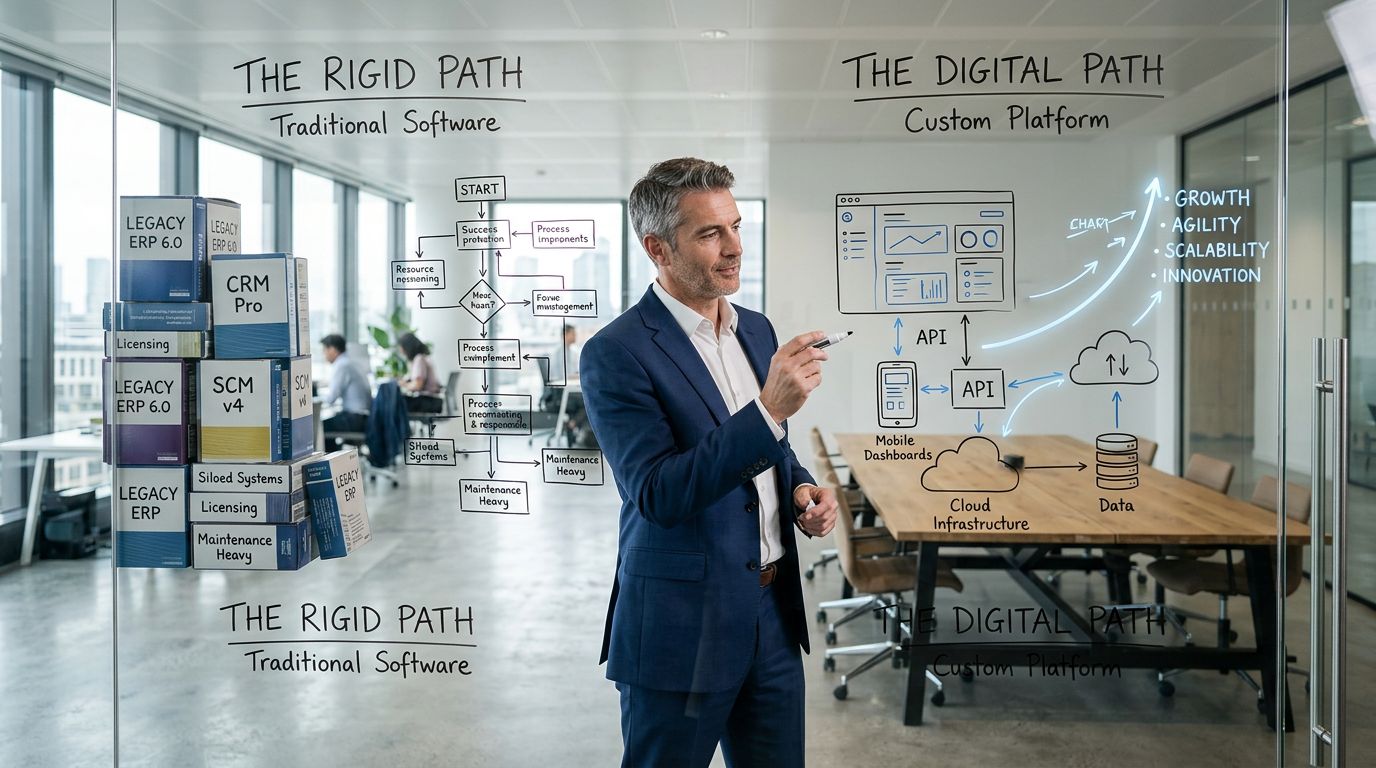
When Does Off-the-Shelf Software Start Costing You More Than Custom?
Off-the-shelf software hides costs in customization fees, per-seat pricing, and workaround labor. Learn when custom becomes 40% cheaper.
Andrej Lovsin
How AI Is Reshaping Enterprise Software Development
AI is changing how enterprise software gets built. Learn how agentic frameworks, automated QA, and AI-assisted architecture are cutting development timelines by 40%.
Filip Kralj
The Discovery Phase That Saves You 6 Months
Projects with clear requirements upfront are 97% more likely to succeed. Learn what a proper software discovery phase includes - stakeholder interviews, technical audits, architecture decisions - and why skipping it costs 6 months and 66% of your budget.
Andrej Lovsin