
How Much Does a Shopware Enterprise Build Cost in 2026?

Table of Contents+
- Why Is Nobody Transparent About Shopware Enterprise Costs?
- What Does a Basic Shopware 6 Store Actually Cost?
- What Drives a Mid-Market Build to EUR 60K-150K?
- What Does a Full Enterprise Shopware Build Look Like?
- How Do Cost Tiers Compare Side by Side?
- Where Do the Hidden Costs Come From?
- How Does a Sprint-Based Model Reduce Cost Overruns?
- What Is the Real Cost of NOT Upgrading?
- When Is Shopware NOT the Right Choice?
- What Should You Budget for a Shopware Enterprise Project?
- How Do You Start Without Wasting Money?
- References
TL;DR
A Shopware 6 enterprise build in 2026 costs between EUR 30,000 and EUR 500,000+, depending on integrations, custom features, and data migration complexity. Basic stores run EUR 30,000-60,000. Mid-market projects with ERP connections land at EUR 60,000-150,000. Full enterprise builds start at EUR 150,000 and regularly exceed EUR 500,000.
Key Takeaways
- •Shopware 6 enterprise builds in the DACH market range from EUR 30,000 for a basic store to EUR 500,000+ for complex multi-channel enterprise projects with deep ERP and PIM integrations.
- •The top 3 cost drivers are integrations (ERP, PIM, CRM), custom feature development, and data migration from legacy systems - together accounting for 50-70% of total project cost.
- •Hidden costs that blow budgets include Shopware licensing (EUR 2,495/month for Evolve plan), hosting infrastructure (EUR 500-5,000/month), SEO migration, and year-one maintenance at 15-20% of build cost.
- •A 14-day sprint delivery model with fixed-scope increments reduces cost overruns by 40-60% compared to traditional waterfall agency contracts with vague timelines and change-order billing.
- •The cost of NOT upgrading is measurable: legacy e-commerce platforms lose 7% of revenue annually through slower page loads, poor mobile experience, and inability to support modern checkout flows.
Shopware enterprise builds cost EUR 30K to 500K+ in 2026. Transparent breakdown of cost tiers, hidden fees, and what drives budget overruns in DACH.
A Shopware 6 enterprise build in 2026 costs between EUR 30,000 and EUR 500,000+, depending on integrations, custom features, and data migration complexity. Basic stores run EUR 30,000-60,000. Mid-market projects with ERP connections land at EUR 60,000-150,000. Full enterprise builds start at EUR 150,000 and regularly exceed EUR 500,000.
Why Is Nobody Transparent About Shopware Enterprise Costs?
Search for "Shopware enterprise cost" and you get agency landing pages with "contact us for a quote" buttons. No numbers. No ranges. No breakdown of what drives the bill from EUR 50K to EUR 500K.
There is a reason for this opacity. Agencies profit from information asymmetry. When you do not know what a project should cost, you cannot negotiate effectively. You cannot benchmark proposals. You accept the first number you receive because you have no reference point.
The result: 66% of enterprise software projects exceed their original budget[1]. E-commerce replatforming projects are worse - Gartner reports that 83% of data migration projects either fail or exceed their budgets and timelines[2]. The DACH market is no exception. In my experience running sales and product for easy.bi, the most common scenario is a company that received a EUR 80K quote, approved it, and ended up paying EUR 140K after scope changes, integration surprises, and "we did not account for that" conversations.
This post exists to fix that. Every number here comes from real DACH market project data, published benchmarks, and Shopware's own pricing. You will know exactly what to budget before your first agency call.
See how our team delivers +35% avg conversion lift across 30+ e-commerce projects.
What Does a Basic Shopware 6 Store Actually Cost?
A basic Shopware 6 store - standard theme, up to 1,000 SKUs, one language, one currency, basic payment and shipping integrations - costs EUR 30,000-60,000 in the DACH market.
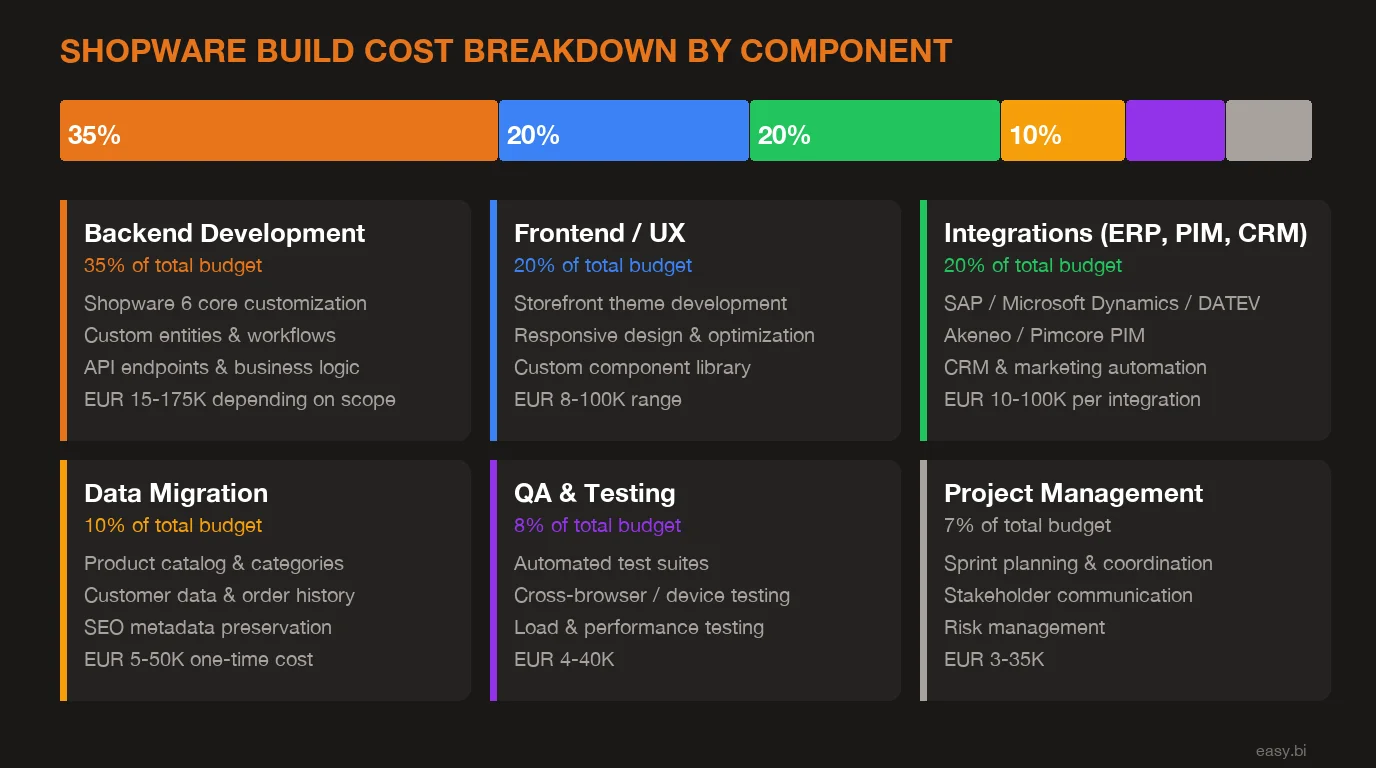
That breaks down as follows: EUR 8,000-15,000 for design and frontend customization, EUR 10,000-20,000 for backend setup, configuration, and basic integrations, EUR 5,000-10,000 for content migration and setup, and EUR 7,000-15,000 for testing, launch preparation, and project management. These numbers assume you are using a commercial Shopware theme (EUR 1,500-4,000 one-time) rather than a fully custom design.
The Shopware plugin ecosystem covers most standard needs. With 4,000+ extensions in the Shopware Store[3], basic functionality like product reviews, SEO tools, and standard payment gateways costs EUR 50-500 per plugin rather than custom development. For simple D2C stores, this tier delivers a production-ready shop in 8-12 weeks.
One common mistake at this tier: underestimating design costs. A EUR 1,500 theme still needs EUR 5,000-8,000 in customization to match your brand. Companies that skip this step launch with a store that looks like every other Shopware installation - and their conversion rates reflect it. The average e-commerce conversion rate sits at 2.5-3.0%, but stores with custom-tailored UX consistently hit 4-5% in the DACH market.
What Drives a Mid-Market Build to EUR 60K-150K?
The jump from basic to mid-market comes from three factors: ERP integration, custom business logic, and multi-language or multi-currency requirements.
ERP integration alone accounts for EUR 15,000-40,000 of the total budget. Connecting Shopware 6 to SAP Business One, Microsoft Dynamics, or DATEV requires bidirectional data sync for orders, inventory, customers, and pricing. 73% of organizations are investing in integration technologies to break down data silos[4], and the complexity of these connections is routinely underestimated in initial quotes.
Custom checkout flows, B2B pricing rules, and product configurators add EUR 10,000-30,000 each. A manufacturer selling configurable products with quantity-based pricing and customer-specific catalogs needs custom rule builders that go beyond Shopware's out-of-the-box capabilities. Multi-language setups (German, English, French for a DACH+EU operation) add EUR 5,000-15,000 for translation workflows, hreflang setup, and locale-specific payment methods.
At this tier, project timelines extend to 3-6 months. The 14-day sprint model that easy.bi uses becomes critical here - each sprint delivers a working increment, so you see progress every two weeks instead of waiting 4 months for a big reveal that misses the mark.
What Does a Full Enterprise Shopware Build Look Like?
Enterprise builds (EUR 150,000-500,000+) involve deep system integration, custom feature development, and complex data migration. These are projects for companies doing EUR 10M+ in annual online revenue with existing ERP, PIM, CRM, and warehouse management systems that all need to talk to Shopware.
The integration layer alone runs EUR 40,000-120,000. A typical enterprise stack connects Shopware to SAP S/4HANA or Microsoft Dynamics 365 (ERP), Akeneo or Pimcore (PIM), Salesforce or HubSpot (CRM), and a warehouse management system. Each integration requires mapping data models, handling conflict resolution, building retry logic, and testing edge cases. The average enterprise uses 130+ SaaS applications[5], and every touchpoint with the e-commerce platform adds cost.
Custom B2B portals with role-based access, approval workflows, and customer-specific pricing add EUR 30,000-80,000. Data migration from legacy platforms - including product data, customer histories, order archives, and URL structures for SEO - runs EUR 20,000-60,000 depending on data quality. Poor data quality costs organizations an average of USD 12.9 million per year[6], and migration is where that bad data becomes your problem.
Performance engineering is another cost center at this tier. Enterprise stores handling 50,000+ daily sessions need Elasticsearch configuration, Redis caching layers, CDN setup, and load testing. Shopware 6 performs well under load when properly configured, but "properly configured" is the operative phrase. Budget EUR 10,000-25,000 for performance optimization and load testing if you expect traffic spikes during campaigns or seasonal peaks. Black Friday traffic in the DACH market grew 28% year-over-year in 2025, and stores that cannot handle the spike lose revenue in the hour that matters most.
How Do Cost Tiers Compare Side by Side?
| Component | Basic (EUR 30-60K) | Mid-Market (EUR 60-150K) | Enterprise (EUR 150-500K+) |
|---|---|---|---|
| Design/Frontend | EUR 8-15K (theme-based) | EUR 15-35K (custom design) | EUR 30-80K (fully custom, headless option) |
| Backend/Config | EUR 10-20K | EUR 20-40K | EUR 40-100K |
| Integrations | EUR 2-5K (payment, shipping) | EUR 15-40K (ERP, basic PIM) | EUR 40-120K (ERP, PIM, CRM, WMS) |
| Data Migration | EUR 2-5K | EUR 5-15K | EUR 20-60K |
| Testing/QA | EUR 3-5K | EUR 5-15K | EUR 15-40K |
| Project Management | EUR 3-8K | EUR 8-20K | EUR 20-50K |
| Timeline | 8-12 weeks | 3-6 months | 6-12 months |
| Shopware License | Community (free) or Rise | Evolve (EUR 2,495/mo) | Beyond (custom pricing) |
Where Do the Hidden Costs Come From?
The project quote is not the total cost. Four categories of hidden costs consistently surprise buyers in the DACH market.
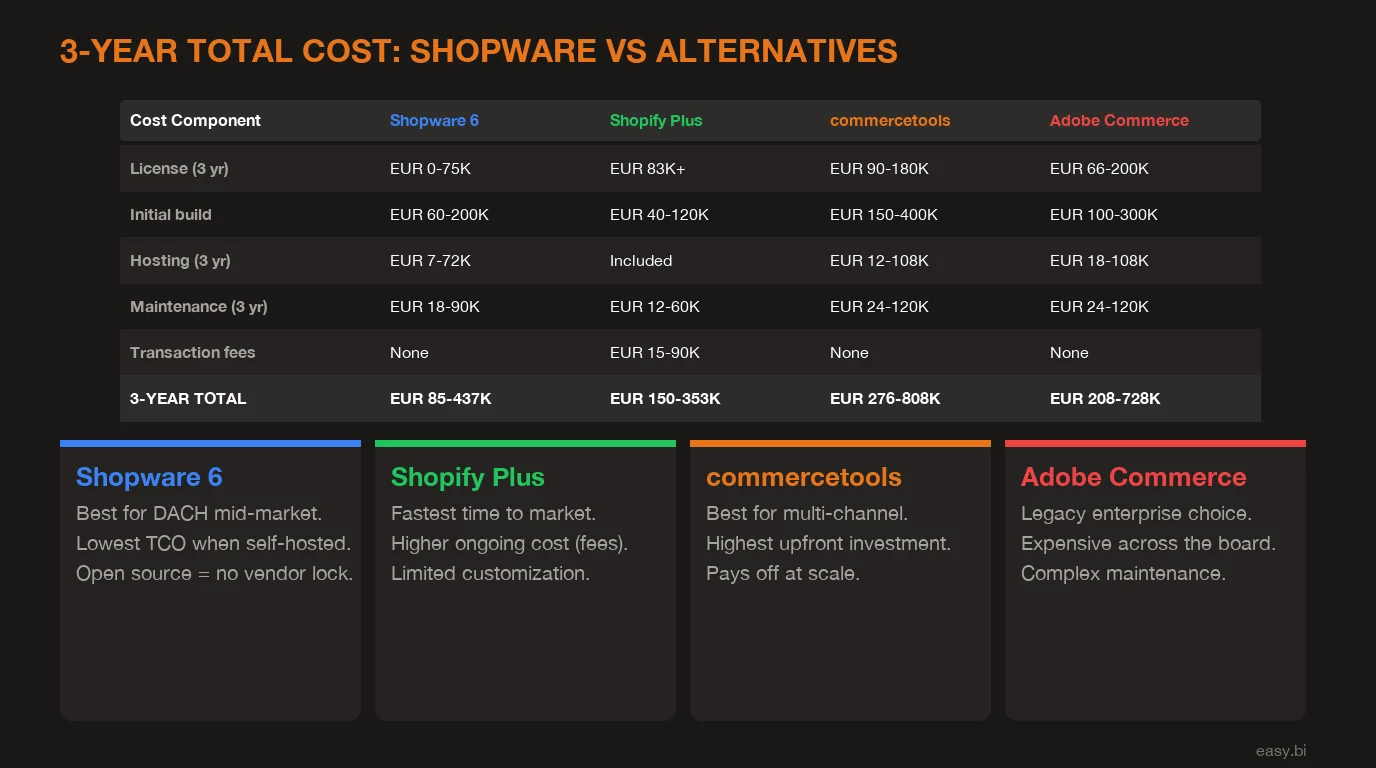
Shopware licensing. The Community Edition is free, but enterprise features require commercial plans. Rise costs EUR 600/month, Evolve costs EUR 2,495/month, and Beyond uses custom pricing. Over 3 years, Evolve licensing alone totals EUR 89,820 - a number that rarely appears in initial project quotes. Worldwide, enterprise software spending is projected to reach USD 1.24 trillion in 2025[7], and licensing is a growing share of that.
Hosting and infrastructure. Shopware 6 on Symfony requires proper hosting. Shared hosting does not cut it for enterprise. Managed cloud hosting (AWS, Hetzner Cloud, or Shopware's own cloud) runs EUR 500-5,000/month depending on traffic, redundancy, and performance requirements. Annual hosting: EUR 6,000-60,000.
SEO migration. If you are replatforming, every URL that changes without a proper 301 redirect costs organic traffic. 53% of all website traffic comes from organic search[8]. A botched SEO migration can wipe out 30-60% of organic traffic for 6-12 months. Proper migration with URL mapping, redirect implementation, and monitoring costs EUR 5,000-15,000 - but skipping it costs far more in lost revenue.
Year-one maintenance. Plan for 15-20% of the initial build cost annually. A EUR 150K build needs EUR 22,500-30,000/year for security patches, Shopware version updates, plugin compatibility fixes, and minor feature additions. This is not optional - Shopware releases major updates regularly, and falling behind creates security vulnerabilities and technical debt.
Add these four categories together for a mid-market build: EUR 29,940/year licensing (Evolve), EUR 18,000/year hosting, EUR 10,000 SEO migration (one-time), and EUR 18,000-24,000/year maintenance. That is EUR 65,940-71,940 in year-one costs on top of the build itself. Over 3 years, total cost of ownership for a EUR 120K build reaches EUR 310,000-350,000. This is the number your CFO needs to see - not just the project quote.
How Does a Sprint-Based Model Reduce Cost Overruns?
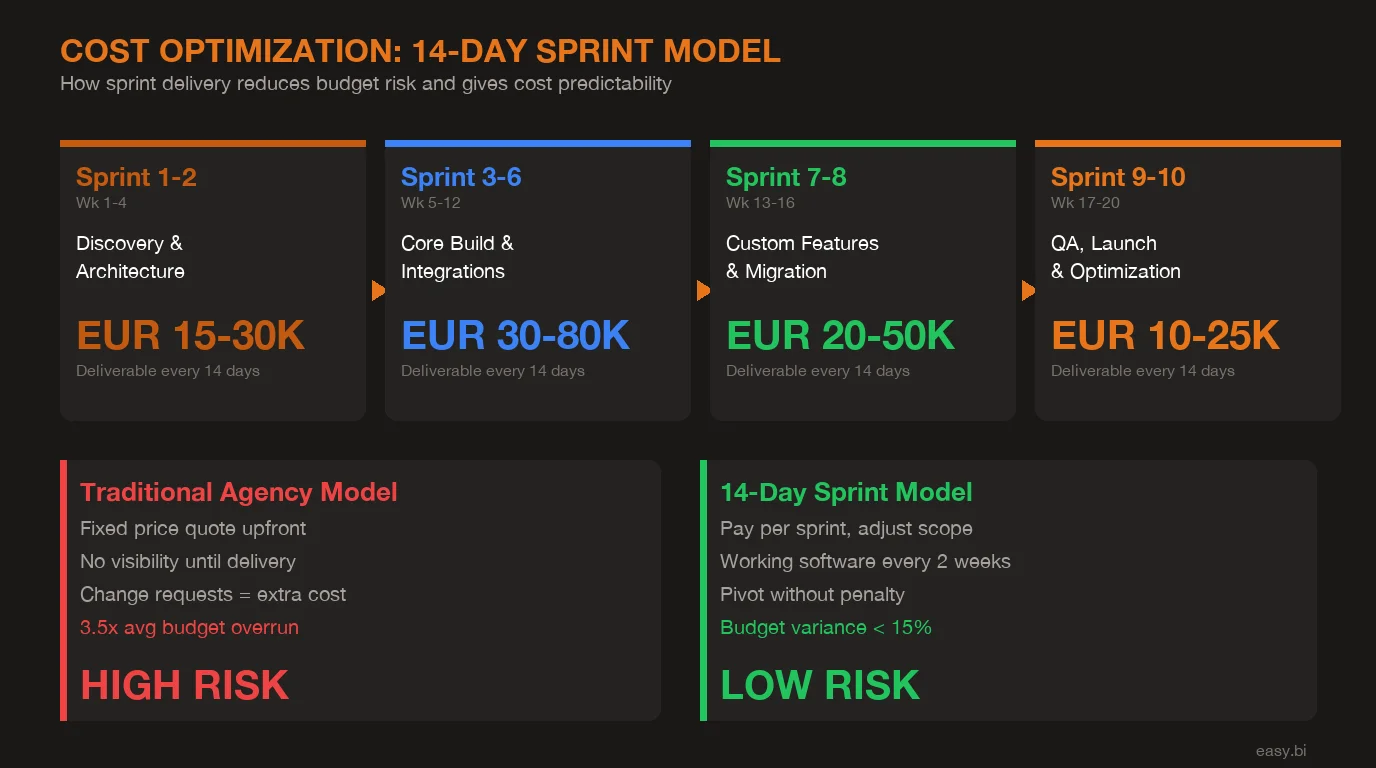
The traditional agency model works like this: you get a quote, sign a contract, wait 4-6 months, and receive a finished product that may or may not match what you needed. Changes mid-project trigger change orders at premium rates. The Standish Group reports that only 29% of software projects are completed on time and on budget[1].
The sprint-based alternative breaks the project into 14-day increments. Each sprint has a fixed scope, a fixed cost, and delivers a working increment. After each sprint, you review working software - not wireframes, not mockups, but actual functionality. You can adjust priorities for the next sprint based on what you learned.
This model does not make projects cheaper. It makes them predictable. You know exactly what you are paying for every two weeks. There are no surprise change orders because scope changes are built into the process - they simply go into the next sprint. Teams that work in sprints deliver 40-60% more predictably than teams using waterfall methods, because problems surface in week 2, not month 4.
At easy.bi, every e-commerce build runs on this 14-day cycle. A client building a EUR 120K Shopware store sees 8-10 sprint deliveries over 4-5 months, each one functional and testable. If business priorities change at sprint 5, the remaining budget shifts to the new priority without a contract renegotiation.
Across 50+ custom projects, easy.bi's clients see 40% lower total cost of ownership compared to off-the-shelf platforms with heavy customization. The sprint model is a key driver of that efficiency - predictable delivery eliminates the change orders and scope surprises that inflate TCO.
The financial advantage is clear: instead of committing EUR 150K upfront with a 6-month delivery horizon and limited visibility, you commit to 2-week increments. After each sprint, you decide whether to continue, adjust scope, or stop. Your maximum financial exposure at any point is one sprint cost - typically EUR 12,000-18,000 - rather than the full project budget. For a CTO managing both technical delivery and budget accountability, this is the difference between controlled spending and hope-based budgeting.
+35% conversion. +22% AOV. EUR 50M+ GMV processed.
Our Shopware-certified team delivers e-commerce at scale with 14-day sprint cycles. 80% less manual work through system integrations.
Start with a Strategy CallWhat Is the Real Cost of NOT Upgrading?
The question is not just "what does a Shopware build cost?" It is "what does staying on your current platform cost?"
Legacy e-commerce platforms carry measurable penalties. E-commerce revenue is projected to reach USD 6.86 trillion in 2025[3], and companies on outdated platforms are losing market share to competitors with faster, more flexible stores. A 1-second delay in page load time reduces conversions by 7%[8]. If your legacy platform loads in 4 seconds and a modern Shopware 6 build loads in 1.5 seconds, that is a measurable revenue difference.
Mobile commerce accounts for 60%+ of e-commerce traffic in the DACH market. Legacy platforms built for desktop-first experiences lose conversions on every mobile session. Cart abandonment on mobile runs 85.65% compared to 69.75% on desktop - and poor mobile UX is a primary driver.
Then there is the integration tax. When your e-commerce platform cannot connect to modern tools - AI-powered search, personalization engines, headless CMS - you build manual workarounds. Those workarounds accumulate. Within 2-3 years, your team spends more time maintaining duct tape than building features. This is the vendor lock-in trap that makes replatforming more expensive with every year you delay.
Put a number on it: if your development team spends 30% of their time on workarounds and maintenance for a legacy platform, and your fully loaded developer cost is EUR 100,000/year per engineer, a 4-person team wastes EUR 120,000 annually on keeping the old system alive. That is a Shopware mid-market build every single year - spent on standing still instead of moving forward. Over 3 years, the cost of inaction exceeds the cost of replatforming by a factor of 2-3x.
When Is Shopware NOT the Right Choice?
Shopware is not the best platform for every scenario, and an honest cost analysis includes the cases where a different solution saves money.
If you operate 5+ markets with different catalogs, currencies, and fulfillment systems, a composable commerce approach with commercetools or a similar MACH-architecture platform gives you better multi-market scalability - at a higher upfront cost (EUR 200K-800K) but lower per-market marginal cost. Forrester reports that 62% of enterprises with 5+ markets are actively adopting composable commerce architectures to reduce per-market deployment cost[9]. For single-market D2C with under EUR 2M in annual revenue, Shopify is faster to launch and cheaper to maintain, even if it offers less customization.
The decision comes down to three factors: annual online revenue (Shopware makes sense above EUR 2M), integration complexity (Shopware handles moderate complexity well, but extreme integration requirements favor composable), and internal technical capacity. When you evaluate the build vs. buy decision for your team, be honest about whether you have the developers to maintain a Shopware installation long-term or whether you need a managed solution.
This is also why choosing the right implementation partner matters more than choosing the right platform. A strong partner will tell you when Shopware is not the right fit - before you spend EUR 100K finding out.
One pattern I see repeatedly: companies default to Shopware because their last agency recommended it, without evaluating whether their requirements actually warrant a full Shopware Enterprise setup. Sometimes a Shopware Rise plan with targeted customization delivers 90% of the value at 40% of the cost. The right partner asks hard questions about your actual needs before proposing the most expensive solution.
What Should You Budget for a Shopware Enterprise Project?
Here is the honest budgeting framework for a DACH-market Shopware enterprise project:
- Build cost: EUR 60,000-500,000+ (based on the tier analysis above)
- Shopware licensing (year 1): EUR 7,200-29,940 (Rise to Evolve plan)
- Hosting (year 1): EUR 6,000-60,000
- SEO migration: EUR 5,000-15,000 (if replatforming)
- Maintenance (year 1): 15-20% of build cost
- Contingency: 15-20% of build cost (non-negotiable)
For a mid-market project quoted at EUR 120,000, the realistic year-one total cost is EUR 170,000-210,000 including licensing, hosting, maintenance, and contingency. That is 40-75% above the build quote. If your budget cannot absorb that range, you need to descope the build - not cut corners on infrastructure or maintenance.
The 15-20% contingency is not padding. It is reality. Requirements change during implementation. Data quality issues surface during migration. Third-party APIs behave differently in production than in staging. Every experienced project manager budgets contingency because every experienced project manager has seen what happens without it.
How Do You Start Without Wasting Money?
Before signing a EUR 150K contract, invest EUR 5,000-10,000 in a scoping sprint. Two weeks of focused discovery work that produces: a technical architecture document, an integration map, a data migration assessment, a realistic timeline, and a cost estimate with line-item breakdown.
This scoping sprint pays for itself by preventing the two most expensive mistakes in e-commerce projects: building the wrong thing, and underestimating integration complexity. It also gives you a benchmark to evaluate other agencies' proposals. When you have a detailed scope document, you can compare quotes on equal terms instead of comparing apples to vague promises.
What a good scoping sprint uncovers that RFP processes miss: the actual state of your product data (clean vs. requiring EUR 20K in cleanup), the real complexity of your ERP's API (documented vs. undocumented endpoints), the SEO equity at risk during migration (sometimes worth more than the build itself), and the internal team capacity available for UAT and content migration. These four factors account for 80% of budget overruns, and a 2-week investment eliminates the guesswork.
E-commerce is a EUR 6.86 trillion market[3] and growing. The companies that win are not the ones who spend the most on their platform. They are the ones who spend accurately - with clear scope, predictable delivery, and no budget surprises in month 4.
References
- [1] Standish Group, CHAOS Report - 66% of enterprise software projects exceed their Source
- [2] Gartner - 83% of data migration projects either fail or exceed their budgets and Source
- [3] Shopware Store & Statista - Shopware marketplace features 4,000+ extensions; glo Source
- [4] MuleSoft Connectivity Benchmark Report - 73% of organizations are investing in i Source
- [5] Productiv SaaS Management Index - The average enterprise uses 130+ SaaS applicat Source
- [6] Gartner Data Quality Research - Poor data quality costs organizations an average Source
- [7] Gartner IT Spending Forecast - Enterprise software spending projected to reach U Source
- [8] BrightEdge Research & Google - 53% of all website traffic comes from organic sea Source
- [9] Forrester - 62% of enterprises with 5+ markets are adopting composable commerce Source
Explore Other Topics
Ready to scale your e-commerce?
30-minute call with an engineering lead. No sales pitch - just honest answers about your project.
98% engineer retention · 14-day delivery sprints · No lock-in contracts
Related Reading

Shopware Plugin Development: Build vs Marketplace vs Custom
Shopware plugin development: marketplace vs custom vs extended. Decision framework, cost analysis, and 8-point quality checklist.
Christian Kaspar
Shopware 6 vs Shopify Plus: Which Fits DACH Enterprise Retail?
Shopware 6 vs Shopify Plus for DACH enterprise retail: honest comparison of costs, DACH compliance, customization, and when each platform fits your business.
Enno Bassen
What Does Custom Software Development Actually Cost in 2026?
Real cost breakdown for custom software in 2026. DACH vs. Eastern Europe vs. offshore rates, 5-year TCO, and EUR pricing by project type.
Christian Kaspar