
Why 70% of E-Commerce Relaunches Fail (And How to Beat the Odds)

Table of Contents+
- What Does "Failure" Actually Mean in E-Commerce Relaunches?
- Root Cause 1: The "Big Bang" Launch Mentality
- Why Do Companies Keep Choosing the Wrong Platform?
- Headless vs. Monolithic: Which Architecture Reduces Relaunch Risk?
- The Multi-Vendor Coordination Problem
- How Does SEO Migration Kill Post-Launch Performance?
- What Does a Successful Relaunch Process Look Like?
- REWE and Fressnapf: What the Winners Did Differently
- How Do You Calculate the True Cost of a Failed Relaunch?
- Your Pre-Relaunch Checklist: 10 Questions to Ask Before You Start
- What Happens Next
- References
TL;DR
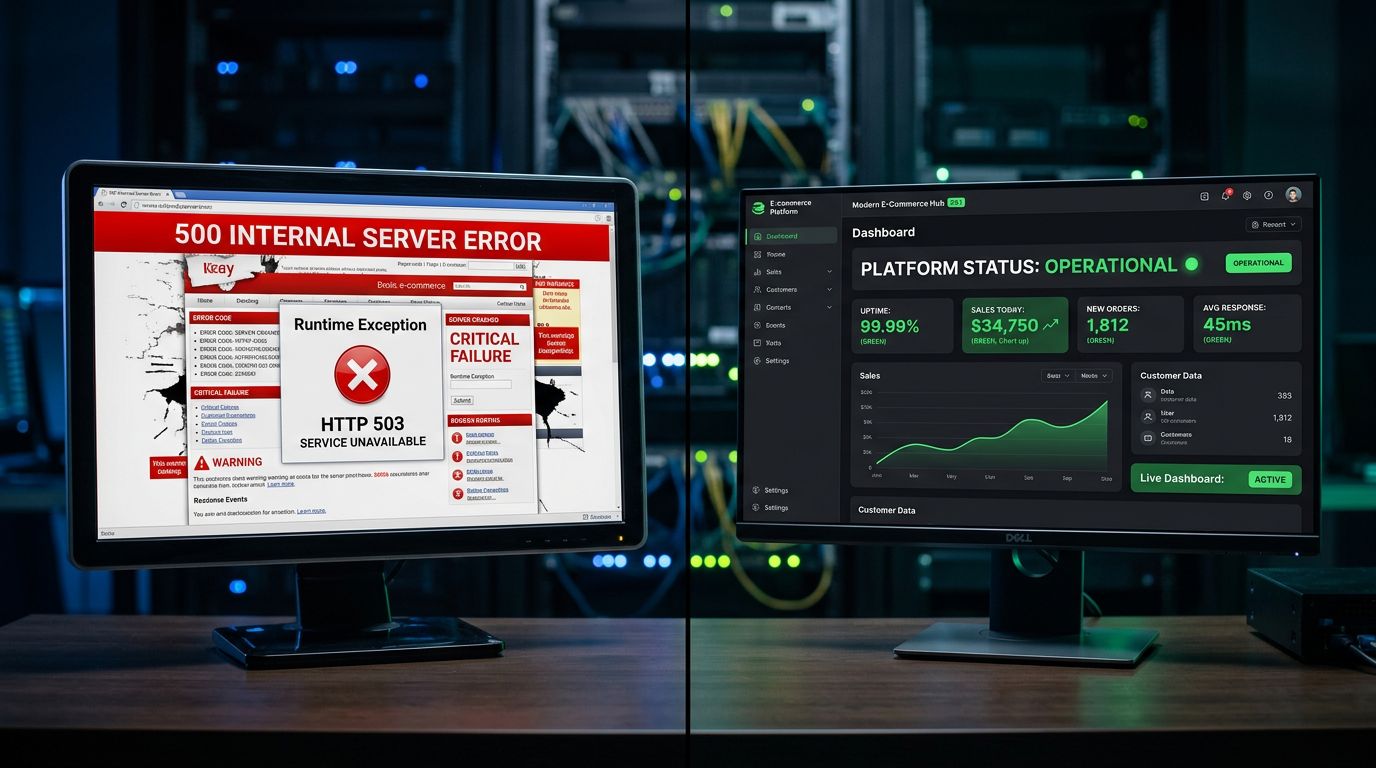
You have board approval. The budget is allocated. Your team is excited about the new platform. Six months later, the relaunch is 3x over budget, 4 months behind schedule, and your conversion rate dropped 22% on launch day.
Key Takeaways
- •70% of e-commerce relaunches exceed budget by 3.5x or miss their launch date entirely - the root cause is almost never technical.
- •Scope creep, wrong platform choices, and multi-vendor coordination failures account for most relaunch disasters.
- •Headless commerce architectures (commercetools, Shopware 6) reduce relaunch risk by decoupling frontend from backend systems.
- •14-day sprint cycles with working deployments every 2 weeks eliminate the 'big bang' launch risk that kills most projects.
- •Companies like REWE and Fressnapf succeeded by choosing a single integrated partner over a patchwork of specialists.
70% of e-commerce relaunches fail due to scope creep, wrong architecture, and vendor chaos. Learn the 5 root causes and a proven framework to beat the odds.
You have board approval. The budget is allocated. Your team is excited about the new platform. Six months later, the relaunch is 3x over budget, 4 months behind schedule, and your conversion rate dropped 22% on launch day.
This is not a hypothetical scenario. Industry data shows that 70% of large-scale e-commerce relaunches fail to meet their original objectives.[1] The failure rate climbs even higher when you factor in projects that technically "launched" but never recovered their pre-relaunch performance metrics.
After 100+ e-commerce projects delivered across REWE Group, Fressnapf, ZooRoyal, and dozens of mid-market retailers, we have seen every way a relaunch can go wrong. More importantly, we know which patterns separate the 30% that succeed from the 70% that don't.
What Does "Failure" Actually Mean in E-Commerce Relaunches?
Before dissecting the causes, you need to define what failure looks like. A relaunch doesn't fail because someone picked the wrong shade of blue for a button. It fails when it misses its business objectives.
The most common failure modes:
- Budget overrun: The average failed relaunch exceeds its original budget by 3.5x. A planned EUR 200K project becomes EUR 700K before anyone admits there's a problem.[2]
- Timeline collapse: 60% of relaunches miss their go-live date by more than 3 months. Some never launch at all.
- Performance regression: Conversion rates drop 15-30% in the first 90 days after launch. Organic traffic tanks because SEO migration was an afterthought.
- Abandonment: The project gets shelved halfway through because stakeholder confidence evaporates.
Each of these outcomes traces back to decisions made (or avoided) in the first 4 weeks of the project.[4]
See how our team delivers +35% avg conversion lift across 30+ e-commerce projects.
Root Cause 1: The "Big Bang" Launch Mentality
The single most destructive pattern in e-commerce relaunches is the big bang approach. You spend 8-12 months building the entire new platform behind closed doors, then flip the switch on launch day.
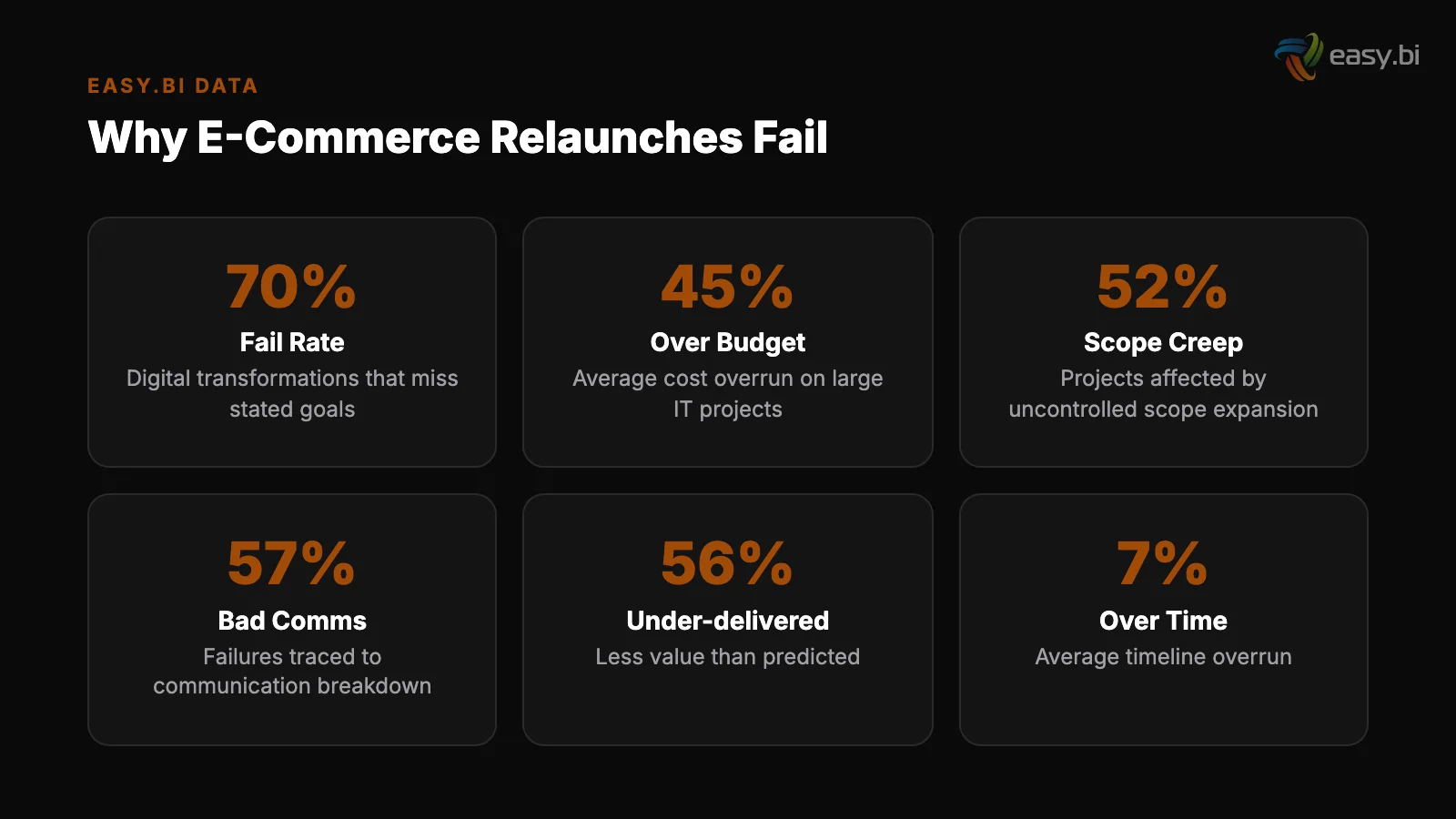
This approach fails because it concentrates all risk into a single moment. Every assumption you made in month 1 gets tested simultaneously in production. There's no feedback loop. No course correction. No way to validate that your new checkout flow actually converts better than the old one.
The Compounding Risk of Delayed Feedback
The average failed relaunch exceeds its original budget by 3.5x. Most of that overrun happens in the last 20% of the project.
Consider what happens in a typical big-bang relaunch. The development team works in isolation, building features based on requirements gathered months earlier. Market conditions shift.
Incremental Delivery as the Alternative
Customer preferences change. Competitor launches alter the landscape. By the time your platform goes live, the requirements document is already outdated. You are launching a platform designed for a market that no longer exists in exactly the form you planned for.
The alternative is incremental delivery. At easy.bi, we use 14-day sprint cycles where every sprint produces a working, deployable increment. This means you can test real user behavior on production traffic within weeks, not months.
REWE Group's digital commerce team adopted this approach for their shop operations. Instead of a monolithic relaunch, they rolled out improvements every 2 weeks. The result: continuous performance gains with zero big-bang launch risk.
Why Do Companies Keep Choosing the Wrong Platform?
Platform selection is the second most common failure point. Enterprises routinely spend EUR 50K-100K on platform evaluations that still lead to the wrong choice. Here's why:
The vendor demo trap. Every e-commerce platform looks spectacular in a demo. Shopware, commercetools, Adobe Commerce, Salesforce Commerce Cloud - they all demo a beautiful storefront with smooth checkout in 30 minutes.
But demos don't show you what happens when you need to integrate your ERP, your PIM, your warehouse management system, and your loyalty program simultaneously.
The feature checklist fallacy. Decision-makers compare platforms using feature matrices with 200+ line items. The platform that checks the most boxes wins.
But feature presence and feature quality are different things. A platform might "support" multi-language, but implementing it properly for DACH markets (German, Austrian German, Swiss German, with different VAT rules, payment methods, and shipping providers) could take 6 months of custom development.
The reference bias. Vendors provide hand-picked reference customers who had ideal conditions: clean data, simple integrations, experienced internal teams. Your situation - 15 legacy integrations, 3 ERPs, and a team that has never migrated platforms - looks nothing like the reference case.
The gap between the reference implementation and your reality is where budgets explode.
The right platform choice depends on your specific integration landscape, your team's technical capabilities, and your scaling trajectory. Not on a feature checklist.
Headless vs. Monolithic: Which Architecture Reduces Relaunch Risk?
The headless commerce debate isn't about technology trends. It's about risk management.
In a monolithic architecture (traditional Shopware 5, Magento 1), the frontend and backend are tightly coupled. Changing the checkout flow means touching the same codebase that handles inventory, pricing, and order management. Every change carries cascading risk.
In a headless architecture (commercetools, Shopware 6 with API-first approach), the frontend is completely decoupled from the commerce engine. You can rebuild the entire customer experience without touching the systems that process orders and manage inventory.
| Factor | Monolithic Relaunch | Headless / Composable |
|---|---|---|
| Relaunch risk | High - all-or-nothing deployment | Low - frontend and backend deploy independently |
| Time to first value | 6-12 months | 8-12 weeks for first customer-facing changes |
| Integration complexity | Tight coupling makes every integration fragile | API-first design makes integrations modular |
| Team scalability | One team bottleneck on shared codebase | Multiple teams work in parallel on separate layers |
| Total cost of ownership | Lower upfront, higher long-term (technical debt) | Higher upfront, lower long-term (modular replacement) |
| Vendor lock-in | High - migration requires full rebuild | Low - swap individual components without full rebuild |
This doesn't mean headless is always the right answer. For a mid-market retailer with straightforward requirements and a small team, a well-implemented Shopware 6 setup delivers faster time-to-value than a fully composable stack. The architecture should match your organizational complexity, not your ambition.
The Multi-Vendor Coordination Problem
Here's a pattern we see repeatedly: a company hires one agency for UX design, another for frontend development, a third for backend and integrations, and a fourth for hosting and DevOps. Each vendor is competent individually. Together, they produce chaos.[3]
The coordination overhead between 3-4 vendors adds 40-60% to project timelines. Every integration point becomes a finger-pointing opportunity. The design agency delivers Figma files that the frontend team says are unbuildable.
The Coordination Cost Multiplier
The frontend team builds components that the backend team says can't be populated with real data. The DevOps team discovers the hosting architecture can't handle the traffic patterns the other teams assumed.
Budget overruns in multi-vendor setups average 3.5x the original estimate. Not because any single vendor is incompetent, but because nobody owns the outcome end-to-end.
Single-Partner Accountability at Fressnapf
The most expensive hire in e-commerce isn't any single vendor - it's the project manager you need to coordinate between four of them. And even then, nobody owns the result.
The Fressnapf 3C platform (Community, CMS, e-Commerce) succeeded precisely because it avoided this trap. One integrated team handled the entire stack - from content management to community features to the commerce engine. One backlog. One definition of done. One team accountable for business outcomes.[5]
How Does SEO Migration Kill Post-Launch Performance?
This is the silent killer of e-commerce relaunches. Teams spend months perfecting the new platform, then treat SEO migration as a last-week checklist item.
The consequences are immediate and severe:
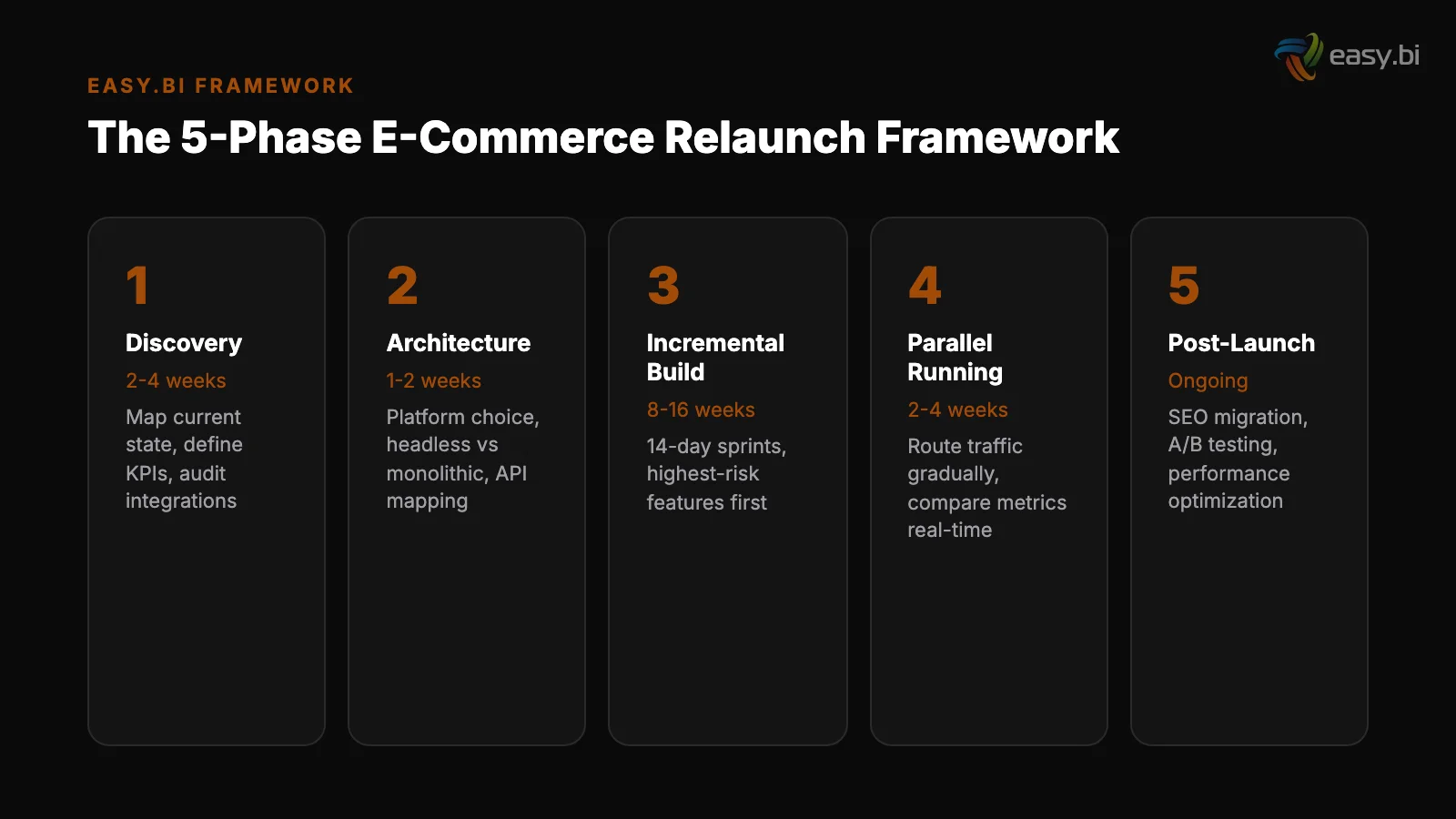
- URL structure changes without comprehensive redirect mapping. If your old site had 50,000 indexed URLs and you change the URL pattern, every inbound link and every search ranking is at risk.
- Metadata loss. Product descriptions, category page titles, and structured data that took years to optimize get wiped in the migration.
- Performance regression. The new platform loads 2 seconds slower because nobody tested with real product catalogs, real images, and real traffic patterns.
- Crawl budget waste. Redirect chains, broken internal links, and orphaned pages consume your crawl budget while Google tries to figure out your new site structure.
The financial impact is staggering. A mid-market retailer generating 40% of revenue from organic search can lose EUR 200-400K in the first quarter after a botched SEO migration. Recovering those rankings takes 6-12 months - if you recover them at all. Some pages never return to their pre-migration positions.
A proper SEO migration plan should be finalized before development starts, not after. It should include a complete URL mapping, redirect rules, canonical tag strategy, structured data migration, and a performance budget. This plan should be tested against the staging environment at least 4 weeks before launch.
What Does a Successful Relaunch Process Look Like?
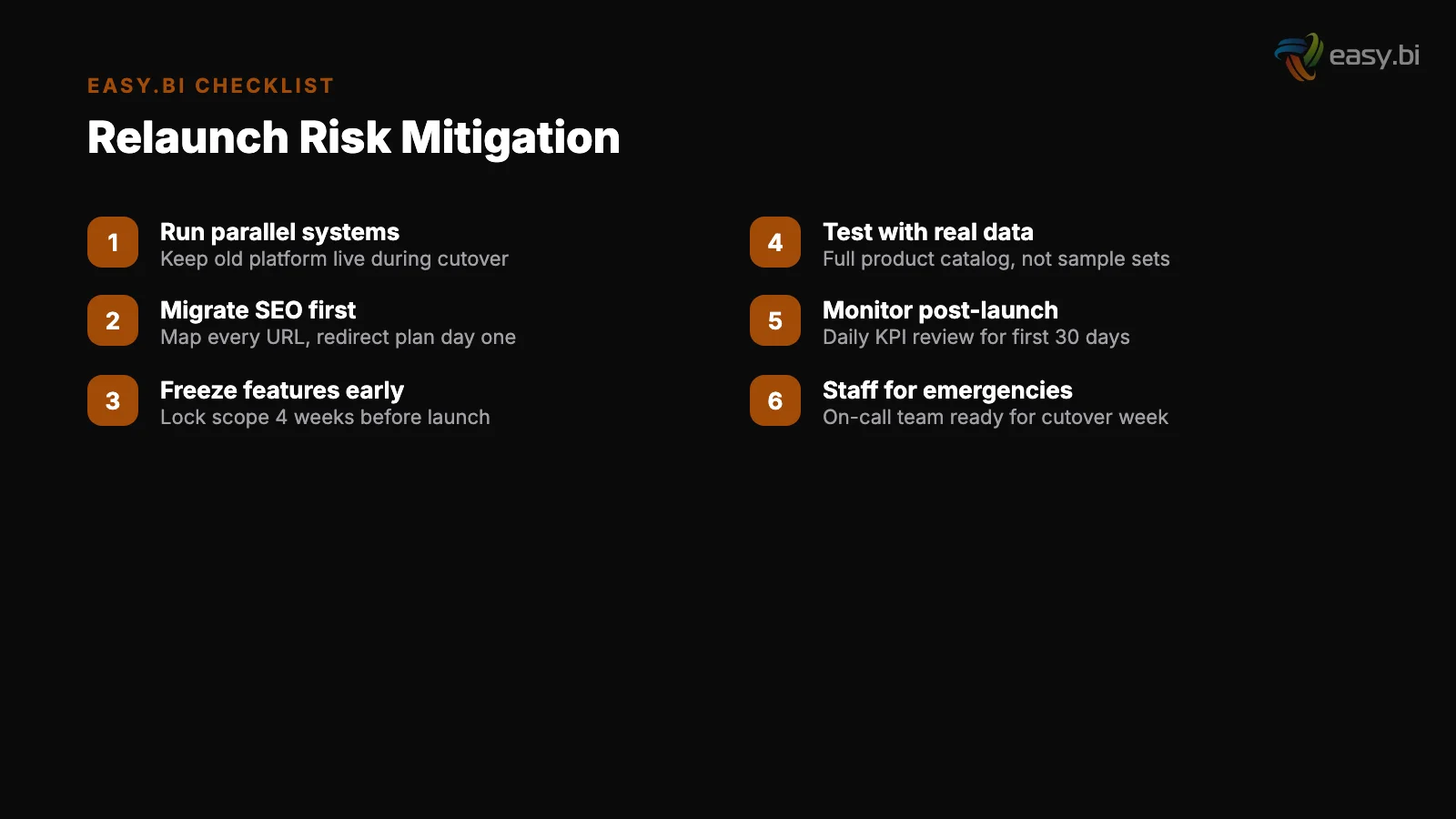
After delivering 100+ e-commerce projects, we've refined a process that consistently beats the 70% failure rate. Here's the framework:
Phase 1: Discovery (2-4 weeks). Map your current state - every integration, every data flow, every business rule that lives in someone's head but isn't documented. Audit your existing analytics to establish baseline KPIs. Define success criteria in numbers: target conversion rate, acceptable page load time, revenue per session.
Phase 2: Architecture Decision (1-2 weeks). Choose your platform and architecture based on your integration landscape, not a feature checklist. If you have 15+ systems that need to talk to your commerce platform, headless is probably right.
If you have 3-4 integrations and a small team, a well-configured Shopware 6 instance will get you to market faster.
Phase 3: Incremental Build (8-16 weeks). Deliver working software every 14 days. Start with the highest-risk, highest-value features: checkout flow, search, and product detail pages. Get real user feedback on staging environments early. Don't save the hard integrations for last.
Phase 4: Parallel Running (2-4 weeks). Run the new and old platforms simultaneously. Route a percentage of traffic to the new platform. Compare conversion rates, page load times, and error rates in real time. Only cut over when the new platform matches or exceeds every baseline KPI.
Phase 5: Post-Launch Optimization (ongoing). The relaunch isn't done on launch day. Plan for 4-8 weeks of intensive optimization after go-live. Monitor search rankings daily. Fix performance issues within hours, not days. Run A/B tests on every major UX change.
+35% conversion. +22% AOV. EUR 50M+ GMV processed.
Our Shopware-certified team delivers e-commerce at scale with 14-day sprint cycles. 80% less manual work through system integrations.
Start with a Strategy CallREWE and Fressnapf: What the Winners Did Differently
REWE Group's digital commerce operations run on a continuous delivery model. There is no "relaunch" in the traditional sense. The platform evolves every 2 weeks through structured sprints. Each sprint has a defined scope, a dedicated team, and measurable outcomes.
The result is a platform that stays current without the risk of a big-bang migration.
Fressnapf took a different but equally effective approach with their 3C platform. They needed to unify community, content management, and e-commerce into a single experience.
Instead of building three separate systems and integrating them (the multi-vendor approach), they chose a single partner to architect and build the entire platform. The unified team eliminated the coordination overhead that kills most complex relaunch projects.
Both companies share three traits that separate them from the 70% failure rate:
- Single-partner accountability. One team owns the outcome. No finger-pointing between vendors.
- Incremental delivery. Working software every 14 days. No big-bang launches.
- Business metrics over technical metrics. Success is measured in conversion rates and revenue, not story points and velocity charts.

How Do You Calculate the True Cost of a Failed Relaunch?
The budget overrun is just the beginning. A failed relaunch carries compounding costs that most businesses don't account for:
- Opportunity cost: Every month your team spends fixing a botched relaunch is a month they're not working on growth initiatives. For a mid-market retailer doing EUR 10M in online revenue, a 6-month delay in optimization represents EUR 500K-1M in unrealized revenue improvements.
- Team morale: Failed projects burn out your best people. The engineers who warned about technical debt leave. The product managers who flagged scope creep update their LinkedIn profiles. Rebuilding that institutional knowledge takes 12-18 months.
- Stakeholder trust: After a failed relaunch, getting budget approval for the next digital initiative becomes 3x harder. The board remembers. The CFO remembers. Your next proposal starts from a trust deficit.
- Competitive gap: While you're recovering from a failed relaunch, your competitors are shipping features. Every quarter you spend stabilizing is a quarter they spend growing.
The total cost of a failed relaunch typically runs 5-8x the original project budget when you factor in these indirect costs. For a EUR 300K project, that's EUR 1.5M-2.4M in total business impact.
We have seen this play out across the DACH retail landscape. One mid-market retailer spent EUR 400K on a Magento 2 migration that stalled at 70% completion. The direct cost was the EUR 400K in sunk development.
The indirect cost: 14 months of frozen feature development while the team tried to salvage the project, 3 senior engineers who left during the chaos, and a competitor who captured 8% market share during the freeze. The total business impact exceeded EUR 2M.
Your Pre-Relaunch Checklist: 10 Questions to Ask Before You Start
Before you commit budget to a relaunch, answer these questions honestly:
- Can you define success in 3 numbers? (Target conversion rate, acceptable page load time, revenue per session goal.) If you can't, you're not ready.
- Have you mapped every integration? List every system that touches your commerce platform. If the list has more than 10 items, budget for headless architecture.
- Is your SEO migration plan written? Not outlined. Written. With URL mappings, redirect rules, and a testing protocol.
- Can you ship incrementally? If your plan requires 6+ months before anything goes live, redesign the plan.
- Do you have one accountable owner? If 3 vendors need to coordinate for a single feature to work, you have a coordination problem that will cost you 40-60% more in timeline.
- Is your team sized correctly? A relaunch needs dedicated resources. If your team is splitting time between the relaunch and maintaining the current platform, you'll do both poorly.
- Have you stress-tested with real data? Demo data performs differently than 50,000 real product records with real images and real customer behavior patterns.
- Do you have a rollback plan? If the new platform underperforms on day 1, can you revert to the old platform within hours?
- Is post-launch optimization budgeted? Plan for 20-30% of your relaunch budget to cover the first 8 weeks after go-live.
- Have you talked to references? Not the vendor's hand-picked references. Find companies who relaunched on the same platform in the last 12 months and ask what they'd do differently.
What Happens Next
If you're planning an e-commerce relaunch and you recognize some of these failure patterns, the worst thing you can do is push forward and hope for the best. For the complete enterprise e-commerce guide covering platform selection, SEO migration, PIM integration, and KPIs, see The Enterprise E-Commerce Playbook.
When you are ready to evaluate specific platforms, see our comparison of Shopware vs commercetools vs Adobe Commerce. If headless architecture is on your roadmap, read Headless Commerce: When It's Worth the Complexity before you decide. The 70% failure rate exists because companies keep repeating the same mistakes.
easy.bi has delivered 100+ projects with a 98% client retention rate. Our 50+ engineers work in 14-day sprint cycles using our Performance Scrum methodology. We don't just build platforms - we own outcomes.
easy.bi maintains 99.9% system uptime across production deployments and delivers 100% of projects on-time and on-budget through 14-day sprint cycles. That reliability is not an accident - it is the result of the incremental delivery framework described above, applied consistently across every engagement.
Whether you need a full relaunch strategy, a second opinion on your current plan, or a team to execute alongside yours, the first step is a conversation with someone who has done this before.
References
- [1] McKinsey (2023). 70% of digital transformations fail to reach their stated goals. mckinsey.com
- [2] McKinsey / Oxford University (2023). mckinsey.com
- [3] PMI Pulse of the Profession (2024). pmi.org
- [4] PMI Pulse of the Profession (2024). pmi.org
- [5] Harvard Business Review / Bain (2023).
Explore Other Topics
Ready to scale your e-commerce?
30-minute call with an engineering lead. No sales pitch - just honest answers about your project.
98% engineer retention · 14-day delivery sprints · No lock-in contracts
Related Reading

E-Commerce Conversion Optimization: The 35% Improvement Framework
A systematic 6-lever framework that delivers +35% conversion rate and +22% AOV for DACH e-commerce. Page speed, checkout, product UX, search, cross-sell, and mobile optimization with measurable benchmarks.
Enno Bassen
The True Cost of Disconnected E-Commerce Systems (ERP, PIM, CRM)
Disconnected ERP, PIM, and CRM systems cost mid-market retailers 80+ hours of manual work per week and 23% in lost revenue. Learn the API-first integration architecture that eliminates data silos.
Enno Bassen
How REWE Runs Multi-Country E-Commerce on 14-Day Sprint Cycles
How enterprise retailers like REWE ship e-commerce features every 14 days. The sprint delivery model, team structure, and QA gates.
Enno Bassen