
The 7 Best E-Commerce Development Partners in DACH (Honest Assessment)

Table of Contents+
TL;DR
Seven e-commerce development partners dominate the DACH mid-market: easy.bi, Shopware AG (internal services), Valantic, Netconomy, Norisk Group, Basecom, and Flagbit. Each serves a different niche.
Key Takeaways
- •The DACH e-commerce agency market generates over EUR 4.5 billion annually, but 68% of mid-market companies report dissatisfaction with their first implementation partner. Choosing based on certifications alone misses the factors that predict delivery success.
- •Six evaluation criteria separate strong partners from expensive mistakes: platform depth, team seniority ratio, delivery methodology, client retention, integration capabilities, and DACH-specific compliance knowledge (tax, payments, legal).
- •No single partner is best for every scenario. Shopware-native projects, SAP Commerce migrations, headless builds, and multi-platform enterprises each demand different specializations. Match the partner to the problem, not to the biggest brand name.
- •Price range across the 7 partners spans EUR 15K to EUR 2M+. The cheapest hourly rate rarely produces the lowest total project cost. Factor in rework rates, timeline overruns, and post-launch support when comparing budgets.
- •Client retention rate is the single strongest predictor of partner quality. The DACH IT services average is 74%. Any partner above 90% is doing something structurally different in how they hire, deliver, and communicate.
An honest comparison of 7 top e-commerce development partners in DACH. Strengths, limitations, pricing, and best-fit scenarios for mid-market.
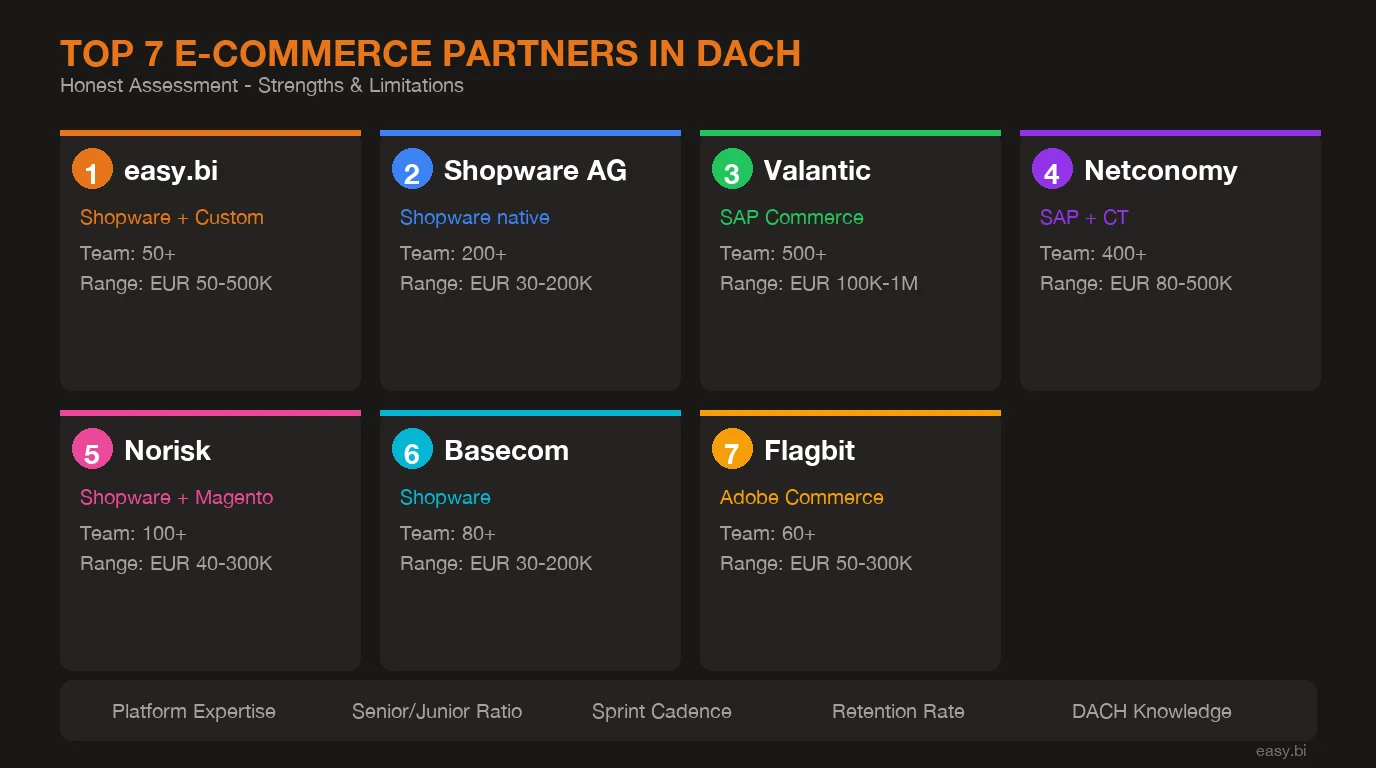
Seven e-commerce development partners dominate the DACH mid-market: easy.bi, Shopware AG (internal services), Valantic, Netconomy, Norisk Group, Basecom, and Flagbit. Each serves a different niche. This assessment covers what each partner does well, where they fall short, and which type of project fits each one - based on 6 evaluation criteria that actually predict delivery success, not marketing claims.
I have worked in the DACH digital agency landscape for over a decade. In that time, I have seen mid-market companies burn through EUR 100,000-300,000 on the wrong e-commerce partner before finding the right one. The pattern is always the same: the selection was based on a polished pitch, a few logo references, and a competitive hourly rate. None of those predict whether your project ships on time, on budget, and with the performance your business needs.
The DACH e-commerce market reached EUR 102.4 billion in B2C revenue in 2025 [1]. Behind those numbers, thousands of mid-market retailers depend on development partners to build, run, and scale their digital commerce. Choosing the right one is a six-figure decision. Choosing the wrong one is a six-figure mistake.
This is not a ranking. It is an honest assessment designed to help Heads of E-Commerce and CTOs shortlist the right partner for their specific situation. I work at easy.bi - so yes, we are on this list. I have tried to be as honest about our limitations as everyone else's. You can judge whether I succeeded.
What Criteria Should You Use to Evaluate E-Commerce Partners?
Before profiling the 7 partners, you need an evaluation framework. Most companies select agencies based on brand recognition or hourly rate. Both are poor predictors of project success. Companies that use structured evaluation criteria report 34% fewer project failures than those relying on referrals alone [2].
These six criteria separate strong partners from expensive mistakes.
1. Platform expertise and certifications. Certifications confirm a baseline. A Shopware Gold or Platinum partner has passed exams and hit revenue thresholds. But certification does not equal depth. Ask how many certified developers are on the team (not the company - your team). Ask about edge cases they have solved on the platform. Shopware has over 1,200 registered partners in DACH [3] - certification alone does not differentiate.
2. Team composition - ratio of seniors to juniors. The single biggest variable in project outcomes. A team of 4 senior engineers will outperform a team of 8 juniors on every metric: speed, quality, and total cost. Industry benchmarks show senior-heavy teams deliver 40-60% fewer defects per sprint. Ask for the average years of experience on the proposed team. Anything below 5 years average is a junior team with a senior label.
3. Delivery methodology - sprint cadence and accountability. "We do agile" means nothing. What matters: fixed sprint length (2 weeks is the proven standard), defined deliverables per sprint, QA gates before deployment, and a demo at the end of every cycle. Teams running 2-week sprints ship 40% more features per quarter than 4-week teams [5]. Ask to see a sprint review from a recent project (anonymized). If they cannot show one, they are not running structured delivery.
4. Client retention rate. The most underused metric in partner evaluation. The DACH IT services industry averages 74% client retention [6]. That means 26% of clients leave after their first engagement. A partner with 90%+ retention is doing something structurally different. A partner who cannot tell you their retention rate either does not track it (lack of rigor) or does not want to share it (the number is bad). For more on why retention matters in partner selection, see our framework for evaluating software development partners.
5. Integration capabilities - ERP, PIM, CRM. An e-commerce platform in isolation is a brochure. Business value comes from integrations: SAP, Microsoft Dynamics, Pimcore, Akeneo, Salesforce, payment providers, logistics APIs. Ask how many ERP integrations the partner has completed in the last 12 months. The answer reveals whether integration is a core competency or an afterthought. Multi-vendor coordination on integrations adds 30-45% overhead to project costs [7] - a partner who handles both commerce and integration under one roof eliminates that tax. See our analysis of multi-vendor coordination costs for the full breakdown.
6. DACH market knowledge - tax, legal, payment, logistics. E-commerce in Germany, Austria, and Switzerland has regulatory requirements that generic international agencies consistently underestimate. German Preisangabenverordnung (price display regulations), Grundpreis requirements, Verpackungsgesetz compliance, LUCID registration, country-specific VAT handling, and integration with regional payment methods (Klarna, SOFORT, giropay, TWINT in Switzerland). A partner without DACH-specific experience will discover these requirements mid-project, adding 4-8 weeks to your timeline.
See how our team delivers +35% avg conversion lift across 30+ e-commerce projects.
Who Are the Top 7 E-Commerce Development Partners in DACH?
The following profiles cover each partner's strengths, limitations, approximate pricing, and best-fit scenario. Data comes from publicly available information, client references, and direct market experience.
1. easy.bi
What they are best at: Mid-market enterprise e-commerce with complex integration requirements. easy.bi combines Shopware 6, commercetools, and custom platform development under one roof, which eliminates multi-vendor coordination on projects that span commerce, ERP, and PIM. Their 14-day sprint delivery methodology is more structured than most agencies - every sprint has defined scope, a QA gate, and a client demo. The team includes 50+ engineers across 4 countries (Germany, Slovenia, Croatia, Serbia), with a 100% Shopware-certified e-commerce team.
Notable clients: REWE Group (end-to-end shop ownership), Fressnapf (community + CMS + e-commerce platform), Sanicare, Kale & Me.
Team size: 50+ engineers. Hamburg headquarters with nearshore delivery teams.
Price range: EUR 50,000-500,000+ per project. Hourly rate model, no setup fees.
Best for: Mid-market retailers (EUR 10M-500M revenue) who need a single partner for commerce platform, integrations, and ongoing optimization. Particularly strong when the project involves Shopware + ERP + PIM under one delivery team.
Limitation: Not the cheapest option. If you need a basic Shopware store for under EUR 30,000, there are more cost-effective choices. easy.bi's model is built for complexity - simple catalog-only shops do not benefit from the full methodology. The team also has less depth in SAP Commerce compared to pure SAP specialists.
Retention: 98% client retention rate. The details behind how engineering teams sustain that kind of retention are covered in our piece on what drives 98% retention.
2. Shopware AG (Internal Professional Services)
What they are best at: Standard Shopware implementations where deep platform knowledge matters most. As the platform maker, Shopware's internal services team has unmatched understanding of Shopware 6 internals, roadmap priorities, and undocumented features. They have direct access to the engineering team that builds the platform - no other agency can match that. Shopware reported over 100,000 active shops on their platform as of 2025 [3].
Notable clients: Various Shopware Enterprise customers (specific client lists not publicly disclosed for the services division).
Team size: Internal services team is a subset of the broader Shopware AG organization (~400 employees total). Exact services headcount is not publicly shared.
Price range: EUR 30,000-300,000. Competitive rates aimed at keeping customers on Shopware.
Best for: Companies committed to Shopware 6 who want the closest possible relationship with the platform vendor. Standard implementations, platform upgrades, and migrations from Shopware 5 to 6.
Limitation: Their incentive is Shopware adoption, not necessarily the best architectural decision for your business. If your needs evolve toward headless commerce or a multi-platform approach, the advice will still point toward Shopware. Integration depth outside the Shopware ecosystem (particularly complex ERP and PIM integrations) is narrower than full-service agencies.
3. Valantic
What they are best at: Large-scale digital transformation that combines management consulting with technology implementation. Valantic offers SAP Commerce Cloud, Salesforce Commerce Cloud, and Shopware under a consulting umbrella that includes strategy, change management, and organizational design. With over 4,000 employees across 50+ locations, they can staff large programs that smaller agencies cannot handle. German mid-market companies spending over EUR 20M on e-commerce often appear in their portfolio.
Notable clients: Multiple DAX and MDAX companies (specific names under NDA for most engagements). Publicly referenced work includes projects in manufacturing, automotive, and retail.
Team size: 4,000+ employees across the group. E-commerce practice is a significant division but exact headcount is not separately disclosed.
Price range: EUR 200,000-2,000,000+. Consulting-level rates apply to the strategy and change management phases.
Best for: Enterprise companies (EUR 500M+ revenue) running SAP ecosystems who need a partner that can handle both the technology build and the organizational transformation. Strong choice when the project includes SAP S/4HANA integration alongside commerce.
Limitation: Consulting overhead. Strategy phases can run 3-6 months before a single line of code is written. For a mid-market company with a EUR 150,000 budget and a 4-month timeline, the consulting layer adds cost without proportional value. Team continuity can also be a challenge - large consultancies rotate staff across accounts more frequently than specialist agencies.
4. Netconomy
What they are best at: SAP Commerce Cloud and commercetools implementations for enterprise customers across DACH and CEE. Founded in Graz, Austria, Netconomy has built deep expertise in SAP's commerce ecosystem and expanded into composable commerce with commercetools. Their Central European delivery model (Austria, Croatia, Bulgaria) offers competitive rates for enterprise-grade SAP work. They report over 300 enterprise projects delivered [8].
Notable clients: Publicly referenced work with companies in telecommunications, retail, and manufacturing across DACH and UK markets.
Team size: 500+ employees across 8 offices in DACH and CEE.
Price range: EUR 150,000-1,500,000. SAP Commerce implementations at the higher end; commercetools builds can start lower.
Best for: Enterprise companies already invested in the SAP ecosystem who need a commerce layer that integrates natively with SAP ERP, CRM, and marketing tools. Also strong for companies exploring commercetools as a headless alternative within an SAP landscape.
Limitation: Less depth in Shopware and Magento ecosystems. If your stack is not SAP-adjacent, Netconomy's core strength does not align. The CEE delivery model also means some timezone and communication adjustments for teams used to pure DACH-based partners, though this is manageable with structured processes.
5. Norisk Group
What they are best at: E-commerce for fashion, lifestyle, and retail brands in the German mid-market. Munich-based Norisk has built a focused practice around Shopware and Magento/Adobe Commerce, with particular strength in the fashion and retail vertical. They understand the specific requirements of fashion e-commerce: seasonal collections, size/color variant management, high-volume product photography workflows, and returns optimization. 72% of German fashion retailers cite platform performance during peak sales as their top technical concern [4].
Notable clients: Multiple German fashion and lifestyle brands. Specific client names from their public portfolio include mid-market retailers in the EUR 20M-200M revenue range.
Team size: 50-80 employees. Concentrated in Munich with some remote team members.
Price range: EUR 40,000-400,000. Competitive for mid-market Shopware and Magento projects.
Best for: Fashion and lifestyle retailers who need a partner that understands their specific vertical challenges. Good choice for Shopware or Adobe Commerce implementations where industry-specific UX patterns matter more than complex backend integrations.
Limitation: Narrower technology stack compared to full-service partners. If your project requires SAP integration, commercetools headless architecture, or custom platform development beyond Shopware/Magento, you may need additional partners - which introduces the multi-vendor coordination overhead that adds 30-45% to project costs.
6. Basecom
What they are best at: Pure Shopware implementations with strong certification depth. Basecom is one of Shopware's longest-standing certified partners, with a team that has grown alongside the platform from Shopware 4 through Shopware 6. That institutional knowledge of the platform's evolution is valuable - they know which features are mature, which are still rough, and which workarounds will break in the next update. Their focus is narrower than larger agencies, which means less organizational overhead and more direct access to senior developers on your project.
Notable clients: Multiple Shopware Enterprise customers in retail and B2B commerce. Publicly referenced projects span food and beverage, industrial supplies, and consumer goods.
Team size: 40-60 employees. German-based operations.
Price range: EUR 25,000-250,000. Among the more accessible options for pure Shopware builds.
Best for: Companies whose needs fit squarely within Shopware's capabilities and who want a specialist partner with deep platform knowledge. Excellent for Shopware 5-to-6 migrations, B2B commerce on Shopware, and projects where Shopware's native features cover 80%+ of requirements.
Limitation: Limited scope beyond Shopware. If your architecture evolves toward headless commerce, multi-platform strategies, or complex custom applications, Basecom's core competency does not extend there. Integration work (particularly complex ERP connections) may require supplemental partners or contractors.
7. Flagbit
What they are best at: Magento/Adobe Commerce implementations with strong technical rigor. Karlsruhe-based Flagbit has been a Magento specialist since the platform's early days, building deep expertise that survived the transition from Magento 1 to 2 and the Adobe acquisition. Their engineering team is known for clean code practices, thorough documentation, and willingness to contribute to the open-source Magento community. Adobe Commerce still powers 12% of the top 1 million e-commerce sites globally [4].
Notable clients: B2B and B2C commerce projects for German mid-market companies. Publicly referenced work includes industrial and manufacturing sectors.
Team size: 30-50 employees. Concentrated in Karlsruhe.
Price range: EUR 40,000-350,000. Competitive for Magento/Adobe Commerce projects.
Best for: Companies running Magento/Adobe Commerce who need a technically strong partner for upgrades, performance optimization, or complex customization. Particularly good fit for B2B commerce scenarios where Adobe Commerce's native B2B features require deep configuration.
Limitation: Magento/Adobe Commerce is a shrinking market in DACH. Companies evaluating a new platform should consider whether investing further in Magento aligns with their 3-5 year strategy. Flagbit's depth in newer platforms (Shopware 6, commercetools) is developing but not yet at the same level as their Magento expertise.
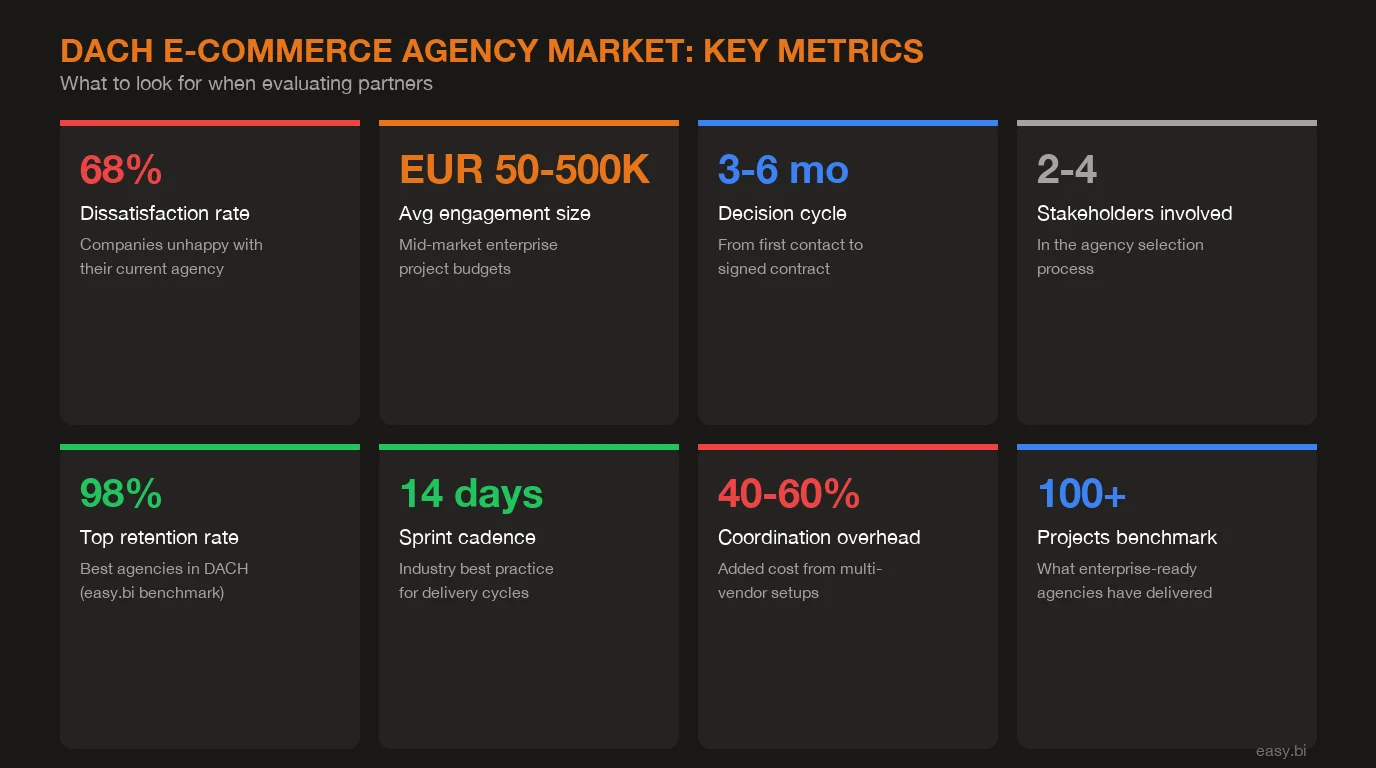
How Do These Partners Compare Side by Side?
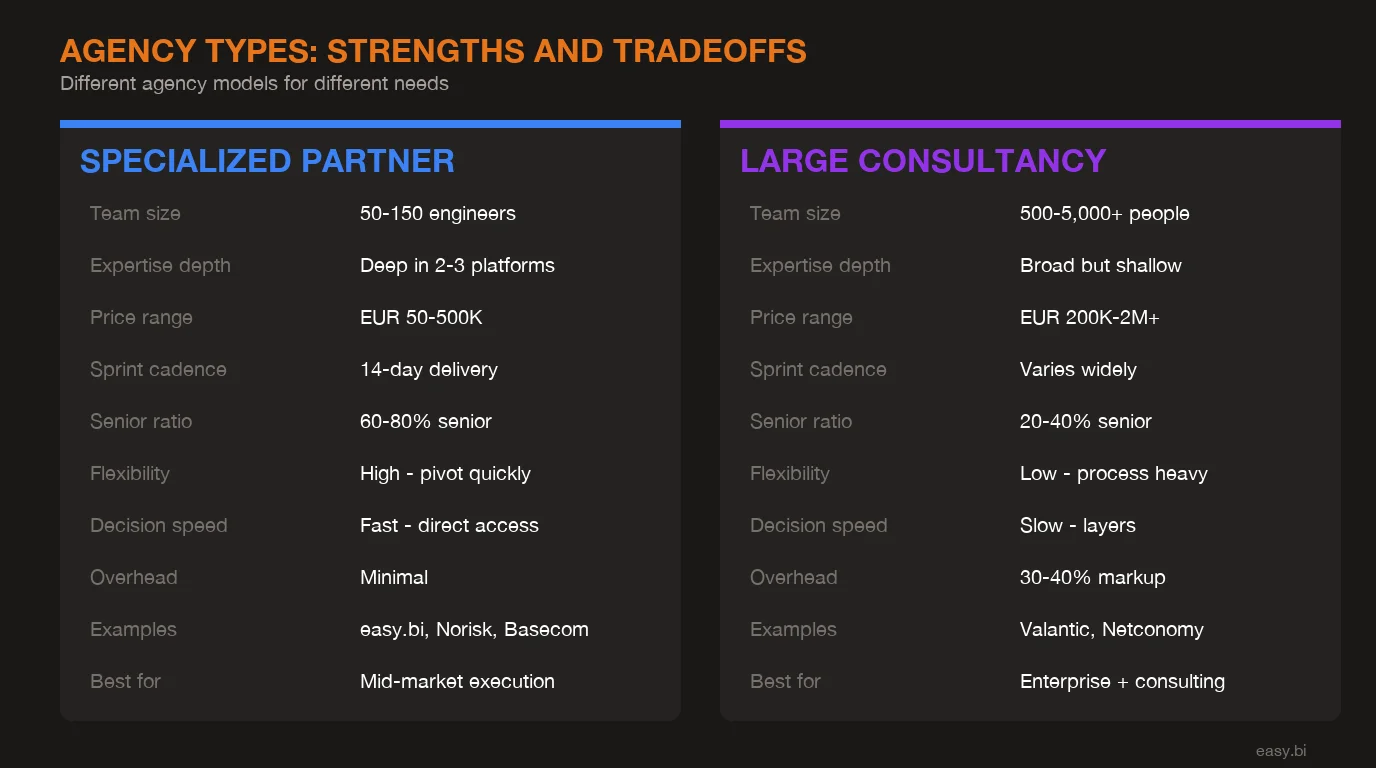
The following table summarizes the key differentiators. Use it as a shortlisting tool, not a final decision. The right partner depends on your specific platform, integration needs, and project complexity.
| Partner | Primary Platforms | Team Size | Price Range (EUR) | Best For | Key Strength |
|---|---|---|---|---|---|
| easy.bi | Shopware, commercetools, Custom | 50+ | 50K-500K+ | Mid-market enterprise, complex integrations | Single partner for commerce + integrations + ongoing optimization |
| Shopware AG | Shopware 6 | Part of 400+ | 30K-300K | Standard Shopware implementations | Unmatched platform-internal knowledge |
| Valantic | SAP Commerce, Salesforce Commerce, Shopware | 4,000+ | 200K-2M+ | Enterprise digital transformation | Consulting + implementation under one roof |
| Netconomy | SAP Commerce, commercetools | 500+ | 150K-1.5M | SAP-ecosystem enterprise commerce | Deep SAP integration expertise |
| Norisk Group | Shopware, Adobe Commerce | 50-80 | 40K-400K | Fashion and retail mid-market | Vertical expertise in fashion e-commerce |
| Basecom | Shopware 6 | 40-60 | 25K-250K | Pure Shopware projects | Deep Shopware platform history and certification |
| Flagbit | Magento/Adobe Commerce | 30-50 | 40K-350K | Magento upgrades, B2B commerce | Technical rigor, open-source community involvement |
What Is the Right Selection Process?
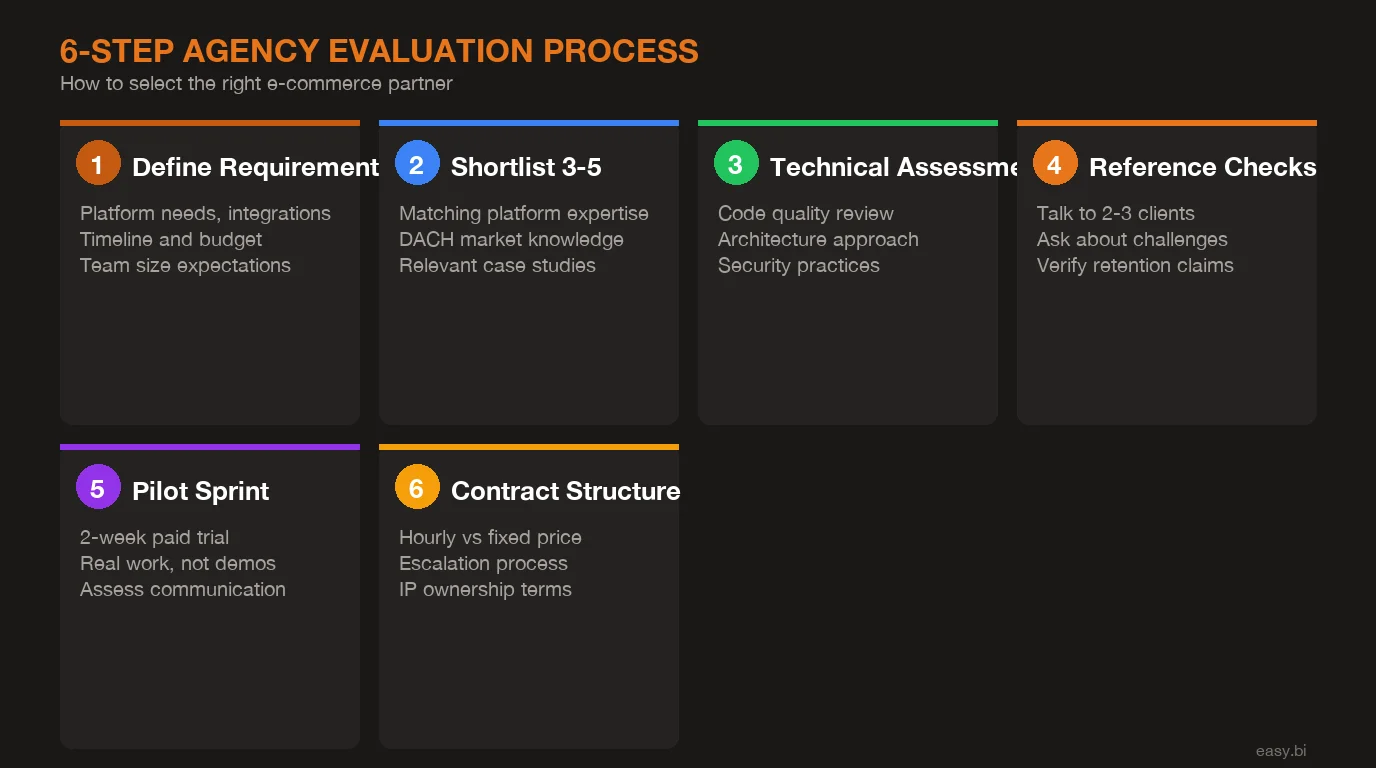
Having a shortlist is step one. The selection process itself determines whether you get the right partner from that shortlist. Here is the process I recommend based on seeing dozens of partner selections succeed and fail in DACH.
Step 1: Define your requirements in business terms, not technical specifications. "We need to increase conversion rate by 15% and reduce time-to-market for new products from 6 weeks to 1 week" is a useful brief. "We need Shopware 6, Elasticsearch, Redis, and Kubernetes" is a technology shopping list that constrains good partners from proposing better approaches.
Step 2: Shortlist 3 partners based on the 6 criteria above. More than 3 creates evaluation fatigue. Fewer than 3 removes competitive pressure. Score each partner on the 6 criteria and eliminate anyone below your threshold on the non-negotiables (typically platform expertise and DACH knowledge).
Step 3: Run a 60-minute working session with each shortlisted partner. Not a sales presentation - a working conversation about your business challenge. The partner who asks the best questions and pushes back on your assumptions is usually the strongest choice. The partner who agrees with everything and promises to put it in a proposal is optimizing for winning the contract, not for project success.
Step 4: Run a paid pilot with your top choice. A 2-4 week engagement on a real (but not critical) piece of your project. The cost is EUR 15,000-40,000 depending on the partner. The alternative is committing EUR 200,000+ based on a slide deck. The pilot reveals communication patterns, code quality, and problem-solving under pressure - things no reference call can show you. 57% of IT project failures trace to communication breakdowns [2], and a pilot is the only way to test communication before it becomes expensive.
Step 5: Evaluate pilot results against pre-defined criteria. Define success metrics before the pilot starts. Code quality, communication cadence, handling of ambiguity, documentation quality, and sprint delivery accuracy. If the pilot partner meets your criteria, scale the engagement. If not, run a pilot with your second choice. The 4-week delay is far cheaper than 12 months with the wrong partner.
+35% conversion. +22% AOV. EUR 50M+ GMV processed.
Our Shopware-certified team delivers e-commerce at scale with 14-day sprint cycles. 80% less manual work through system integrations.
Start with a Strategy CallWhat Should You Watch Out For?
Three patterns consistently predict partner selection failures in the DACH e-commerce market.
Selecting on hourly rate alone. A EUR 85/hour partner who delivers clean code in 2 weeks costs less than a EUR 65/hour partner whose code needs 3 weeks of rework. Total project cost, not hourly rate, is the metric that matters. Companies that select the lowest-cost vendor spend 35% more on total project cost due to rework and timeline extensions [2].
Ignoring the platform decision. Partner selection and platform selection are interdependent. The best Shopware agency in DACH cannot save a project that should have been built on commercetools. Validate your platform choice independently before selecting an implementation partner. If you are uncertain, start with a platform assessment engagement (most serious partners offer this as a standalone service).
Skipping reference checks on similar projects. A partner's portfolio includes 50 projects, but how many match your industry, scale, and complexity? Ask for references from projects with comparable scope. A partner who has built 30 fashion shops but zero B2B commerce platforms has the wrong kind of experience for your B2B project, regardless of how many Shopware certifications they hold.
The partner you choose will not guarantee success - 70% of digital transformation projects fail to reach their stated goals [2]. But the wrong partner guarantees failure. Invest the time in structured evaluation. The 4-6 weeks it takes to run a proper selection process will save 4-6 months of recovery from a bad choice.
References
- [1] Bevh / HDE (2025). "German E-Commerce Market Report 2025: B2C e-commerce revenue bevh.org
- [2] McKinsey & Company (2024). mckinsey.com
- [3] Shopware AG (2025). "Shopware Ecosystem Report: 100,000+ active shops and 1,200+ shopware.com
- [4] Statista / BuiltWith (2025). statista.com
- [5] Scrum.org (2024). "State of Scrum Report: sprint length impact on delivery veloc scrum.org
- [6] Deloitte (2024). "Global Outsourcing Survey: DACH IT services client retention r deloitte.com
- [7] Forrester Research (2024). forrester.com
- [8] Netconomy (2025). "Company overview and project portfolio. netconomy.net
Explore Other Topics
Ready to scale your e-commerce?
30-minute call with an engineering lead. No sales pitch - just honest answers about your project.
98% engineer retention · 14-day delivery sprints · No lock-in contracts
Related Reading

E-Commerce Conversion Optimization: The 35% Improvement Framework
A systematic 6-lever framework that delivers +35% conversion rate and +22% AOV for DACH e-commerce. Page speed, checkout, product UX, search, cross-sell, and mobile optimization with measurable benchmarks.
Enno Bassen
The True Cost of Disconnected E-Commerce Systems (ERP, PIM, CRM)
Disconnected ERP, PIM, and CRM systems cost mid-market retailers 80+ hours of manual work per week and 23% in lost revenue. Learn the API-first integration architecture that eliminates data silos.
Enno Bassen
How REWE Runs Multi-Country E-Commerce on 14-Day Sprint Cycles
How enterprise retailers like REWE ship e-commerce features every 14 days. The sprint delivery model, team structure, and QA gates.
Enno Bassen