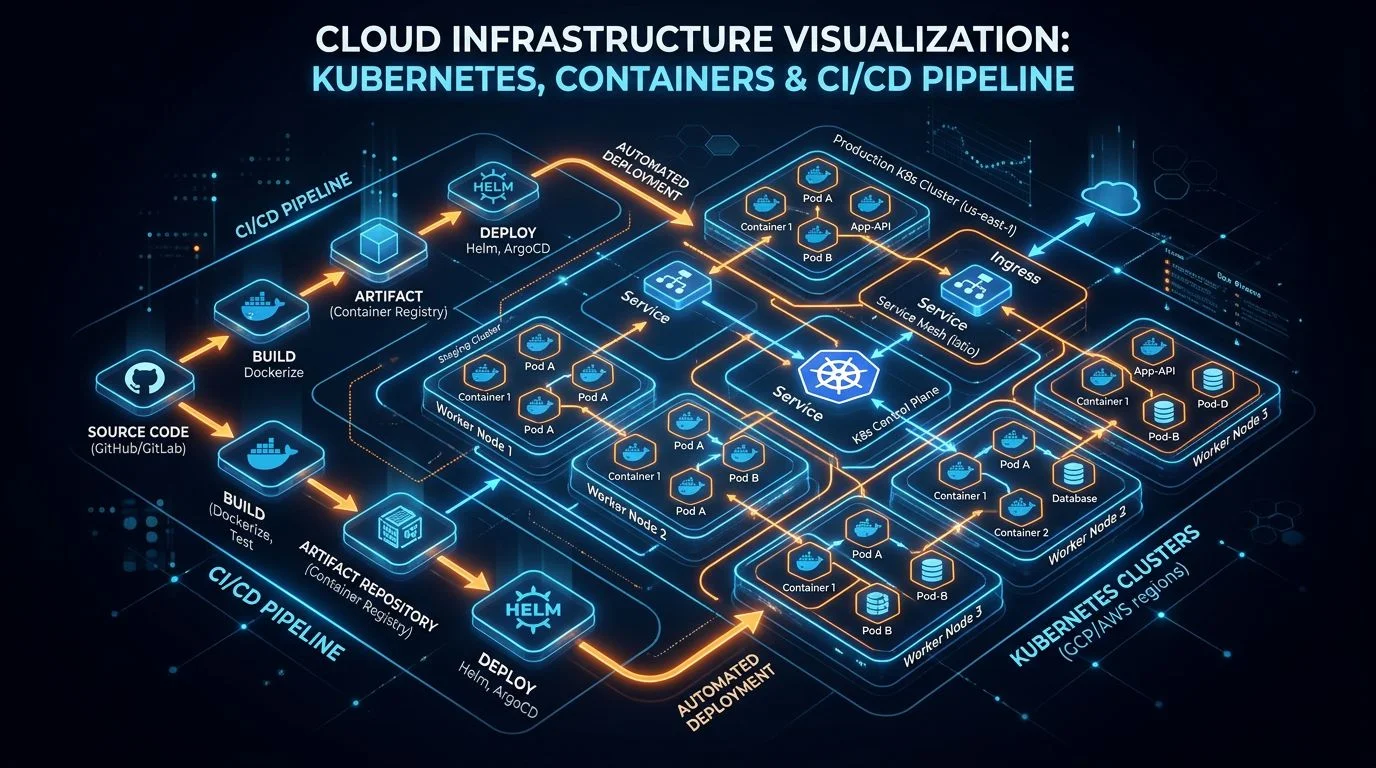
Cloud-Native From Day One: Kubernetes, Docker, and CI/CD for Mid-Market

Table of Contents+
TL;DR
Cloud adoption in German enterprises reached 84% in 2024, with multi-cloud strategies growing 28% year-over-year . But adoption does not equal architecture. Most mid-market companies have migrated workloads to cloud providers without rethinking how their applications are built, deployed, and operated.
Key Takeaways
- •Cloud-native is not 'put everything in Kubernetes.' It is a set of architectural decisions - containerization, infrastructure as code, CI/CD pipelines, and observability - that let you deploy, scale, and recover independently. Mid-market companies benefit most when they adopt these practices incrementally, not all at once.
- •Teams using CI/CD deploy 208x more frequently than those without and see 40% fewer production incidents when automated testing coverage exceeds 80%. CI/CD is the single highest-ROI infrastructure investment for any mid-market engineering team.
- •Kubernetes makes sense when you run 10+ services, need horizontal auto-scaling, or operate across multiple cloud providers. For applications with fewer than 10 services and predictable traffic, Docker Compose with a managed container service delivers 90% of the benefit at 20% of the operational cost.
- •GitOps - managing infrastructure through Git pull requests - increases deployment frequency by 44% while cutting change failure rates by 50%. It turns infrastructure changes into auditable, reviewable, and reversible code changes.
- •Cloud spend waste averages 32% of total cloud budgets due to idle resources and over-provisioning. Right-sizing containers, using spot instances, and implementing FinOps practices from day one prevent mid-market companies from burning budget on infrastructure they do not use.
Cloud-native architecture with Kubernetes, Docker, and CI/CD delivers 208x more frequent deployments and 2.6x higher profitability. Learn when mid-market companies need Kubernetes, when Docker Compose is enough, and how to build cloud-native infrastructure without enterprise-level budgets.
Cloud adoption in German enterprises reached 84% in 2024, with multi-cloud strategies growing 28% year-over-year [1]. But adoption does not equal architecture. Most mid-market companies have migrated workloads to cloud providers without rethinking how their applications are built, deployed, and operated.
The result: cloud bills that grow faster than the business, deployment processes that still require a dedicated ops engineer, and infrastructure that cannot scale when it matters.
Cloud-native architecture is the fix. It means designing applications as containerized, loosely coupled services that are deployed through automated pipelines, scaled on demand, and observed in real time.
For mid-market companies - the 50-to-2,000-employee organizations that make up the backbone of the DACH economy - cloud-native is not about chasing enterprise-scale Kubernetes clusters. It is about building infrastructure that compounds your engineering team's output instead of consuming it.
This article covers what cloud-native actually means for mid-market, when Kubernetes is worth the complexity (and when it is not), how to implement CI/CD and GitOps from day one, and how to avoid the most expensive mistakes.
What Does Cloud-Native Actually Mean for Mid-Market?
Cloud-native is not a product. It is a set of architectural principles defined by the Cloud Native Computing Foundation (CNCF): containerization, microservices (or well-structured modular monoliths), CI/CD automation, and declarative infrastructure. The CNCF reports 5.6 million cloud-native developers globally, representing 31% of all backend developers [2].
This is not a niche practice - it is the mainstream approach to building production software.
For mid-market companies, cloud-native means three things in practice:
Containers replace servers
Containers replace servers. Your application runs inside Docker containers - lightweight, portable units that include everything needed to execute: code, runtime, libraries, and configuration. A container runs identically on a developer's laptop, a CI server, and production.
This eliminates the "works on my machine" problem that wastes 10-15% of engineering time on environment-related debugging. Docker is used by 52% of professional developers [3], making it the most widely adopted tool outside of version control.
Pipelines replace people. Every code change triggers an automated pipeline: build the container, run tests, scan for vulnerabilities, deploy to staging, run integration tests, deploy to production. Teams using CI/CD deploy 208x more frequently than those without [4].
The human role shifts from executing deployments to designing pipelines and reviewing code.
Infrastructure becomes code. Your servers, networks, databases, and load balancers are defined in version-controlled configuration files - Terraform for cloud resources, Helm charts for Kubernetes manifests, Docker Compose for local development. Infrastructure as Code (IaC) adoption rose to 71% of organizations in 2023 [5].
It reduces configuration drift issues by 90% and cuts server provisioning time from weeks to hours.
See how we deliver 60% faster time-to-market with 40% lower TCO than off-the-shelf.
When Does Kubernetes Make Sense for Mid-Market?
Kubernetes usage among professional developers reached 19% in 2023, up from 13% in 2021 [3]. It is the industry standard for container orchestration - scheduling containers across servers, managing networking between services, handling auto-scaling, and recovering from failures. It is also genuinely complex infrastructure that requires dedicated expertise to operate.
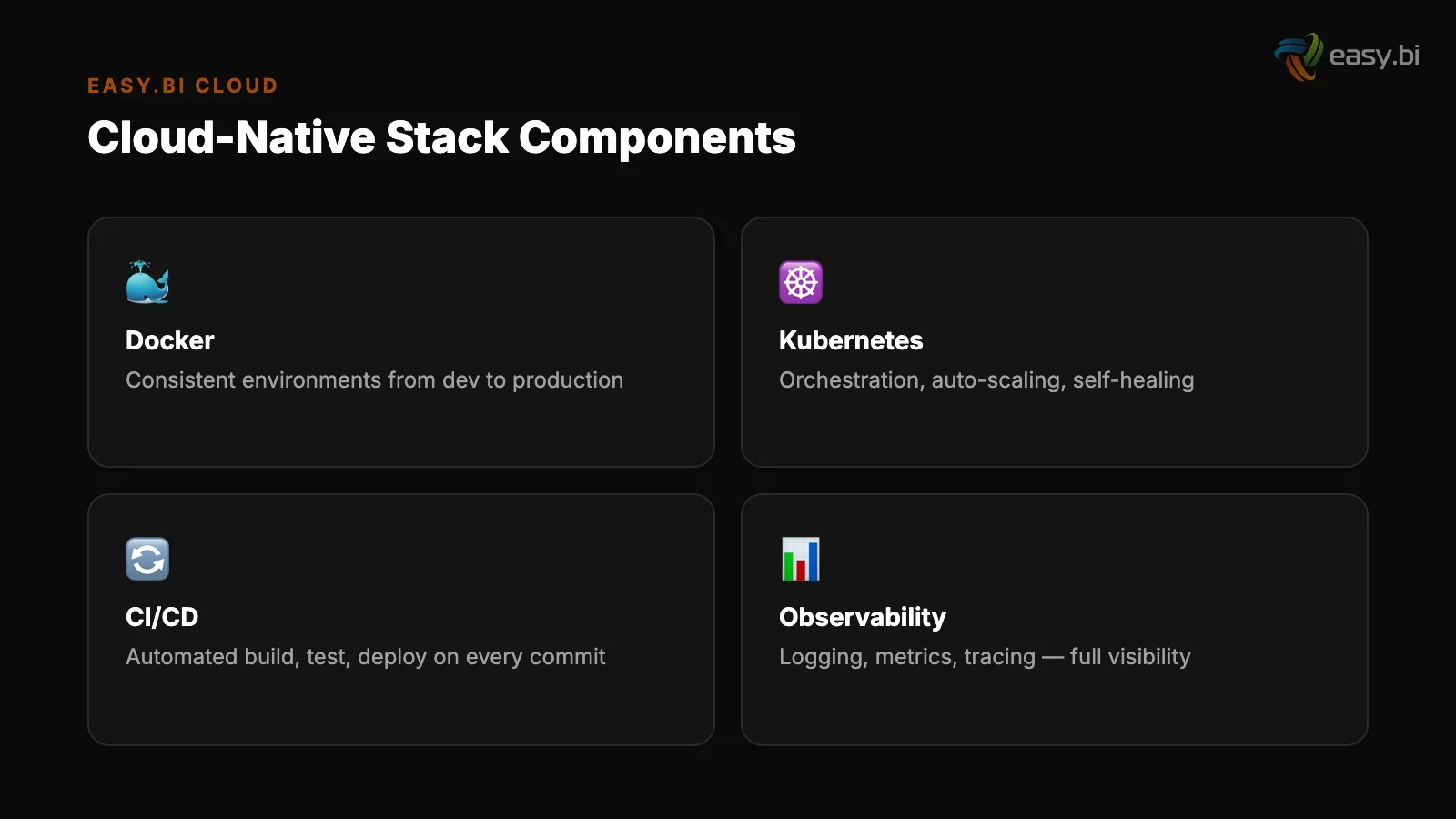
The honest assessment: most mid-market applications do not need Kubernetes on day one. Here is the decision framework.
Choose Kubernetes when
| Factor | Kubernetes | Docker Compose + Managed Service |
|---|---|---|
| Number of services | 10+ microservices or modules | 1-9 services |
| Team size (ops-capable) | 2+ engineers with K8s experience | 1 engineer with Docker experience |
| Traffic pattern | Unpredictable spikes, auto-scaling needed | Predictable, steady traffic |
| Multi-cloud requirement | Yes - K8s abstracts the cloud provider | No - single cloud provider is fine |
| Compliance/isolation | Namespace-based multi-tenancy | Simple network isolation sufficient |
| Monthly infrastructure budget | EUR 2,000+ | EUR 200-2,000 |
| Operational complexity tolerance | High - team can manage upgrades, networking, RBAC | Low - want managed infrastructure |
Choose Kubernetes when you run 10+ services that need independent scaling, your traffic is unpredictable (seasonal e-commerce, event-driven spikes), you need multi-cloud portability, or your compliance requirements demand namespace-level isolation.
Managed Kubernetes services (AWS EKS, Google GKE, Azure AKS) reduce operational burden significantly - you manage workloads, the cloud provider manages the control plane.
Choose Docker Compose + managed containers when your application is a modular monolith or 3-5 services, your team has limited Kubernetes experience, traffic is predictable, and you want to minimize operational overhead. AWS ECS, Google Cloud Run, or Azure Container Apps give you container orchestration without the Kubernetes learning curve.
You can always migrate to Kubernetes later - containers are portable by design.
Choose Docker Compose + managed containers when
Organizations with high DevOps maturity are 2.6x more likely to exceed profitability, market share, and productivity goals. The path to that maturity starts with containerization and CI/CD - not with Kubernetes. Get the fundamentals right first. [6]
How Should You Build CI/CD Pipelines From Day One?
CI/CD is the single highest-ROI infrastructure investment a mid-market engineering team can make. Continuous integration means every code change is automatically built and tested. Continuous deployment means every passing change is automatically deployed to production.
The combined effect: faster feedback, fewer bugs, and deployments that happen in minutes instead of days.
The average CI pipeline run time decreased from 11.4 minutes in 2021 to 8.2 minutes in 2023 for teams using parallelism and caching [7].
Fast pipelines change developer behavior - when you know your change will be tested and deployed in under 10 minutes, you commit smaller changes more frequently, which reduces risk per deployment.
1. Build
A production-ready CI/CD pipeline for mid-market applications includes 5 stages:
1. Build. Compile the application, install dependencies, create Docker images. This stage should take under 2 minutes. Cache dependency downloads (npm, Composer, pip) between runs. Use multi-stage Docker builds to keep final images small - a typical PHP/Symfony application image should be under 150MB.
2. Test. Run unit tests, integration tests, and static analysis. Automated testing coverage exceeding 80% correlates with 40% fewer production incidents [8]. Run tests in parallel when possible. Fail fast - if unit tests fail, skip integration tests to save pipeline minutes.
2. Test
3. Security scan. 55% of CI/CD pipelines now include automated security scanning [9]. Run SAST (static analysis) against your code and SCA (software composition analysis) against your dependencies. Flag critical vulnerabilities as pipeline blockers. Treat medium vulnerabilities as warnings that must be addressed within the current sprint.
4. Deploy to staging. Automatically deploy every passing build to a staging environment that mirrors production. Run smoke tests against staging: key API endpoints respond correctly, database migrations applied cleanly, external integrations reachable. This catches environment-specific issues before they reach production.
5. Deploy to production. For teams new to continuous deployment, start with a manual approval gate between staging and production. As confidence grows, remove the gate and deploy automatically. Use progressive delivery practices - canary releases and blue-green deployments - that reduce deployment-related incidents by 74% [10].
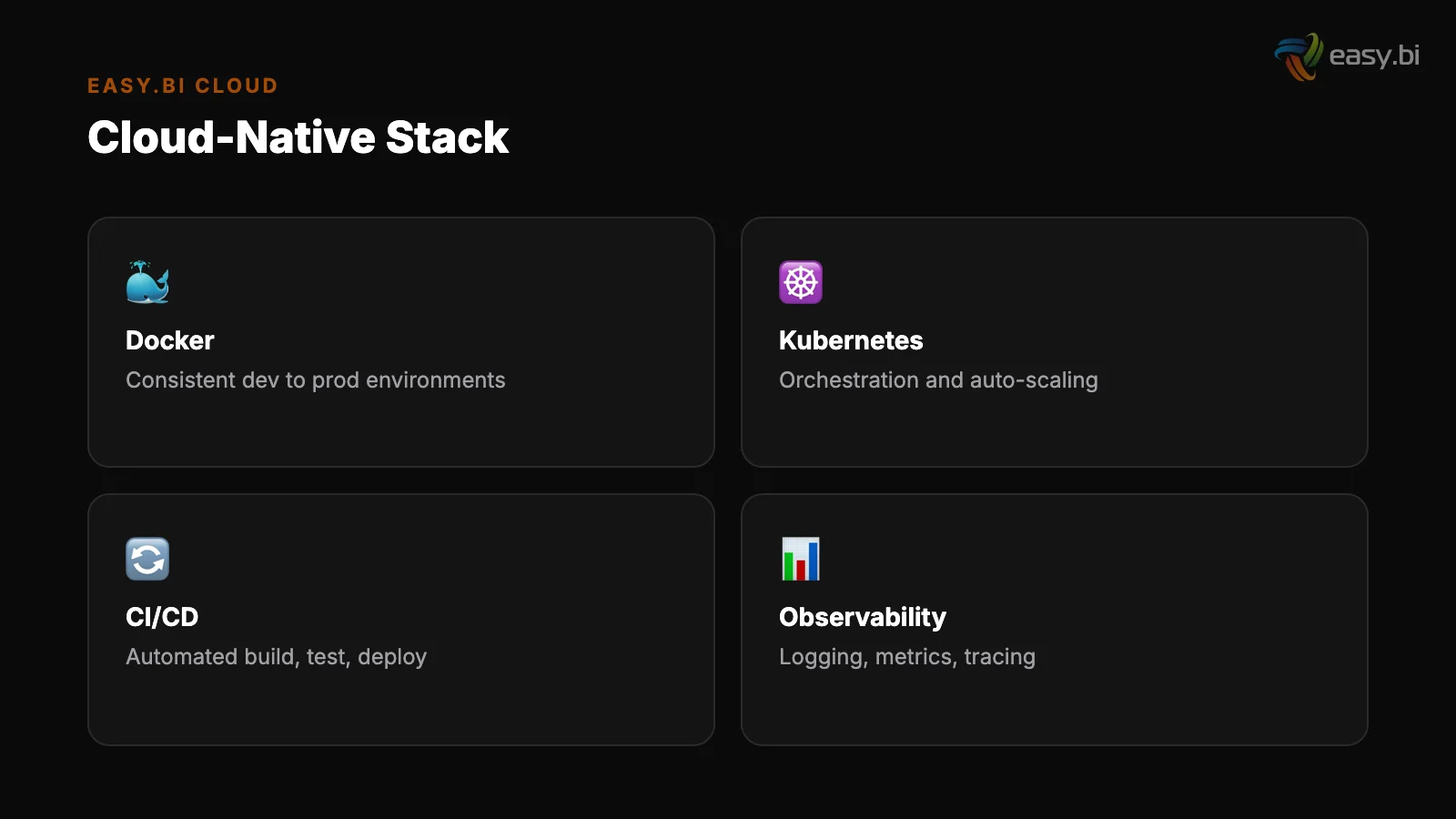
What Is GitOps and Why Does It Matter?
GitOps is infrastructure management through Git. Every infrastructure change - scaling a service, updating an environment variable, adding a database - starts as a pull request.
The pull request is reviewed by a team member, merged, and automatically applied by a GitOps operator (ArgoCD or Flux) that watches the repository and reconciles the actual infrastructure state with the declared state in Git.
Companies using GitOps deploy 44% more frequently with 50% lower change failure rates compared to traditional deployment methods [11]. The reasons are structural:
Audit trail
Audit trail. Every infrastructure change is a Git commit with an author, timestamp, and description.
When something breaks, git log tells you exactly what changed, who changed it, and when. 70% of production outages are caused by configuration changes or deployments [12] - GitOps makes every one of those changes traceable and reversible.
Review process. Infrastructure changes go through the same pull request review as application code. A team member reviews the Kubernetes manifest change, the Terraform module update, or the Helm chart modification before it applies. This catches misconfigurations before they reach production.
Review process
Rollback by revert. If a deployment causes issues, git revert restores the previous infrastructure state. The GitOps operator detects the change and automatically reconciles.
Recovery time drops from "figure out what changed and how to undo it" to "revert the last commit." Elite DevOps performers achieve mean time to recovery under one hour [13] - GitOps is a key enabler.
For mid-market companies, GitOps brings enterprise-grade infrastructure discipline without enterprise-grade complexity. You do not need a dedicated platform team. You need a Git repository with your infrastructure definitions and a GitOps operator that keeps reality in sync with that repository.
How Do You Avoid Cloud Waste?
Cloud spend waste averages 32% of total cloud budgets due to idle resources and over-provisioning [14]. For a mid-market company spending EUR 5,000/month on cloud infrastructure, that is EUR 1,600/month - EUR 19,200/year - burned on resources nobody uses. FinOps practices prevent this waste from the start.
Right-size from day one. Do not provision production-sized infrastructure for development and staging. Use smaller instance types, lower replica counts, and scheduled scaling that shuts down non-production environments overnight and on weekends. A staging environment that runs 12 hours/day, 5 days/week costs 35% of a 24/7 environment.
Right-size from day one
Use spot/preemptible instances for non-critical workloads. CI/CD runners, batch processing, and staging environments run perfectly on spot instances at 60-90% discounts. Your production application runs on on-demand or reserved instances for reliability. This split alone can reduce total cloud costs by 20-30%.
Set resource requests and limits on every container. A container without CPU/memory limits consumes whatever is available. A container with properly tuned limits runs efficiently and predictably. Monitor actual resource usage for 2 weeks after deployment, then right-size limits to 120% of observed peak usage.
Implement cost tagging and alerting. Tag every cloud resource with project, environment, and team. Set budget alerts at 80% and 100% of monthly targets. Review cost reports weekly during the first 3 months, monthly after that.
FinOps adoption grew to 39% of organizations in 2023 [15] - adopting it early gives mid-market companies cost discipline that compounds over every infrastructure decision.
50+ custom projects. 99.9% uptime. 60% faster.
Senior-only engineering teams deliver production-grade platforms in under 4 months. No juniors on your project.
Start with a Strategy CallWhat Does a Cloud-Native Migration Path Look Like?
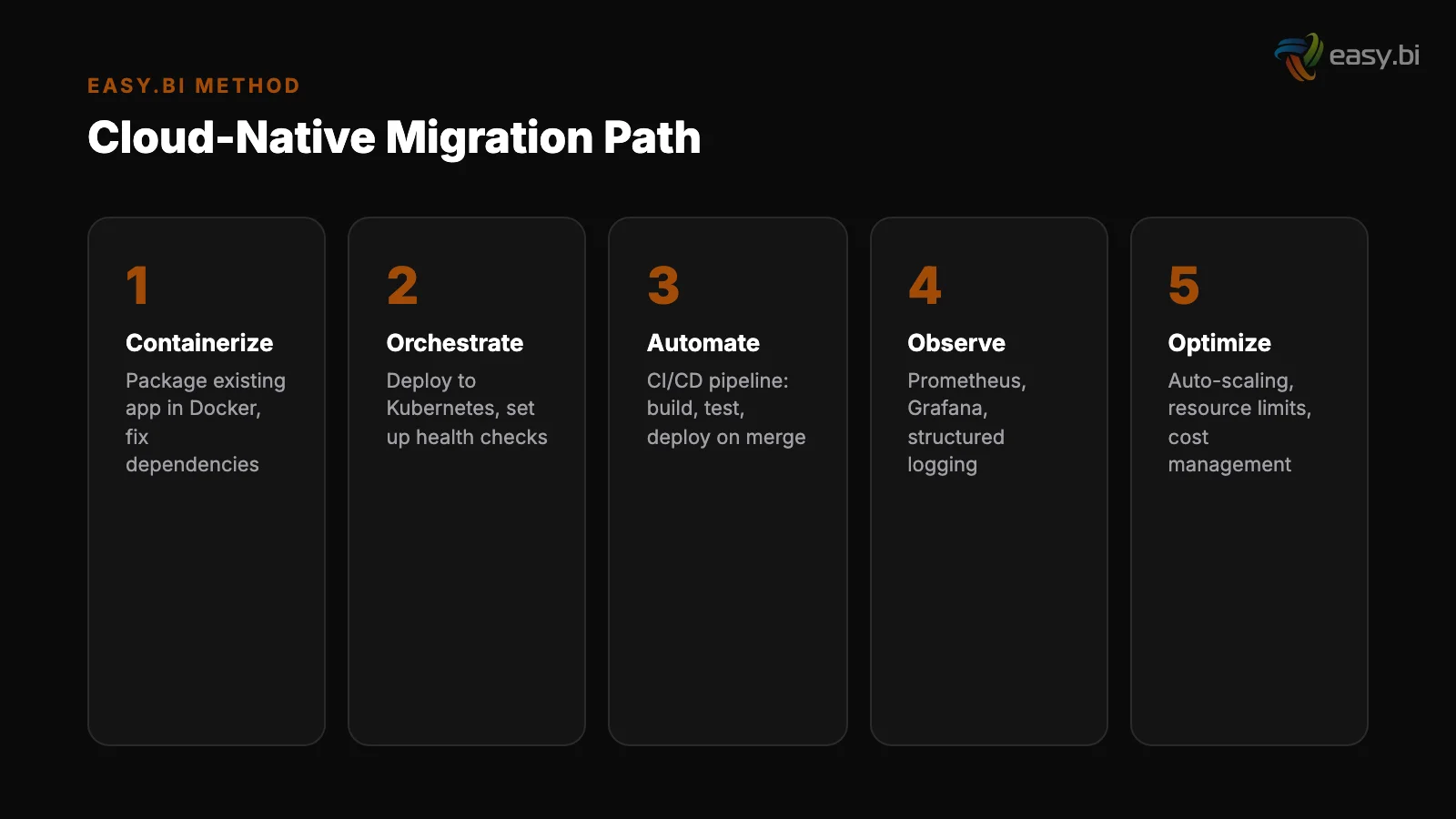
The mistake mid-market companies make is treating cloud-native as a big-bang migration. It is not. It is a gradual adoption path that starts with the highest-leverage practices and adds complexity only when the business demands it.
Month 1: Containerize and automate. Dockerize your application. Set up a CI/CD pipeline that builds, tests, and deploys containers. Deploy to a managed container service (ECS, Cloud Run). This alone delivers the majority of cloud-native benefits: consistent environments, automated deployments, and reproducible builds.
Month 1: Containerize and automate
Month 2-3: Infrastructure as Code. Define your cloud resources in Terraform. Set up GitOps with ArgoCD or Flux. Every infrastructure change now goes through Git. Terraform is the most popular IaC tool at 55% market share [16] - your team will find documentation, tutorials, and community support for any scenario.
Month 4-6: Observability and scaling. Add monitoring (Prometheus + Grafana or a managed service like Datadog), centralized logging (ELK stack or cloud-native equivalent), and distributed tracing (Jaeger or cloud-native equivalent). Organizations with mature observability practices resolve incidents 69% faster [17].
Set up horizontal pod autoscaling based on CPU, memory, or custom metrics.
Month 2-3: Infrastructure as Code
Month 6+: Evaluate Kubernetes. If your application has grown beyond 10 services, needs auto-scaling, or requires multi-cloud deployment, migrate to managed Kubernetes. Your containers are already portable. Your CI/CD pipelines need minor updates. Your IaC already defines most of the infrastructure. The migration is incremental, not disruptive.
This is the path easy.bi follows with mid-market clients. Our Performance Scrum methodology delivers working infrastructure improvements every 14 days - not a 6-month migration plan that delivers nothing until the end. Each sprint adds a cloud-native capability that immediately improves development velocity, deployment reliability, or cost efficiency.
Where Should You Start?
Cloud-native architecture is not about adopting every CNCF project. It is about making infrastructure decisions that compound your team's productivity instead of consuming it.
For mid-market companies, the sequence is clear: containerize first, automate with CI/CD second, add IaC and GitOps third, and adopt Kubernetes only when the complexity of your application justifies the complexity of the platform.
The numbers are unambiguous. CI/CD increases deployment frequency by 208x. GitOps reduces change failure rates by 50%. IaC eliminates 90% of configuration drift issues. Observability cuts incident resolution time by 69%. Each practice delivers measurable value independently. Together, they create an infrastructure foundation that scales with your business.
For a deeper look at how infrastructure decisions fit into the broader framework of building custom software that succeeds, read our pillar guide on building custom software that does not fail.
When you are ready to evaluate your cloud-native readiness or plan a migration, explore our custom solutions approach - or book an expert call to discuss your infrastructure with an engineer who has built cloud-native platforms across the DACH mid-market.
References
- [1] Bitkom (2024). "Cloud adoption in German enterprises reached 84% in 2024, with m
- [2] CNCF (2024). "5.6 million cloud-native developers globally, representing 31% of cncf.io
- [3] Stack Overflow (2023). stackoverflow.co
- [4] GitLab (2023). "87.5% of respondents use CI/CD pipelines; teams using CI/CD depl gitlab.com
- [5] HashiCorp (2023). "Infrastructure as Code adoption rose to 71% of organizations hashicorp.com
- [6] Puppet / DORA (2024). "Organizations with high DevOps maturity are 2. dora.dev
- [7] CircleCI (2023). "Average CI pipeline run time decreased from 11. circleci.com
- [8] CircleCI (2023). "Automated testing coverage exceeding 80% correlates with 40% f circleci.com
- [9] GitLab (2023). "55% of CI/CD pipelines now include automated security scanning." gitlab.com
- [10] LaunchDarkly (2023). "Progressive delivery practices reduce deployment-related i launchdarkly.com
- [11] Weaveworks / CNCF (2023). cncf.io
- [12] PagerDuty (2023). "70% of all production outages are caused by configuration cha pagerduty.com
- [13] DORA / Google Cloud (2023). cloud.google.com
- [14] Flexera (2024). "Cloud spend waste averages 32% of total cloud budgets." flexera.com
- [15] FinOps Foundation (2023). "FinOps adoption grew to 39% of organizations in 2023. finops.org
- [16] HashiCorp (2023). "Terraform is the most popular IaC tool at 55% market share. hashicorp.com
- [17] Splunk (2023). "Organizations with mature observability practices resolve incide splunk.com
Explore Other Topics
Ready to build your custom platform?
30-minute call with an engineering lead. No sales pitch - just honest answers about your project.
98% engineer retention · 14-day delivery sprints · No lock-in contracts
Related Reading

AI Strategy for Mid-Market: You Do Not Need a Data Science Team
Mid-market companies (EUR 20M-500M) do not need data scientists to deploy AI. They need AI-literate engineers and the right implementation partner. A practical AI strategy framework with the 3 opportunities every mid-market company has.
Filip Kralj
AI Governance for Mid-Market: You Need Less Than You Think
Enterprise AI governance frameworks are overkill for mid-market companies. Learn what the EU AI Act actually requires, how risk classification works in practice, and a 90-day governance roadmap that covers data privacy with LLMs, model monitoring, and regulatory compliance without paralysis.
Andrej Lovsin
Why Your MVP Takes 9 Months (And How to Ship in 8 Weeks)
90% of startups fail, with 42% citing no market need. Learn why MVPs take 9 months instead of 8 weeks, and the sprint model that eliminates scope creep, perfectionism, and waterfall disguised as agile.
Andrej Lovsin