
Technical Debt Is a Business Decision - Here's How to Make It

Table of Contents+
- What Is Technical Debt, Really?
- The Four Types of Technical Debt
- When Should You Take On Technical Debt Intentionally?
- How Do You Quantify Technical Debt in Business Terms?
- What Does a Prioritization Framework Look Like?
- How Do You Refactor Without Stopping Feature Development?
- What Happens When You Ignore Technical Debt Too Long?
- How easy.bi Manages Technical Debt Across 100+ Projects
- References
TL;DR
Every engineering team carries technical debt. The question is not whether you have it - you do. The question is whether you are managing it as a deliberate business decision or letting it accumulate as an invisible tax on every sprint.
Key Takeaways
- •Technical debt is a financial instrument, not a moral failing. Like financial debt, it has interest rates, compounding costs, and situations where taking it on deliberately accelerates business outcomes. The problem is not debt itself - it is untracked, unquantified debt that accumulates silently until it cripples delivery velocity.
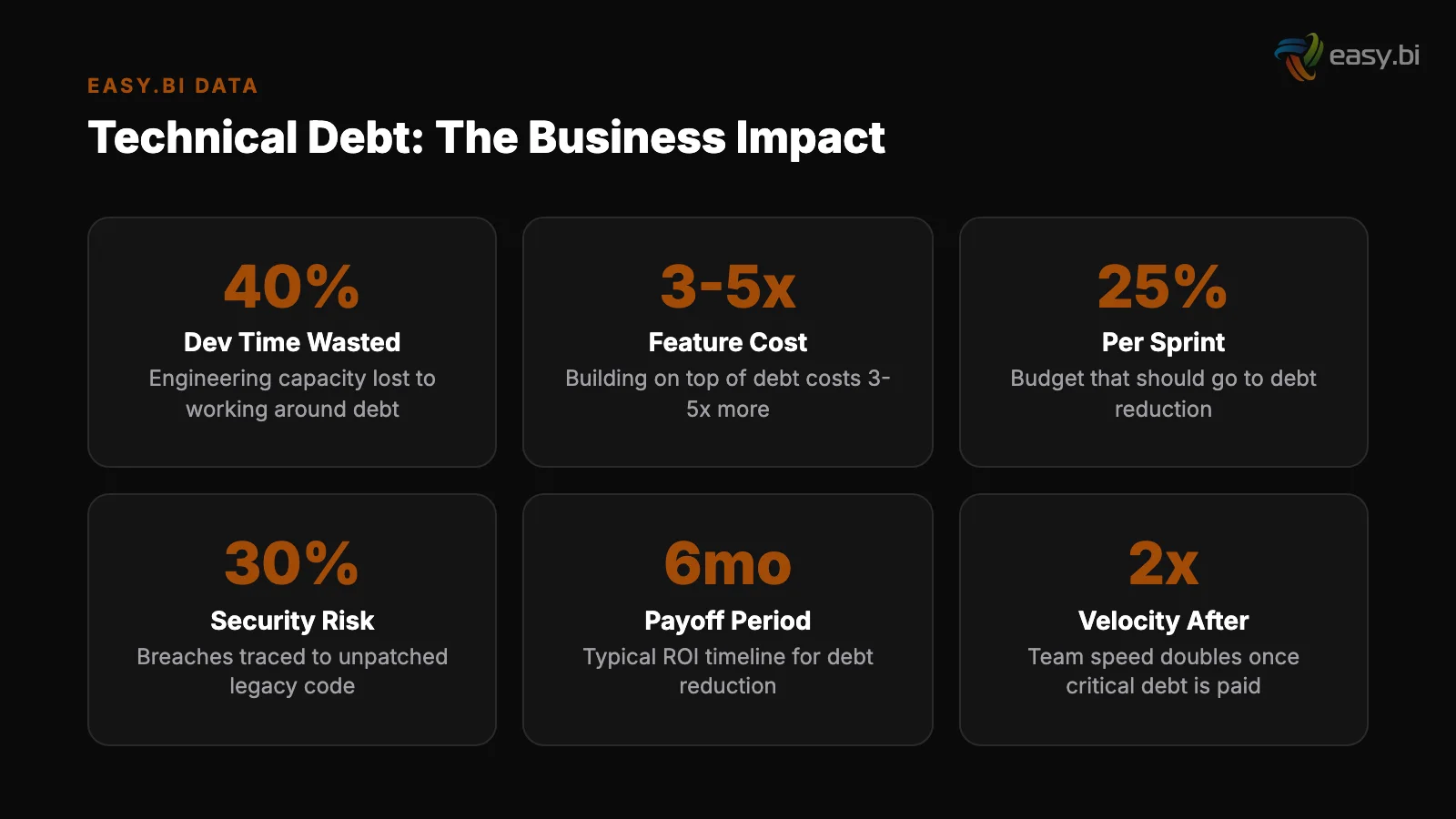
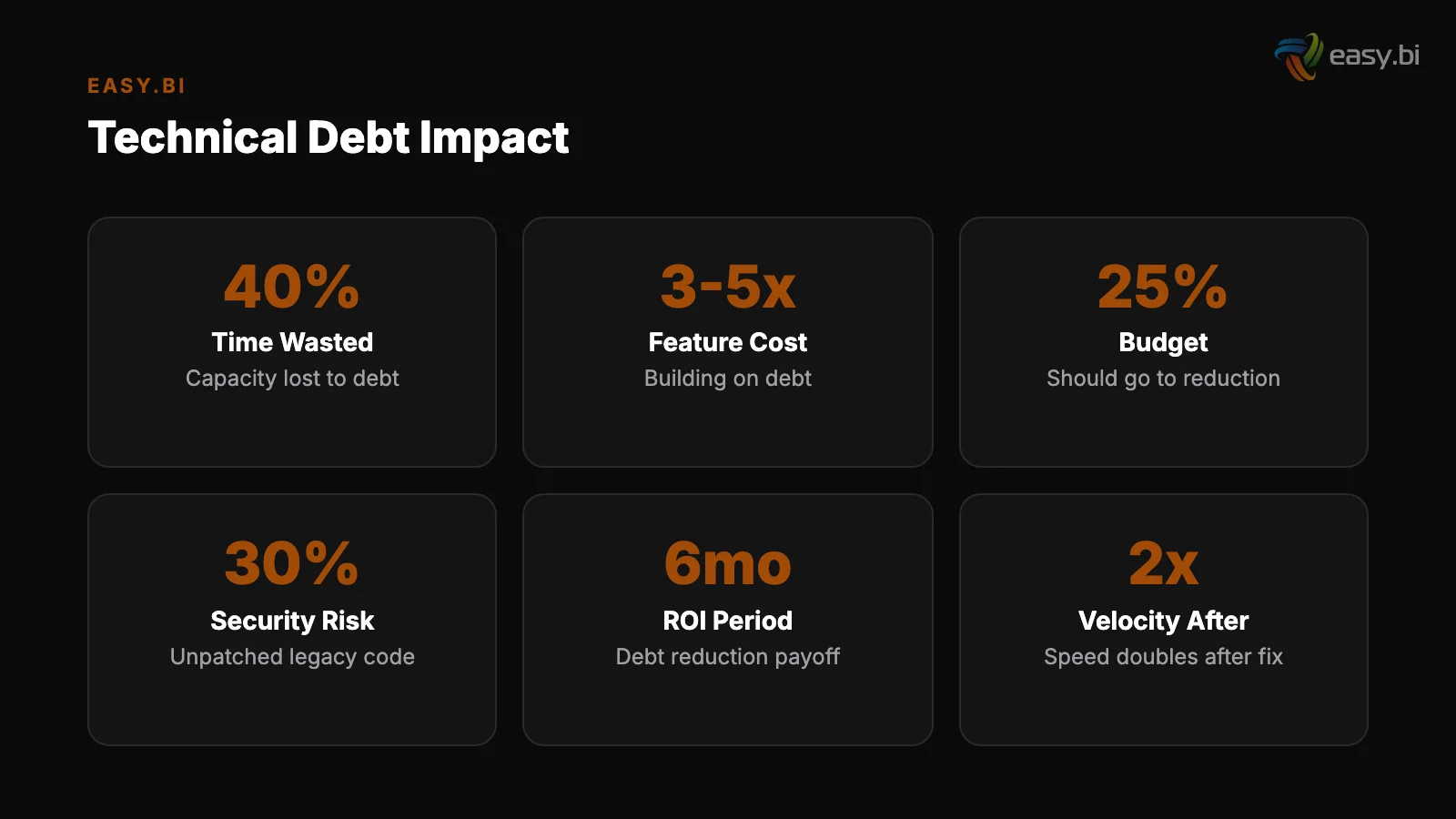
- •The average developer spends 41% of their time on maintenance and technical debt rather than new feature development. For a 10-person engineering team at average DACH rates, that translates to roughly EUR 400,000 per year spent servicing debt instead of building value.
- •Deliberate technical debt - taken on consciously with a documented repayment plan - is a valid business strategy. Shipping a time-sensitive feature with a known shortcut that you plan to refactor in the next sprint is smart. Shipping the same shortcut without documenting it is how debt becomes invisible and compounds.
- •Quantifying technical debt in hours and euros, not abstract severity scores, is the only way to get executive buy-in for refactoring. When you tell a CFO that 23% of engineering capacity is servicing invisible debt, the conversation changes from 'why should we refactor' to 'how fast can we start.'
- •The strangler fig pattern - incrementally replacing legacy components while the system continues to run - is the safest refactoring strategy for production systems. It avoids the big-bang rewrite trap that kills 70% of large-scale IT projects.
Technical debt is not a failure of engineering discipline - it is a financial instrument. Learn the four types of tech debt, when to take it on intentionally, how to quantify it in business terms, and practical refactoring strategies that keep feature development moving.
Every engineering team carries technical debt. The question is not whether you have it - you do. The question is whether you are managing it as a deliberate business decision or letting it accumulate as an invisible tax on every sprint.
After leading engineering across dozens of enterprise projects, I can tell you that the difference between teams that ship reliably and teams that grind to a halt is rarely talent or tooling. It is how they treat their debt.
What Is Technical Debt, Really?
Ward Cunningham coined the term "technical debt" in 1992 as a metaphor for the financial consequences of shipping code that works but is not yet structured for long-term maintainability. The metaphor is more precise than most people realize.
Financial debt has a principal (the cost to fix the shortcut), interest (the ongoing cost of working around it), and compounding (the rate at which interest grows as more code depends on the shortcut).
89% of IT leaders say technical debt impacts their ability to innovate [1]. That number should alarm anyone running a product roadmap.
It means that nearly 9 out of 10 technology leaders are watching their teams slow down - not because of skill gaps or budget constraints, but because past shortcuts are compounding faster than they can be repaid.
The average developer spends 41% of their time on maintenance and technical debt rather than new feature development [2]. For a mid-market DACH company with a 10-person engineering team, that is roughly 4 full-time engineers worth of capacity lost to debt servicing.
At average senior developer rates in Germany (EUR 72,000-85,000), that represents EUR 300,000-400,000 annually - spent not on building new capabilities, but on keeping existing ones functional.
The cost of poor software quality in the US alone was $2.41 trillion in 2022, with technical debt and operational failures as the primary contributors [3]. Technical debt is not a code hygiene issue. It is one of the largest hidden costs in the global economy.
See how we deliver 60% faster time-to-market with 40% lower TCO than off-the-shelf.
The Four Types of Technical Debt
Not all technical debt is created equal. Martin Fowler's technical debt quadrant provides a useful classification, but I find a more operational taxonomy works better for prioritization decisions.
| Type | Cause | Interest Rate | Repayment Strategy |
|---|---|---|---|
| Deliberate-Tactical | Conscious shortcut to meet a deadline | Low (if documented) | Scheduled refactoring in next 1-2 sprints |
| Deliberate-Strategic | Architecture trade-off for faster market entry | Medium | Planned migration when scale demands it |
| Accidental-Knowledge | Team lacked domain knowledge at build time | Medium-High | Refactor as domain understanding deepens |
| Accidental-Entropy | Gradual degradation from hundreds of small changes | High (compounds silently) | Continuous refactoring discipline |
Deliberate-Tactical debt is the least dangerous because it is visible. You know it exists, you know where it lives, and you have a plan to address it.
A team that ships a feature with a hardcoded configuration because the dynamic configuration service is not ready yet - and logs a ticket to replace it - is managing debt responsibly.
Deliberate-Tactical debt
Deliberate-Strategic debt is the most interesting category. This is when you choose a monolithic architecture for your MVP because microservices would add 3 months to your launch timeline. That is not a mistake.
That is a calculated bet that getting to market faster outweighs the migration cost you will pay later. The key is documenting the decision and the trigger point for migration.
Accidental-Knowledge debt happens on every project. The team builds a data model based on their initial understanding of the business domain, then discovers 6 months later that the model does not support a critical workflow they did not know about.
This is not negligence - it is the natural consequence of building software in complex domains where full understanding emerges over time.
Accidental-Entropy debt is the silent killer. No single commit introduces it. It accumulates through hundreds of small, reasonable decisions - an extra parameter here, a conditional branch there, a copied function with minor modifications.
After 2-3 years, the codebase becomes brittle in ways that no individual developer caused but every developer suffers from.
When Should You Take On Technical Debt Intentionally?
The answer is more often than most engineering purists would like to admit. Technical debt is not inherently bad, just as financial debt is not inherently bad. A mortgage lets you live in a house before you can afford to buy it outright.
Technical debt lets you ship value before you can afford to build the perfect architecture.
Take on deliberate debt when the business value of shipping now significantly outweighs the cost of repayment later. Specific scenarios where intentional debt makes sense:
- Market validation: You are testing a hypothesis and need to ship a feature in 2 weeks, not 6. If the hypothesis is wrong, the code gets deleted anyway. If it is right, you refactor with confidence that the investment is justified.
- Competitive windows: A competitor just launched a feature your customers are asking about. Shipping a functional version in one sprint and refactoring over the next two is better than spending 6 weeks on the perfect implementation while customers evaluate alternatives.
- Seasonal deadlines: Your e-commerce client needs Black Friday readiness by October. Shipping with known architectural shortcuts and scheduling a January refactoring sprint is a rational business decision.
- Learning-first development: You are building in an unfamiliar domain. Building the first version as a learning exercise - accepting that you will rebuild parts of it - is more efficient than trying to architect the perfect solution with incomplete domain knowledge.
The best engineering teams do not avoid technical debt. They take it on deliberately, track it explicitly, and repay it strategically. The worst teams take on the same amount of debt - they just do not know it.
How Do You Quantify Technical Debt in Business Terms?
The biggest obstacle to managing technical debt is that engineers describe it in technical terms ("the API layer needs refactoring") while business stakeholders think in financial terms ("what does this cost us?"). Bridging this gap requires translating debt into hours and euros.
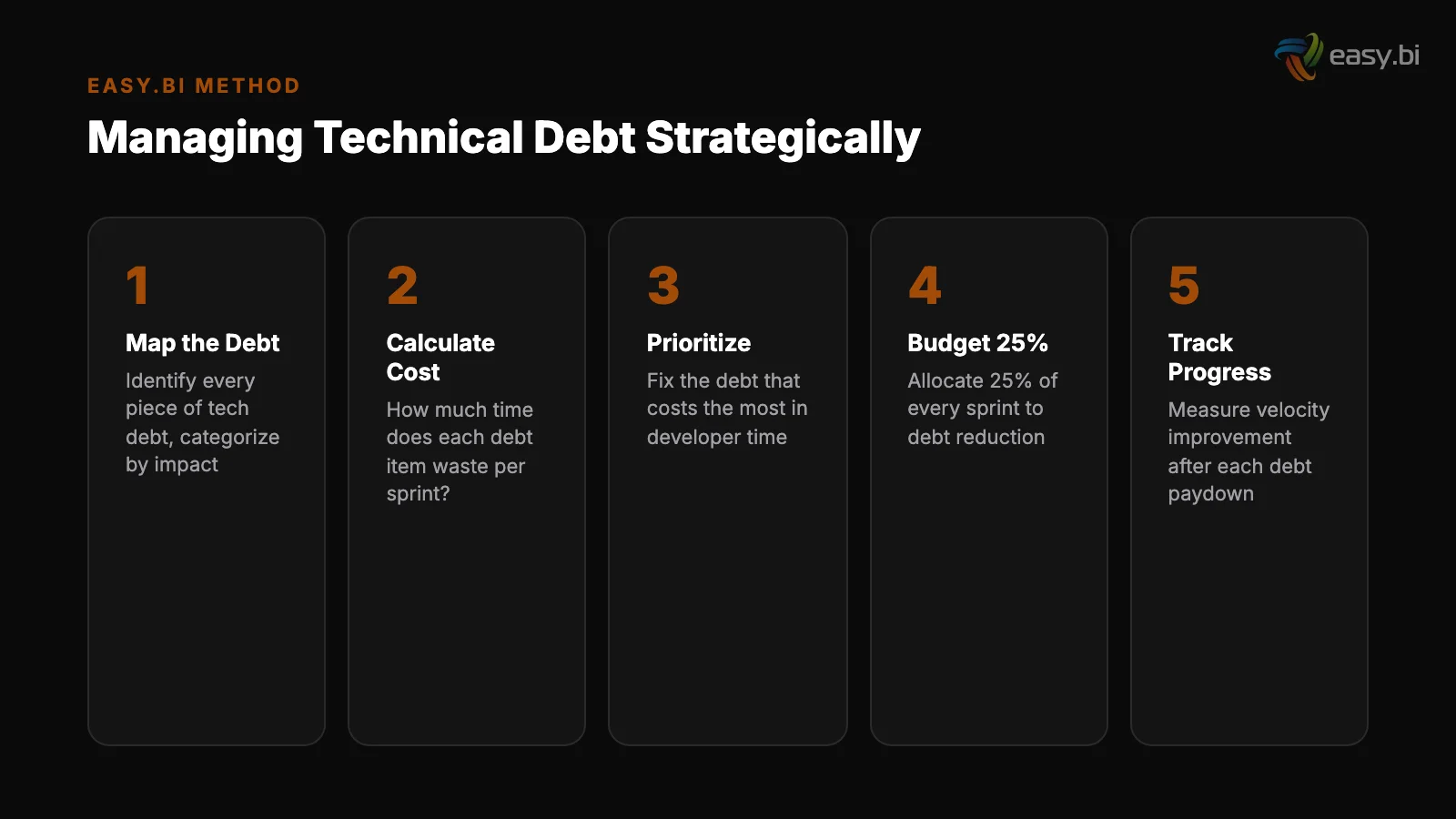
Here is the framework we use across projects at easy.bi:
Step 1: Identify debt items
Step 1: Identify debt items. Audit the codebase for known shortcuts, outdated dependencies, code duplication, and areas with high defect density. Each item becomes a debt ticket with a description of what is wrong and why it matters.
Step 2: Estimate principal. For each debt item, estimate the engineering hours required to fix it properly. This is the principal - the one-time cost of repayment.
Step 3: Estimate interest. For each debt item, estimate the ongoing cost per sprint of working around it.
This includes extra development time for features that touch the affected area, debugging time from defects caused by the debt, and onboarding time for new team members who need to understand the workaround.
The average developer already spends 23% of their time - one full day per week - dealing with technical debt [4].
Step 2: Estimate principal
Step 4: Calculate the payback period. Divide the principal by the interest per sprint. If fixing a debt item takes 40 hours (principal) and the team spends 8 hours per sprint working around it (interest), the payback period is 5 sprints. After sprint 5, every subsequent sprint saves 8 hours.
Step 5: Prioritize by payback period. Debt items with the shortest payback periods should be addressed first - they deliver the fastest return on refactoring investment. A 3-sprint payback is more urgent than a 12-sprint payback, regardless of how "ugly" the code looks.
This approach works because it speaks the language of business. When you present a debt item as "40 hours to fix, saves 8 hours per sprint, pays for itself in 10 weeks," the conversation with product leadership becomes collaborative rather than adversarial.
What Does a Prioritization Framework Look Like?
Not all debt deserves immediate attention. Some debt is stable - it exists, everyone knows about it, and it costs very little in ongoing interest. Other debt is actively compounding and degrading delivery velocity week over week.
We prioritize using three factors:
1. Blast radius
1. Blast radius. How many features, teams, or systems does this debt item affect? Debt in a shared library that 15 services depend on has a larger blast radius than debt in an isolated utility function.
High blast radius means the interest rate is multiplied across every team that touches the affected code.
2. Rate of change. How frequently does the team need to modify the affected area? Debt in a module that changes every sprint costs more interest than debt in a module that has not been touched in 6 months. Focus refactoring effort on high-change areas first.
2. Rate of change
3. Defect correlation. Does the affected area generate a disproportionate number of bugs? If 40% of your production incidents originate from 10% of your codebase, that 10% is where your debt is compounding fastest.
Elite DevOps performers maintain a change failure rate of 0-5%, compared to 46-60% for low performers [5]. Technical debt is one of the primary drivers of that gap.
Combining these three factors into a simple scoring matrix gives you a prioritized backlog that product managers and engineering leads can review together during sprint planning.
50+ custom projects. 99.9% uptime. 60% faster.
Senior-only engineering teams deliver production-grade platforms in under 4 months. No juniors on your project.
Start with a Strategy CallHow Do You Refactor Without Stopping Feature Development?
The most common objection to addressing technical debt is "we cannot afford to pause feature development." This objection is valid - and it reveals a false dichotomy. Refactoring does not require stopping feature work. It requires integrating refactoring into feature work.
The Boy Scout Rule: Leave the code better than you found it. Every feature development task that touches a debt-affected area includes a small refactoring scope - renaming a misleading variable, extracting a duplicated function, adding missing tests. No individual change is large enough to affect the sprint commitment.
Over 6-12 months, the cumulative effect is transformational.
The Boy Scout Rule
The Strangler Fig Pattern: Named after the tropical vine that gradually envelops a host tree, this pattern replaces legacy components incrementally.
You build the new implementation alongside the old one, route traffic progressively to the new version, and remove the old version only after the new one is proven in production. No big-bang rewrite. No single point of failure. The system continues to serve users throughout the migration.
The 20% Rule: Allocate 20% of each sprint to debt repayment. In a 2-week sprint with 80 available engineering hours, 16 hours go to the highest-priority debt items from the prioritized backlog. This is not a tax on productivity - it is an investment.
Teams that maintain this discipline consistently see their velocity increase after 3-4 sprints because they are removing the friction that slows everything else down.
Refactoring as part of feature work: When a feature requires changes to a debt-affected area, scope the feature ticket to include refactoring that area. The feature provides the business justification. The refactoring provides the technical improvement. Both ship together.
This is the most sustainable approach because it ties every refactoring effort to a visible business outcome.
What Happens When You Ignore Technical Debt Too Long?
I have seen what happens when organizations ignore technical debt for years. The pattern is remarkably consistent across industries and tech stacks.
Phase 1: Velocity decline. Features that used to take one sprint now take two. The team attributes this to "increasing complexity" rather than debt. Sprint commitments start being missed. Product managers add buffer to estimates.
Phase 1: Velocity decline
Phase 2: Quality degradation. Production incidents increase. Hotfixes introduce new bugs because the code is too tangled to modify safely. QA cycles lengthen because regression risk is everywhere. The team spends more time fighting fires than building features.
Phase 3: Talent attrition. Senior engineers - the ones with the skill and context to manage the debt - leave. They are frustrated by the inability to do quality work and attracted by greenfield opportunities elsewhere.
The software development industry already has a 13.2% turnover rate, higher than professional services overall [6]. Technical debt accelerates that churn.
Phase 2: Quality degradation
Phase 4: The rewrite trap. Leadership, frustrated by declining velocity and quality, authorizes a complete rewrite. This is almost always a mistake. 70% of digital transformations fail to reach their stated goals [7], and big-bang rewrites are among the riskiest forms of digital transformation.
The new system takes longer than estimated, the old system continues to degrade, and the organization ends up maintaining two systems instead of one.
The alternative is continuous, disciplined debt management - the approach described in this article. It is less dramatic than a rewrite but far more likely to succeed.
How easy.bi Manages Technical Debt Across 100+ Projects
Across 100+ projects delivered since 2015, we have developed a technical debt management practice that is built into our Performance Scrum methodology rather than bolted on as an afterthought.
Debt register: Every project maintains a living debt register - a prioritized list of known technical debt items with estimated principal, interest, and payback period. This register is reviewed during every sprint planning session alongside the feature backlog. It is visible to the client, not hidden in an engineering-only backlog.
Debt register
Architecture Decision Records (ADRs): When we take on deliberate debt, we document why in an ADR. The record captures the decision, the alternatives considered, the expected cost of the shortcut, and the trigger condition for repayment.
This ensures that deliberate debt remains deliberate - it does not slip into the accidental category when the original decision-maker moves to a different project.
Automated quality gates: Our CI/CD pipelines include automated checks for code complexity, test coverage trends, and dependency vulnerabilities. These gates do not prevent deployment, but they surface warning signals before debt accumulates to dangerous levels.
When test coverage drops below a project-specific threshold or cyclomatic complexity exceeds a defined limit, the debt register gets a new entry automatically.
Quarterly debt reviews: Beyond sprint-level management, we conduct quarterly reviews of each project's overall debt position. This longer-horizon view catches strategic debt that may have been acceptable 6 months ago but has now shifted from a low-interest loan to a high-interest credit card as the system has grown.
Architecture Decision Records (ADRs)
The result: our 98% client retention rate is built partly on the trust that comes from transparent debt management. Clients do not experience the gradual velocity decline that erodes confidence in engineering partnerships. They see consistent delivery velocity because we invest in the codebase health that makes consistent velocity possible.
For the full framework on building software projects that avoid the most common failure modes, read our pillar guide on building custom software that does not fail. For practical approaches to maintaining code quality at scale, see automated QA and AI-assisted testing.
And for the infrastructure decisions that either accelerate or compound technical debt, read cloud-native Kubernetes for mid-market companies.
If your engineering team is spending more time fighting existing code than building new capabilities, that is a solvable problem. Explore our custom solutions approach - we help teams quantify their debt, prioritize repayment, and get back to shipping features that move the business forward.
References
- [1] McKinsey (2024). "89% of IT leaders say technical debt impacts their ability to mckinsey.com
- [2] Stripe (2023). "The average developer spends 41% of their time on maintenance an
- [3] CISQ / Synopsys (2023). "The cost of poor software quality in the US was $2. it-cisq.org
- [4] Stripe (2022). "The average developer spends 23% of their time dealing with tech stripe.com
- [5] DORA (2024). "Elite performers have a change failure rate of 0-5%, compared to 4 dora.dev
- [6] LinkedIn / BLS (2024). linkedin.com
- [7] McKinsey (2023). "70% of digital transformations fail to reach their stated goal mckinsey.com
Explore Other Topics
Ready to build your custom platform?
30-minute call with an engineering lead. No sales pitch - just honest answers about your project.
98% engineer retention · 14-day delivery sprints · No lock-in contracts
Related Reading

Microservices vs. Monolith: When to Split (And When Splitting Kills You)
Practical decision framework for microservices vs. monolith. Team size thresholds, cost data, and the modular monolith middle ground for DACH mid-market.
Filip Kralj
Accessibility as a Business Advantage, Not a Compliance Checkbox
Accessibility is not a legal obligation to minimize - it is a market expansion strategy. Learn how the European Accessibility Act affects your products, why 15% of your potential customers have disabilities, and quick wins you can ship this week to improve both accessibility and SEO.
Timo Koerner
The essential elements of business software solutions
Explore key elements of enterprise software for manufacturing and engineering success, from SaaS to cloud computing and team management.
Filip Kralj