
The Discovery Phase That Saves You 6 Months

Table of Contents+
- Why Does Skipping Discovery Cost 6 Months?
- What Does a Proper Discovery Phase Include?
- How Do You Run Stakeholder Interviews That Actually Work?
- What Should the Technical Audit Cover?
- How Do You Make Architecture Decisions During Discovery?
- What Shortcuts Backfire Every Time?
- What Is the ROI of a Proper Discovery Phase?
- How Should You Start Your Next Project?
- References
TL;DR
66% of custom software projects fail or are challenged - over budget, behind schedule, or delivering less value than planned . The single biggest predictor of which third you land in is what happens in the first 2-4 weeks. Not the technology choice. Not the team size. Not the budget.
Key Takeaways
- •Projects with clear requirements upfront are 97% more likely to succeed than those without. Discovery is not a bureaucratic formality - it is the single highest-leverage investment in your entire project lifecycle, typically consuming 5-10% of total budget while preventing 40-60% of downstream rework.
- •57% of project failures trace back to communication breakdowns between business and technology stakeholders. Discovery forces those conversations before code is written, when fixing a misunderstanding costs hours instead of sprints.
- •A proper discovery phase takes 2-4 weeks and produces 4 deliverables: business process maps, an integration inventory, non-functional requirements, and measurable success criteria. Skip any of these and you are encoding failure into the project's DNA.
- •The cost of fixing a defect in production is 6.5x higher than fixing it during design. Discovery shifts defect detection left by turning assumptions into documented decisions before a single line of code is written.
- •Common shortcuts that backfire: skipping stakeholder interviews ('the CEO knows what we need'), assuming integrations are simple ('it is just an API call'), copying a competitor's feature set instead of mapping your own business processes, and treating discovery as a one-time document rather than a living reference.
Projects with clear requirements upfront are 97% more likely to succeed. Learn what a proper software discovery phase includes - stakeholder interviews, technical audits, architecture decisions - and why skipping it costs 6 months and 66% of your budget.
66% of custom software projects fail or are challenged - over budget, behind schedule, or delivering less value than planned [1]. The single biggest predictor of which third you land in is what happens in the first 2-4 weeks. Not the technology choice. Not the team size. Not the budget.
The discovery phase.
Projects with clear requirements upfront are 97% more likely to succeed than those without [1]. Yet discovery remains the most commonly skipped, compressed, or faked phase in software development. The business is eager to start building. The development team is eager to start coding.
Nobody wants to spend 3 weeks asking questions when they could be shipping features. So they skip discovery, start coding on assumptions, and spend the next 6 months discovering what they should have learned in weeks 1-3.
After delivering 100+ custom software projects for DACH mid-market companies since 2015, I can tell you: the projects that succeed are the ones where the client was willing to invest 2-4 weeks understanding the problem before solving it.
The projects that fail are the ones that started with a Jira board full of user stories written by someone who never talked to the people who would actually use the software.
This article covers what a proper discovery phase includes, why each component matters, and the specific shortcuts that turn a 4-month project into a 10-month regret.
Why Does Skipping Discovery Cost 6 Months?
The math is straightforward. The cost of fixing a defect found in production is 6.5x higher than fixing it during the design phase [2].
Discovery is the design phase for your entire project - the 2-4 weeks where you turn assumptions into documented decisions, surface hidden complexity, and align every stakeholder on what "done" actually looks like.
When you skip discovery, three things happen simultaneously:
Requirements emerge during development
Requirements emerge during development. Instead of discovering business rules before coding starts, the team discovers them when they hit edge cases during sprint 3, sprint 5, sprint 8. Each discovery triggers rework: database schema changes, API contract revisions, UI redesigns.
Scope creep affects 52% of all projects, increasing delivery time by an average of 27% [3]. But most of what teams call "scope creep" is actually "requirements that should have been discovered upfront."
Architecture decisions get locked in prematurely. Without a complete picture of integration requirements, data volumes, and performance targets, architects make technology decisions based on incomplete information. By the time the missing requirements surface, the architecture is already built.
Changing it means partial or full rewrites. 83% of software projects exceed their original schedule [4]; premature architecture decisions are a leading cause.
Architecture decisions get locked in prematurely
Stakeholder alignment collapses. 57% of projects fail due to communication breakdown between business and technology stakeholders [5]. Discovery is where you force alignment: what does this software need to do, for whom, by when, and how do we measure success?
Without that shared understanding, the development team builds what they think the business needs, the business evaluates what they actually need, and the gap between the two grows with every sprint.
The 6-month number is not arbitrary. Across our 100+ projects, the median schedule overrun for projects that compressed or skipped discovery is 5-7 months. The median overrun for projects that completed a full discovery phase: 2-3 weeks.
See how we deliver 60% faster time-to-market with 40% lower TCO than off-the-shelf.
What Does a Proper Discovery Phase Include?
A discovery phase for a mid-market custom software project takes 2-4 weeks and produces four deliverables. Each one addresses a specific failure mode. Skip any of them and you are placing a bet that the failure mode it prevents will not affect your project.
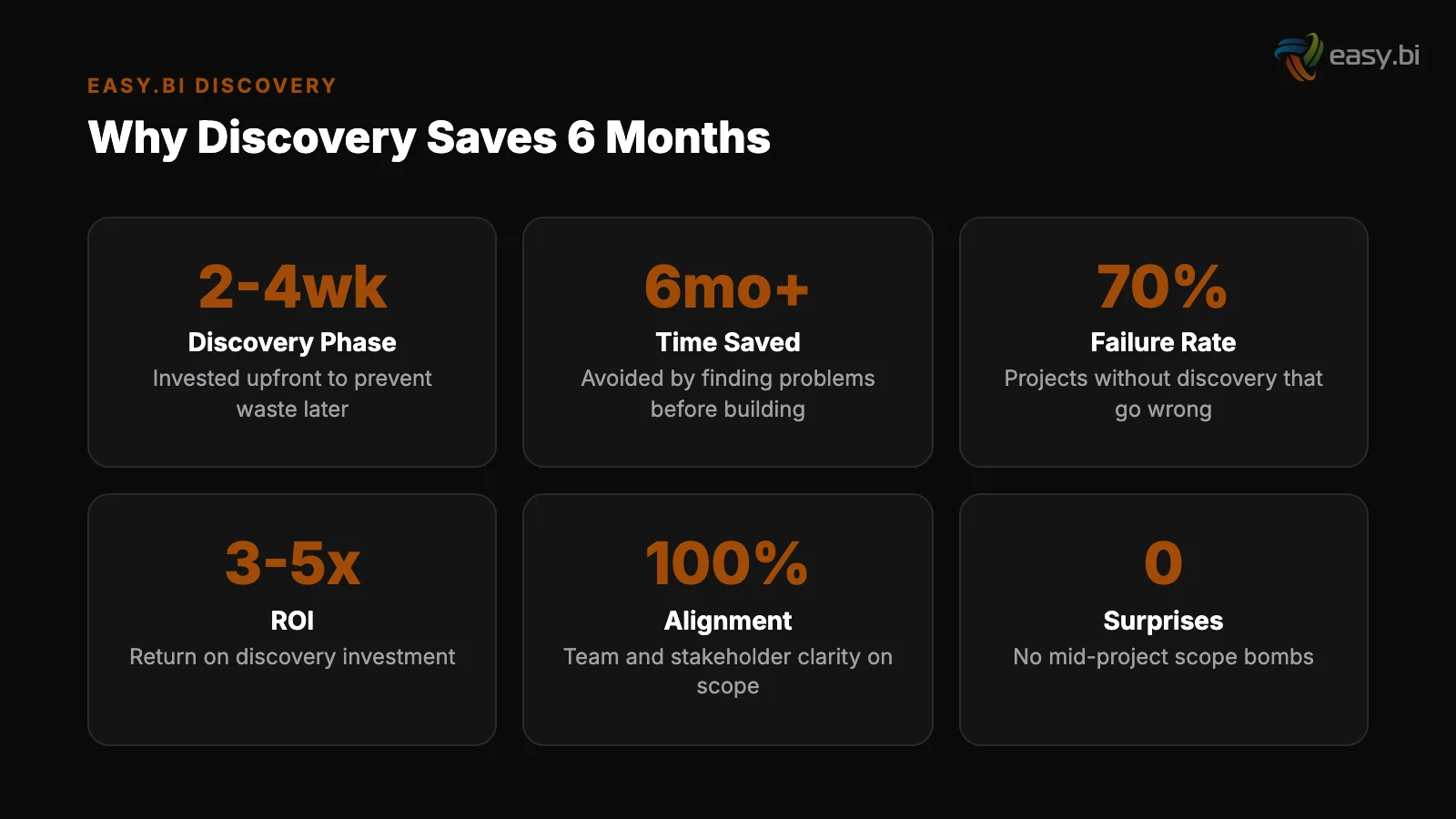
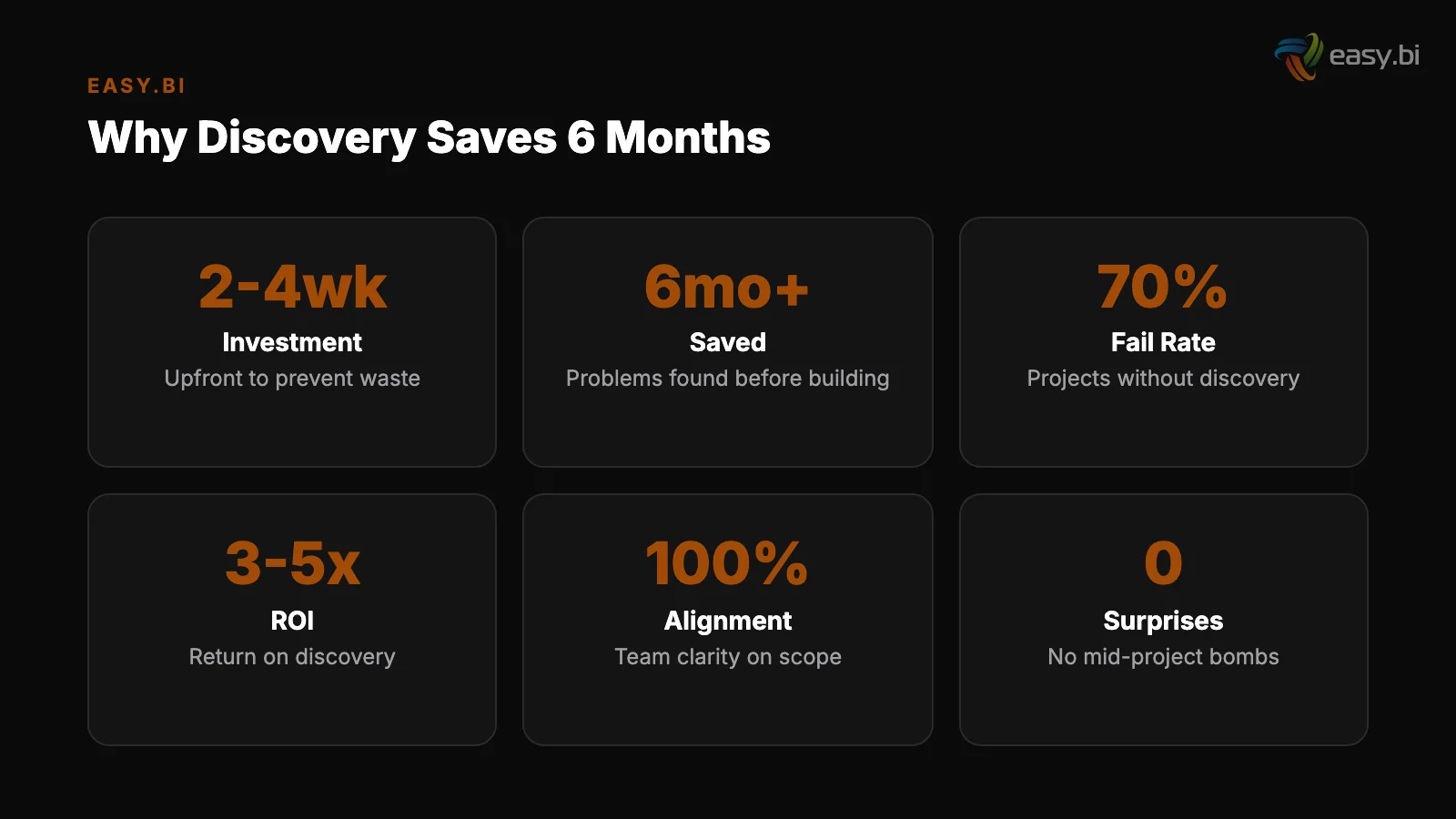
Industry data says that bet loses more often than it wins.
1. Business process mapping. Every workflow the software needs to support, documented with inputs, outputs, decision points, exception paths, and the business rules that govern each step. This is not a feature list.
It is a map of how the business actually operates - including the workarounds, manual steps, and institutional knowledge that live in spreadsheets and people's heads.
The process mapping phase typically uncovers 30-50% more complexity than the initial brief suggested.
When we built the order processing system for WeberHaus, the discovery phase identified 47 distinct business rules around offline capability - rules that were obvious to the field workers who used the system daily but invisible to the managers who wrote the project brief.
Discovering those rules in week 2 cost a few hours of interviews. Discovering them in sprint 6 would have cost a month of rework.
1. Business process mapping
2. Integration inventory. A complete list of every system the software needs to communicate with: ERPs, CRMs, data warehouses, third-party APIs, legacy databases, file systems, email services, payment gateways.
For each integration, document the protocol (REST, SOAP, file transfer, database link), data format (JSON, XML, CSV, proprietary), authentication method, rate limits, SLA requirements, and the responsible team on the other side.
Integration complexity is the most consistently underestimated factor in custom software projects. "It is just an API call" is the sentence that has launched a thousand schedule overruns.
Lekkerland's SAP S/4HANA migration required mapping 23 integration endpoints before development started - each with its own authentication model, data format, and error handling requirements. That mapping took 8 days during discovery.
Without it, the team would have spent weeks per integration discovering requirements through trial and error in production-adjacent systems.
3. Non-functional requirements. Performance targets (response time under X milliseconds for Y concurrent users), availability requirements (99.9% uptime = 8.7 hours of permitted downtime per year), security constraints (GDPR compliance, data residency requirements, encryption standards), and scalability projections (expected growth in users, data volume, and transaction throughput over 3 years).
2. Integration inventory
Non-functional requirements determine architecture. An application that must handle 100 concurrent users has fundamentally different infrastructure needs than one that must handle 100,000. A system that stores personal health data has different security requirements than an internal project management tool.
These requirements must be known before architecture decisions are made - not discovered when the system fails a load test or a compliance audit.
4. Measurable success criteria. Three to five KPIs with baseline measurements and target values.
Not "improve efficiency" but "reduce order processing time from 12 minutes to 3 minutes." Not "better user experience" but "increase task completion rate from 62% to 85%." If you cannot define success in numbers, you cannot measure it, and if you cannot measure it, you will never agree on whether the project succeeded.
The discovery phase is the cheapest place to find problems. Every assumption validated in discovery is a rework cycle eliminated in development. At 5-10% of total project budget, discovery consistently delivers the highest return of any project phase.
How Do You Run Stakeholder Interviews That Actually Work?
Stakeholder interviews are the core activity of discovery. They are also the activity most commonly done wrong.
The typical failure mode: the project manager sends a questionnaire, the executive fills it out with what they think the software should do, and the development team builds exactly that - only to discover it does not match how the business actually operates.
Effective stakeholder interviews follow three principles:
Interview the users, not just the sponsors
Interview the users, not just the sponsors. The person funding the project knows the strategic goals. The person using the software daily knows the operational reality. Both perspectives are essential, but operational reality takes precedence when they conflict.
Interview at least 3 levels: executive sponsor (why are we building this), middle management (what business processes does it support), and end users (how do you actually do this work today).
Observe, do not just ask. People cannot accurately describe their own workflows. They forget steps that have become automatic, skip exception paths they handle intuitively, and underestimate the complexity of tasks they perform daily.
Shadowing a user through their actual workflow for 2-3 hours reveals more requirements than a 1-hour interview. When we work with DACH manufacturing and logistics clients, on-site observation consistently uncovers 20-30% of requirements that interviews alone miss.
Observe, do not just ask
Document decisions, not just requirements. Every interview produces decisions: "We will support offline mode for field workers." "Order approval requires two signatures above EUR 10,000." "Customer data must stay within EU data centers." Document each decision with the reasoning behind it, the stakeholder who made it, and the alternatives that were considered and rejected.
This decision log becomes the project's institutional memory - essential when questions arise 6 months later about why a particular approach was chosen.
| Interview Approach | Time Required | Requirements Coverage | Risk of Missing Critical Requirements |
|---|---|---|---|
| Executive questionnaire only | 2-4 hours | 30-40% | High - misses operational reality |
| Interviews (sponsor + management) | 1-2 weeks | 60-70% | Medium - misses user-level detail |
| Full discovery (all levels + observation) | 2-4 weeks | 85-95% | Low - systematic coverage |
| No discovery (start from feature list) | 0 hours | 15-25% | Very high - building on assumptions |
What Should the Technical Audit Cover?
The technical audit is the engineering team's contribution to discovery. While stakeholder interviews map business requirements, the technical audit maps the existing landscape: what systems exist, what state they are in, what constraints they impose, and what risks they carry.
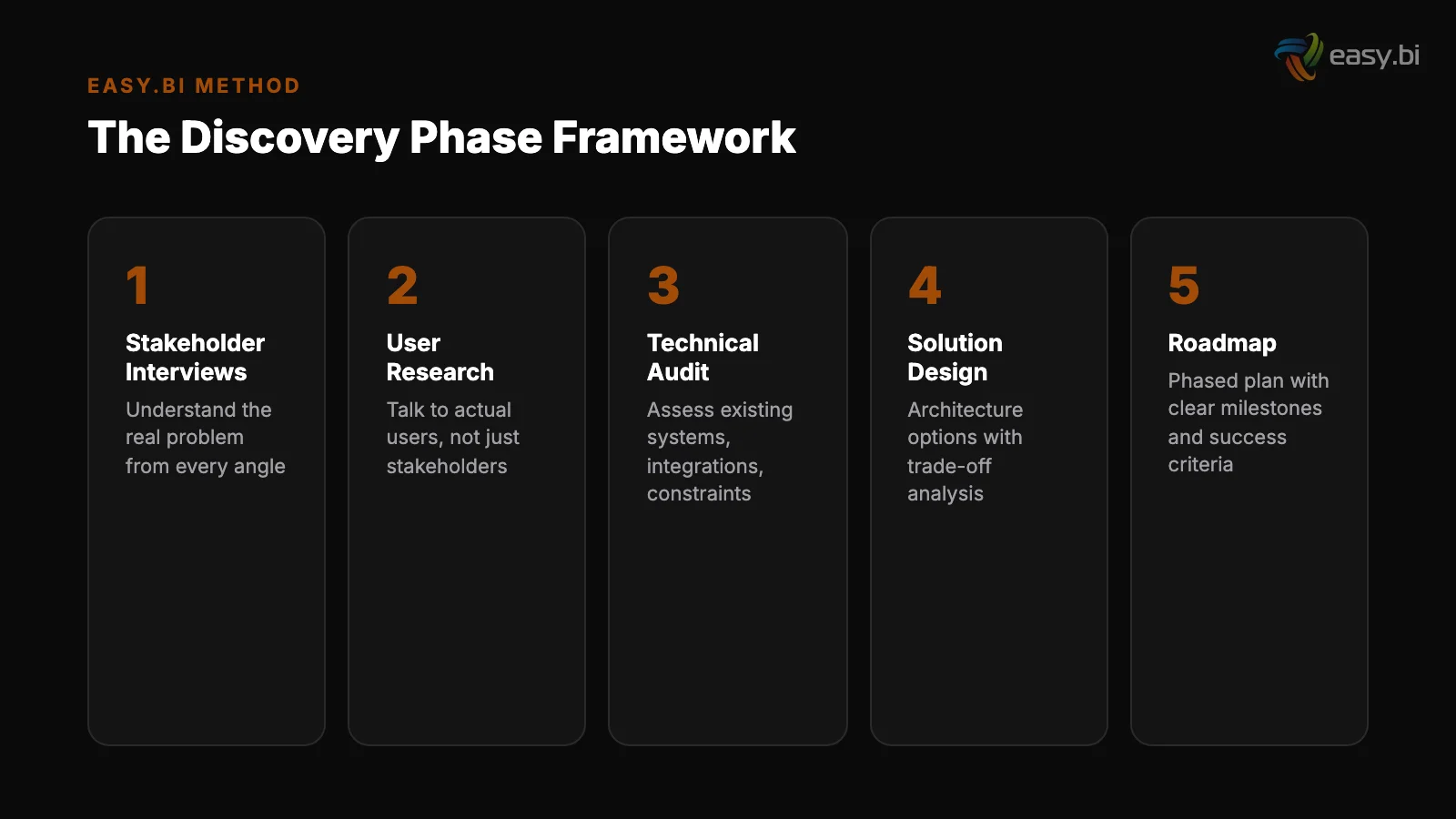
Four areas require assessment:
Existing system architecture
Existing system architecture. Document every system in the current landscape: technology stack, hosting environment, data stores, integration points, authentication mechanisms.
Identify systems that will be replaced, systems that will be integrated with, and systems that must continue running unchanged. 89% of IT leaders say technical debt impacts their ability to innovate [6] - the technical audit quantifies that debt before you start building on top of it.
Data assessment. What data exists, where does it live, what format is it in, how clean is it, and who owns it? Data migration is consistently the most underestimated work in software projects.
A 500,000-row customer database with 15 years of inconsistent formatting, duplicate records, and missing fields is a 3-sprint data cleanup project disguised as an "import task."
Data assessment
Security and compliance baseline. What are the current security practices? Where are the gaps relative to requirements (GDPR, industry regulations, customer contracts)? German companies lost EUR 206 billion to cybercrime in 2024 [7]. The technical audit identifies security risks before they become architectural constraints discovered mid-build.
Infrastructure capacity. Can the existing infrastructure support the new system? What needs to change? Cloud adoption in German enterprises reached 84% [8], but many mid-market companies still run hybrid environments where cloud and on-premise systems must coexist. The technical audit maps this reality so architecture decisions account for it.
How Do You Make Architecture Decisions During Discovery?
Discovery produces the information needed to make informed architecture decisions. Without discovery, architecture is guesswork. With discovery, architecture is engineering.
The key decisions that must be made during discovery - and that cannot be responsibly made without it:
Build vs. buy
Build vs. buy. If 80% of your requirements match an off-the-shelf product, custom building is usually the wrong call. Discovery quantifies this overlap. The remaining 20% - your unique business logic, your specific integration landscape, your competitive differentiation - determines whether custom software is justified.
German enterprises spend an average of EUR 1.2 million annually on custom software development [9]. That investment must target problems that off-the-shelf products genuinely cannot solve.
Monolith vs. services. The number of distinct business domains, team size, and expected scaling requirements determine the starting architecture. Microservices architecture increases deployment frequency by 75% but also increases operational complexity by 40% [10]. For a 5-person team building a 3-domain application, a well-structured monolith is the right answer.
For a 20-person team building a 12-domain platform, service-oriented architecture earns its complexity.
Monolith vs. services
Technology stack. Team capabilities, integration requirements, performance targets, and the talent market all factor into the stack decision. With 149,000 unfilled IT positions in Germany [11], choosing a technology with a thin talent pool adds recruitment risk on top of technical risk.
Discovery surfaces these constraints so the technology choice is informed, not aspirational.
Integration strategy. Synchronous API calls, asynchronous message queues, event-driven architectures, file-based batch processing - each integration pattern has different reliability, performance, and complexity profiles. The integration inventory from discovery tells you which pattern fits each connection.
Choosing the wrong pattern leads to fragile integrations that fail silently and corrupt data gradually.
50+ custom projects. 99.9% uptime. 60% faster.
Senior-only engineering teams deliver production-grade platforms in under 4 months. No juniors on your project.
Start with a Strategy CallWhat Shortcuts Backfire Every Time?
After 100+ projects, the shortcuts that cause the most damage are remarkably consistent. They all share a common trait: they feel like time savings in week 1 and reveal themselves as time debts by month 3.
"The CEO knows what we need." The CEO knows the strategic vision. They do not know the 47 business rules around offline capability, the 23 integration endpoints, or the data quality issues in the 15-year-old customer database.
Skipping end-user interviews to save 1 week costs 1-3 months of rework when reality diverges from the executive summary.
"The CEO knows what we need."
"It is just an API call." No integration is "just an API call." Every integration has authentication, error handling, rate limiting, data format mismatches, versioning, timeout handling, and a team on the other side that may or may not respond to your questions. Budget 2-3 days per integration for discovery.
Budget 1-2 sprints per integration for implementation. Anything less is optimism masquerading as planning.
"We will figure out the requirements as we go." Agile does not mean "no requirements." Agile means responding to change over following a plan - but you need a plan to change from. Discovery produces that plan. Without it, you are not iterating toward a goal.
You are wandering without a map. The average cost overrun on software projects is 66% of original budget [12]. "Figuring it out as we go" is the primary contributor.
"It is just an API call."
"Let us copy what [competitor] built." Your competitor's software reflects their business processes, their integration landscape, their organizational structure. Copying their feature set means building software optimized for someone else's business. Discovery maps your business - your workflows, your constraints, your competitive advantages.
That is what the software needs to serve.
"We don't have time for discovery." You do not have time to skip it. A 3-week discovery phase on a 4-month project consumes 19% of the timeline. The average schedule overrun for projects without discovery: 5-7 months - a 125-175% timeline increase. Discovery is not a delay.
It is schedule insurance.
What Is the ROI of a Proper Discovery Phase?
Discovery typically costs 5-10% of total project budget. For a EUR 200,000 project, that is EUR 10,000-20,000. The return on that investment:
Reduced rework. Projects with thorough discovery experience 40-60% less rework than those without. On a EUR 200,000 project, 40% less rework saves EUR 30,000-50,000 in development cost.
Reduced rework
Accurate estimates. Discovery replaces guesses with data. When you know the integration complexity, data volume, and business rules before estimating, your timeline accuracy improves from the industry average of 17% schedule variance to 5-10%. Predictable timelines mean predictable budgets and predictable business planning.
Stakeholder alignment. Discovery produces a shared understanding documented in artifacts that everyone has reviewed and approved. This eliminates the "that is not what I meant" conversations that derail sprints 4, 5, and 6.
Cross-functional teams are 35% more productive than siloed teams [13], and discovery is what makes a group of stakeholders into a cross-functional team.
Accurate estimates
Informed architecture. Architecture decisions made with complete information compound in your favor over 3-5 years. Architecture decisions made on assumptions compound against you. API-first companies grow revenue 38% faster [14] - but only if the API design reflects actual business capabilities, which requires discovery to identify those capabilities.
At easy.bi, discovery is not optional. It is the first phase of every engagement, built into our Performance Scrum methodology. The output - business process maps, integration inventory, non-functional requirements, success criteria - becomes the foundation for sprint planning, architecture decisions, and acceptance testing.
Our 98% client retention rate over 100+ projects is not despite this discipline. It is because of it.
How Should You Start Your Next Project?
If your next software project matters - if the budget is significant, the timeline is real, and the business outcome is measurable - start with discovery. Not with a Jira board. Not with wireframes. Not with a technology proof-of-concept.
Start with 2-4 weeks of structured investigation that maps the problem before you solve it.
The discovery phase produces the information that every downstream decision depends on: architecture, technology stack, team structure, sprint planning, integration design, and acceptance criteria. Without that information, every downstream decision is a guess.
And guesses, compounded over 6-12 months of development, produce the 66% failure rate that the industry accepts as normal.
It does not have to be normal. Read the full framework in our pillar guide on building custom software that does not fail.
When you are ready to start your discovery phase, explore our custom solutions approach - or book an expert call to discuss your project with someone who has run 100+ discovery engagements, not a salesperson reading from a script.
References
- [1] Standish Group (2023).
- [2] IBM Systems Sciences Institute (2022). ibm.com
- [3] PMI (2024). "Scope creep affects 52% of all projects, increasing delivery time b pmi.org
- [4] Standish Group (2023). "83% of software projects exceed their original schedule.
- [5] PMI (2024). "57% of projects fail due to communication breakdown between busines pmi.org
- [6] McKinsey (2024). "89% of IT leaders say technical debt impacts their ability to mckinsey.com
- [7] Bitkom (2024). "German companies lost EUR 206 billion to cybercrime in 2024." bitkom.org
- [8] Bitkom (2024). "Cloud adoption in German enterprises reached 84%." bitkom.
- [9] Lunendonk Studie (2024). "German enterprises spend an average of EUR 1.
- [10] O'Reilly (2024). "Microservices architecture increases deployment frequency by 7 oreilly.com
- [11] Bitkom (2024). "Germany faces a shortage of 149,000 IT specialists." bitkom.
- [12] PMI (2024). "The average cost overrun on software projects is 66% of original bu pmi.org
- [13] Harvard Business Review / Bain (2023).
- [14] MuleSoft / Salesforce (2023). "API-first companies grow revenue 38% faster. mulesoft.com
Explore Other Topics
Ready to build your custom platform?
30-minute call with an engineering lead. No sales pitch - just honest answers about your project.
98% engineer retention · 14-day delivery sprints · No lock-in contracts
Related Reading

When Does Off-the-Shelf Software Start Costing You More Than Custom?
Off-the-shelf software hides costs in customization fees, per-seat pricing, and workaround labor. Learn when custom becomes 40% cheaper.
Andrej Lovsin
Why Your Vendor Built You a Cage (And How to Get Out)
Vendor lock-in costs DACH enterprises millions in switching costs, lost agility, and inflated licensing. Learn the 5 lock-in patterns, how to quantify the real cost, and practical strategies for escaping proprietary ecosystems using API-first architecture and open standards.
Andrej Lovsin
How to Write a Software Requirements Document That Developers Actually Use
Traditional SRS documents fail 60% of the time. Learn the user story plus acceptance criteria format that developers actually use, with templates, common mistakes, and collaboration frameworks.
Christian Kaspar