
What Does Custom Software Development Actually Cost in 2026?

Table of Contents+
- What Are the Actual Hourly Rates by Region in 2026?
- What Does Each Project Type Actually Cost to Build?
- Why Is the Build Cost Only Half the Story?
- What Does the Five-Year TCO Look Like by Project Type?
- When Does Custom Software Beat SaaS on Cost?
- How Do You Avoid the "Cheap Build, Expensive Maintain" Trap?
- What Should a Realistic Budget Look Like?
- What Are the Hidden Costs That Blow Up Budgets?
- References
TL;DR
Custom software in 2026 costs EUR 50,000-150,000 for simple applications, EUR 150,000-350,000 for mid-complexity platforms, and EUR 400,000-1,200,000 for enterprise systems. Five-year TCO runs 2-3 times the build cost. DACH rates are EUR 80-150 per hour, Eastern Europe EUR 35-70, offshore EUR 18-40. The cheapest rate rarely produces the lowest total cost.
Key Takeaways
- •The initial build represents only 40-50% of the total cost of ownership - maintenance, hosting, and technical debt account for the rest over a five-year period, making the cheapest build often the most expensive long-term choice.
- •DACH development rates (EUR 80-150 per hour) deliver 15-20% of initial build cost in annual maintenance; offshore rates (EUR 18-40 per hour) often result in 30-50% rework costs that eliminate the initial savings.
- •A mid-complexity business platform costs EUR 150,000-350,000 to build and EUR 30,000-70,000 per year to maintain; a complex enterprise system costs EUR 400,000-1,200,000 to build with EUR 80,000-200,000 annual maintenance.
- •The five-year TCO of custom software is typically 2-3 times the initial build cost, but it breaks even against SaaS subscriptions at approximately 33 months for mid-market organizations.
- •Budget 15-20% of initial development cost annually for maintenance as a baseline - teams that underfund maintenance see technical debt consume 40% of their IT budget within three years.
Real cost breakdown for custom software in 2026. DACH vs. Eastern Europe vs. offshore rates, 5-year TCO, and EUR pricing by project type.
Every buyer of custom software asks the same question: what will this cost? Every vendor gives the same unhelpful answer: it depends. This article replaces "it depends" with specific numbers, broken down by project complexity, development region, and the five-year total cost of ownership that most quotes conveniently omit.
The initial build cost is the number on the proposal. It is also the least important number. Post-launch expenses - maintenance, hosting, and technical debt - account for up to 50% of the total cost of ownership over five years.[1] A EUR 200,000 build that costs EUR 40,000 per year to maintain is a EUR 400,000 commitment over five years. A EUR 120,000 build from a cheaper vendor that costs EUR 60,000 per year to maintain (because of poor code quality) is a EUR 420,000 commitment. The cheap option was more expensive.
This article provides the real numbers for 2026, based on current market rates across DACH, Eastern Europe, and offshore markets.
What Are the Actual Hourly Rates by Region in 2026?
Hourly rates vary dramatically by region, experience level, and vendor size. These are the ranges you will encounter when sourcing custom software development in 2026, based on current market data.
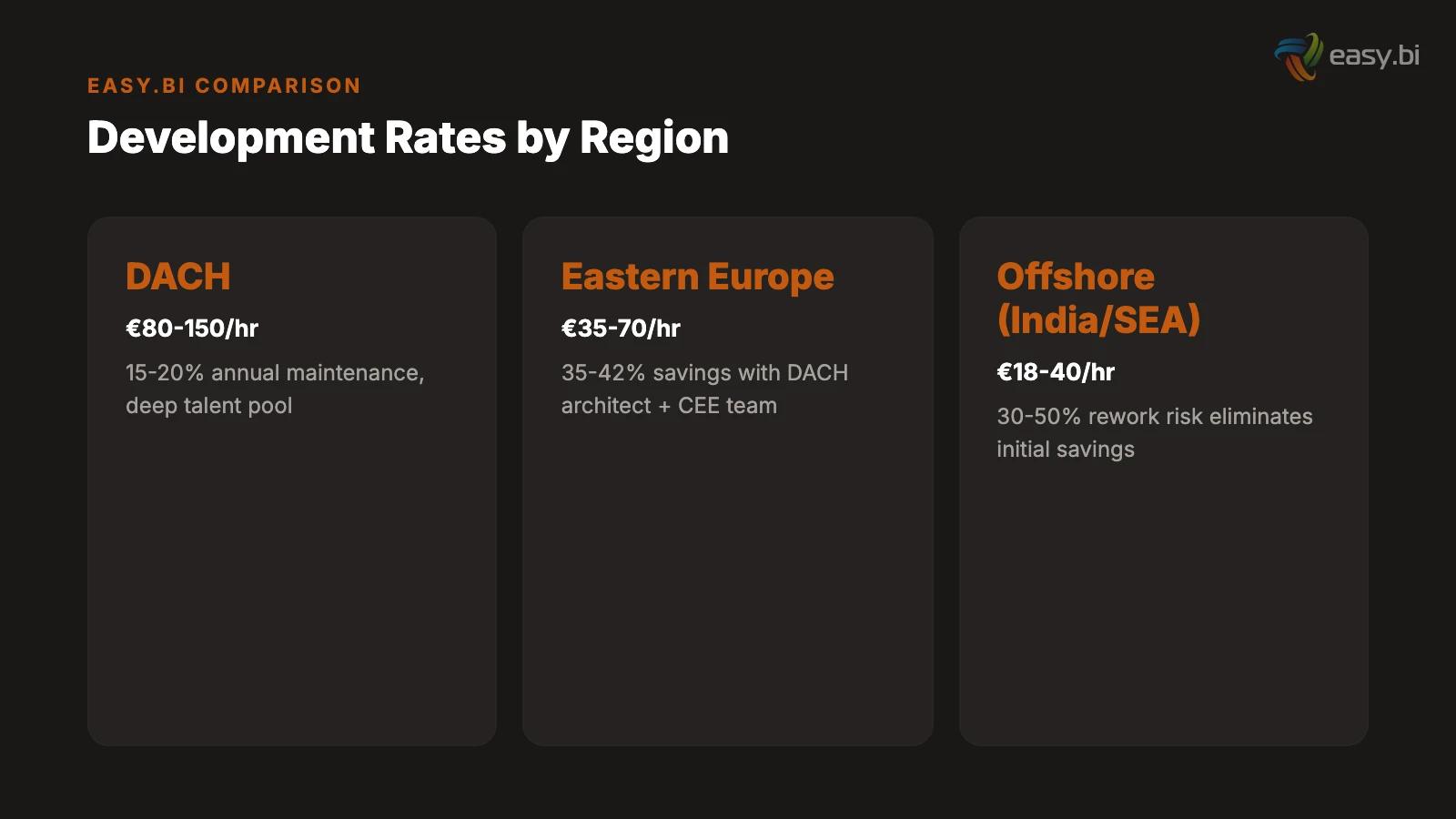
DACH region (Germany, Austria, Switzerland). Senior developers in the DACH market command EUR 80-120 per hour as employees, while freelancers average EUR 102 per hour.[2] Development agencies charge EUR 100-180 per hour depending on their positioning: boutique agencies and enterprise-focused firms charge EUR 130-180, while mid-market specialists operate at EUR 80-130. Switzerland sits at the top of this range, with rates reaching EUR 180-280 per hour for specialized firms.[3]
Eastern Europe (Poland, Romania, Czech Republic, Ukraine). Mid-to-senior developers in Central and Eastern Europe charge EUR 35-70 per hour, with Poland and Romania at the upper end (EUR 45-90 for senior roles) and Ukraine and Bulgaria at the lower end (EUR 25-55).[4] The quality-to-cost ratio in this region is strong, particularly for teams with EU work experience and English proficiency. Companies combining senior DACH architects at EUR 80-100 per hour with CEE implementation teams at EUR 32-45 per hour report 35-42% savings on development costs.[4]
Offshore (India, Southeast Asia). Rates range from EUR 18-45 per hour, with India averaging EUR 30 per hour for mid-level developers.[5] The rate advantage is significant on paper. In practice, rework costs of 30-50% are common when communication gaps, time zone friction, and quality inconsistencies compound over a 12-month project.[5] The cost of replacing a developer due to attrition - which is higher in offshore markets - runs 1.5 to 2 times their annual salary in lost productivity and ramp-up time.
In 15 years of backend engineering, I have seen exactly one offshore engagement that delivered the promised cost savings without quality trade-offs. The engagement worked because the client invested EUR 40,000 in a detailed technical specification before a single line of code was written. The specification eliminated the ambiguity that usually causes offshore rework.
| Region | Junior (EUR/hr) | Mid-Level (EUR/hr) | Senior (EUR/hr) | Architect (EUR/hr) |
|---|---|---|---|---|
| Germany | 45-65 | 65-90 | 80-120 | 100-160 |
| Austria | 40-60 | 60-85 | 75-110 | 95-150 |
| Switzerland | 70-100 | 100-140 | 130-200 | 160-280 |
| Poland | 25-40 | 40-60 | 55-90 | 70-110 |
| Romania | 22-35 | 35-55 | 50-80 | 65-100 |
| Ukraine | 18-30 | 30-50 | 45-70 | 55-90 |
| India | 12-22 | 22-35 | 30-50 | 40-65 |
See how we deliver 60% faster time-to-market with 40% lower TCO than off-the-shelf.
What Does Each Project Type Actually Cost to Build?
Hourly rates are meaningless without project scope. Here are realistic cost ranges for three tiers of project complexity, based on DACH market rates (EUR 80-150 per hour average blended rate). Adjust down 35-50% for Eastern European partners and 50-70% for offshore, then add the rework and management overhead discussed above.
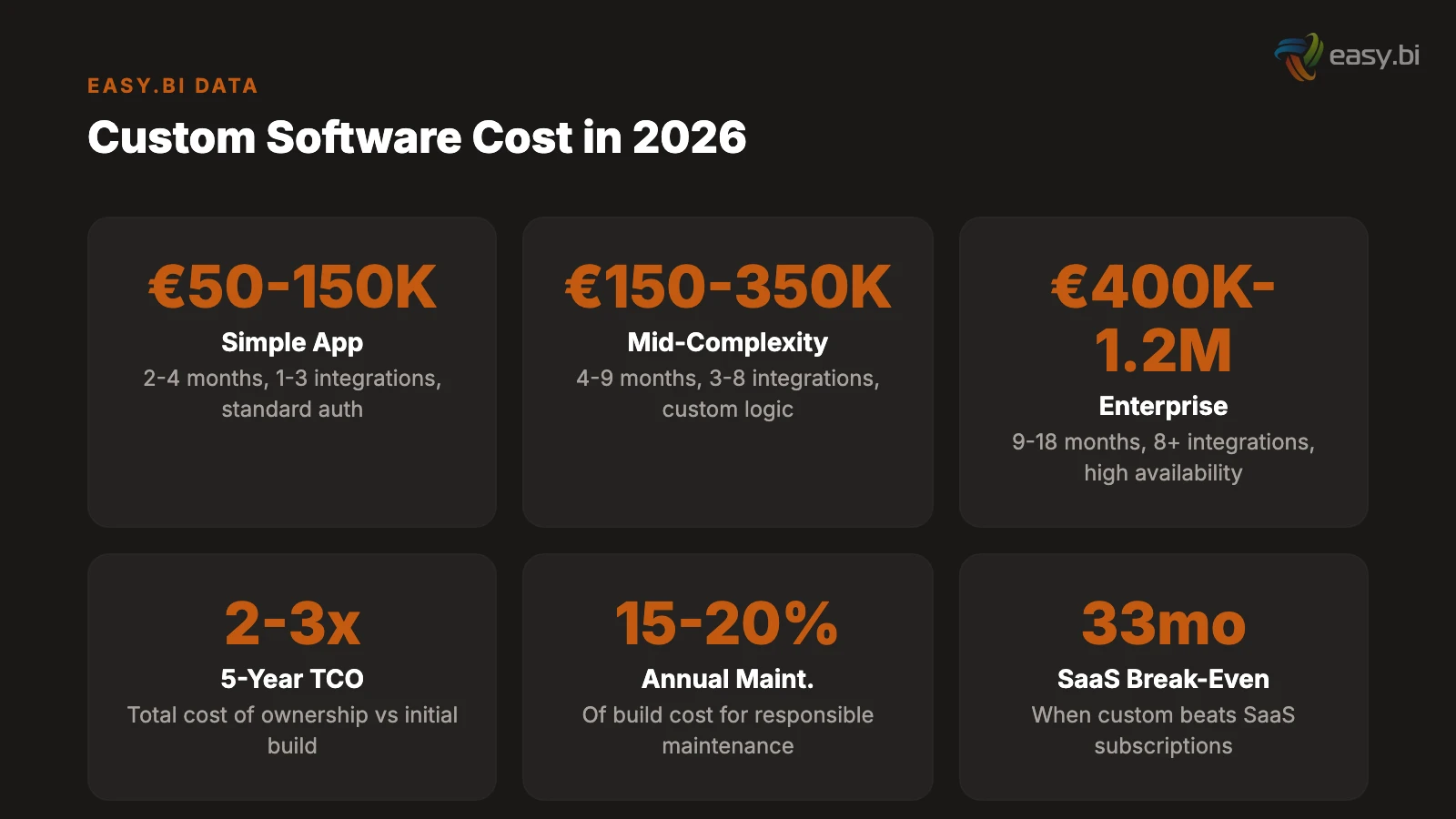
Tier 1: Simple applications (EUR 50,000-150,000). Internal tools, single-purpose business applications, customer-facing portals with standard functionality. These projects involve 400-1,200 development hours, 1-3 integrations, standard authentication, and off-the-shelf UI components. Timeline: 2-4 months. Examples: employee onboarding portal, inventory tracking dashboard, customer feedback system.
Tier 2: Mid-complexity platforms (EUR 150,000-350,000). Multi-user business platforms, workflow automation systems, B2B portals with custom business logic. These projects involve 1,200-3,000 development hours, 3-8 integrations, role-based access control, custom UI components, and moderate reporting capabilities. Timeline: 4-9 months. Examples: order management platform, field service application, dealer portal with ERP integration.
Tier 3: Complex enterprise systems (EUR 400,000-1,200,000). Mission-critical platforms, multi-tenant SaaS products, systems with high-availability requirements and complex integration landscapes. These projects involve 3,000-10,000+ development hours, 8+ integrations, distributed architecture, advanced security requirements, and custom reporting and analytics. Timeline: 9-18 months. Examples: enterprise resource planning extensions, multi-channel commerce platforms, regulatory compliance systems.
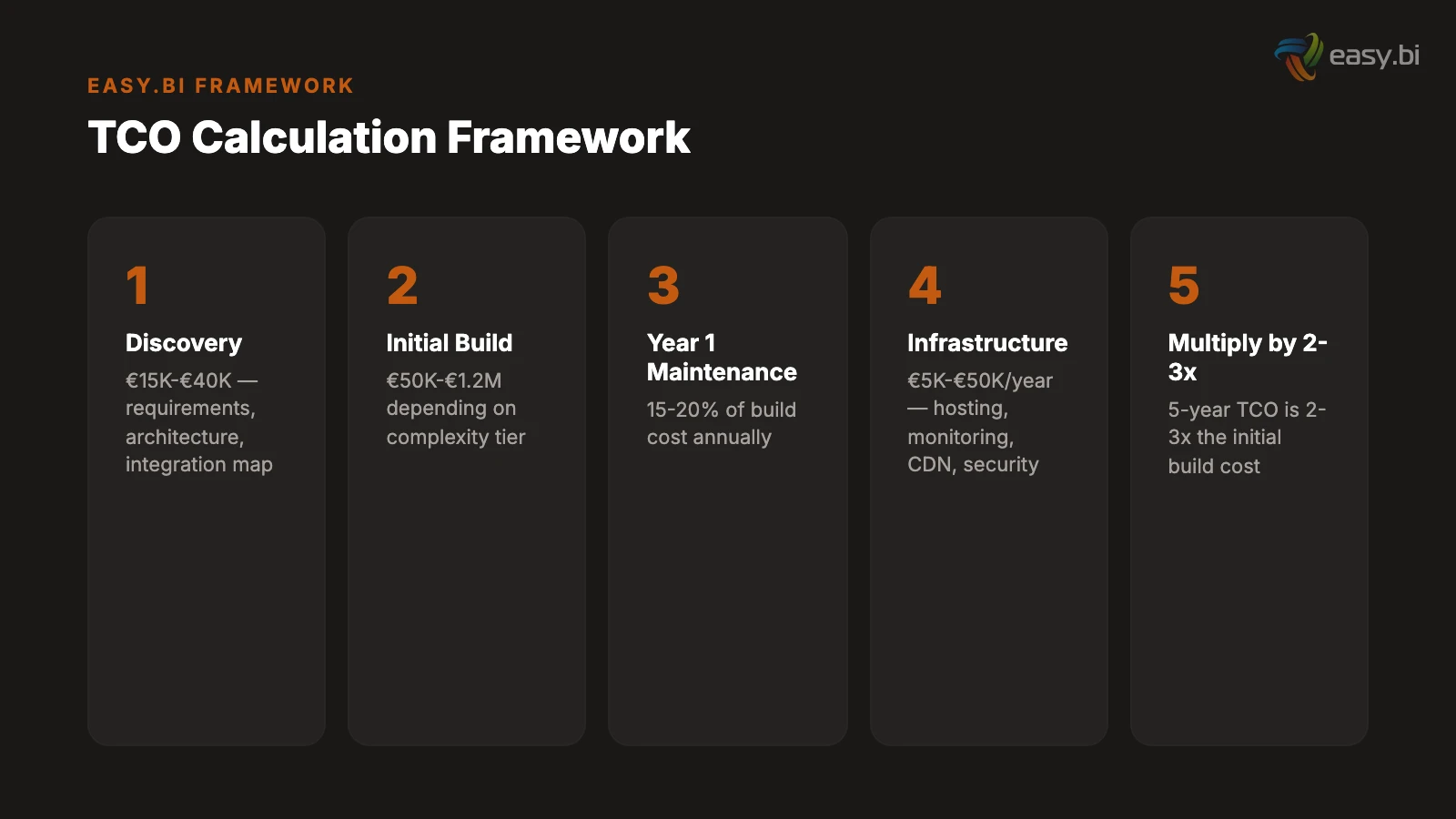
These ranges represent the build cost only. They do not include discovery (add EUR 15,000-40,000), project management overhead (typically 10-15% of development cost), or the infrastructure and maintenance costs that begin on day one of production use.
A critical cost factor that most quotes omit is the discovery phase. A proper discovery - business process mapping, integration inventory, non-functional requirements, and architecture decisions - costs EUR 15,000-40,000 and takes 2-4 weeks. Skipping discovery to save this cost is the most expensive decision a buyer can make. Projects with clear requirements upfront are 97% more likely to succeed, while projects that skip discovery regularly exceed budgets by 40-80% as undiscovered requirements surface during development.[7]
Project management overhead adds another 10-15% to the development cost. For a Tier 2 project, that is EUR 15,000-50,000. This covers sprint planning, backlog management, client communication, risk tracking, and quality assurance coordination. Some vendors include project management in their hourly rates. Others bill it separately. Ask explicitly, because this line item changes the effective comparison between vendors by 10-15%.
Why Is the Build Cost Only Half the Story?
The initial development phase accounts for roughly 40-50% of the total budget over a five-year ownership period.[1] The remaining 50-60% is distributed across maintenance, hosting, support, and the silent cost of technical debt.
For enterprise systems, total cost of ownership is often two to three times higher than the initial build cost.[1] A EUR 300,000 build becomes a EUR 600,000-900,000 five-year commitment. This is not a surprise expense - it is a predictable cost that every buyer should plan for from the proposal stage.
Annual maintenance: 15-20% of build cost. Budgeting 15-20% of the initial development cost annually for maintenance is a safe, industry-standard practice.[1] For a EUR 250,000 build, that is EUR 37,500-50,000 per year. This covers bug fixes, security patches, dependency updates, minor feature additions, and performance monitoring. Teams that allocate less than 15% see technical debt accumulate and eventually consume 40% of their IT budget.[6]
Infrastructure costs: EUR 5,000-50,000 per year. Cloud hosting for a mid-complexity platform runs EUR 500-2,000 per month depending on traffic, data storage, and availability requirements. Add monitoring tools (EUR 200-500/month), logging and alerting (EUR 100-300/month), and CDN or security services (EUR 100-400/month). Enterprise systems with high-availability requirements, multi-region deployment, and disaster recovery can reach EUR 5,000-10,000 per month.
Technical debt cost: 33-42% of developer time. Developers report spending between 33% and 42% of their work time dealing with rework, bug fixes, and maintenance related to technical debt.[6] The attributed technical debt cost is EUR 280,000 per year for a project of one million lines of code, accumulating to EUR 1.4 million over five years.[6] This cost is invisible in the first year but compounds aggressively in years 2 through 5.
What Does the Five-Year TCO Look Like by Project Type?
Here is the full five-year cost picture for each project tier, assuming DACH development rates and responsible maintenance budgeting.
| Cost Component | Tier 1: Simple | Tier 2: Mid-Complexity | Tier 3: Enterprise |
|---|---|---|---|
| Discovery phase | EUR 15,000-25,000 | EUR 25,000-40,000 | EUR 35,000-60,000 |
| Initial build | EUR 50,000-150,000 | EUR 150,000-350,000 | EUR 400,000-1,200,000 |
| Project management | EUR 5,000-15,000 | EUR 15,000-40,000 | EUR 40,000-120,000 |
| Year 1 maintenance | EUR 10,000-25,000 | EUR 30,000-60,000 | EUR 80,000-200,000 |
| Years 2-5 maintenance | EUR 35,000-90,000 | EUR 100,000-220,000 | EUR 280,000-720,000 |
| Infrastructure (5 years) | EUR 30,000-60,000 | EUR 60,000-180,000 | EUR 180,000-600,000 |
| Total 5-year TCO | EUR 145,000-365,000 | EUR 380,000-890,000 | EUR 1,015,000-2,900,000 |
These numbers explain why the vendor selection conversation should never focus on hourly rates alone. A vendor charging EUR 120 per hour who builds maintainable code with 80% test coverage will cost less over five years than a vendor charging EUR 60 per hour whose code requires 40% more maintenance annually.
When Does Custom Software Beat SaaS on Cost?
The build-versus-buy decision has a clear financial inflection point. Total spending on SaaS subscriptions over 5 years typically exceeds initial custom development costs by 72% - yet SaaS costs continue indefinitely, while custom software has a declining cost curve.[1]
The break-even point is approximately 33 months for mid-market organizations.[1] Before 33 months, SaaS is cheaper because you avoid the upfront build cost. After 33 months, custom software becomes cheaper because your annual costs (maintenance + infrastructure) are lower than the recurring SaaS subscription - and they decline as the application stabilizes.
This calculation assumes 50 or more users. For organizations with fewer than 50 users, the per-user SaaS cost rarely exceeds the custom development alternative within a 5-year window. For organizations with 200+ users, the break-even point moves forward to 18-24 months because SaaS per-user costs scale linearly while custom software costs are largely fixed regardless of user count.
The cost comparison also depends on how closely the SaaS product matches your requirements. If an off-the-shelf product covers 80% of your needs, customizing the remaining 20% through the SaaS platform's extension mechanisms is almost always cheaper than building custom. If the product covers only 50% of your needs, the customization costs, workaround complexity, and workflow compromises make custom development the better financial decision. For a detailed analysis of this decision, see our article on build vs. buy for e-commerce platforms.
There is a third factor that rarely appears in cost comparisons: the cost of compromising business processes to fit a SaaS product. When a company modifies its workflows to accommodate software limitations, the cost is not visible on an invoice. It appears as reduced efficiency, workaround complexity, and employee frustration. Custom software eliminates this hidden cost by conforming to the business, not the other way around. For companies whose business processes are their competitive advantage, this alignment is the primary financial justification for custom development.
50+ custom projects. 99.9% uptime. 60% faster.
Senior-only engineering teams deliver production-grade platforms in under 4 months. No juniors on your project.
Start with a Strategy CallHow Do You Avoid the "Cheap Build, Expensive Maintain" Trap?
The most expensive custom software is the software built cheaply. Low initial cost and low total cost are different objectives, and they frequently conflict. Here are five practices that minimize total cost of ownership, even if they increase the initial build cost.
Practice 1: Invest in automated testing from sprint 1. Applications with 80%+ test coverage experience 40% fewer production incidents. The upfront cost of writing tests adds 15-25% to the initial build. The return is a 40-60% reduction in maintenance costs over five years because bugs are caught in development, not production. A bug caught in development costs EUR 100 to fix. The same bug in production costs EUR 5,000-15,000 when you factor in incident response, hotfix deployment, data cleanup, and user support.
Practice 2: Document architecture decisions. Architecture Decision Records (ADRs) add 2-3 hours per major decision during development. They save 20-40 hours per decision when a new team member needs to understand why the system was built a certain way. Over five years with normal team turnover, this documentation pays for itself 10 times over.
Practice 3: Choose boring technology. Every novel technology choice adds maintenance risk. A PHP/Symfony application maintained by a developer pool of millions costs less to maintain than a Rust/Actix application maintained by a developer pool of thousands. The DACH hiring market for PHP developers is deep. The market for Elixir developers is not. Hiring costs are maintenance costs. For a deeper look at this principle, see our article on the Symfony decision for enterprise choice.
Practice 4: Budget for maintenance from day one. Add 15-20% of the build cost as a recurring annual line item in your budget the moment you sign the development contract. Not when the application launches. Not when the first bug appears. From day one. This budget ensures maintenance is a planned activity, not an emergency response. For a comprehensive approach to managing the ongoing cost of software, see our guide on technical debt as a business decision.
Practice 5: Negotiate maintenance terms in the initial contract. The development vendor is the lowest-cost maintenance provider because they know the codebase. Negotiate a maintenance retainer at development rates (not premium support rates) as part of the initial contract. This prevents the common scenario where maintenance is contracted separately at 30-50% higher rates, or where the client is forced to find a new vendor who needs months to understand the existing codebase.
What Should a Realistic Budget Look Like?
Here is a budget template for a DACH mid-market company planning a Tier 2 custom software project (mid-complexity platform). Adjust the numbers proportionally for simpler or more complex projects.
Year 0 (Build phase): Discovery: EUR 30,000. Development (6 months, 2 senior developers + 1 architect part-time): EUR 250,000. Project management and QA: EUR 35,000. Infrastructure setup and CI/CD: EUR 10,000. Total year 0: EUR 325,000.
Year 1 (Stabilization): Maintenance (20% of build cost): EUR 50,000. Infrastructure: EUR 18,000. Feature additions (planned enhancements): EUR 40,000. Total year 1: EUR 108,000.
Years 2-5 (Steady state, annual): Maintenance (15% of build cost): EUR 37,500. Infrastructure: EUR 18,000. Feature additions and improvements: EUR 30,000. Total per year: EUR 85,500. Total years 2-5: EUR 342,000.
Five-year total: EUR 775,000. This is 2.4 times the initial build cost - consistent with the industry benchmark of 2-3 times. The build cost of EUR 325,000 is the number on the proposal. The five-year commitment of EUR 775,000 is the number you should approve in your budget.
Notice the cost curve: year 0 is EUR 325,000, year 1 is EUR 108,000, and years 2-5 average EUR 85,500 each. The cost declines sharply after the build phase and stabilizes at roughly 26% of the initial investment per year. This declining curve is what makes custom software financially attractive compared to SaaS for long-term use - SaaS costs remain flat or increase annually, while custom software costs decrease as the application matures and stabilizes.
For companies comparing vendors, ask every candidate to provide a five-year TCO projection, not just a build estimate. The vendor who presents a build cost 20% lower but does not discuss maintenance is not cheaper - they are hiding 60% of the total cost. Transparent vendors provide TCO projections because they know their code quality reduces long-term maintenance costs. That confidence in long-term cost is a stronger quality signal than any technical assessment.
For organizations evaluating whether custom development fits their budget, our custom solutions team provides detailed TCO projections as part of the discovery phase - before any development commitment is made.
What Are the Hidden Costs That Blow Up Budgets?
Beyond the predictable costs outlined above, four hidden costs consistently surprise buyers who have not built custom software before.
Hidden cost 1: Integration complexity. Every integration with an external system (ERP, CRM, payment gateway, legacy database) adds unpredictable work. The estimate is typically 40-80 hours per integration. The reality is 80-160 hours. A Tier 2 project with 5 integrations can see EUR 30,000-60,000 in integration costs above the initial estimate. Map every integration during discovery and add a 50-100% buffer to each estimate.
Hidden cost 2: Data migration. Moving data from old systems to new systems is consistently underestimated. Data is dirty, formats are inconsistent, and edge cases are abundant. A data migration for a mid-complexity project typically costs EUR 15,000-40,000, depending on data volume and complexity. The pre-migration phase - assessment, mapping, and cleansing rules - consumes 50-70% of total migration effort.[7]
Hidden cost 3: User training and change management. Software that nobody knows how to use delivers zero value. Budget EUR 5,000-20,000 for training materials, admin documentation, and user onboarding sessions. For enterprise systems with complex workflows, add EUR 10,000-30,000 for change management support to ensure adoption. The average enterprise application achieves only 65% adoption in the first year without formal training programs.
Hidden cost 4: Security audits and compliance. GDPR compliance, penetration testing, and security audits add EUR 10,000-30,000 to the project cost. For applications handling financial data, healthcare data, or operating in regulated industries, the compliance cost can reach EUR 50,000-100,000. These costs are non-negotiable for DACH companies - the penalties for non-compliance far exceed the cost of doing it right. For a comprehensive view of budget overrun patterns, see our analysis of the seven reasons custom software projects go over budget.
References
- [1] Leobit, "Total Cost of Ownership for Custom Software Projects: What Businesses N leobit.com
- [2] Freelancermap, "The IT Freelance Market in Germany - Market Insights 2025," , 20 freelancermap.com
- [3] Index.dev, "European Developer Hourly Rates in 2026: Full Cost Guide by Region," index.dev
- [4] Devico, "Software development rates in Eastern Europe: 2026 breakdown by country devico.io
- [5] Acquaintsoft, "Software Development Rates in India 2026: Real Rate Card by Role, acquaintsoft.com
- [6] CAST Software, "Coding in the Red: The State of Global Technical Debt, 2025," , castsoftware.com
- [7] Keyhole Software, "Custom Software Development Cost: 2026 Pricing and Timeline B keyholesoftware.com
- [8] Andersen, "How Much Does Custom Software Development Cost: 2026 Budget Guide," , andersenlab.com
Explore Other Topics
Ready to build your custom platform?
30-minute call with an engineering lead. No sales pitch - just honest answers about your project.
98% engineer retention · 14-day delivery sprints · No lock-in contracts
Related Reading

Building Custom Software That Doesn't Fail: A CTO's Framework
66% of custom software projects fail. This CTO's framework covers discovery, API-first architecture, tech stack selection, 14-day delivery cycles, and technical debt management to beat the odds.
Filip Kralj
What makes custom software development so crucial for today's supply chain industry?
Custom software boosts supply chain efficiency, drives innovation, and enhances financial stability, ensuring a competitive edge in logistics.
Andrej Lovsin
How do custom software development services improve decision making capabilities?
Custom software enhances financial institutions' efficiency, decision-making, and security, maintaining competitiveness and regulatory compliance.
Enno Bassen