
The Symfony Decision: When PHP Is the Right Enterprise Choice

Table of Contents+
- What Changed With PHP 8+?
- Why Does Symfony Win for Business Applications?
- How Does API Platform Change the Development Equation?
- When Should You Choose Symfony Over Java or Node.js?
- What About the PHP Talent Market?
- How Do You Structure a Symfony Enterprise Project?
- What Are the Common Symfony Pitfalls?
- Is PHP the Right Choice for Your Next Enterprise Project?
- References
TL;DR
PHP runs 77% of all websites with a known server-side programming language. Symfony is the framework that turns PHP from a scripting language into an enterprise development platform.
Key Takeaways
- •PHP 8+ delivers up to 3x performance improvements over PHP 7, closing the speed gap with Java and Node.js for most enterprise workloads. Combined with JIT compilation and fiber-based async, PHP is no longer the language you remember from 2015.
- •Symfony's dependency injection, event-driven architecture, and bundle ecosystem give you enterprise-grade structure without the overhead of Java's Spring Boot. For business process automation and API-driven platforms, it delivers faster time-to-value with lower operational complexity.
- •API Platform, built on Symfony, generates fully documented REST and GraphQL APIs from data models in hours, not weeks. Teams using it ship API-first platforms 40-60% faster than hand-coding every endpoint.
- •The PHP talent pool is the largest server-side community globally, with 77% of websites using it. For DACH companies facing a 149,000 IT specialist shortage, choosing Symfony means faster hiring and lower recruitment risk.
- •The decision between PHP/Symfony, Java/Spring Boot, and Node.js is not about which is 'best' - it is about matching the technology to your team size, performance requirements, and integration landscape. Symfony wins for mid-market business applications; Java wins for high-throughput transaction systems; Node.js wins for real-time event-driven architectures.
PHP 8+ delivers 3x performance gains and Symfony provides enterprise-grade architecture out of the box. Learn when PHP beats Java and Node.js for enterprise applications, how API Platform accelerates development, and why 77% of server-side web runs on PHP.
PHP runs 77% of all websites with a known server-side programming language. Symfony is the framework that turns PHP from a scripting language into an enterprise development platform.
Yet in boardrooms across the DACH region, PHP still triggers reflexive skepticism - a reputation stuck in 2010, when spaghetti WordPress plugins defined the ecosystem. That reputation no longer matches reality.
PHP 8+ brought JIT compilation, union types, fibers for async programming, and performance improvements that deliver up to 3x faster execution than PHP 7. Symfony 7 provides dependency injection, an event dispatcher, a robust HTTP kernel, and API Platform for generating production-ready APIs from data models.
Together, they power business-critical applications at companies like Spotify (backend services), Trivago, and dozens of mid-market enterprises across Germany, Austria, and Switzerland.
This article breaks down when PHP/Symfony is the right enterprise choice, when it is not, and how to make the decision based on data rather than developer tribalism.
What Changed With PHP 8+?
PHP 8.0 through 8.3 represent the largest performance and language-design leap in PHP's history. The JIT compiler, introduced in 8.0, compiles hot code paths to native machine code at runtime. For CPU-intensive operations - data transformation, PDF generation, image processing - JIT delivers 1.5-3x speedups over PHP 7.4.
For typical web request-response cycles, the improvement is 10-20%, which compounds across millions of requests.
Three changes matter most for enterprise development:
Fibers (PHP 8.1)
Fibers (PHP 8.1). Fibers enable cooperative multitasking without the callback complexity of Node.js. You can write async I/O code that reads like synchronous code.
For applications making multiple API calls per request - fetching from an ERP, checking inventory in a PIM, validating against a payment gateway - fibers let you run those calls concurrently without threading complexity or callback pyramids.
Typed properties and enums (PHP 8.0-8.1). Strong typing eliminates entire categories of runtime errors. When your Order entity has a status property typed as an OrderStatus enum, invalid states become impossible at the language level.
This is the kind of safety that Java developers take for granted - now available in PHP with less boilerplate.
Typed properties and enums (PHP 8.0-8.1)
Attributes (PHP 8.0). Native attributes replace docblock annotations, giving Symfony and Doctrine a cleaner, IDE-supported metadata system. Route definitions, ORM mappings, and validation rules live directly on the code they describe, reducing the gap between documentation and implementation.
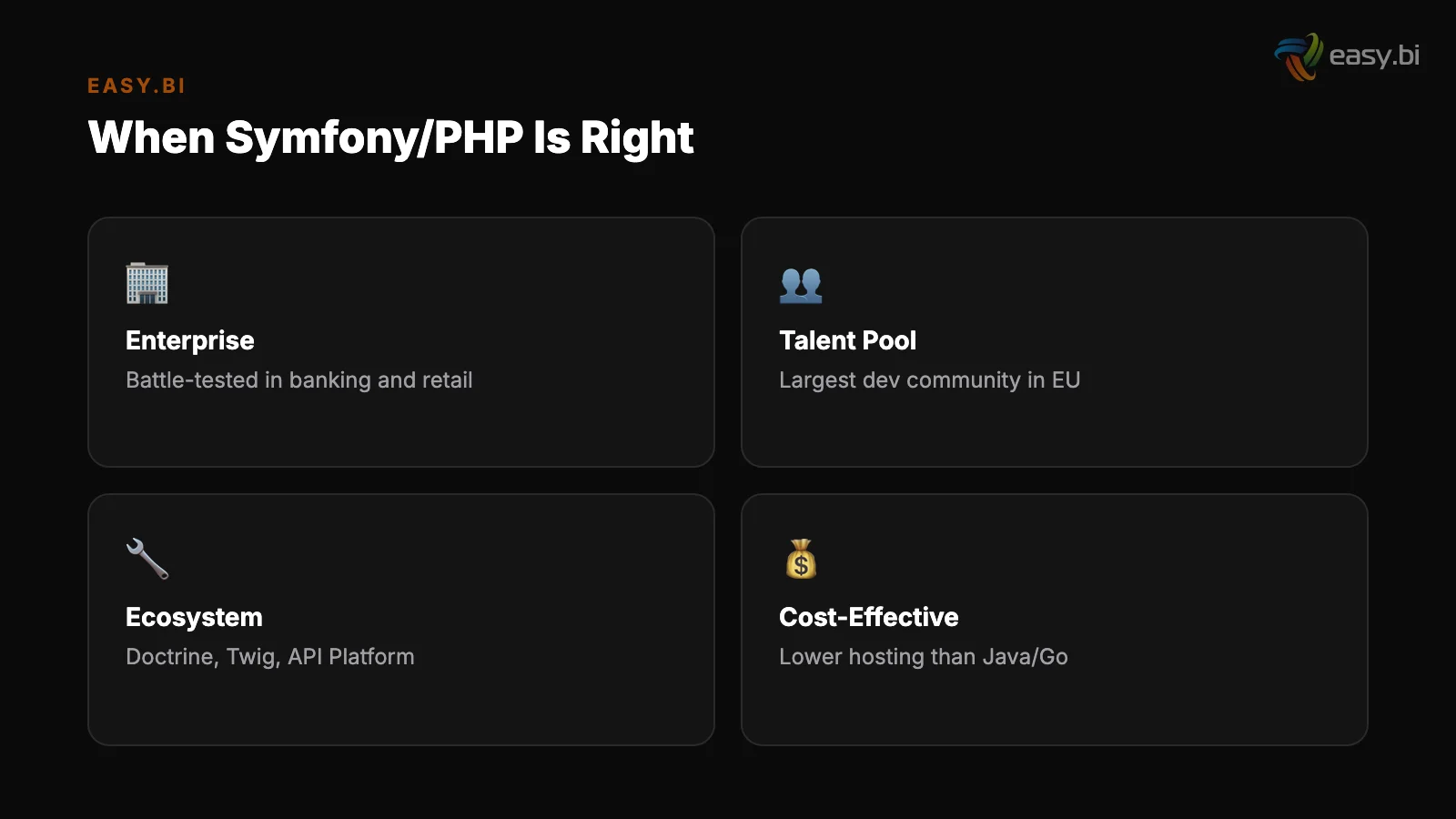
PHP 8.3 benchmarks show request throughput within 15% of Java Spring Boot for typical API workloads, while requiring 40% less memory per container. For the 95% of enterprise applications that are not high-frequency trading systems, PHP performance is no longer a technical concern - it is a perception problem. [1]
See how we deliver 60% faster time-to-market with 40% lower TCO than off-the-shelf.
Why Does Symfony Win for Business Applications?
Symfony is an opinionated framework that enforces architectural patterns most teams need but rarely implement consistently on their own: dependency injection, event-driven communication, layered architecture, and configuration-over-convention. This structure is exactly what enterprise projects need to stay maintainable beyond the first 6 months.
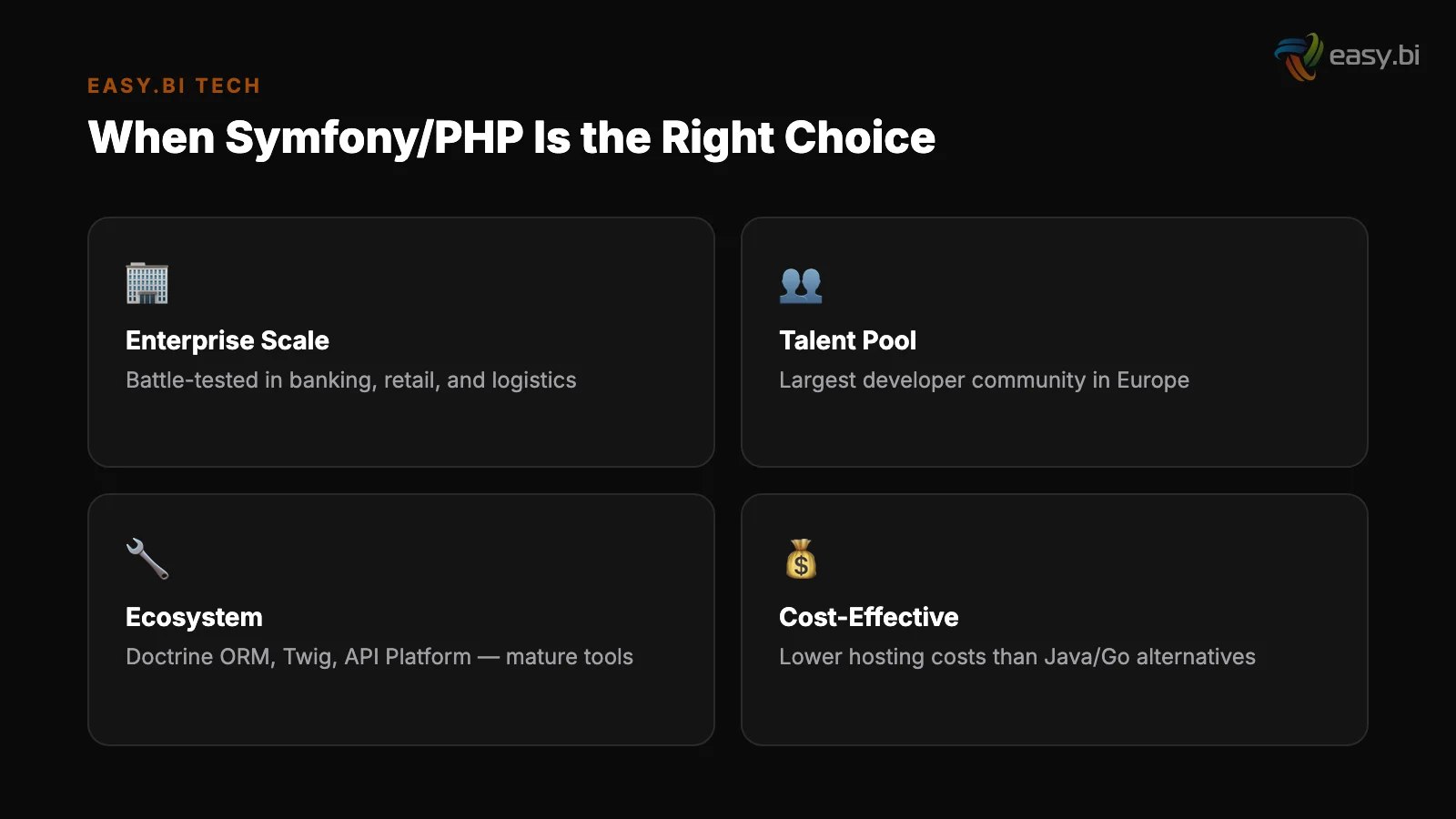
The Symfony ecosystem includes 50+ official components and thousands of community bundles. Each component is independently usable - you can add Symfony's HTTP client to a Laravel project or use its Messenger component for async job processing in any PHP application.
This modularity means you adopt what you need without buying into a monolithic framework.
Service container and dependency injection
For custom business applications - the kind easy.bi builds for DACH mid-market companies - Symfony's strengths align directly with project requirements:
Service container and dependency injection. Every service in your application is registered, configured, and injected automatically. This eliminates the tight coupling that makes legacy PHP applications impossible to test.
When your OrderService depends on a PaymentGateway interface rather than a specific Stripe implementation, swapping payment providers becomes a configuration change, not a refactoring project.
Event-driven architecture
Event-driven architecture. Symfony's EventDispatcher lets you decouple business logic from side effects. When an order is placed, the OrderPlaced event triggers email notifications, inventory updates, ERP synchronization, and analytics tracking - each handled by independent listeners that can be added, removed, or modified without touching the core order logic.
This pattern is essential for enterprise applications where business rules change quarterly.
Messenger component for async processing. Long-running tasks - report generation, bulk data imports, external API synchronization - run asynchronously through message queues (RabbitMQ, Amazon SQS, Redis). The application responds instantly to the user while background workers handle heavy processing.
This architecture pattern, built into Symfony, would require significant custom code in most Node.js frameworks.
How Does API Platform Change the Development Equation?
API Platform is a Symfony-based framework that generates production-ready REST and GraphQL APIs from your data models. Define a PHP entity with attributes, and API Platform generates CRUD endpoints, OpenAPI documentation, JSON-LD support, pagination, filtering, sorting, and validation - all following API-first best practices without writing controller code.
The development speed impact is substantial. A team building a traditional REST API spends 30-40% of sprint time on endpoint boilerplate: request validation, response serialization, pagination logic, error handling, documentation. API Platform eliminates that boilerplate while generating documentation that stays in sync with the actual implementation.
| Capability | Symfony + API Platform | Spring Boot + Spring Data REST | Node.js + Express |
|---|---|---|---|
| API generation from models | Automatic (REST + GraphQL) | Automatic (REST only) | Manual |
| OpenAPI documentation | Auto-generated, always current | Auto-generated with SpringDoc | Manual or via swagger-jsdoc |
| Built-in authentication | JWT, OAuth2, API keys | Spring Security (complex setup) | Passport.js (manual wiring) |
| Real-time subscriptions | Mercure (built-in) | WebSocket (manual setup) | Socket.io (manual setup) |
| Admin interface | Auto-generated React admin | None (third-party) | None (third-party) |
| Time to first working API | Hours | Days | Days to weeks |
For mid-market companies that need to ship API-first platforms quickly, API Platform compresses the timeline from months to weeks. The auto-generated admin interface alone saves 2-4 sprints of backoffice development.
And because it builds on Symfony's foundation, you retain full control to customize any generated behavior when business logic demands it.
When Should You Choose Symfony Over Java or Node.js?
The technology decision is a business decision. Choosing Symfony over Java/Spring Boot or Node.js depends on 4 factors: team composition, performance requirements, integration landscape, and long-term maintenance cost.
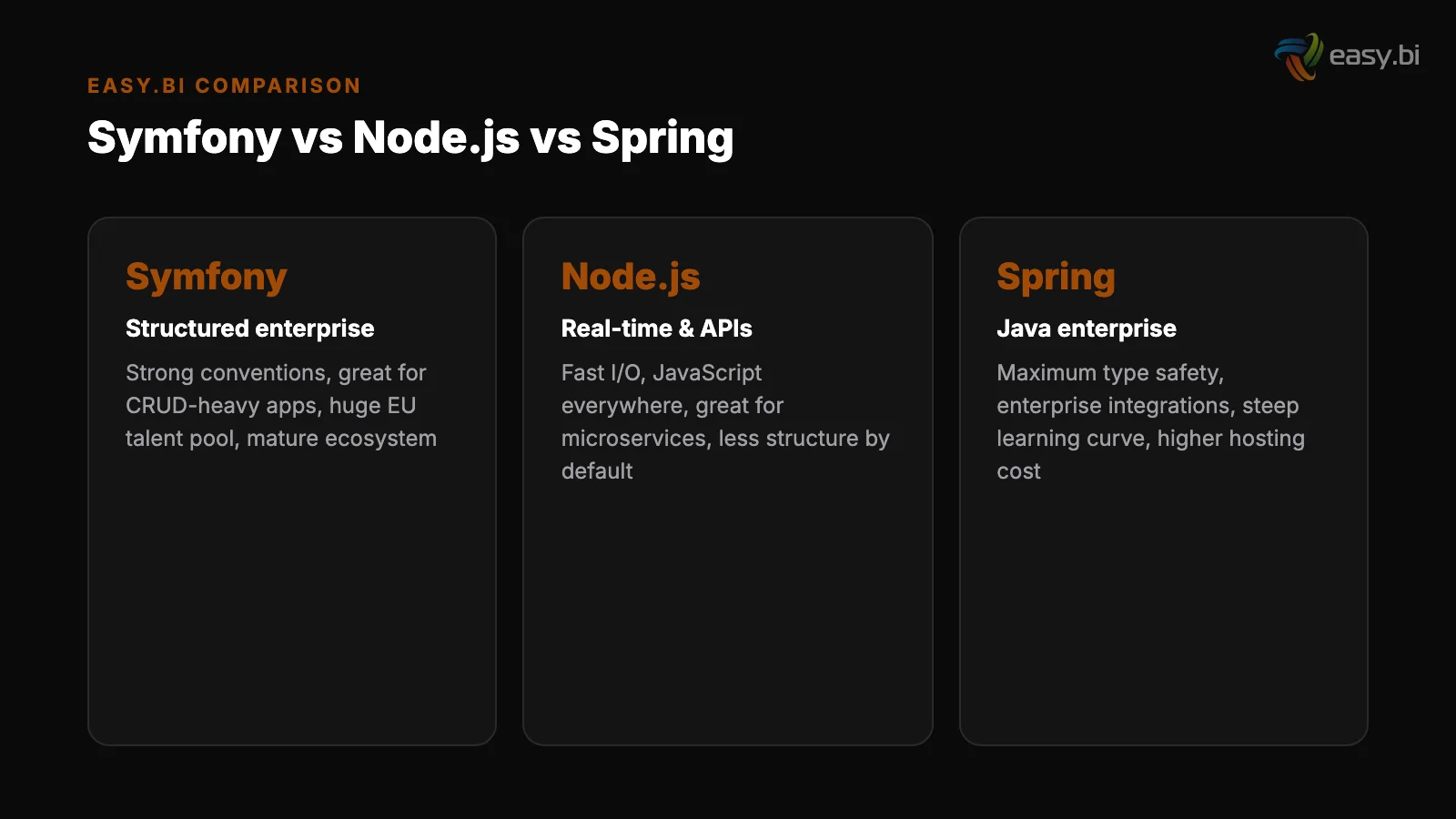
Choose Symfony when:
Choose Symfony when
- Your application is a business process automation platform, internal tool, or API-driven service that handles hundreds to tens of thousands of concurrent users - not millions.
- Your team has PHP experience or you are hiring in a market where PHP developers are available (they are - PHP has the largest server-side talent pool globally).
- You need rapid API development with built-in documentation, validation, and admin interfaces (API Platform).
- Your integration landscape involves REST APIs, message queues, and database operations - not high-frequency streaming or real-time bidirectional communication.
Choose Java/Spring Boot when:
- You need strict type safety enforced at compile time for financial or safety-critical systems.
- Your application requires sustained high throughput: 50,000+ concurrent connections, sub-millisecond response times, or complex multi-threaded processing.
- Your organization already runs a JVM ecosystem with shared libraries and infrastructure.
Choose Node.js when:
- Your application is event-driven with heavy real-time requirements: chat, live dashboards, streaming data.
- Your team is primarily JavaScript/TypeScript developers and you want a single language across frontend and backend.
- You are building a lightweight microservice or serverless function, not a full business application.
At easy.bi, PHP/Symfony is our primary backend technology for custom business applications. Our team includes senior Symfony developers who have built platforms for companies like WeberHaus (100% process digitization with offline capability) and STORE ROOM (market-leading application in Austria). The choice was not tribal - it was pragmatic.
Symfony delivers the fastest time-to-value for the type of applications our DACH mid-market clients need: custom platforms with complex business logic, API-first architecture, and enterprise integrations.
What About the PHP Talent Market?
Germany faces a shortage of 149,000 IT specialists [2], and the average time to fill an IT position is 7.1 months [3]. In this environment, choosing a technology with a deep talent pool is not a preference - it is a risk management decision.
PHP developers represent the largest server-side programming community. While Node.js at 42% and Python at 37% of professional developers lead in Stack Overflow surveys [4], PHP's installed base of 77% of all websites means the practical talent pool - developers who can ship production PHP code - is enormous.
More importantly, Symfony developers tend to be experienced enterprise developers, not entry-level script writers. The framework's complexity acts as a natural filter.
For DACH companies that cannot wait 7 months to fill a position, a nearshore team with established Symfony expertise becomes a strategic advantage. easy.bi's team of 50+ engineers across 4 countries includes a dedicated PHP/Symfony practice that has delivered 100+ projects since 2015 with a 98% client retention rate.
You get senior Symfony developers working in your time zone, speaking your language, and understanding your business context - without the 7-month recruiting cycle.
50+ custom projects. 99.9% uptime. 60% faster.
Senior-only engineering teams deliver production-grade platforms in under 4 months. No juniors on your project.
Start with a Strategy CallHow Do You Structure a Symfony Enterprise Project?
A well-structured Symfony project follows patterns that prevent the spaghetti code PHP is (unfairly) famous for. The architecture separates concerns cleanly: domain logic knows nothing about HTTP, infrastructure adapts to domain interfaces, and the framework is a delivery mechanism - not the application itself.
Hexagonal architecture (ports and adapters). Your business logic lives in the domain layer with zero framework dependencies. Symfony provides the adapters: HTTP controllers translate requests into domain commands, Doctrine repositories implement domain repository interfaces, and Messenger handles async dispatch.
If you ever need to migrate away from Symfony (unlikely, but possible), your domain logic moves unchanged.
Hexagonal architecture (ports and adapters)
Bounded contexts via bundles. Large applications split into Symfony bundles that map to business domains: OrderBundle, InventoryBundle, CustomerBundle. Each bundle owns its entities, services, and API endpoints. Communication between bundles happens through domain events, not direct service calls.
This structure scales from a single-team monolith to a multi-team modular system without architectural rewrites.
CI/CD from sprint 1. Teams using CI/CD deploy 208x more frequently than those without [5]. A Symfony project starts with a Dockerized development environment, PHPUnit and PHPStan in the CI pipeline, and automated deployment to staging on every merge.
Symfony's built-in profiler and debug toolbar make performance issues visible during development, not after production deployment.
What Are the Common Symfony Pitfalls?
Symfony's power comes with complexity that can work against teams who do not respect it.
Over-abstracting too early. Symfony makes it easy to build elaborate service architectures. But a 5-entity application does not need CQRS, event sourcing, and domain-driven design. Start with simple services and Doctrine entities. Introduce architectural patterns when the complexity demands them, not before.
The best Symfony code is the simplest code that solves the business problem.
Over-abstracting too early
Ignoring Symfony's upgrade path. Symfony releases a new major version every 2 years with a clear deprecation and migration path. Teams that skip deprecation warnings accumulate upgrade debt that becomes a multi-sprint migration instead of a gradual transition. Run bin/console debug:container --deprecations in every sprint and fix what it reports.
Treating Doctrine as a database query tool. Doctrine is an ORM that maps objects to database tables. When you bypass it with raw SQL for every complex query, you lose lazy loading, change tracking, and the repository pattern. Use DQL or the QueryBuilder for 90% of queries.
Use native SQL only for genuine performance-critical operations where ORM overhead matters - reports, analytics aggregations, bulk operations.
Skipping automated testing. Symfony applications without test coverage become unmaintainable within 12 months. Automated testing coverage exceeding 80% correlates with 40% fewer production incidents [6]. Symfony's test framework makes functional testing straightforward: boot the kernel, make HTTP requests, assert responses. There is no excuse for shipping Symfony code without tests.
Is PHP the Right Choice for Your Next Enterprise Project?
PHP/Symfony is the right choice for custom business applications where time-to-value, maintainability, and talent availability matter more than raw throughput benchmarks. It is not the right choice for real-time streaming platforms, high-frequency trading systems, or applications where sub-millisecond latency is a hard requirement.
For the vast majority of DACH mid-market enterprise projects - process automation, API platforms, internal tools, customer portals, integration layers - Symfony delivers results faster and at lower total cost of ownership than Java/Spring Boot, with more architectural rigor than Node.js/Express.
The decision is not about which language is "best." It is about which language, framework, and team deliver the business outcome you need within the constraints you have.
For a deeper look at how technology choices fit into the broader framework of building custom software that succeeds, read our pillar guide on building custom software that does not fail.
And when you are ready to evaluate Symfony for your next project, explore our custom solutions approach - or book an expert call to discuss your architecture with an engineer who has shipped Symfony to production for a decade.
References
- [1] TechEmpower Framework Benchmarks (2024). "PHP 8. techempower.com
- [2] Bitkom (2024). "Germany faces a shortage of 149,000 IT specialists." bitkom.
- [3] Bundesagentur fur Arbeit (2024). arbeitsagentur.de
- [4] Stack Overflow (2023). "Node. stackoverflow.co
- [5] GitLab (2023). "87.5% of respondents use CI/CD pipelines; teams using CI/CD depl gitlab.com
- [6] CircleCI (2023). "Automated testing coverage exceeding 80% correlates with 40% f circleci.com
Explore Other Topics
Ready to build your custom platform?
30-minute call with an engineering lead. No sales pitch - just honest answers about your project.
98% engineer retention · 14-day delivery sprints · No lock-in contracts
Related Reading

Design Systems for Enterprise: Siemens Case Study
Design systems reduce development time by 25-50% and accelerate time-to-market by 47%. Learn how Siemens built a unified UI library with Angular, Storybook, and Figma - and the governance model that made it stick.
Timo Koerner
Why Your Vendor Built You a Cage (And How to Get Out)
Vendor lock-in costs DACH enterprises millions in switching costs, lost agility, and inflated licensing. Learn the 5 lock-in patterns, how to quantify the real cost, and practical strategies for escaping proprietary ecosystems using API-first architecture and open standards.
Andrej Lovsin
How Much Does a Shopware Enterprise Build Cost in 2026?
Shopware enterprise builds cost EUR 30K to 500K+ in 2026. Transparent breakdown of cost tiers, hidden fees, and what drives budget overruns in DACH.
Enno Bassen