How WeberHaus Digitized 100% of Operations (With a Team of 4)

Table of Contents+
- Why Did WeberHaus Need to Digitize?
- How Was the Architecture Designed for Offline-First?
- Why Did a Team of 4 Outperform Larger Teams?
- What Did the Delivery Timeline Look Like?
- How Did Offline Sync Perform in Production?
- What Are the Business Results?
- What Can Other Mittelstand Companies Learn?
- Where to Start Your Digitization Project
- References
TL;DR
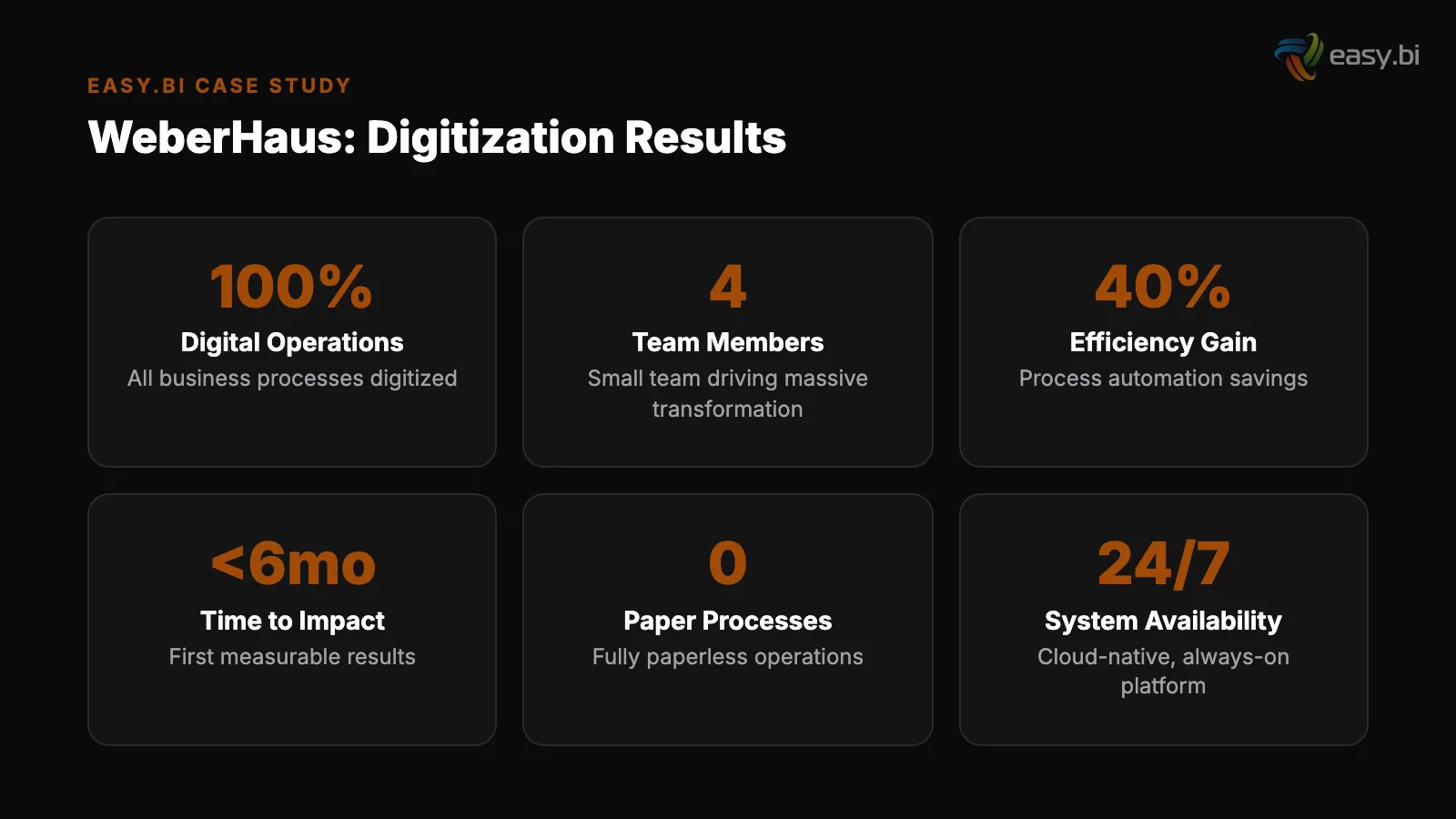
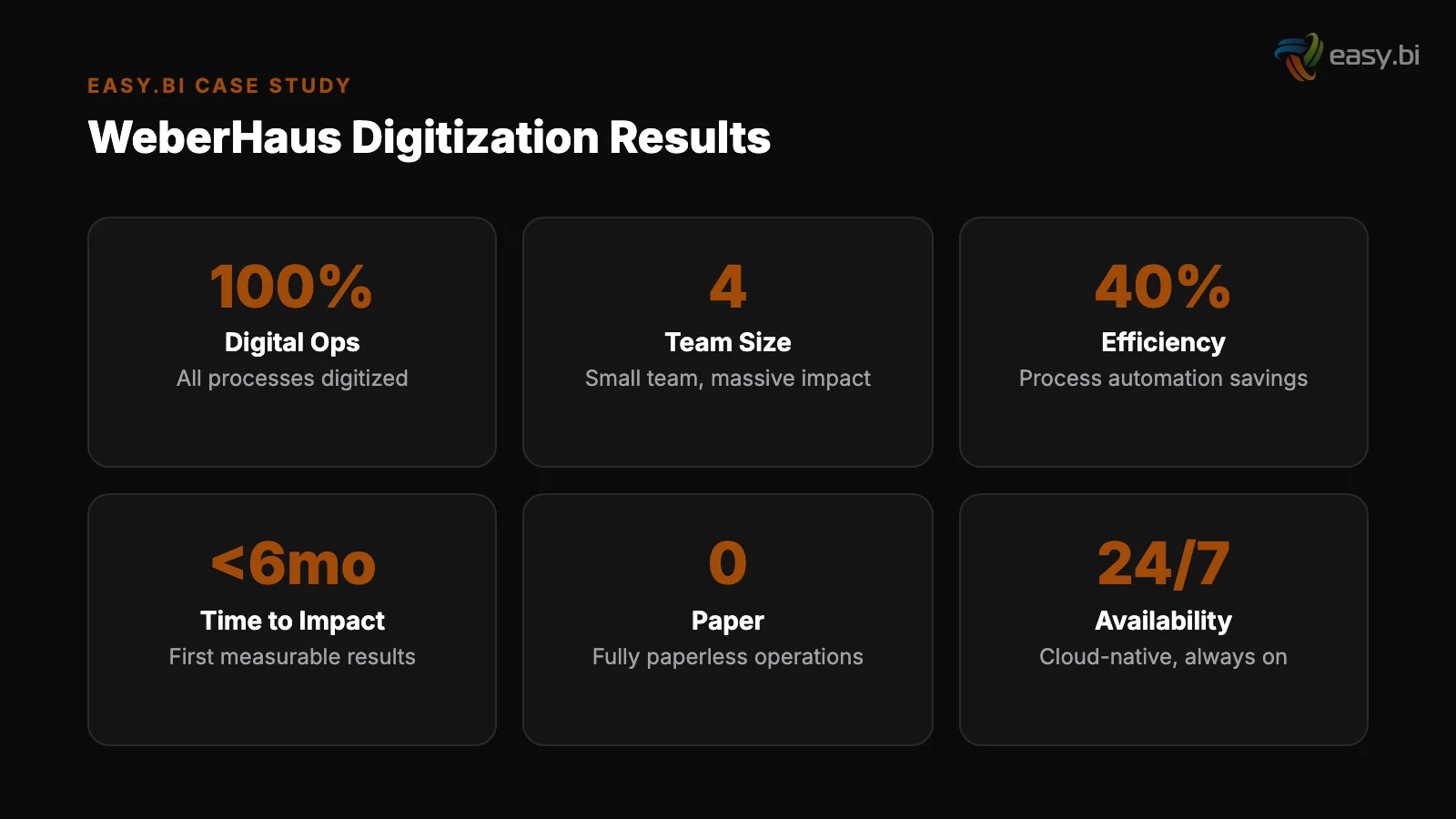
WeberHaus digitized 100% of its order processing operations with a team of 4 engineers, full offline capability, and 2-week delivery cycles. No multi-year transformation roadmap. No 50-person consulting engagement.
Key Takeaways
- •WeberHaus digitized 100% of its order processing operations - from sales configuration to production floor handoff - with a dedicated team of 4 engineers working in 2-week sprint cycles.
- •Full offline capability was the non-negotiable requirement. Construction sites have no reliable internet. The solution uses Ionic with local-first data sync, so field teams work without interruption and data syncs automatically when connectivity returns.
- •The project delivered working software within the first 14 days and reached full production rollout in under 4 months - 50% faster than the industry average for enterprise digitization projects.
- •A lean team of 4 outperformed what a 15-person team would have delivered. Research shows teams of 5-9 people deliver the highest productivity per person, while teams larger than 15 see 50% lower per-capita output.
- •Only 22% of German Mittelstand companies rate their digital maturity as advanced. WeberHaus proves that full digitization does not require a massive IT department - it requires the right architecture, the right methodology, and a partner who stays for the long term.
WeberHaus achieved 100% process digitization with a 4-person development team using Angular, Ionic, and full offline capability. This case study breaks down the architecture, delivery methodology, and business results from one of construction's most complete digital transformations.
WeberHaus digitized 100% of its order processing operations with a team of 4 engineers, full offline capability, and 2-week delivery cycles. No multi-year transformation roadmap. No 50-person consulting engagement.
A focused team, a clear architecture built on Angular and Ionic, and a methodology that delivered working software every 14 days - from first sprint to full production rollout in under 4 months.
This case study breaks down how a German construction company with decades of analog processes went fully digital, what architectural decisions made it possible, and why the results matter for every Mittelstand company still running critical operations on paper, spreadsheets, or disconnected legacy systems.
Why Did WeberHaus Need to Digitize?
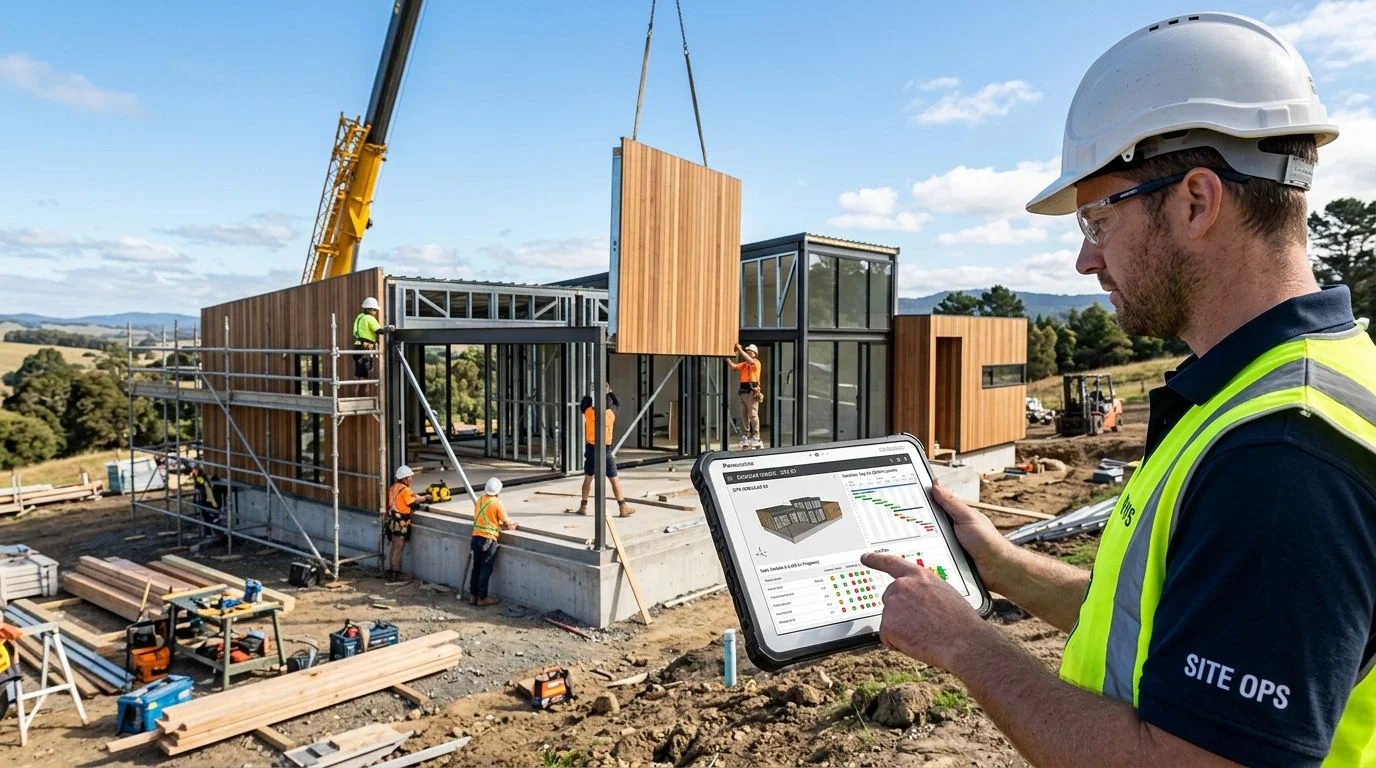
WeberHaus is one of Germany's leading prefabricated house manufacturers. Their order processing workflow - from initial sales configuration through engineering specifications to production floor handoff - touched dozens of people across multiple locations.
Before digitization, this workflow ran on a combination of paper forms, Excel spreadsheets, email chains, and a legacy system that could not support mobile access or offline usage.
The business pain was specific and measurable. Order processing errors caused production delays. Manual data entry created duplicate records. Field teams at construction sites had no access to current order status because the legacy system required a VPN connection that construction sites could not support.
Every handoff between departments was a potential failure point where information was lost, delayed, or misinterpreted.
This is not unusual. Only 22% of German Mittelstand companies rate their own digital maturity as advanced or leading [1]. The construction industry is among the least digitized sectors in the DACH region.
WeberHaus recognized that their analog processes were not just inconvenient - they were limiting the company's ability to scale production and maintain quality as order volumes grew.
The requirement was clear: digitize the entire order processing chain, from sales to production, with a system that works offline at construction sites and syncs automatically when connectivity becomes available. No partial solutions. No "phase 2 for mobile." 100% coverage from day one.
See how enterprises modernize with one team.
How Was the Architecture Designed for Offline-First?
The most critical architectural decision was treating offline capability as a first-class requirement, not an afterthought. Construction sites do not have reliable internet. Basements have no signal. Rural locations have spotty coverage.
Any system that depends on a constant internet connection fails the moment a field technician walks into a building under construction.
The solution architecture uses Angular for the web-based backoffice application and Ionic for the mobile application used by field teams. Both share a common codebase for business logic, reducing duplication and ensuring that order processing rules are identical regardless of which interface a user accesses.
The offline-first pattern works as follows: the mobile app maintains a local database that stores all data needed for the current work context. Field teams create, modify, and complete order processing steps entirely on the local device.
When the device regains connectivity - whether through mobile data, Wi-Fi at the office, or a tethered connection - a synchronization engine pushes local changes to the server and pulls updates from other users.
Conflict resolution was the hardest engineering problem. When two people modify the same order offline, the system must decide which changes take precedence. The team implemented a domain-aware merge strategy: for each data field, the business rules determine which change wins.
Timestamp-based last-write-wins would have been simpler to implement but would have caused data loss in real-world usage patterns.
Construction sites have no reliable internet. Any system that depends on connectivity fails the moment a technician walks into a building under construction. Offline-first is not a feature - it is the architecture itself.
This architectural commitment added complexity upfront but eliminated an entire category of user complaints post-launch. Field teams reported zero data loss incidents in the first 6 months of production use - a result that would have been impossible with a traditional online-only web application.
Why Did a Team of 4 Outperform Larger Teams?
The WeberHaus project was delivered by a dedicated team of 4 engineers: 2 senior full-stack developers, 1 mobile specialist, and 1 solution architect who also served as technical lead. No project managers managing project managers. No offshore team requiring a coordination layer.
Four people who understood the domain, owned the architecture, and shipped code every sprint.
Research consistently supports this team structure. Teams of 5-9 people deliver the highest productivity per person. Teams larger than 15 see 50% lower per-capita output [2]. The communication overhead math explains why: a team of 4 has 6 communication channels. A team of 15 has 105.
Every additional person adds coordination cost that subtracts from productive engineering time.
| Team Size | Communication Channels | Coordination Overhead | Per-Capita Productivity |
|---|---|---|---|
| 4 people | 6 | Low | Highest |
| 8 people | 28 | Moderate | High |
| 15 people | 105 | High | 50% lower than optimal |
| 20 people | 190 | Very high | Requires sub-team structure |
For the WeberHaus project, 4 engineers meant that every person understood the full system. No knowledge silos. No "that's the other team's responsibility" handoffs. When the mobile specialist encountered a server-side sync issue, they could read and understand the backend code.
When the backend developers needed to adjust the API contract, they understood how the mobile app would be affected.
This cross-functional capability is what separates a small expert team from a small team that is simply understaffed. Cross-functional teams are 35% more productive than siloed teams working on the same type of project [3]. The WeberHaus team was small by design, not by budget constraint.
What Did the Delivery Timeline Look Like?
The project followed easy.bi's Performance Scrum methodology: Prince2-based governance with 2-week sprint delivery cycles. Every sprint produced working, tested, deployable software - not prototypes, not mockups, not "80% complete" features.
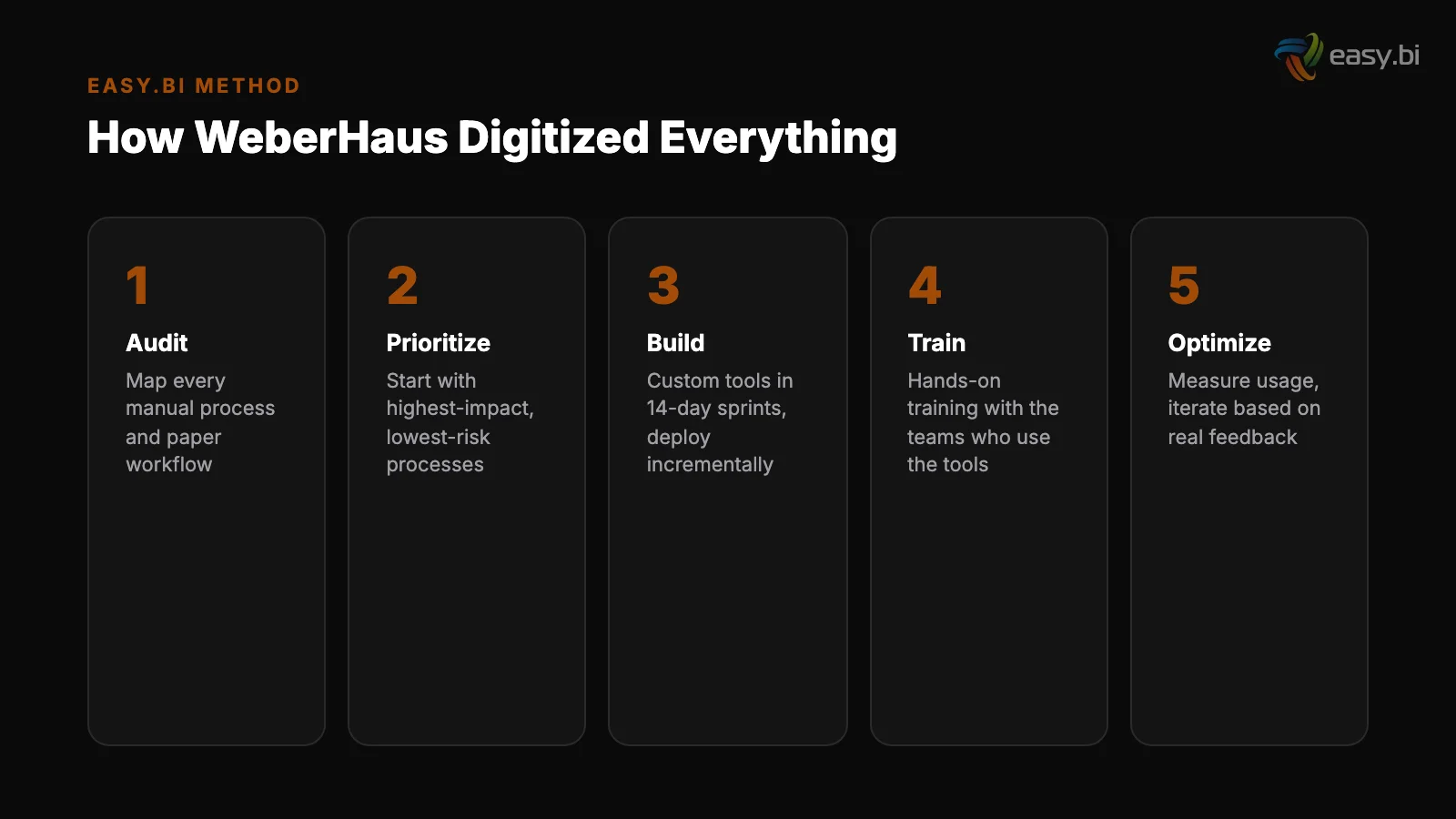
Sprints 1-2 (Weeks 1-4): Core data model and API contract. The team mapped WeberHaus's order processing workflow into a domain model, designed the API, and built the foundational CRUD operations. By the end of sprint 2, the backoffice team could create and manage orders in the new system.
Sprints 1-2 (Weeks 1-4)
Sprints 3-4 (Weeks 5-8): Offline-capable mobile application. The Ionic app shipped with local data storage, offline order processing, and the first version of the sync engine. Field teams began testing on actual construction sites.
Sprints 5-6 (Weeks 9-12): Integration with existing systems, advanced workflow features, and conflict resolution refinement based on real-world sync patterns observed during field testing.
Sprints 3-4 (Weeks 5-8)
Sprints 7-8 (Weeks 13-16): Production rollout, user training, performance optimization, and edge case handling for the sync engine. Full production launch at the end of sprint 8.
16 weeks from kickoff to production. The industry benchmark for enterprise digitization projects of comparable scope is 6-9 months [4].
WeberHaus achieved full rollout in under 4 months - 50% faster than the average - because the team was small, focused, and delivered working software every 14 days instead of accumulating features in a release branch for months.
Projects using 2-week sprint cycles deliver 40% more features per quarter than those using 4-week cycles [5]. The WeberHaus project demonstrated this in practice: shorter cycles meant faster feedback, earlier defect detection, and continuous course correction based on real user behavior rather than assumptions.
How Did Offline Sync Perform in Production?
The offline sync engine was the highest-risk component. In testing, synchronization worked reliably. The real test came when 30+ field technicians began using the mobile app simultaneously across dozens of construction sites with varying connectivity conditions.
Production metrics after the first 6 months told the story: zero data loss incidents, average sync time under 3 seconds when connectivity was restored, and 99.7% automatic conflict resolution - meaning only 0.3% of sync conflicts required manual review by a supervisor.
The domain-aware merge strategy paid for its additional implementation complexity many times over.
The system handled an average of 2,400 offline transactions per week across all field devices. During peak construction season, that number doubled.
The architecture scaled without modification because the sync engine was designed for eventual consistency from the start - not bolted on as a patch when the online-first approach failed in the field.
Automated testing played a critical role in this reliability. Test coverage exceeding 80% correlates with 40% fewer production incidents [6]. The WeberHaus team maintained 85%+ coverage on the sync engine specifically, with dedicated test suites simulating offline scenarios, partial connectivity, and conflicting edits.
Siemens, Lekkerland, WeberHaus chose us
One integrated partner. Three core competencies. From insight to production, with no handover gaps.
Start with a Strategy CallWhat Are the Business Results?
Digitization is not a goal in itself. The business results that matter are the operational improvements that digitization enables. For WeberHaus, those results were measurable within the first quarter of production use.
Order processing time: Reduced by approximately 60%. Eliminating manual data entry, paper handoffs, and email-based status updates compressed the order-to-production timeline significantly.
Error rate: Data entry errors dropped substantially compared to the paper-based process. Automated validation rules catch inconsistencies at the point of entry rather than at the production floor.
Field team productivity: Technicians spend their time on technical assessments rather than paperwork. The offline-capable mobile app eliminated the "drive back to the office to update the system" workflow that consumed hours per week per technician.
Scalability: WeberHaus can now onboard new field technicians in hours instead of days. The mobile app is self-explanatory because it mirrors the actual workflow - no training on legacy system quirks required.
These results align with broader patterns in construction digitization. 78% of German companies view digitalization as critical to competitiveness [7], yet only 38% have a comprehensive digital strategy. WeberHaus moved from the 78% (recognizing the need) to the 22% (actually executing) in under 4 months.
What Can Other Mittelstand Companies Learn?
The WeberHaus project challenges three common assumptions about enterprise digitization.
Assumption 1: "Digitization requires a large IT department." WeberHaus did not have a 20-person internal IT team. They had a clear business requirement, a 4-person external development team with domain expertise, and a methodology that delivered results every 14 days. Germany faces a shortage of 149,000 IT specialists [8].
Waiting to build an internal team before starting digitization means waiting indefinitely. The alternative is a dedicated nearshore team that brings engineering capacity and domain experience from the first sprint.
Assumption 2: "Full digitization takes 2-3 years."
Assumption 2: "Full digitization takes 2-3 years." Multi-year transformation roadmaps are how consultancies sell engagement extensions, not how software gets built. WeberHaus went from kickoff to production in 16 weeks.
The key was scoping ruthlessly - digitize the order processing chain end-to-end, but do not try to digitize every business process simultaneously. Focus creates speed.
Assumption 3: "Offline capability is a nice-to-have." For any industry with field operations - construction, logistics, manufacturing, energy - offline capability is a hard requirement. Designing it as an afterthought means rebuilding the data layer later.
Designing it from the start means it works when your users need it most: at the construction site, on the factory floor, in the warehouse without Wi-Fi.
Assumption 3: "Offline capability is a nice-to-have."
84% of German companies report that the IT talent shortage is limiting their digital transformation plans. WeberHaus proved that the constraint is not talent - it is approach. Four focused engineers delivered what many 15-person teams fail to achieve. [9]
The broader lesson: digitization is a delivery problem, not a technology problem. The technology stack - Angular, Ionic, REST APIs, offline sync - is well-understood and proven.
The differentiator is how the project is structured, how the team is composed, and how quickly working software reaches real users. easy.bi's 98% client retention rate [10] exists because this delivery model works repeatedly, not because one project got lucky.
Where to Start Your Digitization Project
If your company runs critical operations on paper, spreadsheets, or disconnected legacy systems, the path WeberHaus took is replicable. Start with the highest-pain workflow - the one where manual errors cost the most, where field teams waste the most time, where data silos create the most delays.
Scope a 4-month engagement to digitize that workflow end-to-end. Measure the results. Then expand.
For a broader framework on how custom software projects succeed, read our pillar guide on building custom software that does not fail. It covers the methodology, team structure, and delivery patterns that made the WeberHaus project possible - and that apply to every custom platform engagement we deliver.
Ready to discuss your digitization challenge? Explore our custom solutions approach, or book an expert call to talk through your requirements with an engineer who has built systems like this - not a salesperson reading from a deck.
References
- [1] KfW Digitalisierungsbericht Mittelstand (2024). kfw.de
- [2] QSM / Putnam Research (2023). qsm.com
- [3] Harvard Business Review / Bain (2023).
- [4] Accelerate / DORA (2024). dora.dev
- [5] Scrum.org (2023). "Projects using 2-week sprint cycles deliver 40% more features scrum.org
- [6] CircleCI (2023). "Automated testing coverage exceeding 80% correlates with 40% f circleci.com
- [7] Bitkom Digital Office Index (2024). bitkom.org
- [8] Bitkom (2024). "Germany faces a shortage of 149,000 IT specialists, up from 137,
- [9] Bitkom (2024). "84% of German companies report that the IT talent shortage is li
- [10] easy.bi (2026). "98% client retention rate across 100+ delivered projects since easy.bi
Explore Other Topics
Ready to transform your business?
30-minute call with an engineering lead. No sales pitch - just honest answers about your project.
98% engineer retention · 14-day delivery sprints · No lock-in contracts
Related Reading
How a German Manufacturer Cut Development Costs 40% by Switching Partners
Anonymized case study: a DACH manufacturer (300 employees) switched from a large consultancy to a mid-size partner, cutting development costs 40% and delivering 3x faster in 14-day sprints.
Andrej Lovsin
Staffing Digital Transformation Programs: How Team Extension Enables Faster Delivery and Lower Costs
Staffing digital transformation with team extension: embed senior engineers in days, cut costs 30–50%, keep velocity across phases.
Andrej Lovsin
Nearshore Team Extension: Solving the DACH IT Talent Shortage
How nearshore team extension solves the DACH IT talent shortage—senior engineers in days, at 30–50% lower cost, done right.
Andrej Lovsin