
The 98% Retention Question: What We Do Differently

Table of Contents+
- Why Retention Is the Only Metric That Matters
- What Body Leasing Gets Wrong
- The Performance Scrum Difference
- How Does a 4-Country Structure Create Retention?
- What Does Ownership Culture Look Like in Practice?
- The Compound Effect of Retention on Project Economics
- What We Are Honest About
- What This Means for Your Next Decision
- References
TL;DR
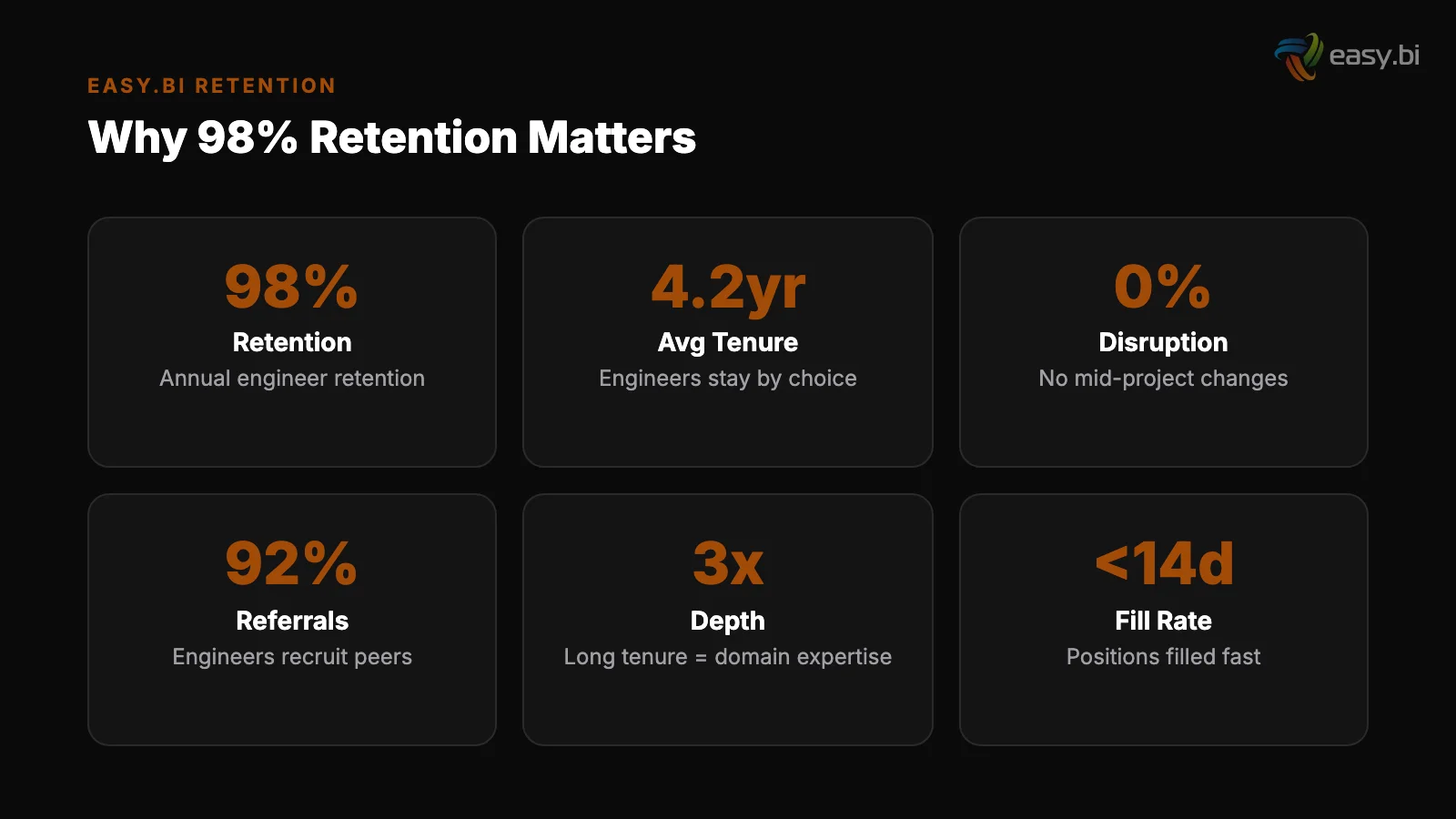
When we tell prospective clients that our client retention rate is 98%, the most common response is not belief - it is skepticism. And it should be. The IT outsourcing industry has earned that skepticism through decades of overpromising and underdelivering.
Key Takeaways
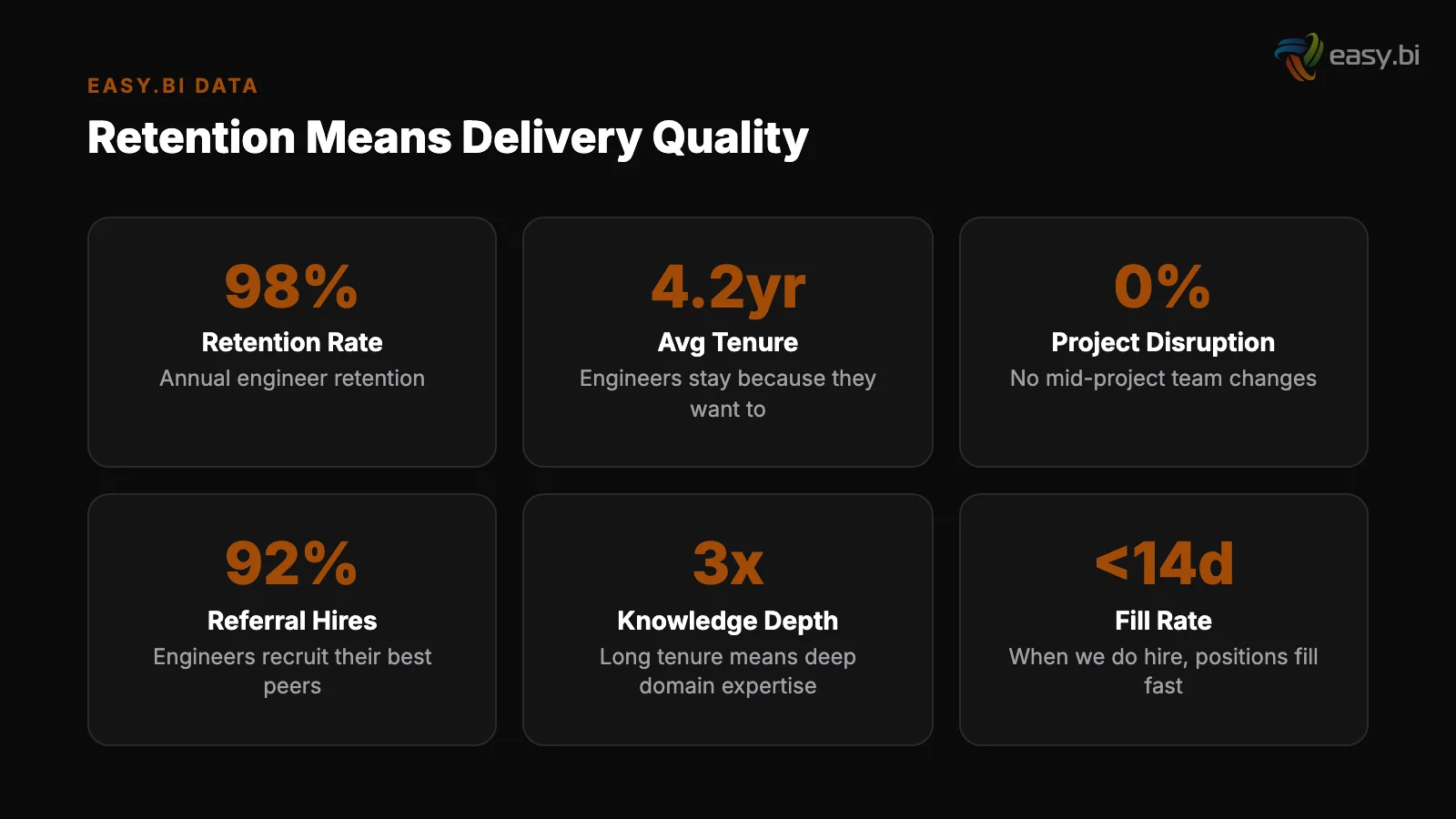
- •easy.bi's 98% client retention rate compares to an industry average of 72-78% for IT outsourcing. That 20+ percentage point gap compounds into measurable project outcomes: lower ramp-up costs, deeper domain knowledge, and faster delivery with every sprint.
- •Body leasing treats engineers as interchangeable units. Ownership culture treats them as invested partners. The structural difference: our engineers stay on projects an average of 3.5+ years, building domain expertise that no new hire can replicate in 6 months.
- •Performance Scrum - our Prince2-based methodology with 14-day sprint delivery - creates accountability that keeps both clients and engineers engaged. Every 2 weeks, working software ships. No ambiguity about progress.
- •Operating across 4 countries (Germany, Austria, Switzerland, Slovenia) is not a cost play. It is a talent access strategy that gives our engineers career growth across markets while giving clients timezone-aligned teams with EU data processing.
- •The IT industry's 13.2% annual turnover rate means the average 5-person team loses at least one member per year. Every departure costs 4-8 weeks of ramp-up productivity. Retention is not a feel-good metric - it is a direct driver of project economics.
How easy.bi achieves 98% client retention across 100+ projects - when the industry average is 72-78%. A transparent look at the retention model: ownership culture, Performance Scrum, 4-country structure, and why we don't do body leasing.
When we tell prospective clients that our client retention rate is 98%, the most common response is not belief - it is skepticism. And it should be. The IT outsourcing industry has earned that skepticism through decades of overpromising and underdelivering.
The average retention rate for IT service providers is 72-78% [1]. Claiming 20+ percentage points above the industry average invites a fair question: what are you actually doing differently?
This article answers that question with specifics. Not marketing language - the actual structural decisions, delivery practices, and cultural choices that produce 98% retention across 100+ projects since 2015. Some of these decisions cost us money in the short term.
All of them make money in the long term - for us and for our clients.
Why Retention Is the Only Metric That Matters
Before explaining how we achieve 98% retention, it is worth understanding why this number matters more than any other metric a development partner can cite.
Retention is a lagging indicator that captures everything else. A partner with high retention has - by definition - delivered projects on time, communicated effectively, maintained quality standards, resolved conflicts productively, and provided enough value that clients chose to continue. No single project metric captures all of this. Retention does.
The financial impact is concrete. Outsourcing partnerships lasting 3+ years deliver 25-30% more value than short-term engagements [2]. This makes intuitive sense.
A team that has worked on your domain for 3 years writes better code, faster, with fewer defects than a team encountering your business logic for the first time. They know your edge cases. They know which stakeholders need what information.
They know the shortcuts that save time and the shortcuts that create technical debt.
The cost of non-retention is equally concrete. Every time a project transitions to a new partner, you lose 3-6 months of ramp-up productivity. The new team reads code they did not write, reverse-engineers undocumented decisions, and rebuilds relationships with stakeholders. During that period, your project velocity drops 40-60%.
For a team of 10 engineers billing EUR 75/hour, that 3-month ramp-up period costs approximately EUR 180,000 in reduced productivity - before the new partner writes a single line of new code.
Companies that invest in developer experience see 4-5x returns in terms of productivity and retention. The same principle applies to client experience: invest in the relationship infrastructure that keeps teams together, and the compound returns show up in every sprint. [3]
See how enterprises modernize with one team.
What Body Leasing Gets Wrong
The dominant model in DACH IT services is body leasing: a staffing company places individual developers at client sites, bills hourly, and replaces them when they leave. The model optimizes for one thing - filling seats. It actively works against everything that produces long-term project success.
Body leasing fails for three structural reasons.
No outcome accountability
No outcome accountability. A body-leased developer is accountable for showing up and writing code. They are not accountable for whether the project ships, whether the architecture scales, or whether the client achieves their business goal.
Accountability lives with the client's project manager, who is often already stretched thin managing multiple workstreams. When nobody on the external team owns the outcome, outcomes suffer.
No team continuity. Body-leased developers are individuals placed in client organizations, not members of a stable team.
When one leaves - and with the industry's 13.2% average annual turnover [4], departures are frequent - the replacement is another individual with no shared context, no established working patterns with the remaining team, and no domain knowledge.
The average tenure of an IT employee in Germany is only 2.8 years [5]. Body leasing inherits this volatility without any mechanism to mitigate it.
No team continuity
No methodology ownership. Body-leased developers adopt whatever process the client uses - or does not use. They cannot bring structured delivery practices because they are individuals, not teams. They cannot enforce code review standards, sprint discipline, or testing requirements because they have no organizational authority to do so.
At easy.bi, we rejected body leasing from the beginning. Our engineers work in integrated teams with shared methodology, shared standards, and shared accountability for outcomes. When we place a team on a client project, that team has already worked together.
They have established communication patterns, coding standards, and a shared understanding of quality. The client does not get individuals - they get a functioning unit.
The Performance Scrum Difference
Our delivery methodology is called Performance Scrum. It is Prince2-based, structured around 2-week sprint cycles with defined work packages. This is not a marketing name for "we do standups" - it is a specific operational framework that creates the accountability structure retention depends on.
Performance Scrum works differently from generic agile in three ways.
Work packages, not story points
Work packages, not story points. Every sprint contains defined work packages with clear acceptance criteria, estimated effort, and business context. Story points are useful for relative estimation within a team, but they are meaningless to a CTO who needs to know what will be delivered by Friday.
Work packages speak the language of business deliverables. This transparency is why clients stay - they always know exactly what they are getting and when.
14-day delivery guarantee. Every sprint produces working software deployed to a staging or production environment. Not a progress report. Not a demo of partially completed features. Working, tested, deployable software. Projects using 2-week sprint cycles deliver 40% more features per quarter than those using 4-week cycles [6].
More importantly, 14-day delivery cycles create a rhythm of continuous proof. Clients see results every 2 weeks. That visibility builds trust. Trust builds retention.
14-day delivery guarantee
Dedicated Project Owner and Customer Advocate. Every project gets two named roles beyond the engineering team. The Project Owner manages scope, priorities, and sprint planning. The Customer Advocate manages the client relationship, escalates issues proactively, and ensures the client's business context stays front and center.
This dual-role structure means no client concern goes unheard and no technical decision happens in a business vacuum.
| Practice | Body Leasing Model | easy.bi Performance Scrum |
|---|---|---|
| Team structure | Individual developers placed at client site | Integrated teams with shared history and standards |
| Delivery cadence | Client-dependent (often ad hoc) | 14-day sprints, working software every cycle |
| Accountability | Hours worked | Business outcomes delivered |
| Quality assurance | Client's responsibility | Built into every sprint (dedicated QA) |
| Project management | Client provides PM | Dedicated Project Owner + Customer Advocate |
| Knowledge continuity | Vulnerable to individual turnover | Team-based: knowledge distributed across members |
| Methodology | Adopts client's process | Performance Scrum with structured work packages |
How Does a 4-Country Structure Create Retention?
Operating across Germany, Austria, Switzerland, and Slovenia is expensive and operationally complex. We do it because this structure solves two retention problems simultaneously: client retention and engineer retention.
Client retention through cultural alignment. Our Hamburg and Frankfurt teams work directly with German clients in their language and business culture. Our Austrian and Swiss presence serves those markets natively. Slovenia provides the engineering depth - 30,000+ IT professionals, 92% university-educated, with the highest English proficiency in CEE [7].
Clients get timezone-aligned teams (Ljubljana is 0-1 hours from Frankfurt) with EU data processing built in. GDPR compliance is not an add-on - it is structural.
Client retention through cultural alignment
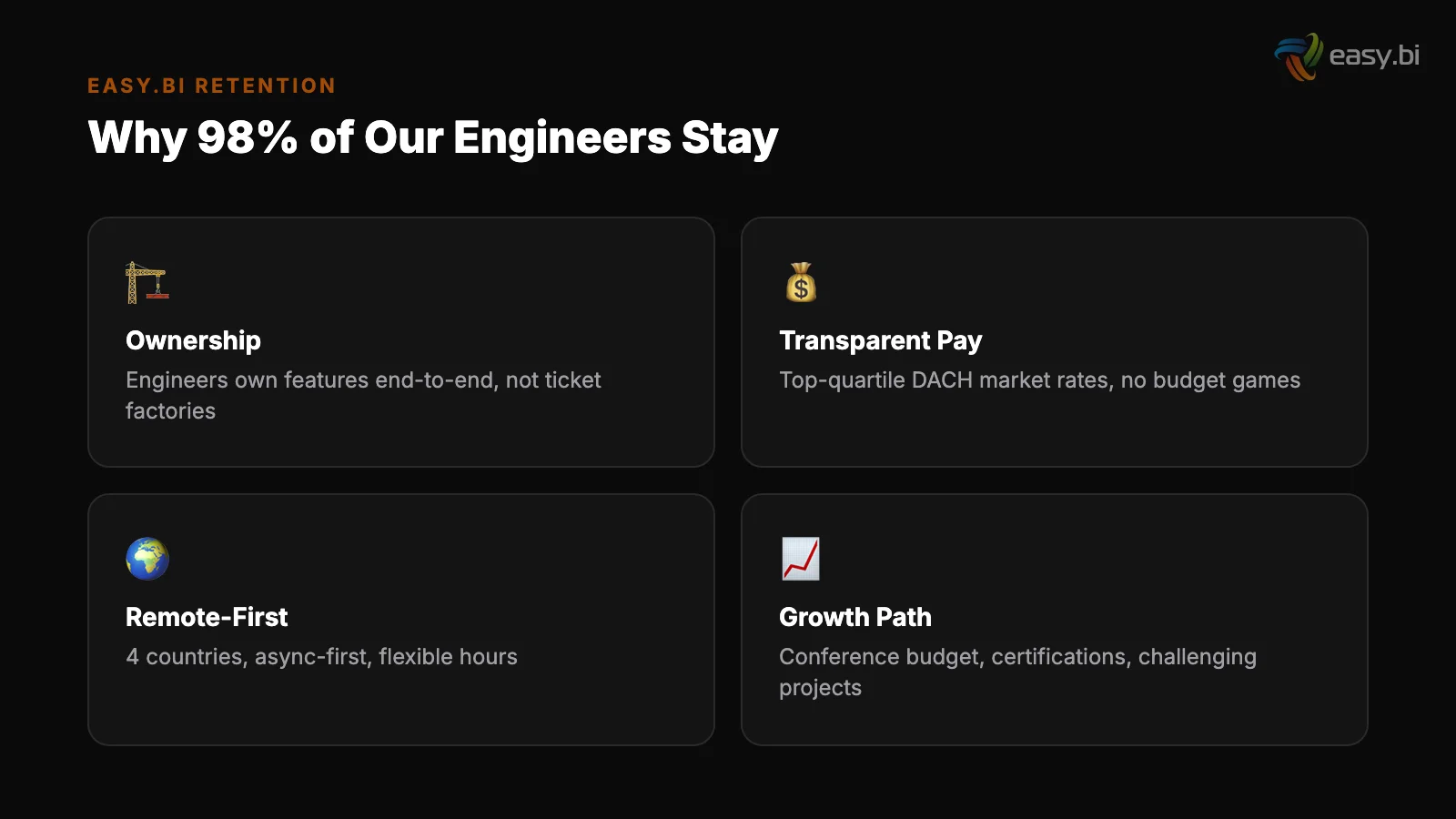
Engineer retention through career growth. This is the part most clients do not see, but it is critical. Our engineers in Ljubljana work on enterprise projects for Siemens, REWE, WeberHaus, and Fressnapf. They solve problems at a scale and complexity that local Slovenian companies rarely offer.
They collaborate with German and Austrian product managers, learning DACH business culture and expanding their professional networks across 4 markets.
This career opportunity is a retention engine. An engineer at easy.bi is not writing code for a local agency - they are building enterprise platforms for Fortune 500 companies, gaining experience that makes them more valuable every year. Keeping that engineer is not about ping-pong tables and free pizza.
It is about giving them work worth staying for.
The result: our internal team turnover is significantly below the industry's 13.2% average [4]. When engineers stay, projects benefit from continuity. When projects benefit from continuity, clients stay. Retention compounds.
What Does Ownership Culture Look Like in Practice?
"Ownership culture" is a phrase that every tech company claims and few define concretely. Here is what it means at easy.bi, with specific practices.
Engineers attend client strategy meetings. Not just sprint planning - actual business strategy discussions.
When a developer understands that the feature they are building will serve 50,000 monthly active users and directly impact the client's Q3 revenue target, they build it differently than when they receive a Jira ticket with a technical specification. This context creates investment. Investment creates ownership. Ownership creates quality.
Engineers attend client strategy meetings
Engineers propose solutions, not just implement specifications. Our team members are expected to challenge requirements that do not make technical sense and propose alternatives when they see a better path. This is explicitly part of our culture - we push back when we see a better path.
Clients sometimes find this uncomfortable at first. After the first time an engineer's counter-proposal saves them 3 weeks of development time, they appreciate it.
Engineers see their code in production. Every engineer has access to production monitoring and observability dashboards for their project. They see how users interact with their code. They see performance metrics. They see error rates.
This closes the feedback loop between writing code and understanding its real-world impact - a loop that body leasing deliberately severs by removing the developer before the code reaches production.
No siloed roles. We do not have "frontend developers" who never see a database or "backend developers" who never see a user interface. Our engineers are expected to understand the full stack of the systems they build.
Cross-functional teams are 35% more productive than siloed teams working on the same type of project [8]. More importantly, full-stack understanding creates engineers who can own features end-to-end, not just components in isolation.
Siemens, Lekkerland, WeberHaus chose us
One integrated partner. Three core competencies. From insight to production, with no handover gaps.
Start with a Strategy CallThe Compound Effect of Retention on Project Economics
Retention creates compound returns that accelerate with time. Here is what those returns look like in practice across our client portfolio.
Sprint 1-4: Ramp-up. The team learns the domain, codebase, and stakeholder landscape. Velocity is building. This is the investment phase - and it is the same for every partner, whether they stay or leave.
Sprint 1-4: Ramp-up
Sprint 5-12: Acceleration. The team has context. Domain-specific decisions happen faster. Code reviews catch business logic errors, not just technical ones. Velocity increases 20-30% compared to the ramp-up phase.
Sprint 13+: Compound returns. The team anticipates requirements before they are formally specified. They know which stakeholders need early involvement. They spot architectural risks from experience with the codebase.
At this stage, the team is 40-50% more productive than they were during ramp-up - and the quality of their decisions improves with each sprint. This is where partnerships lasting 3+ years deliver the 25-30% additional value that Deloitte measured [2].
Sprint 5-12: Acceleration
Now consider what happens when a partner churns at sprint 12. The replacement team starts at sprint 1 again. You pay for the ramp-up phase twice. The compound returns from sprints 13+ never materialize.
Over a 3-year project, one partner transition at the 12-month mark costs approximately 6 months of accumulated productivity - a cost that rarely appears in any budget line item but shows up in every missed deadline.
This is why 98% retention is not a vanity metric. It is a direct driver of the speed, quality, and cost-efficiency our clients experience. Every client who stays past sprint 12 benefits from compound returns. With 98% retention, almost all of our clients reach that inflection point.
What We Are Honest About
Transparency is a stated value, so here is what we are transparent about.
98% retention does not mean 100%. We have lost clients. In some cases, the project scope changed in ways that no longer matched our capabilities. In other cases, the client brought development in-house after we helped them build the foundation - which we consider a success, not a loss.
And in a few cases, the relationship did not work despite good intentions on both sides. We learn from every departure.
Our model is not the cheapest. Slovenian developer rates of EUR 45-75/hour are 40-50% below German rates [9], but they are not the EUR 20-30/hour rates you find in India or Vietnam. We pay our engineers well because retention starts with compensation that reflects the value of their work.
Companies that invest in developer experience see 4-5x returns in productivity and retention [3]. We have seen this firsthand.
We are not a fit for every project. Body leasing works for some situations - short-term staff augmentation for a 3-month spike, or backfilling a single developer role during a hiring process.
If you need one Java developer for 3 months with no integration into a broader team, body leasing is simpler and cheaper. Our model delivers its full value on projects of 6+ months with teams of 3+ engineers where domain knowledge and team continuity matter.
What This Means for Your Next Decision
When you evaluate development partners, ask for their retention rate. Not their revenue. Not their headcount. Not their client logo wall. Their retention rate - both client retention and internal team retention.
These two numbers tell you more about what working with a partner will actually be like than any sales presentation or case study ever could.
If a partner cannot provide these numbers, that is your answer. If a partner provides numbers significantly below the 72-78% industry average, that is also your answer. And if a partner claims 90%+ retention, verify it with references you choose - not references they provide.
For the broader strategic framework on structuring your development capacity, read our comprehensive guide on the build vs. buy decision. For the talent market dynamics that make partner retention even more critical, see why senior engineers leave.
And for a deeper understanding of what legacy system costs accumulate when teams churn, explore the true cost of legacy systems.
If you want to experience what 98% retention feels like from the client side, start with our custom solutions approach - or book an expert call to discuss your project with an engineering leader who has been delivering for DACH clients since 2015.
References
- [1] Deloitte (2024). "Outsourcing client retention rates average 72-78%. deloitte.com
- [2] Deloitte (2024). "Outsourcing partnerships lasting 3+ years deliver 25-30% more deloitte.com
- [3] McKinsey (2023). "Companies that invest in developer experience see 4-5x returns mckinsey.com
- [4] LinkedIn / BLS (2024). linkedin.com
- [5] StepStone / Glassdoor (2024). "Average tenure of an IT employee in Germany is 2. stepstone.de
- [6] Scrum.org (2023). "2-week sprint cycles deliver 40% more features per quarter th scrum.org
- [7] SPIRIT Slovenia (2024).
- [8] Harvard Business Review / Bain (2023).
- [9] Accelerance (2024). "Slovenian developer hourly rates average EUR 45-75 vs.
Ready to transform your business?
30-minute call with an engineering lead. No sales pitch - just honest answers about your project.
98% engineer retention · 14-day delivery sprints · No lock-in contracts
Related Reading

Why Senior Engineers Leave - And How to Build Teams That Stay
Senior engineers leave over legacy tech, no ownership, and bad management. Learn how easy.bi maintains 98% retention across 50+ engineers and 4 countries.
Andrej Lovsin
How could the developer services from LangChain bring about a revolution in the logistics industry?
LangChain services optimize logistics, boosting efficiency, reducing costs, and ensuring competitiveness in a fast-paced industry.
Andrej Lovsin
How does digital strategy have the potential to revolutionize energy and environmental services?
Enhance energy services with digital strategy: improve team management, modernize IT, and speed market entry sustainably for competitive advantage.
Andrej Lovsin