
Build vs Buy Your E-Commerce Platform: The EUR Decision Framework

Table of Contents+
- Why Does the Build vs Buy Decision Cost Companies Years?
- What Are the Real Costs of a Custom-Built E-Commerce System?
- How Much Does a Platform-Based E-Commerce Implementation Cost?
- When Does Building Your Own Platform Make Financial Sense?
- When Does Buying a Platform Deliver Better Results?
- What Is the Hybrid Approach and Why Does It Win?
- How Do You Score Your Build vs Buy Decision?
- What Are the Hidden Costs of Building That Nobody Mentions?
- What Are the Hidden Costs of Buying That You Should Plan For?
- How Should You Make the Final Decision?
- What Are the Most Common Build vs Buy Questions?
- References
TL;DR
If your e-commerce workflows are standard - catalog, cart, checkout, fulfillment - buy a platform. Build custom only when your commerce logic IS your competitive advantage and no existing platform can support it. This decision framework gives you the EUR math to make the right call.
Key Takeaways
- •80% of mid-market DACH retailers should buy a platform (Shopware, commercetools) rather than build custom. Build only when commerce IS your product and unique workflows are your competitive advantage.
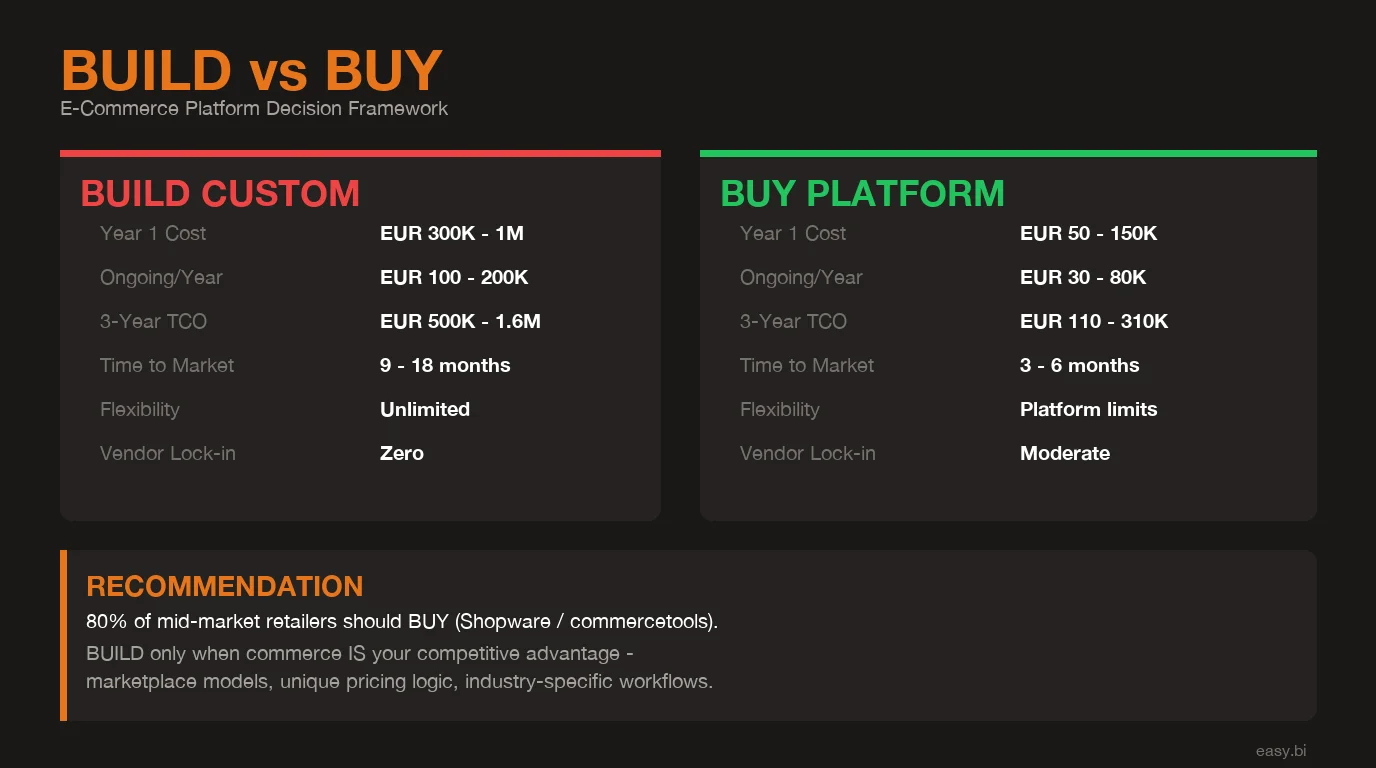
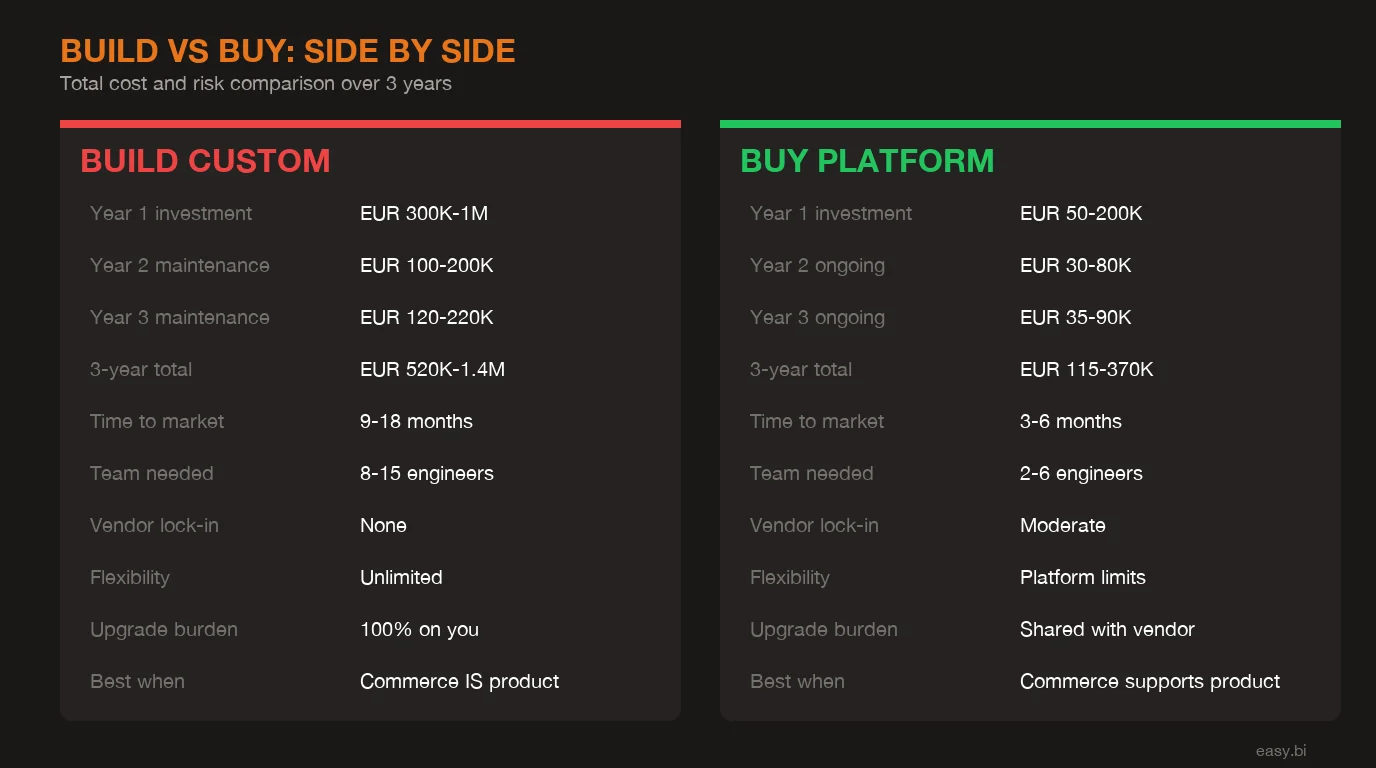
- •A custom-built e-commerce system costs EUR 300K-1M in year 1 and EUR 100-200K annually to maintain. A platform-based build costs EUR 50-150K in year 1 and EUR 30-80K annually - a 3-year TCO difference of 2-4x.
- •The hybrid approach wins: buy the commerce platform, build the differentiators on top. Composable architecture lets you own your competitive logic without owning the plumbing.
- •Five criteria determine the right choice: uniqueness of business logic, speed-to-market requirement, available engineering talent, integration complexity, and 3-year total cost of ownership.
- •The most expensive build-vs-buy mistake is not picking wrong - it is switching 18 months in after sinking EUR 500K into an approach that does not fit your business model.
80% of mid-market retailers should buy. Use this EUR decision framework with real cost comparisons, scoring criteria, and case examples to make the right call.
If your e-commerce workflows are standard - catalog, cart, checkout, fulfillment - buy a platform. Build custom only when your commerce logic IS your competitive advantage and no existing platform can support it. This decision framework gives you the EUR math to make the right call.
Why Does the Build vs Buy Decision Cost Companies Years?
The build-vs-buy decision for e-commerce platforms is the most consequential technology choice a mid-market retailer makes. Get it right, and you have a scalable commerce engine that grows with your business. Get it wrong, and you spend 18-24 months and EUR 500K+ building something that a EUR 100K platform implementation would have delivered faster.[1]
The problem is not a lack of information. CTOs and CEOs have access to vendor comparisons, analyst reports, and case studies. The problem is that most of this information comes from vendors with a financial interest in one outcome. Platform vendors say "buy." Development agencies say "build." Neither gives you the neutral framework you need.
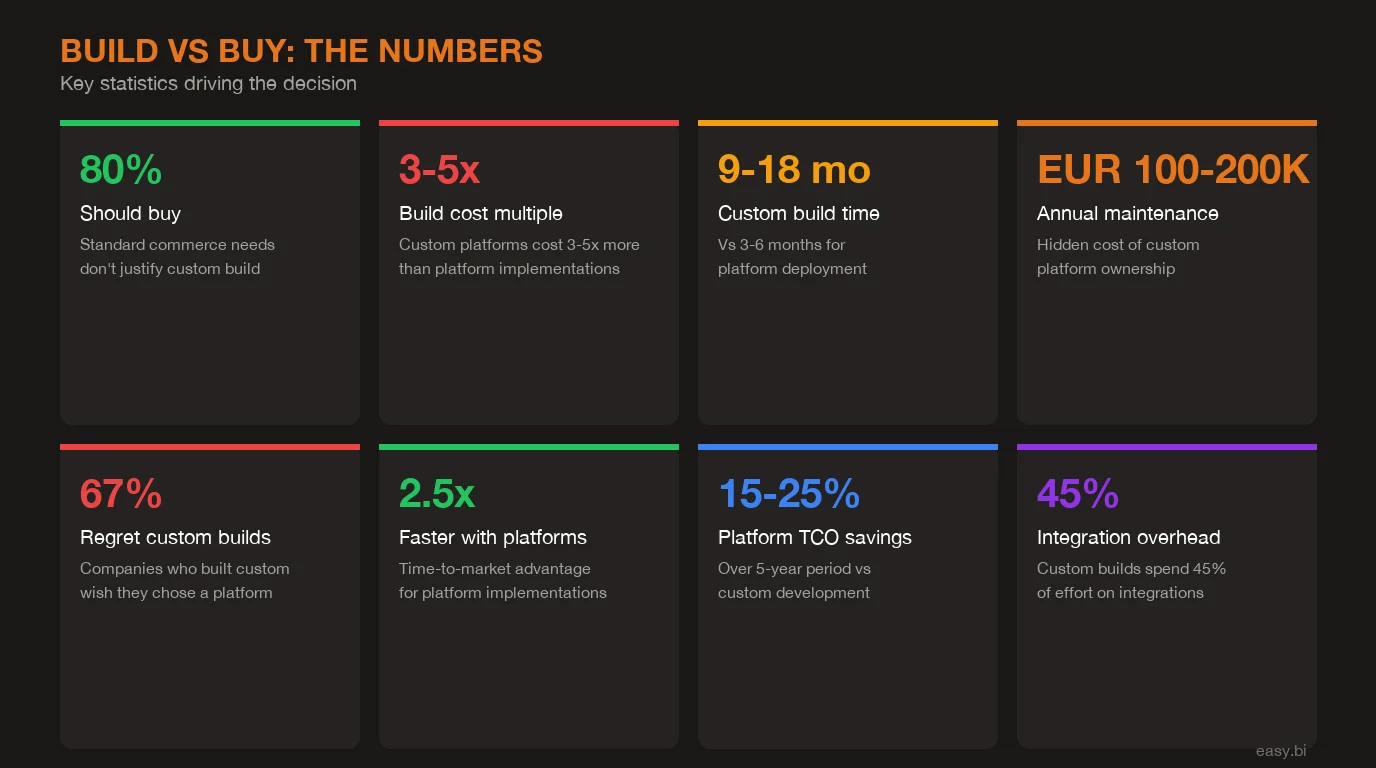
The real cost of a wrong decision is not the initial investment. It is the opportunity cost. Every month spent building commodity infrastructure - cart logic, payment integration, order management - is a month your engineering team is not building the features that differentiate your business. 68% of custom e-commerce projects exceed their original timeline by more than 6 months.[2] That is 6 months of delayed revenue, delayed market entry, and delayed competitive positioning.
Then comes the sunk cost trap. After investing EUR 300K and 12 months into a custom build, the decision to switch to a platform feels like admitting failure. So companies double down. They hire more developers. They extend the timeline. They add budget. And the gap between what they have built and what a platform delivers out of the box keeps widening. Gartner reports that 83% of data and analytics projects fail to deliver on their objectives - and custom e-commerce builds follow a similar pattern when the requirements do not justify the approach.[3]
This article gives you a decision framework with real EUR numbers. No vendor bias. No theoretical arguments. Just the math, the criteria, and the case examples you need to make an informed call.
See how our team delivers +35% avg conversion lift across 30+ e-commerce projects.
What Are the Real Costs of a Custom-Built E-Commerce System?
Custom e-commerce development costs are consistently underestimated. The initial build is the smallest part of the total investment. Maintenance, security, compliance, and talent retention create ongoing cost obligations that compound year over year.
Here is what a custom mid-market e-commerce platform actually costs:
Year 1: EUR 300K-1M. This covers core development (catalog, cart, checkout, payment integration, order management), infrastructure setup, QA, and launch. The range depends on complexity - a B2C storefront sits at the lower end, a multi-tenant marketplace at the upper end. The average enterprise software project costs 66% more than initially estimated.[4]
Annual maintenance: EUR 100-200K. Security patches, infrastructure management, bug fixes, performance optimization, and compliance updates. Industry benchmarks show that maintenance costs run 15-20% of initial development cost per year for enterprise software.[5] For a EUR 500K build, that is EUR 75-100K annually before you add a single new feature.
Hidden costs most teams miss:
- Recruitment. Senior e-commerce developers in DACH command EUR 80-120K salaries. You need 3-5 of them on an ongoing basis. The average time to fill a senior developer role in Germany is 62 days.[6]
- Security and compliance. PCI DSS compliance alone costs EUR 20-50K annually for custom implementations. Platforms absorb this cost across thousands of merchants.
- Upgrades you do not see. Payment provider API changes, tax regulation updates (EU VAT reform affected every DACH retailer), browser compatibility - these are not features. They are mandatory updates that consume 20-30% of your engineering capacity.
- Knowledge concentration. When the 2-3 developers who built the core architecture leave, you face a 3-6 month knowledge transfer gap. 70% of custom software projects experience critical knowledge loss within 3 years.[2]
How Much Does a Platform-Based E-Commerce Implementation Cost?
Platform-based implementations distribute costs differently. The platform vendor handles infrastructure, security, compliance, and core feature development. You pay for configuration, customization, and integration.
Year 1: EUR 50-150K. This covers platform licensing (Shopware, commercetools, Adobe Commerce), implementation, theme customization, integration with ERP/PIM/CRM, data migration, and launch. Shopware sits at the lower end for standard B2C. commercetools sits higher for complex multi-market setups.
Annual costs: EUR 30-80K. Platform licensing (EUR 5-40K depending on tier), hosting, ongoing customization, and integration maintenance. The platform vendor handles security patches, compliance updates, and core feature development. Your team focuses on business-specific features.
A 2024 Forrester study found that platform-based commerce implementations achieve 90% faster time to market compared to custom builds, with 40% lower 3-year TCO for standard commerce use cases.[1]
| Cost category | Custom build | Platform (Shopware/commercetools) |
|---|---|---|
| Year 1 development | EUR 300K-1M | EUR 50-150K |
| Annual maintenance | EUR 100-200K | EUR 30-80K |
| 3-year TCO | EUR 500K-1.4M | EUR 110-310K |
| Time to launch | 12-24 months | 8-16 weeks |
| Team required | 3-5 dedicated developers | 1-2 developers + agency partner |
| Security/compliance | Your responsibility (EUR 20-50K/year) | Platform responsibility (included) |
| PCI DSS scope | Full scope | Reduced scope (SAQ-A eligible) |
The 3-year TCO difference is 2-4x. For a mid-market retailer doing EUR 10-50M in online revenue, the platform approach frees EUR 200-800K over 3 years for investment in customer experience, marketing, and the business logic that actually differentiates you.
When Does Building Your Own Platform Make Financial Sense?
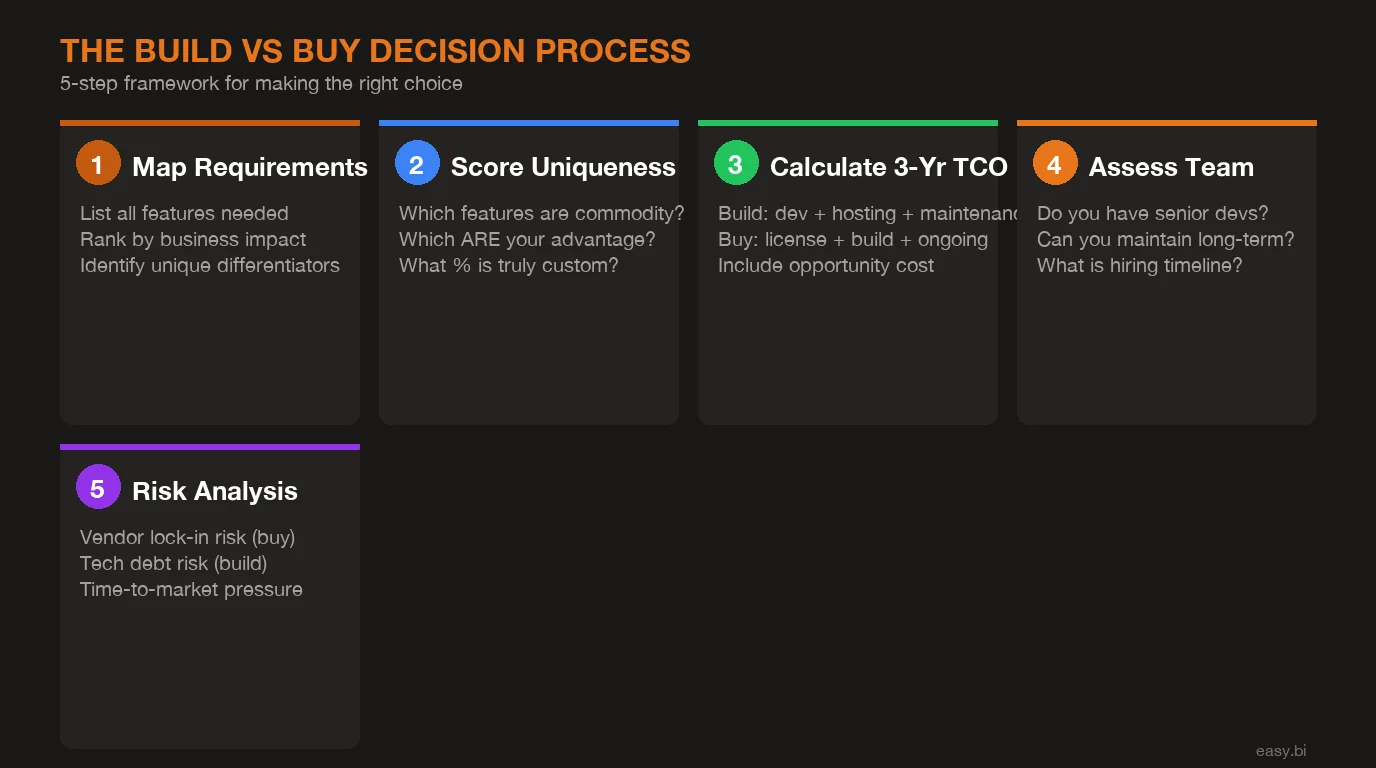
Building makes sense in exactly one scenario: when your commerce logic is so unique that it IS your competitive advantage, and no platform - even with extensive customization - can support it.
This is rarer than most CTOs think. Only 15-20% of mid-market e-commerce requirements fall outside what Shopware 6 or commercetools can handle with plugins, extensions, and API-based customization.[1]
Marketplace models with custom matching. If you operate a two-sided marketplace where the matching algorithm between buyers and sellers is your differentiator - think specialized B2B procurement platforms - the marketplace logic is too intertwined with the commerce engine to bolt onto a standard platform.
Proprietary pricing engines. Dynamic pricing based on real-time supply data, customer-specific negotiated rates across thousands of SKUs, or auction-based models. Standard platform pricing modules handle tiers and volume discounts. They do not handle custom pricing algorithms that process 50+ variables per transaction.
Industry-specific workflows. Construction material commerce with project-based ordering, bulk configurators, and delivery scheduling tied to construction timelines. Medical device ordering with regulatory approval workflows embedded in the checkout process. These vertical-specific workflows touch every layer of the commerce stack.
WeberHaus is an example where building custom was the right call. Their commerce workflows - configuring houses with thousands of options, calculating delivery timelines based on production schedules, integrating with manufacturing systems in real time - are so unique that a standard platform would require more customization than a custom build. The commerce logic IS the product.
In my experience as a founder of a software development company that has built both custom and platform-based solutions, the honest answer is this: for every company where custom was the right choice, I have seen five where a platform with targeted customization would have delivered the same outcome at a fraction of the cost.
When Does Buying a Platform Deliver Better Results?
Buying wins when your competitive advantage is not in the commerce plumbing but in what you do on top of it: brand, product selection, customer experience, marketing, logistics, and pricing strategy.
Standard B2C and B2B commerce. Catalog browsing, cart, checkout, payment, fulfillment tracking - this is solved infrastructure. Shopware 6 handles 95% of standard B2C requirements out of the box. commercetools handles complex multi-market B2B scenarios. Building these capabilities from scratch is like building your own database engine instead of using PostgreSQL. You can. You should not.
Speed to market. 67% of retailers cite time-to-market as a top-3 priority for e-commerce investments.[7] A platform-based implementation launches in 8-16 weeks. A custom build launches in 12-24 months. That is 9-21 months of lost revenue, lost market data, and lost customer feedback that should be shaping your product roadmap.
Ecosystem benefits. Shopware's plugin marketplace has 4,000+ extensions. commercetools connects to 100+ pre-built integrations. Each pre-built integration saves 2-4 weeks of custom development. A typical mid-market setup requires 8-12 integrations (ERP, PIM, CRM, payment, shipping, analytics, search, email, loyalty). That is 16-48 weeks of development that the ecosystem absorbs.
REWE is the counterexample to WeberHaus. REWE runs one of Europe's largest online grocery operations on a platform foundation with heavy customization on top. Their competitive advantage is not the commerce engine - it is logistics, assortment, and market position. The platform handles catalog and checkout. Custom code handles last-mile delivery optimization and warehouse integration. They built what matters and bought the rest.
What Is the Hybrid Approach and Why Does It Win?
The binary build-vs-buy framing is outdated. The right approach for 60-70% of mid-market enterprises is: buy the platform, build the differentiators.
Composable commerce architectures make this practical. Use Shopware 6 or commercetools as your commerce engine. Build custom frontends with headless architecture. Add custom microservices for the specific business logic that differentiates you - pricing algorithms, recommendation engines, workflow automation - while the platform handles catalog, cart, checkout, and order management.
Companies using composable commerce approaches report 25% faster time-to-market for new features and 30% lower 3-year TCO compared to fully custom builds.[8]
The hybrid approach works because it aligns investment with value. The commerce platform is a commodity - it does not differentiate you, so do not spend engineering time on it. Your unique business logic is your competitive advantage - so own it, build it, and iterate on it. For a deeper look at how composable and headless architecture supports this model, read our custom software development framework guide.
At easy.bi, this is the approach we recommend and implement most often. We configure the commerce platform in the first 4-6 weeks, then spend the remaining sprints building the custom components that make our clients' businesses unique. The client gets a production-ready commerce foundation fast and invests their budget in the features that generate competitive returns.
easy.bi delivers custom platforms 60% faster than typical in-house builds, with 3x operational efficiency gains through process automation. That speed comes from reusable architecture patterns refined across dozens of DACH e-commerce implementations.
How Do You Score Your Build vs Buy Decision?
Use this five-criteria framework to score your specific situation. Rate each criterion 1-5. A total score of 15+ favors building. Below 15, buy a platform.
| Criterion | Score 1-2 (favors buy) | Score 3 (neutral) | Score 4-5 (favors build) |
|---|---|---|---|
| Business logic uniqueness | Standard catalog/cart/checkout with minor customization | Some unique workflows but 70%+ is standard | Commerce logic IS the product; no platform can support it |
| Speed-to-market requirement | Need to launch within 3-6 months | 6-12 month timeline acceptable | 12-24 month timeline acceptable; first-mover advantage not critical |
| Engineering talent available | 0-2 e-commerce developers; relying on agency | 3-4 developers with some e-commerce experience | 5+ experienced developers; ability to recruit and retain |
| Integration complexity | 3-5 systems (ERP, payment, shipping) | 6-10 systems with some custom data flows | 15+ systems with real-time, bidirectional data exchange |
| 3-year budget | EUR 100-300K total | EUR 300-600K total | EUR 600K+ total; ongoing investment commitment secured |
Score 5-10: Buy a platform. Shopware 6 for standard DACH B2C, commercetools for multi-market or complex B2B. Invest your budget in implementation quality and custom extensions.
Score 11-14: Hybrid approach. Buy the commerce platform, build custom components for your unique business logic. This is the sweet spot for most mid-market enterprises.
Score 15-25: Building may be justified. Validate with a 4-week proof-of-concept before committing to the full build. Ensure you have the team, the timeline, and the budget to see it through.
Across the 100+ e-commerce projects we have delivered, fewer than 10% scored above 15. The majority landed in the 8-13 range - clear hybrid territory. For context on how build vs buy decisions apply to software teams more broadly, the same scoring logic holds: build what differentiates, buy what does not.
+35% conversion. +22% AOV. EUR 50M+ GMV processed.
Our Shopware-certified team delivers e-commerce at scale with 14-day sprint cycles. 80% less manual work through system integrations.
Start with a Strategy CallWhat Are the Hidden Costs of Building That Nobody Mentions?
Every custom build proposal focuses on development cost. The costs that sink custom projects are the ones that do not appear in the initial estimate.
Recruitment and retention. You need 3-5 senior developers permanently. In DACH, that is EUR 320-600K in annual salaries alone. Developer turnover in Germany averages 13% annually.[6] Every departure costs 6-9 months of salary in replacement and ramp-up costs. Over 3 years, expect to replace 1-2 developers on a 5-person team.
Security responsibility. A custom platform puts PCI DSS compliance, penetration testing, vulnerability management, and incident response on your team. The average cost of a data breach in Germany is EUR 4.3M.[5] Platform vendors spread this risk across thousands of merchants and invest millions annually in security infrastructure you cannot replicate at mid-market scale.
Regulatory compliance. EU VAT reform, Digital Services Act, GDPR updates, accessibility requirements (EAA 2025) - each regulatory change requires development effort on a custom platform. On Shopware or commercetools, the vendor ships compliance updates to all merchants simultaneously. For your custom build, each update is a project.
Feature parity drift. Commercial platforms ship 50-200 feature updates per year. Customer reviews, wishlists, loyalty programs, AI-powered search, personalization engines - features your competitors get automatically. On a custom platform, every feature is a build-or-skip decision. After 3 years, the feature gap between your custom build and a well-configured platform is significant.
Understanding and managing technical debt is critical for any custom build. Every shortcut taken during initial development becomes a tax on future velocity.
What Are the Hidden Costs of Buying That You Should Plan For?
Platform-based implementations have their own cost traps. Knowing them in advance prevents budget surprises.
Customization ceilings. Every platform has limits. When your business requirement falls outside the platform's architecture, you face three options: change your business process, build an expensive workaround, or accept the limitation. 45% of platform implementations require at least one significant business process compromise.[7]
Vendor lock-in. Migrating from one commerce platform to another costs EUR 150-400K and takes 6-12 months. Your catalog data, customer data, order history, and integration logic are all platform-specific. The switching cost gives the vendor negotiating power in license negotiations. Plan for this by keeping your data portable and your integration layer abstracted.
License cost escalation. Platform licensing often scales with revenue. A platform that costs EUR 10K/year at EUR 5M revenue may cost EUR 40K/year at EUR 20M revenue. Model your licensing costs at 3x and 5x your current revenue to avoid surprises as you grow.
Extension quality variance. Not all marketplace plugins are production-grade. 30% of Shopware plugins require modification to meet enterprise security and performance standards. Budget for plugin evaluation and customization, not just installation.
How Should You Make the Final Decision?
The build-vs-buy decision reduces to one question: Is your commerce logic a commodity or a competitive advantage?
If you sell products through a standard catalog with standard checkout and standard fulfillment - it is a commodity. Buy the platform. Invest your budget and engineering talent in what actually differentiates your business: product selection, customer experience, brand, marketing, and operational excellence.
If your commerce logic - the way transactions happen, the way prices are calculated, the way buyers and sellers interact - is fundamentally different from standard e-commerce and that difference is why customers choose you, then building may be justified. Score it with the framework above. If you score 15+, validate with a proof-of-concept before committing.
For everyone in between - which is most mid-market DACH enterprises - the hybrid approach delivers the best outcome. Buy the commerce platform. Build the differentiators on top. Ship in weeks, not years. Invest in what matters.
If you are evaluating this decision for your business and want a technical assessment based on your specific requirements, start a conversation about your e-commerce architecture. We have guided dozens of DACH enterprises through this decision - and we are honest about when building is the right call and when it is not.
What Are the Most Common Build vs Buy Questions?
How long does it take to build a custom e-commerce platform from scratch?
A production-ready custom e-commerce platform takes 12-24 months to build, including catalog management, checkout, payment integration, order management, and basic reporting. Most teams underestimate by 40-60%. A platform-based implementation launches in 8-16 weeks with equivalent core functionality. The gap is not just development time - it is the time your business spends without a production commerce system generating revenue and customer data.
Can you migrate from a custom-built platform to Shopware or commercetools later?
Yes, but it is expensive. Migration from custom to platform typically costs EUR 150-400K and takes 6-12 months. The biggest cost is not the technical migration - it is re-implementing business logic that was baked into custom code. Companies that document their business rules during the custom build reduce migration costs by 30-40%. If you do build custom, maintain clean documentation as insurance.
What is the break-even point for building a custom e-commerce platform?
For most mid-market retailers, the break-even point is 5-7 years - if the custom system delivers measurable competitive advantage. If the custom build replicates features available in commercial platforms, it never breaks even. The math only works when your commerce logic is so unique that no platform can accommodate it, even with extensions and heavy customization. Run the 3-year TCO comparison before committing.
References
- [1] Forrester - Total Economic Impact of Composable Commerce (2024)
- [2] Standish Group - CHAOS Report: Software Project Outcomes (2023)
- [3] Gartner - Data and Analytics Project Success Rates (2023)
- [4] McKinsey - Delivering Large-Scale IT Projects On Time, On Budget (2023)
- [5] IBM - Cost of a Data Breach Report (2024)
- [6] Bitkom - IT-Fachkraeftemangel in Deutschland (2024)
- [7] Digital Commerce 360 - Mid-Market E-Commerce Technology Priorities (2024)
- [8] MACH Alliance - Composable Commerce Business Impact Research (2024)
Explore Other Topics
Ready to scale your e-commerce?
30-minute call with an engineering lead. No sales pitch - just honest answers about your project.
98% engineer retention · 14-day delivery sprints · No lock-in contracts
Related Reading
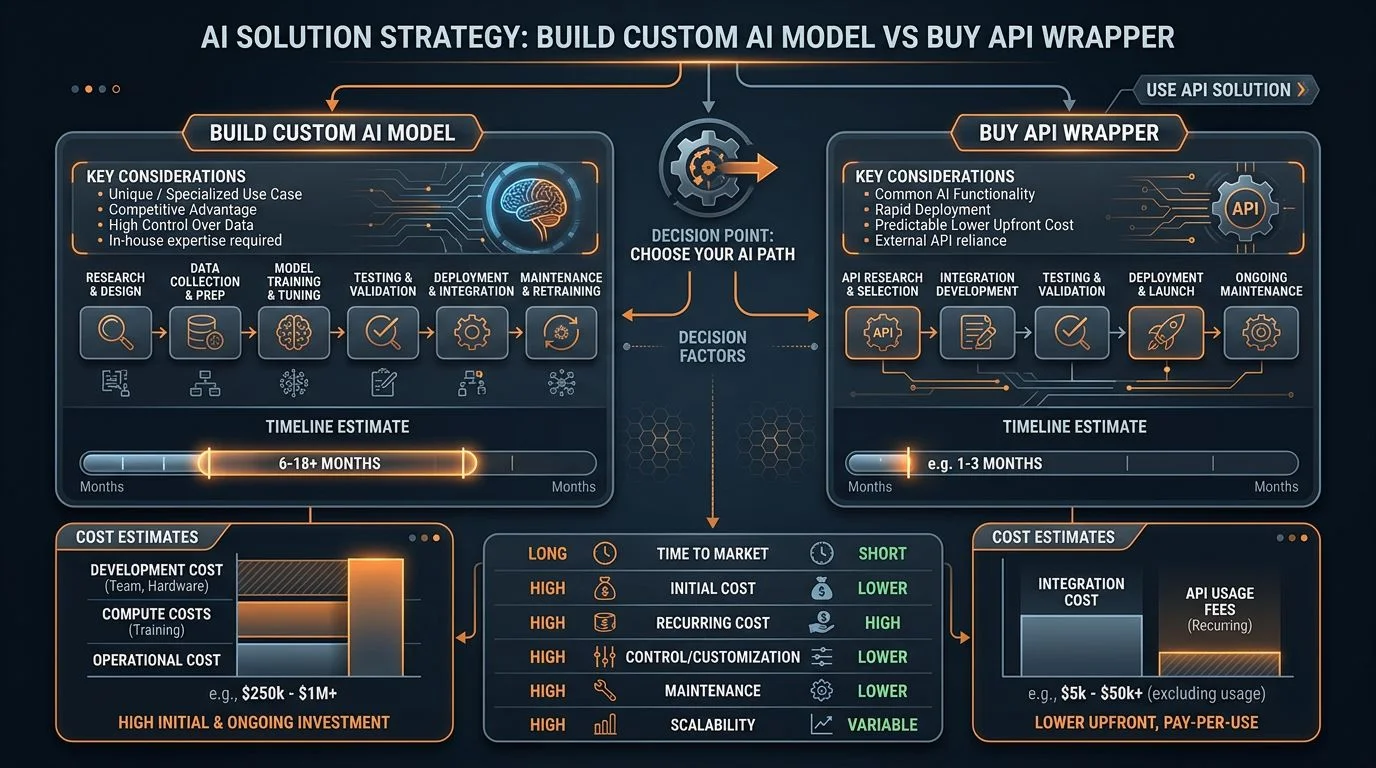
The AI Build vs. Buy Decision: Custom Models vs. API Wrappers
Custom models cost $100M+ to train from scratch. API wrappers ship in days. Learn when to build, buy, or combine - with cost comparisons, data privacy implications, and vendor lock-in strategies for enterprise AI.
Filip Kralj
The Build vs. Buy Decision: How to Staff Enterprise Software Projects in 2026
The build vs. buy decision in 2026 depends on talent availability, team structure, and outcome accountability. Compare in-house, nearshore, and offshore models with DACH market data and a practical decision framework.
Andrej Lovsin
E-Commerce Conversion Optimization: The 35% Improvement Framework
A systematic 6-lever framework that delivers +35% conversion rate and +22% AOV for DACH e-commerce. Page speed, checkout, product UX, search, cross-sell, and mobile optimization with measurable benchmarks.
Enno Bassen