
The Multi-Vendor Trap: Why Coordination Costs Kill Your Budget

Table of Contents+
- Why Does the Multi-Vendor Model Feel Safe but Fail?
- What Does Coordination Overhead Actually Cost?
- How Does Finger-Pointing Kill Your Timeline?
- Where Do Integration Testing Gaps Hide?
- What Does the Real Cost Comparison Look Like?
- How Does Single-Partner Accountability Change the Math?
- When Is Multi-Vendor the Right Choice?
- References
TL;DR
You have a complex enterprise software project. Your procurement team suggests splitting the work across 3-4 vendors to "reduce dependency on any single provider." It sounds like prudent risk management. On paper, it distributes risk.
Key Takeaways
- •Multi-vendor setups feel like risk diversification but concentrate risk at every integration point. With 4 vendors, you have 6 coordination interfaces - each a potential failure point where assumptions diverge, timelines slip, and accountability disappears.
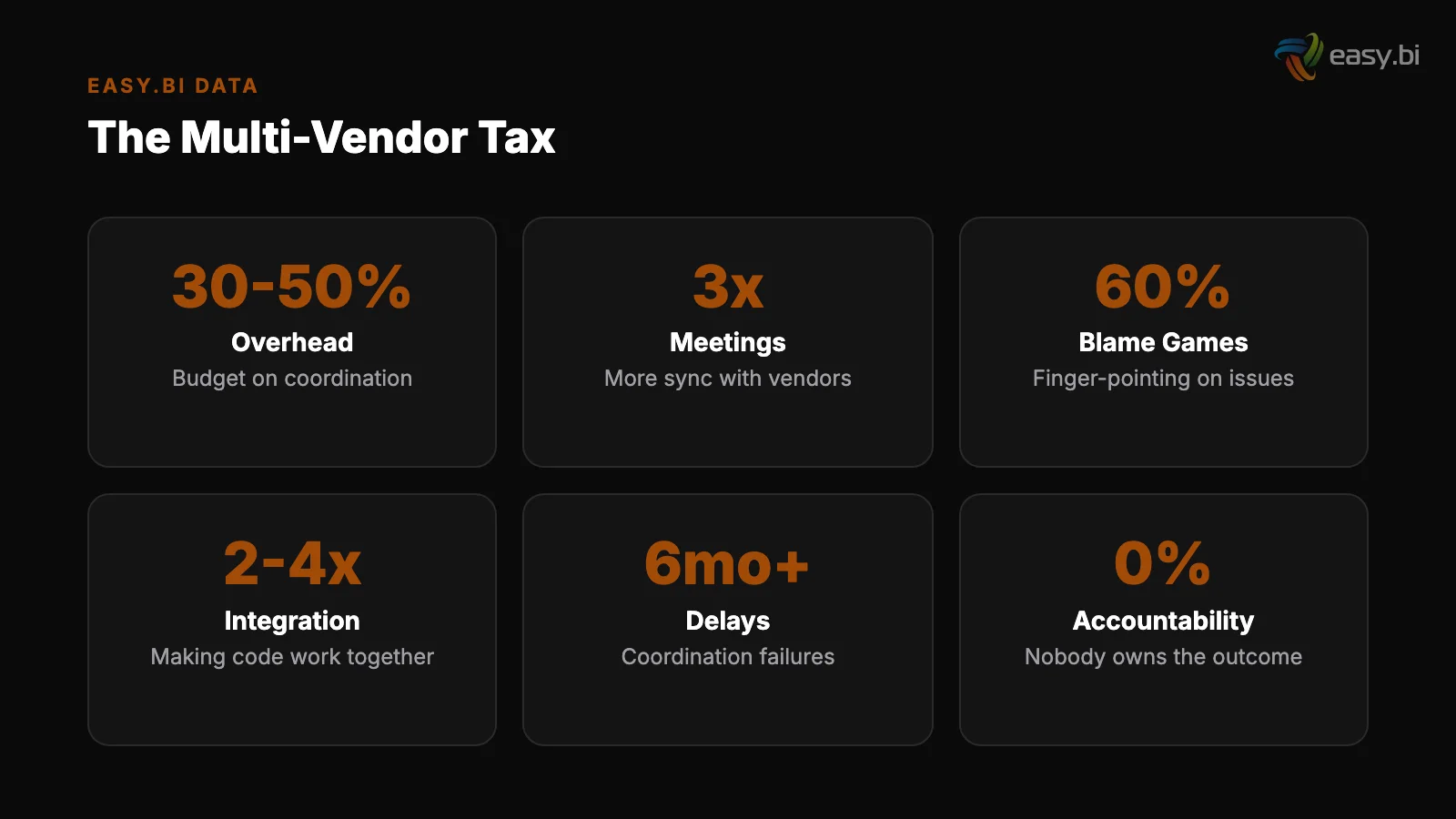
- •Coordination overhead adds 40-60% to project timelines. Budget overruns in multi-vendor setups average 3.5x the original estimate, driven by finger-pointing, rework cycles, and integration testing gaps that no single vendor owns.
- •57% of software project failures trace to communication breakdowns between stakeholders. Multi-vendor setups multiply this risk by the number of handoff points between teams that do not share a backlog, a sprint cadence, or a definition of done.
- •Cross-functional teams under single-partner accountability are 35% more productive than siloed teams. One backlog, one Project Owner, one deployment pipeline eliminates the coordination tax that multi-vendor setups impose on every feature.
- •Multi-vendor is the right choice for genuinely independent workstreams - a mobile app built against a stable API, or a marketing site separate from the core platform. For integrated enterprise systems, single-partner delivery costs less and ships faster.
Multi-vendor software development setups add 40-60% to project timelines and push budgets to 3.5x the original estimate. Learn why coordination overhead, finger-pointing, and integration gaps destroy projects - and how single-partner accountability changes the math.
You have a complex enterprise software project. Your procurement team suggests splitting the work across 3-4 vendors to "reduce dependency on any single provider." It sounds like prudent risk management. On paper, it distributes risk.
In practice, it concentrates risk at every integration point between vendors - and those integration points are where enterprise projects go to die.
I have seen this pattern destroy budgets and timelines at DACH mid-market companies for over a decade. The project that was supposed to cost EUR 500,000 finishes at EUR 1.75 million. The launch date that was 6 months away becomes 14 months.
The CTO who approved the multi-vendor approach spends their evenings mediating technical disputes between agencies who each insist the problem is on the other side of the API.
This article breaks down why multi-vendor setups fail, what they actually cost, and when the model is - and is not - the right choice. Every number comes from published research or from patterns we have observed across 100+ DACH enterprise projects at easy.bi.
Why Does the Multi-Vendor Model Feel Safe but Fail?
The multi-vendor model appeals to procurement logic. Spread the work across multiple providers. If one underperforms, replace them without losing the entire project. Negotiate better rates by creating competition between vendors. These arguments sound reasonable. They are also wrong for integrated software projects.
The flaw is in the assumption that software development is modular in the way procurement expects. When you buy office furniture from 4 suppliers, each supplier delivers an independent product. Desks do not need to integrate with chairs at the API level.
Software components are fundamentally different - they share data models, authentication flows, error handling patterns, deployment pipelines, and performance constraints. Every boundary between vendors becomes a boundary where these shared concerns must be negotiated, documented, tested, and maintained.
The research is clear on what happens next. 66% of software projects fail or are challenged - over budget, over time, or with fewer features than planned [1]. Multi-vendor setups do not reduce this failure rate. They amplify it by introducing coordination complexity that single-team projects do not face.
The pattern repeats across industries. One agency handles UX design. A second builds the frontend. A third delivers backend and integrations. A fourth manages DevOps and hosting. Each vendor is competent in isolation. Together, they produce a project where nobody owns the outcome end-to-end.
See how enterprises modernize with one team.
What Does Coordination Overhead Actually Cost?
Coordination overhead is the invisible tax on multi-vendor projects. It does not appear as a line item in any vendor's invoice. It shows up as meetings, emails, Slack threads, Jira ticket ping-pong, integration debugging sessions, and the CTO's evenings spent reading status reports from 4 different project managers.
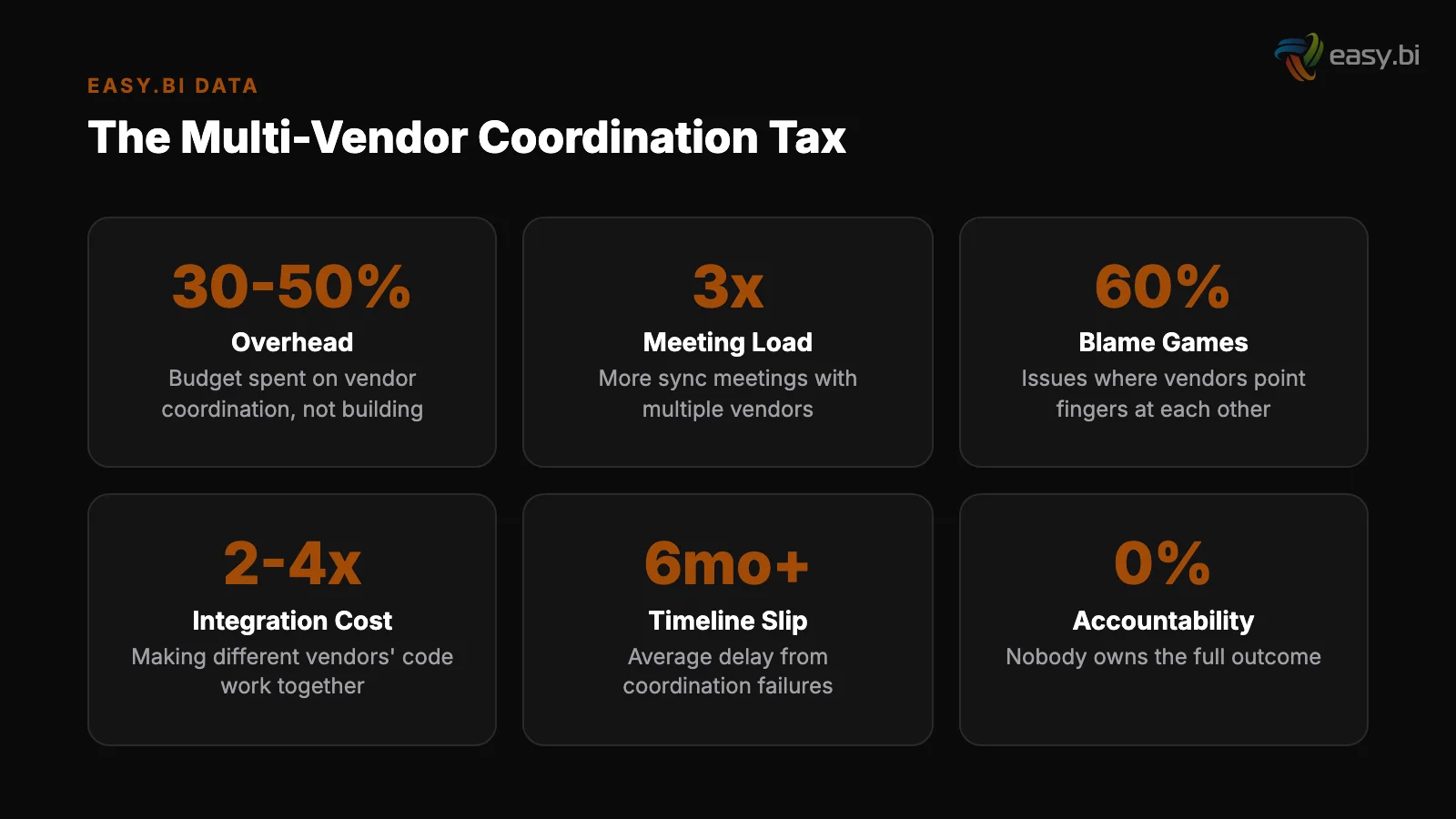
Here is the math. With 2 vendors, you have 1 coordination interface. With 3 vendors, you have 3 interfaces. With 4 vendors, you have 6 interfaces. The formula is n(n-1)/2 - the same quadratic growth that Brooks's Law describes for team communication.
Each interface requires alignment on data formats, authentication, error handling, deployment timing, and testing responsibility.
| Number of Vendors | Coordination Interfaces | Estimated Timeline Increase | Typical Budget Multiplier |
|---|---|---|---|
| 1 (single partner) | 0 | Baseline | 1.0x |
| 2 | 1 | 15-25% | 1.3-1.5x |
| 3 | 3 | 30-45% | 1.8-2.5x |
| 4 | 6 | 40-60% | 2.5-3.5x |
| 5 | 10 | 60-80% | 3.0-4.0x |
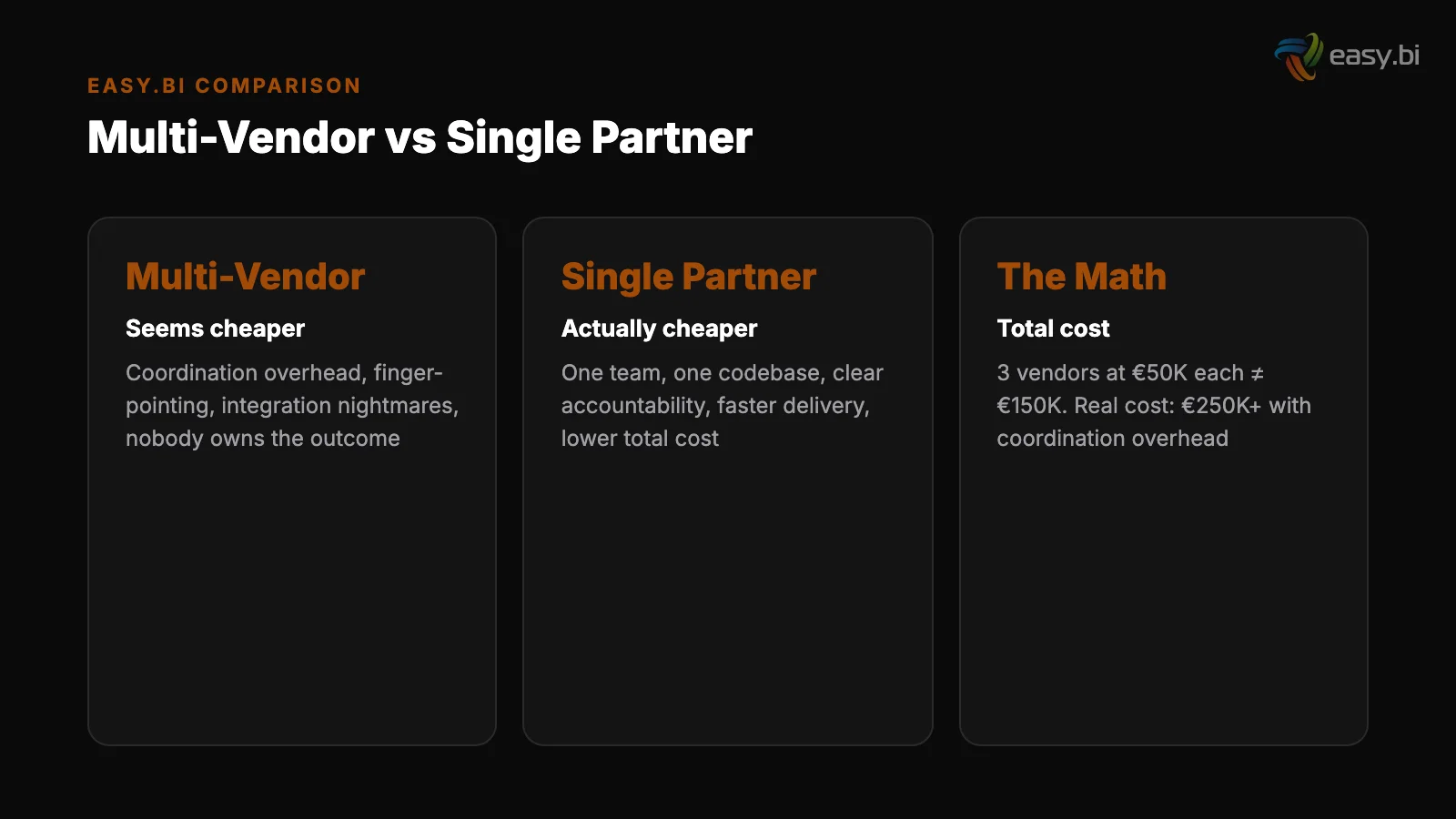
The 3.5x budget overrun stat is not hypothetical. It comes from aggregated data across multi-vendor enterprise projects where coordination costs were tracked separately from development costs. The average cost overrun on software projects is already 66% of original budget [2].
Multi-vendor setups push that number significantly higher because every vendor's overrun compounds through the integration chain.
Scope creep amplifies the problem. Scope creep affects 52% of all projects, increasing delivery time by an average of 27% [3]. In a single-partner setup, scope changes flow through one backlog and one prioritization process.
In a multi-vendor setup, a scope change in vendor A's domain ripples through vendors B, C, and D - each of whom needs to assess impact, adjust their timelines, and renegotiate their deliverables.
A change that takes 2 hours to absorb in a single-team project takes 2 days to propagate through a 4-vendor setup.
57% of software project failures trace directly to communication breakdowns between stakeholders. Multi-vendor setups don't reduce this risk - they multiply it by the number of handoff points between teams that don't share a backlog, a sprint cadence, or a definition of done. [4]
How Does Finger-Pointing Kill Your Timeline?
When a multi-vendor project falls behind, the first response from every vendor is the same: the problem is on the other side of the integration boundary.
The frontend team says the API is too slow. The backend team says the frontend is making too many calls. The DevOps team says the infrastructure can handle both if they were built properly. The UX agency says the design was implemented incorrectly. Everyone has a reasonable argument.
Nobody has a solution. And the client - who hired 4 vendors precisely to avoid managing technical details - is now the unwilling arbitrator of disputes they do not have the technical depth to resolve.
This finger-pointing is not a cultural failure. It is a structural incentive. Each vendor is contractually accountable for their own deliverables, not for the integrated outcome. When the system does not work, each vendor can point to their own component working correctly in isolation.
The failure exists in the space between components - a space that no vendor's contract covers.
The timeline impact is severe. A technical dispute that would be resolved in 30 minutes within a single team takes 1-2 weeks in a multi-vendor setup. It requires scheduled meetings, vendor-by-vendor investigation, documented findings, and often a compromise that satisfies nobody but allows the project to move forward.
Multiply this by the 5-10 integration disputes that occur in a typical 12-month enterprise project, and you have added 3-5 months to your timeline - before accounting for the rework that follows each dispute resolution.
Where Do Integration Testing Gaps Hide?
Integration testing is the orphan responsibility of multi-vendor projects. Every vendor tests their own component thoroughly. Nobody tests the integrated system with the same rigor - because nobody owns it.
The gap manifests at four levels.
Data contract violations
Data contract violations. Vendor A's API returns a date as "2026-03-21" and vendor B's frontend expects "21.03.2026". In isolation, both work. Together, the feature breaks.
These contract violations are trivial to fix individually but occur in dozens of places across a multi-vendor integration - and they only surface when the components are connected for the first time.
Authentication flow failures. Each vendor implements their portion of the auth flow correctly against the specification. But the specification did not cover the edge case where a token expires during a long-running transaction that spans two vendors' services. The user sees a cryptic error.
The bug report bounces between vendors for 2 weeks.
Authentication flow failures
Performance degradation under load. Vendor A's service handles 1,000 requests per second. Vendor B's service also handles 1,000 requests per second. Together, with the serialization overhead of crossing the integration boundary, the system handles 400 requests per second.
Nobody planned for the integration tax on performance because nobody modeled the integrated system.
Deployment coordination failures. Vendor A deploys a breaking API change on Tuesday. Vendor B deploys the corresponding frontend update on Thursday. For 2 days, the system is broken in production. In a single-team setup, both changes would deploy in the same release.
In a multi-vendor setup, deployment coordination becomes a project management exercise that adds overhead to every release cycle.
Automated testing catches 80% of defects before production [5] - but only when tests cover the integrated system, not just individual components. The cost of fixing a bug in production is 6x higher than fixing it during implementation [6].
Multi-vendor integration gaps push more bugs to production, where they cost more to fix and damage user trust.
What Does the Real Cost Comparison Look Like?
Here is a real cost comparison for a 12-month enterprise project requiring 10 engineers. These numbers are composites from patterns we have observed, not from a single project.
| Cost Category | Single Partner (10 engineers) | Multi-Vendor (3 vendors, 10 total engineers) |
|---|---|---|
| Development cost (hourly rates) | EUR 720,000 | EUR 680,000 (mixed rates) |
| Project management | EUR 80,000 (1 Project Owner) | EUR 180,000 (3 PMs + client coordination) |
| Integration testing | Included in sprint delivery | EUR 60,000 (separate integration sprints) |
| Coordination overhead (meetings, alignment) | Minimal | EUR 95,000 (estimated 8-12 hours/week) |
| Rework from integration issues | EUR 35,000 (5% rework rate) | EUR 120,000 (15-18% rework rate) |
| Timeline extension (3-5 months) | N/A | EUR 250,000 (additional dev + opportunity cost) |
| Total | EUR 835,000 | EUR 1,385,000 |
The multi-vendor approach saves EUR 40,000 on hourly development rates. It costs EUR 550,000 more in coordination overhead, integration testing, rework, and timeline extension. The "risk-diversified" approach costs 66% more than the single-partner approach - and delivers later.
This is not unusual. Organizations waste an average of $122 million for every $1 billion invested in projects due to poor project performance [7]. Multi-vendor coordination is one of the largest drivers of that waste in enterprise software.
Siemens, Lekkerland, WeberHaus chose us
One integrated partner. Three core competencies. From insight to production, with no handover gaps.
Start with a Strategy CallHow Does Single-Partner Accountability Change the Math?
A single partner with cross-functional capabilities eliminates the coordination tax entirely. One team handles architecture, frontend, backend, DevOps, and QA under one backlog, one sprint cadence, and one definition of done.
The structural advantages are measurable. Cross-functional teams are 35% more productive than siloed teams working on the same type of project [8]. That productivity gap widens as project complexity increases - precisely because cross-functional teams do not pay the coordination tax that multi-vendor setups impose.
Single-partner accountability means one entity is responsible for the integrated outcome. When the frontend is slow, the same team that built it also built the API it calls and the infrastructure it runs on. The diagnosis takes 30 minutes, not 2 weeks.
The fix ships in the next sprint, not after a multi-vendor negotiation about who caused the problem and who pays for the fix.
At easy.bi, this is how we structure every engagement. Our 50+ engineers across Hamburg, Frankfurt, Ljubljana, and Skopje work as one integrated team. Custom Solutions, E-Commerce, and UX Growth capabilities sit under one roof - not as separate companies that need to coordinate through the client.
One Project Owner manages the entire backlog. One sprint cadence delivers working software every 14 days. One team accountable for your business outcome.
This does not mean we do everything internally. If a project requires a specific capability we do not have - say, SAP S/4HANA consulting - we bring in a specialist partner, but we manage that integration as part of our backlog.
The client has one interface, one status report, and one team to hold accountable. The coordination overhead stays on our side, not the client's.
When Is Multi-Vendor the Right Choice?
Multi-vendor is not always wrong. It is the right model for genuinely independent workstreams that do not share data, deployment pipelines, or user flows.
Separate products that coexist. A marketing website and a core SaaS platform are different products that happen to share a brand. Building the marketing site with an agency and the platform with a development partner is fine - because there is no integration boundary to manage.
Separate products that coexist
Commoditized services alongside custom development. Using AWS for infrastructure, a CDN provider for asset delivery, and a development partner for the application is multi-vendor in name only. These services are standardized products with well-documented APIs, not custom-built components that require coordination.
Post-launch maintenance of stable systems. Once a system is stable and well-documented, splitting maintenance across vendors is lower risk than during active development. The architecture is frozen, the interfaces are established, and the coordination burden drops dramatically.
When you need to be wrong, fast. If you are genuinely unsure which partner is the best fit, running 2-3 week paid pilots with multiple vendors in parallel - each working on an isolated, well-defined task - can produce comparison data faster than sequential evaluations.
This is multi-vendor as an evaluation strategy, not as a delivery strategy.
Commoditized services alongside custom development
The multi-vendor trap triggers when integrated systems are split across vendors who do not share a backlog, a deployment pipeline, or a definition of quality.
If the output of vendor A is the input of vendor B, you do not have two independent vendors - you have one poorly coordinated team.
For the strategic framework that sits above vendor structure, read our pillar guide on the build vs. buy decision. If you are evaluating whether your current multi-vendor setup is working, our guide on how to evaluate a software development partner provides the signals that predict quality.
And if rapid team scaling is the driver behind your multi-vendor consideration, see how scaling from 2 to 20 engineers works within a single-partner model.
If your current project is stuck in multi-vendor coordination overhead and you want to explore consolidation, explore our integrated delivery model or book an expert call. We will assess your current setup honestly - including whether consolidation to a single partner actually makes sense for your specific situation.
References
- [1] Standish Group (2023). "66% of software projects fail or are challenged.
- [2] PMI (2024). "Average cost overrun on software projects is 66% of original budget. pmi.org
- [3] PMI (2024). "Scope creep affects 52% of all projects, increasing delivery time b pmi.org
- [4] PMI (2024). "57% of projects fail due to communication breakdown between stakeho pmi.org
- [5] Capgemini (2024). "Automated testing catches 80% of defects before production.
- [6] IBM Systems Sciences Institute (2023). ibm.com
- [7] PMI (2024). "Organizations waste $122 million for every $1 billion invested in p pmi.org
- [8] Harvard Business Review / Bain (2023).
Explore Other Topics
Ready to transform your business?
30-minute call with an engineering lead. No sales pitch - just honest answers about your project.
98% engineer retention · 14-day delivery sprints · No lock-in contracts
Related Reading

How to Evaluate a Software Development Partner (Without Getting Burned)
A practical checklist for evaluating software development partners: what to ask, red flags to watch for, how to assess technical depth, and why paid pilots beat RFPs. Based on patterns from 100+ DACH enterprise projects.
Enno Bassen
The Build vs. Buy Decision: How to Staff Enterprise Software Projects in 2026
The build vs. buy decision in 2026 depends on talent availability, team structure, and outcome accountability. Compare in-house, nearshore, and offshore models with DACH market data and a practical decision framework.
Andrej Lovsin
What makes custom software development so crucial for today's supply chain industry?
Custom software boosts supply chain efficiency, drives innovation, and enhances financial stability, ensuring a competitive edge in logistics.
Andrej Lovsin