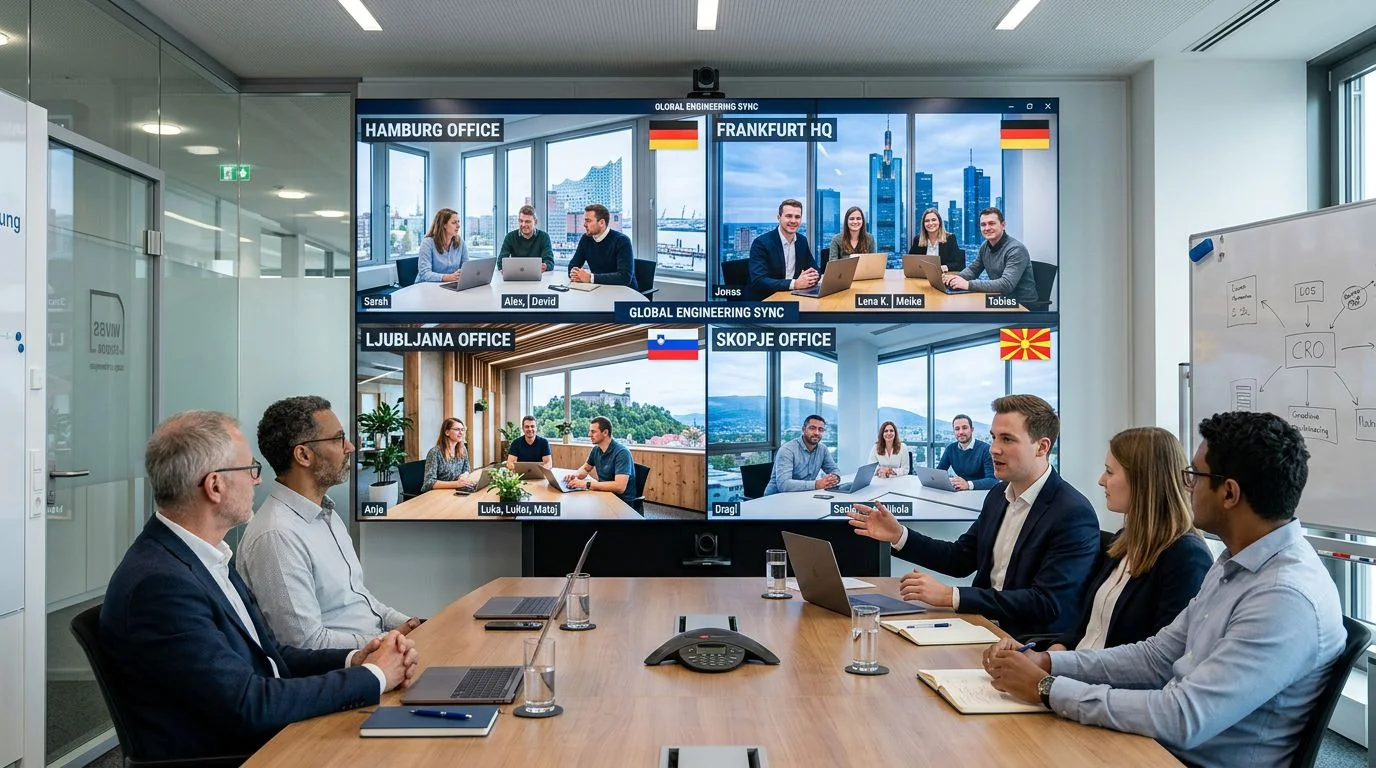
Remote Engineering Teams That Work: Hamburg, Frankfurt, Ljubljana, Skopje

Table of Contents+
- Why Does Remote Engineering Work Differently in Europe?
- How Does Timezone Alignment Change Everything?
- What Should Be Async vs. What Must Be Sync?
- How Do Cultural Differences Across DACH and SEE Affect Delivery?
- What Tooling Actually Matters for Distributed Teams?
- How Does easy.bi Run Teams Across 4 Countries?
- What Have We Learned After 10 Years of Distributed Delivery?
- References
TL;DR
I founded easy.bi in 2015 with a simple premise: the best engineers are not all in the same city. Ten years later, we have 50+ engineers across Hamburg, Frankfurt, Ljubljana, and Skopje, delivering 100+ projects for DACH enterprise and mid-market clients.
Key Takeaways
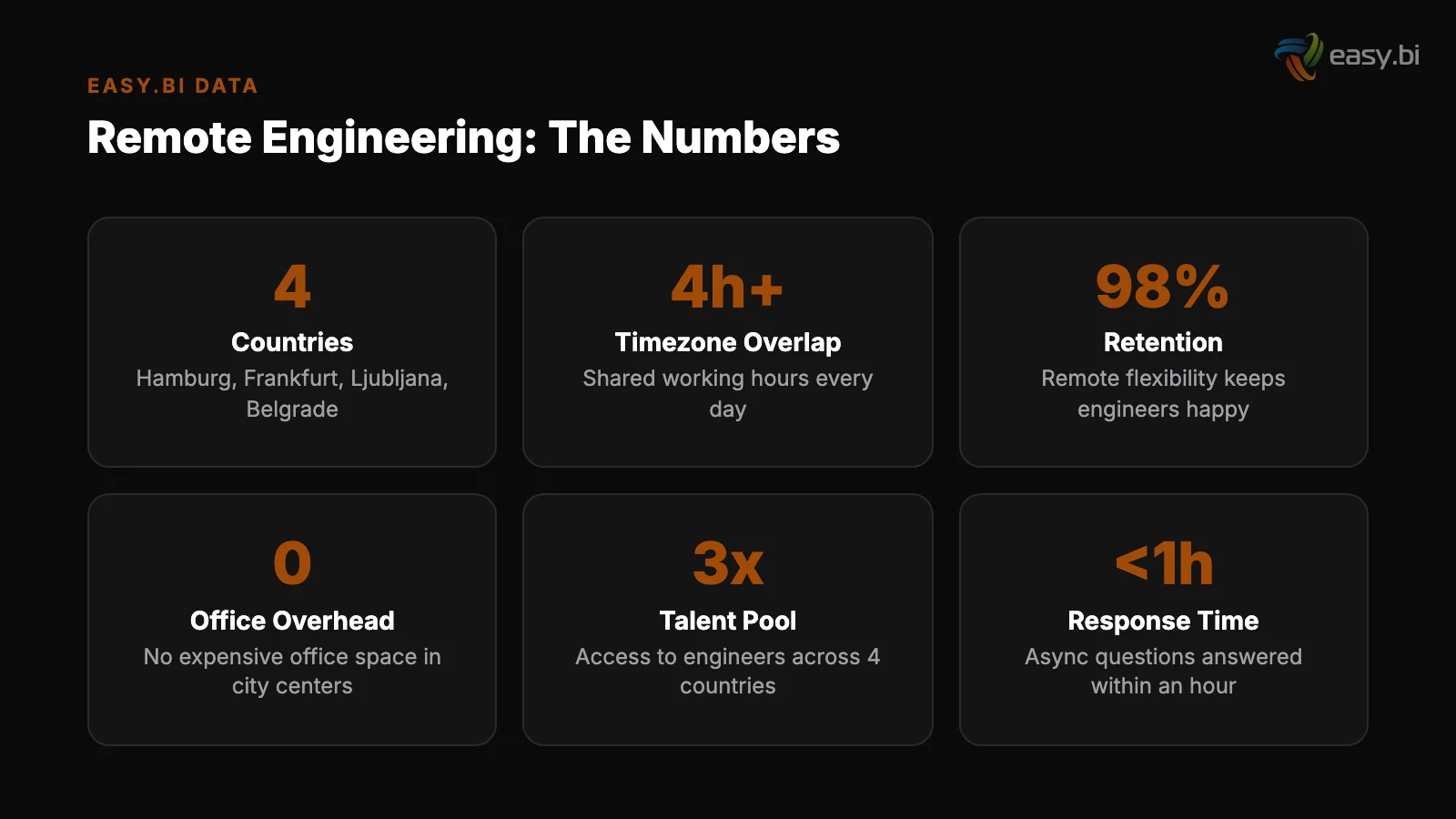
- •Timezone alignment is a project success factor, not a convenience. Ljubljana is 0-1 hours from Frankfurt - blocking issues resolve in minutes, not overnight. This single advantage is why 73% of German IT decision-makers prefer CEE nearshore over offshore.
- •68% of German IT professionals now work hybrid or fully remote. Distributed engineering is the operational default, not the exception. The question is not whether to manage remote teams but how to structure communication for velocity and quality.
- •Async-first communication with deliberate sync rituals produces better outcomes than either extreme. Architecture decisions, sprint reviews, and retrospectives must be synchronous. Status updates, code reviews, and documentation must be asynchronous.
- •Cultural differences between DACH and SEE are real but manageable. Slovenian and North Macedonian engineers adapt quickly to German directness and quality expectations because the gap is cultural proximity, not cultural distance - unlike offshore destinations with fundamentally different business communication norms.
- •easy.bi's 4-country model works because distributed delivery was designed into the organization from day one, not bolted on during a pandemic. Shared coding standards, CI/CD pipelines, and Performance Scrum methodology create team cohesion that transcends geography.
How easy.bi runs distributed engineering teams across Hamburg, Frankfurt, Ljubljana, and Skopje. Timezone alignment, async vs sync communication, cultural considerations across DACH and SEE, and 10 years of lessons from delivering 100+ projects with remote teams.
I founded easy.bi in 2015 with a simple premise: the best engineers are not all in the same city. Ten years later, we have 50+ engineers across Hamburg, Frankfurt, Ljubljana, and Skopje, delivering 100+ projects for DACH enterprise and mid-market clients.
Not as a temporary pandemic arrangement - as a deliberate organizational architecture built for distributed delivery from day one.
This article is not a generic remote work guide. There are thousands of those.
This is a specific account of what works and what does not when you run engineering teams across DACH and Southeast Europe - the timezone considerations, the cultural nuances, the tooling that matters, and the lessons that only come from doing this at scale for a decade.
If you are a CTO evaluating whether distributed teams can deliver enterprise-grade software for your organization, this is the practical reality behind the theory.
Why Does Remote Engineering Work Differently in Europe?
Most remote engineering advice comes from US-based companies managing teams across Pacific and Eastern time zones - a 3-hour gap that creates meaningful scheduling friction. Or from companies with teams in India or the Philippines - an 8-12 hour gap that forces a fully asynchronous workflow.
European distributed engineering operates in a fundamentally different context. The entire continent spans 3 time zones (UTC to UTC+2 during winter, UTC+1 to UTC+3 during summer). Hamburg to Ljubljana is 0-1 hours. Frankfurt to Skopje is 0-1 hours.
This means full overlap during core working hours - 9 AM to 5 PM CET for the entire team, regardless of location.
This timezone alignment changes the communication model entirely. You do not need to choose between synchronous and asynchronous. You can use both, deliberately, based on what each type of communication serves. 68% of German IT professionals now work in hybrid or fully remote setups [1].
Distributed work is the default, not the exception. The infrastructure - both technical and cultural - already exists.
The second European advantage is regulatory alignment. All easy.bi locations operate within the EU (or with EU-aligned legal frameworks). GDPR compliance is structural, not contractual. Data processing agreements are standard. IP protection follows EU directives.
This eliminates an entire category of risk that companies face with offshore arrangements - GDPR compliance is the number one reason DACH companies prefer EU-based nearshore partners [2].
The third advantage is cultural proximity. Slovenia and North Macedonia share more cultural DNA with Germany and Austria than most people expect. Work ethic, directness in communication, engineering education standards, and business process orientation are closer between Ljubljana and Frankfurt than between Frankfurt and most offshore destinations.
This is not bias - it is a measured preference. 88% of Austrian IT decision-makers consider cultural compatibility more important than cost savings when choosing development partners [3].
See how enterprises modernize with one team.
How Does Timezone Alignment Change Everything?
I have seen timezone gaps destroy projects that had every other success factor in place - talented engineers, clear requirements, sufficient budget. The gap was not in skill or resources. It was in the 8-18 hours of dead time between a question asked and a question answered.
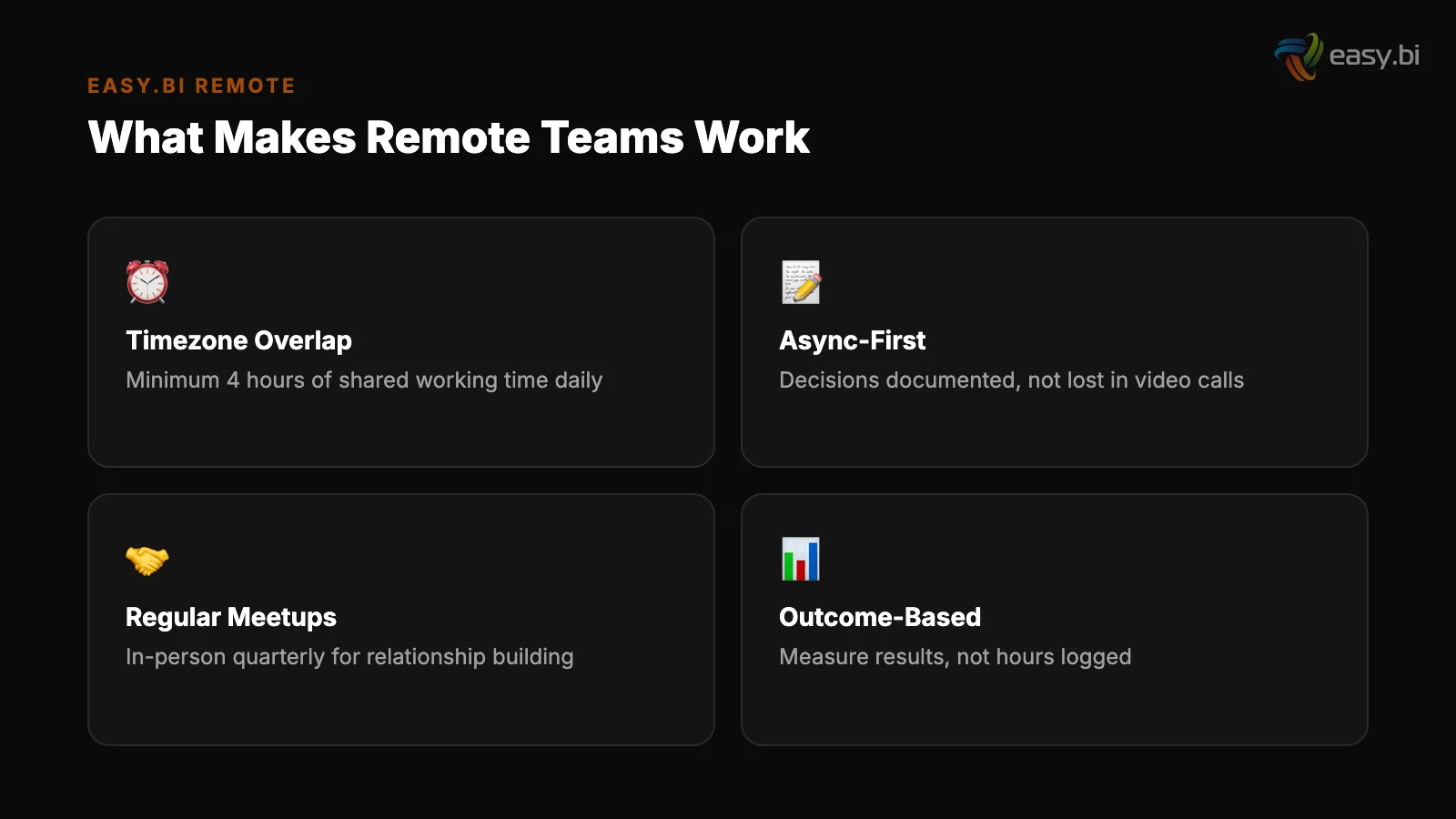
Here is what timezone alignment looks like in practice at easy.bi.
A developer in Ljubljana encounters a blocker at 10:30 AM. They post the question in the project Slack channel. The architect in Hamburg sees it at 10:30 AM (same time). By 11:00 AM, the blocker is resolved. The developer commits their code before lunch. Total delay: 30 minutes.
Now compare that to an offshore scenario. The same blocker surfaces at 10:30 AM CET. The offshore team in Bangalore is at 3:00 PM IST - still working, but context-switching to their afternoon tasks. If the architect is in Germany, they respond at 10:45 AM CET.
The offshore developer picks it up the next morning at 9:00 AM IST (4:30 AM CET). Total delay: 22.5 hours.
Multiply that by 2-3 blocking issues per week - a conservative estimate for complex enterprise projects - and the offshore model accumulates 45-67 hours of dead time per week. Over a 6-month project, that is over 1,000 hours of accumulated delay.
At any hourly rate, that delay costs more than the rate differential saves.
| Communication Scenario | Same Timezone (Hamburg-Ljubljana) | Offshore (Frankfurt-Bangalore) |
|---|---|---|
| Morning standup | 9:30 AM CET for everyone | 9:30 AM CET = 2:00 PM IST (post-lunch lull) |
| Blocker resolution | 30 minutes average | 18-24 hours average |
| Ad hoc architecture discussion | Scheduled within 1 hour | Scheduled for next business day |
| Sprint review with client | 3:00 PM CET works for all | 3:00 PM CET = 7:30 PM IST (after hours) |
| Emergency production fix | Team available 9 AM - 6 PM CET | 4-hour overlap window only |
| Effective collaboration hours per day | 8 hours | 3-4 hours |
Timezone alignment is the number two reason - after cultural fit - that DACH companies choose CEE nearshore partners [4]. After running distributed teams for 10 years, I would rank it number one. Cultural gaps can be bridged with training and experience.
Timezone gaps are physics - you cannot negotiate with the rotation of the earth.
What Should Be Async vs. What Must Be Sync?
The biggest mistake distributed teams make is defaulting to one communication mode for everything. All-sync teams spend half their day in video calls. All-async teams lose alignment on decisions that needed 10 minutes of real-time discussion.
After a decade of iteration, we have settled on clear rules for what goes where.
Must be synchronous (video, cameras on)
Must be synchronous (video, cameras on):
- Daily standups - 15 minutes maximum, blockers and dependencies only
- Sprint planning - the team needs to debate scope and trade-offs in real time
- Sprint reviews and demos - the client sees working software and gives immediate feedback
- Retrospectives - honest team reflection requires the nuance of live conversation
- Architecture decisions that affect multiple teams - written proposals followed by a live 30-minute discussion
- Conflict resolution - tone and intent get lost in text; resolve disagreements face-to-face
Must be asynchronous (written, documented):
Must be asynchronous (written, documented)
- Code reviews - the reviewer needs time to read and think, not a synchronous walkthrough
- Status updates - a daily written summary in the project channel beats a 30-minute meeting
- Architecture decision records (ADRs) - written proposals that anyone can review on their own schedule
- Technical specifications - detailed specs benefit from careful writing, not improvised verbal descriptions
- Bug reports and feature requests - written documentation ensures nothing is lost in translation
The best distributed teams are not the ones that communicate the most. They are the ones that communicate the right things through the right channels. A 15-minute synchronous standup followed by 7 hours of focused async work beats 4 hours of meetings followed by 3 hours of fragmented coding.
One practice that transformed our distributed delivery: the written sprint review. Before each client demo, the Project Owner writes a 1-page summary of what was delivered, what changed from the plan, and what is planned next. This document goes to the client 2 hours before the live review.
The synchronous meeting then focuses on questions and feedback, not on explaining what was built. Meeting time drops from 60 minutes to 25. Client satisfaction increases because they have time to prepare thoughtful feedback.
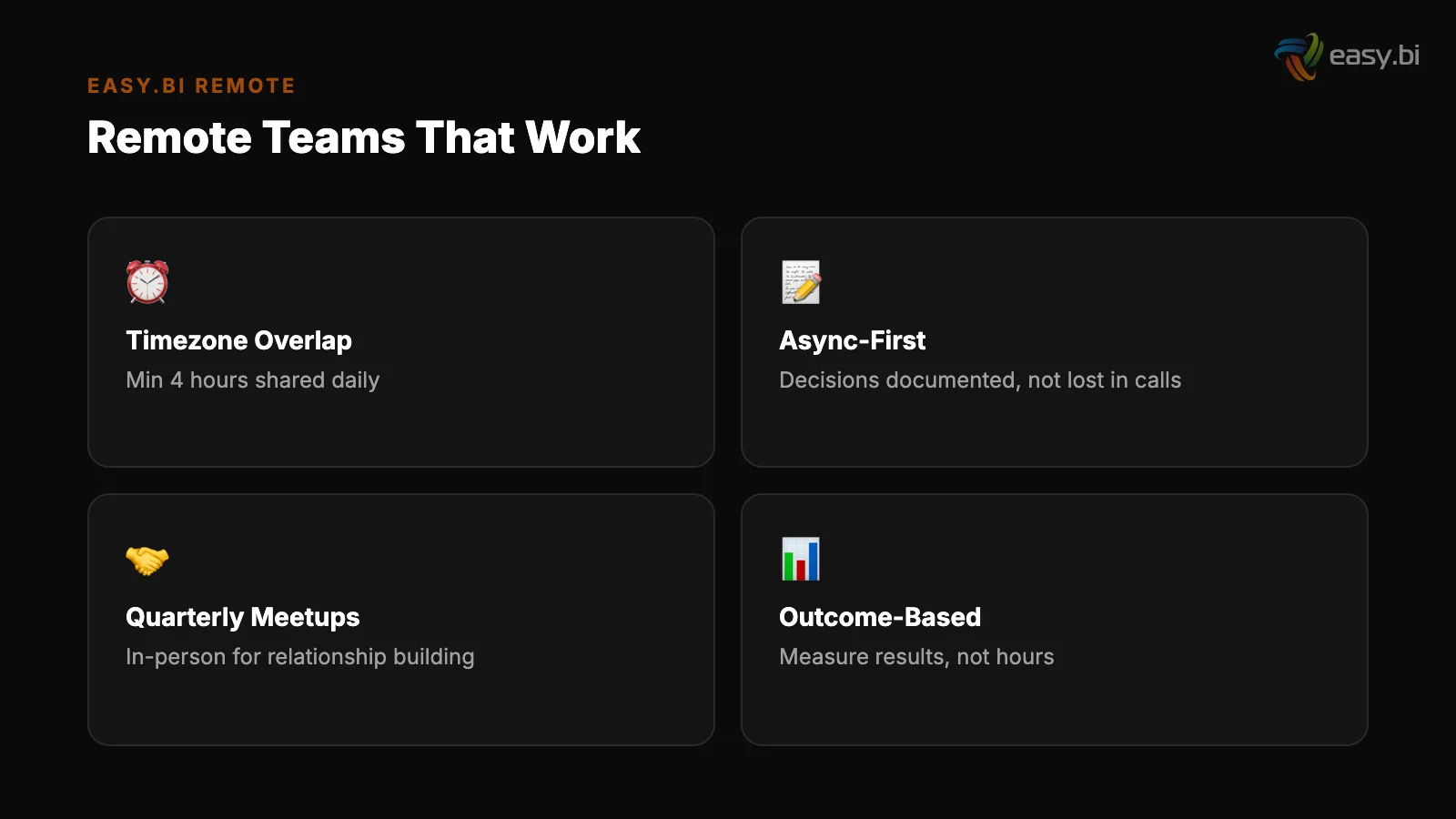
How Do Cultural Differences Across DACH and SEE Affect Delivery?
Cultural differences between Germany/Austria/Switzerland and Slovenia/North Macedonia are real. Ignoring them creates friction. Over-indexing on them creates unnecessary barriers. The practical truth is somewhere in between.
Communication directness. German business culture is famously direct. Slovenian culture is direct too - more so than most Southeastern European cultures. North Macedonian culture defaults slightly more toward politeness and indirectness.
In practice, this means new team members from Skopje sometimes need explicit coaching that "This code needs to be restructured" is feedback, not criticism. After 2-3 sprints, the calibration happens naturally. We accelerate it by pairing new engineers with experienced team members who have already navigated this adjustment.
Communication directness
Decision-making speed. German organizations often require more stakeholder alignment before decisions are made. Slovenian and North Macedonian engineers are accustomed to faster, more autonomous decision-making.
This mismatch can create frustration in both directions - engineers who feel blocked by slow client decisions, and clients who feel engineers are moving ahead without sufficient alignment. Our Project Owner role exists partly to bridge this gap, translating between the decision-making cultures without slowing either side.
Quality expectations. "Done" means the same thing across all our locations: tested, code-reviewed, documented, and deployed to staging. This was not automatic - we built it deliberately through shared coding standards, shared CI/CD pipelines, and shared definition of done.
The cultural distance between Slovenia and Germany on quality expectations is small. The distance between Slovenia and Germany on process formality is larger - Slovenian engineers tend to be pragmatic and prefer lightweight processes, while German clients often expect more documentation and governance.
We bridge this through Performance Scrum, which provides the structured work packages and reporting that German clients expect without the bureaucratic overhead that kills engineering velocity.
English proficiency. Slovenia ranks first in CEE for English proficiency among IT professionals, with 94% rated B2 or higher [5]. In practice, every engineer at easy.bi communicates in English at a professional level. Language is not a barrier. This matters because communication breakdowns cause 57% of project failures [6].
Eliminating language as a potential source of breakdown removes a significant risk factor.
What Tooling Actually Matters for Distributed Teams?
Tool selection for distributed teams is both overrated and underrated. Overrated because no tool fixes a broken communication culture. Underrated because the wrong tools create daily friction that compounds into serious productivity losses over months.
Here is what we actually use and why, after trying dozens of alternatives over 10 years.
Communication: Slack + daily written updates
Communication: Slack + daily written updates. Real-time chat for quick questions, project channels for team-specific discussions, threads for anything that needs context. The critical practice: every team member posts a 3-sentence written update at end of day - what they finished, what they are working on next, and any blockers.
This replaces morning standups on days when the standup adds no value beyond the written update.
Video: Google Meet with cameras on. We enforce cameras-on for all synchronous meetings. Distributed teams lose non-verbal communication - facial expressions, body language, energy level. Cameras-on partially recovers this. It also creates accountability.
A team member who would zone out during an audio-only call stays engaged when their face is visible.
Code: GitHub with branch protection and required reviews. All code lives in client-owned repositories. Branch protection rules enforce that every merge to main requires at least one approved review and all CI checks passing. This is the same regardless of whether the developer is in Hamburg or Skopje.
Code quality is structural, not geographical.
Video: Google Meet with cameras on
Project management: Jira or Linear with shared boards. The specific tool matters less than the practice: one board visible to everyone, including the client. No separate boards per location. No hidden backlogs.
Every task, every status change, every blocker is visible to the entire team and the client in real time.
Documentation: Confluence or Notion with mandatory ADRs. Every architecture decision gets a written record before implementation. Every sprint gets a written review document. Every API gets documented endpoints. The discipline of writing forces clarity of thought - and creates a knowledge base that survives team member changes.
CI/CD: GitHub Actions or GitLab CI with automated deployment. Every commit triggers the test suite. Every merge to main deploys to staging. Every production release is automated with rollback capability. The pipeline is the same for all engineers, regardless of location.
This shared infrastructure creates a common operating environment that makes geography irrelevant to delivery quality.
Siemens, Lekkerland, WeberHaus chose us
One integrated partner. Three core competencies. From insight to production, with no handover gaps.
Start with a Strategy CallHow Does easy.bi Run Teams Across 4 Countries?
Our 4-country structure was not an accident of growth. It was a deliberate architectural decision made early in easy.bi's history, based on three principles.
Principle 1: Presence where clients are, engineering where talent is. Hamburg and Frankfurt give us face-to-face access to German enterprise clients. These are the cities where client meetings happen, where stakeholder workshops run, and where relationship trust is built.
Ljubljana and Skopje give us access to deep engineering talent pools - 30,000+ IT professionals in Slovenia alone [7], with university education rates and English proficiency that match or exceed many Western European markets.
Principle 2: One culture, four locations
Principle 2: One culture, four locations. We do not run four offices with four cultures. We run one engineering organization that happens to span four cities. Shared coding standards. Shared Performance Scrum methodology. Shared definition of done. Shared CI/CD pipelines.
Engineers from different locations work on the same projects, review each other's code, and participate in the same retrospectives. New engineers in any location go through the same onboarding process, covering the same technical standards and cultural expectations.
Principle 3: Face-to-face matters - quarterly. Distributed teams work daily through digital channels. But the trust foundation that makes distributed collaboration effective is built in person.
We bring project teams together physically at least once per quarter - either at a client site, at one of our offices, or at a team offsite. These in-person sessions focus on relationship building, long-range planning, and the unstructured conversations that create team cohesion.
The investment is meaningful (travel, accommodation, lost coding days). The return is measurable in team velocity and retention.
The result of these principles: our 98% client retention rate across 100+ projects. Clients do not experience easy.bi as a remote team they hired somewhere in Eastern Europe.
They experience us as their engineering team - people who understand their domain, show up at sprint reviews with thoughtful questions, and ship working software every 14 days. The fact that some team members are in Ljubljana and others in Hamburg is operationally invisible to the client.
What Have We Learned After 10 Years of Distributed Delivery?
Ten years of running distributed engineering teams has taught us lessons that contradict some popular remote work advice. Here are the ones that have made the biggest difference.
Over-communicate on intent, under-communicate on status. Most distributed teams drown in status updates and starve for context. We flip this: spend less time reporting what you did and more time explaining why you are doing it.
When every team member understands the business objective behind their sprint work, they make better autonomous decisions. That autonomy reduces the coordination overhead that kills distributed team velocity.
Over-communicate on intent, under-communicate on status
Hire for writing ability. The single best predictor of success in a distributed engineering role is the ability to write clearly. Not code - prose.
An engineer who writes clear PR descriptions, articulate Slack messages, and thorough architecture decision records creates fewer misunderstandings and fewer rework cycles than a more technically skilled engineer who communicates in fragments. We weight writing ability heavily in our hiring process for all locations.
Timezone alignment is non-negotiable for complex work. Simple, well-specified tasks can cross timezone boundaries. Complex, evolving enterprise projects cannot. Every time we have attempted to stretch a project team across a 5+ hour timezone gap, the coordination cost exceeded the talent access benefit.
Our 4-country footprint stays within CET/CEST for this reason. If a project required engineers in the US or Asia, we would recommend a different partner - not stretch our model beyond its effective range.
Invest in shared experiences, not shared tools. The best distributed team tool is a shared dinner in Ljubljana with the client CTO. The second best is a 2-day workshop where the full team maps out the next quarter's architecture together. Tools enable distributed work.
Shared experiences create the trust that makes distributed work enjoyable - and enjoyable teams are productive teams that stay together. Companies that invest in developer experience see 4-5x returns in productivity and retention [8]. Shared experiences are the highest-leverage investment in developer experience for distributed teams.
Hire for writing ability
Transparency eliminates distance. When every team member sees the same dashboards, the same CI/CD pipeline status, and the same production metrics, geography stops mattering. At easy.bi, every engineer has access to the project's full observability stack - deployment frequency, error rates, response times, test coverage trends.
This shared visibility creates a single source of truth that distributed teams cannot function without.
For the broader strategic framework on structuring distributed development capacity, read our pillar guide on the build vs. buy decision for enterprise software projects. For a detailed comparison of staffing models including distributed nearshore teams, see in-house vs. nearshore vs. offshore.
And to understand the retention dynamics that keep distributed teams together long enough to compound their effectiveness, read what drives 98% retention in software teams.
If you are exploring distributed team models for your next project and want to see how our 4-country structure works in practice, explore our custom solutions approach or book an expert call. I am happy to share specifics from our experience - including the mistakes we made along the way.
References
- [1] Bitkom (2024). "Remote work adoption among German IT professionals reached 68%." bitkom.org
- [2] BVDW (2023). "GDPR compliance is the #1 reason DACH companies prefer EU-based ne
- [3] WKO / IDC Austria (2024).
- [4] Deloitte (2023). "Timezone alignment is the #2 reason DACH companies choose CEE deloitte.com
- [5] EF (2024). "Slovenia ranks 1st in CEE for English proficiency among IT professio ef.com
- [6] PMI (2024). "57% of projects fail due to communication breakdown between stakeho pmi.org
- [7] SPIRIT Slovenia (2024).
- [8] McKinsey (2023). "Companies that invest in developer experience see 4-5x returns mckinsey.com
Explore Other Topics
Ready to transform your business?
30-minute call with an engineering lead. No sales pitch - just honest answers about your project.
98% engineer retention · 14-day delivery sprints · No lock-in contracts
Related Reading

Scaling From 2 to 20 Engineers in 6 Weeks (Without Losing Quality)
How to scale an engineering team from 2 to 20 in 6 weeks without losing code quality or delivery velocity. Onboarding frameworks, code review standards during growth, team topology at scale, and easy.bi's 4-country scaling model based on 100+ DACH projects.
Andrej Lovsin
The Importance of Team Management in Sports and Fitness
Enhance sports team performance with strategic collaboration and technology for effective management and success.
Filip Kralj
How to Manage Remote Teams: Setting Clear Ownership Boundaries for Extended Engineers
Learn how to manage remote teams by setting clear ownership boundaries for extended engineers—define, document, and measure who owns what.
Andrej Lovsin