In-House vs. Nearshore vs. Offshore: The Real Comparison (Not the Sales Pitch)

Table of Contents+
- Why the Old Comparison Framework No Longer Works
- The Honest Cost Comparison
- What Does Timezone Overlap Actually Mean for Your Project?
- How Does Cultural Alignment Affect Quality?
- When Does Each Model Actually Work?
- What About IP Protection and Data Sovereignty?
- The easy.bi Model: Why We Chose 4 Countries
- How to Make This Decision for Your Next Project
- References
TL;DR
Every software development vendor has a version of the in-house vs. nearshore vs. offshore comparison. Most of them are sales pitches disguised as analysis - conveniently concluding that whatever model the vendor sells is the best one. This article is different.
Key Takeaways
- •Germany's 149,000 IT specialist shortage and 7.1-month average time-to-fill make pure in-house development impractical for most mid-market companies with near-term delivery deadlines.
- •Nearshore CEE teams deliver 35% faster project timelines than onshore-only models, with full timezone overlap and EU data processing built in - 73% of German IT decision-makers already prefer this model.
- •Offshore saves 50-70% on hourly rates but adds 3-7 hours of timezone gap that compounds into communication debt, knowledge silos, and an average 27% increase in delivery time from scope misalignment.
- •The real cost comparison is not hourly rates - it is total cost of ownership including ramp-up time, communication overhead, rework cycles, and knowledge retention across the full project lifecycle.
- •easy.bi operates across 4 DACH-adjacent countries (Germany, Austria, Switzerland, Slovenia) with 50+ engineers, combining the cultural alignment of in-house with the scalability and cost structure of nearshore.
An honest comparison of in-house, nearshore, and offshore software development models for DACH companies. Real cost data, timezone impact, quality differences, and when each model works - based on 100+ delivered projects.
Every software development vendor has a version of the in-house vs. nearshore vs. offshore comparison. Most of them are sales pitches disguised as analysis - conveniently concluding that whatever model the vendor sells is the best one. This article is different.
We operate across 4 countries and have delivered 100+ projects for DACH clients since 2015. We have seen all three models work. We have also seen all three fail. The difference is never the model itself - it is how honestly you evaluate the trade-offs.
If you are a CTO or IT leader at a mid-market company making this decision right now, here is the comparison nobody else will give you: the one that includes the numbers vendors leave out.
Why the Old Comparison Framework No Longer Works
The traditional nearshore vs. offshore debate frames the decision as a cost optimization exercise. Find the lowest hourly rate, multiply by estimated hours, pick the cheapest option. This framework was already flawed 10 years ago. In 2026, it is actively dangerous.
Three structural shifts have changed the calculus. First, Germany's IT talent shortage hit 149,000 unfilled positions, up from 137,000 the prior year [1]. In-house is no longer the "default" option - for many companies, it is the option they cannot execute on.
Second, GDPR enforcement and data sovereignty requirements have made offshore legally complex for any project handling EU personal data. Third, the normalization of distributed work means the question is not "remote or not" but "which kind of remote delivers the best outcomes."
The companies that get this decision right evaluate total cost of ownership - not hourly rates. They factor in ramp-up time, communication overhead, rework cycles, timezone friction, and knowledge retention. When you calculate all of that, the cheapest hourly rate often becomes the most expensive project.
See how enterprises modernize with one team.
The Honest Cost Comparison
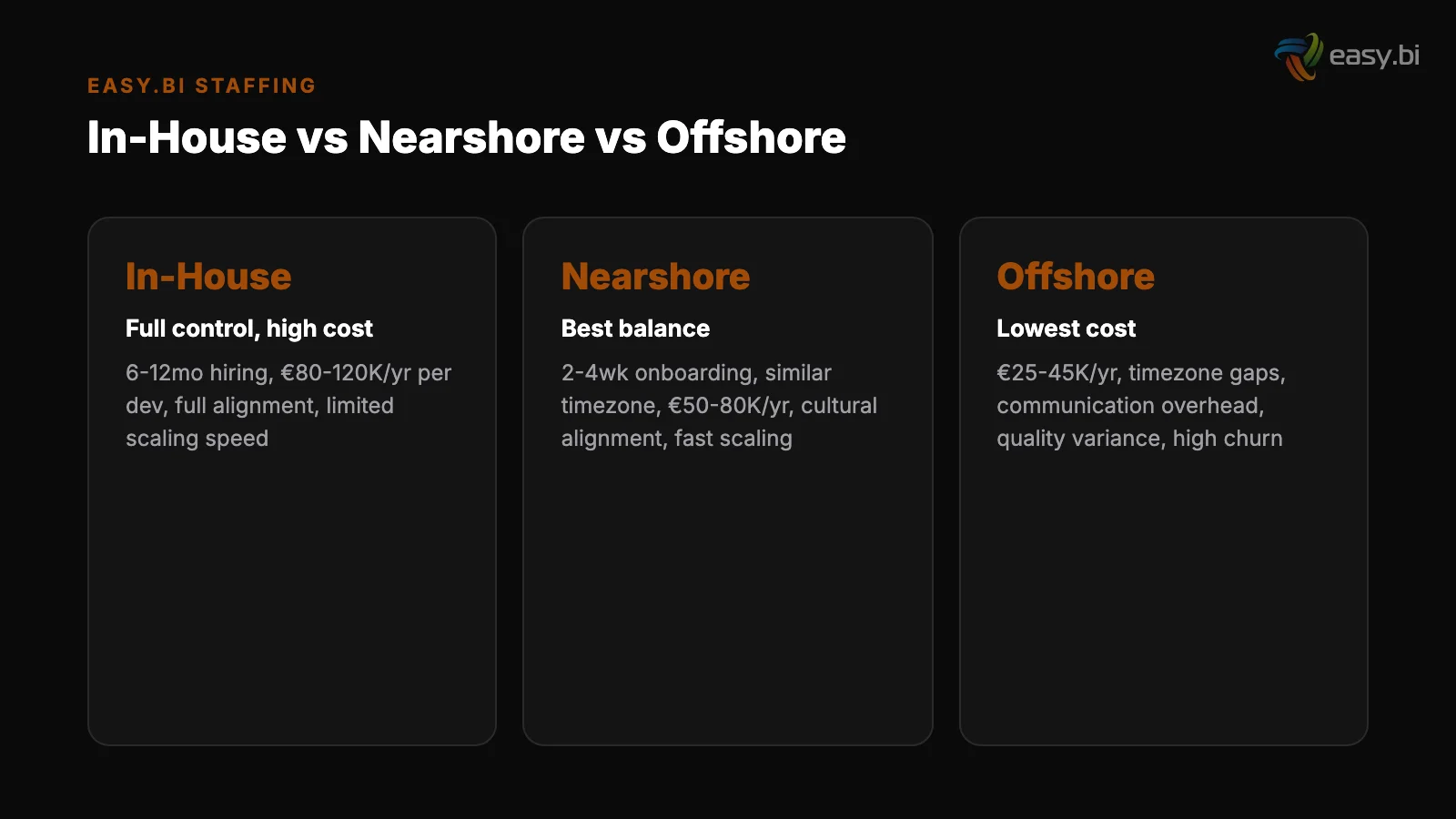
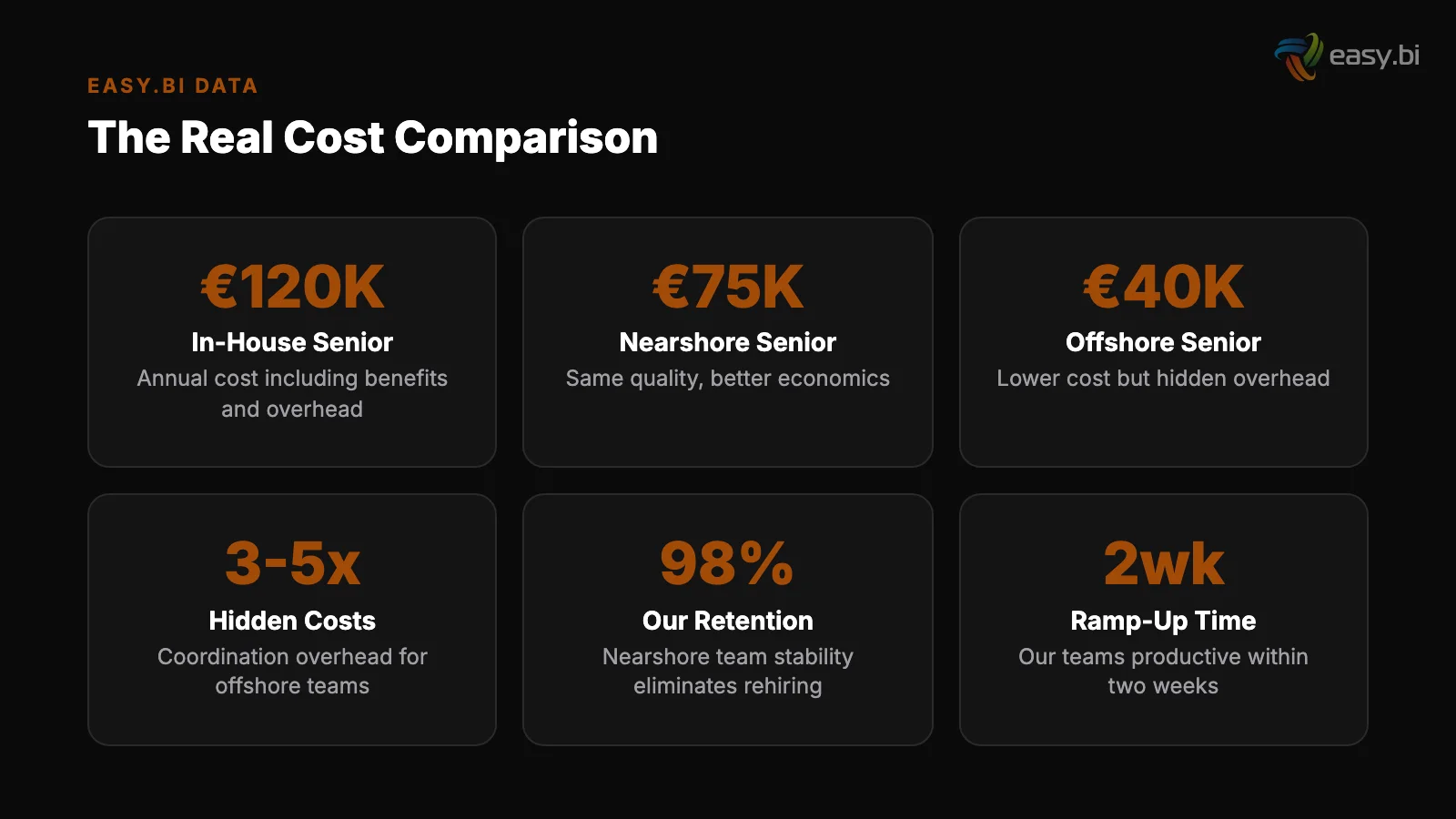
Here is what each model actually costs when you include the factors most vendor comparisons leave out.
| Cost Factor | In-House (Germany) | Nearshore (CEE / EU) | Offshore (Asia) |
|---|---|---|---|
| Hourly rate | EUR 90-150 | EUR 45-85 | EUR 20-45 |
| Recruitment cost per hire | EUR 15,000-30,000 | EUR 0 (partner absorbs) | EUR 0 (partner absorbs) |
| Time to assemble team | 4-7 months | 2-4 weeks | 1-3 weeks |
| Ramp-up to full productivity | 2-4 weeks (cultural fit exists) | 2-4 weeks | 4-8 weeks (communication patterns) |
| Rework rate (% of delivered work) | 5-10% | 8-12% | 15-25% |
| Management overhead (hours/week) | 2-4 hours | 3-5 hours | 8-15 hours |
| Knowledge loss at turnover | High (single points of failure) | Medium (team-based delivery) | High (frequent rotation) |
| GDPR compliance cost | Built-in | Built-in (EU processing) | EUR 10,000-50,000+ (legal, DPAs, audits) |
The hourly rate gap between nearshore and offshore looks attractive - EUR 45-85 vs. EUR 20-45. But when you add 15-25% rework rates, 8-15 hours per week of management overhead, and the GDPR compliance infrastructure required for offshore data processing, the total cost gap shrinks dramatically.
For complex enterprise projects, nearshore frequently costs less than offshore when measured on a per-outcome basis.
76% of outsourcing clients report satisfaction with their service providers, but only 38% say they achieved their original cost-saving targets. The gap between expected and actual savings is almost always driven by hidden costs that hourly rate comparisons ignore. [2]
What Does Timezone Overlap Actually Mean for Your Project?
Timezone overlap is the most underestimated factor in the nearshore vs. offshore decision. Vendors dismiss it as a minor inconvenience. In practice, it determines whether your team can iterate in real time or operates on a 24-hour feedback loop that doubles the time for every decision.
Ljubljana is 0-1 hours from Frankfurt. Your 9:30 AM standup is your nearshore team's 9:30 or 10:30 AM standup. When a blocker emerges at 2 PM, you resolve it by 3 PM. When a stakeholder changes a requirement at 11 AM, the team adjusts before lunch.
Bangalore is 4.5 hours ahead of Frankfurt. Your 9:30 AM standup is their 2:00 PM - after lunch, when energy drops. When a blocker emerges at 2 PM CET, your offshore team is wrapping up at 6:30 PM IST. The blocker sits until the next morning.
That is 18 hours of dead time per blocking issue. Over a 6-month project, those 18-hour gaps compound into weeks of lost delivery time.
The math is straightforward. If your team encounters 2 blocking issues per week that require cross-team discussion - a conservative estimate for complex enterprise projects - offshore adds 36 hours of dead time per week. Over 6 months, that is 936 hours of accumulated delay.
At EUR 30/hour offshore, that delay alone costs EUR 28,080. Add the rework from decisions made without real-time input, and the timezone gap erases most of the rate advantage.
This is not theoretical. Scope creep affects 52% of all projects, increasing delivery time by an average of 27% [3]. Timezone gaps amplify scope creep because misunderstandings that would be caught in a 5-minute conversation instead become features built to the wrong specification.
How Does Cultural Alignment Affect Quality?
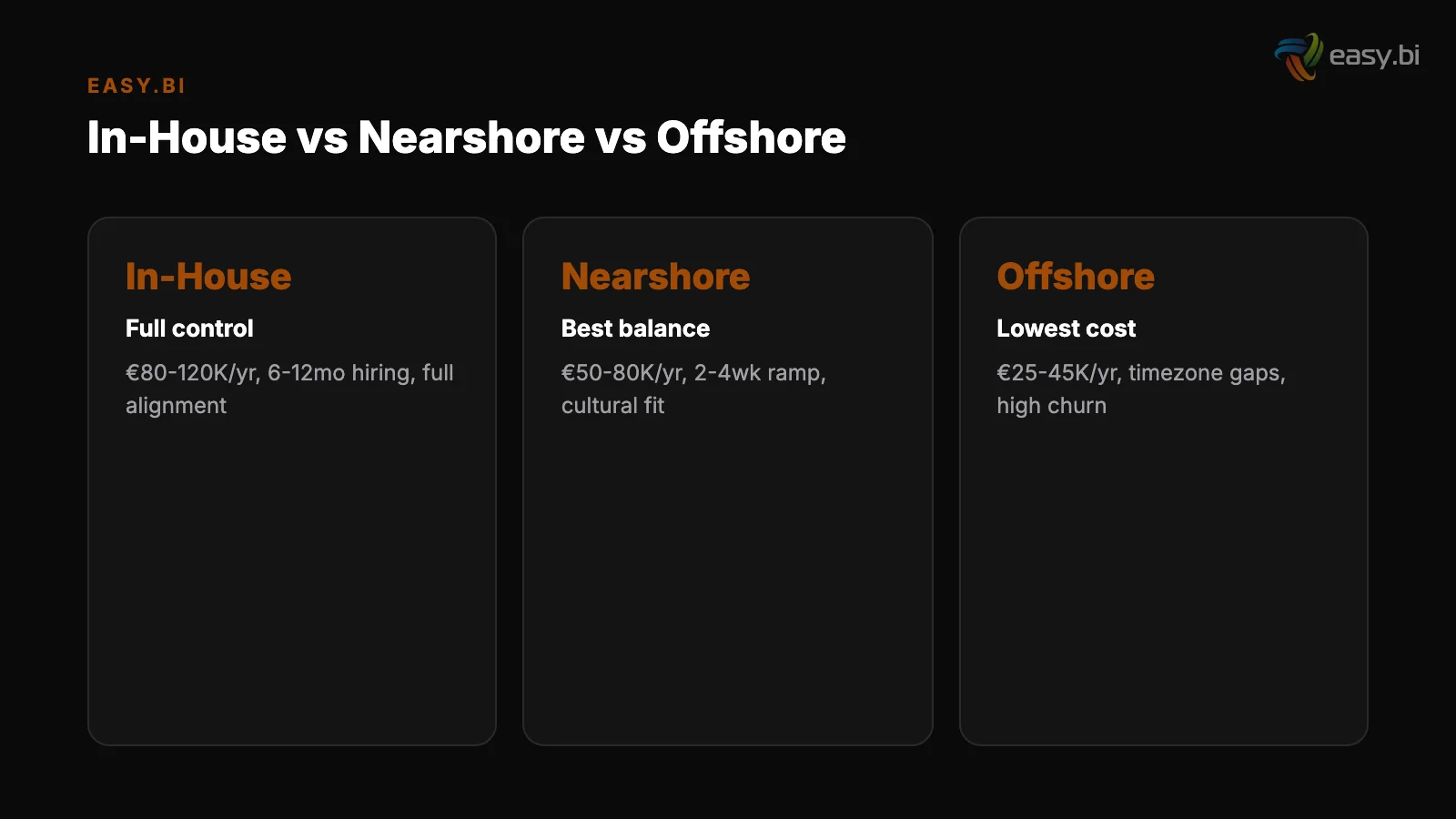
Cultural alignment is the factor that DACH decision-makers rank highest - yet it is the hardest to quantify in a spreadsheet. 88% of Austrian IT decision-makers consider cultural compatibility more important than cost savings when choosing development partners [4]. They are not being sentimental. They are being practical.
Cultural alignment affects three concrete project outcomes:
Communication directness
Communication directness. German business culture values direct, explicit communication. When a requirement is ambiguous, a culturally aligned team asks for clarification before building.
A team in a high-context culture may interpret silence as agreement and build based on assumptions. 57% of project failures trace to communication breakdowns between business and technology stakeholders [5]. Cultural distance amplifies this risk.
Quality expectations. "Done" means different things in different engineering cultures. In DACH, "done" typically means tested, documented, code-reviewed, and deployed to a staging environment. In some offshore contexts, "done" means the code compiles. This expectation gap creates rework cycles that consume 15-25% of delivered output.
Quality expectations
Business context understanding. A Slovenian developer who has worked with German enterprise clients for 5 years understands Mittelstand decision-making, regulatory requirements, and quality expectations intuitively. An equally talented developer in India or Vietnam would need months to acquire that context - if they acquire it at all.
Slovenia's IT sector employs over 30,000 professionals, 92% university-educated, with the highest English proficiency in CEE [6].
This is why 73% of German IT decision-makers prefer CEE nearshore partners over offshore alternatives [7]. The preference is driven by project outcomes, not bias.
When Does Each Model Actually Work?
Every model has legitimate use cases. The failure is not in choosing nearshore or offshore - it is in choosing the wrong model for the wrong project type.
In-house works when you are building core intellectual property that defines your competitive advantage, you have 12+ months before delivery pressure, and you can attract senior engineers in the current market.
If your product is your software - a SaaS platform, a proprietary algorithm, a trading system - the domain knowledge required makes in-house the right default. But be honest about whether you can actually hire. The average time to fill an IT position in Germany is 7.1 months [8].
If your project cannot wait that long, in-house is not a viable option regardless of preference.
In-house works when
Nearshore works when the project requires close collaboration, GDPR compliance is mandatory, and you need a team of 3-20 engineers working in your timezone. This covers the majority of DACH enterprise software projects: custom platforms, e-commerce builds, legacy modernizations, and API integrations.
DACH companies that use dedicated nearshore teams report 35% faster project delivery compared to purely onshore models [9].
Offshore works when you have well-specified, isolated workstreams that do not require daily DACH-timezone collaboration. Mobile app development with a frozen API specification. Automated test suite expansion. Data entry and migration tasks with clear rules.
The common thread: the work can be defined completely upfront, requires minimal real-time communication, and follows repeatable patterns.
Siemens, Lekkerland, WeberHaus chose us
One integrated partner. Three core competencies. From insight to production, with no handover gaps.
Start with a Strategy CallWhat About IP Protection and Data Sovereignty?
IP protection concerns are the most frequently cited objection to both nearshore and offshore models. The concern is legitimate - but the risk profile varies dramatically by geography.
Within the EU, intellectual property is protected by the EU Copyright Directive, the Trade Secrets Directive, and GDPR. Contracts with Slovenian or German entities are enforceable under EU law. Data processing stays within the EU, satisfying GDPR requirements without additional legal infrastructure.
GDPR compliance is the number one reason DACH companies prefer EU-based nearshore partners over offshore alternatives [10].
Offshore IP protection requires additional contractual layers: data processing agreements with non-EU entities, Standard Contractual Clauses for data transfers, and often local legal counsel in the offshore jurisdiction. Enforcement of IP claims across jurisdictions (e.g., Germany vs. India) is slow, expensive, and uncertain.
For projects involving sensitive customer data or proprietary business logic, this legal gap creates real risk - not theoretical risk.
The practical solution: ensure all code is committed to your repository from day one, use standard open-source frameworks that any team can maintain, and build contracts that give you full IP ownership with no restrictions. At easy.bi, every line of code lives in the client's repository.
If a client decides to bring development in-house, they own everything needed to continue independently.
The easy.bi Model: Why We Chose 4 Countries
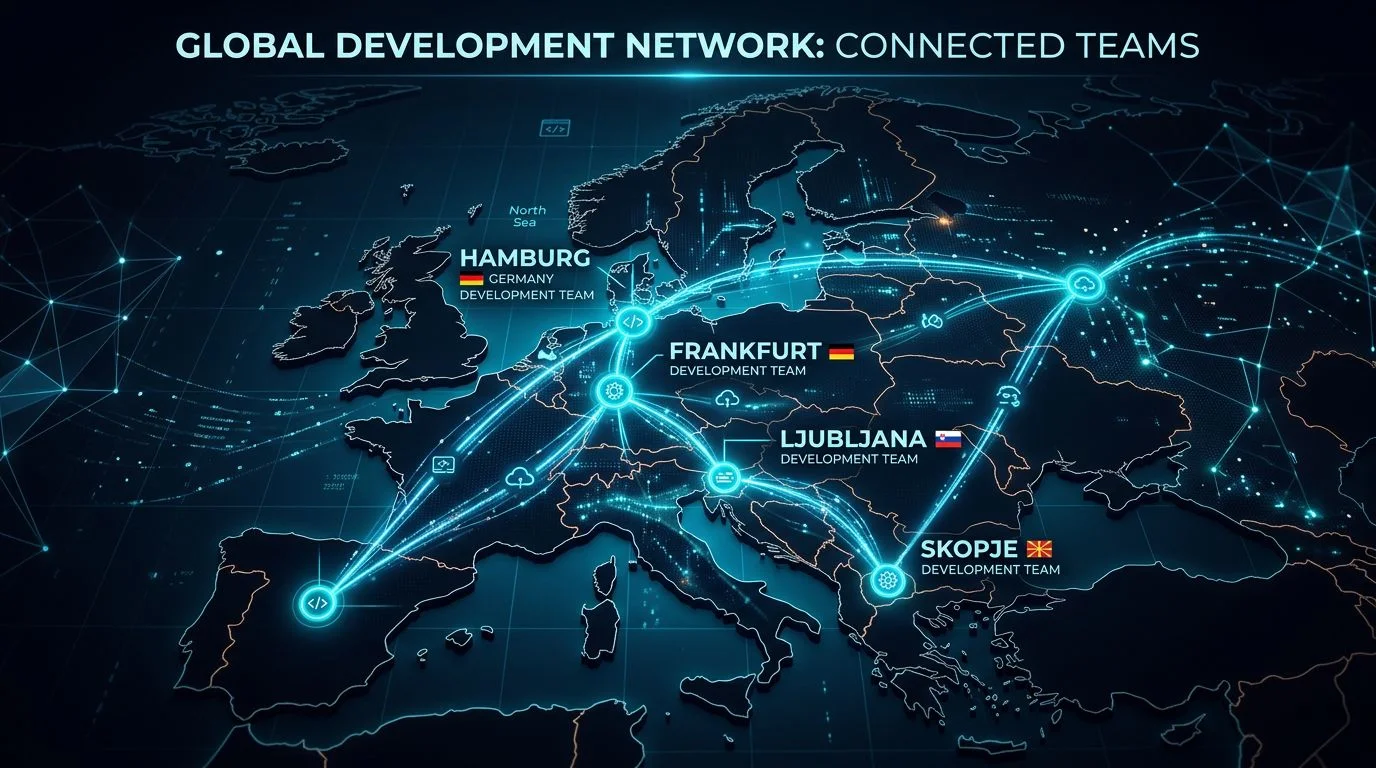
We built easy.bi across Germany, Austria, Switzerland, and Slovenia deliberately - not because we wanted offices in 4 countries, but because this structure solves the specific problems DACH companies face.
Our Hamburg and Frankfurt presence means we speak the language of German Mittelstand decision-makers - literally and figuratively. Our Austrian and Swiss presence gives us direct access to those markets.
Our Ljubljana engineering hub gives us access to 30,000+ IT professionals in a country where 92% hold university degrees and 94% of IT professionals score B2 or higher in English proficiency [6].
This is not body leasing. Our 50+ engineers work as integrated teams using our Performance Scrum methodology - 14-day sprint cycles with structured work packages. Every project gets a dedicated Project Owner and Customer Advocate. The people who architect your system are the people who build it.
No bench rotation, no bait-and-switch.
The result: 98% client retention across 100+ projects. The industry average for IT outsourcing client retention is 72-78% [11]. That 20+ percentage point gap is not marketing - it is the compound effect of cultural alignment, timezone overlap, team stability, and outcome accountability working together over years.
How to Make This Decision for Your Next Project
Stop comparing hourly rates. Start comparing total cost of ownership across these dimensions:
1. Calculate your actual in-house timeline. How many engineers do you need? Multiply by 7.1 months average time-to-fill. If that timeline exceeds your delivery deadline, in-house is off the table - no matter how much you prefer it.
1. Calculate your actual in-house timeline
2. Define your collaboration intensity. If the project requires daily standup-level interaction with business stakeholders, offshore introduces friction that will cost more than it saves. If the work can be fully specified upfront with weekly check-ins, offshore can work.
3. Map your data sovereignty requirements. If you process EU personal data, staying within the EU is not just preferred - it is the path of least legal resistance. The compliance cost of offshore data processing often exceeds the rate savings.
4. Assess your management capacity. Offshore teams require 8-15 hours per week of coordination. Nearshore teams require 3-5. In-house requires 2-4. If your IT leadership is already stretched thin, adding management overhead to save on hourly rates is a false economy.
2. Define your collaboration intensity
5. Check retention rates. Ask every potential partner for their client retention rate and their internal team turnover rate. Outsourcing partnerships lasting 3+ years deliver 25-30% more value than short-term engagements [12]. A partner with high turnover will cost you more in ramp-up cycles than they save on rates.
The build vs. buy decision is ultimately a staffing model decision. For a comprehensive framework covering all the factors, read our pillar guide on the build vs. buy decision for enterprise software projects.
And for a deeper look at why retaining senior engineers is so difficult in the current market, see our analysis of why senior engineers leave.
If you are evaluating models for an upcoming project, we are happy to share specifics from similar engagements - not a sales pitch, but real numbers from real projects. Explore how we deliver custom software, or book an expert call to discuss your situation.
References
- [1] Bitkom (2024). "Germany faces a shortage of 149,000 IT specialists." bitkom.
- [2] Deloitte (2024). "76% of outsourcing clients report satisfaction, but only 38% a deloitte.com
- [3] PMI (2024). "Scope creep affects 52% of all projects, increasing delivery time b pmi.org
- [4] WKO / IDC Austria (2024).
- [5] PMI (2024). "57% of projects fail due to communication breakdown between stakeho pmi.org
- [6] SPIRIT Slovenia (2024).
- [7] Hays (2024). "73% of German IT decision-makers prefer CEE nearshore partners." hays.de
- [8] Bundesagentur fur Arbeit (2024). arbeitsagentur.de
- [9] ISG Provider Lens (2024). "Dedicated nearshore teams report 35% faster delivery. isg-one.com
- [10] BVDW (2023). "GDPR compliance is the #1 reason DACH companies prefer EU-based ne
- [11] Deloitte (2024). "Outsourcing client retention rates average 72-78%. deloitte.com
- [12] Deloitte (2024). "Outsourcing partnerships lasting 3+ years deliver 25-30% more deloitte.com
Explore Other Topics
Ready to transform your business?
30-minute call with an engineering lead. No sales pitch - just honest answers about your project.
98% engineer retention · 14-day delivery sprints · No lock-in contracts
Related Reading

Nearshore Team Extension: Solving the DACH IT Talent Shortage
How nearshore team extension solves the DACH IT talent shortage—senior engineers in days, at 30–50% lower cost, done right.
Andrej Lovsin
How to Onboard Nearshore Engineers Into Your Agile Team
Learn how to onboard nearshore engineers in 7–14 days with a week-by-week system for tool access, first PRs, agile ceremonies, and success metrics.
Andrej Lovsin
Nearshore Software Developers vs. Hiring Locally in DACH: Cost, Speed, and Outcomes Compared
Nearshore software developers vs hiring locally in DACH: compare real 2026 cost, 7-14 day onboarding speed, and outcomes to pick the right capacity model.
Andrej Lovsin