
Why Senior Engineers Leave - And How to Build Teams That Stay

Table of Contents+
- The Real Cost of Losing a Senior Engineer
- Why Do Senior Engineers Actually Leave?
- How Does easy.bi Maintain 98% Retention Across 4 Countries?
- What Makes Remote Engineering Teams Work at Scale?
- How Do You Fix Retention Before You Lose More People?
- When Hiring Fails, Build a Team That Does Not Need Constant Hiring
- The First Step Is Honest Assessment
- References
TL;DR
"We can't find senior developers." This is the most common sentence we hear from CTOs and engineering leaders across the DACH region. It is also the wrong diagnosis.
Key Takeaways
- •Replacing a senior engineer costs 6-9 months of salary - in the DACH market with a 45% talent gap, some positions stay unfilled for 6+ months.
- •The top 3 reasons senior engineers leave are legacy tech stacks, lack of ownership over outcomes, and management that treats them as interchangeable resources.
- •easy.bi retains 98% of its team by giving engineers real ownership: Siemens UI architecture, REWE commerce systems, WeberHaus process digitization - not maintenance tickets.
- •Remote-first teams across 4 countries access talent pools that office-only companies cannot reach, reducing hiring timelines from 6 months to 6 weeks.
- •Retention is not about ping-pong tables and free lunch. It is about challenging work, clear ownership, and a tech stack that senior engineers actually want to work on.
Senior engineers leave over legacy tech, no ownership, and bad management. Learn how easy.bi maintains 98% retention across 50+ engineers and 4 countries.
"We can't find senior developers." This is the most common sentence we hear from CTOs and engineering leaders across the DACH region. It is also the wrong diagnosis.
The problem is not that senior engineers do not exist. The DACH market has thousands of experienced developers with 10+ years of production experience. The problem is that most companies cannot keep them. The 45% talent gap in senior engineering roles is not a supply problem.
It is a retention problem disguised as a hiring problem.
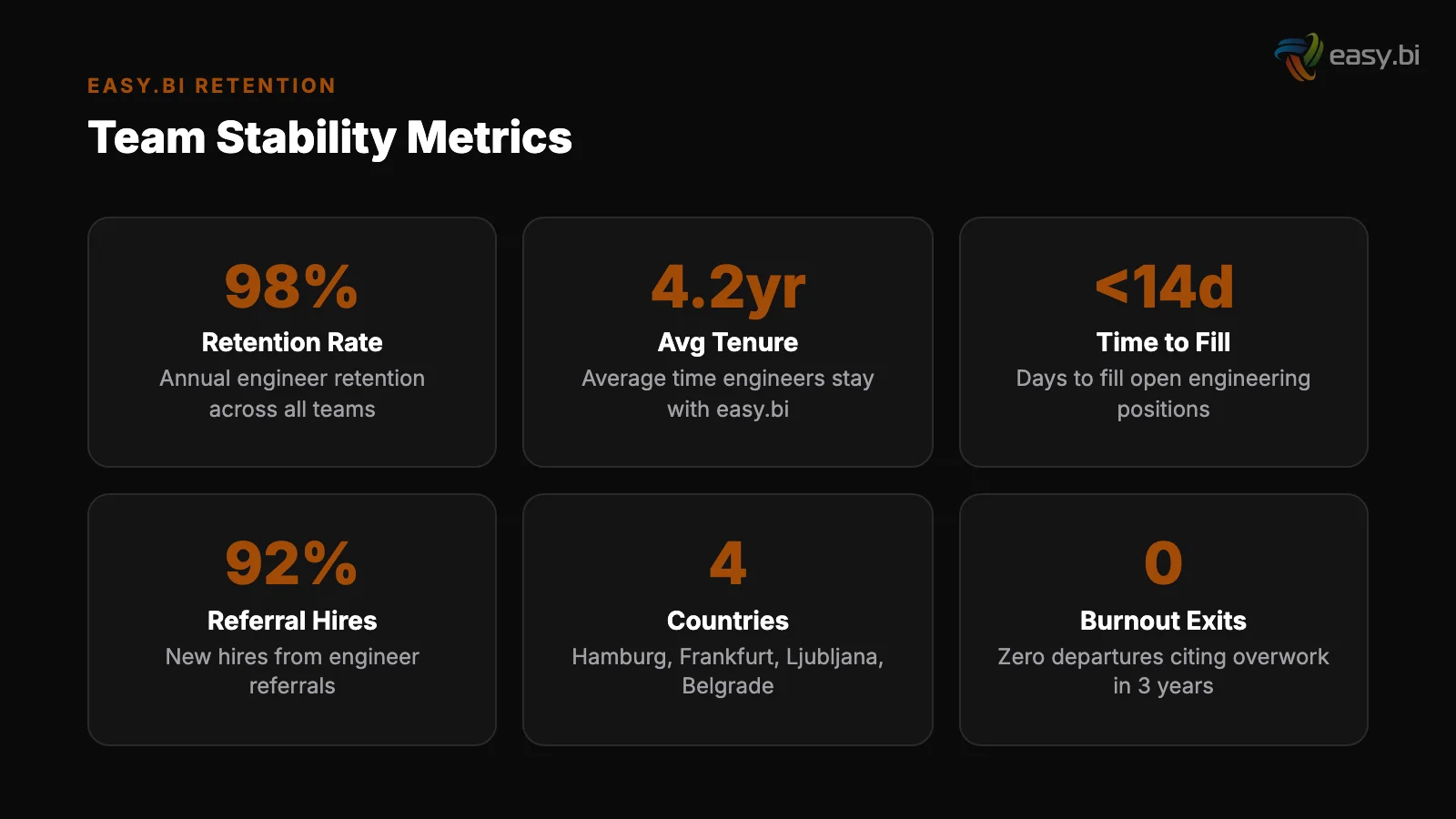
At easy.bi, we employ 50+ engineers across 4 countries. Our retention rate is 98%. This is not an accident. It is the result of deliberate decisions about technology, ownership, and how we treat the people who build our products.
This article explains what we learned - and what you can apply to your own organization.
The Real Cost of Losing a Senior Engineer
Before discussing solutions, you need to understand the scale of the problem. Losing a senior engineer is not a line item. It is a compounding business event.
Direct Replacement Costs
Direct costs are significant on their own. Recruiting fees, interview time across your engineering team, onboarding ramp-up. Industry data puts this at 6-9 months of the departing engineer's salary.[1] For a senior engineer earning EUR 90-120K in the DACH market, that is EUR 45-90K per departure.
The Cascading Departure Risk
But indirect costs dwarf the direct ones:
- Institutional knowledge loss. The departing engineer understood why the system was built a certain way. That context lives in their head, not in documentation. The replacement will make mistakes the original engineer learned to avoid 2 years ago.
- Team disruption. Senior engineers mentor juniors, review code, and make architectural decisions. When they leave, the entire team slows down - not just by one person's capacity, but by the multiplier effect they had on everyone else.
- Project delays. The replacement needs 3-6 months to reach full productivity on an enterprise codebase. Every project the departing engineer touched gets delayed.
- Cascading departures. When a respected senior engineer leaves, others start questioning their own reasons to stay. One departure often triggers 2-3 more within 6 months.
| Cost Category | Typical Range (DACH) | Timeline |
|---|---|---|
| Recruiting and hiring | EUR 15-30K | 3-6 months to fill role |
| Onboarding and ramp-up | EUR 30-50K in reduced productivity | 3-6 months to full output |
| Institutional knowledge loss | EUR 50-100K in rework and errors | 12-18 months to rebuild context |
| Team productivity impact | 10-20% team velocity reduction | 3-6 months |
| Cascading departures risk | 1-2 additional departures within 6 months | Multiplies all costs above |
Total cost of one senior engineer departure: EUR 150-300K when you factor in all direct and indirect impacts. For a company losing 3-4 senior engineers per year, that is EUR 450K-1.2M in annual attrition costs - money that could fund an entire product team.

See how enterprises modernize with one team.
Why Do Senior Engineers Actually Leave?
Exit interviews capture surface-level reasons: better offer, career growth, relocation. The real reasons are more specific - and more fixable.
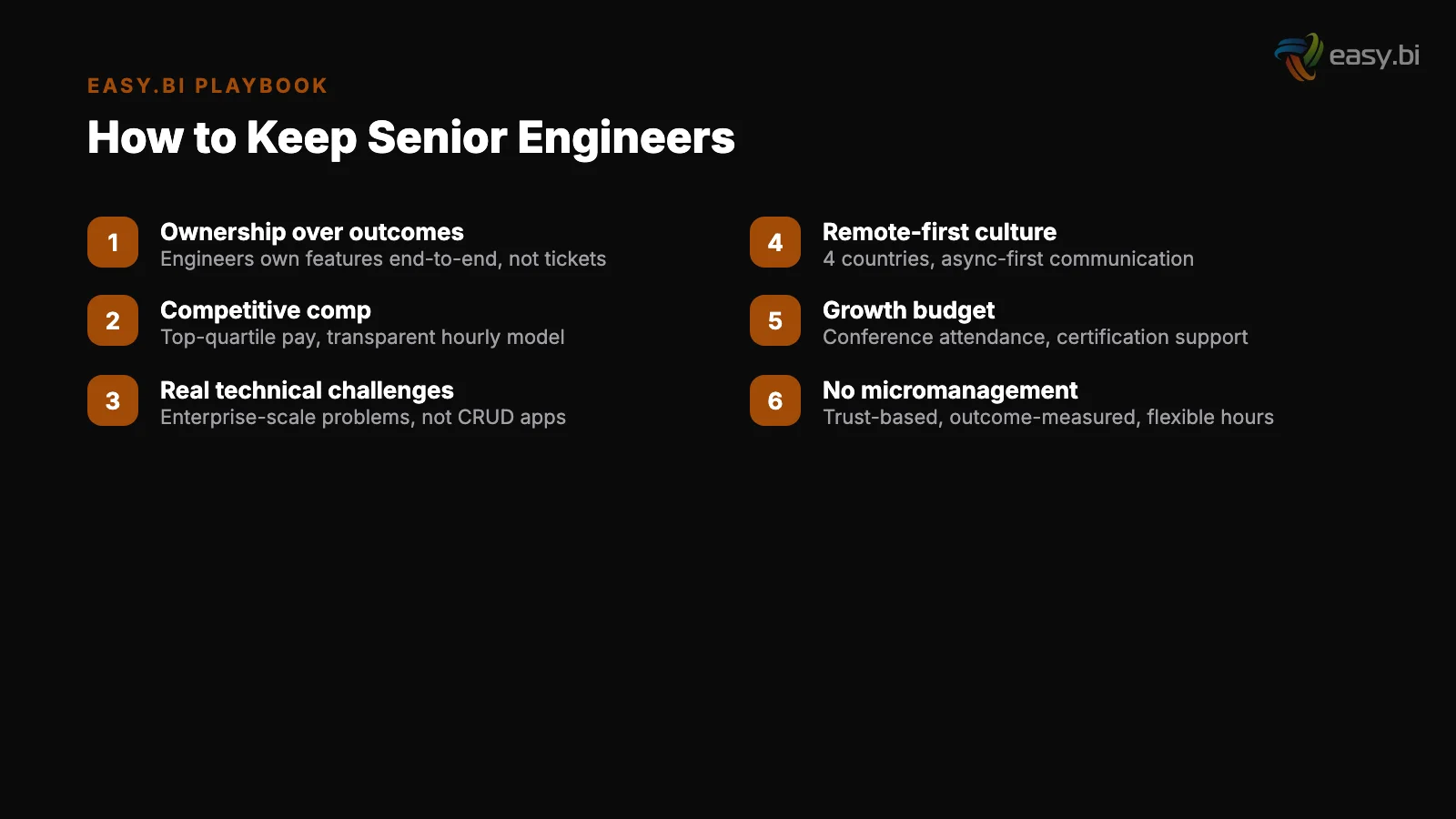
Reason 1: Legacy tech stacks. A senior engineer with expertise in Kubernetes, React, and distributed systems does not want to spend their days maintaining a 12-year-old PHP monolith.[4] They will tolerate it for 6-12 months. Then they update their LinkedIn profile.
The DACH market has enough demand that a senior Kubernetes engineer can have 5 offers within 2 weeks.
Reason 2: No ownership over outcomes. Large organizations often reduce senior engineers to ticket-takers. They implement specifications written by someone else, with no input on architecture, no visibility into business impact, and no ownership over the result.
Senior engineers want to see the connection between their work and the business outcome. When that connection breaks, engagement drops and departure follows.
Reason 3: Management that treats engineers as resources. The word "resource" in an engineering context is a retention killer. Senior engineers are not interchangeable units. They have specific expertise, specific interests, and specific career trajectories.
Companies that manage them as FTEs on a spreadsheet lose them to companies that manage them as individuals.
There is a fourth reason that rarely surfaces in exit interviews: death by process.
When a senior engineer needs 3 approvals to merge a pull request, 2 committee meetings to propose an architecture change, and a 6-week procurement process to try a new tool, they are not being managed - they are being suffocated.
The best engineers leave for environments where they can move at the speed of their own capability.
Nobody quits over salary. They quit because they spent 6 months maintaining a system they told management should be replaced - and nobody listened.
How Does easy.bi Maintain 98% Retention Across 4 Countries?
Our retention rate is not the result of one policy or one perk. It is the product of several structural decisions that compound over time.
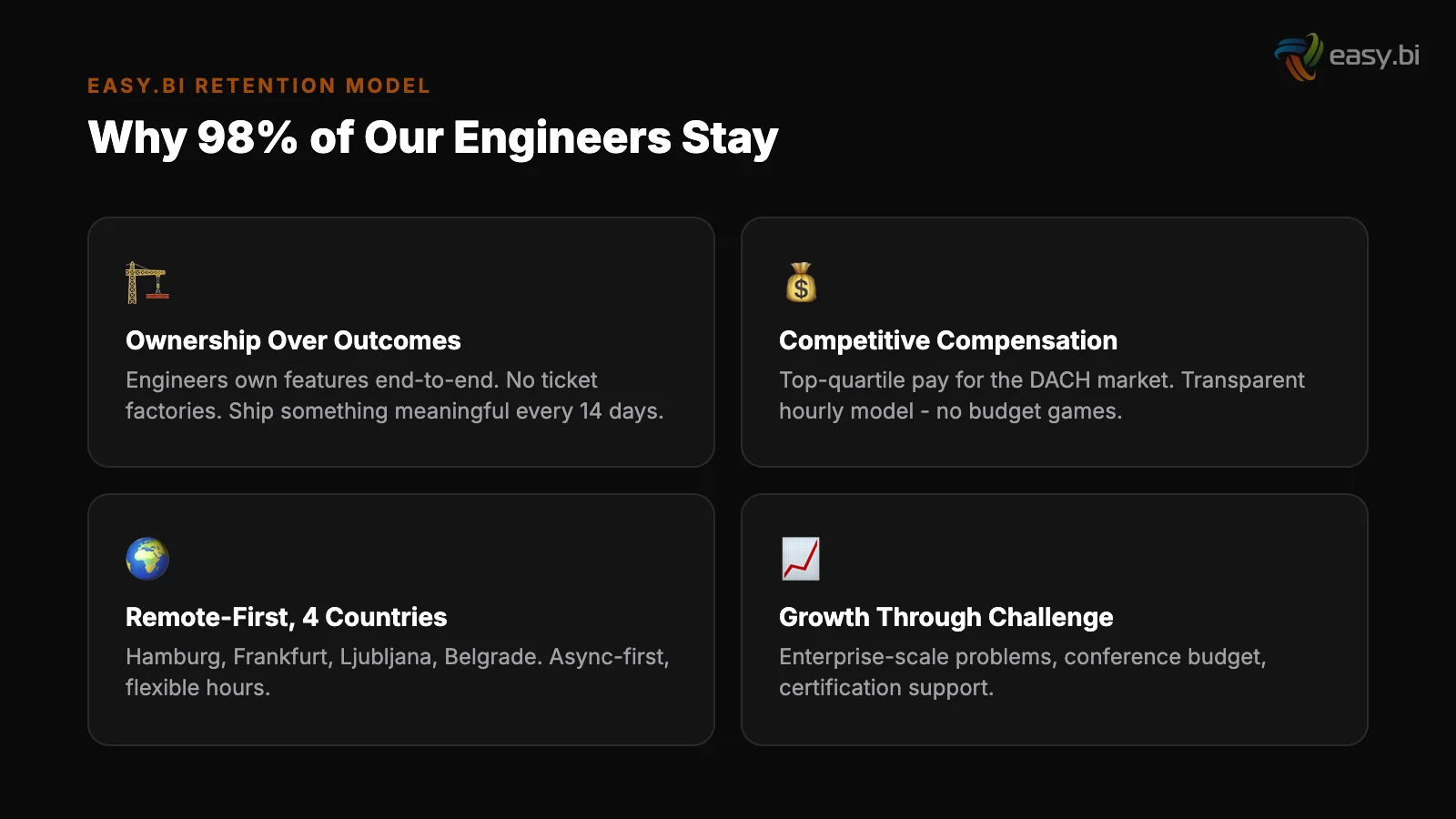
Real projects with real impact. Our engineers work on Siemens' unified UI library (Angular, Storybook, Figma), REWE Group's commerce platform, WeberHaus' process digitization, and Lekkerland's SAP migration. These are not maintenance assignments. They are complex, technically challenging projects where the engineer's decisions directly affect business outcomes.
Current tech stacks. We work with Angular, React, Vue, Symfony, Python, Kubernetes, Docker, and our own ebiCore AI framework. Engineers join because the technology is current. They stay because it keeps evolving. Nobody gets stuck maintaining a framework that stopped receiving updates.
Ownership within Performance Scrum. Our 14-day sprint methodology gives engineers ownership over deliverables, not just tasks. A developer does not close a ticket - they ship a working feature that goes to production. They see the business impact. They participate in the retrospective. They influence the next sprint's priorities.
Distributed team structure. 50+ engineers across 4 countries. This is not a cost optimization play. It is a talent access strategy. The best Angular engineer for a specific project might be in Ljubljana, Hamburg, or Sarajevo.
A distributed model lets us hire the best person for the role regardless of geography.
What Makes Remote Engineering Teams Work at Scale?
Distributed teams fail when companies take an office-centric culture and force it through video calls. They succeed when the operating model is built for distribution from the ground up.
Three practices that make our 4-country team function as one unit:
Asynchronous by default. Sprint planning, retrospectives, and architecture reviews happen synchronously. Everything else - code reviews, documentation, status updates - happens asynchronously. This respects time zones and eliminates the meeting overload that burns out remote engineers.
Clear ownership boundaries. Every feature, every module, every integration point has a named owner. When ownership is ambiguous, remote teams grind to a halt waiting for decisions. When ownership is clear, teams ship independently.
14-day cadence as the heartbeat. The sprint cycle creates natural synchronization points without requiring constant coordination. Every 14 days, the team aligns on what shipped, what is next, and what needs adjusting. Between sprints, teams operate autonomously within their ownership boundaries.

How Do You Fix Retention Before You Lose More People?
If your senior engineering attrition rate exceeds 15% annually, you have a structural problem. Here is how to diagnose and address it.
Audit your tech stack honestly. List every technology your team works with daily. Circle the ones that a senior engineer would put on their resume with pride. If less than half the list passes that test, your tech stack is a retention liability.
Measure ownership, not output. Do your senior engineers know the business impact of their last 3 sprints? Can they explain why the feature they built matters to the customer? If the answer is no, you have an ownership gap that will eventually become a retention gap.
Talk to the people who stayed. Exit interviews are too late. Run stay interviews with your current senior engineers. Ask them what they would change. Ask them what would make them consider leaving. Act on what they tell you.
Remove maintenance burden from your best people. If your senior engineers spend more than 30% of their time on maintenance tasks, you are misallocating your most expensive and scarcest resource.
Use AI-assisted tools, automated QA, and junior-senior pairing to shift maintenance work away from the people whose skills are hardest to replace.
Siemens, Lekkerland, WeberHaus chose us
One integrated partner. Three core competencies. From insight to production, with no handover gaps.
Start with a Strategy CallWhen Hiring Fails, Build a Team That Does Not Need Constant Hiring
The DACH market's 45% talent gap in senior engineering is not going to close. Betting your delivery capability on your ability to out-hire competitors is a losing strategy. The math does not work.
The alternative: build a team that retains. A team with 98% retention does not need to hire 10 senior engineers per year to maintain headcount. It needs to hire 1. The recruiting budget, the interview time, the onboarding overhead - all of it shrinks dramatically when people stay.
easy.bi has grown to 50+ engineers not by winning bidding wars for talent, but by creating an environment where senior engineers do their best work. Challenging projects across Siemens, REWE, Fressnapf, and WeberHaus. Current technology stacks. Real ownership over outcomes. 14-day sprint cycles that produce visible, measurable results.
The 98% retention rate is not a marketing number. It is the metric that makes everything else possible - 100+ delivered projects, enterprise-scale references, and the ability to staff a new engagement with proven engineers instead of fresh hires.
The First Step Is Honest Assessment
If your team is losing senior engineers, the cause is almost certainly one of the three factors above: legacy tech, missing ownership, or management culture.
Retention is deeply connected to the staffing model you choose - for the full build vs. buy decision framework, see The Build vs. Buy Decision: How to Staff Enterprise Software Projects in 2026.
The cost of legacy systems is the #1 trigger for retention problems - read The True Cost of Legacy Systems to understand the full picture. And for a transparent look at how easy.bi achieves 98% retention, see The 98% Retention Question: What We Do Differently.
For the detailed comparison of staffing models, see In-House vs. Nearshore vs. Offshore: The Real Comparison. The fix starts with an honest assessment of which one - or which combination - applies to your organization.
For companies that need senior engineering capacity now, working with a team that has already solved the retention problem is faster than solving it internally. easy.bi's 50+ engineers deliver across 4 countries with a 98% retention rate.
Your project gets staffed with engineers who chose to stay - not engineers who are still deciding.
References
- [1] LinkedIn Workforce Report / BLS (2024). linkedin.com
- [2] Bitkom (2024). Germany faces a shortage of 149,000 IT specialists, up from 137,0
- [3] McKinsey Developer Velocity Report (2023). mckinsey.com
- [4] Stripe Developer Coefficient Report (2023).
- [5] Accelerance (2023). Dedicated development teams outperform time-and-materials te accelerance.com
Explore Other Topics
Ready to transform your business?
30-minute call with an engineering lead. No sales pitch - just honest answers about your project.
98% engineer retention · 14-day delivery sprints · No lock-in contracts
Related Reading

The 98% Retention Question: What We Do Differently
How easy.bi achieves 98% client retention across 100+ projects - when the industry average is 72-78%. A transparent look at the retention model: ownership culture, Performance Scrum, 4-country structure, and why we don't do body leasing.
Andrej Lovsin
What motivates the advancement of manufacturing and engineering in the future?
SaaS and microservices enhance manufacturing efficiency by streamlining processes and fostering innovation, ensuring future success in engineering.
Andrej Lovsin
How to Manage Remote Teams: Setting Clear Ownership Boundaries for Extended Engineers
Learn how to manage remote teams by setting clear ownership boundaries for extended engineers—define, document, and measure who owns what.
Andrej Lovsin