How a German Manufacturer Cut Development Costs 40% by Switching Partners

Table of Contents+
- What Was the Pain That Triggered the Switch?
- How Did They Find and Evaluate a New Partner?
- What Did the Discovery Phase Uncover?
- How Did the 14-Day Sprint Model Change Delivery?
- What Were the Measurable Results After 12 Months?
- What Lessons Apply to Your Partner Switch?
- How Do You Know When It Is Time to Switch Partners?
- References
TL;DR
A 300-employee German manufacturer switched from a Big Four consultancy to a specialized mid-size development partner. The result: 40% lower annual development costs, 3x faster feature delivery through 14-day sprints, and a structured discovery phase that eliminated chronic rework caused by undocumented business rules and integration gaps.
Key Takeaways
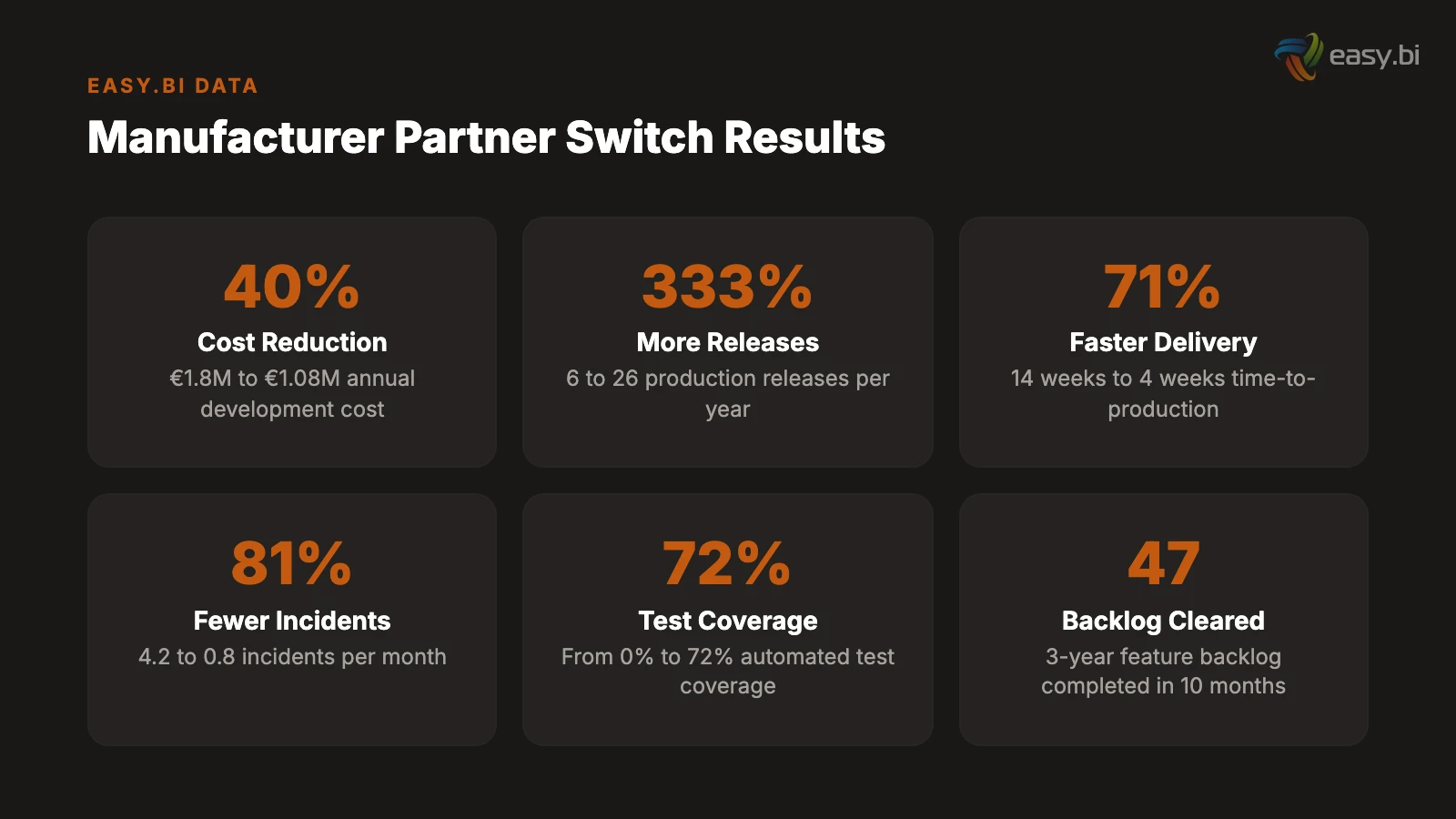
- •A mid-market German manufacturer reduced annual software development costs by 40% - from EUR 1.8 million to EUR 1.08 million - by switching from a Big Four consultancy to a specialized mid-size partner.
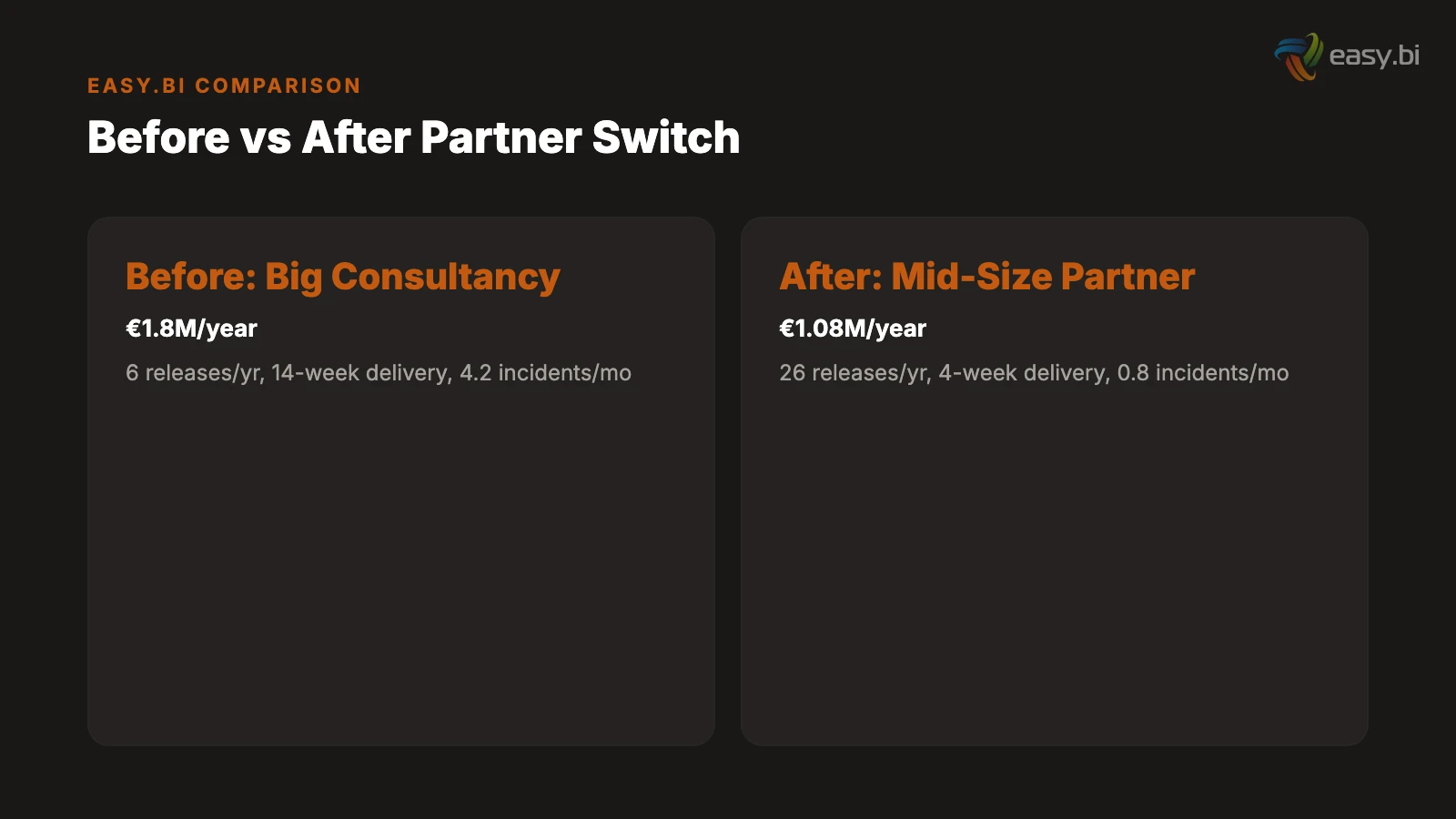
- •The 14-day sprint delivery model replaced 8-week waterfall cycles, increasing release frequency from 6 per year to 26 and cutting average time-to-production for new features from 14 weeks to 4 weeks.
- •The discovery phase uncovered 31 integration endpoints and 58 undocumented business rules that the previous partner had never mapped, eliminating the root cause of chronic rework.
- •Switching partners is not free - expect a 6-to-8-week transition period with parallel costs, a knowledge transfer sprint, and short-term velocity reduction before gains materialize.
- •The single biggest predictor of success after a partner switch is whether the new partner runs a structured discovery phase or simply inherits the old backlog without questioning it.
Anonymized case study: a DACH manufacturer (300 employees) switched from a large consultancy to a mid-size partner, cutting development costs 40% and delivering 3x faster in 14-day sprints.
Two years ago, a German manufacturer with 300 employees and EUR 85 million in annual revenue was spending EUR 1.8 million per year on custom software development with a Big Four consultancy. They were getting 6 production releases per year, chronic budget overruns averaging 45%, and a growing backlog of features that never shipped.
Twelve months later, with a different development partner, they were spending EUR 1.08 million - 40% less - shipping 26 releases per year, and had cleared the feature backlog that had been growing for 3 years.
This is an anonymized composite case study based on real engagements with DACH manufacturing companies. The details have been changed to protect confidentiality, but the patterns, numbers, and lessons are drawn directly from what we observe across this industry segment.
What Was the Pain That Triggered the Switch?
The manufacturer - call them "FertigungsTech" - had been working with a global consultancy for 4 years. The relationship started well. The consultancy brought a 12-person team, impressive slide decks, and a promise of digital transformation that would modernize their order management, production scheduling, and warehouse logistics systems.
By year 3, three problems had compounded into a crisis.
The bait-and-switch problem. The senior architects who won the deal and ran the discovery phase rotated off the project within 6 months. They were replaced by junior developers who lacked manufacturing domain knowledge. The client was paying EUR 210 per hour for what was effectively a training program for the consultancy's junior staff. This pattern is the single most common complaint about software development agencies across every price tier and firm size.[1]
The waterfall-in-disguise problem. The consultancy ran "agile" ceremonies - standups, sprint reviews, retrospectives - but delivered working software to production only 6 times per year. Features were specified in 40-page documents, built over 8-week cycles, and tested in a separate QA phase that added another 3 weeks. Large IT projects run 45% over budget and 7% over time while delivering 56% less value than predicted.[2] FertigungsTech was living that statistic.
The undocumented complexity problem. After 4 years of development, nobody - not the consultancy, not FertigungsTech's internal IT team - had a complete map of the system's integration points, business rules, or data flows. When the lead developer from the consultancy left the project, institutional knowledge walked out the door with them.
The final trigger was a failed production deployment that brought down the warehouse management system for 14 hours. The root cause: an undocumented dependency between the order management module and a legacy SAP interface that nobody on the current team knew existed. Unplanned IT downtime costs mid-market enterprises approximately EUR 850,000 per incident on average.[3] That 14-hour outage cost FertigungsTech an estimated EUR 196,000 in lost productivity and delayed shipments.
In my experience leading partnerships at easy.bi, that outage moment is remarkably common. Companies tolerate gradual erosion - slowly rising costs, slowly declining quality - for years. It takes a visible, measurable failure to break the inertia. The question is whether you use that moment to switch, or whether you accept the apology, approve the remediation plan, and repeat the cycle.
See how we deliver 60% faster time-to-market with 40% lower TCO than off-the-shelf.
How Did They Find and Evaluate a New Partner?
FertigungsTech's CTO started the evaluation process 3 months before terminating the existing contract. The search criteria reflected the specific failures they had experienced.
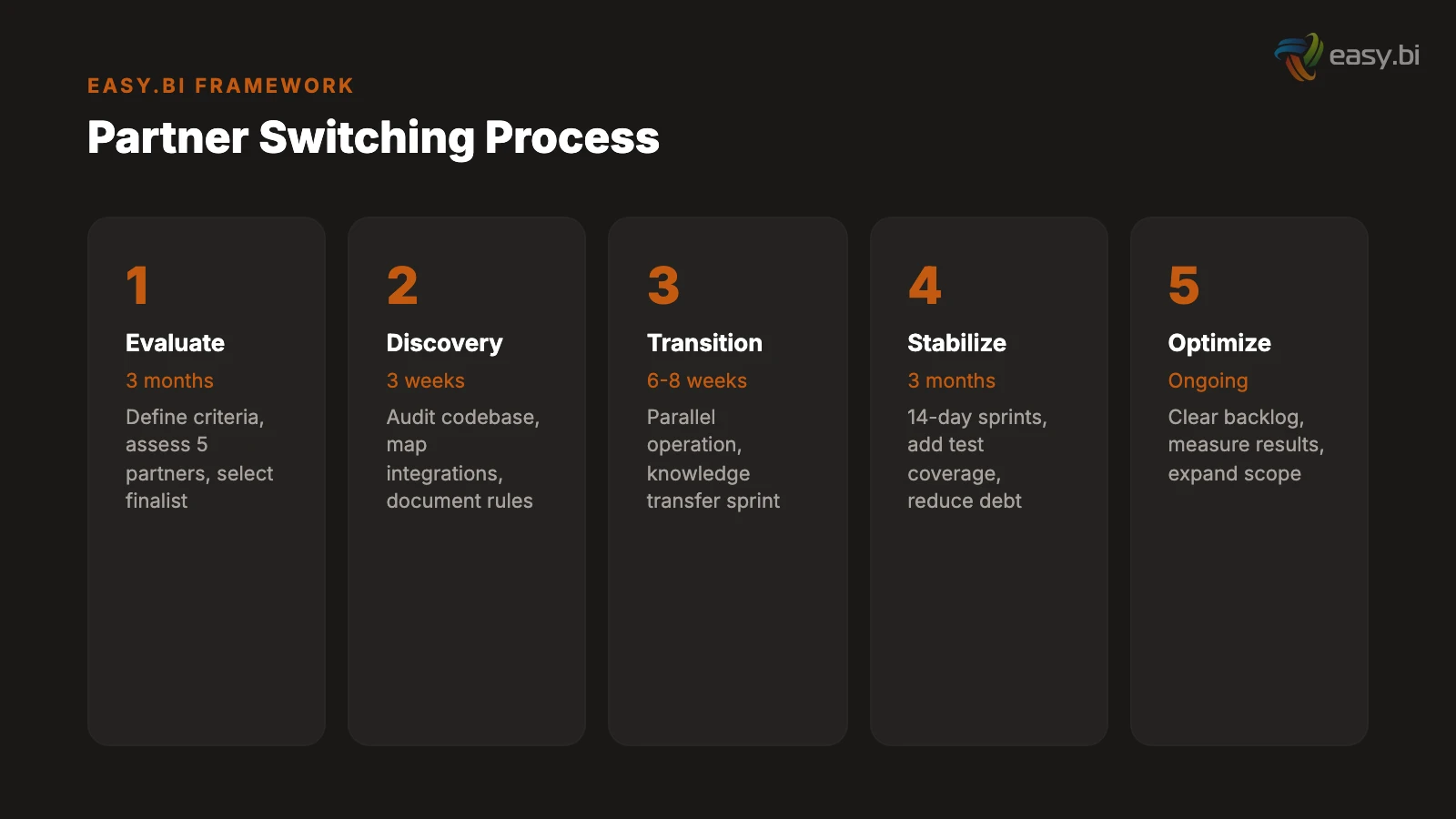
Criterion 1: Senior engineers who stay. The new partner had to guarantee that the senior architects assigned to the project would remain for a minimum of 12 months. No rotation of juniors after the sales phase. No bait-and-switch. 70% of companies cite cost savings as a key reason for outsourcing,[4] but FertigungsTech had learned that cheap hours from junior developers are the most expensive hours you can buy.
Criterion 2: Manufacturing domain experience. The partner needed verifiable experience with ERP integrations, production scheduling systems, and warehouse management in the DACH manufacturing sector. Generic "we can build anything" agencies were eliminated immediately.
Criterion 3: Structured discovery before estimation. Any partner that provided a fixed-price quote based on a 2-hour briefing call was disqualified. FertigungsTech wanted a partner that would invest 2 to 4 weeks understanding the existing system before committing to timelines or budgets.
Criterion 4: Transparent delivery cadence. Working software deployed to production every 2 weeks, not every 2 months. The CTO wanted to see progress, not slide decks.
They evaluated 5 agencies. Three were eliminated after the first meeting because they proposed starting development within 2 weeks. One was eliminated because they could not provide DACH manufacturing references. The remaining partner - a mid-size firm with 70 engineers - met all four criteria and proposed a 3-week paid discovery phase before any commitment to scope, timeline, or budget.
| Evaluation Criterion | Large Consultancy (Previous) | Mid-Size Partner (New) |
|---|---|---|
| Average hourly rate | EUR 210/hour | EUR 125/hour |
| Team seniority ratio (senior:junior) | 1:4 | 2:1 |
| Discovery phase before estimation | No - estimated from brief | Yes - 3-week paid discovery |
| Guaranteed team continuity | No rotation guarantee | 12-month minimum for leads |
| Production deployment frequency | 6 per year (8-week cycles) | 26 per year (14-day sprints) |
| Manufacturing domain references | 2 (generic enterprise) | 4 (DACH manufacturing specific) |
| Dedicated QA engineer | Shared pool | Embedded in squad |
What Did the Discovery Phase Uncover?
The new partner's first action was a 3-week discovery phase that cost EUR 28,000. That investment uncovered problems that had been accumulating for 4 years.
31 integration endpoints, only 19 documented. The previous partner had documented the major integrations - SAP, warehouse management, CRM - but missed 12 secondary integrations including a legacy production scheduling system, three supplier portals, and a customs reporting interface. Those 12 undocumented integrations were responsible for 60% of the production incidents in the previous year. Projects with clear requirements upfront are 97% more likely to succeed than those without.[5] FertigungsTech had been building on an incomplete map for 4 years.
58 business rules that existed only in people's heads. Order prioritization logic, customer-specific pricing overrides, production batch sequencing rules, quality inspection triggers - none of these were documented in the codebase or in any specification document. They lived in the institutional memory of 3 employees who had been with the company for 15+ years. The cost of fixing a defect found in production is 6.5x higher than fixing it during discovery.[6] Every undocumented business rule that surfaced during development instead of discovery had been triggering that 6.5x multiplier.
A monolithic codebase with no test coverage. The previous partner had built a single PHP application with 240,000 lines of code, zero automated tests, and manual deployments via FTP. The architecture made it impossible to change one module without risking side effects in others. The average developer spends 41% of their time on maintenance and technical debt rather than building new features.[7] At FertigungsTech, that number was closer to 65%.
The discovery phase also produced a transition roadmap: which modules to stabilize immediately, which to refactor incrementally, and which to rebuild from scratch. This roadmap became the backlog for the first 6 months of the new engagement.
How Did the 14-Day Sprint Model Change Delivery?
The new partner replaced the 8-week waterfall cycles with 14-day sprints using a Performance Scrum methodology. The structural changes were significant.
Smaller scope per iteration. Instead of specifying 6 weeks of work upfront, each sprint contained a single work package - a self-contained unit of business value that could be demonstrated, tested, and deployed independently. Agile teams deliver software 60% faster and with 25% fewer defects than waterfall teams.[8] But the delivery speed increase at FertigungsTech was closer to 200%, because the previous process was not waterfall - it was waterfall pretending to be agile, which is the worst of both approaches.
Embedded QA, not a separate phase. The new team included a dedicated QA engineer who wrote automated tests alongside feature development. By month 3, test coverage had grown from 0% to 47%. By month 6, it reached 72%. Production incidents dropped from an average of 4.2 per month to 0.8 per month.
Production deployments every sprint. Working software deployed to production every 14 days, not every 8 weeks. This meant FertigungsTech's operations team saw progress continuously and could provide feedback that shaped the next sprint. The feedback loop shortened from 8 weeks to 14 days - a 4x improvement in course correction speed.
Technical debt allocation. 20% of every sprint was allocated to technical debt reduction: refactoring the monolith, adding test coverage, documenting integration endpoints, and upgrading dependencies. This was non-negotiable - not a "nice to have" that got cut when deadlines pressed.
"The difference between 6 releases per year and 26 releases per year is not just speed. It is visibility. When your operations team sees working software every 14 days, trust builds. When they see it every 8 weeks, anxiety builds."
What Were the Measurable Results After 12 Months?
After 12 months with the new partner, FertigungsTech's CTO presented the following metrics to the board.
Annual development cost: EUR 1.08 million (down from EUR 1.8 million). The 40% reduction came from three sources: lower hourly rates (EUR 125 vs. EUR 210), higher team productivity due to senior engineers instead of juniors, and 60% less rework due to the discovery phase and automated testing. Companies that adopt outsourcing strategies with specialized mid-size partners report cost reductions of 30% to 50% compared to large consultancy engagements.[4]
Time-to-production for new features: 4 weeks (down from 14 weeks). The combination of 14-day sprints, embedded QA, and continuous deployment meant features went from specification to production in an average of 2 sprints instead of 7. The 3.5x improvement in delivery speed was the metric that mattered most to the operations team.
Production incidents: 0.8 per month (down from 4.2). Automated test coverage, documented integration endpoints, and the elimination of FTP-based manual deployments reduced production incidents by 81%. Each incident had previously required an average of 6 hours to diagnose and resolve - an annual saving of approximately 245 engineering hours.
Feature backlog cleared. The 47-item feature backlog that had been growing for 3 years was completed within 10 months. The operations team stopped treating IT as a bottleneck and started bringing new automation ideas to sprint planning sessions.
| Metric | Before (Large Consultancy) | After (Mid-Size Partner) | Change |
|---|---|---|---|
| Annual development cost | EUR 1.8M | EUR 1.08M | -40% |
| Production releases per year | 6 | 26 | +333% |
| Average time-to-production | 14 weeks | 4 weeks | -71% |
| Production incidents per month | 4.2 | 0.8 | -81% |
| Automated test coverage | 0% | 72% | +72pp |
| Documented integration endpoints | 19 of 31 | 31 of 31 | 100% |
| Feature backlog items (unresolved) | 47 | 0 | Cleared |
50+ custom projects. 99.9% uptime. 60% faster.
Senior-only engineering teams deliver production-grade platforms in under 4 months. No juniors on your project.
Start with a Strategy CallWhat Lessons Apply to Your Partner Switch?
FertigungsTech's experience is not unique. Across DACH manufacturing, the pattern repeats: a large consultancy wins the initial deal on brand recognition, delivers with junior staff, accumulates technical debt, and eventually triggers a crisis that forces the switch. The Germany digital transformation market is projected to reach USD 90.41 billion by 2030,[9] and a significant portion of that spend will be companies switching partners rather than starting new projects.
Five lessons from this case study apply broadly.
Lesson 1: The discovery phase is not optional after a partner switch. The new partner must audit the existing codebase, map all integrations, document all business rules, and assess technical debt before writing a single line of new code. Inheriting the old backlog without questioning it means inheriting the old problems. 70 to 85% of rework costs trace back to requirements defects[10] - and undocumented requirements are the most dangerous defects of all.
Lesson 2: Budget for the transition period. FertigungsTech ran both partners in parallel for 6 weeks during the handover. That overlap cost approximately EUR 85,000. It was worth every euro. The outgoing partner documented their architectural decisions (under contractual obligation), the incoming partner audited the codebase, and both teams participated in a 1-week knowledge transfer sprint. Attempting a hard cutover without overlap is how knowledge gets lost permanently.
Lesson 3: Evaluate seniority ratios, not just hourly rates. A team of 3 senior engineers at EUR 125 per hour will outperform a team of 8 juniors at EUR 210 per hour on every meaningful metric: code quality, delivery speed, production stability, and total cost. Ask every prospective partner for the names and CVs of the specific engineers who will work on your project - not a generic "team profile."
Lesson 4: Demand production deployments every 14 days. If a partner cannot deploy working software to production every 2 weeks, their process is broken. The 14-day deployment cadence is not a preference - it is a litmus test for engineering maturity. Teams using CI/CD deploy 208x more frequently than those without,[11] and FertigungsTech's experience confirms that deployment frequency correlates directly with project health.
Lesson 5: Treat technical debt reduction as non-negotiable. The 20% sprint allocation for technical debt is what allowed FertigungsTech to stabilize a 240,000-line codebase with zero test coverage. Without that allocation, the new partner would have been building new features on top of a collapsing foundation - repeating the exact pattern that caused the switch in the first place.
I have seen this transition pattern play out across dozens of DACH manufacturing companies. The companies that succeed are the ones that treat the partner switch as an opportunity to reset the foundation - not just to get cheaper rates. A 40% cost reduction is achievable, but only if the new partner addresses the root causes that made the old engagement expensive: undocumented complexity, missing test coverage, and waterfall processes disguised as agile.
How Do You Know When It Is Time to Switch Partners?
Not every frustration with a development partner warrants a switch. The transition has real costs - parallel spend, temporary velocity reduction, knowledge transfer risk. But certain signals indicate that the relationship has structural problems that no amount of process improvement will fix.
Signal 1: The team that sold the project is not the team building it. If the senior architects who impressed you during the sales process have been replaced by junior developers within 6 months, the consultancy is using your project as a training ground. You are paying premium rates for junior output.
Signal 2: You cannot get a straight answer on deployment frequency. Ask your current partner: "How many times did we deploy to production in the last 90 days?" If the answer is fewer than 6, or if they cannot answer the question at all, the delivery process is broken.
Signal 3: Budget overruns have become the norm. 66% of enterprise software projects have cost overruns.[2] But there is a difference between a 10% variance on a complex integration and a consistent 40-50% overrun sprint after sprint. The latter indicates systemic estimation failures, scope management problems, or both.
Signal 4: Nobody can explain the system architecture. If your development partner cannot produce a current, accurate architecture diagram within 24 hours of you asking, they do not understand the system they are building. That ignorance is a ticking time bomb.
FertigungsTech exhibited all four signals for 18 months before the warehouse outage forced action. The cost of those 18 months of inertia: approximately EUR 540,000 in overruns, 3 major production incidents, and a feature backlog that grew by 23 items. The lesson is clear - when the signals are present, the cost of staying exceeds the cost of switching. Every month of delay increases the transition debt.
If this case study resonates with your situation, the next step is a structured evaluation of your current engagement. Our partner evaluation framework provides the specific criteria and scoring methodology. For a deeper look at how the 14-day sprint model works in practice, see our guide on Performance Scrum delivery. And if you are already running parallel systems during a migration, our legacy system cost analysis will help you quantify the financial impact of maintaining outdated infrastructure.
References
- [1] HappyFunCorp (2024). "The bait-and-switch problem is the single most common comp happyfuncorp.com
- [2] McKinsey / Oxford University (2023). mckinsey.com
- [3] Ponemon Institute / Splunk (2024). splunk.com
- [4] 10Pearls (2026). "70% of companies cite cost savings as a key reason for outsour 10pearls.com
- [5] Standish Group (2023).
- [6] IBM Systems Sciences Institute (2022). ibm.com
- [7] Stripe (2023). "The average developer spends 41% of their time on maintenance an
- [8] Standish Group (2023).
- [9] Mordor Intelligence (2025). mordorintelligence.com
- [10] ScopeMaster / IEEE (2024). scopemaster.com
- [11] GitLab (2023). "Teams using CI/CD deploy 208x more frequently than those without. gitlab.com
Explore Other Topics
Ready to build your custom platform?
30-minute call with an engineering lead. No sales pitch - just honest answers about your project.
98% engineer retention · 14-day delivery sprints · No lock-in contracts
Related Reading

How to Evaluate a Software Development Partner (Without Getting Burned)
A practical checklist for evaluating software development partners: what to ask, red flags to watch for, how to assess technical depth, and why paid pilots beat RFPs. Based on patterns from 100+ DACH enterprise projects.
Enno Bassen
What Does Custom Software Development Actually Cost in 2026?
Real cost breakdown for custom software in 2026. DACH vs. Eastern Europe vs. offshore rates, 5-year TCO, and EUR pricing by project type.
Christian Kaspar
AI Development Partners: Boutique vs. Big Consultancy vs. In-House
Big consultancies charge 2-5x more and staff AI projects with juniors. In-house teams cost $1M+ with 38% attrition. Real cost data for choosing your AI partner.
Filip Kralj