
The 7 Reasons Custom Software Projects Go Over Budget

Table of Contents+
- Reason 1: Why Does Scope Creep Happen (And Why Is It Not Really About Scope)?
- Reason 2: How Do Poor Requirements Cause Budget Overruns?
- Reason 3: When Do Architecture Decisions Cause Budget Overruns?
- Reason 4: What Do Vendor Switching Costs Really Look Like?
- Reason 5: Why Is Integration Complexity Always Underestimated?
- Reason 6: How Do Testing Gaps Create Budget Overruns?
- Reason 7: How Does Technical Debt Compound Into Budget Overruns?
- What Is the Prevention Framework?
- References
TL;DR
Custom software overruns trace to seven causes: scope creep from poor change control, inadequate requirements, wrong architecture decisions, vendor switching, underestimated integrations, testing gaps, and compounding technical debt. The average project exceeds budget by 27%. Each cause is preventable with specific controls implemented during discovery.
Key Takeaways
- •66% of enterprise software projects experience budget overruns, with the average project costing 27% more than planned and 15% of projects exceeding budgets by 200% or more.
- •Scope creep is the most cited cause, but the root problem is inadequate requirements management - projects with formal change control are 35% less likely to exceed budgets.
- •Integration complexity is the most underestimated cost driver, with the average enterprise project requiring 23+ integration endpoints that each add unpredictable work.
- •Technical debt compounds silently - developers spend 33-42% of their time on debt-related rework, and this percentage grows every quarter when maintenance is underfunded.
- •Every overrun on this list is preventable with specific, documented controls implemented before the first line of code is written.
Data-driven analysis of 7 reasons custom software projects blow budgets. Root causes, real cost impact, and prevention strategies for each.
Two-thirds of custom software projects exceed their budgets. This is not a new statistic, and it has not improved in a decade. McKinsey and Oxford University found that 66% of enterprise software projects experience budget overruns, with large IT projects running up to 80% over budget and delivering 56% less value than predicted.[1]
The average project costs 27% more than planned. Fifteen percent of projects blow their budgets by 200% or more.[2] These are not exceptional cases. These are the statistical norm.
The reasons are not mysterious. They are not random. They are seven specific, recurring failure patterns that show up in project after project, company after company. Each one is preventable - not through better intentions, but through specific controls that cost a fraction of the overruns they prevent.
Reason 1: Why Does Scope Creep Happen (And Why Is It Not Really About Scope)?
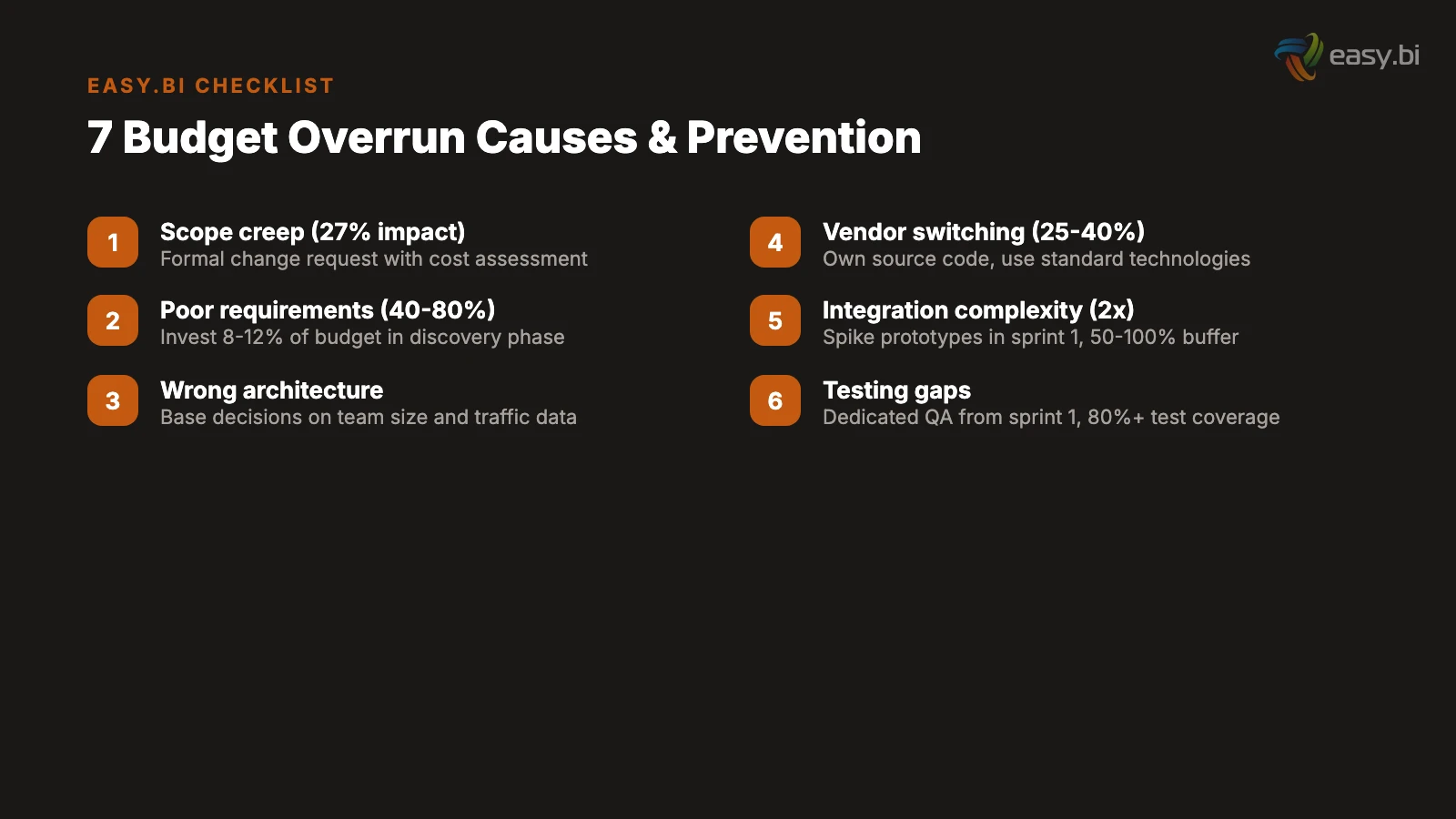
Scope creep is the most cited reason for budget overruns. PMI research shows 52-55% of projects experience it, with an average cost impact of 27% above the original estimate.[3] But calling it "scope creep" misdiagnoses the problem. Scope does not creep on its own. It creeps because the project lacks a mechanism to make scope changes visible and costly.
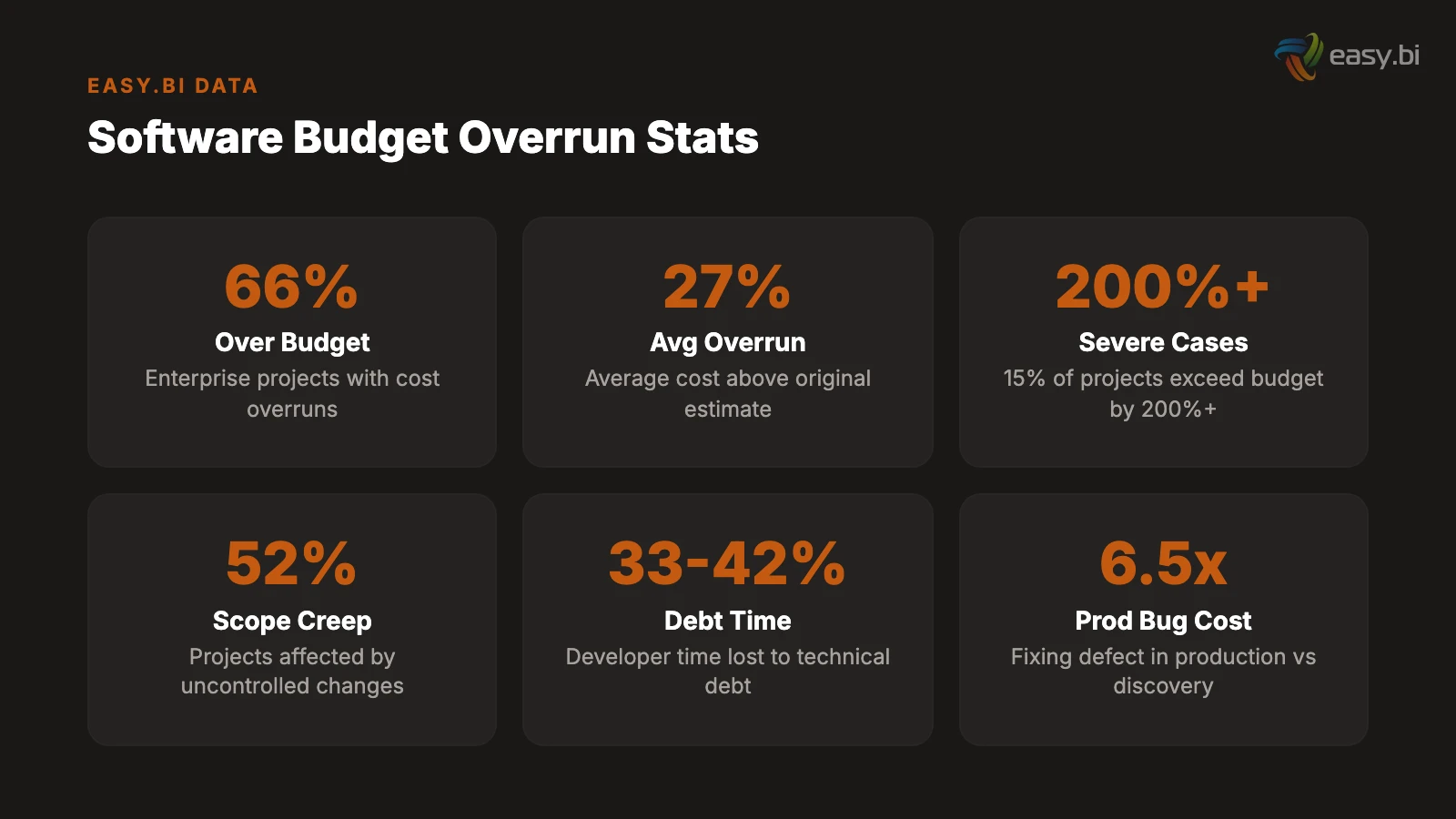
The root cause is the absence of formal change control. Projects without formal change management processes are 35% more likely to exceed costs or miss deadlines.[3] When any stakeholder can walk up to a developer and say "can you also add this field" without a documented process, the cumulative effect of 50 small changes is a 30% budget overrun that nobody authorized.
Scope creep escalates in three stages. Stage 1 is the small requests: "just add this field," "make this button do something slightly different." Each request takes 2-4 hours. Nobody documents them. Stage 2 is the medium additions: "we need a reporting dashboard" or "the workflow needs an approval step." These take 2-4 weeks but get absorbed into existing sprints. Stage 3 is the realization: the project is 40% over budget, but there is no paper trail showing where the money went. The cost was distributed across hundreds of undocumented decisions.
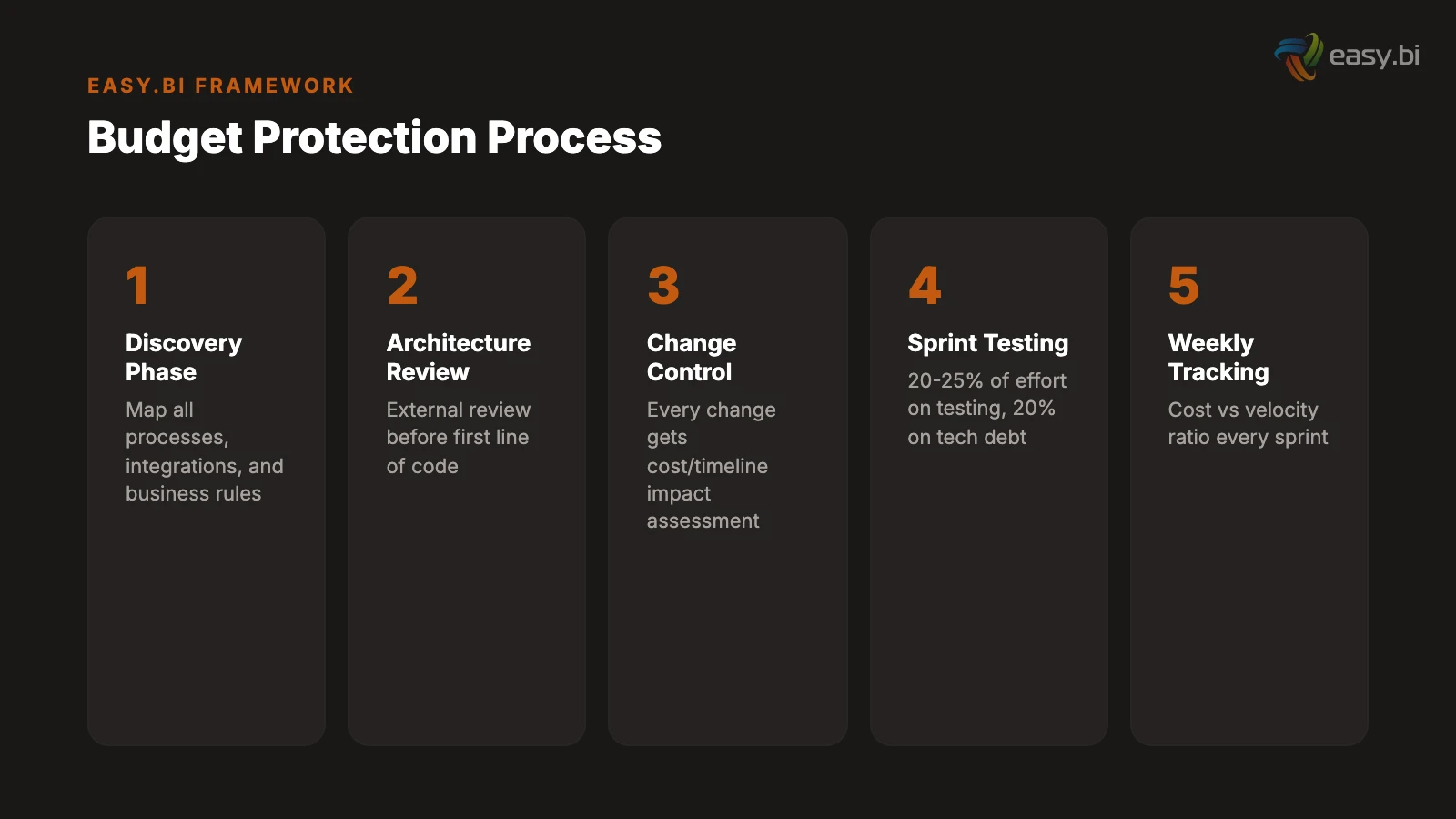
How to prevent it: Implement a formal change request process before development begins. Every change, regardless of size, gets a written request with a cost and timeline impact assessment. The product owner approves or rejects based on the documented trade-off. This process adds 30 minutes of overhead per change and saves thousands of EUR in untracked scope additions. For a complete discovery framework that prevents scope-related overruns, see our guide on the discovery phase that saves you 6 months.
See how we deliver 60% faster time-to-market with 40% lower TCO than off-the-shelf.
Reason 2: How Do Poor Requirements Cause Budget Overruns?
Requirements problems are the upstream cause that triggers every downstream overrun. The Standish Group found that projects with clear requirements upfront are 97% more likely to succeed.[4] The inverse is equally true: ambiguous requirements guarantee budget overruns because the team discovers missing specifications during development, when changes cost 10-50 times more than they would during discovery.
The specific failure modes in requirements are predictable. First, business rules that live in one person's head never get documented. The accounting department has 12 exception cases for invoice processing that the requirements document describes in a single sentence: "system processes invoices." Each undiscovered exception case adds 20-40 hours of development work when it surfaces mid-sprint.
Second, non-functional requirements are omitted entirely. The requirements describe what the system does but not how fast it does it, how many users it supports, how it handles failures, or what compliance standards it must meet. These omissions cause architecture rework - the most expensive kind of rework because it affects every component built on top of the wrong foundation.
On one project, we discovered 47 distinct business rules around offline capability during the discovery phase that were not in the original brief. Finding them cost EUR 8,000 in discovery time. If those rules had surfaced during development, the rework would have exceeded EUR 120,000.
Third, stakeholder alignment is assumed rather than verified. The sales team, the operations team, and the finance team each have different expectations for the same system. Without a structured discovery phase that brings all stakeholders into the same room, these conflicting expectations surface as scope changes during development.
How to prevent it: Invest 8-12% of the total project budget in a structured discovery phase. Map every business process with inputs, outputs, decision points, and exception paths. Document non-functional requirements with specific numbers (response time under 200ms, 99.9% uptime, 10,000 concurrent users). Get sign-off from every stakeholder group before development begins.
Reason 3: When Do Architecture Decisions Cause Budget Overruns?
Architecture decisions made in the first two weeks of a project determine 60-80% of the total cost of ownership. The wrong architecture does not cause an immediate budget overrun. It causes a slow, compounding increase in development cost as the team works against the architecture instead of with it.
The most common architecture overrun in the DACH mid-market is premature microservices adoption. A 2025 CNCF survey found that 42% of organizations that adopted microservices are now consolidating services back into larger units.[5] Microservices add 30-40% operational overhead compared to a monolith for equivalent functionality. For a 15-person development team at a EUR 10 million DACH company, that overhead translates to EUR 200,000-600,000 in annual costs that produce zero product features.
The second architecture failure is under-engineering: choosing an architecture that cannot handle the actual production workload. A system designed for 1,000 users that needs to serve 50,000 users requires not a scaling effort but a rebuild. The rebuild costs 60-80% of the original development budget and delays the project by 4-8 months.
The third failure is technology selection based on trends rather than team capabilities. Choosing a framework that nobody on the team has production experience with adds 30-50% to development time through learning curves, incorrect patterns, and rework as the team discovers the right approach through trial and error.
How to prevent it: Base architecture decisions on three data points: team size, expected traffic, and the hiring market for the chosen technology. Document every architecture decision with its rationale in an Architecture Decision Record. Get the architecture reviewed by someone outside the project team before development begins. For a decision framework on the most common architecture question, see our guide on microservices vs. monolith decision.
Reason 4: What Do Vendor Switching Costs Really Look Like?
Vendor switching during a project is one of the most expensive events that can occur. Data migration alone is cited by 47% of enterprises as a significant barrier when considering switching providers.[6] The pre-migration phase - planning, assessment, strategy, and tool selection - consumes 50-70% of total switching effort.[6]
The direct costs are visible: onboarding a new vendor, transferring knowledge, re-establishing development environments, and the 4-8 weeks of reduced productivity as the new team learns the codebase. The indirect costs are larger: decisions made by the original vendor that only they understand, undocumented configuration choices, and the institutional knowledge that walks out the door when the relationship ends.
Vendor switches happen for three reasons. First, the original vendor underperformed and the client loses confidence. Second, the project was deliberately split between multiple vendors for "risk diversification" - a strategy that reliably increases costs by 25-40% through coordination overhead. Third, the original vendor becomes unavailable (business failure, key personnel departure, capacity constraints).
In every case, the switching cost is proportional to how tightly coupled the project is to the vendor's proprietary tools, processes, and knowledge. A project using standard technologies with comprehensive documentation and accessible source control can survive a vendor switch with 4-6 weeks of productivity loss. A project using the vendor's proprietary framework with minimal documentation faces 3-6 months of recovery.
How to prevent it: Three controls reduce vendor switching risk. First, the client owns the source code repository from day one - no exceptions. Second, all development uses standard, open-source technologies with broad hiring market support. Third, the development process includes mandatory documentation of architecture decisions, deployment procedures, and configuration details. These controls cost nothing extra during development and save months of recovery time if a switch becomes necessary. For a deep dive on lock-in prevention, see our guide on escaping vendor lock-in.
Reason 5: Why Is Integration Complexity Always Underestimated?
Integration is the most consistently underestimated cost driver in custom software projects. Every integration with an external system - ERP, CRM, payment gateway, legacy database, third-party API - introduces unpredictable complexity that standard estimation methods fail to capture.
The average enterprise project requires mapping 23 or more integration endpoints before development begins. Each endpoint involves protocol negotiation (REST, SOAP, file transfer, message queue), data format mapping, authentication implementation, error handling, and retry logic. The estimate for each integration is typically 40-80 hours. The reality is typically 80-160 hours - a consistent 2x underestimation factor.
The underestimation occurs because integration estimates assume the external system behaves as documented. In practice: APIs return undocumented error codes, authentication tokens expire at unexpected intervals, rate limits are not published, data formats have edge cases not covered in the specification, and legacy systems have quirks that are understood only by the one engineer who built them 15 years ago and has since left the company.
Integration complexity multiplies with each additional system. Two integrations have one interaction path. Five integrations have 10 potential interaction paths. Ten integrations have 45 potential interaction paths. Each path needs testing, error handling, and monitoring. The testing matrix grows geometrically while the budget estimate grew linearly.
How to prevent it: During discovery, create a complete integration inventory: every system, every protocol, every data format, every authentication method, and every SLA requirement. Add a 50-100% buffer to every integration estimate - this is not padding, it is reflecting the actual historical variance. Build integration prototypes ("spike" stories) in the first sprint to validate assumptions before committing to estimates. Budget for a dedicated integration testing environment that mirrors production connectivity.
50+ custom projects. 99.9% uptime. 60% faster.
Senior-only engineering teams deliver production-grade platforms in under 4 months. No juniors on your project.
Start with a Strategy CallReason 6: How Do Testing Gaps Create Budget Overruns?
Testing is the most frequently cut line item when projects face schedule pressure. It is also the most expensive item to cut. A defect found during development costs EUR 100-500 to fix. The same defect found in production costs EUR 5,000-15,000 when you factor in incident response, emergency deployment, data cleanup, customer communication, and support overhead.[7]
Applications with test coverage exceeding 80% experience 40% fewer production incidents.[7] The math is straightforward: if a mid-complexity project has 200 potential defects and a team with no automated testing catches 60% of them before production, 80 defects reach users. At EUR 5,000-15,000 per production defect, the cost is EUR 400,000-1,200,000 in post-launch remediation. A team with 80% test coverage catches 85% of defects before production, leaving 30 defects for users. The cost drops to EUR 150,000-450,000. The delta - EUR 250,000-750,000 - is the return on investment in testing.
Testing gaps create budget overruns through three mechanisms. First, production incidents consume developer time that was budgeted for feature development. Each critical bug diverts 2-5 developer-days from planned work. Second, emergency fixes bypass code review and testing, creating new defects that trigger the next round of production incidents. Third, confidence erosion slows the team: when deployments are risky because test coverage is low, deployment frequency drops, feedback cycles lengthen, and the project falls behind schedule.
| Testing Investment | Defect Detection Rate | Production Incidents (per 200 defects) | Estimated Remediation Cost |
|---|---|---|---|
| No automated testing | 50-60% | 80-100 defects reach production | EUR 400,000-1,500,000 |
| Basic test coverage (40-60%) | 70-75% | 50-60 defects reach production | EUR 250,000-900,000 |
| Comprehensive coverage (80%+) | 85-90% | 20-30 defects reach production | EUR 100,000-450,000 |
| Coverage + E2E + performance testing | 92-95% | 10-16 defects reach production | EUR 50,000-240,000 |
How to prevent it: Include a dedicated QA engineer in the project team from sprint one - not as a part-time role, not as something developers "also do." Define a minimum test coverage target (80%) in the project contract. Automate the test suite in the CI/CD pipeline so no code reaches production without passing all tests. Budget testing at 20-25% of development effort - this is the actual cost, not an overhead to be minimized.
Reason 7: How Does Technical Debt Compound Into Budget Overruns?
Technical debt is the silent budget killer. It does not cause a dramatic failure. It causes a slow, steady decline in delivery velocity until the project grinds to a halt. Developers spend 33-42% of their work time dealing with rework, bug fixes, and maintenance related to technical debt.[8] That percentage grows every quarter when debt is not actively managed.
In 2025, enterprises burn 40% of their IT budgets maintaining legacy systems rather than building new capabilities.[8] Technical debt costs EUR 280,000 per year for a project of one million lines of code, accumulating to EUR 1.4 million over five years if left unmanaged.[8] The global scale is staggering: companies worldwide carry 61 billion days of repair time in accumulated technical debt.[8]
Technical debt compounds through four mechanisms in custom software projects. First, shortcuts taken under schedule pressure create fragile code that breaks when modified, increasing the time for every subsequent feature. Second, outdated dependencies accumulate security vulnerabilities that eventually require emergency updates - updating a dependency one version behind takes an hour; updating one three years behind takes a sprint. Third, missing documentation forces every new team member to reverse-engineer the codebase, multiplying onboarding time by 2-3x. Fourth, inconsistent patterns across the codebase mean every developer reinvents solutions, creating divergent approaches that increase maintenance burden.
I track a metric on every project: the ratio of feature delivery time in sprint 1 versus sprint 20. On projects that allocate 20% of sprint capacity to debt reduction, this ratio stays between 1.0x and 1.3x. On projects that defer all debt management, the ratio reaches 2.5x to 3.0x - meaning features take nearly three times longer to deliver by sprint 20.
88% of IT leaders worry that technical debt affects their ability to keep pace with competitors, and analysts predict that by 2027, 75% of organizations will face systemic failures due to unmanaged technical debt.[8]
How to prevent it: Allocate 20% of every sprint's capacity to technical debt reduction. This is a non-negotiable part of every sprint, not a separate activity that gets cancelled under pressure. Track debt quantitatively: every piece of technical debt gets a ticket with an estimated cost of delay and a business impact assessment. Set a monthly cadence for dependency updates. Measure the feature delivery time ratio across sprints - if it exceeds 1.5x, increase the debt allocation before the project stalls.
What Is the Prevention Framework?
The seven causes and their prevention strategies form a unified framework. Implementing all seven controls during the discovery phase costs 8-12% of the total project budget. Failing to implement them costs 27% on average, and up to 200% in severe cases.[2] The return on prevention is 2-17x the investment.
The controls reinforce each other. Thorough requirements discovery reduces scope creep. Architecture decisions aligned with team capabilities reduce integration surprises. Testing from sprint one catches defects before they become production incidents. Technical debt management maintains velocity throughout the project. Change control makes every scope addition a conscious budget decision rather than an invisible cost accumulation.
| Budget Overrun Cause | Average Cost Impact | Prevention Cost | ROI of Prevention |
|---|---|---|---|
| Scope creep (no change control) | +27% of total budget | EUR 3,000-5,000 (process setup) | 15-25x return |
| Poor requirements | +40-80% rework | EUR 15,000-40,000 (discovery phase) | 3-8x return |
| Wrong architecture | +30-40% operational overhead | EUR 5,000-10,000 (architecture review) | 10-20x return |
| Vendor switching | +25-40% coordination cost | EUR 2,000-5,000 (documentation, code access) | 20-30x return |
| Integration underestimation | +100% per integration | EUR 5,000-15,000 (spike prototypes) | 5-10x return |
| Testing gaps | +EUR 250,000-750,000 in remediation | 20-25% of dev effort (built-in) | 3-5x return |
| Technical debt | 33-42% of developer time lost | 20% of sprint capacity (built-in) | 4-8x return |
For DACH mid-market companies, these controls are not theoretical. They are the specific practices that separate the 34% of projects that succeed from the 66% that do not. The investment in prevention is modest: EUR 20,000-50,000 in additional discovery and process setup for a EUR 300,000 project. The alternative - a 27% average overrun - costs EUR 81,000 and delivers less value.
Every overrun on this list is preventable. Not with better luck. Not with better developers. With specific, documented controls implemented before the first line of code is written.
The cost of implementing all seven prevention strategies is 8-12% of the total project budget. For a EUR 300,000 project, that is EUR 24,000-36,000. The average overrun without these controls is 27% - or EUR 81,000. The severe case (15% of projects) is a 200% overrun - or EUR 600,000. Prevention is not just cheaper. It is the only rational financial decision.
One final observation: the seven causes on this list are interconnected. Poor requirements lead to scope creep. Wrong architecture decisions lead to integration surprises. Testing gaps accelerate technical debt. Addressing one cause in isolation provides partial protection. Addressing all seven creates a reinforcing system where each control strengthens the others. The discovery phase is where this system is designed. The sprint cadence is where it is executed. The weekly review is where it is monitored.
For a complete delivery framework that addresses all seven risk areas, see our article on building custom software that does not fail. For understanding how to structure the financial relationship with your development partner, see our comparison of fixed-price vs. time-and-materials contracts. And when you are ready to apply these controls to your next project, our custom solutions team builds the prevention framework into every engagement from day one.
References
- [1] McKinsey / Oxford University, "Delivering large-scale IT projects on time, on bu mckinsey.com
- [2] Acquaintsoft, "Eliminate Software Budget Overrun: 14 Facts and Statistics," , 20 acquaintsoft.com
- [3] PMI, "Pulse of the Profession - Scope Creep and Change Management," , 2024. pmi.org
- [4] Standish Group, "CHAOS Report 2020 - Requirements and Project Success," standish
- [5] CNCF, "Cloud Native Survey 2025 - Microservices Consolidation Trends," , 2025. cncf.io
- [6] DataFlowMapper, "Data Migration Cost Analysis and Calculator," , 2025. dataflowmapper.com
- [7] QSM, "How to Avoid Software Cost and Schedule Overruns," , 2025. qsm.com
- [8] CAST Software, "Coding in the Red: The State of Global Technical Debt, 2025," , castsoftware.com
Explore Other Topics
Ready to build your custom platform?
30-minute call with an engineering lead. No sales pitch - just honest answers about your project.
98% engineer retention · 14-day delivery sprints · No lock-in contracts
Related Reading

What Does Custom Software Development Actually Cost in 2026?
Real cost breakdown for custom software in 2026. DACH vs. Eastern Europe vs. offshore rates, 5-year TCO, and EUR pricing by project type.
Christian Kaspar
Building Custom Software That Doesn't Fail: A CTO's Framework
66% of custom software projects fail. This CTO's framework covers discovery, API-first architecture, tech stack selection, 14-day delivery cycles, and technical debt management to beat the odds.
Filip Kralj
What makes custom software development so crucial for today's supply chain industry?
Custom software boosts supply chain efficiency, drives innovation, and enhances financial stability, ensuring a competitive edge in logistics.
Andrej Lovsin