
5 E-Commerce Replatforming Mistakes That Cost More Than the Migration

Table of Contents+
- Why Does Underestimating Data Migration Sink 40% of Replatforming Projects?
- How Does Feature Parity Thinking Trap You in the Past?
- What Does Ignoring SEO Migration Actually Cost in Lost Revenue?
- Why Do Big-Bang Cutovers Fail 60-70% of the Time?
- What Happens When You Choose the Platform Before Defining Requirements?
- What Does a Replatforming Done Right Look Like?
- Frequently Asked Questions
- References
TL;DR
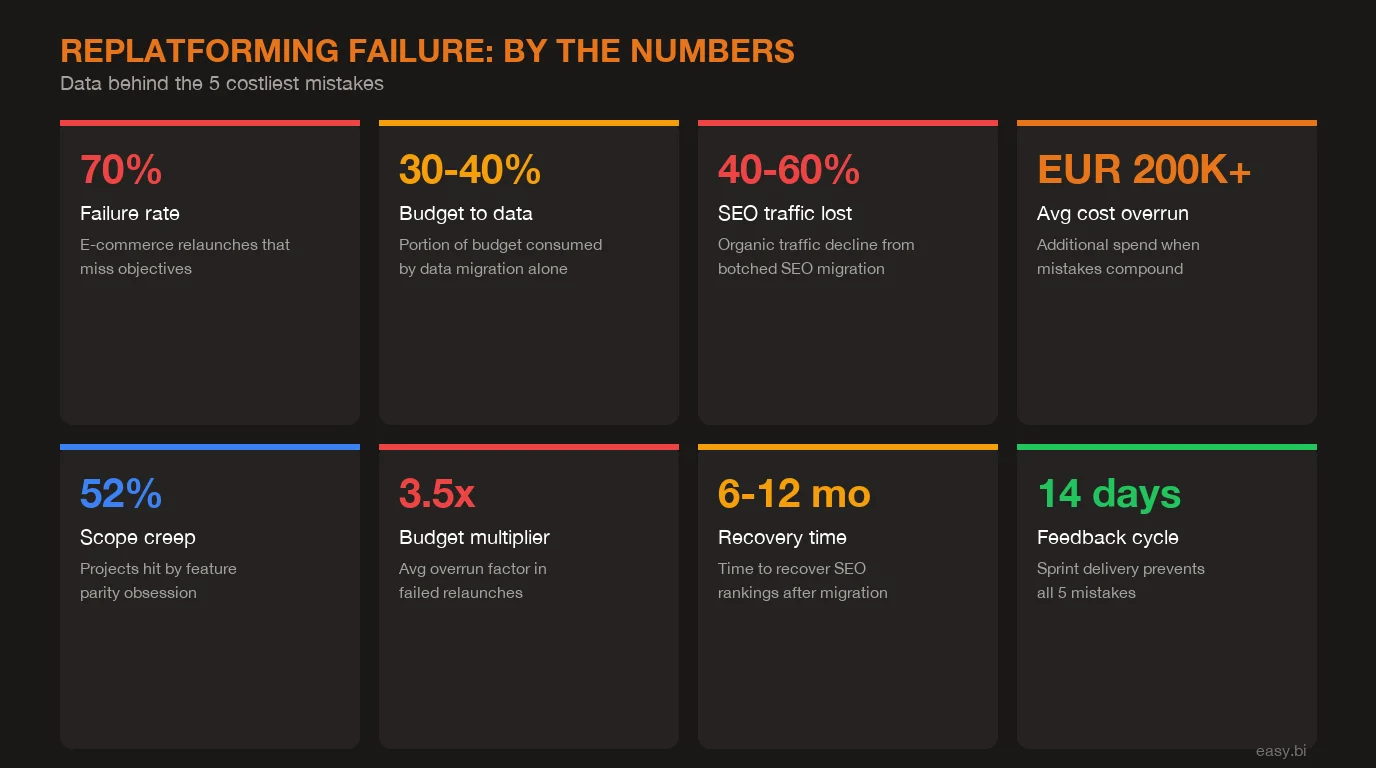
E-commerce replatforming projects fail at a rate of 60-75%, and the failures rarely come from bad technology choices. They come from five specific, preventable mistakes that cost DACH retailers EUR 500K or more per project.
Key Takeaways
- •Data migration consumes 30-40% of total replatforming project time and budget. Teams that treat it as a weekend task blow past deadlines and run 60-80% over budget.
- •Feature parity obsession - rebuilding every function from the old platform - adds 4-6 months to timelines. Audit usage data first: 30-50% of existing features typically have zero active users.
- •SEO migration failures cause 40-60% organic traffic loss that takes 6-18 months to recover. Redirect mapping, structured data transfer, and URL planning must start before a single line of code is written.
- •Big-bang cutovers carry a 60-70% failure rate for complex e-commerce systems. Phased migration with parallel running reduces risk and lets teams validate revenue impact at each stage.
- •Choosing a platform before defining requirements locks you into vendor limitations. Define business requirements, integration needs, and growth projections first - then evaluate platforms against your actual criteria.
5 replatforming mistakes that cost DACH retailers EUR 500K+. Data migration traps, SEO traffic loss, big-bang cutovers, and how to prevent each one.
E-commerce replatforming projects fail at a rate of 60-75%, and the failures rarely come from bad technology choices.[1] They come from five specific, preventable mistakes that cost DACH retailers EUR 500K or more per project. This post breaks down each mistake, quantifies the damage in euros, and shows you exactly how to avoid them - based on 100+ migration projects we have delivered at easy.bi.
Why Does Underestimating Data Migration Sink 40% of Replatforming Projects?
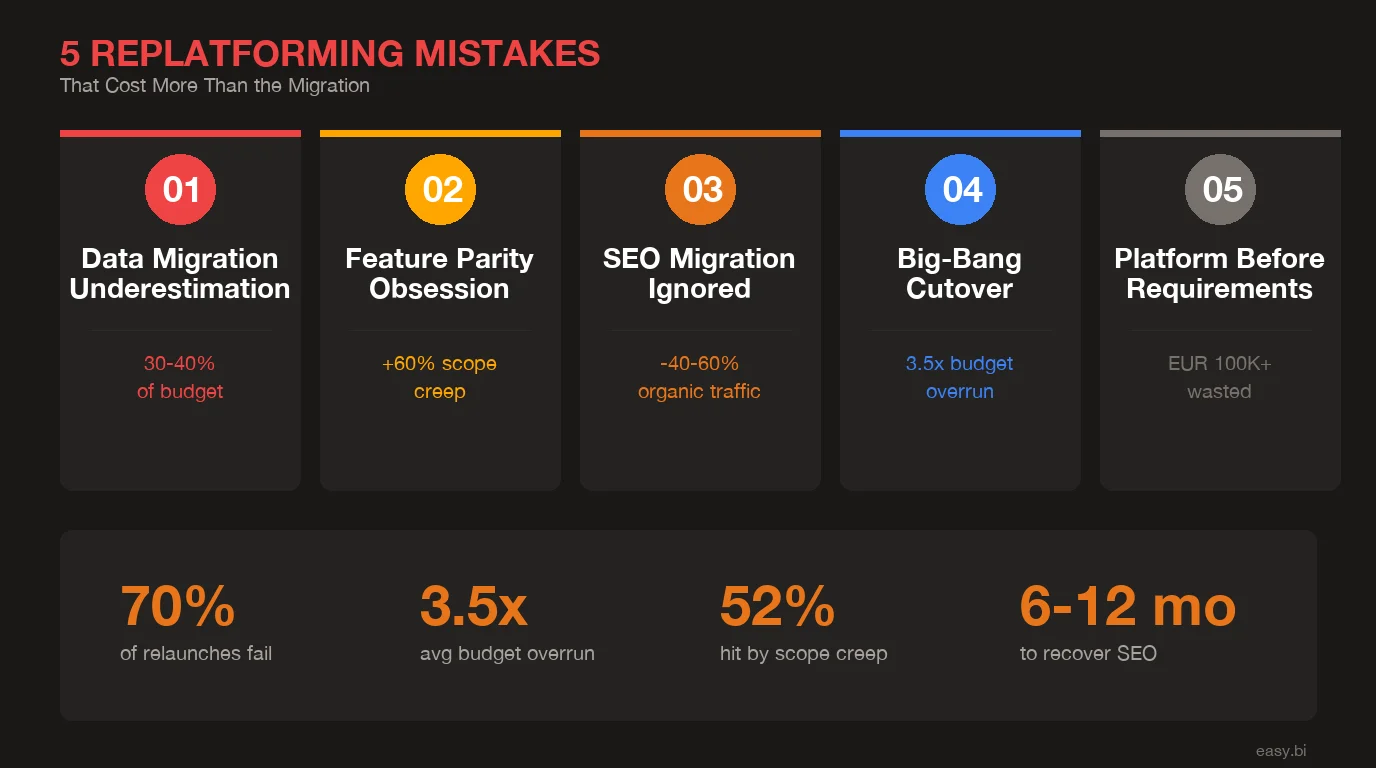
Data migration is the single most underestimated task in every replatforming project. Product catalogs, customer histories, order records, pricing rules, SEO metadata, content assets, and configuration data all need to move from system A to system B. Most project plans allocate 5-10% of the timeline for this work. The actual requirement is 30-40%.[2]
The problem starts with assumptions. Teams assume data will transfer cleanly between platforms. It does not. Product data in a legacy Magento or Hybris installation has accumulated years of inconsistencies: duplicate SKUs, missing attributes, conflicting category hierarchies, and custom fields that have no equivalent in the target platform. Customer records have merged accounts, outdated addresses, and payment tokens tied to deprecated gateways.
A German fashion retailer with EUR 22M in online revenue hired a systems integrator to migrate from Magento 1 to Shopware 6. The integrator estimated 4 weeks for data migration. The actual migration took 14 weeks. Product data required manual cleaning of 18,000 SKUs with inconsistent attribute mapping. Customer order histories spanning 7 years had to be normalized across three different data schemas the old system had used over time. The project ran 80% over budget - EUR 340K above the original EUR 420K estimate - with data migration accounting for nearly all of the overrun.
Gartner reports that 83% of data migration projects either fail outright or exceed their budgets and timelines.[3] The cost is not just engineering time. Every week of delay means another week running two systems in parallel, paying for both licenses, and splitting team focus. Dual-system operation costs mid-market retailers EUR 8K-15K per week in combined licensing, infrastructure, and support overhead.
The data types that cause the most problems are not the obvious ones. Product titles and prices migrate easily. What breaks projects is relational data: which products belong to which categories, which customers have which payment methods on file, which order records link to which fulfillment entries. These relationships often differ structurally between platforms, requiring custom transformation logic that no off-the-shelf migration tool handles.
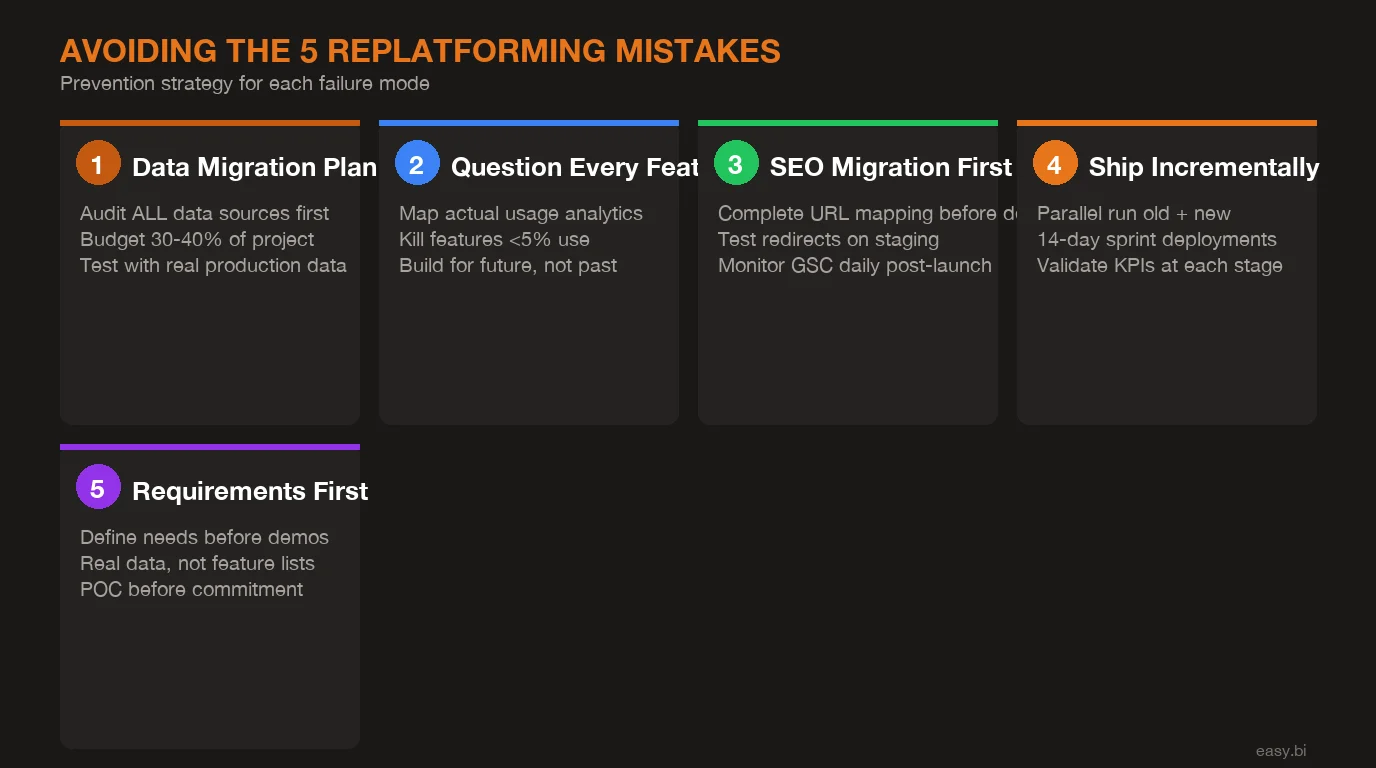
How to prevent it: Run a full data audit before the project starts. Map every data entity, its source format, its target format, and the transformation rules required. Budget 35% of total project time for data migration. Build automated validation scripts that compare source and target data after each migration run. Plan for a minimum of three full migration rehearsals before the live cutover. Each rehearsal reveals new edge cases - the third run is typically the first one that completes without manual intervention.
See how our team delivers +35% avg conversion lift across 30+ e-commerce projects.
How Does Feature Parity Thinking Trap You in the Past?
The second most expensive mistake is insisting that the new platform must replicate every feature of the old one. This sounds reasonable. It is not. Feature parity obsession adds 4-6 months to project timelines and inflates budgets by 40-60%.[4]
Here is what actually happens. A mid-market retailer runs a 10-year-old e-commerce platform. Over that decade, the business has added custom product configurators, loyalty point calculators, complex B2B pricing rules, abandoned cart workflows, and dozens of integrations. Some of these features are critical. Many are not. Studies show that 30-50% of features in enterprise software are rarely or never used.[5]
When the replatforming project begins, someone creates a spreadsheet listing every feature of the current system. That spreadsheet becomes the requirements document. No one asks whether the custom gift-wrapping module that was built in 2018 still generates any revenue. No one checks if the complex tiered discount engine is used by more than 3 customers. The team spends 6 weeks rebuilding a feature that serves 0.1% of orders.
The Standish Group reports that 64% of software features are rarely or never used in practice.[5] In a replatforming context, that means nearly two-thirds of the features teams spend months rebuilding deliver zero measurable business value. At an average development cost of EUR 5K-15K per feature, a platform with 80 custom features wastes EUR 256K-768K on unused functionality.
From my experience leading product decisions across dozens of e-commerce projects, the feature parity spreadsheet is where replatforming budgets go to die. I have seen teams spend EUR 80K rebuilding a custom returns portal that 12 customers used per month - when a EUR 200/month SaaS tool would have handled it better.
| Approach | Timeline Impact | Budget Impact | Risk Level |
|---|---|---|---|
| Full feature parity | +4-6 months | +40-60% over budget | High - delays cascade |
| Usage-based prioritization | On schedule | On budget | Low - data-driven decisions |
| Feature parity + new features | +6-9 months | +60-100% over budget | Very high - scope creep |
| MVP + iterative releases | -2 months vs parity | -20-30% vs parity | Lowest - validated at each stage |
How to prevent it: Before writing a single requirement, pull usage analytics for every feature. How many users interact with it per month? What revenue does it generate? Features with fewer than 100 monthly users or less than 1% revenue contribution go to a "post-launch evaluation" list, not the migration scope. The new platform should be better than the old one, not a carbon copy of it.
What Does Ignoring SEO Migration Actually Cost in Lost Revenue?
Organic search drives 33-43% of all e-commerce traffic.[6] A botched SEO migration wipes out 40-60% of that traffic overnight - and recovery takes 6-18 months.[7] For a retailer doing EUR 15M in online revenue with 40% from organic search, that is EUR 2.4-3.6M in revenue at risk over the recovery period.
The damage happens in three ways. First, URL structure changes without proper 301 redirects. A Magento store with URLs like /catalog/product/view/id/4523 migrating to Shopware with URLs like /product-name needs a redirect map for every single URL. Not just product pages - category pages, filtered URLs, CMS pages, blog posts, and any URL that has accumulated backlinks or search rankings. A mid-market catalog with 5,000 products typically has 15,000-25,000 indexed URLs when you include category combinations, filtered views, and pagination.
Second, structured data loss. Product schema markup (price, availability, reviews), breadcrumb data, and organization schema often live in platform-specific implementations. When the platform changes, this structured data disappears from search results. Rich snippets vanish. Click-through rates drop 20-30% even when rankings hold.[8]
Third, internal linking architecture breaks. The old platform's category structure, cross-sell links, and navigation built a web of internal links over years. A new platform with a different information architecture destroys that link equity distribution overnight. Google's own documentation states that it takes 4-6 months minimum for a site to recover from a major URL migration, and complex e-commerce sites with 10,000+ URLs often need 12-18 months to regain pre-migration traffic levels.[7]
The most expensive line item in any replatforming project is not on the invoice. It is the organic traffic you lose because someone decided SEO migration could wait until after launch. I have watched a DACH electronics retailer lose EUR 180K per month in organic revenue for 9 months because redirect mapping was treated as a post-launch task.
For the complete playbook on protecting organic traffic during a platform change, read our detailed guide on e-commerce SEO migration.
How to prevent it: Start SEO migration planning in week one of the project. Crawl the existing site completely. Map every indexed URL to its new equivalent. Implement 301 redirects before launch - not after. Recreate all structured data markup on the new platform. Monitor Google Search Console daily for 90 days post-launch. Budget 10-15% of the project specifically for SEO migration work.
Why Do Big-Bang Cutovers Fail 60-70% of the Time?
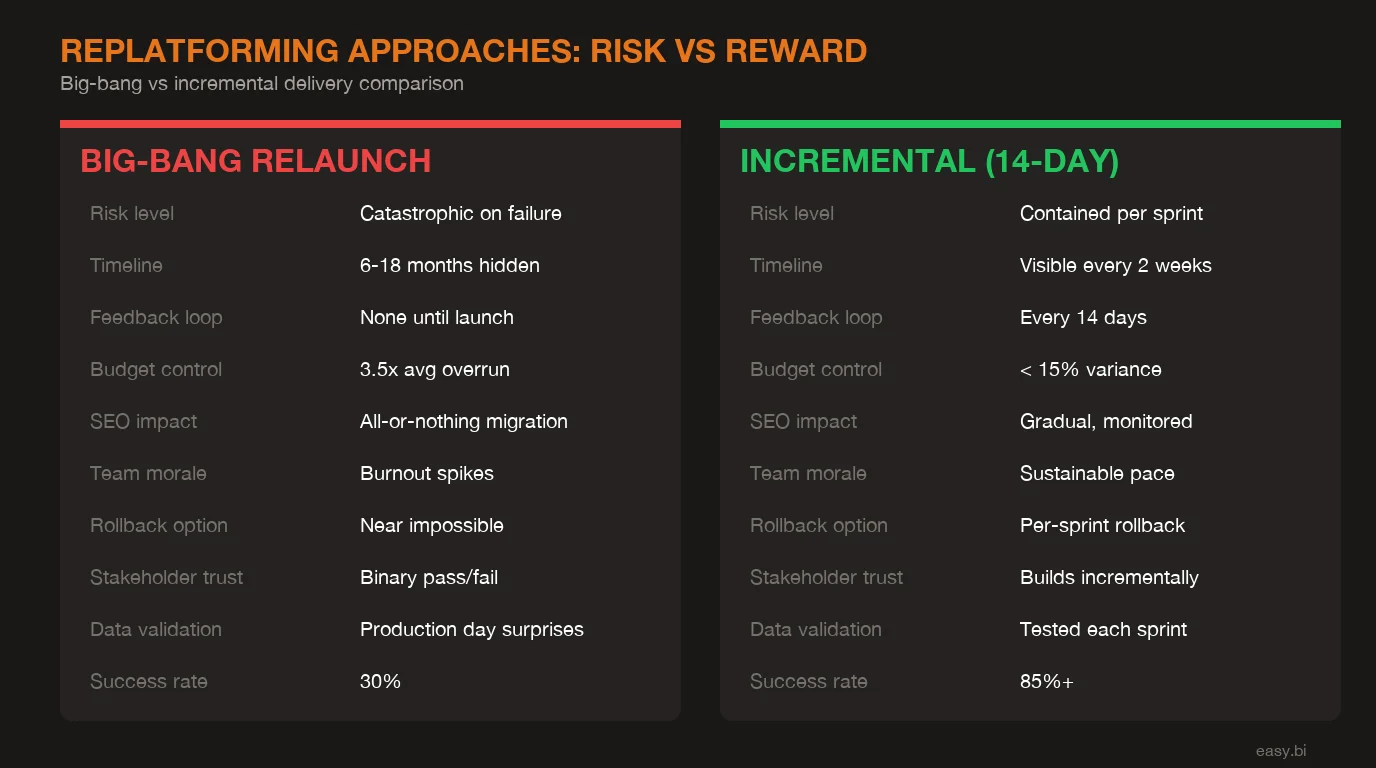
A big-bang cutover means running the old platform until Friday, flipping DNS to the new platform on Saturday, and hoping everything works by Monday morning. This approach fails 60-70% of the time for complex e-commerce systems.[1]
The math is against you. A mid-market e-commerce platform has 20-40 third-party integrations: payment providers, ERP, PIM, WMS, shipping carriers, tax calculation, fraud detection, email marketing, analytics, and more. Each integration has its own failure modes. Even if each integration has a 95% chance of working correctly on launch day, the probability that all 30 integrations work flawlessly in production simultaneously is 0.95^30 = 21%. That means a 79% chance that at least one critical integration fails on day one.
A German home goods retailer with EUR 18M in annual online revenue attempted a big-bang migration from a legacy custom platform to commercetools. Launch weekend, the ERP integration failed to sync inventory for 3,400 of their 12,000 SKUs. The payment provider webhook configuration had a URL mismatch that caused 15% of orders to process payment but not create order records. Customer service received 280 tickets in 48 hours. The team spent 3 weeks in emergency firefighting mode. Estimated revenue loss during the stabilization period: EUR 420K.
The alternative is phased migration. Move one product category or one geographic market at a time. Run both systems in parallel with a routing layer that sends traffic to the appropriate platform. This approach takes longer on paper - typically 2-3 months more than a big-bang timeline - but delivers faster in practice because it eliminates the 4-8 week stabilization crisis that follows most big-bang launches.
McKinsey data shows that IT projects with phased rollouts are 2.5x more likely to deliver on time and budget compared to big-bang approaches.[4] For e-commerce specifically, phased migration lets you validate revenue impact at each stage. If conversions drop after migrating the first category, you fix it before migrating the rest - instead of discovering problems when your entire business is on the new platform.
The 14-day sprint model works particularly well for phased migrations. Each sprint delivers a migrated category or feature set, tested against production traffic, with measurable acceptance criteria. If a sprint reveals a problem, the blast radius is limited to one category - not your entire business.
How to prevent it: Plan a phased migration with parallel running. Migrate one product category first. Monitor conversion rates, error rates, and revenue per session for 2 weeks. Fix issues. Migrate the next category. The routing layer adds EUR 15K-25K in additional engineering cost, but it is a fraction of the EUR 200K-500K cost of a failed big-bang launch. For shops doing EUR 10M+ annually, the insurance value alone justifies the investment.
What Happens When You Choose the Platform Before Defining Requirements?
This mistake usually starts at a conference or a vendor lunch. A senior stakeholder sees a demo of Platform X. The demo is impressive - they always are. The stakeholder returns to the office and announces the company is moving to Platform X. Requirements? Those come later. The decision is already made.
Gartner research indicates that 67% of enterprise technology purchases are influenced more by vendor marketing than by actual business requirements analysis.[3] In e-commerce, this leads to two specific and expensive problems.
First, the feature checklist fallacy. The team creates a checklist of required features and asks vendors to check boxes. Every enterprise platform checks every box - "yes, we support that" - because every feature exists in some form. The differences are in implementation quality, performance at scale, and total cost of ownership. A checkbox comparison cannot capture these differences. A EUR 200K platform selection based on checkboxes is not a technical decision - it is a marketing outcome.
Second, architecture mismatch. A retailer that needs heavy B2B functionality (custom pricing per account, approval workflows, quote management) picks a platform optimized for B2C because the B2C demo looked better. A retailer with 500,000 SKUs and complex product relationships picks a platform that performs well with 10,000 SKUs but degrades at scale. These mismatches surface 4-6 months into the project, when switching platforms means starting over.
A DACH sporting goods retailer with EUR 35M in combined B2B and B2C revenue selected a popular headless platform after a compelling demo focused on their B2C storefront. Six months into implementation, the team discovered that the platform's B2B module could not handle their tiered pricing logic for 2,400 wholesale accounts. Rebuilding the pricing engine as a custom microservice added EUR 120K and 3 months to the project. The total cost of not defining B2B requirements upfront: EUR 180K in additional development plus 4 months of delayed revenue from the new platform.
The cost of choosing wrong is not just the migration budget. It is the opportunity cost of 12-18 months spent on the wrong foundation, plus the cost of migrating again in 2-3 years when the platform's limitations become business constraints. For the broader impact of technology decisions that compound over time, see our analysis of legacy system hidden costs and how technical debt management prevents these situations from recurring.
How to prevent it: Write business requirements before talking to any vendor. Document your current transaction volume, SKU count, integration requirements, B2B vs B2C split, geographic markets, and 3-year growth projections. Define non-negotiable performance thresholds: page load time under 2 seconds, checkout capable of handling 500 concurrent sessions, API response time under 200ms. Then evaluate platforms against your requirements - not against each other's marketing.
+35% conversion. +22% AOV. EUR 50M+ GMV processed.
Our Shopware-certified team delivers e-commerce at scale with 14-day sprint cycles. 80% less manual work through system integrations.
Start with a Strategy CallWhat Does a Replatforming Done Right Look Like?
The five mistakes above share a common root cause: treating replatforming as a technology project instead of a business transformation. The platform is the tool. The goal is measurably better commerce performance - faster pages, higher conversion, lower operational costs, and a foundation that supports growth for the next 5-7 years. Forrester estimates that companies spend USD 1.8 trillion per year on digital transformation initiatives, with a 70% failure rate driven primarily by poor planning, not poor technology.[4]
A properly executed replatforming follows a specific sequence. Requirements and data audit come first (4-6 weeks). Platform evaluation against documented criteria comes second (3-4 weeks). Architecture and migration planning comes third (3-4 weeks). Only then does implementation begin - with phased delivery, continuous monitoring, and SEO protection baked into every sprint.
The total investment for a mid-market replatforming done right ranges from EUR 250K to EUR 600K depending on catalog complexity and integration count. The investment for a replatforming done wrong - the project that overruns, loses organic traffic, and requires emergency fixes - ranges from EUR 600K to EUR 1.2M for the same scope.[1]
At easy.bi, we run replatforming projects in 14-day sprints with measurable deliverables at each stage. Each sprint produces working, tested functionality - not documents and promises. If you are planning a replatforming or recovering from one that went wrong, start with a technical assessment. We will tell you what it will actually take - including the parts that vendor demos do not cover.
Frequently Asked Questions
How long does an e-commerce replatforming project typically take?
For mid-market retailers (EUR 10-50M online revenue), replatforming takes 6-14 months depending on catalog complexity and integration count. Data migration alone accounts for 30-40% of that timeline. Projects that skip proper planning regularly exceed 18 months and double their original budget.
What is the average cost of a failed e-commerce replatforming?
Failed replatforming projects cost 2.5-3x the original budget on average. For a mid-market DACH retailer, that translates to EUR 400K-800K in direct costs plus EUR 200K-500K in lost revenue during extended downtime, SEO recovery, and team productivity loss. The total impact regularly exceeds EUR 1M.
Should we migrate to a headless commerce platform?
Headless is the right architecture for teams with dedicated frontend engineering capacity and complex multi-channel requirements. It is the wrong choice for teams that picked it because a vendor demo looked impressive. Define your actual requirements - API needs, channel strategy, team skills - before deciding on architecture.
References
- [1] McKinsey - Delivering Large-Scale IT Projects On Time and On Budget (2024)
- [2] IBM - Data Migration: Costs, Risks, and Best Practices (2023)
- [3] Gartner - Data Migration Success Rates and Enterprise Technology Purchasing Trends (2024)
- [4] Forrester - Total Economic Impact of E-Commerce Replatforming (2024)
- [5] Pendo - State of Software: Feature Adoption and Usage Data (2023)
- [6] Wolfgang Digital - E-Commerce KPI Benchmarks: Traffic Sources (2024)
- [7] Ahrefs - Site Migration SEO: Traffic Recovery Timelines and Data (2023)
- [8] Search Engine Land - Structured Data and Rich Results CTR Impact Study (2024)
Explore Other Topics
Ready to scale your e-commerce?
30-minute call with an engineering lead. No sales pitch - just honest answers about your project.
98% engineer retention · 14-day delivery sprints · No lock-in contracts
Related Reading

The True Cost of Disconnected E-Commerce Systems (ERP, PIM, CRM)
Disconnected ERP, PIM, and CRM systems cost mid-market retailers 80+ hours of manual work per week and 23% in lost revenue. Learn the API-first integration architecture that eliminates data silos.
Enno Bassen
E-Commerce Conversion Optimization: The 35% Improvement Framework
A systematic 6-lever framework that delivers +35% conversion rate and +22% AOV for DACH e-commerce. Page speed, checkout, product UX, search, cross-sell, and mobile optimization with measurable benchmarks.
Enno Bassen
How REWE Runs Multi-Country E-Commerce on 14-Day Sprint Cycles
How enterprise retailers like REWE ship e-commerce features every 14 days. The sprint delivery model, team structure, and QA gates.
Enno Bassen