When Does Off-the-Shelf Software Start Costing You More Than Custom?

Table of Contents+
- Why Does "Good Enough" Software Stop Being Good Enough?
- What Are the Hidden Costs That Vendor Pricing Pages Never Show?
- Where Is the Crossover Point Where Custom Becomes Cheaper?
- When Does Off-the-Shelf Still Win?
- When Does Custom Software Deliver a Clear Advantage?
- Is the Hybrid Approach the Best of Both Worlds?
- What Does the Build Decision Actually Look Like in Practice?
- How Do You Mitigate the Risk of Going Custom?
- What Does the Cost Equation Look Like for DACH Mid-Market Companies?
- How Do You Start the Transition Without Disrupting Operations?
- References
TL;DR
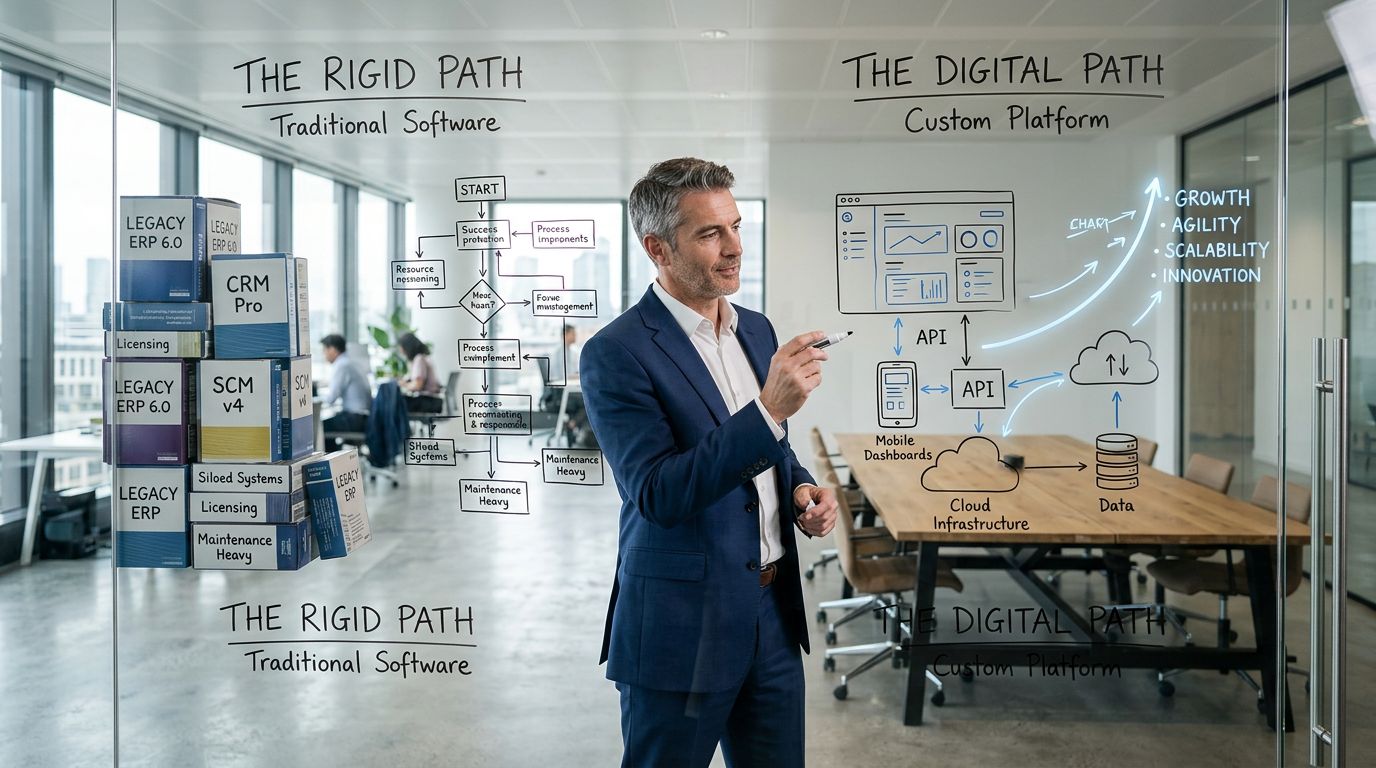
Off-the-shelf software looks like the rational choice until you add up what it actually costs.
Key Takeaways
- •Off-the-shelf software that costs EUR 50,000 in year one often reaches EUR 250,000+ by year three when you add customization fees, per-seat pricing at scale, integration middleware, and workaround labor - making the total cost of ownership 40% higher than a purpose-built alternative.
- •The crossover point where custom becomes cheaper than off-the-shelf typically hits when your company has 50+ users, more than 3 system integrations, or business logic that requires workarounds in the standard product - most DACH mid-market companies pass this threshold by year two.
- •Per-seat SaaS pricing is a growth tax that punishes success. A platform charging EUR 50 per user per month costs EUR 3,000 monthly for 60 users - EUR 36,000 annually for software your team spends 30% of their time working around rather than working with.
- •Custom software delivers 3x operational efficiency gains through process automation because it matches your actual workflows instead of forcing your team to adapt to someone else's assumptions about how your business should operate.
- •The hybrid approach - SaaS for commodity functions like email and accounting, custom for competitive differentiators - gives most mid-market companies the best cost-to-value ratio while avoiding both over-engineering and vendor dependency traps.
Off-the-shelf software hides costs in customization fees, per-seat pricing, and workaround labor. Learn when custom becomes 40% cheaper.
Off-the-shelf software looks like the rational choice until you add up what it actually costs. This article breaks down the hidden expenses that turn a EUR 50,000 annual license into a EUR 250,000+ total cost of ownership - and provides a decision framework for when building custom software delivers 40% lower TCO with 3x the operational efficiency.
Why Does "Good Enough" Software Stop Being Good Enough?
Every enterprise software purchase starts with the same pitch: fast deployment, proven features, lower risk than building from scratch. And for the first 6-12 months, the pitch holds up. The platform works. The team adapts. The business processes bend to fit the tool's assumptions.
Then the friction starts. A workflow that should take 3 clicks takes 11. A report that should run in real time requires a nightly batch export and a spreadsheet. An integration that should be seamless needs a middleware layer that costs EUR 2,000 per month and breaks every time the vendor pushes an update.
This is the "good enough" trap. The software is not broken - it is just slowly, steadily making everything harder. 70% of digital transformations fail to reach their stated goals[1], and a significant portion of those failures trace back to platform limitations that accumulated over years of workarounds.
The danger is that each individual workaround seems minor. A custom Excel macro here, a manual data entry step there, an API middleware subscription to bridge two systems that should talk to each other natively. No single workaround justifies replacing the platform. But the aggregate cost of 20 workarounds running simultaneously across 60 users is a different calculation entirely.
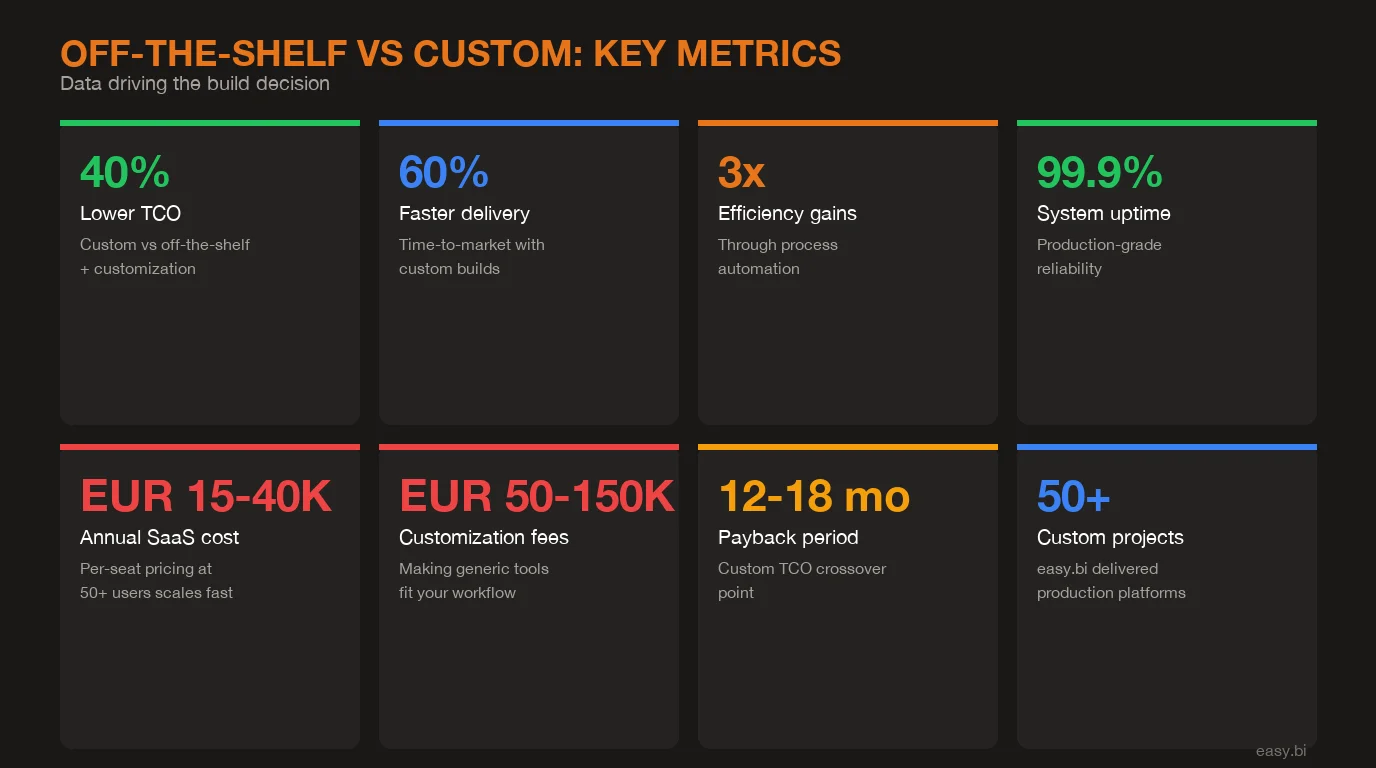
See how we deliver 60% faster time-to-market with 40% lower TCO than off-the-shelf.
What Are the Hidden Costs That Vendor Pricing Pages Never Show?
The license fee is the number on the pricing page. It is also the smallest line item in total cost of ownership. After working with DACH mid-market companies on 50+ custom projects since 2015, I have seen the same hidden costs appear in every off-the-shelf deployment that outgrows its original scope.
Customization fees. Enterprise SaaS vendors charge EUR 150-300 per hour for platform customization. A mid-complexity configuration project - custom fields, workflow automations, role-based permissions, and reporting dashboards - typically runs EUR 30,000-80,000. And those customizations break with every major platform update, triggering additional maintenance fees. The average cost overrun on software projects is 66%[2], and customization-driven scope creep is a primary contributor.
Per-seat pricing at scale. A SaaS tool at EUR 50 per user per month seems reasonable for a 10-person team - EUR 6,000 annually. Scale to 60 users and that becomes EUR 36,000 per year. Scale to 200 and it is EUR 120,000. Per-seat pricing is a growth tax that punishes success. Your revenue grows linearly, but your software costs grow with headcount regardless of whether each user extracts proportional value.
Integration middleware. Off-the-shelf tools rarely talk to each other without help. The average mid-market enterprise runs 15-30 business applications[3]. Connecting them requires iPaaS platforms (EUR 12,000-60,000 annually), custom API adapters, or manual data transfers. Each integration point is a maintenance burden and a potential failure point.
Workaround labor. This is the cost nobody tracks. When your CRM does not support your actual sales process, your team builds workarounds - spreadsheets, manual steps, copy-paste operations between systems. Developers spend 41% of their time on maintenance and technical debt rather than new feature development[4]. For non-technical staff working around platform limitations, that percentage is often higher.
API rate limits and data access fees. Many SaaS vendors restrict API calls per month, charge for data exports, or limit webhook integrations on lower-tier plans. When your business needs real-time data synchronization across systems, these limits become functional bottlenecks that force expensive plan upgrades.
Where Is the Crossover Point Where Custom Becomes Cheaper?
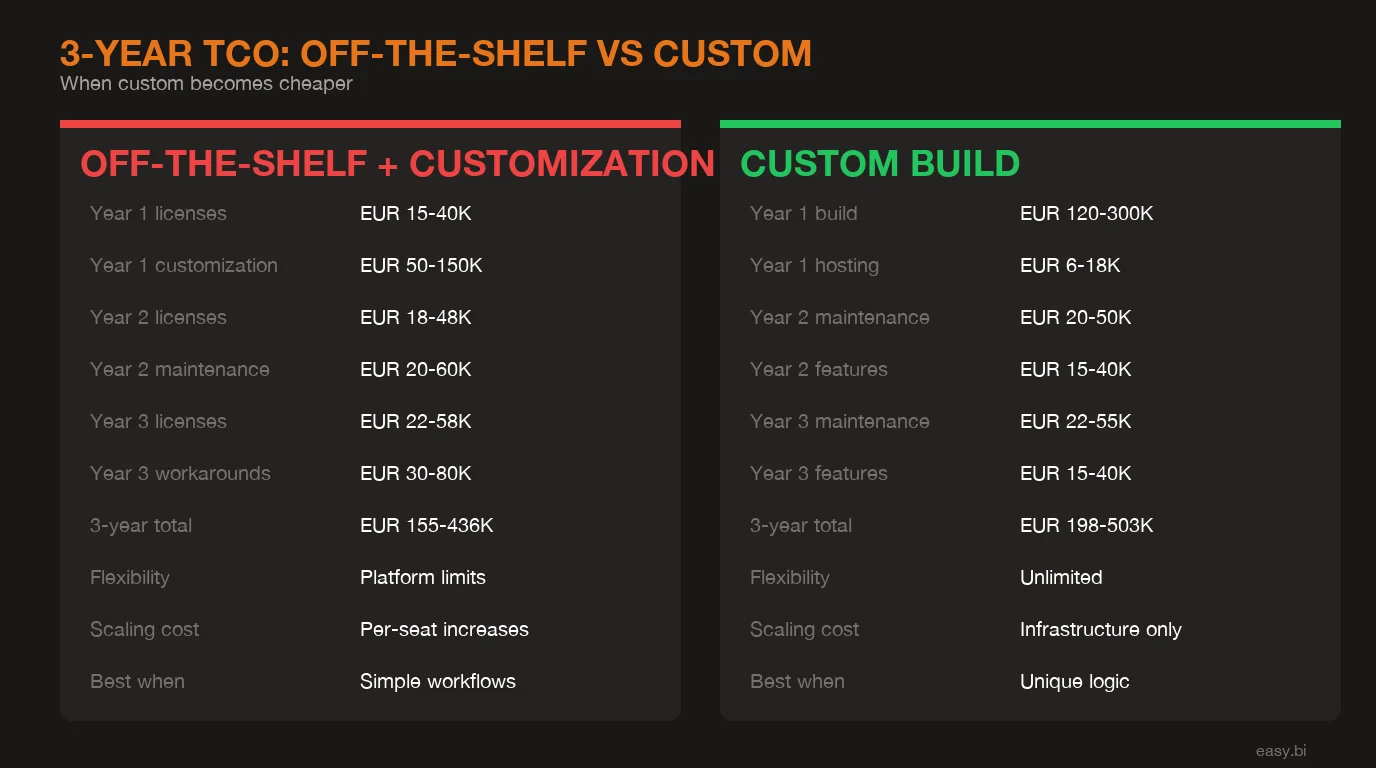
The crossover point is not a fixed number - it depends on user count, integration complexity, and how far your business processes deviate from what the off-the-shelf tool assumes. But the pattern is consistent enough to model.
| Cost Category | Off-the-Shelf (3-Year TCO) | Custom Build (3-Year TCO) |
|---|---|---|
| Year 1: License / Development | EUR 60,000 | EUR 150,000 |
| Year 1: Customization / Configuration | EUR 45,000 | EUR 0 (built to spec) |
| Year 1: Integration | EUR 25,000 | EUR 20,000 |
| Year 2: License renewal + seat growth | EUR 85,000 | EUR 0 |
| Year 2: Maintenance + updates | EUR 30,000 | EUR 35,000 |
| Year 2: Additional customization | EUR 35,000 | EUR 25,000 (new features) |
| Year 3: License renewal + seat growth | EUR 110,000 | EUR 0 |
| Year 3: Maintenance + workarounds | EUR 40,000 | EUR 30,000 |
| Year 3: Opportunity cost (lost efficiency) | EUR 50,000 | EUR 10,000 |
| 3-Year Total | EUR 480,000 | EUR 270,000 |
This model reflects what we see across DACH mid-market engagements: a company with 60-100 users, 5+ system integrations, and business logic that does not fit standard SaaS assumptions. The off-the-shelf path costs 40% more over 3 years[5] - and that gap widens every year as licensing scales with headcount while custom maintenance stays flat.
The crossover typically hits in month 18-24. Year one favors off-the-shelf because the upfront development cost for custom is higher. By year two, the compounding license fees, customization charges, and workaround labor shift the balance. By year three, it is not close.
When Does Off-the-Shelf Still Win?
Custom software is not always the right answer. Off-the-shelf wins in specific, well-defined scenarios - and being honest about those scenarios is what separates good advice from a sales pitch.
Small teams with standard workflows. A 15-person company running a standard sales pipeline does not need a custom CRM. HubSpot or Pipedrive at EUR 50 per user per month is the correct choice. The business process matches the tool's assumptions, the team is small enough that per-seat costs stay manageable, and the integration requirements are minimal.
Commodity functions. Email, basic accounting, HR administration, project management for internal teams - these are solved problems where off-the-shelf tools deliver 95% of what any company needs. Building a custom email client or accounting system is almost never justified.
Speed-to-deploy requirements. When you need a solution running in 2 weeks, not 2 months, off-the-shelf is the pragmatic choice. A startup validating product-market fit should not build custom infrastructure - they should use Shopify, Stripe, and Notion until they have enough users and revenue to justify custom tooling.
The decision is straightforward: if your needs match 80%+ of what a standard tool provides, and per-seat costs stay below 5% of revenue, off-the-shelf is the right choice. Below those thresholds, you are paying for simplicity. Above them, you are paying a tax on growth.
When Does Custom Software Deliver a Clear Advantage?
Custom software wins when the gap between what your business needs and what off-the-shelf provides creates measurable cost or efficiency losses. In my experience building software for DACH enterprises over the past decade, four conditions reliably signal the crossover point.
Unique business logic. If your competitive advantage depends on processes that no standard tool supports, every workaround is eroding that advantage. A logistics company with proprietary routing algorithms cannot run on generic fleet management software without stripping out the logic that differentiates them. Custom platforms deliver 3x operational efficiency gains through process automation[5] precisely because they match actual workflows instead of forcing generic ones.
50+ users with complex roles. Per-seat licensing at scale is a compounding cost. But the bigger issue is role complexity. When your organization has 8 different permission levels, 12 workflow variants, and 5 approval chains, configuring an off-the-shelf tool to handle all of them costs more than building a system designed for your actual org chart.
Complex integrations. When your platform needs to exchange real-time data with ERP, CRM, warehouse management, payment processing, and business intelligence tools, the integration layer becomes the product. Off-the-shelf tools treat integrations as add-ons. Custom systems treat them as core architecture. API-first companies grow revenue 38% faster than those without an API strategy[6] - partly because their systems communicate without friction.
Competitive differentiation. If the software your team uses every day is identical to what your competitors use, your operational efficiency ceiling is identical too. Custom software that automates your specific processes, surfaces your specific metrics, and supports your specific customer experience creates separation that off-the-shelf tools structurally cannot provide.
Is the Hybrid Approach the Best of Both Worlds?
For most mid-market companies, the answer is not "all custom" or "all off-the-shelf" - it is a deliberate hybrid. Use SaaS for commodity functions. Build custom where your business logic creates competitive advantage. Connect them with API-first architecture.
The hybrid model works when you apply a clear rule: standardize the undifferentiated, customize the strategic. Your accounting does not differentiate you - use DATEV or SAP Business One. Your customer onboarding process does differentiate you - build it custom. Your email works fine with Microsoft 365. Your production planning system that coordinates 4 warehouses across 3 countries needs to match your actual operations, not a vendor's template.
The technical key to making hybrid work is API-first architecture. When every component communicates through documented, versioned APIs, swapping one tool for another is an integration project, not a migration crisis. Your custom order management system talks to Shopify's API today and can talk to a custom e-commerce frontend tomorrow without rebuilding the core logic.
Where companies go wrong with hybrid is treating integration as an afterthought. The middleware layer between your SaaS tools and custom systems needs the same architectural discipline as the custom systems themselves. Build it with proper error handling, monitoring, and documentation - or it becomes the most fragile part of your stack. For a deeper look at how this architectural approach prevents vendor dependency, read our guide on escaping vendor lock-in.
50+ custom projects. 99.9% uptime. 60% faster.
Senior-only engineering teams deliver production-grade platforms in under 4 months. No juniors on your project.
Start with a Strategy CallWhat Does the Build Decision Actually Look Like in Practice?
The decision to go custom is not a single moment - it is a progression. I have watched dozens of DACH companies walk the same path: adopt SaaS, customize SaaS, hit limitations, evaluate custom, build custom. The companies that save the most money are the ones who recognize the crossover point early instead of spending another EUR 100,000 on workarounds.
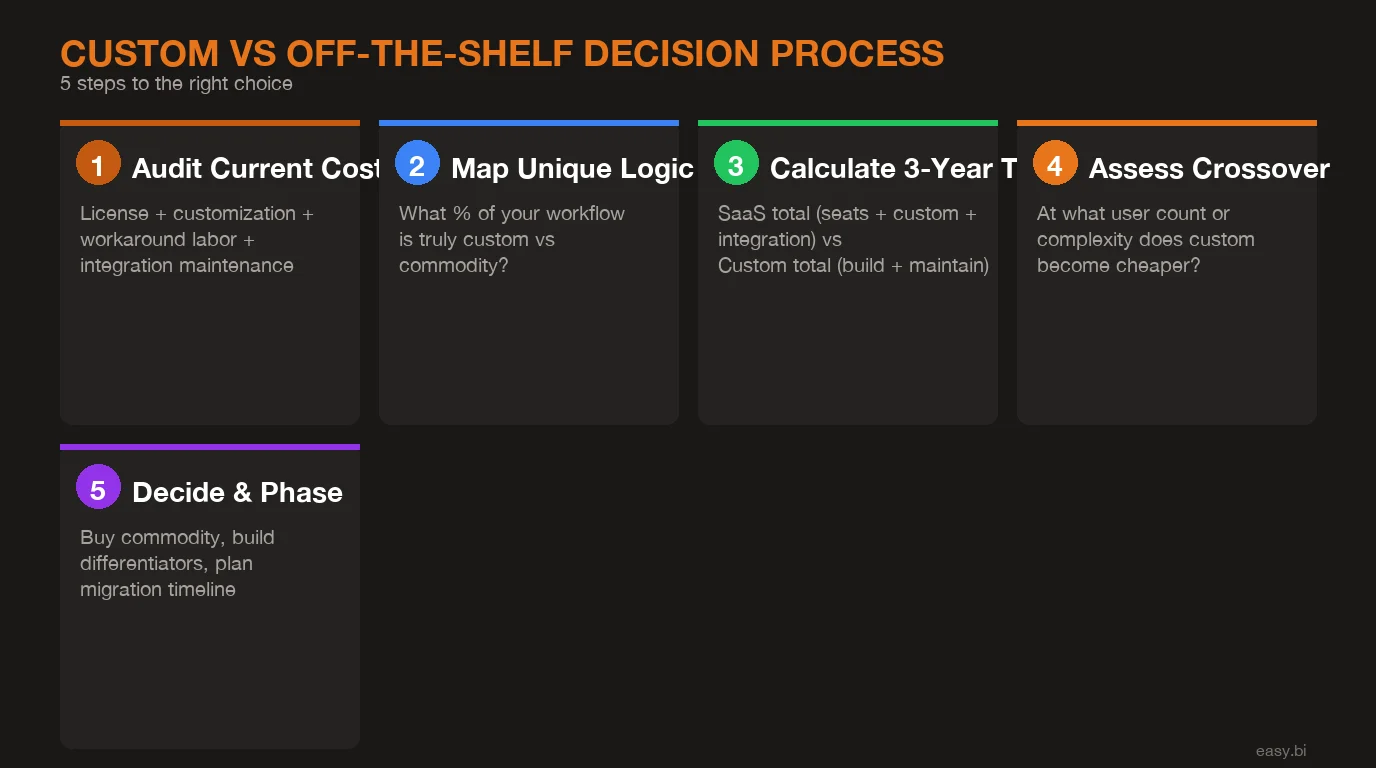
A practical build decision follows four steps. First, audit your current TCO honestly - not just license fees, but customization costs, integration costs, and workaround labor across every team that touches the platform. Most companies underestimate their true off-the-shelf costs by 40-60% because the expenses are scattered across department budgets.
Second, map the gaps. Document every workaround, every manual step, every feature request that the vendor cannot or will not build. Quantify the time cost in hours per week and multiply across your user base. This gap analysis usually reveals that your team spends 15-25 hours per week compensating for platform limitations.
Third, scope a custom alternative. Not a complete replacement of everything - start with the highest-pain workflows where the gap between need and capability is largest. A focused custom build addressing your top 3 pain points can be scoped, built, and deployed in 8-12 weeks with 14-day sprint delivery.
Fourth, run the 3-year TCO comparison. Include every cost category from the table above. If custom wins by 20%+ over 3 years, the decision is clear. If the margin is smaller, factor in the operational efficiency gains and competitive advantage that a purpose-built tool provides. For a parallel analysis in the e-commerce space, see our breakdown of the build vs. buy decision for e-commerce platforms.
How Do You Mitigate the Risk of Going Custom?
The most common objection to custom software is risk: what if the project fails, goes over budget, or takes twice as long as planned? These are legitimate concerns. 66% of software projects exceed their original budget[2]. The question is how to structure the engagement to contain that risk.
Start with a discovery phase. A 2-4 week discovery engagement that produces a technical specification, architecture proposal, and realistic estimate costs EUR 10,000-25,000 and eliminates the largest source of project risk: building the wrong thing. Discovery is not overhead - it is insurance against EUR 200,000 mistakes.
Demand fixed-scope, iterative delivery. Every sprint should produce working software. At easy.bi, we deliver in 14-day sprint cycles - meaning you see functional progress every 2 weeks, not after 6 months of development behind closed doors. If the direction is wrong, you catch it in week 2, not month 6.
Own your code from day one. Your codebase should live in your repository, built on open-source frameworks that any competent engineering team can maintain. If the engagement ends, you walk away with documented, standards-based code - not a proprietary artifact that only one vendor can touch. 89% of IT leaders say technical debt limits their ability to innovate[7]. Vendor-dependent custom code is one of the most expensive forms of that debt.
Measure outcomes, not hours. The right development partner is accountable for system uptime, delivery velocity, and business outcomes - not just billed hours. Custom platforms built with proper engineering practices achieve 99.9% system uptime[5] because they are designed for your specific load patterns and failure modes, not for a generic "average customer."
What Does the Cost Equation Look Like for DACH Mid-Market Companies?
The DACH market has specific dynamics that make the off-the-shelf hidden cost problem more acute than in other regions. Germany's IT specialist shortage of 149,000 positions[8] means the workaround labor cost is higher - every hour your team spends compensating for platform limitations is an hour of expensive, scarce talent that could be building competitive advantage instead.
At easy.bi, we have seen the TCO math play out across 50+ custom projects for companies like Siemens, Lekkerland, and WeberHaus. The pattern is consistent: clients who switch from heavily customized off-the-shelf platforms to purpose-built solutions see 40% lower TCO over 3 years, 60% faster time-to-market for new features, and 3x operational efficiency gains through process automation that matches their actual workflows.
Those numbers are not theoretical. They come from measuring the before and after across real engagements where we replaced SaaS platforms that had accumulated years of customization debt with custom systems designed for the client's specific business logic.
The 99.9% uptime figure comes from the same dataset. Off-the-shelf platforms deliver high uptime for their core functionality, but the middleware, integrations, and workarounds around them introduce failure points that the vendor's SLA does not cover. A custom system with proper DevOps practices eliminates those peripheral failure points because the entire stack is designed and monitored as one unit.
For a broader view of how legacy systems and accumulated workarounds compound into strategic liabilities, read our analysis of the true cost of legacy systems - the dynamics are nearly identical whether the legacy system is a 15-year-old on-premise installation or a 3-year-old SaaS platform buried under customizations.
How Do You Start the Transition Without Disrupting Operations?
The transition from off-the-shelf to custom does not require a big-bang replacement. The approach that delivers the lowest risk and fastest value follows the strangler fig pattern: build the custom replacement alongside the existing system, migrate workflows incrementally, and decommission the old platform only after the new one is proven in production.
Start with the highest-pain workflow. Identify the process where off-the-shelf limitations cost the most in time, errors, or missed opportunities. Build a custom replacement for that single workflow. Deploy it. Validate it with real users. Then move to the next workflow.
This incremental approach means your team never faces a hard cutover. The old system handles everything except the workflows you have already migrated. Risk is contained to one workflow at a time. And each successful migration builds organizational confidence in the custom approach before you commit to the next phase.
The typical timeline for a first workflow migration is 8-12 weeks from kickoff to production. By month 6, most clients have migrated 3-5 core workflows and can already measure the TCO improvement. By month 12, the old platform handles only peripheral functions - and the license renewal conversation looks very different when you can credibly threaten to walk away.
References
- [1] McKinsey (2023). "70% of digital transformations fail to reach their stated goal mckinsey.com
- [2] PMI (2024). "The average cost overrun on software projects is 66% of original bu pmi.org
- [3] MuleSoft / Salesforce (2024). mulesoft.com
- [4] Stripe (2023). "The average developer spends 41% of their time on maintenance an
- [5] easy.bi (2026). Internal data from 50+ custom software projects for DACH mid-mar
- [6] MuleSoft / Salesforce (2023). "API-first companies grow revenue 38% faster. mulesoft.com
- [7] McKinsey (2024). "89% of IT leaders say technical debt impacts their ability to mckinsey.com
- [8] Bitkom (2024). "Germany faces a shortage of 149,000 IT specialists." bitkom.
Explore Other Topics
Ready to build your custom platform?
30-minute call with an engineering lead. No sales pitch - just honest answers about your project.
98% engineer retention · 14-day delivery sprints · No lock-in contracts
Related Reading

What Does Custom Software Development Actually Cost in 2026?
Real cost breakdown for custom software in 2026. DACH vs. Eastern Europe vs. offshore rates, 5-year TCO, and EUR pricing by project type.
Christian Kaspar
The 7 Reasons Custom Software Projects Go Over Budget
Data-driven analysis of 7 reasons custom software projects blow budgets. Root causes, real cost impact, and prevention strategies for each.
Filip Kralj
Building Custom Software That Doesn't Fail: A CTO's Framework
66% of custom software projects fail. This CTO's framework covers discovery, API-first architecture, tech stack selection, 14-day delivery cycles, and technical debt management to beat the odds.
Filip Kralj