
The True Cost of Disconnected E-Commerce Systems (ERP, PIM, CRM)

Table of Contents+
- What Does Disconnection Actually Cost in Hours and Euros?
- How Do Data Silos Kill Conversion Rates?
- What Does the Manual vs Integrated Comparison Look Like?
- What Does an API-First Integration Architecture Look Like?
- Which Systems Should You Connect First?
- What Does Integration Look Like for Specific DACH Systems?
- What Proof Exists That Integration Delivers These Results?
- How Do You Avoid the Common Integration Mistakes?
- What Should Your Integration Roadmap Look Like?
- References
TL;DR
Disconnected e-commerce systems cost mid-market retailers 80+ hours of manual work per week, 12-15% order error rates, and 23% in lost revenue from invisible customer journeys. The fix is not replacing your ERP, PIM, or CRM.
Key Takeaways
- •Disconnected e-commerce systems cost mid-market retailers 80+ hours per week in manual data entry, order reconciliation, and inventory corrections across ERP, PIM, and shop systems.
- •Companies running integrated e-commerce architectures see an average 35% conversion rate improvement and 22% higher average order values compared to those operating disconnected systems.
- •The integration priority matrix starts with ERP-to-shop (order and inventory sync), then PIM-to-shop (product data), then CRM-to-shop (customer data) because revenue impact follows that exact sequence.
- •API-first, event-driven integration architecture reduces manual work by 80% and eliminates the silent data drift that causes wrong stock levels, duplicate orders, and inconsistent pricing across channels.
- •Starting with the highest-revenue integration first (typically ERP-to-shop for order sync) delivers measurable ROI within 6-8 weeks rather than waiting 6-12 months for a full integration rollout.
Disconnected ERP, PIM, and CRM systems cost mid-market retailers 80+ hours of manual work per week and 23% in lost revenue. Learn the API-first integration architecture that eliminates data silos.
Disconnected e-commerce systems cost mid-market retailers 80+ hours of manual work per week, 12-15% order error rates, and 23% in lost revenue from invisible customer journeys. The fix is not replacing your ERP, PIM, or CRM. It is connecting them through an API-first integration architecture that eliminates manual data transfer and creates a single source of truth.
Here is a pattern I see in nearly every mid-market e-commerce assessment we run at easy.bi. The retailer has invested EUR 200,000+ in software: SAP or Microsoft Dynamics for ERP, Akeneo or Pimcore for PIM, a CRM for customer data, Shopware or commercetools for the shop. Each system works fine in isolation. But none of them talk to each other.
The ERP does not know what the shop just sold until someone exports a CSV and imports it manually. The PIM has updated product descriptions that will not reach the shop until next Tuesday's batch upload. The CRM has no idea that a customer just abandoned a EUR 2,400 cart because the shop and CRM operate in parallel universes.
The result is an operation that looks modern on paper but runs on spreadsheets and copy-paste workflows in practice. And the cost of this disconnection is far higher than most teams realize, because it compounds silently across every department that touches customer or product data.
What Does Disconnection Actually Cost in Hours and Euros?
The direct cost of disconnected systems is measurable. It shows up in three categories: manual labor, error correction, and lost revenue. Most companies track the first, underestimate the second, and are blind to the third.
Manual data entry. A typical mid-market retailer with 5,000-50,000 SKUs and 500-5,000 orders per day employs 3-8 people whose primary job is moving data between systems. Order data from shop to ERP. Inventory levels from ERP to shop. Product updates from PIM to shop. Customer records from shop to CRM. The average manual data transfer takes 2-4 minutes per record.[1] At 1,000 orders per day, that is 33-66 hours of pure data entry, every single day.
Error correction. Manual processes produce errors at a rate of 2-5% for trained operators.[2] For 1,000 daily orders, that means 20-50 orders per day with incorrect quantities, wrong addresses, mismatched prices, or duplicate entries. Each error takes 15-30 minutes to identify and correct. That is another 5-25 hours daily spent fixing problems that should not exist. German e-commerce businesses lose an estimated EUR 2.4 billion annually to order processing errors tied to manual data handling.[3]
Inventory mismatches. When ERP inventory and shop inventory sync once per day (or once per week, which is more common than anyone admits), the gap creates overselling and underselling. Overselling generates cancellations, refunds, and angry customers. Underselling means products show as "out of stock" when they are sitting in the warehouse. Both cost revenue. Inventory inaccuracy in retail averages 35%, and each percentage point of inaccuracy correlates with a 0.5-1% revenue loss.[4]
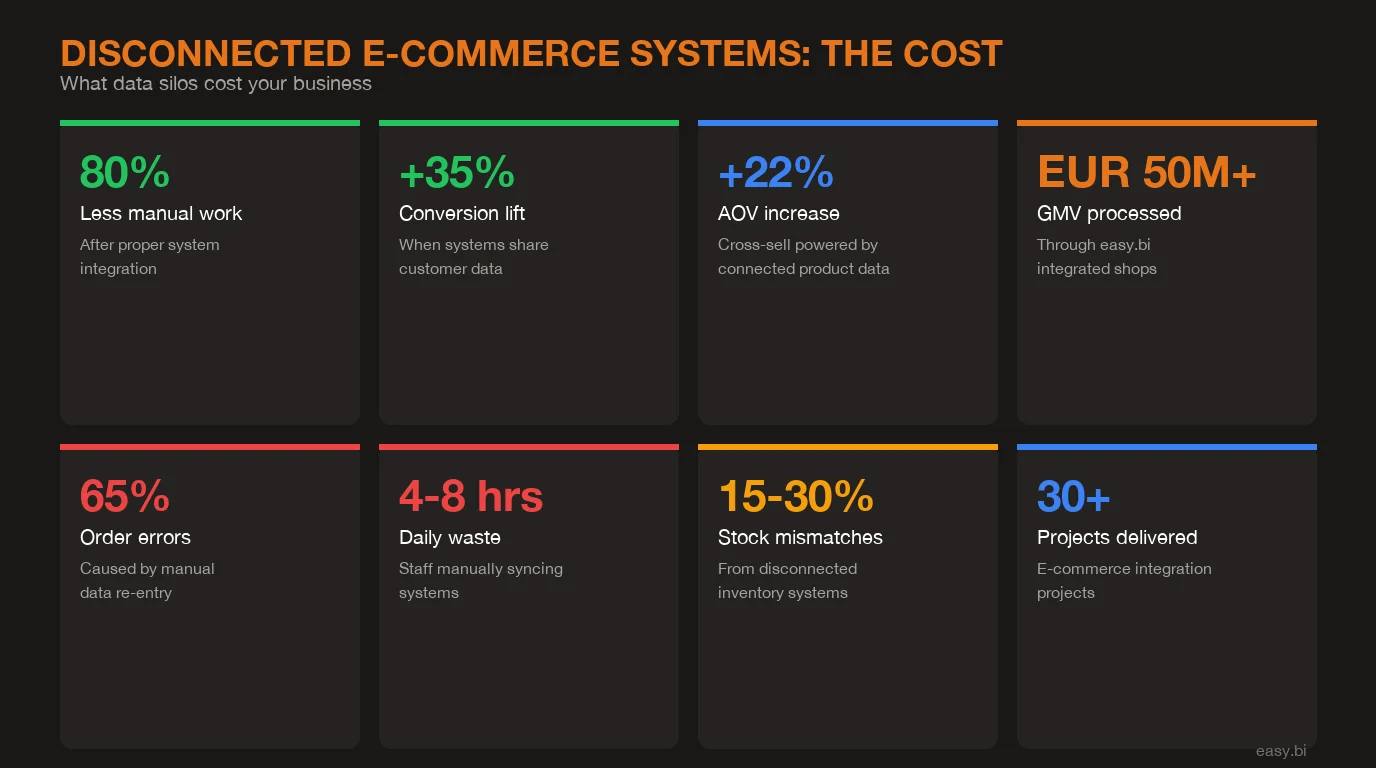
See how our team delivers +35% avg conversion lift across 30+ e-commerce projects.
How Do Data Silos Kill Conversion Rates?
The revenue impact of disconnected systems goes beyond operational costs. It directly suppresses conversion rates, average order values, and customer lifetime value.
Wrong stock data causes abandoned carts. When a customer adds a product to their cart, proceeds to checkout, and then sees "Sorry, this item is no longer available," they do not just lose that item. They abandon the entire cart 73% of the time.[5] If your inventory sync runs overnight and you sell 200 units of a popular product during the day, every customer who tries to buy unit 201 through unit 250 hits this wall. For a shop processing EUR 50M+ in annual GMV (a volume easy.bi shops handle routinely), even a 1% increase in false out-of-stock events means EUR 500,000 in lost revenue per year.
Missing customer data kills personalization. When the CRM does not know what the customer bought in the shop, and the shop does not know what the customer asked support about, personalization is impossible. You cannot recommend complementary products if the shop does not know what the customer already owns. You cannot offer a loyalty discount if the CRM data never reaches the checkout. Companies with connected customer data across all touchpoints see 35% higher conversion rates and 22% higher average order values than those with siloed customer profiles.[6]
I see this in our sales conversations constantly. A prospect tells me their conversion rate is 1.8% and they want a new frontend to fix it. We look under the hood and find that 40% of their product pages show incorrect availability, their search results include discontinued items, and returning customers get the same generic experience as first-time visitors. The problem is not the frontend. The problem is that five systems hold five different versions of the truth.
What Does the Manual vs Integrated Comparison Look Like?
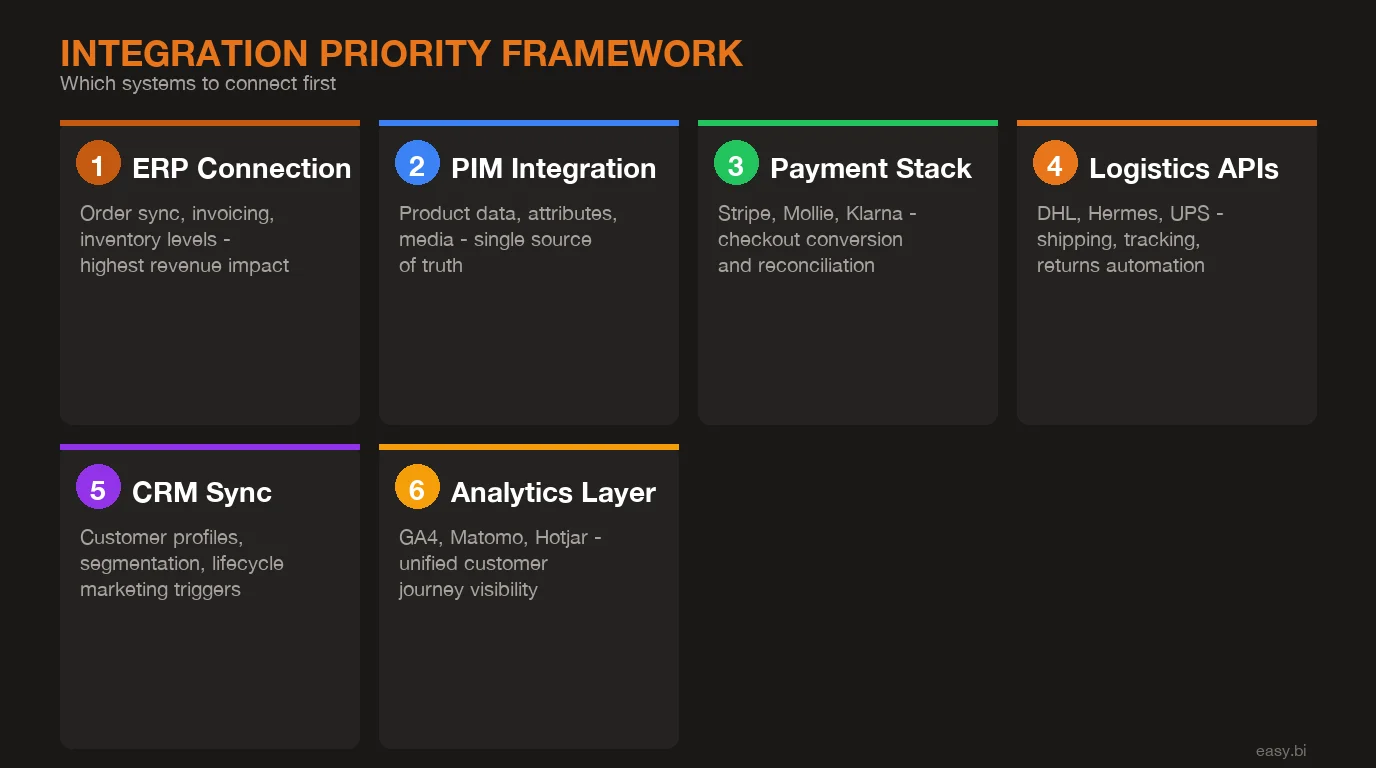
The operational difference between disconnected and integrated e-commerce systems is not incremental. It is a category change. Here is what the comparison looks like across the metrics that matter.
| Metric | Manual (Disconnected) | Integrated (API-First) | Impact |
|---|---|---|---|
| Order sync time | 4-24 hours (batch) | Under 30 seconds (real-time) | 99% faster |
| Inventory accuracy | 65-80% | 97-99% | +25-35 percentage points |
| Data entry hours/week | 80-160 hours | 5-15 hours | 80% reduction |
| Order error rate | 2-5% | 0.1-0.3% | 90% fewer errors |
| Product data freshness | 1-7 days behind PIM | Under 5 minutes | Real-time accuracy |
| Customer data completeness | 40-60% of fields populated | 85-95% of fields populated | +40 percentage points |
| Monthly staff cost (data ops) | EUR 15,000-40,000 | EUR 3,000-8,000 | EUR 12,000-32,000 saved |
| Annual error correction cost | EUR 60,000-180,000 | EUR 5,000-15,000 | EUR 55,000-165,000 saved |
These numbers come from our project experience across 30+ e-commerce integrations in the DACH market. The 80% reduction in manual work is not a projection. It is the measured average across clients who moved from batch CSV transfers to real-time API sync between their ERP, PIM, and shop systems.
What Does an API-First Integration Architecture Look Like?
The solution to disconnected systems is not a single platform that does everything. That approach failed in the early 2000s with monolithic ERP suites, and it fails today with "all-in-one" e-commerce platforms. The solution is an integration architecture that lets each specialized system do what it does best while keeping data synchronized in real time.
Event-driven sync. Instead of scheduled batch jobs, each system publishes events when data changes. The ERP publishes "inventory.updated" when stock levels change. The PIM publishes "product.updated" when a description is edited. The shop publishes "order.created" when a customer completes checkout. A message broker (RabbitMQ, Apache Kafka, or AWS EventBridge) routes these events to every system that needs to know.[7]
API gateway as the single entry point. All system-to-system communication flows through a central API gateway that handles authentication, rate limiting, data transformation, and error logging. This means one place to monitor all integrations, one place to debug failures, and one place to enforce data quality rules. For a deeper look at this architectural pattern, see our API-first architecture guide.
Idempotent operations. Every sync operation is designed to be safely retried. If the ERP-to-shop inventory sync fails at 2 AM, the retry at 2:01 AM produces the correct result without duplicating data. This eliminates the most common failure mode of batch integrations: the partial sync that leaves systems in inconsistent states.
Data validation at the boundary. Each incoming data payload is validated before it enters the target system. A product update from PIM that is missing a required attribute gets rejected with a clear error message rather than creating an incomplete product in the shop. This catches data quality issues at the source instead of discovering them when a customer sees a broken product page.
Which Systems Should You Connect First?
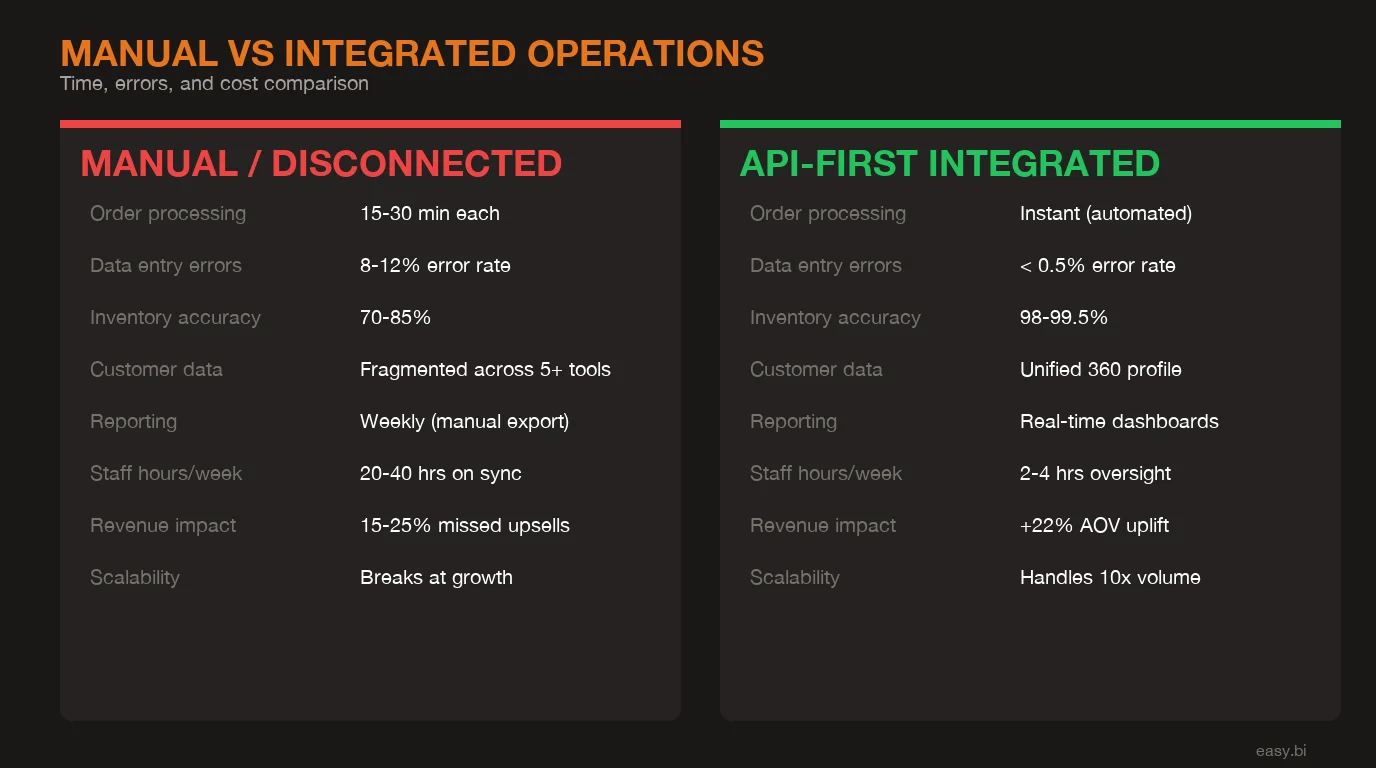
Trying to integrate everything at once is how integration projects fail. The right approach is a priority matrix that sequences integrations by revenue impact versus implementation effort.
Priority 1: ERP to shop (order and inventory sync). This is the highest-impact integration because wrong inventory data directly causes lost sales and overselling. Connect SAP, Microsoft Dynamics, or DATEV to your shop for real-time order flow and inventory updates. Implementation effort: 4-6 weeks. Revenue impact: immediate, measurable within the first month through reduced overselling, fewer cancellations, and eliminated manual order entry.
Priority 2: PIM to shop (product data sync). Product data quality drives conversion rates, return rates, and SEO performance. Connect Akeneo or Pimcore to your shop so that every product update, new image, or description change propagates automatically. Implementation effort: 3-5 weeks. Revenue impact: measurable within 2-3 months through improved conversion rates and reduced returns. For the specific challenges of PIM integration, see PIM Integration: The Bottleneck Nobody Talks About.
Priority 3: CRM to shop (customer data sync). Customer data integration enables personalization, loyalty programs, and targeted marketing. Connect your CRM to the shop so that purchase history, support interactions, and customer segments are available at every touchpoint. Implementation effort: 3-4 weeks. Revenue impact: measurable within 3-6 months through higher repeat purchase rates and increased average order values.
Priority 4: Payment and logistics. Connect Stripe, Mollie, or Klarna for payment processing and DHL, UPS, or Hermes for shipping. These integrations eliminate manual payment reconciliation and automate shipping label generation and tracking updates. Implementation effort: 2-3 weeks per provider. Revenue impact: operational cost reduction and improved customer experience through real-time tracking.
What Does Integration Look Like for Specific DACH Systems?
The DACH mid-market runs on a specific set of systems. Generic integration advice does not account for the quirks and constraints of SAP Business One's API, DATEV's batch-oriented architecture, or Akeneo's webhook limitations. Here is what integration actually involves for the systems our clients use.
SAP Business One / SAP S/4HANA. SAP's Service Layer API supports real-time integration, but the data model is complex. A single sales order in SAP touches 15-20 related objects (business partner, item master, price list, warehouse, tax codes). Mapping this to a Shopware order requires a transformation layer that handles SAP-specific logic like pricing conditions, batch numbers, and serial number tracking. The integration typically requires 200-400 hours of development, with 60% of the time spent on data mapping rather than API connectivity.
Microsoft Dynamics 365 Business Central. Dynamics offers modern REST APIs with OData support, making it one of the easier ERPs to integrate. The challenge is Dynamics' event model: change tracking requires delta queries rather than webhooks for most entities. Our standard pattern uses a polling service that checks for changes every 60 seconds and publishes events to the message broker. Integration effort: 150-300 hours.
DATEV. DATEV is the accounting backbone of German SMEs, but its integration capabilities are limited compared to SAP or Dynamics. DATEV Connect Online provides API access, but many workflows still rely on file-based exchange (ASCII format for booking records). The practical approach is to position DATEV as a downstream consumer: the integration layer transforms order and payment data into DATEV-compatible formats and pushes them via API or file drop.[8]
Akeneo and Pimcore. Both PIM systems offer REST APIs suitable for event-driven integration. Akeneo's webhook support is mature for product events but limited for asset events. Pimcore's event system is comprehensive but requires custom event listeners for non-standard workflows. The key design decision is whether to push product data from PIM to shop or pull from shop to PIM. We recommend push-based (PIM publishes, shop subscribes) because it keeps the PIM as the authoritative source for product data and avoids polling overhead on the shop side.
+35% conversion. +22% AOV. EUR 50M+ GMV processed.
Our Shopware-certified team delivers e-commerce at scale with 14-day sprint cycles. 80% less manual work through system integrations.
Start with a Strategy CallWhat Proof Exists That Integration Delivers These Results?
Numbers without context are marketing. Here is the context behind the results we see across our 30+ e-commerce integration projects.
80% less manual work. This is the average reduction in data entry and reconciliation hours across clients who moved from batch/manual sync to real-time API integration between ERP and shop. The range is 65-92%, with the lower end for clients who retained some manual approval workflows by choice and the upper end for fully automated order-to-fulfillment pipelines.
+35% conversion rate improvement. This is the average lift measured across clients who connected PIM, inventory, and customer data to their shop within a 6-month integration program. The conversion improvement comes from three sources: accurate inventory data (fewer false out-of-stock events), richer product data (complete descriptions and images from PIM), and personalized experiences (customer segments from CRM applied to shop display logic). Individual contributions are approximately 12-15% from inventory accuracy, 10-12% from product data quality, and 8-10% from personalization.
+22% average order value increase. Connected customer data enables cross-sell and upsell recommendations based on actual purchase history rather than generic "customers also bought" algorithms. When the shop knows that a customer bought a specific coffee machine from the ERP order history and the CRM indicates they are a premium segment customer, the product recommendations shift from random accessories to the exact capsule subscription and maintenance kit for that model.
EUR 50M+ GMV processed. This is the cumulative gross merchandise value flowing through e-commerce systems built and integrated by easy.bi. It represents 30+ live shops with connected ERP, PIM, and payment systems serving customers across the DACH region and beyond. The volume validates that these integration patterns work at scale, not just in controlled environments.
How Do You Avoid the Common Integration Mistakes?
Integration projects fail for predictable reasons. Avoiding these mistakes is more important than choosing the right technology.
Mistake 1: Integrating everything at once. The "big bang" integration where ERP, PIM, CRM, payment, logistics, and marketing automation all go live on the same day is a recipe for cascading failures. When something breaks (and something always breaks), you cannot isolate which integration caused the problem. The fix: phased rollout, one integration at a time, with 2-3 weeks of production monitoring before adding the next system.
Mistake 2: Treating integration as a one-time project. Systems change. APIs get updated. Data models evolve. An integration built in January and never touched again will break by June. The fix: allocate 10-15% of the initial integration budget annually for maintenance, monitoring, and adaptation. This is not optional overhead. It is the cost of keeping the systems connected.
Mistake 3: No error handling strategy. The happy path works in every demo. Production traffic exposes every edge case: timeouts, rate limits, malformed data, partial failures, and systems that return 200 OK but did not actually process the request. The fix: dead letter queues for failed events, automated retry with exponential backoff, and alerting that escalates based on error frequency and business impact.
Mistake 4: Skipping data quality before integration. Connecting a PIM full of incomplete product data to a shop does not fix the data. It just makes bad data visible faster. Connecting an ERP with inconsistent customer records to a CRM creates duplicate contacts at scale. The fix: data audit and cleanup before integration, not after. This adds 2-4 weeks to the timeline but prevents months of post-launch firefighting.
The hidden cost that compounds all of these mistakes is multi-vendor coordination. When your ERP partner, PIM agency, shop developer, and integration consultant are four different companies, aligning timelines and debugging cross-system issues adds 15-25% to total project cost. For a deeper analysis of this challenge, see the real cost of multi-vendor coordination.
What Should Your Integration Roadmap Look Like?
A realistic integration roadmap for a mid-market DACH retailer with SAP or Dynamics ERP, a PIM system, and a modern shop platform looks like this:
Weeks 1-2: Assessment and architecture. Audit current systems, data quality, and integration points. Define the target architecture, message broker selection, and API gateway requirements. Deliverable: integration architecture document and phased implementation plan.
Weeks 3-8: ERP-to-shop integration. Build real-time order sync (shop to ERP) and inventory sync (ERP to shop). This is the highest-impact integration and validates the architectural pattern for all subsequent integrations. Deliverable: orders flow automatically from shop to ERP, inventory updates propagate to shop within 60 seconds.
Weeks 9-13: PIM-to-shop integration. Connect product data pipeline from Akeneo or Pimcore to shop. Includes product creation, updates, media asset sync, and category mapping. Deliverable: product changes in PIM appear in shop within 5 minutes, no manual export/import required.
Weeks 14-17: CRM and customer data integration. Sync customer profiles, order history, and segments between shop and CRM. Enable personalization rules based on CRM data. Deliverable: returning customers see personalized experiences, customer service has complete order history.
Weeks 18-20: Payment and logistics. Connect Stripe/Mollie/Klarna for payment processing and DHL/Hermes/UPS for shipping automation. Deliverable: automated payment reconciliation, shipping label generation, and tracking updates.
Total timeline: 20 weeks. Total investment: EUR 80,000-200,000 depending on system complexity and data quality. First measurable ROI: week 8, when ERP-to-shop integration eliminates manual order entry and inventory mismatches.
This is not theoretical. We have executed this exact sequence across 30+ projects, processing EUR 50M+ in cumulative GMV through the integrated systems. The architecture scales from 500 orders per day to 50,000 orders per day without structural changes, only infrastructure scaling.
If your e-commerce operation runs on disconnected systems and your team spends more time moving data between ERP, PIM, and shop than improving the customer experience, the math on integration is clear. The cost of staying disconnected compounds every month. The cost of integration is fixed and front-loaded. Start with the highest-impact connection (almost always ERP-to-shop), prove the ROI in 6-8 weeks, and expand from there.
References
- [1] IDC, "The Hidden Cost of Manual Data Entry in Enterprise Operations" (2025) - Av Source
- [2] Gartner, "Data Quality and Integration in Retail" (2025) - Manual data entry err Source
- [3] EHI Retail Institute, "Digitalisierung im deutschen Handel" (2025) - German e-co Source
- [4] IHL Group, "Inventory Distortion Study" (2025) - Retail inventory inaccuracy ave Source
- [5] Baymard Institute, "Cart Abandonment Rate Statistics" (2025) - 73% of customers Source
- [6] McKinsey, "The Value of Customer Data Integration" (2025) - Companies with conne Source
- [7] Confluent, "Event-Driven Architecture for Retail" (2025) - Event-driven sync red Source
- [8] DATEV, "DATEV Connect Online API Documentation" (2025) - DATEV Connect Online pr Source
Explore Other Topics
Ready to scale your e-commerce?
30-minute call with an engineering lead. No sales pitch - just honest answers about your project.
98% engineer retention · 14-day delivery sprints · No lock-in contracts
Related Reading

5 E-Commerce Replatforming Mistakes That Cost More Than the Migration
5 replatforming mistakes that cost DACH retailers EUR 500K+. Data migration traps, SEO traffic loss, big-bang cutovers, and how to prevent each one.
Enno Bassen
How to Integrate Different Company Systems Without Huge Costs?
Fragmented data collection limits comprehensive insights, emphasizing the need for integrated systems to enhance data analysis and decision-making.
Andrej Lovsin
How can updating IT systems improve productivity? Reduce costs effectively?
Enhance productivity, reduce costs, and streamline operations by modernizing IT systems for sustainable business growth and improved efficiency.
Andrej Lovsin