Headless Commerce: When It's Worth the Complexity

Table of Contents+
- What Does "Headless" Actually Mean in Practice?
- Why Is Headless Growing So Fast?
- When Does Headless Not Make Sense?
- What Does the Headless Tech Stack Look Like?
- How Does Headless Affect Your Development Team?
- What Does a Realistic Headless Migration Path Look Like?
- Is Headless Right for Your Business?
- References
TL;DR
Headless commerce is worth the complexity when you operate across multiple markets, maintain 10+ backend integrations, and have a frontend engineering team that can own a separate deployment pipeline. For everyone else, it adds cost and operational overhead without proportional business value.
Key Takeaways
- •Headless commerce decouples the frontend from the commerce engine, letting you change the customer experience without touching order management or inventory.
- •35% of mid-market and enterprise retailers have adopted headless architectures - up from 22% in 2021.
- •Year-1 costs run 20-40% higher than monolithic platforms, but total cost of ownership drops 30% by year 3.
- •You need at least 6 experienced developers, 10+ backend integrations, and multi-market requirements before headless makes financial sense.
- •The biggest headless failures happen when companies adopt the architecture before building the engineering maturity to operate it.
Headless commerce adoption hit 35% among enterprise retailers. Learn when the architectural complexity pays off, when it doesn't, and how to decide for your business.
Headless commerce is worth the complexity when you operate across multiple markets, maintain 10+ backend integrations, and have a frontend engineering team that can own a separate deployment pipeline. For everyone else, it adds cost and operational overhead without proportional business value.
That answer will annoy both headless evangelists and monolithic traditionalists. Good. After building commerce systems for REWE, Fressnapf, ZooRoyal, and dozens of mid-market DACH retailers, we have seen headless deliver transformative results - and we have seen it crater projects that were not ready for it.
What Does "Headless" Actually Mean in Practice?
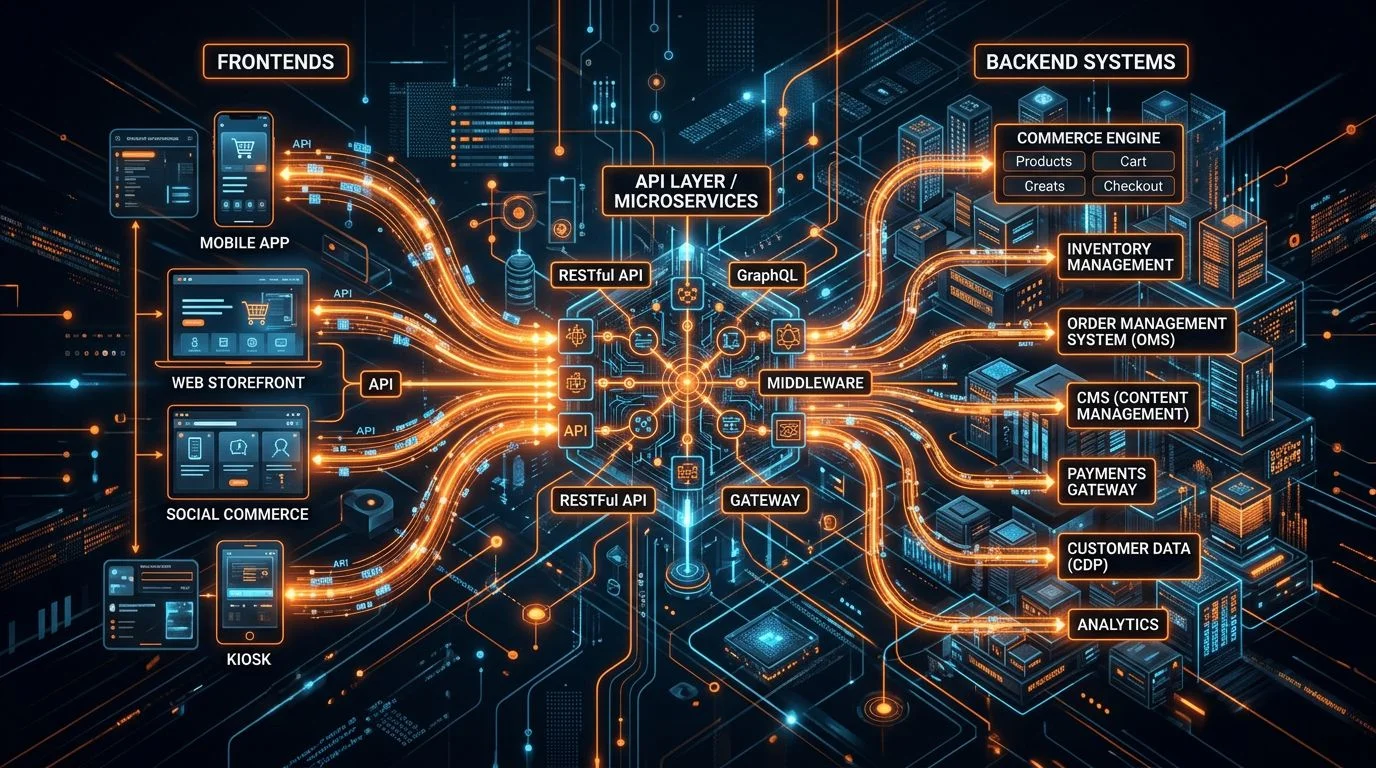
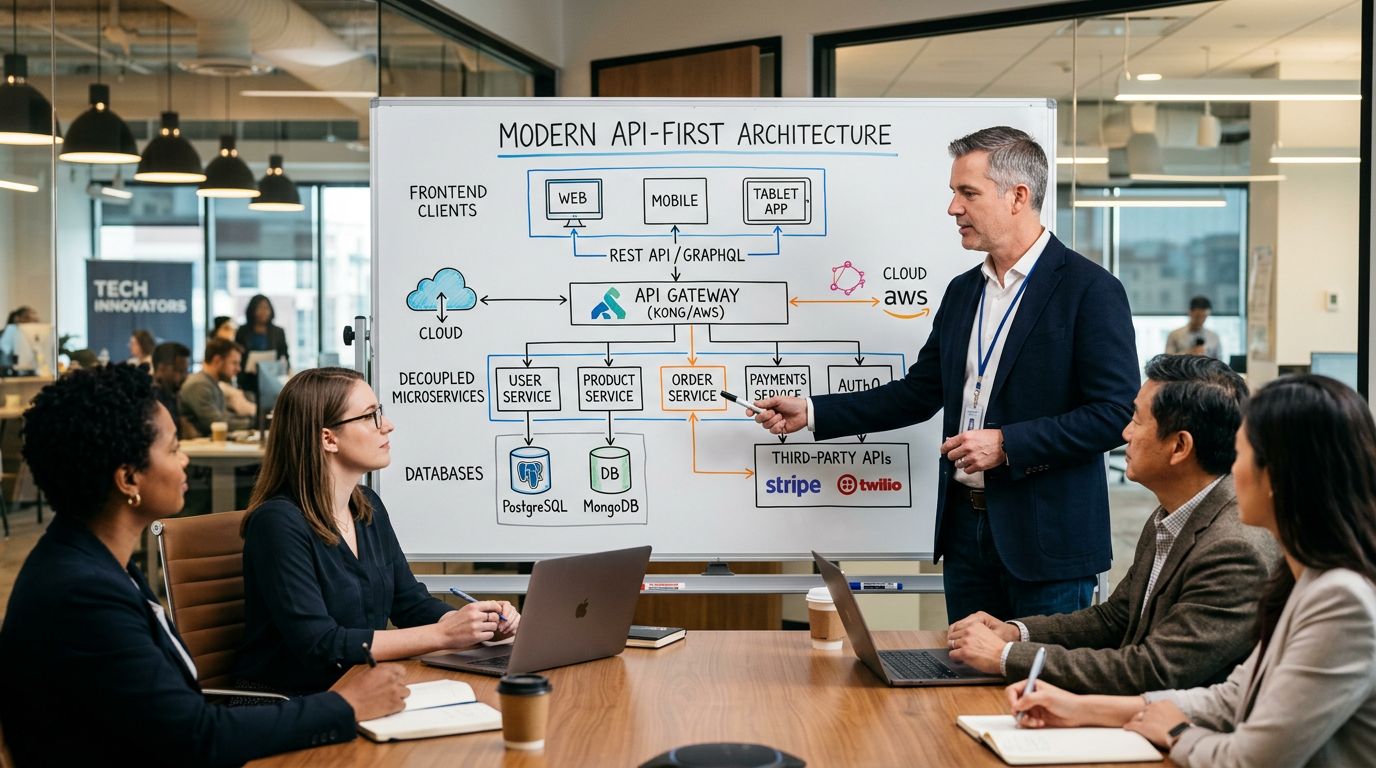
Headless commerce separates the frontend (what customers see and interact with) from the backend (product catalog, pricing, cart, checkout, order management). The two layers communicate through APIs. This is not a new concept - it is how most modern software works.
But in e-commerce, it represents a fundamental shift from the all-in-one platforms that dominated the last decade.
In a traditional monolithic setup - Shopware 5, Magento 1, older Salesforce Commerce Cloud - the storefront is tightly coupled to the commerce engine. Changing a checkout button means deploying the same codebase that handles inventory and pricing. Every frontend change carries backend risk.
The Decoupled Frontend Model
In a headless setup, the frontend is a standalone application (typically built with React, Next.js, or Vue/Nuxt) that calls commerce APIs for product data, cart operations, and checkout. You deploy the frontend independently. You test it independently. You scale it independently.
commercetools is API-only by design. Shopware 6 offers headless mode via its Store API. Adobe Commerce provides REST and GraphQL APIs. The platform choice determines how native the headless experience feels, but the architectural pattern works with any modern commerce engine.
See how our team delivers +35% avg conversion lift across 30+ e-commerce projects.
Why Is Headless Growing So Fast?
Headless commerce adoption reached 35% among mid-market and enterprise retailers in 2023, up from 22% in 2021.[1] Three forces are driving this growth.
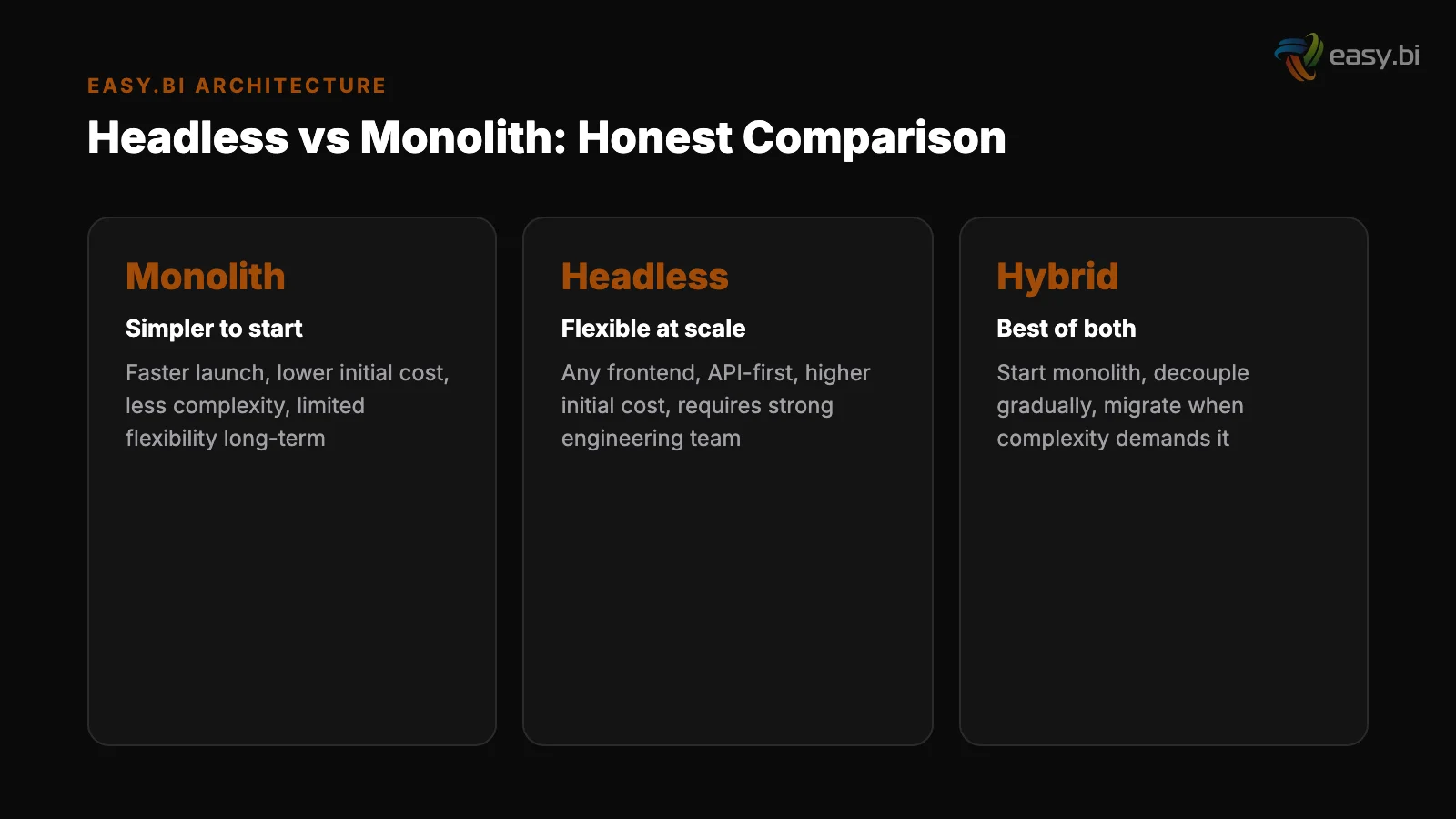
Channel multiplication. Your customers interact with your brand on the website, a mobile app, in-store kiosks, marketplace integrations, and increasingly through voice assistants and social platforms. A monolithic platform renders one storefront. A headless architecture lets you build unique experiences for each channel from the same commerce backend.
Frontend velocity. Marketing teams want to launch campaigns in days, not sprints. Headless frontends deployed via CDNs like Vercel or Netlify let you ship landing pages, seasonal promotions, and A/B test variants without touching the commerce engine. Composable approaches deliver 25% faster time-to-market for new features compared to monolithic platforms.[2]
Integration as the Driving Force
Integration complexity. Enterprise e-commerce is no longer just a shop. It is a hub connecting ERP, PIM, CRM, warehouse management, payment providers, shipping carriers, and analytics tools. Monolithic platforms try to handle everything internally and do most things poorly.
Headless architectures let you pick the best tool for each job and connect them via APIs.
When Does Headless Not Make Sense?
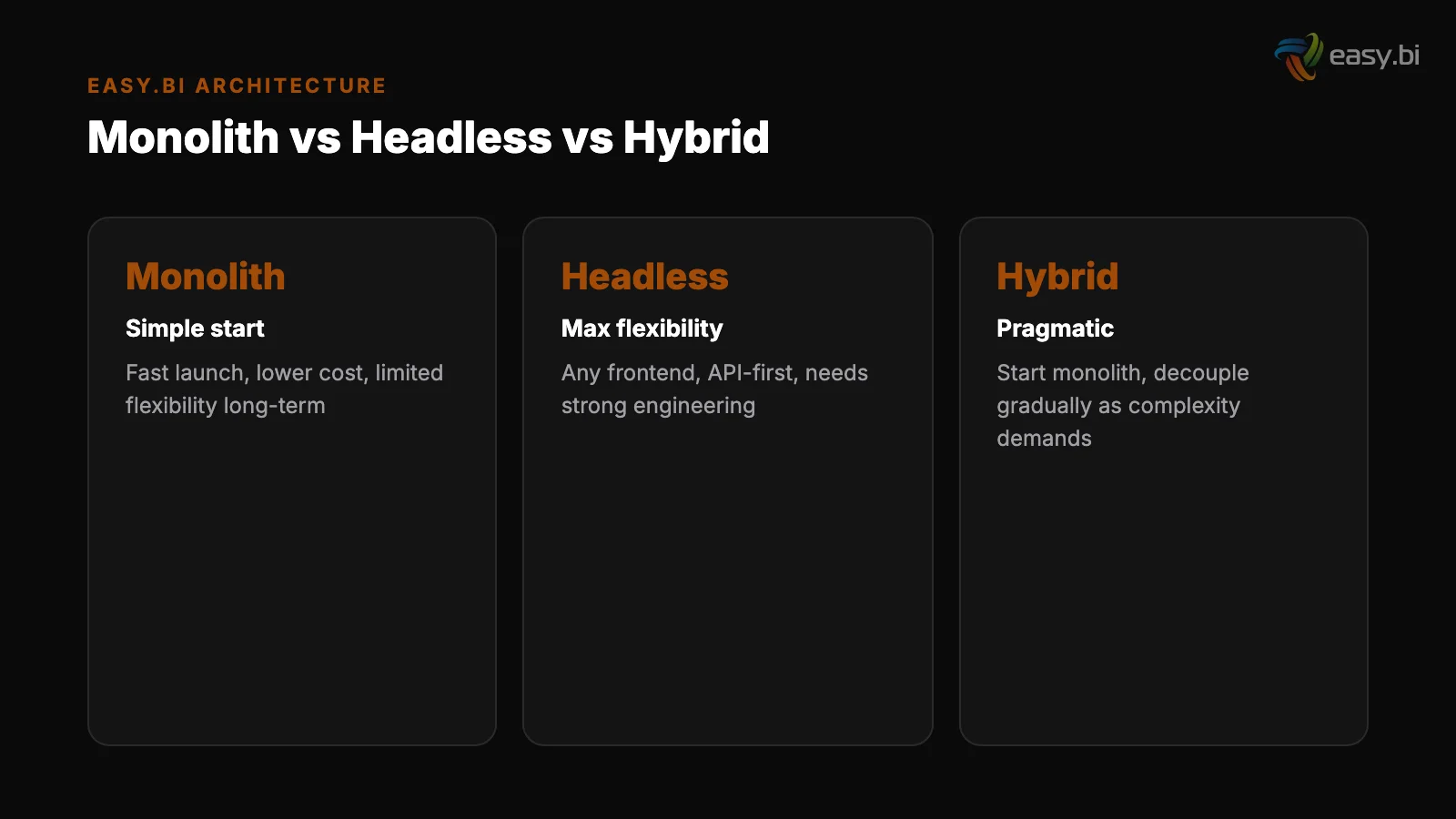
Headless is not a universal upgrade. It is a trade-off. You gain frontend flexibility and long-term scalability. You pay with upfront complexity and higher year-1 costs.
The total cost of ownership for a headless commerce stack is 20-40% higher in year 1 compared to monolithic platforms. By year 3, it is 30% lower - but only if you have the team to maintain it.[3]
Headless does not make sense when:
- Your team is small. If you have fewer than 6 developers, the operational overhead of maintaining a separate frontend application, a separate CMS, separate search infrastructure, and separate deployment pipelines will consume all your engineering capacity. A well-configured Shopware 6 instance delivers 80% of the benefit at 40% of the cost.
- Your requirements are standard. If you sell products in 1-2 DACH markets with standard checkout, standard shipping, and standard payment methods, a monolithic platform handles this perfectly. Headless solves complexity problems. If you do not have complexity, it creates it.
- Your timeline is tight. Headless projects take 14-20 weeks to first launch, compared to 8-12 weeks for monolithic setups. If you need to be live in 2 months, headless will not get you there.
- Your integrations are simple. If your commerce platform connects to 3-5 backend systems, the integration layer is manageable in any architecture. Headless shines when you have 15+ systems that need to exchange data in real time.
The biggest headless failures happen when companies adopt the architecture before building the engineering maturity to operate it. Headless does not fix organizational problems. It amplifies them.
What Does the Headless Tech Stack Look Like?
A headless commerce stack is not one product. It is an assembly of specialized services. Here is what a typical enterprise headless stack includes:
| Layer | Purpose | Common choices |
|---|---|---|
| Commerce engine | Product catalog, pricing, cart, checkout, orders | commercetools, Shopware 6 (API mode), Adobe Commerce |
| Frontend | Customer-facing storefront | Next.js, Nuxt, Remix, custom React |
| CMS | Content management, landing pages | Storyblok, Contentful, Strapi |
| Search | Product discovery, filtering, autocomplete | Algolia, Elasticsearch, Typesense |
| PIM | Product data management | Pimcore, Akeneo |
| Hosting/CDN | Frontend delivery, edge caching | Vercel, Netlify, Cloudflare |
| Payments | Transaction processing | Stripe, Adyen, Mollie, Unzer |
Each layer is an independent system with its own deployment, monitoring, and team ownership. This modularity is the strength and the risk. When everything works, you have best-of-breed performance at every layer. When something breaks, you need to trace issues across 5-7 interconnected services.
How Does Headless Affect Your Development Team?
Headless changes your team structure. A monolithic Shopware project needs PHP/Symfony developers who understand the full stack. A headless project needs specialists.
The Minimum Viable Team Structure
You need frontend engineers (React/Next.js) who own the storefront. You need backend engineers who own the commerce API layer and integrations. You need a DevOps engineer who manages the infrastructure for multiple independently deployed services. You need an architect who understands how these pieces fit together.
Teams of 5-9 people deliver the highest productivity per person.[4] For a headless project, that translates to 2-3 frontend engineers, 2-3 backend engineers, 1 DevOps engineer, and a technical lead. This is the minimum viable team. Anything less, and you are spreading people too thin across too many moving parts.
At easy.bi, we run headless projects with 14-day sprint cycles. Every sprint produces a deployable increment across all layers - frontend, commerce API, and integrations.
This prevents the common failure mode where the frontend team builds for 3 months in isolation and then discovers the APIs do not support their assumptions.
+35% conversion. +22% AOV. EUR 50M+ GMV processed.
Our Shopware-certified team delivers e-commerce at scale with 14-day sprint cycles. 80% less manual work through system integrations.
Start with a Strategy CallWhat Does a Realistic Headless Migration Path Look Like?
Nobody should go headless overnight. The safest path is incremental.
Phase 1: API-first on existing platform (4-6 weeks). If you run Shopware 6, enable the Store API and build a proof-of-concept frontend for a single high-traffic page - your product detail page or category page. Measure performance against the existing storefront.
Validate that your team can operate in a headless workflow.
Phase 2: Parallel frontend (6-10 weeks). Build the full storefront as a separate application. Run both the old and new frontends in parallel, routing a percentage of traffic to the new one. Compare conversion rates, page load times, and error rates.
Commerce Engine Migration and Expansion
Phase 3: Commerce engine migration (8-16 weeks). If you are moving from Shopware to commercetools, this is where you migrate catalog data, pricing rules, and order management. Do this after the frontend is proven, not before. The frontend validates that the architecture works.
The commerce engine migration is a data and integration project.
Phase 4: Optimize and expand (ongoing). Add channels - mobile app, marketplace integrations, B2B portal. Each new channel connects to the same commerce APIs. This is where the headless investment pays compound returns.
Is Headless Right for Your Business?
Answer these 5 questions honestly:
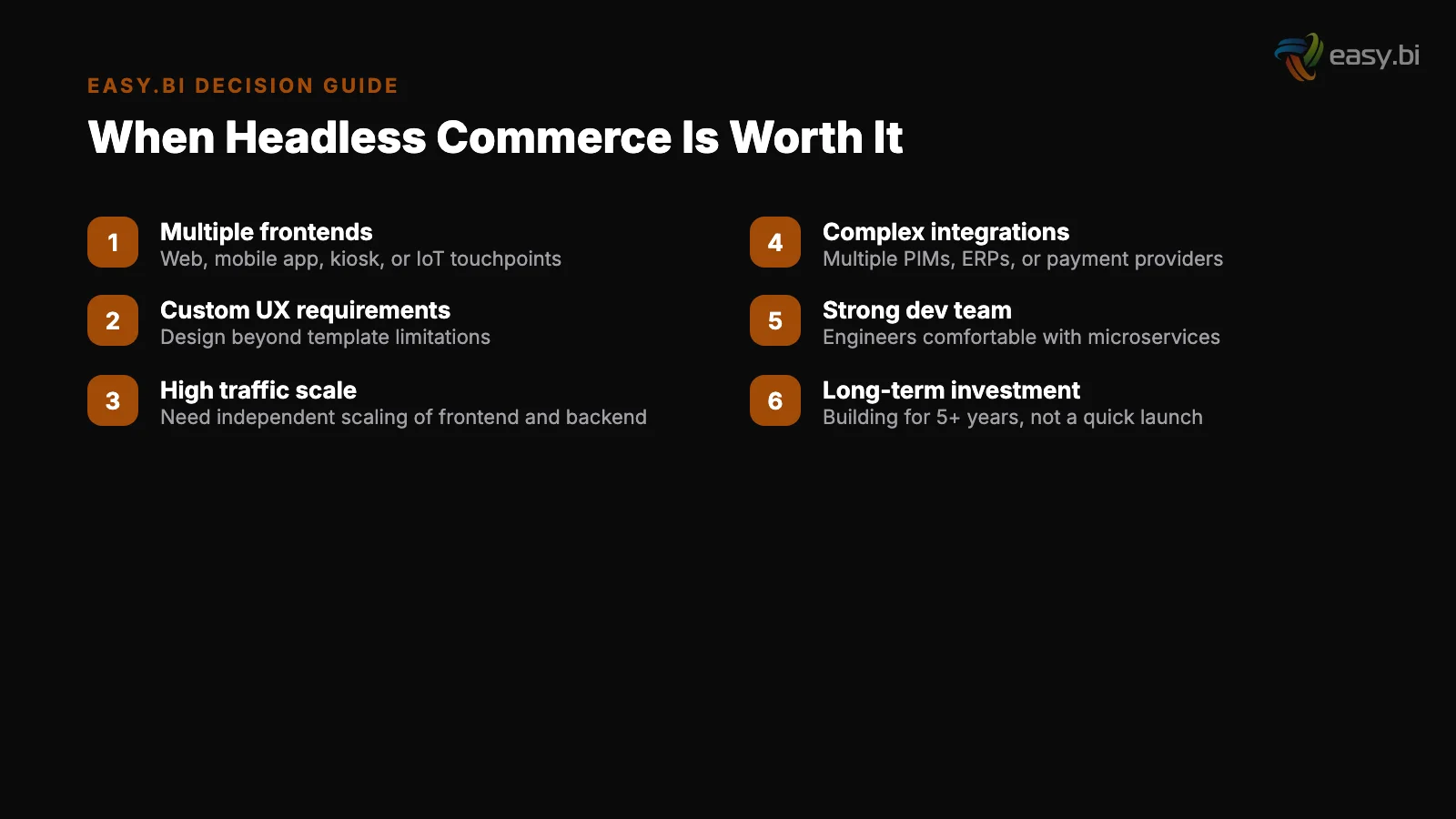
- Do you operate in 3+ markets with different currencies, tax rules, and fulfillment?
- Does your commerce platform integrate with 10+ backend systems?
- Do you have 6+ developers with API and frontend framework experience?
- Are you planning to serve customers through 3+ channels (web, app, kiosk, marketplace)?
- Can you invest 20-40% more in year 1 for lower costs by year 3?
If you answered yes to 3 or more, headless will likely pay off. If you answered yes to fewer than 3, a well-implemented monolithic platform - Shopware 6 in most DACH cases - delivers better ROI.
For a deeper look at how platform choice connects to the broader e-commerce strategy, read the Enterprise E-Commerce Playbook. For a side-by-side platform comparison, see Shopware vs commercetools vs Adobe Commerce.
And if you are concerned about what happens to your organic traffic during migration, do not skip The SEO Migration Nobody Plans For.
If you are weighing headless for your e-commerce platform and want an honest assessment of whether your organization is ready, start with a conversation. We have implemented headless for companies that were ready - and talked others out of it when they were not.
References
Explore Other Topics
Ready to scale your e-commerce?
30-minute call with an engineering lead. No sales pitch - just honest answers about your project.
98% engineer retention · 14-day delivery sprints · No lock-in contracts
Related Reading
Headless Commerce ROI: When the Architecture Pays for Itself
Headless commerce costs EUR 150-400K but pays for itself in 18-24 months. Get the ROI math, 3-year TCO comparison, and decision framework.
Filip Kralj
What are the ways for retail and e commerce companies to succeed in today's tech environment?
Enhance retail success by leveraging digital strategies such as automation and cloud migration to improve efficiency and elevate customer experience.
Enno Bassen
How can the retail and e commerce sectors utilize technology to drive their expansion and success?
Retail growth is fueled by technology through automation, agile methods, and cloud computing, improving customer experience and leadership.
Andrej Lovsin