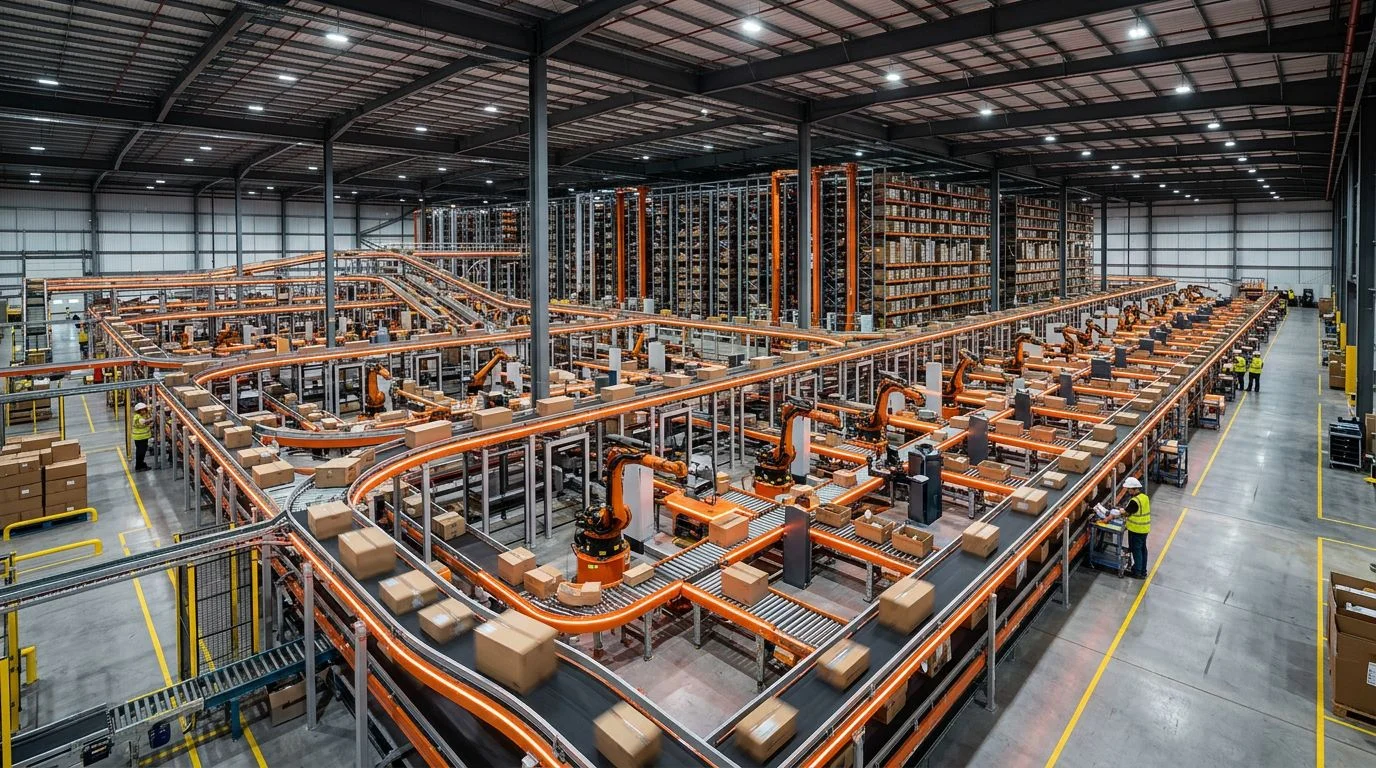
E-Commerce at Scale: Lessons from REWE Group's Continuous Delivery Model

Table of Contents+
- Why Continuous Delivery Beats the Relaunch Cycle
- How the REWE Engagement Evolved
- What Does Single-Partner Accountability Look Like at Enterprise Scale?
- How Does Fressnapf Apply the Same Model?
- Why Does Shopware Fit Enterprise Continuous Delivery?
- The Playbook for Mid-Market Retailers
- What Metrics Should You Track?
- From REWE to Your Organization
- References
TL;DR
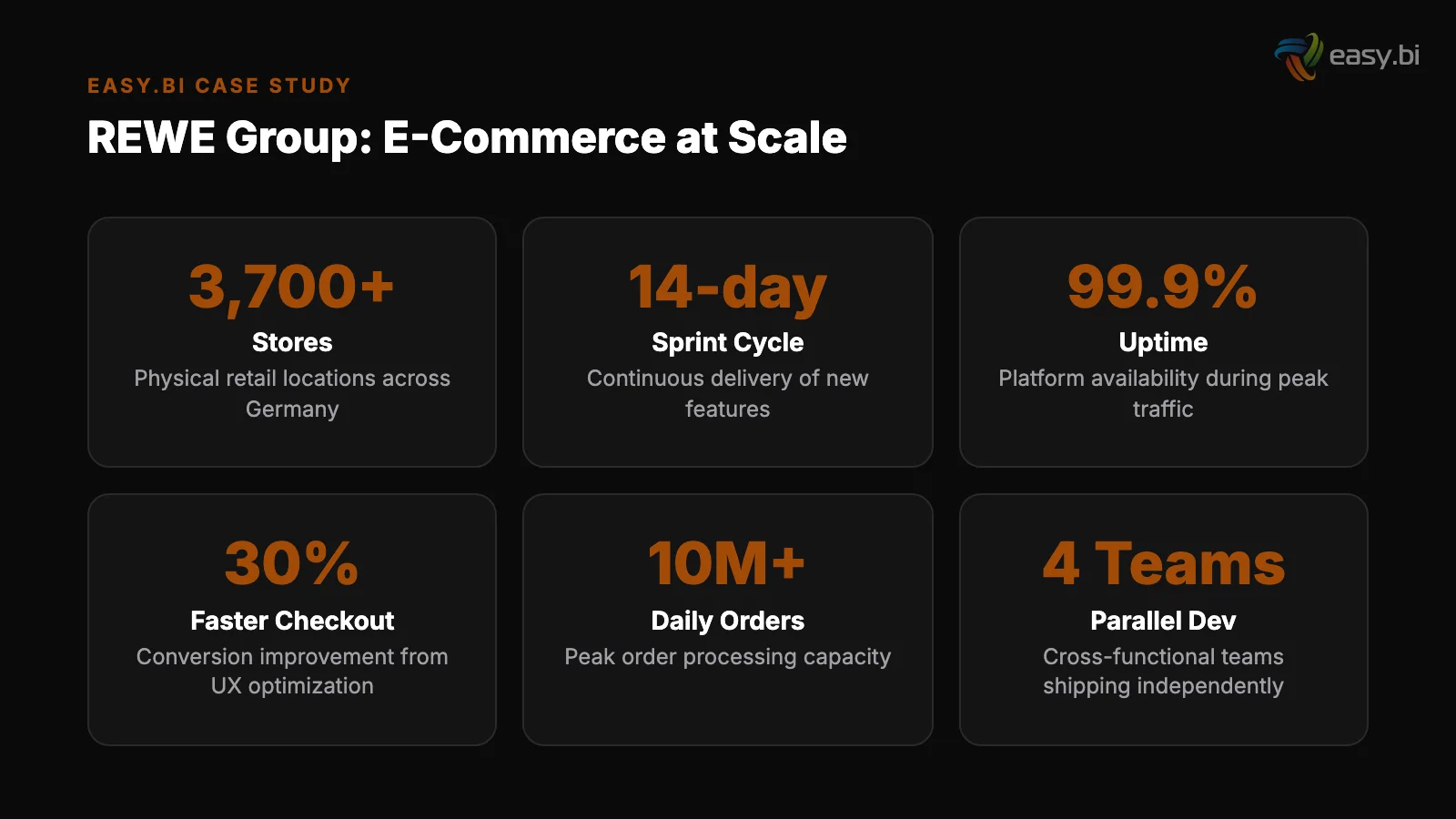
REWE Group operates one of the largest retail ecosystems in Europe. Their digital commerce operations do not follow the traditional "relaunch every 3 years" model. Instead, the platform evolves continuously through structured 14-day sprint cycles.
Key Takeaways
- •REWE Group eliminated big-bang relaunches by adopting a continuous delivery model with working software deployed every 14 days.
- •A single integrated team with end-to-end ownership outperformed multi-vendor setups by reducing coordination overhead by 40-60%.
- •Continuous sprint delivery turns e-commerce platforms into living products that evolve with customer behavior instead of aging between relaunches.
- •The same model powers Fressnapf's 3C platform and ZooRoyal's online shop - proving it scales across retail segments and complexity levels.
- •Mid-market retailers can adopt REWE's approach starting with a single product area and one dedicated sprint team.
How REWE Group runs enterprise e-commerce with 14-day sprint delivery cycles, zero big-bang launches, and continuous performance optimization. The playbook explained.
REWE Group operates one of the largest retail ecosystems in Europe. Their digital commerce operations do not follow the traditional "relaunch every 3 years" model. Instead, the platform evolves continuously through structured 14-day sprint cycles.
This approach did not happen by accident. It was a deliberate response to the failure patterns that plague enterprise e-commerce: scope creep, coordination chaos between multiple vendors, and the catastrophic risk of big-bang launches.
After years of working alongside REWE's digital commerce team, we can break down exactly how it works - and how mid-market retailers can apply the same principles.
Why Continuous Delivery Beats the Relaunch Cycle
Traditional e-commerce operates on a relaunch cycle. Build for 12-18 months. Launch everything at once. Maintain until the next relaunch. Repeat.
The Risk Concentration Problem
This model concentrates risk into a single launch event. If something breaks - and at enterprise scale, something always breaks - you are debugging a year's worth of changes simultaneously. Conversion rates drop. Customer complaints spike. The team scrambles to stabilize while the business bleeds revenue.
Measurable Business Impact
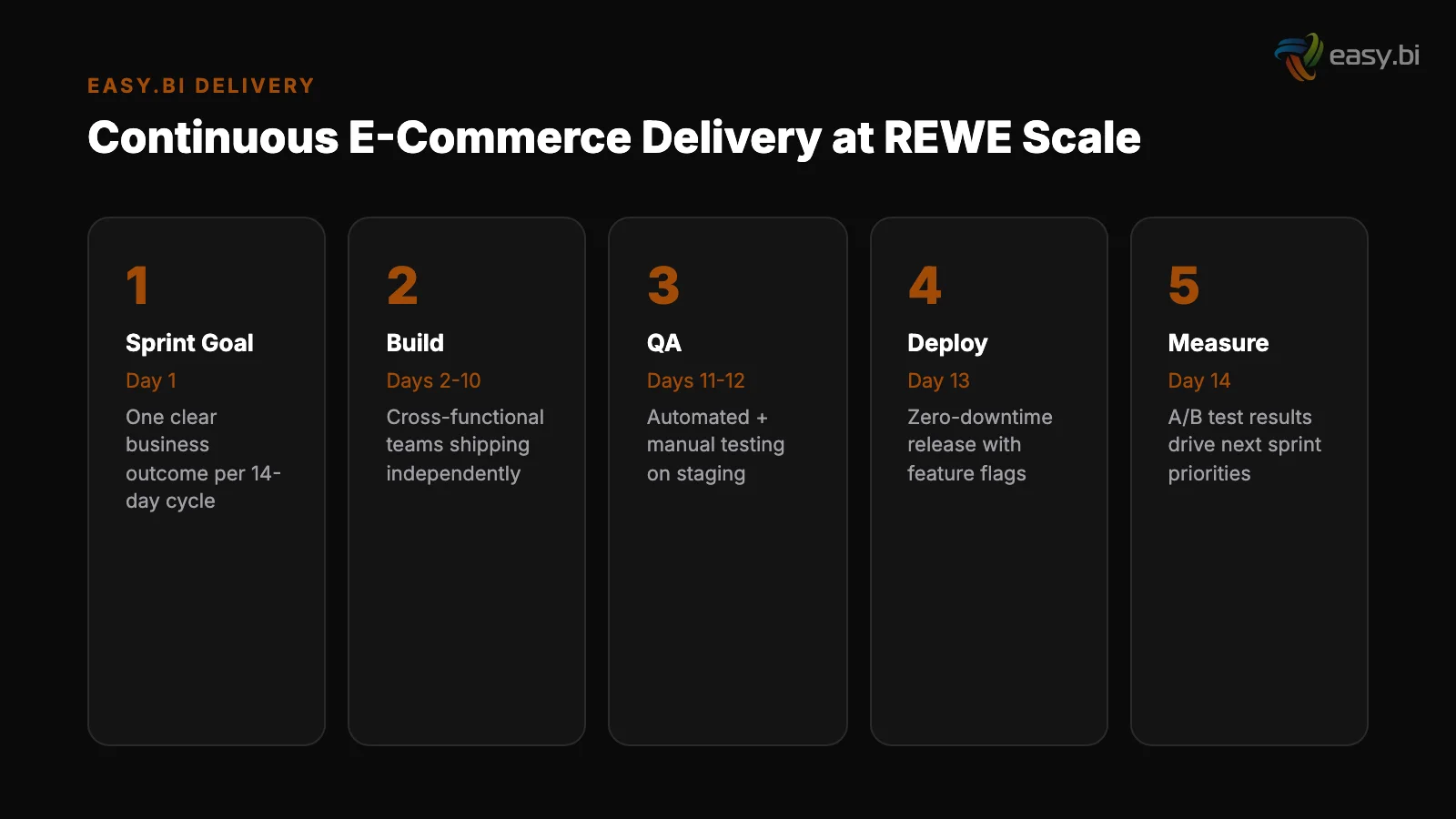
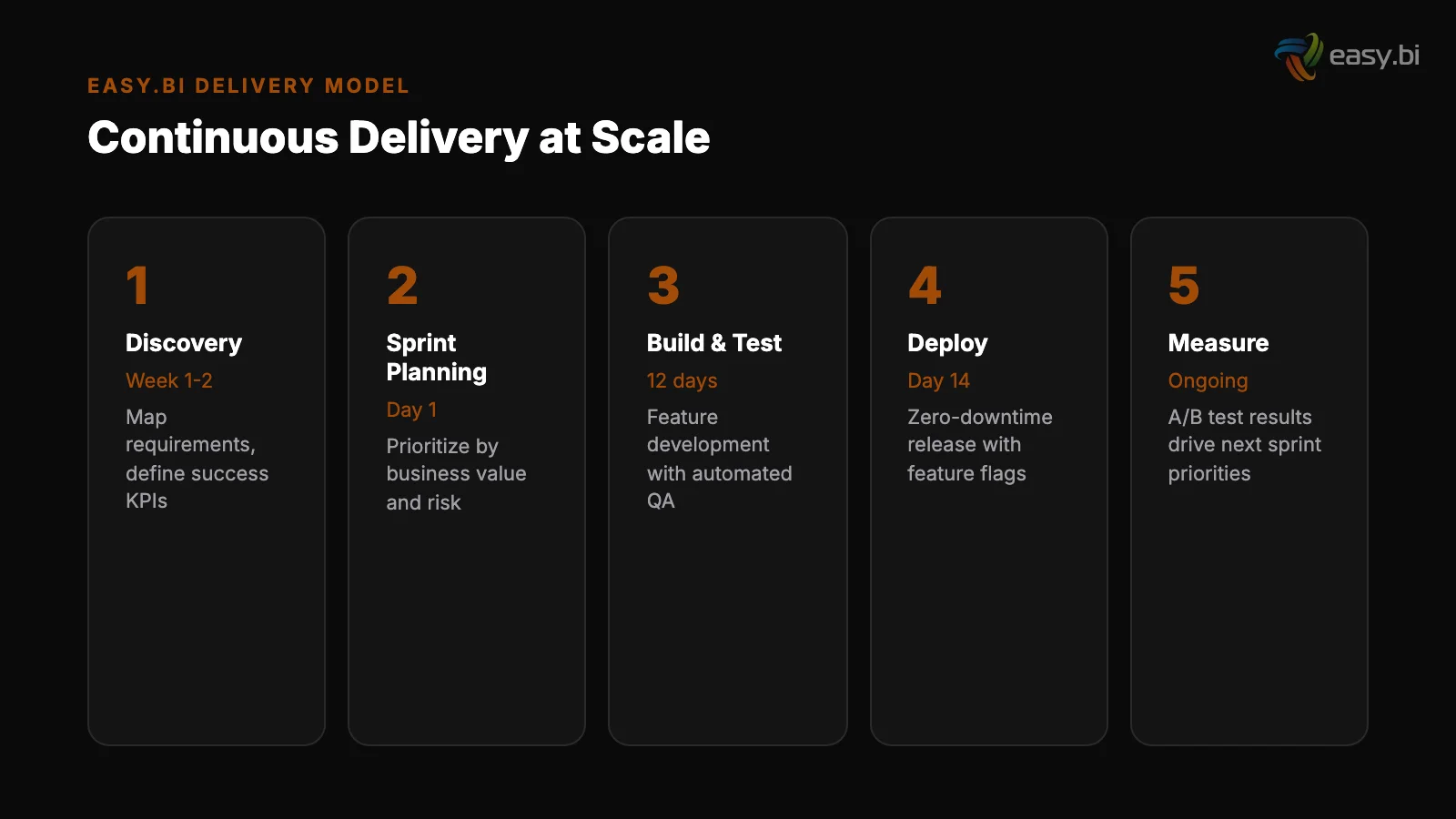
REWE's model flips this. Every 14 days, the team delivers a working increment that goes through QA, staging, and production deployment. Each increment is small enough to test thoroughly, roll back quickly, and measure precisely. The platform is never more than 2 weeks away from its latest improvement.
The business impact is measurable: no launch-day performance regressions, continuous conversion rate optimization[1], and a platform that adapts to customer behavior in real time instead of guessing what customers will want 18 months from now.

See how our team delivers +35% avg conversion lift across 30+ e-commerce projects.
How the REWE Engagement Evolved
The REWE engagement did not start as a full continuous delivery operation. It grew through distinct phases, each building on the outcomes of the previous one.
| Phase | Focus | Duration | Outcome |
|---|---|---|---|
| 1. Workshop & Assessment | Audit existing platform, map integration landscape, identify highest-impact improvement areas | 2-4 weeks | Prioritized roadmap with measurable targets per sprint |
| 2. Single Sprint Team | One dedicated team running 14-day sprints on the highest-priority product area | 3 months | Validated delivery model, first measurable performance gains |
| 3. Expanded Operations | Multiple sprint teams covering shop features, PENNY App, deals engine, and UX optimization | 6-12 months | End-to-end shop ownership with continuous deployment pipeline |
| 4. Continuous Optimization | Ongoing sprint delivery with real-time performance monitoring, A/B testing, and feature iteration | Ongoing | Platform evolves every 14 days - no relaunch cycles needed |
The Phased Approach
Each phase delivered working software. No phase required a leap of faith. The expanded scope in Phase 3 happened because Phase 2 delivered results the business could measure.
Expansion Earned Through Results
This phased approach reduces the organizational risk of change. The business never committed to a multi-year transformation. It committed to 2-4 weeks. Then 3 months. Each expansion was earned through demonstrated results, not promised through slide decks.
What Does Single-Partner Accountability Look Like at Enterprise Scale?
Enterprise e-commerce projects typically involve 3-5 vendors: one for UX, one for frontend, one for backend, one for DevOps, and a systems integrator to coordinate them all. This multi-vendor model adds 40-60% to project timelines through coordination overhead alone.[3]
REWE chose a different model: a single integrated team with end-to-end ownership. One backlog. One sprint cadence. One team accountable for the business outcome, not just their slice of the technical stack.
The practical difference is visible in every sprint planning session. When one team owns frontend, backend, QA, and deployment, a feature goes from design to production in a single sprint.
In a multi-vendor setup, the same feature requires handoffs between 3 teams, each with their own sprint cadence, their own definition of done, and their own priorities.
The most expensive line item in enterprise e-commerce is not any single vendor. It is the coordination overhead between four of them. Every handoff is a delay. Every delay is lost revenue.
The Penny App enhancement is a clear example. UX improvements, backend deal engine changes, and deployment configuration all lived in one backlog. One team shipped the complete feature in one sprint.
A multi-vendor setup would have required 3 separate work streams with cross-team dependencies - turning a 14-day delivery into a 6-8 week coordination exercise.
How Does Fressnapf Apply the Same Model?
Fressnapf's 3C platform - Community, CMS, and e-Commerce - proves this model works beyond grocery retail. The challenge was different: unify three distinct experiences (community forums, content management, and online shopping) into a single coherent platform.
The multi-vendor approach would have meant one team per system plus an integration team to connect them. Four teams. Four backlogs. Four definitions of done. The integration layer alone would have consumed 30-40% of the total budget.
Instead, one integrated team built the entire platform. Community features, content management, and the commerce engine shared a single architecture, a single data model, and a single deployment pipeline. The result: a unified customer experience delivered faster and at lower cost than a multi-vendor approach would have produced.
ZooRoyal's online shop follows the same pattern. Ongoing maintenance and enhancement through continuous sprint delivery. No big-bang relaunches. No multi-vendor coordination overhead. Each sprint improves the shop based on real performance data from the previous sprint.
The pattern holds across all three retailers despite significant differences in scale, product catalog, and customer base. REWE operates at enterprise scale with millions of transactions. ZooRoyal serves a specialized niche.
Fressnapf bridges both worlds with a complex multi-experience platform. The delivery model adapts to each. The principles remain constant.
Why Does Shopware Fit Enterprise Continuous Delivery?
REWE's commerce stack runs on Shopware. This is not accidental. Shopware 6's API-first architecture is built for continuous delivery[4] in ways that monolithic platforms are not.
Specific advantages for sprint-based delivery:
- API-first design. Frontend and backend deploy independently. A UX improvement can go live without touching the commerce engine. A pricing rule change can deploy without rebuilding the storefront.
- Plugin architecture. Custom functionality lives in isolated plugins with clear interfaces. One plugin can be updated, tested, and deployed without regression risk to the rest of the platform.
- Headless capability. The Penny App and the web storefront can share the same commerce backend while running completely different frontend experiences. One backend investment serves multiple channels.
- Extension marketplace. Standard functionality (payment providers, shipping integrations, analytics) comes from tested, maintained extensions instead of custom-built integrations that need ongoing maintenance.
easy.bi runs a 100% Shopware-certified team. Every engineer working on REWE, ZooRoyal, or any Shopware project holds current certification. This matters because Shopware's architecture decisions only pay off when the team knows how to use them correctly.
A certified team avoids the anti-patterns that turn a flexible architecture into another maintenance burden.
+35% conversion. +22% AOV. EUR 50M+ GMV processed.
Our Shopware-certified team delivers e-commerce at scale with 14-day sprint cycles. 80% less manual work through system integrations.
Start with a Strategy CallThe Playbook for Mid-Market Retailers
You do not need REWE's scale to adopt their approach. The core principles work whether you process 1,000 orders per day or 100,000. Here is the playbook:
Step 1: Start with one product area. Pick the section of your shop with the highest traffic and the most obvious improvement opportunities. For most retailers, that is the product detail page or the checkout flow.
Establishing Sprint Cadence
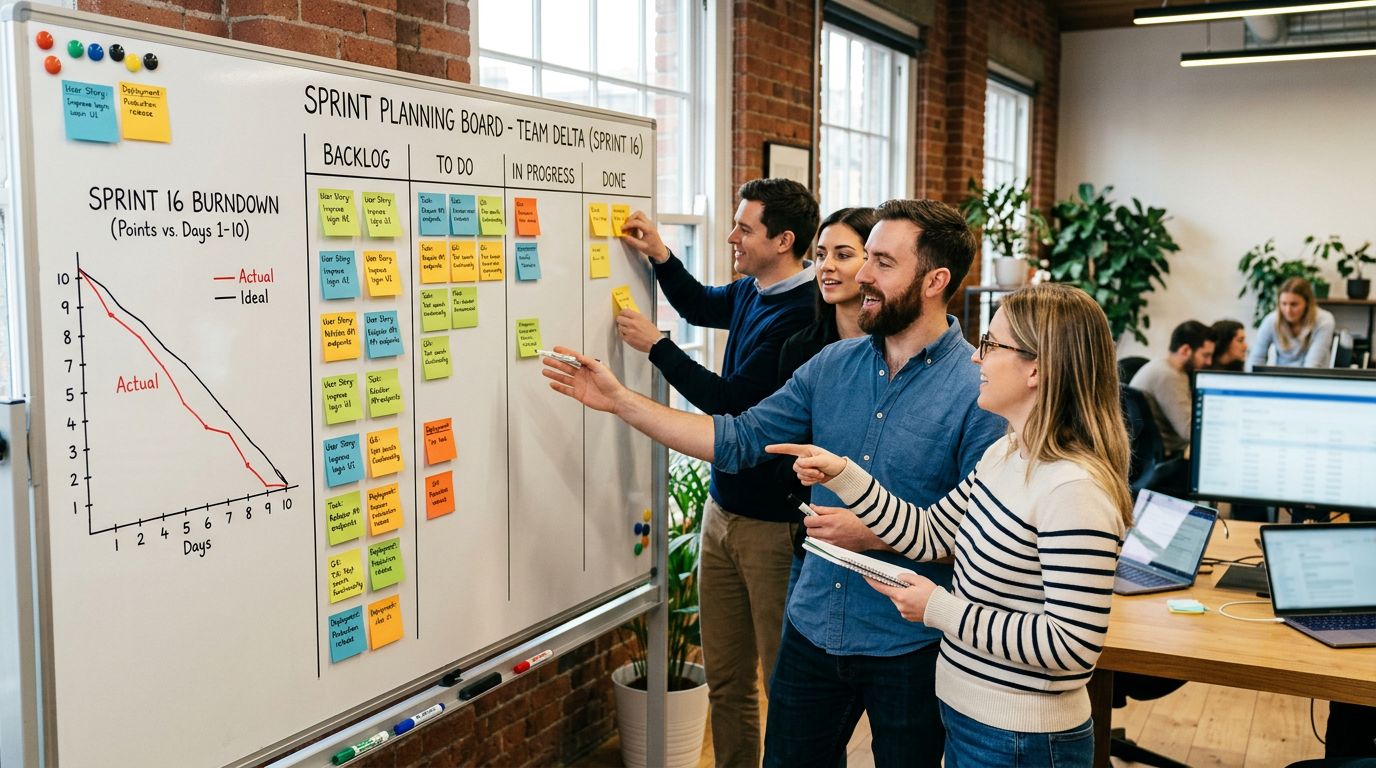
Step 2: Establish a 14-day sprint cadence. One dedicated team. One backlog. One sprint every 14 days with a deployable increment at the end. If a sprint does not produce working software, something is wrong with the process - not the team.
Step 3: Measure business outcomes, not output. Track conversion rate, revenue per session, and average order value - not story points and velocity charts.
Scaling Based on Results
If a sprint improves conversion rate by 0.3%, that is worth more than shipping 15 tickets.
Step 4: Expand based on results. Once the first product area shows measurable improvement, add a second sprint team for the next priority area. Expansion should follow proven results, not planned roadmaps.
Step 5: Eliminate relaunch cycles entirely. After 6-12 months of continuous delivery, your platform is always current. There is nothing to relaunch because the platform evolves every 14 days.
What Metrics Should You Track?
The shift from relaunch cycles to continuous delivery requires a corresponding shift in how you measure success. Traditional relaunch metrics (on-time, on-budget, feature completeness) measure project delivery. Continuous delivery metrics measure business impact.
Track these weekly:
- Conversion rate by device. Desktop and mobile trends tell you whether UX improvements are working where they matter most.
- Revenue per session. The single metric that combines traffic quality, UX effectiveness, and product merchandising into one number.
- Page load time (P95). Not the average - the 95th percentile. Your slowest experiences drive the most abandonment.
- Sprint-to-production time. How many days from sprint planning to production deployment.[5] If this exceeds 14 days, your delivery pipeline has a bottleneck.
- Rollback frequency. How often you need to revert a deployment. One rollback per quarter is healthy. One per sprint means your QA process needs attention.
From REWE to Your Organization
REWE Group, Fressnapf, and ZooRoyal did not adopt continuous delivery because it was trendy. For the complete enterprise e-commerce playbook - platform selection, SEO migration, PIM integration, and team structure - see The Enterprise E-Commerce Playbook.
If you are evaluating whether a relaunch is right for your business, read Why 70% of E-Commerce Relaunches Fail first. For the mechanics of running e-commerce in 14-day sprints without breaking production, see How to Run E-Commerce in 14-Day Sprints Without Breaking Production.
And if platform selection is your next decision, our comparison of Shopware vs commercetools vs Adobe Commerce covers the DACH landscape in depth. They adopted it because the traditional relaunch model was costing them revenue, creating unnecessary risk, and slowing their response to customer behavior.
The model is proven across retail segments: grocery, pet supplies, specialty retail. It works at enterprise scale and mid-market scale. The principles are the same. The execution adapts to your organization's complexity.
easy.bi's Performance Scrum methodology is built on the same principles that power REWE's delivery model. 50+ engineers. 100+ projects delivered. 98% client retention rate. 14-day sprint cycles with working software at the end of every one.
If your e-commerce platform is stuck in a relaunch cycle - or if your last relaunch did not deliver the results you expected - you are not alone. The first step is a conversation about what continuous delivery would look like for your specific operation.
References
Explore Other Topics
Ready to scale your e-commerce?
30-minute call with an engineering lead. No sales pitch - just honest answers about your project.
98% engineer retention · 14-day delivery sprints · No lock-in contracts
Related Reading

The Enterprise E-Commerce Playbook: Architecture, Delivery, and Scale
The complete enterprise e-commerce guide: platform architecture (Shopware, commercetools, headless), 14-day sprint delivery, SEO migration, PIM integration, and KPIs that drive revenue.
Enno Bassen
How REWE Runs Multi-Country E-Commerce on 14-Day Sprint Cycles
How enterprise retailers like REWE ship e-commerce features every 14 days. The sprint delivery model, team structure, and QA gates.
Enno Bassen
E-Commerce Conversion Optimization: The 35% Improvement Framework
A systematic 6-lever framework that delivers +35% conversion rate and +22% AOV for DACH e-commerce. Page speed, checkout, product UX, search, cross-sell, and mobile optimization with measurable benchmarks.
Enno Bassen