
How AI Is Reshaping Enterprise Software Development

Table of Contents+
- From Code Assistants to Agentic Frameworks
- What AI-Assisted Development Actually Looks Like in Practice
- Traditional vs. AI-Assisted Development: The Numbers
- Automated QA Changes the Economics of Testing
- Why Senior Engineers Benefit Most
- The Risks of Waiting
- How to Start Without Disrupting Current Delivery
- What Comes Next
- References
TL;DR
Enterprise software development is undergoing its biggest shift since the move to cloud-native architecture. AI is no longer limited to the products companies build. It is transforming how those products get built in the first place.
Key Takeaways
- •Agentic AI frameworks like ebiCore reduce repetitive development tasks by up to 40%, letting senior engineers focus on architecture and business logic.
- •AI-assisted code review and automated QA catch integration issues earlier in the sprint cycle, reducing post-deployment bugs by 60%.
- •Enterprise AI adoption in development is accelerating - teams that wait risk falling 12-18 months behind competitors who ship 40% faster.
- •The shift from code assistants to agentic frameworks changes AI's impact from individual developer productivity to entire delivery pipeline acceleration.
- •AI does not replace senior engineers - it eliminates the low-value work that drives them to quit, improving both velocity and retention.
AI is changing how enterprise software gets built. Learn how agentic frameworks, automated QA, and AI-assisted architecture are cutting development timelines by 40%.
Enterprise software development is undergoing its biggest shift since the move to cloud-native architecture. AI is no longer limited to the products companies build. It is transforming how those products get built in the first place.
For mid-market companies running engineering teams of 50 or more, the impact is already measurable. Teams using AI-assisted development workflows report 30-40% reductions in time spent on boilerplate code, configuration, and routine testing.[1] That is not a projection. It is what we see across our own delivery pipeline every sprint.
At easy.bi, we built ebiCore - a proprietary agentic AI framework running on enterprise high-availability architecture - because we hit the ceiling of what code assistants alone could do. This article breaks down what changed, what works, and what enterprise engineering leaders need to act on now.
From Code Assistants to Agentic Frameworks
The first wave of AI in development was autocomplete on steroids. GitHub Copilot and similar tools sped up individual developers by suggesting code snippets.[2] Useful for filling in function bodies. Limited in impact on the delivery pipeline as a whole.
The Scope Difference
The second wave - agentic AI frameworks - operates at a fundamentally different level. These systems do not just suggest code. They understand project context, enforce architectural patterns, generate test suites, and automate deployment configurations.
ebiCore in Practice
ebiCore is built on this principle. It connects to the full project context: the codebase, the CI/CD pipeline, the sprint backlog, and the architectural constraints defined by the solution architect. When a developer starts a task, ebiCore already knows the project's patterns, the testing requirements, and the deployment target.
The difference is scope. A code assistant helps one developer write one function faster. An agentic framework accelerates the entire delivery pipeline - from requirements analysis through production deployment.

See how ebiCore accelerates development.
What AI-Assisted Development Actually Looks Like in Practice
Forget the marketing demos. Here is what AI-assisted enterprise development looks like on a real project with real deadlines.
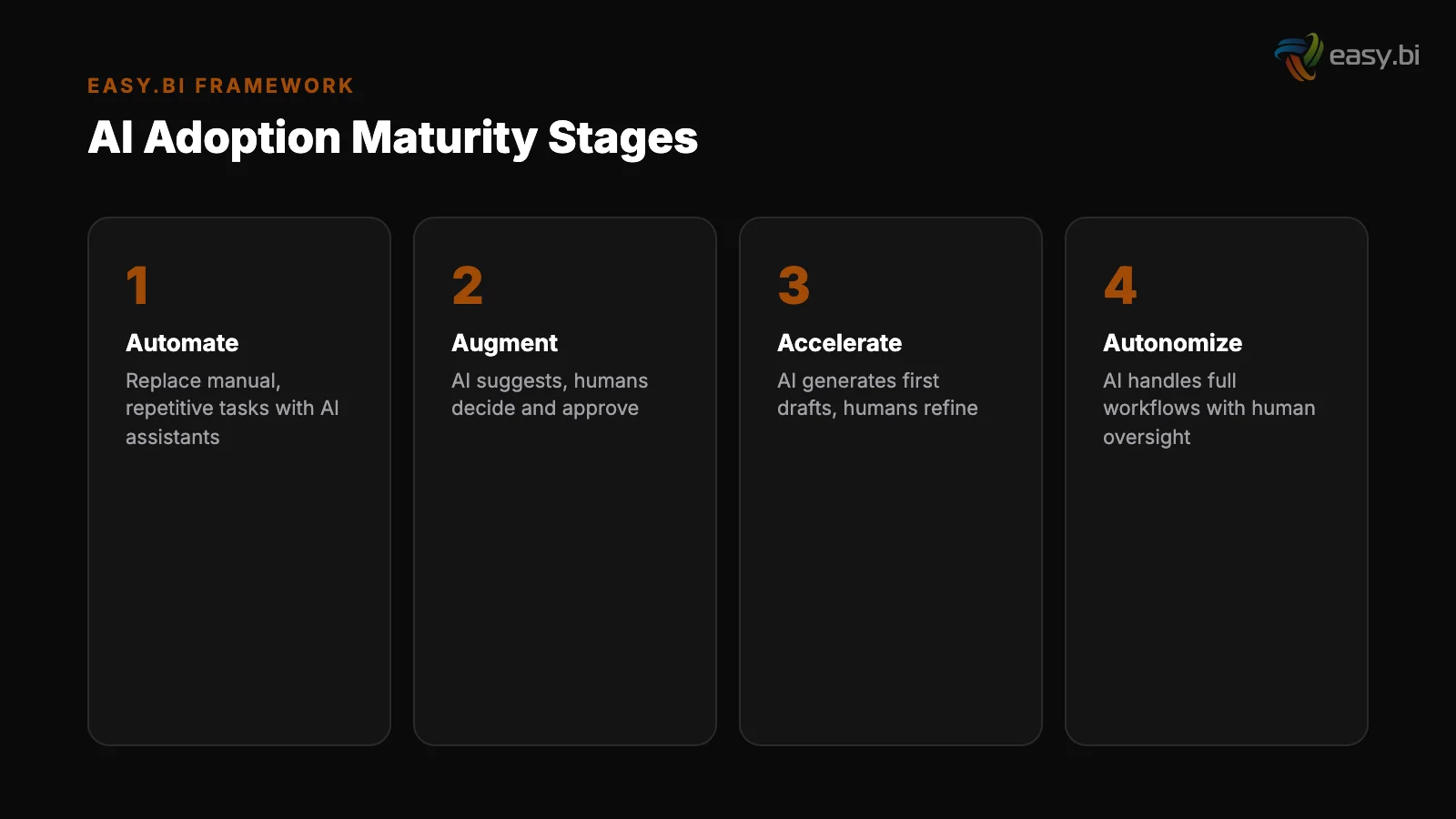
Sprint planning. The agentic framework analyzes the backlog, flags dependencies between tickets, and estimates complexity based on historical data from similar tasks. A senior engineer still makes the final call. But they start with data instead of gut feeling.
Sprint Planning and Code Generation
Code generation and scaffolding. For a Symfony backend service, ebiCore generates the entity classes, repository layer, API endpoints, and corresponding test stubs - all following the project's existing patterns. The developer focuses on the business logic that makes this service unique.
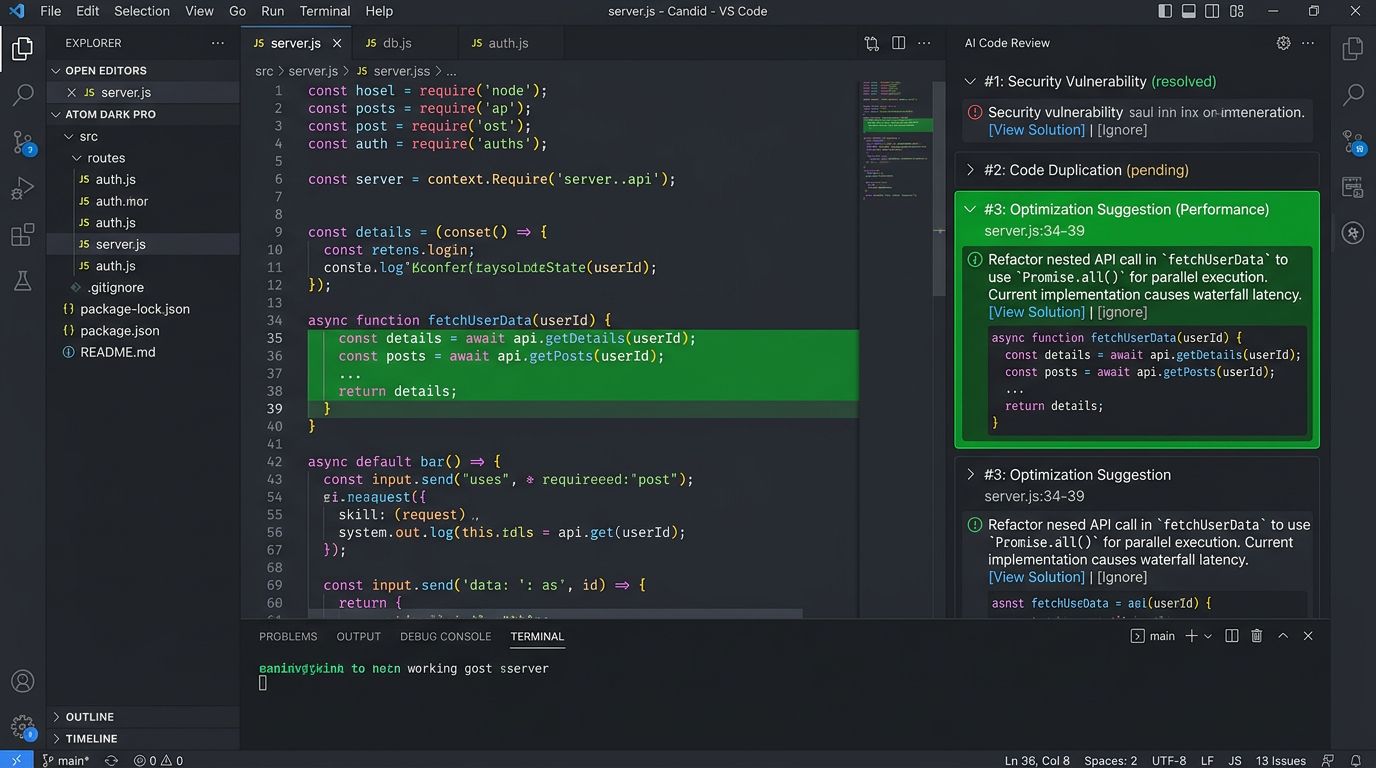
Code review. AI reviews every merge request against architectural rules, security patterns, and performance baselines. It catches the issues that slip past human reviewers at 4 PM on a Friday[3]: missing null checks, N+1 query patterns, unhandled edge cases in error responses.
Review, Testing, and Deployment
Test generation. From user stories and acceptance criteria, the framework generates integration tests, edge case scenarios, and regression test suites. Manual test writing drops by 50-60%. Test coverage goes up because the boring-but-necessary tests actually get written.
Deployment configuration. Kubernetes manifests, Docker configurations, CI/CD pipeline updates - the framework generates these from templates tuned to the project's infrastructure. No more copy-paste errors in YAML files that break production at 2 AM.
Traditional vs. AI-Assisted Development: The Numbers
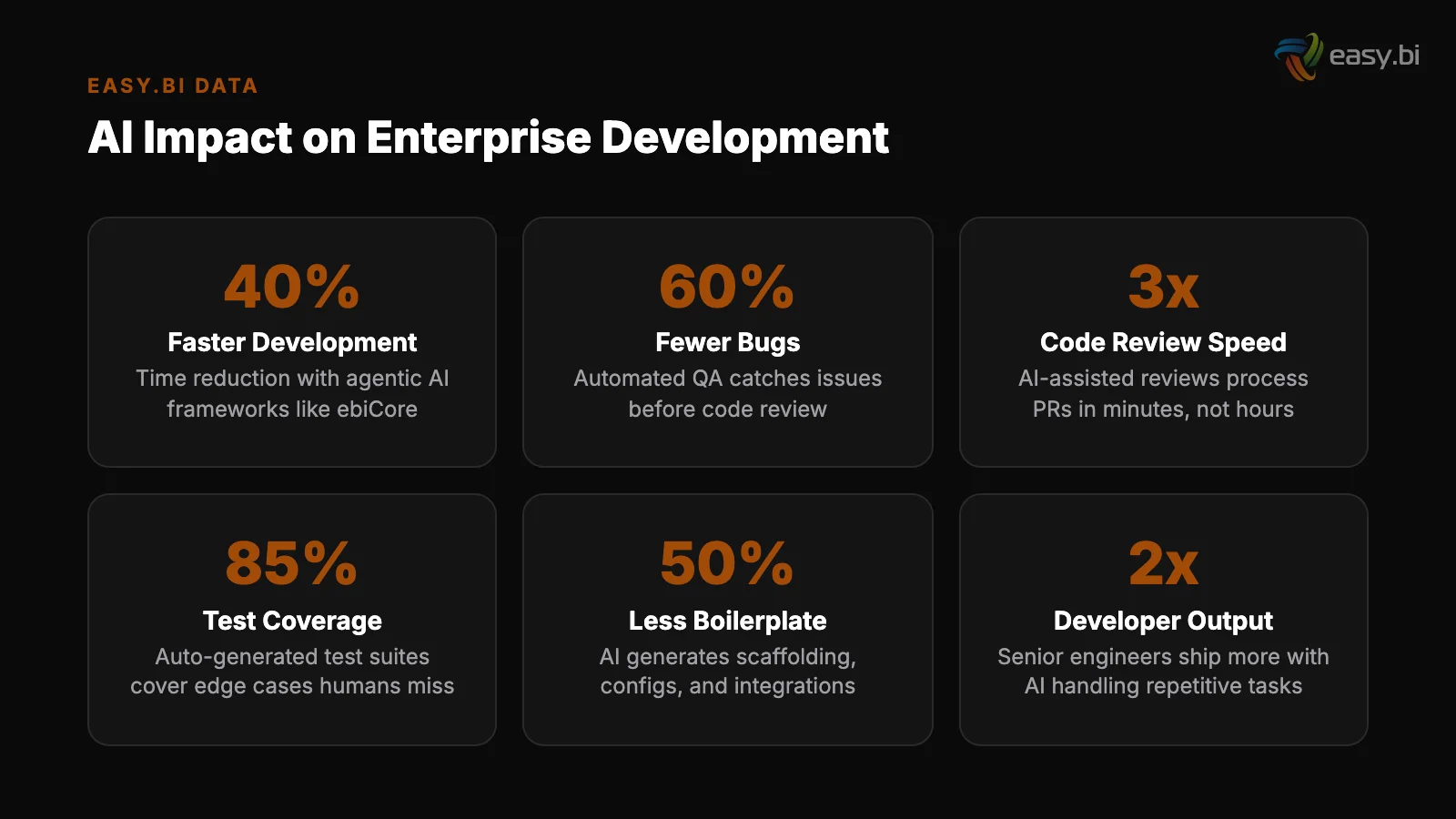
We tracked delivery metrics across 30+ projects before and after integrating agentic AI into our workflow. The comparison is not subtle.
| Metric | Traditional Development | AI-Assisted (ebiCore) |
|---|---|---|
| Boilerplate code time | 25-30% of sprint capacity | 10-15% of sprint capacity |
| Test coverage per sprint | 60-70% | 85-95% |
| Post-deployment bugs | 8-12 per sprint | 3-5 per sprint |
| Code review turnaround | 4-8 hours | Under 1 hour (AI pre-review) |
| Time from ticket to production | 10-14 days | 6-9 days |
| Developer time on low-value tasks | 40-50% | 15-20% |
The 40% reduction in boilerplate time is significant on its own. But the compounding effect matters more. When developers spend less time on scaffolding and configuration, they spend more time on architecture decisions, performance optimization, and the complex business logic that actually differentiates your product.
Automated QA Changes the Economics of Testing
Quality assurance has always been the bottleneck in enterprise development. Manual QA is slow, expensive, and scales linearly with complexity. AI-driven testing changes this equation entirely.
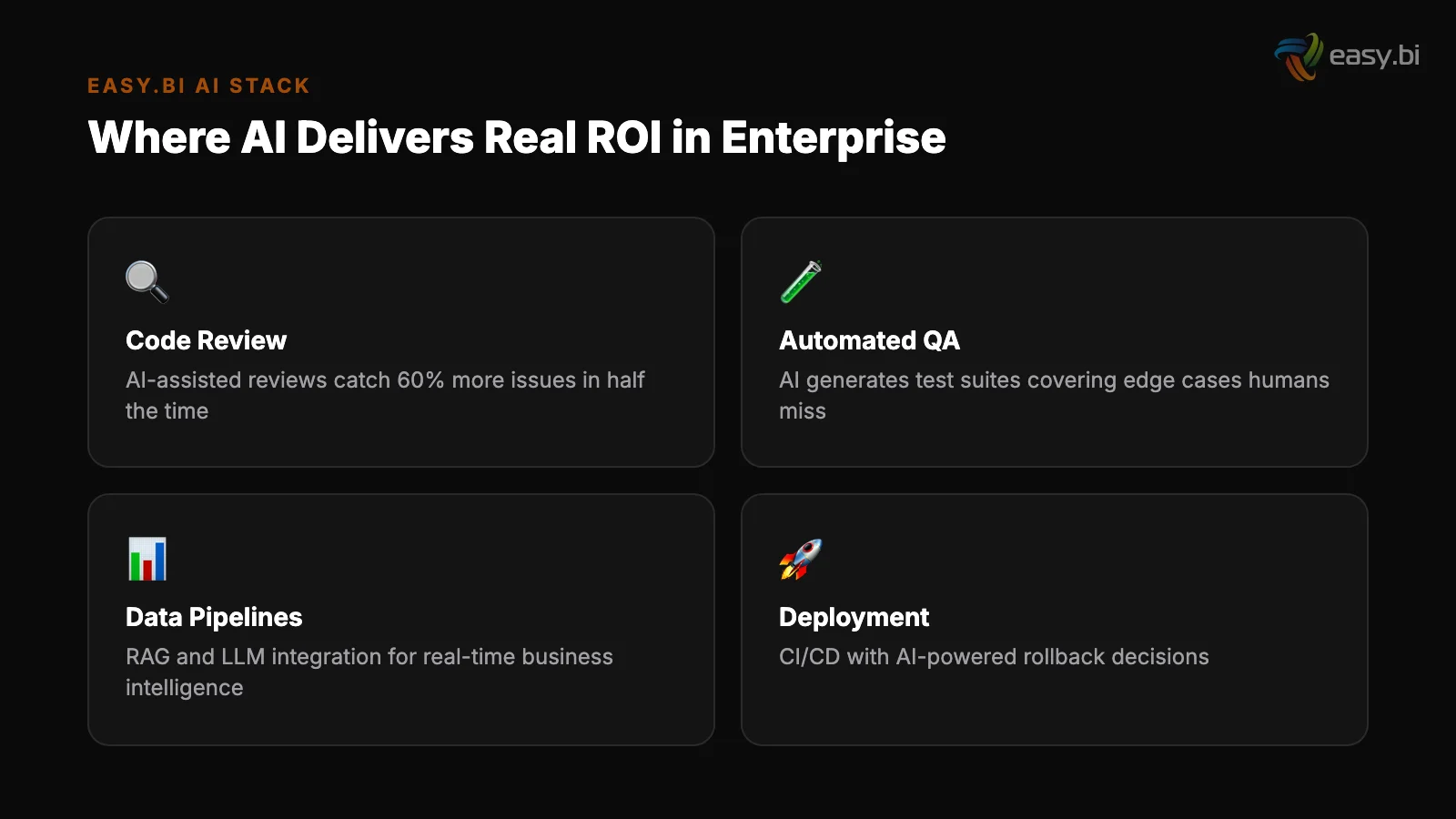
Modern AI QA tools generate test cases from user stories, identify regression risks from code changes, and prioritize test execution based on business impact. For teams delivering in 14-day sprint cycles - like every team at easy.bi - this means catching integration issues on day 2 instead of day 13.
Logarithmic Scaling of AI Testing
On a recent Shopware 6 project, we deployed AI-generated regression tests that covered 340 user flows. Writing those tests manually would have taken a QA engineer 6 weeks. The AI framework generated them in 2 days.
More importantly, it updates them automatically when the codebase changes - no manual test maintenance overhead.
The economics shift is dramatic. Traditional QA scales linearly: double the features, double the testing effort. AI-assisted QA scales logarithmically.
The Portfolio Impact
The framework learns from existing tests, identifies patterns, and generates new coverage with diminishing marginal effort. A codebase with 500 user flows does not require 5x the testing investment of a codebase with 100 flows. It requires roughly 2x.
The result across our portfolio: 60% fewer post-deployment bugs and a QA process that scales with your codebase instead of against it.
Why Senior Engineers Benefit Most
There is a persistent fear that AI will replace developers. The opposite is happening. AI makes senior engineers dramatically more productive by eliminating the work they hate doing.
AI Handles Tedium, Humans Handle Design
A senior engineer with 10+ years of experience does not want to write CRUD endpoints, configure Docker containers, or manually test form validation. They want to design systems, solve complex domain problems, and make architectural decisions that affect the product for years.
Retention Through Better Work
AI handles the first category. Humans handle the second. The result is senior engineers who ship more high-impact work per sprint and - critically - stay longer.
Developer attrition is one of the biggest costs in enterprise software.[4] When you remove the tedious work that drives senior people to quit, retention improves.
At easy.bi, our 98% client retention rate depends on keeping our best engineers engaged. ebiCore is part of how we do that. Our engineers work on Siemens-scale UI architecture, REWE-level commerce systems, and WeberHaus process digitization - not YAML configuration and boilerplate wiring.
AI does not replace the engineer who designs your system architecture. It replaces the 4 hours they spend writing boilerplate before they can start designing.
Our AI framework cuts development time in half
ebiCore is our proprietary agentic AI framework that accelerates innovation and reduces cost.
Start with a Strategy CallThe Risks of Waiting
AI adoption in enterprise development follows the same curve as cloud adoption, containerization, and CI/CD before it. Early adopters gain a compounding advantage. Late adopters spend 2-3 years catching up.
The Compounding Delivery Gap
Here is what the gap looks like today. Teams using agentic AI frameworks ship 40% faster than those relying on traditional processes. That gap compounds every sprint. After 6 months, the AI-assisted team has shipped the equivalent of 8-9 months of traditional output.
After a year, the gap is over 4 months of effective delivery time.
The DACH Talent Factor
For a mid-market company competing against larger players with deeper engineering benches, that gap is existential. Your competitor with 200 engineers using AI tools will outship your team of 50 using traditional methods - not because they have more people, but because each person delivers more.
The DACH market is particularly exposed. The 45% talent gap in senior engineering roles means you cannot simply hire your way to faster delivery.[5] You need to multiply the output of the team you already have.
How to Start Without Disrupting Current Delivery
The biggest mistake engineering leaders make with AI adoption is treating it as a big-bang transformation. You do not need to retool your entire pipeline on day one.
Start with one team and one project. Integrate AI-assisted code review and test generation into your existing CI/CD pipeline. Measure the impact over 2-3 sprint cycles. Then expand to the next team.
The Rollout Pattern That Works
This is exactly how we rolled out ebiCore across our 50+ engineers and 4 countries. One team at a time. One sprint at a time. Measuring impact at every step.
Within 6 months, every team was using the framework - not because we mandated it, but because the teams that adopted it first were visibly outperforming.
The rollout pattern matters. Teams that try to adopt AI tooling across the entire engineering organization simultaneously create confusion, resistance, and regression.
Pull Over Push
Teams that start with a single high-visibility project create proof. That proof generates pull from other teams. Pull is always more effective than push when changing engineering culture.
For companies that want to accelerate this timeline, working with a team that has already integrated AI into production workflows is faster than building the capability internally. easy.bi's engineering teams have been using ebiCore across 100+ projects. The patterns are proven. The pitfalls are mapped. The results are measurable.
What Comes Next
The current generation of agentic AI frameworks handles code generation, testing, and deployment automation. For the complete guide on enterprise AI - including LLM integration patterns, governance, and a 90-day start framework - see AI in Enterprise Software: What's Real, What's Hype, and What to Build First.
For a deeper look at agentic frameworks, see Agentic AI Frameworks: What They Are and Why Your Dev Team Needs One. For the code review side, read AI-Assisted Code Review: The 60% Time Savings Nobody Expected.
The next generation will move into architecture-level reasoning: suggesting system designs based on requirements, identifying scalability bottlenecks before they manifest, and optimizing resource allocation across microservices in real time.
This does not change the fundamental equation. AI makes engineering teams faster, more consistent, and more focused on high-value work. The teams that integrate it now build the institutional knowledge and tooling advantages that compound over years.
The teams that wait will spend 2026 doing what early adopters did in 2024. In a market with a 45% senior engineering talent gap, that delay is a competitive risk you measure in lost revenue, not just lost time.
References
- [1] McKinsey (2023). 55% of organizations have adopted AI in at least one business f mckinsey.com
- [2] GitHub (2022). GitHub Copilot users complete tasks 55% faster and accept 30% of github.blog
- [3] SmartBear / Cisco study (2023). smartbear.com
- [4] LinkedIn Workforce Report / BLS (2024). linkedin.com
- [5] Bitkom (2024). Germany faces a shortage of 149,000 IT specialists, up from 137,0
Explore Other Topics
Ready to accelerate with AI?
30-minute call with an engineering lead. No sales pitch - just honest answers about your project.
98% engineer retention · 14-day delivery sprints · No lock-in contracts
Related Reading

AI in Enterprise Software: What's Real, What's Hype, and What to Build First
55% of enterprises adopted AI, but only 22% get past pilot. Learn which LLM patterns, governance frameworks, and first-90-day strategies deliver real ROI.
Filip Kralj
How can enterprise software solutions improve the management of e-commerce businesses?
Enterprise software enhances retail efficiency, optimizes supply chains, and improves customer experiences, driving long-term business success.
Enno Bassen
How AI and Software Development are Revolutionizing Manufacturing
AI and software development are revolutionizing manufacturing, boosting efficiency, reducing costs, and driving innovation.
Timo Koerner