
What Does an AI Pilot Actually Cost? (Real Numbers, Not Guesses)

Table of Contents+
- What Does a Chatbot Pilot Actually Cost?
- What Does a Process Automation Pilot Cost?
- What Does a Predictive Analytics Pilot Cost?
- What Hidden Costs Do Most Budgets Miss?
- What Is the Real Cost of Scaling From Pilot to Production?
- How Should You Structure the Budget for Approval?
- What Does the First-Year Total Cost of Ownership Look Like?
- How Do You Avoid Becoming a Failed AI Pilot Statistic?
- Frequently Asked Questions
- References
TL;DR
AI pilots cost EUR 25,000 to 120,000 depending on type, but the build is only 30-40% of total cost. Data preparation consumes 60-80% of project time. Production scaling multiplies pilot costs by 2.5x to 4x. Budget for 18 months of operations before approving the pilot, and define measurable success metrics before writing any code.
Key Takeaways
- •A realistic AI pilot budget for a DACH mid-market company ranges from EUR 25,000 for a basic chatbot to EUR 120,000 for a predictive analytics system. The visible build cost is only 30-40% of total cost of ownership - data preparation, integration, change management, and ongoing operations consume the rest.
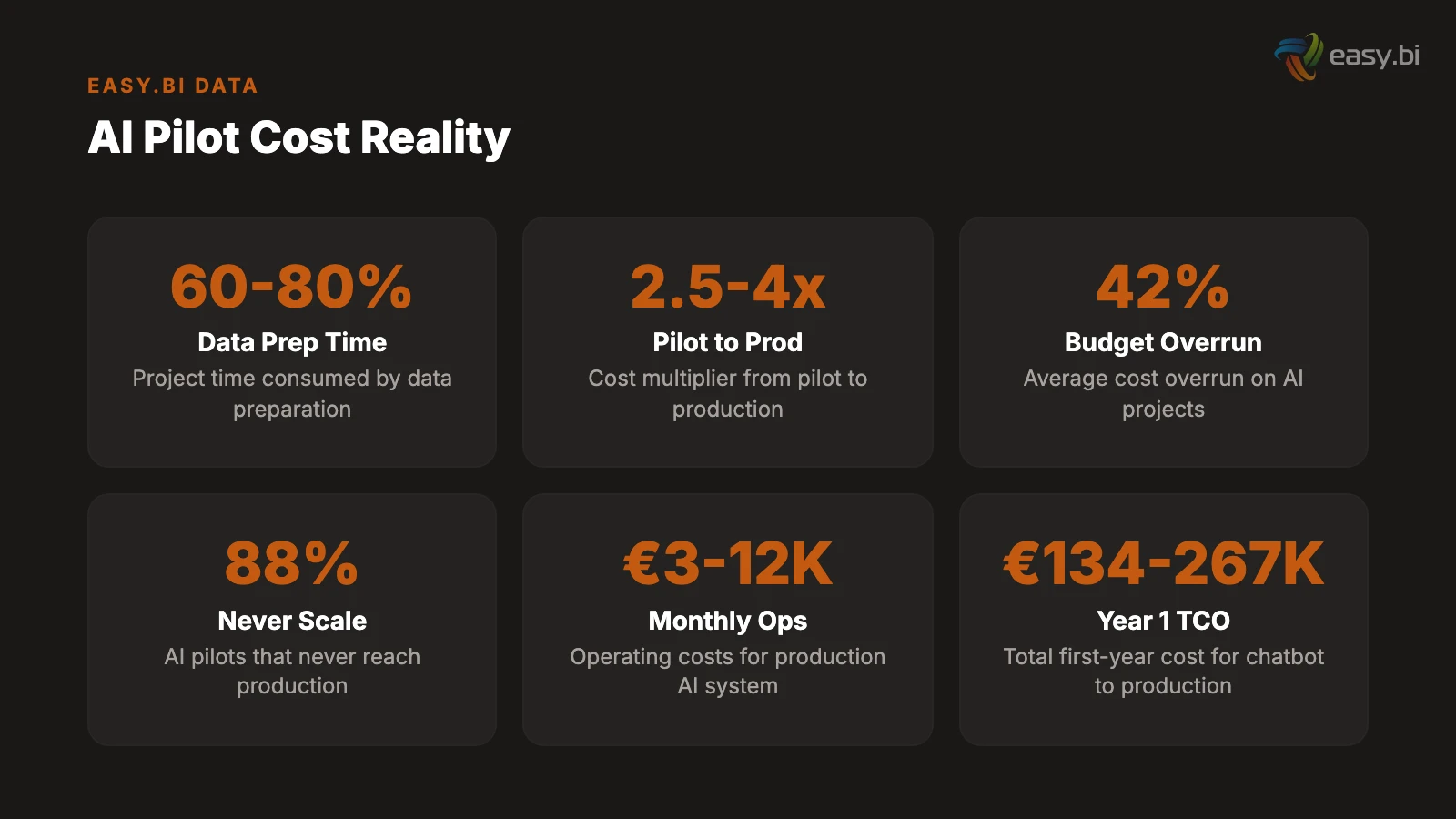
- •Data preparation is the largest hidden cost, consuming 60-80% of project time and 30-50% of the total AI budget. Most organizations underestimate this by 30-40%, leading to an average budget overrun of 42% across AI projects.
- •The pilot-to-production cost multiplier is 2.5x to 4x. A EUR 50,000 pilot becomes a EUR 125,000 to 200,000 production deployment. Infrastructure scaling, data pipeline hardening, security compliance, and change management drive the increase.
- •Monthly operating costs for a production AI system serving real users run EUR 3,000 to 12,000, covering LLM API fees, infrastructure, monitoring, and maintenance. Budget for 18 months of operating costs before approving the pilot.
- •42% of companies abandoned at least one AI initiative in 2025. The primary causes were not technical failure but poor data readiness, unclear success metrics, and loss of executive sponsorship. Define measurable outcomes before writing the first line of code.
Real cost breakdowns for AI pilots by type: chatbots (EUR 20K-55K), process automation (EUR 30K-80K), and predictive analytics (EUR 40K-120K). Includes hidden costs most budgets miss and a complete budget template.
"What will this AI pilot cost?" is the first question every CFO asks and the last question most AI vendors answer honestly. The typical response - "it depends" followed by a range so wide it is useless - does not help mid-market CTOs build a business case or secure budget approval.
I am going to give you the real numbers. Not theoretical ranges from analyst reports, but the actual cost structures we see across AI pilot deployments for DACH mid-market companies. Chatbots, process automation, predictive analytics - broken down by component, with the hidden costs that most budgets miss.
These numbers are based on 2026 pricing for European deployments. They assume a mid-market company with 100 to 5,000 employees, existing digital infrastructure, and a team that has not deployed production AI before.
What Does a Chatbot Pilot Actually Cost?
Customer-facing AI chatbots are the most common first pilot. They are visible, measurable, and deliver ROI within months if built correctly. They are also the most frequently underbudgeted.
A production-quality customer support chatbot with RAG - one that answers questions from your knowledge base, escalates to human agents, and integrates with your existing support platform - costs EUR 20,000 to 55,000 for the pilot phase.[1]
Here is where that budget goes:
| Component | Cost Range (EUR) | % of Pilot Budget | Timeline |
|---|---|---|---|
| Discovery and requirements | 3,000-6,000 | 10-15% | 1-2 weeks |
| Data preparation and knowledge base structuring | 5,000-12,000 | 20-25% | 2-3 weeks |
| RAG pipeline development (chunking, embeddings, retrieval) | 6,000-15,000 | 25-30% | 2-3 weeks |
| Frontend and integration | 3,000-10,000 | 15-20% | 1-2 weeks |
| Testing, QA, and prompt optimization | 3,000-8,000 | 10-15% | 1-2 weeks |
| Deployment and handover | 1,500-4,000 | 5-8% | 3-5 days |
Monthly operating costs after deployment: EUR 800 to 2,500. That covers LLM API fees (EUR 200-800 depending on conversation volume), vector database hosting (EUR 100-500), monitoring tools (EUR 200-500), and a monthly optimization review (EUR 300-700).
The timeline from kickoff to deployment is 6 to 10 weeks. Not 6 months. Not a year. If someone tells you a chatbot pilot takes longer than 12 weeks, they are either overscoping the pilot or underestimating their team.
The most common budget overrun in chatbot pilots is data preparation. Companies estimate 1 week for "getting the knowledge base ready" and discover it takes 3 weeks because their documentation is inconsistent, outdated, or scattered across 4 different systems. Budget for the longer timeline.
See how ebiCore accelerates development.
What Does a Process Automation Pilot Cost?
Process automation pilots - document classification, invoice processing, email routing, data extraction from unstructured sources - sit in the middle of the cost spectrum. They require deeper integration with existing systems and more rigorous accuracy validation than chatbots.
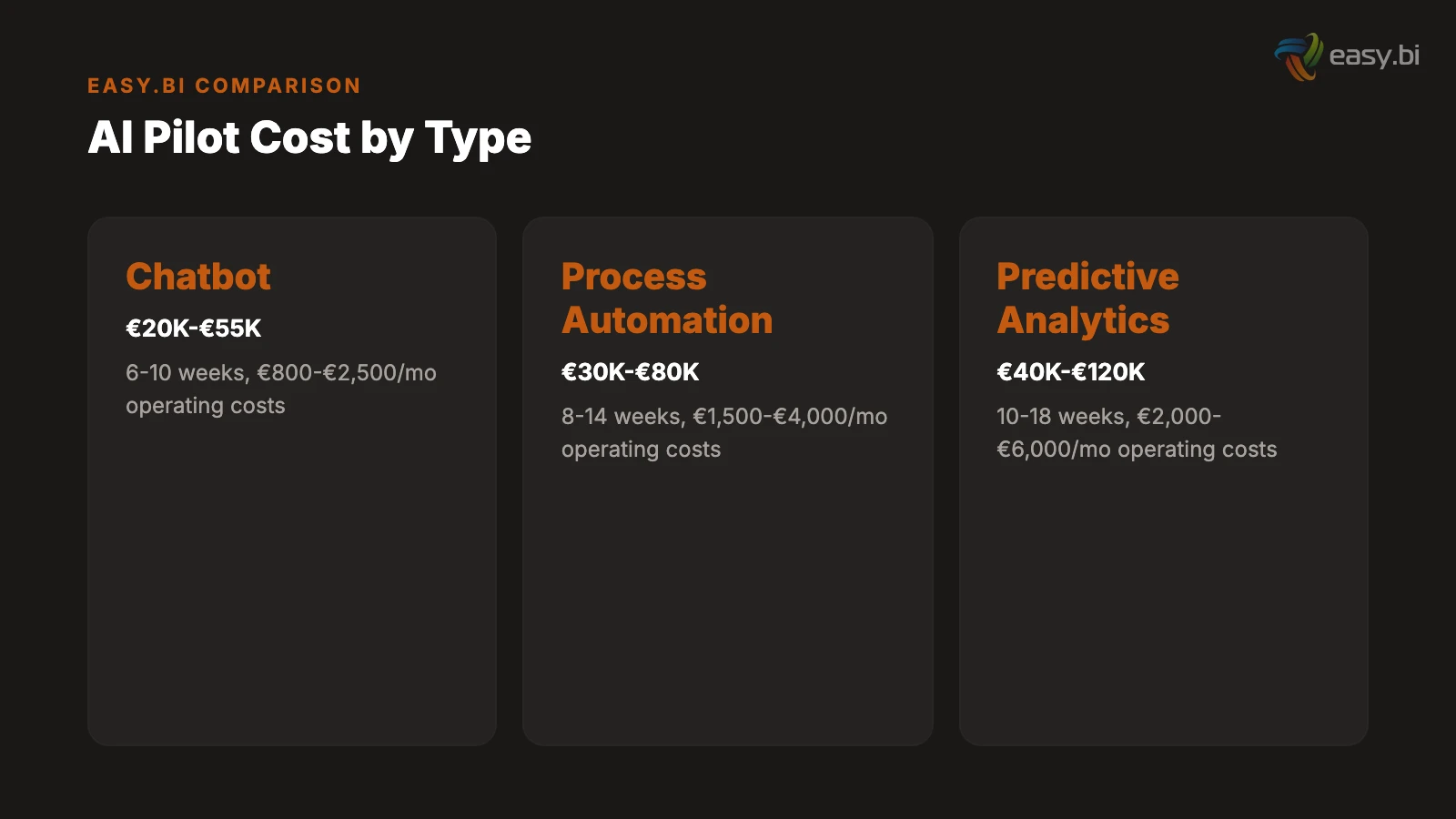
A typical process automation pilot costs EUR 30,000 to 80,000.[2]
The cost structure shifts compared to chatbots. Integration complexity drives the budget rather than the AI model itself. Connecting to ERP systems, CRM platforms, document management systems, and email infrastructure requires custom development that varies dramatically based on the target systems.
For a document classification and extraction system - say, automatically categorizing incoming invoices and extracting key fields - the breakdown looks like this:
- Discovery and process mapping: EUR 4,000-8,000 (2-3 weeks). Understanding the current manual process, identifying edge cases, and defining accuracy thresholds.
- Data preparation and labeling: EUR 8,000-20,000 (2-4 weeks). Collecting representative document samples, labeling training data, handling format variations.
- Model development and testing: EUR 10,000-25,000 (3-5 weeks). Building the classification and extraction pipeline, prompt engineering or fine-tuning, accuracy benchmarking.
- System integration: EUR 5,000-15,000 (2-4 weeks). Connecting to the ERP, building the handoff workflow, implementing exception handling.
- UAT and deployment: EUR 3,000-8,000 (1-2 weeks). User acceptance testing, parallel running with the manual process, deployment.
Monthly operating costs: EUR 1,500 to 4,000, depending on document volume and the number of integrations to maintain.
54% of companies underestimate their initial AI investment by 30-40%, particularly in data preparation and system integration.[3] Process automation pilots are where this underestimation hits hardest because integration complexity is difficult to estimate until you start building.
The most expensive process automation pilot I have overseen was not the most complex one - it was the one where the client's ERP system had no documented API. We spent EUR 18,000 on reverse-engineering the integration. That line item was not in the original budget.
What Does a Predictive Analytics Pilot Cost?
Predictive analytics pilots - demand forecasting, churn prediction, pricing optimization, anomaly detection - are the highest-cost category because they require the most data engineering and the longest validation cycles.
A predictive analytics pilot for a mid-market company costs EUR 40,000 to 120,000.[2]
The cost distribution is heavily front-loaded toward data work. Predictive models are only as good as the historical data they learn from, and most mid-market companies have data quality issues they have never had a reason to fix until now.
| Component | Cost Range (EUR) | Timeline | Key Risk |
|---|---|---|---|
| Data audit and feasibility assessment | 5,000-10,000 | 1-2 weeks | Data may be insufficient for the use case |
| Data pipeline engineering | 10,000-30,000 | 3-6 weeks | Legacy systems with no clean export path |
| Feature engineering and model development | 10,000-35,000 | 3-6 weeks | Insufficient signal in available data |
| Validation and backtesting | 5,000-15,000 | 2-3 weeks | Model performs well in test, poorly in production |
| Dashboard and integration | 5,000-15,000 | 2-3 weeks | Users do not trust or adopt the predictions |
| Deployment and monitoring setup | 3,000-10,000 | 1-2 weeks | Model drift without monitoring |
Monthly operating costs: EUR 2,000 to 6,000, covering compute infrastructure, data pipeline maintenance, model monitoring, and periodic retraining.
The critical risk in predictive analytics pilots is not the model - it is the data. I have seen three separate pilots where the client's data audit revealed that the available historical data was insufficient to train a reliable model. Two of those pilots pivoted to a different use case. One was abandoned. The EUR 5,000-10,000 data audit at the start of the project is the cheapest insurance you will buy.
What Hidden Costs Do Most Budgets Miss?
The visible build cost - the line items in the vendor quote or the internal project budget - is only 30-40% of the total cost of ownership for an AI pilot. The other 60-70% is invisible until the invoices arrive.[3]
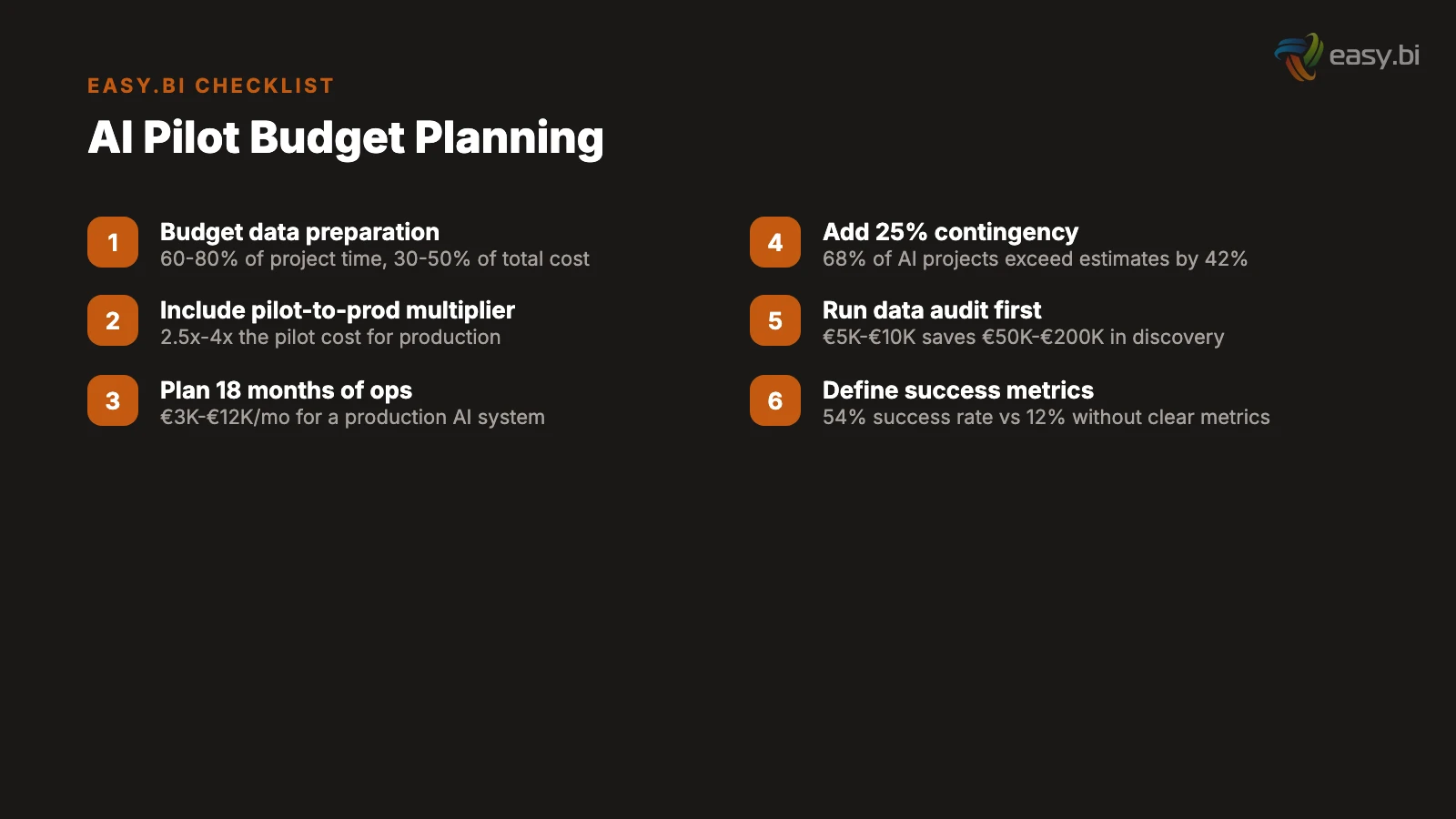
Data preparation (30-50% of total budget). Data preparation is the single largest cost in any AI project, consuming 60-80% of project time.[4] Cleaning, labeling, deduplicating, and formatting data for AI consumption is unglamorous work that no vendor demo includes. Budget EUR 10,000 to 40,000 depending on your data maturity.
Change management (10-15% of total budget). The AI system works. Nobody uses it. This happens in more than half of pilot deployments. Training sessions, documentation, workflow redesign, and running the AI system in parallel with the manual process until teams trust the output - all of this costs time and money. One study found that the hidden costs of parallel operation can equal the AI system's annual licensing cost.[5]
Security and compliance (5-10% of total budget). GDPR data processing agreements with AI vendors. Security assessments of new infrastructure. Data residency verification. For DACH companies, these are non-negotiable and non-trivial. Budget EUR 3,000-8,000 for a standard pilot.
Opportunity cost of internal teams. Your CTO, data engineers, and domain experts will spend 20-40% of their time on the pilot for 2-3 months. That is time they are not spending on other priorities. At DACH mid-market salary levels, the internal time investment adds EUR 15,000-40,000 to the true cost of a pilot.
Infrastructure costs that creep. GPU instances left running over weekends. Vector database storage that grows faster than expected. API costs that spike during testing phases. 68% of AI projects exceed initial estimates by an average of 42%.[3] Set a 25% contingency buffer and track infrastructure costs weekly, not monthly.
What Is the Real Cost of Scaling From Pilot to Production?
This is the number that kills AI initiatives. The pilot works. The demo is impressive. The board approves production deployment. Then the real budget appears.
The pilot-to-production cost multiplier is 2.5x to 4x.[6] A EUR 50,000 pilot becomes a EUR 125,000 to 200,000 production deployment. A EUR 100,000 pilot scales to EUR 250,000 to 400,000 in production.
Where does the multiplier come from?
- Infrastructure scaling. The pilot runs on a single server handling 100 requests per day. Production needs to handle 10,000 requests per day with 99.9% uptime, auto-scaling, failover, and geographic redundancy. Infrastructure costs alone increase by 3-5x.
- Data pipeline hardening. The pilot uses manual data uploads. Production needs automated pipelines that ingest, validate, transform, and index data continuously. Building production-grade data pipelines costs EUR 15,000-40,000.
- Security and compliance. The pilot ran in a sandbox. Production handles real customer data with GDPR obligations, audit logging, access controls, and encryption at rest and in transit. Security hardening adds EUR 10,000-25,000.
- Monitoring and observability. The pilot was monitored by the team that built it. Production needs automated monitoring for model accuracy, latency, error rates, and data drift. Building this infrastructure costs EUR 8,000-20,000.
- Change management at scale. The pilot was used by 5 people who volunteered. Production means rolling out to 50-500 users who did not ask for a new tool. Training, documentation, feedback loops, and adoption tracking add EUR 10,000-30,000.
88% of AI pilots never make it to production - not because the technology failed, but because the full cost of production deployment was never properly budgeted.[6]
The fix is simple but uncomfortable: include production scaling costs in the pilot business case from day one. If the combined pilot-plus-production budget does not generate positive ROI within 18 months, either reduce scope or choose a different use case.
How Should You Structure the Budget for Approval?
CFOs do not approve AI experiments. They approve business cases with clear costs, timelines, and expected returns. Here is how to structure the budget for a mid-market AI pilot that survives finance review.
Phase 1: Feasibility (EUR 5,000-10,000, 2 weeks). Data audit, technical feasibility assessment, vendor evaluation, and success metrics definition. This phase answers the question: "Is this pilot worth doing?" If the answer is no, you have spent EUR 10,000 instead of EUR 100,000 to find out.
Phase 2: Pilot build (EUR 20,000-80,000, 6-12 weeks). The actual development, including data preparation, model development, integration, testing, and deployment. Scope this tightly - the pilot should prove the concept with a defined user group, not solve every edge case.
Phase 3: Validation (EUR 5,000-15,000, 4-8 weeks). Run the pilot with real users. Measure accuracy, adoption, and business impact against the success metrics defined in Phase 1. This phase determines whether production deployment is justified.
Phase 4: Production scaling (EUR 50,000-200,000, 8-16 weeks). Only if Phase 3 validates the business case. Infrastructure scaling, security hardening, full integration, change management, and monitoring.
Total budget request for a complete AI initiative: EUR 80,000 to 305,000 from feasibility through production. Present this as a staged investment with clear go/no-go decision points at each phase boundary. The CFO approves Phase 1. Phase 2 approval depends on Phase 1 results. And so on.
This staged approach protects the organization from committing EUR 200,000 to a use case that a EUR 10,000 feasibility study would have eliminated.
Our AI framework cuts development time in half
ebiCore is our proprietary agentic AI framework that accelerates innovation and reduces cost.
Start with a Strategy CallWhat Does the First-Year Total Cost of Ownership Look Like?
Here is the full picture for a mid-market AI chatbot pilot that reaches production - the most common scenario we see in the DACH market.
| Cost Category | Amount (EUR) | When Incurred |
|---|---|---|
| Feasibility assessment | 5,000-8,000 | Month 1 |
| Pilot build (including data preparation) | 25,000-45,000 | Months 1-3 |
| Pilot validation period | 5,000-10,000 | Months 3-4 |
| Production scaling | 50,000-100,000 | Months 4-7 |
| Change management and training | 8,000-20,000 | Months 5-8 |
| Monthly operations (8 months at EUR 2,000-4,000) | 16,000-32,000 | Months 5-12 |
| Security and compliance | 5,000-12,000 | Months 4-6 |
| Internal team time (opportunity cost) | 20,000-40,000 | Months 1-7 |
| First-year total | 134,000-267,000 |
That range - EUR 134,000 to 267,000 for a chatbot that reaches production - is the number most organizations do not see until month 6. The vendor quote said EUR 30,000. The actual first-year cost is 4-9x higher.
This does not mean AI pilots are not worth the investment. The successful ones generate 3-5x ROI within 14 months.[7] But the ROI calculation must use the real total cost, not the vendor quote.
How Do You Avoid Becoming a Failed AI Pilot Statistic?
42% of companies abandoned at least one AI initiative in 2025, with an average sunk cost of EUR 4.2 million per abandoned project.[8] The primary causes were not technical:
- Data quality issues insurmountable: 38%
- Business case no longer viable: 29%
- Loss of executive sponsorship: 21%
- Technical approach infeasible: 12%
Three decisions at the start of a pilot prevent most failures:
Decision 1: Define measurable success metrics before writing code. "Improve customer support" is not a metric. "Reduce average first-response time from 4 hours to 15 minutes for the top 20 question categories" is a metric. Projects with clear pre-approval metrics achieve 54% success rates versus 12% for those without.[8]
Decision 2: Run the data audit first. Spend EUR 5,000-10,000 on a data feasibility assessment before committing to a EUR 50,000 build. If your data quality is insufficient, fix the data first or choose a different use case. This is not a delay - it is the fastest path to a working system.
Decision 3: Secure sustained executive sponsorship. AI pilots with sustained executive sponsorship achieve 68% success rates. Those that lose sponsorship mid-project achieve 11%.[8] Assign an executive sponsor who will attend monthly reviews for the full pilot duration, not just sign the initial budget approval.
For the strategic framework on choosing between building and buying AI capabilities, read the AI build vs. buy decision. For technical details on RAG, fine-tuning, and other integration patterns, see LLM integration patterns for enterprise. And for the governance framework that should accompany every AI pilot, read AI governance for mid-market.
If you want to scope an AI pilot with honest cost estimates and clear success metrics, explore our AI services. We help DACH mid-market companies deploy AI pilots that reach production - with budgets that reflect reality, not marketing.
Frequently Asked Questions
How much does a basic AI chatbot pilot cost?
A production-quality AI chatbot pilot for a DACH mid-market company costs EUR 20,000 to 55,000, including discovery, RAG pipeline development, integration with existing systems, and testing. Monthly operating costs add EUR 800 to 2,500 for API fees, hosting, and monitoring. The timeline is 6 to 10 weeks from kickoff to deployment.
What is the biggest hidden cost in AI projects?
Data preparation. It consumes 60 to 80 percent of project time and 30 to 50 percent of the total budget. Most organizations discover their data is inconsistent, incomplete, or stored in formats that require significant transformation before an AI model can use it. Budget EUR 10,000 to 40,000 for data preparation alone.
How much more does production deployment cost compared to the pilot?
The pilot-to-production cost multiplier is 2.5x to 4x. A EUR 50,000 pilot becomes EUR 125,000 to 200,000 in production. The increase comes from infrastructure scaling, security hardening, monitoring systems, data pipeline automation, and change management programs.
What monthly costs should I budget for a production AI system?
Budget EUR 3,000 to 12,000 per month for a production AI system. This covers LLM API fees (EUR 500 to 3,000), cloud infrastructure (EUR 500 to 2,000), monitoring and maintenance (EUR 1,000 to 3,000), and periodic model retraining or prompt optimization (EUR 1,000 to 4,000). These costs scale with query volume and system complexity.
References
- [1] AI Journal (2025). "AI Chatbot Development Cost 2025: Factors, Location, Feature aijourn.com
- [2] DesignRush (2026). "How Much Does AI Cost in 2026? Full Pricing Breakdown. designrush.com
- [3] Pertama Partners (2026). "Hidden Costs of AI Implementation. pertamapartners.com
- [4] Dan Cumberland Labs (2025). dancumberlandlabs.com
- [5] Opagio (2025). "AI Integration Costs: Hidden Expenses of AI." opag.io
- [6] HST Solutions (2025). "AI Proof of Concept vs Production Deployment: Why 87% of hst.ie
- [7] NewVantage Partners (2024).
- [8] Pertama Partners (2026). "AI Project Failure Rate 2026: 80% Fail. pertamapartners.com
Explore Other Topics
Ready to accelerate with AI?
30-minute call with an engineering lead. No sales pitch - just honest answers about your project.
98% engineer retention · 14-day delivery sprints · No lock-in contracts
Related Reading

What Does Custom Software Development Actually Cost in 2026?
Real cost breakdown for custom software in 2026. DACH vs. Eastern Europe vs. offshore rates, 5-year TCO, and EUR pricing by project type.
Christian Kaspar
Why 85% of AI Projects Fail Before Production
Data-driven analysis of why 85% of AI projects fail before production. Covers organizational, data, process, and partner-selection causes with a diagnostic checklist for mid-market CTOs in the DACH region.
Filip Kralj
How Much Does a Shopware Enterprise Build Cost in 2026?
Shopware enterprise builds cost EUR 30K to 500K+ in 2026. Transparent breakdown of cost tiers, hidden fees, and what drives budget overruns in DACH.
Enno Bassen