
PIM Integration: The Bottleneck Nobody Talks About

Table of Contents+
- Why Does Every E-Commerce Project Underestimate PIM?
- What Does Bad Product Data Actually Cost?
- Pimcore vs Akeneo: Which PIM for Which Situation?
- What Integration Patterns Actually Work?
- How Do You Fix Product Data Quality Before Integration?
- What Does the Integration Timeline Really Look Like?
- How Does PIM Integration Fit Into the Broader E-Commerce Architecture?
- References
TL;DR
PIM integration is the project phase that derails more e-commerce launches than any platform migration or frontend rebuild. It takes 8-14 weeks in practice, not the 2-4 weeks on the project plan. It surfaces data quality problems that have been accumulating for years.
Key Takeaways
- •PIM adoption among enterprises with 10,000+ SKUs reached 67%, yet most integrations underperform because teams treat PIM as a database rather than a data governance system.
- •Product data quality problems cause 30-40% of e-commerce returns - fixing the PIM integration directly reduces return costs and support tickets.
- •Pimcore leads as the open-source PIM for DACH enterprises; Akeneo dominates the commercial SaaS segment. The right choice depends on your customization needs and team capabilities.
- •Event-driven sync patterns outperform batch imports for multi-channel e-commerce - real-time product updates across web, app, and marketplace without nightly job failures.
- •The average PIM integration takes 8-14 weeks, not the 2-4 weeks most project plans allocate. Underestimating this timeline is the #1 cause of e-commerce launch delays.
PIM integration is the hidden bottleneck in 67% of enterprise e-commerce projects. Learn why Pimcore and Akeneo integrations fail, how to fix product data quality, and which sync patterns actually work.
PIM integration is the project phase that derails more e-commerce launches than any platform migration or frontend rebuild. It takes 8-14 weeks in practice, not the 2-4 weeks on the project plan. It surfaces data quality problems that have been accumulating for years.
And it forces hard conversations about who owns product data - conversations that most organizations have been avoiding.
After integrating Pimcore and Akeneo with Shopware, commercetools, and Adobe Commerce across dozens of DACH retailers, we have a clear picture of where PIM integrations fail and what separates the projects that ship on time from the ones that slip by months.
Why Does Every E-Commerce Project Underestimate PIM?
PIM integration looks simple on paper. You have product data in system A. You need it in system B. Connect the API, map the fields, sync the data. Done.
In reality, PIM integration is a data governance project disguised as a technical task. The technical API connection takes days. The data quality work takes months.
PIM adoption in enterprises with 10,000+ SKUs reached 67% in 2023.[1] But adoption does not equal maturity. Most PIM installations are glorified spreadsheets with an API - thousands of products with inconsistent attributes, missing descriptions, duplicate entries, and images in wrong formats.
When you connect this data to a new commerce platform, every inconsistency becomes visible. And every inconsistency is a potential conversion killer.
The average e-commerce conversion rate is 2.86%, with top performers reaching 5.2%.[2] The gap between average and top is often product data quality. Complete product descriptions, consistent attributes, high-quality images, and accurate inventory data do not just look better - they convert better and reduce returns.
See how our team delivers +35% avg conversion lift across 30+ e-commerce projects.
What Does Bad Product Data Actually Cost?
Product data quality is not an abstract concern. It has a direct, measurable cost.
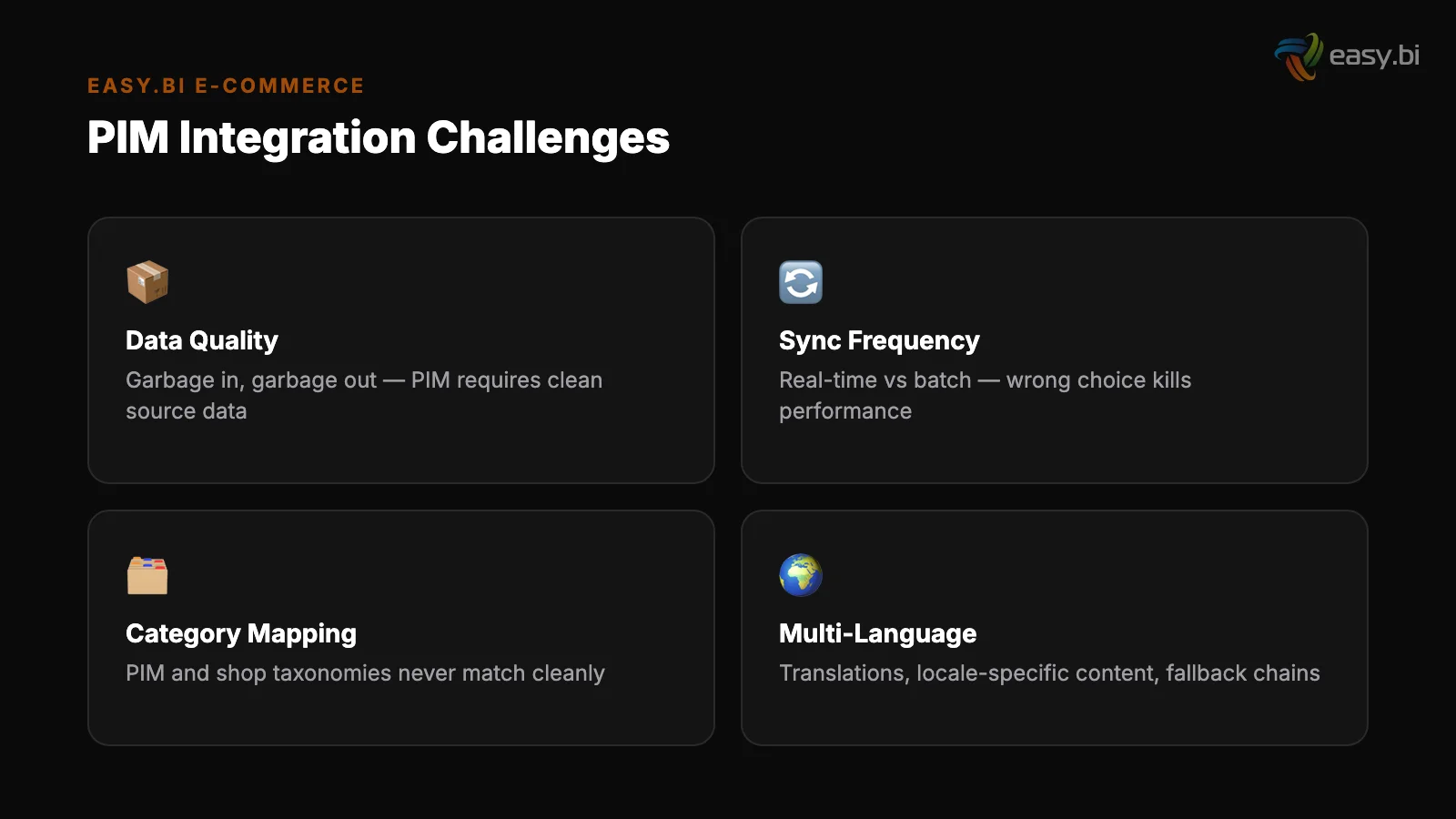
Returns. Inaccurate product descriptions, missing size guides, and wrong color representations drive returns. Return rates in German e-commerce average 16.3%, with fashion at 26%.
Each return costs retailers an average of EUR 5.20 per item.[3] For a retailer shipping 100,000 items per month, reducing the return rate by 3 percentage points through better product data saves EUR 15,600 per month - EUR 187,200 per year.
Returns
Support tickets. When product pages lack specifications, customers ask. Every "What are the dimensions?" email or chat message costs EUR 5-15 in support staff time. Multiply that across thousands of SKUs with incomplete data, and the annual cost reaches six figures.
SEO and discoverability. Incomplete or duplicate product data creates thin content pages that search engines penalize. If 30% of your product pages have descriptions under 50 words, you are leaving organic traffic on the table.
Support tickets
Multi-channel inconsistency. When your website shows one price, your marketplace listing shows another, and your mobile app shows a third, customers lose trust. Multi-channel retailers achieve 287% higher purchase rates than single-channel retailers[4] - but only when the data is consistent across channels.
The PIM is not a nice-to-have middleware layer. It is the single source of truth for every product touchpoint your customer encounters. When it is wrong, everything downstream is wrong - your shop, your marketplace listings, your print catalogs, your customer support scripts.
Pimcore vs Akeneo: Which PIM for Which Situation?
The DACH enterprise PIM market is dominated by two platforms. The choice between them is not about which is "better" - it is about which fits your team, your data complexity, and your integration requirements.
| Dimension | Pimcore | Akeneo |
|---|---|---|
| License model | Open-source core, commercial Enterprise edition | Free Community edition, commercial Growth/Enterprise |
| Architecture | Monolithic PHP/Symfony, includes DAM + MDM + CMS | API-first SaaS, focused PIM only |
| Best for | Complex data models, heavy customization, combined PIM+DAM needs | Clean PIM-focused use cases, multi-channel product syndication |
| Team requirement | PHP/Symfony developers who understand data modeling | Less custom development, more configuration-driven |
| Integration complexity | Flexible but custom - every integration is bespoke | Strong connector ecosystem, pre-built integrations |
| DACH market presence | Strong, especially in manufacturing and B2B | Growing, strongest in retail and fashion |
| TCO (first year, mid-market) | EUR 40,000-80,000 (implementation + hosting) | EUR 30,000-60,000 (license + implementation) |
Pimcore is the right choice when your product data model is complex - products with hundreds of attributes, configurable variants, technical specifications, regulatory data, and multi-language content.
Pimcore's data modeling is the most flexible in the market, but that flexibility requires engineering talent to build and maintain. easy.bi has deep Pimcore experience from projects like the Basalt-Actien-Gesellschaft assessment and the Macrocom portal development.
Akeneo is the right choice when you need a fast, clean PIM implementation focused on multi-channel product syndication. Akeneo's connector marketplace offers pre-built integrations with Shopware, commercetools, and all major marketplaces.
The trade-off is less customization - if your data model does not fit Akeneo's opinionated structure, you will fight the platform instead of using it.
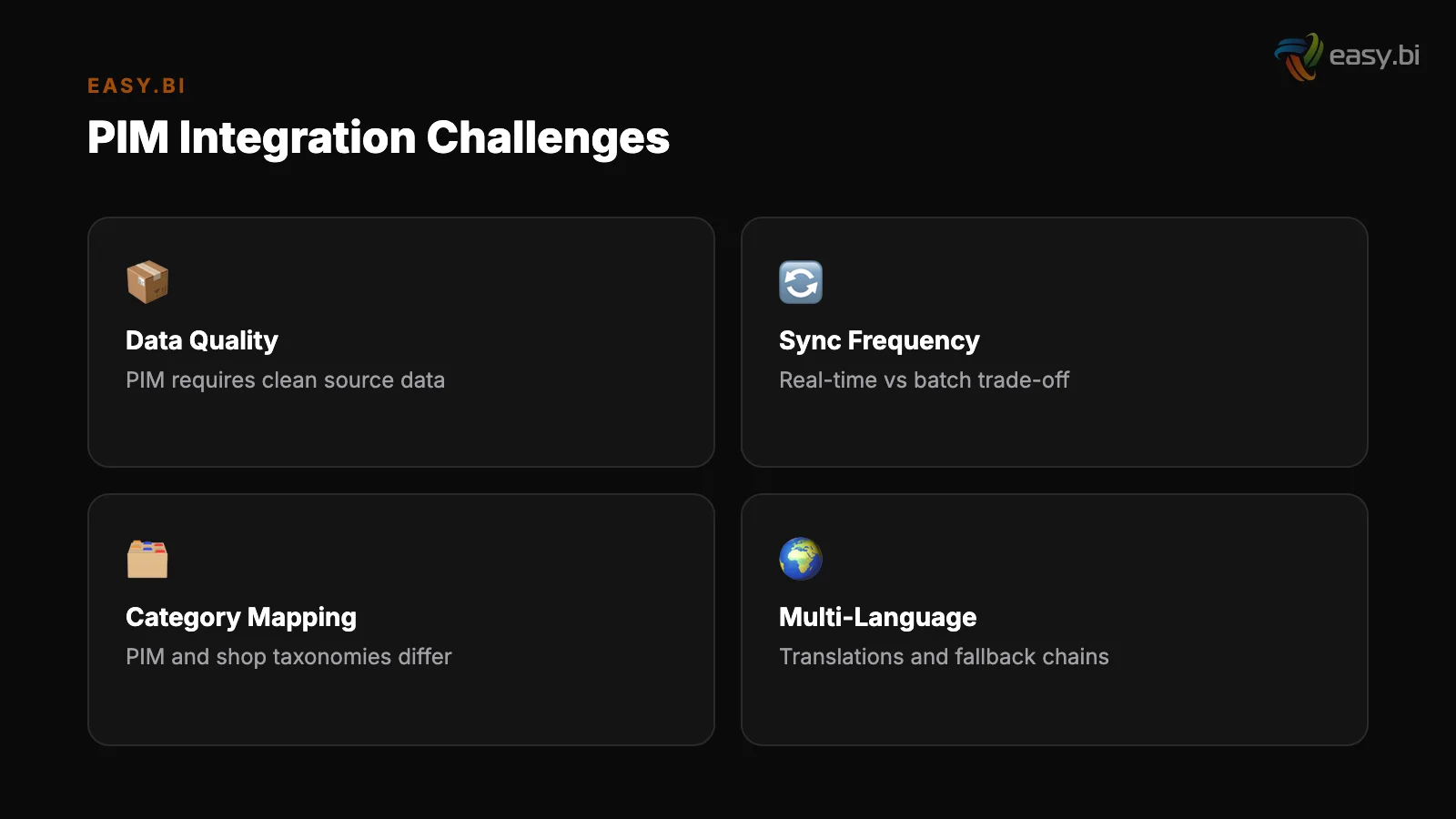
What Integration Patterns Actually Work?
The integration pattern between PIM and commerce platform determines how fresh your product data is, how resilient the sync is, and how much engineering time you spend maintaining it.
Pattern 1: Batch import (simplest, least reliable). A scheduled job - typically nightly - exports product data from PIM as CSV or XML, transforms it, and imports it into the commerce platform. This works for small catalogs with infrequent changes.
It breaks when you have 50,000+ SKUs, frequent price updates, or multi-market data with different update schedules. Nightly jobs fail silently. By the time someone notices a sync failure on Tuesday morning, your shop has been showing Monday's prices for 12 hours.
Pattern 1: Batch import (simplest, least reliable)
Pattern 2: API-based polling (moderate, common). The commerce platform periodically calls the PIM API to check for updated products - every 5 minutes, every 15 minutes, or every hour. This is more responsive than batch import and easier to debug.
The downside is wasted API calls when nothing has changed, and potential rate limiting on large catalogs.
Pattern 3: Event-driven sync (most reliable, recommended). The PIM publishes events (product.created, product.updated, product.deleted) to a message queue - RabbitMQ, Kafka, or AWS SQS. The commerce platform subscribes to these events and processes them in near real-time.
This is the pattern we recommend for any shop with 5,000+ SKUs or multi-channel requirements. Updates propagate in seconds, not hours. Failed syncs are retried automatically. And you have a complete audit trail of every data change.
Pattern 4: GraphQL federation (emerging). Instead of syncing data between systems, the commerce frontend queries both PIM and commerce engine directly via a GraphQL gateway. Product content comes from PIM. Pricing and inventory come from the commerce engine. No sync lag, no data duplication.
The downside is runtime dependency - if the PIM is down, your product pages are incomplete. This pattern works best with headless architectures and CDN caching layers.
How Do You Fix Product Data Quality Before Integration?
Connecting a PIM with bad data to a new commerce platform does not fix the data - it just moves the problems to a more visible system. The data quality work must happen before or during the integration, not after.
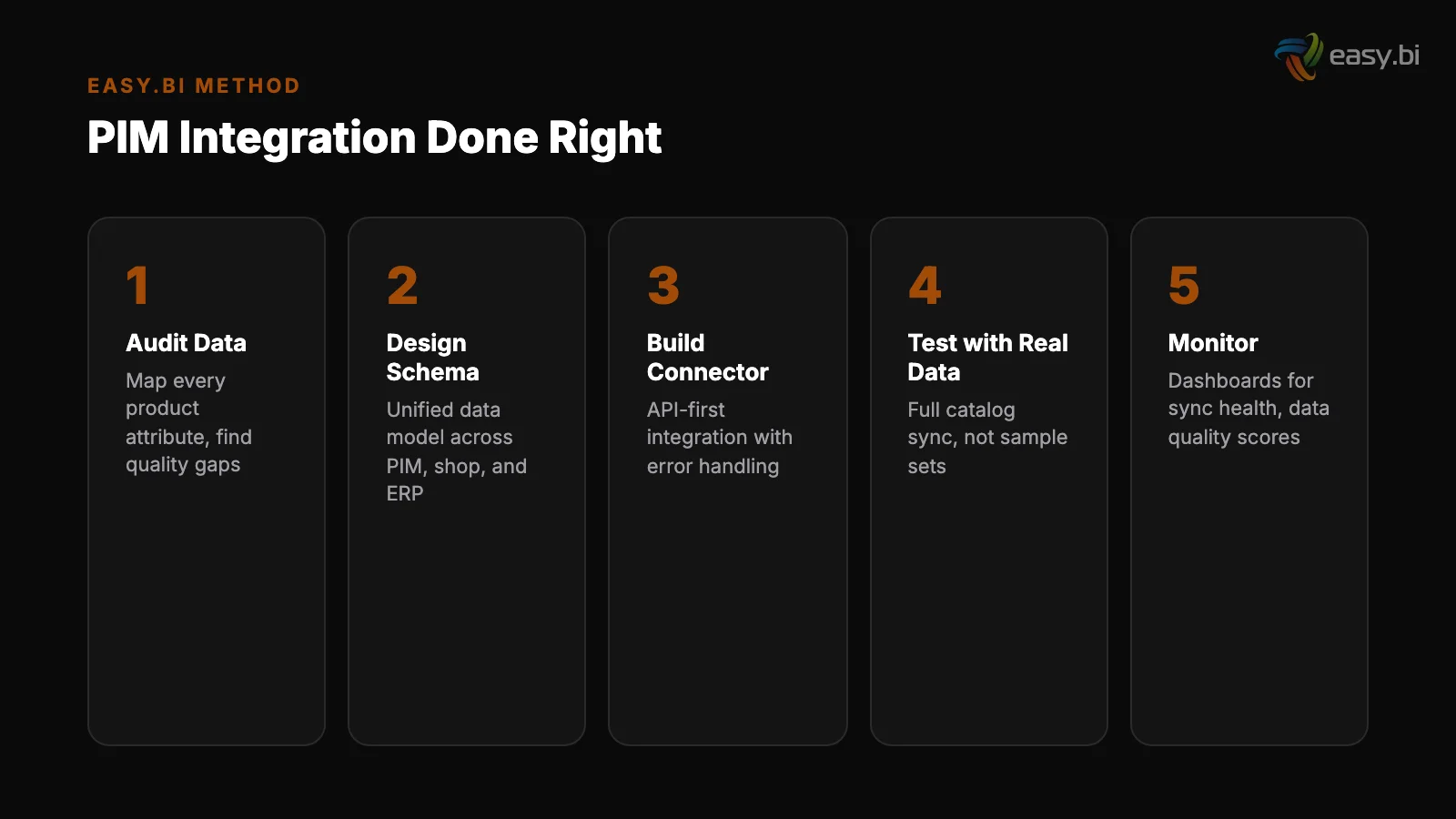
Step 1: Audit completeness. Export your entire product catalog and measure fill rates for every attribute. How many products have descriptions? Size information? At least 3 images? Weight and dimensions? For a typical DACH retailer, the first audit reveals that 20-40% of products are missing critical attributes.
Step 1: Audit completeness
Step 2: Define mandatory attributes by product type. Not every product needs the same data. A t-shirt needs size, color, material, and care instructions. A power tool needs voltage, wattage, certification marks, and safety warnings.
Define the minimum viable data set for each product type and flag everything that falls short.
Step 3: Automate what you can. Image resizing, format conversion (to WebP for web, to TIFF for print), and SEO metadata generation can be automated. Product descriptions cannot - or at least should not be - fully automated if you care about quality.
But you can use templates and AI-assisted generation for initial drafts that humans review.
Step 4: Establish governance. Define who owns product data. Who approves new products? Who updates pricing? Who adds translations? Without clear ownership, data quality degrades within months of the initial cleanup. The PIM should enforce approval workflows - no product goes live without all mandatory attributes completed and approved.
+35% conversion. +22% AOV. EUR 50M+ GMV processed.
Our Shopware-certified team delivers e-commerce at scale with 14-day sprint cycles. 80% less manual work through system integrations.
Start with a Strategy CallWhat Does the Integration Timeline Really Look Like?
Most project plans allocate 2-4 weeks for PIM integration. Most PIM integrations take 8-14 weeks. Here is where the time actually goes:
Weeks 1-2: Data modeling and mapping. Align the PIM data model with the commerce platform's product structure. This is where you discover that PIM attributes do not map cleanly to Shopware properties, that variant structures differ between systems, and that multi-language content has inconsistent locale codes.
Weeks 1-2: Data modeling and mapping
Weeks 3-5: Integration development. Build the sync pipeline - event publishing, message queue, transformation logic, error handling, retry mechanisms, and monitoring. The code itself is not complex.
The edge cases are: How do you handle a product that exists in PIM but references a category that does not exist in the shop yet? How do you sync a price update that arrives during a promotional override?
Weeks 6-8: Data migration and quality remediation. Migrate the full catalog. Run quality checks. Fix the 20-40% of products with incomplete data. This is the phase that always takes longer than planned because the data problems are worse than anyone estimated.
Weeks 3-5: Integration development
Weeks 9-12: Testing and stabilization. End-to-end testing of the sync pipeline under production-like conditions. Load testing with full catalog size. Failure scenario testing - what happens when the PIM is down? When the message queue fills up? When a product update contains invalid data?
Weeks 13-14: Go-live and monitoring. Deploy to production. Monitor sync latency, error rates, and data consistency for the first 2 weeks. Tune retry intervals and alerting thresholds.
How Does PIM Integration Fit Into the Broader E-Commerce Architecture?
PIM is not a standalone system. It sits at the center of your product data ecosystem, feeding the commerce platform, marketplace integrations, print catalogs, mobile apps, and increasingly, AI-powered product recommendations.
The quality of your PIM integration determines the quality of every downstream system. A poorly integrated PIM creates a cascade of problems: wrong prices on the marketplace, missing images in the app, outdated descriptions in the print catalog, and hallucinated product features in AI recommendations.
For the strategic context on how PIM fits into enterprise e-commerce architecture, read the Enterprise E-Commerce Playbook. For platform-specific integration considerations, see Shopware vs commercetools vs Adobe Commerce. For the headless architecture perspective on PIM integration, explore Headless Commerce: When It's Worth the Complexity.
And for real-world lessons on running PIM-integrated e-commerce at scale, see Lessons from REWE.
If your e-commerce platform is held back by product data quality or a PIM integration that does not perform, start with an honest assessment of where the data stands today.
easy.bi's integration work across SAP, DATEV, Akeneo, and Pimcore has reduced manual data handling by 80% for e-commerce clients. That reduction comes from event-driven sync patterns and automated data validation - the same approaches described in this article.
We have built PIM integrations for catalogs of 5,000 SKUs and 500,000 SKUs - the patterns scale, but the data quality work does not have shortcuts.
References
- [1] Ventana Research - PIM Adoption in Enterprise E-Commerce (2023)
- [2] Statista - Global E-Commerce Conversion Rate Benchmarks (2024)
- [3] EHI Retail Institute - Returns and Logistics in German E-Commerce (2023)
- [4] Omnisend - Omnichannel Marketing Statistics (2023)
Explore Other Topics
Ready to scale your e-commerce?
30-minute call with an engineering lead. No sales pitch - just honest answers about your project.
98% engineer retention · 14-day delivery sprints · No lock-in contracts
Related Reading

The True Cost of Disconnected E-Commerce Systems (ERP, PIM, CRM)
Disconnected ERP, PIM, and CRM systems cost mid-market retailers 80+ hours of manual work per week and 23% in lost revenue. Learn the API-first integration architecture that eliminates data silos.
Enno Bassen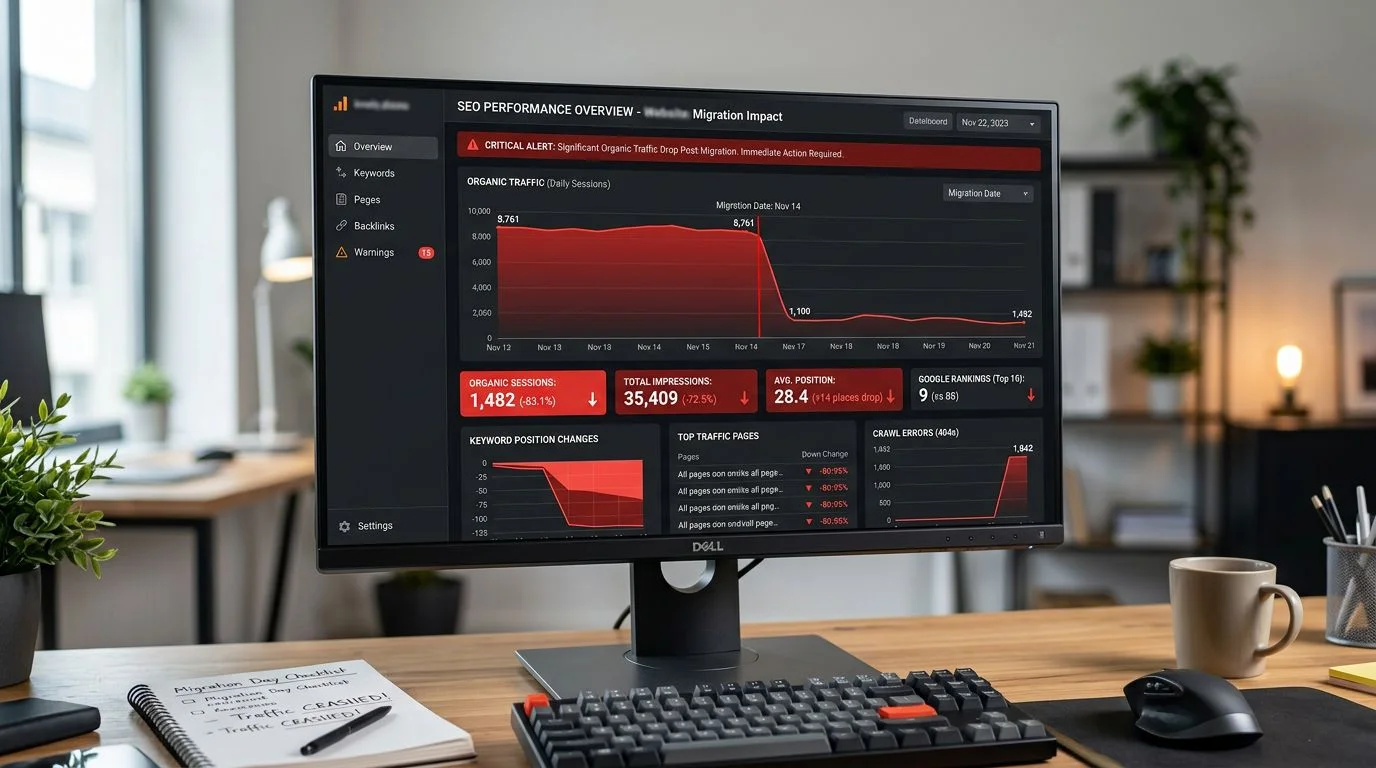
The SEO Migration Nobody Plans For (Until It's Too Late)
E-commerce SEO migrations fail because they start too late. Learn the URL mapping, redirect strategy, and performance budget that protect your organic revenue.
Enno Bassen
Why is API integration so important for achieving success in the retail and e commerce industries?
API integration boosts retail efficiency, scalability, and customer satisfaction, crucial for staying competitive in today's dynamic market landscape.
Timo Koerner