
AI Development Partners: Boutique vs. Big Consultancy vs. In-House

Table of Contents+
- Why Does Your AI Partner Choice Matter More Than Your AI Strategy?
- What Are the Three AI Partner Models?
- How Do the Costs Actually Compare?
- What About Success Rates and Time-to-Value?
- When Should You Choose Each Model?
- What Are the Hidden Risks Nobody Mentions?
- How Should Mid-Market Companies Evaluate AI Partners?
- What Does the Data Say About ROI?
- Frequently Asked Questions
- References
TL;DR
80% of AI projects fail before production. Your choice of development partner is the single biggest factor in whether yours joins them. Big consultancies charge 2-5x more than boutiques and staff projects with juniors. In-house teams cost $1M+ in Year 1 and face 38% annual attrition. For mid-market enterprises, specialized boutique partners deliver 40% faster time-to-value at 50-70% lower cost.
Key Takeaways
- •80% of AI projects fail before production - partner choice is the single biggest controllable variable
- •Big consultancies charge $500K-$2M+ and staff projects with juniors after selling with seniors
- •In-house AI teams cost $1M-$1.8M in Year 1 and face 38% annual attrition
- •Boutique specialists deliver 40% faster time-to-value at 50-70% lower cost for mid-market companies
- •Demand a paid 2-4 week pilot before any full engagement commitment
Big consultancies charge 2-5x more and staff AI projects with juniors. In-house teams cost $1M+ with 38% attrition. Real cost data for choosing your AI partner.
TL;DR: 80% of AI projects fail before production. Your choice of development partner is the single biggest factor in whether yours joins them. Big consultancies charge 2-5x more than boutiques and staff projects with juniors. In-house teams cost $1M+ in Year 1 and face 38% annual attrition. For mid-market enterprises, specialized boutique partners deliver 40% faster time-to-value at 50-70% lower cost.
Why Does Your AI Partner Choice Matter More Than Your AI Strategy?
The AI consulting market is projected to exceed $15 billion in 2026, growing at 26.2% CAGR[1]. Every firm claims AI expertise. But 80.3% of AI projects still fail - a rate twice that of traditional IT projects, according to RAND Corporation research[2].
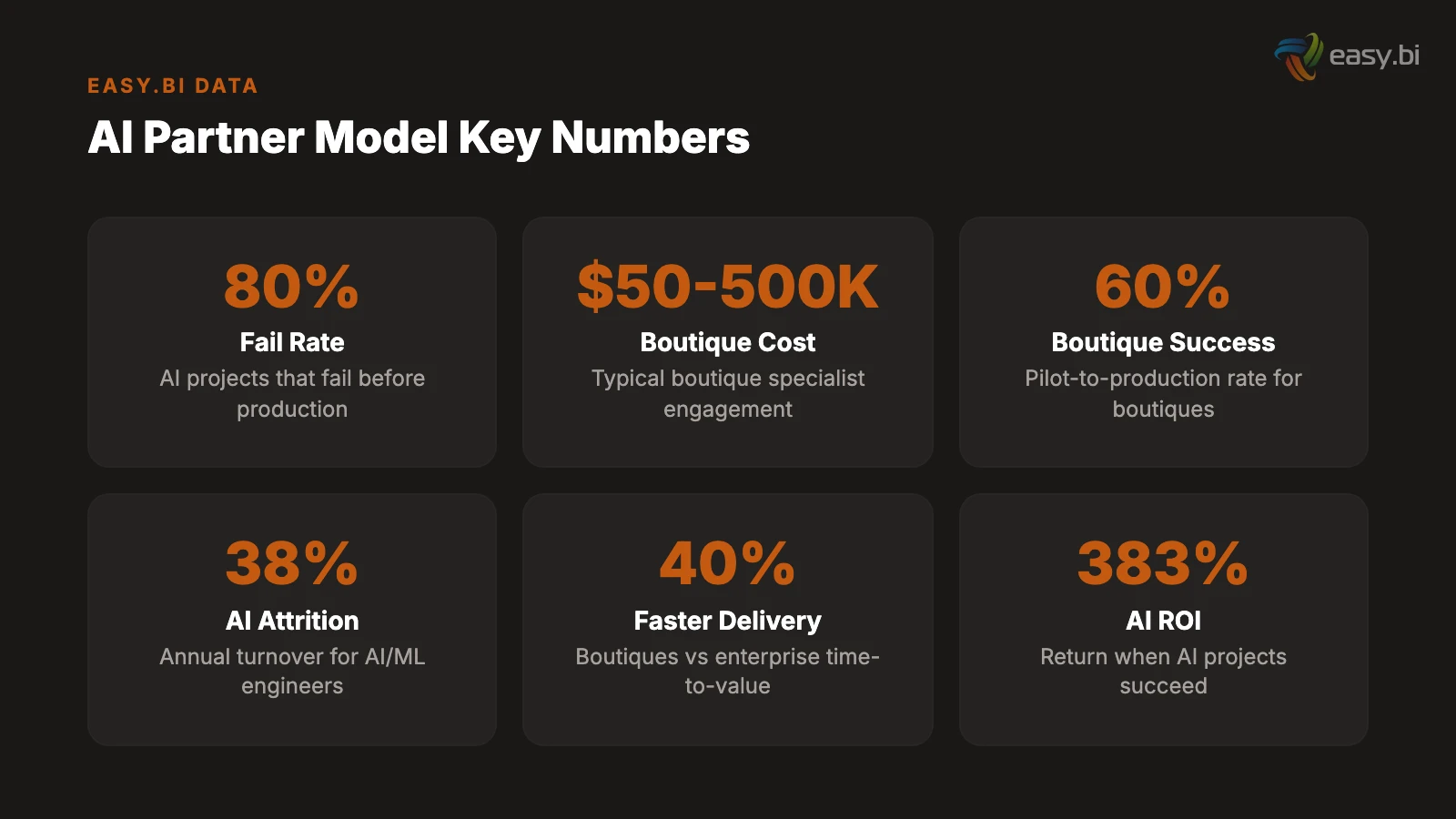
The difference between the 20% that succeed and the 80% that fail is rarely the algorithm. It is the team that builds it, the process that governs it, and the partner model that shapes both. We have seen this pattern across dozens of AI engagements: the same use case succeeds or fails based almost entirely on who builds it and how.
This post compares three models - big consultancy, boutique specialist, and in-house team - with real cost data, timelines, and success rates. No sales pitch. Just the math.
See how ebiCore accelerates development.
What Are the Three AI Partner Models?
Before comparing costs and outcomes, here is what each model actually means in practice:
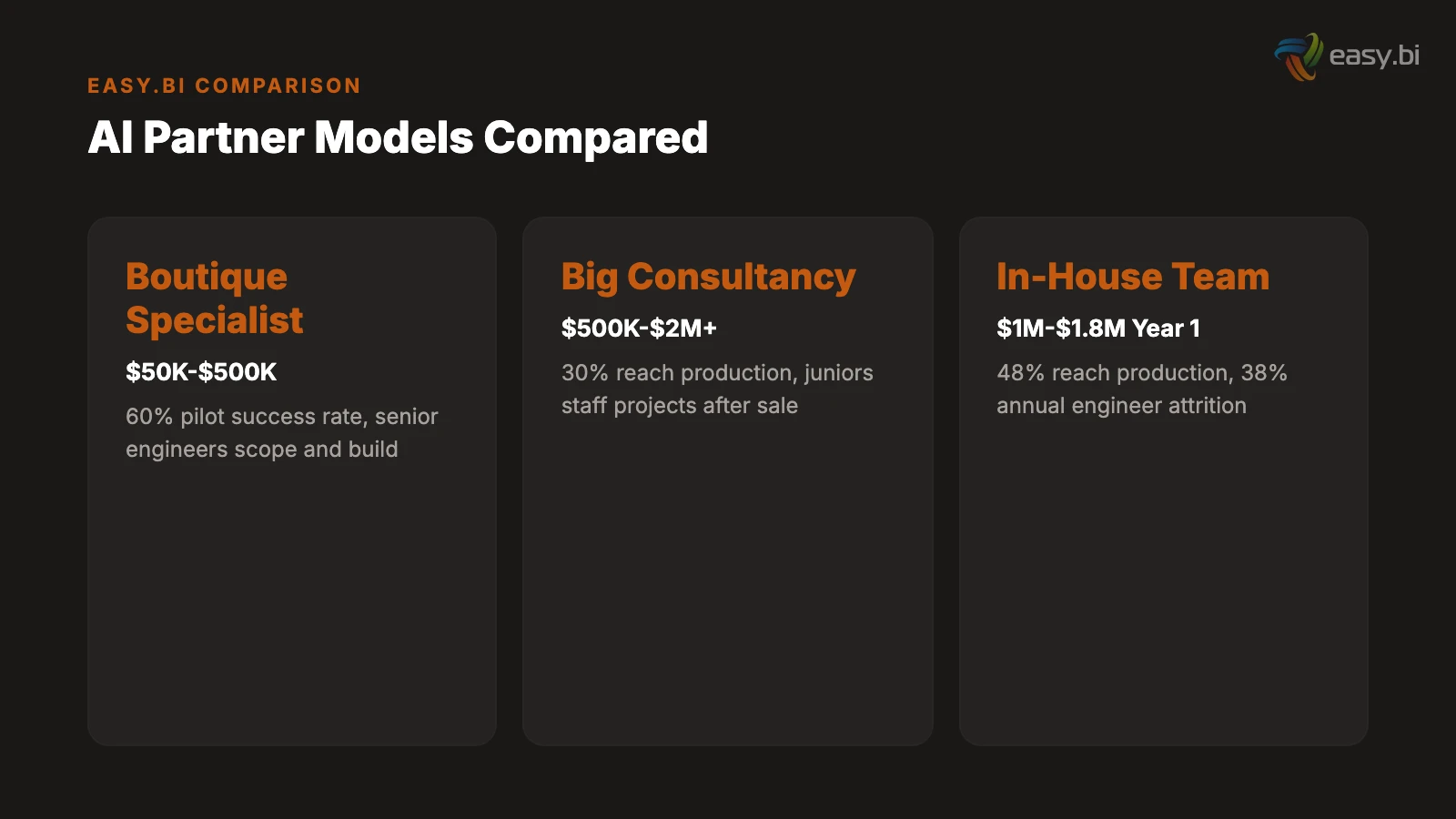
Big Consultancy (McKinsey, Accenture, Deloitte, BCG): Global firms with AI practices staffed by hundreds. They sell with senior partners, then staff projects with analysts and junior engineers. Engagements start at $500K and routinely exceed $2M. They excel at board-level strategy and organizational change management.
Boutique Specialist (firms with 20-200 engineers, deep AI focus): Smaller firms where senior practitioners both sell and deliver. The architect who scopes your project is the same person who builds it. Engagements typically range from $50K to $500K. They excel at getting working AI into production fast.
In-House Team (hiring your own AI engineers): Building internal AI capability with full-time hires. You own the talent, the IP, and the roadmap. But you also own the recruiting burden, the ramp-up time, and the retention risk in a market where AI engineers leave at 38% annually[3].
How Do the Costs Actually Compare?
Cost is where the models diverge most dramatically. Here is the real math for a typical mid-market AI engagement - building a production-grade AI feature (not a PowerPoint deck):
| Cost Factor | Big Consultancy | Boutique Specialist | In-House Team |
|---|---|---|---|
| Typical engagement | $500K-$2M+ | $50K-$500K | $1M-$1.8M (Year 1) |
| Senior AI engineer daily rate | $2,500-$4,000 | $1,200-$2,000 | $800-$1,200 (loaded) |
| Time to first deliverable | 8-16 weeks | 2-6 weeks | 3-6 months (after hiring) |
| Hidden costs | Change orders, travel, licensing | Minimal - fixed sprint pricing | Recruiting ($15-40K/hire), benefits (+30%), tooling |
| Who does the work | Junior analysts supervised by seniors | Senior engineers directly | Your hires (if you can find them) |
The in-house model looks cheapest on a per-day basis. But the total Year 1 cost tells a different story. Building an in-house AI team costs $1M-$1.8M when you include recruiting fees ($15-40K per hire), 3-6 month ramp-up periods where productivity is near zero, and the 25-30% benefits overhead on top of base salaries[4].
And that assumes you can actually hire. Senior AI engineers in Europe command EUR 120,000-180,000 base salary. In the US, the range is $180,000-$250,000[4]. The median time-to-fill for an AI engineer role is 4-6 months - longer than many AI projects themselves.
What About Success Rates and Time-to-Value?
Cost means nothing if the project fails. Here is where the partner models produce dramatically different outcomes:
Big consultancies deliver excellent strategy decks but struggle with production deployment. BCG research shows 70% of AI pilots never reach production, primarily due to organizational factors[5]. The handoff from strategy team to implementation team introduces the same failure mode that plagues all large-firm IT projects: the people who understand the problem are not the people who build the solution.
Boutique specialists achieve 40% faster time-to-value at 50-70% lower cost than enterprise engagements[6]. The reason is structural: fewer layers of decision-making, senior practitioners on every project, and 8-12 week implementation timelines versus the multi-quarter engagements typical of large firms. Organizations with appropriately-sized external AI guidance achieve positive ROI 60% more often than those proceeding independently[7].
In-house teams face a different problem entirely: the 38% annual attrition rate for AI/ML engineers[3]. Compare that to 13% for general software engineers. You spend 6 months hiring, 3 months onboarding, and then lose a third of your team every year. The institutional knowledge loss alone can set projects back by quarters.
| Metric | Big Consultancy | Boutique Specialist | In-House Team |
|---|---|---|---|
| Prototype to production | 6-12 months | 8-12 weeks | 6-18 months |
| AI pilot success rate | ~30% reach production | ~60% reach production | ~48% reach production |
| Annual team attrition | N/A (engagement-based) | N/A (engagement-based) | 38% for AI engineers |
| Knowledge retention | Low (team rotates off) | High (same team throughout) | Variable (attrition-dependent) |
| IP ownership | Varies (check contract) | Typically client-owned | 100% client-owned |
When Should You Choose Each Model?
The right choice depends on three factors: your budget, your timeline, and whether you need AI as a core competency or a competitive feature.
Choose a big consultancy when:
- You need board-level buy-in and organizational change management
- The engagement is primarily strategic (AI roadmap, not AI code)
- Your budget exceeds $500K and you need a brand name for internal politics
- You are a Fortune 500 company with existing consulting relationships
Choose a boutique specialist when:
- You need working AI in production, not a strategy deck
- Your budget is $50K-$500K (the mid-market sweet spot)
- Speed matters - you need results in weeks, not quarters
- You want senior engineers who both scope and build
- You need a partner who understands your industry deeply
Choose in-house when:
- AI is your core product (you are building an AI company)
- You have 3+ years of continuous AI development ahead
- You can afford $1M+ in Year 1 and absorb 38% annual attrition
- You already have strong engineering leadership to manage AI talent
In my experience working with mid-market enterprises across the DACH region, the boutique model wins for 80% of companies. The reason is simple: most companies do not need AI as a core competency. They need AI as a competitive feature - a recommendation engine, a process automation, an intelligent internal tool. For that, a specialized partner who has built it before will outperform a team learning on the job.
What Are the Hidden Risks Nobody Mentions?
Every partner model has risks that sales teams conveniently omit:
Big consultancy risk: the bait-and-switch. The senior partner who pitches your project is not the person who builds it. McKinsey and Accenture staff projects with a thin senior layer and a deep bench of analysts. You pay $4,000/day rates for work done by people with 2-3 years of experience. One pattern I have seen repeatedly: companies spend $800K on an AI strategy engagement and end up with a 200-page report that no one can implement.
Boutique risk: capacity constraints. Smaller firms cannot always scale. If your project grows from 3 engineers to 15, a 50-person boutique may hit its ceiling. The mitigation is simple: ask about team scaling capacity before you sign. A good boutique has a bench or a proven scaling model.
In-house risk: the talent death spiral. You hire 4 AI engineers. In 12 months, 1-2 leave (38% attrition). You spend 4-6 months replacing them. The replacements need 3 months to onboard. Meanwhile, the remaining team is overloaded, which increases their own flight risk. MIT research shows that 42% of companies abandoned most of their AI initiatives in 2025, up from 17% in 2024[8]. Talent instability is a leading cause.
Our AI framework cuts development time in half
ebiCore is our proprietary agentic AI framework that accelerates innovation and reduces cost.
Start with a Strategy CallHow Should Mid-Market Companies Evaluate AI Partners?
If you are a mid-market enterprise (EUR 20M-500M revenue, 100-5,000 employees), here is the evaluation framework that separates good partners from expensive ones:
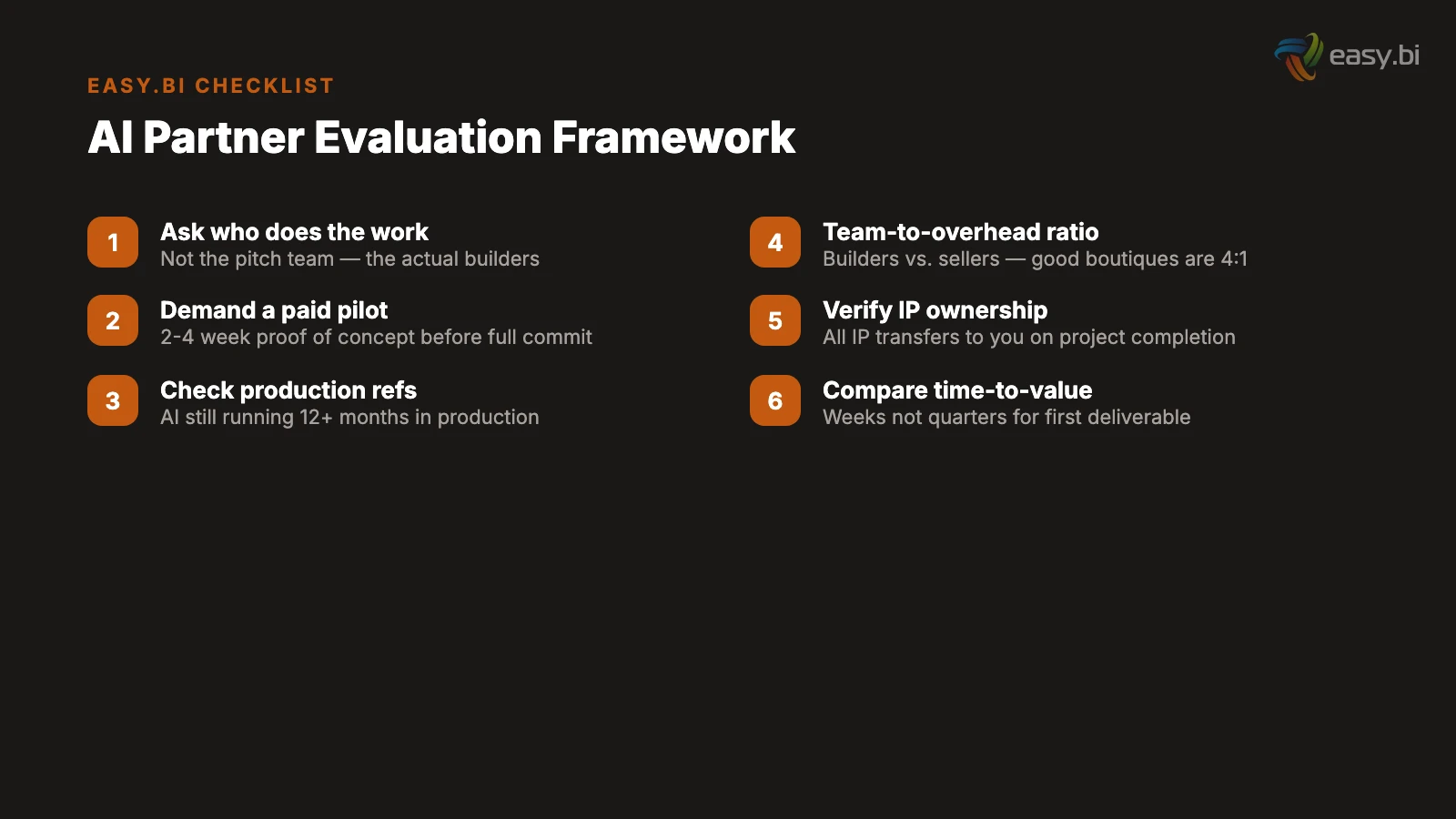
1. Ask who will actually do the work. Not who is on the proposal. Not who presents in the pitch meeting. Who will write the code, train the models, and deploy to production? If the answer involves a handoff, that is a red flag.
2. Demand a paid pilot before a full engagement. Any credible AI partner will offer a 2-4 week paid proof of concept. If they want a 6-month commitment before showing you working software, walk away.
3. Check production references, not pilot references. Getting a demo to work is easy. Getting AI to run reliably in production at scale is the actual challenge. Ask for 3 references where their AI is still running in production 12+ months later.
4. Look at the team-to-overhead ratio. What percentage of their staff actually builds things versus sells, manages, and coordinates? In large consultancies, the ratio is often 1:1 or worse. In good boutiques, it is 4:1 or better.
5. Verify IP ownership upfront. Some firms retain ownership of frameworks, models, or training data. Ensure your contract explicitly transfers all IP to you upon project completion.
What Does the Data Say About ROI?
When AI projects succeed, the returns are substantial. Successful AI implementations achieve 383% return on investment[9]. Two-thirds (66%) of organizations report productivity and efficiency gains from enterprise AI adoption[7].
But the keyword is "when." With an 80% failure rate, the expected value of an AI investment depends almost entirely on your ability to get into that 20%. The partner model you choose is the single largest controllable variable in that equation.
The math is straightforward: a $200K boutique engagement with a 60% success rate has a higher expected value than a $1.5M big consultancy engagement with a 30% success rate. Even accounting for the bigger consultancy potentially delivering larger projects, the risk-adjusted return favors the boutique model for most mid-market use cases.
The right AI partner is not the one with the best brand. It is the one where senior engineers both scope and build your project, where you see working software in weeks rather than months, and where the same team that starts the project finishes it.
Frequently Asked Questions
How much does an AI development partner typically cost?
Big consultancies charge $500K-$2M+ per engagement. Boutique specialists range from $50K-$500K. Building an in-house AI team costs $1M-$1.8M in Year 1 including recruiting, benefits, and tooling. The boutique model delivers 40% faster time-to-value at 50-70% lower cost than enterprise engagements.
Why do 80% of AI projects fail?
RAND Corporation research identifies three primary causes: 33.8% are abandoned mid-project, 28.4% deliver no measurable value, and 18.1% cannot justify their costs post-deployment. The root cause is usually organizational - not technical. The wrong partner model amplifies these risks.
Should a mid-market company build an in-house AI team?
Only if AI is your core product and you have 3+ years of continuous development ahead. Otherwise, the 38% annual attrition rate for AI engineers, combined with $1M+ Year 1 costs and 4-6 month hiring timelines, makes the in-house model prohibitively expensive for feature-level AI work.
What is the biggest red flag when evaluating an AI partner?
The bait-and-switch: senior partners pitch the project, then hand it off to junior staff. Ask directly: "Will the person presenting today be writing code on my project?" If the answer is no, you are paying senior rates for junior work.
References
- [1] Copilot Experts (2026). Top 10 AI Consulting Firms in 2026. copilot-experts.com
- [2] RAND Corporation (2024). pertamapartners.com
- [3] Bain & Company (2025). Technology Workforce Report: AI/ML Engineer Attrition. groovyweb.co
- [4] Groovy Web (2026). In-House vs Outsourced AI Development: Real Cost Math 2026. groovyweb.co
- [5] BCG (2025). Why AI Pilots Fail to Scale. nexergroup.com
- [6] AI Smart Ventures (2026). aismartventures.com
- [7] Deloitte (2026). The State of AI in the Enterprise. deloitte.com
- [8] MIT Project NANDA (2025). Enterprise AI Abandonment Trends. aigovernancetoday.com
- [9] SoftwareSeni (2026). Why 80% of AI Projects Fail While Successful Implementation softwareseni.com
Explore Other Topics
Ready to accelerate with AI?
30-minute call with an engineering lead. No sales pitch - just honest answers about your project.
98% engineer retention · 14-day delivery sprints · No lock-in contracts
Related Reading
How a German Manufacturer Cut Development Costs 40% by Switching Partners
Anonymized case study: a DACH manufacturer (300 employees) switched from a large consultancy to a mid-size partner, cutting development costs 40% and delivering 3x faster in 14-day sprints.
Andrej Lovsin
How to Evaluate a Software Development Partner (Without Getting Burned)
A practical checklist for evaluating software development partners: what to ask, red flags to watch for, how to assess technical depth, and why paid pilots beat RFPs. Based on patterns from 100+ DACH enterprise projects.
Enno Bassen
How AI and Software Development are Revolutionizing Manufacturing
AI and software development are revolutionizing manufacturing, boosting efficiency, reducing costs, and driving innovation.
Timo Koerner