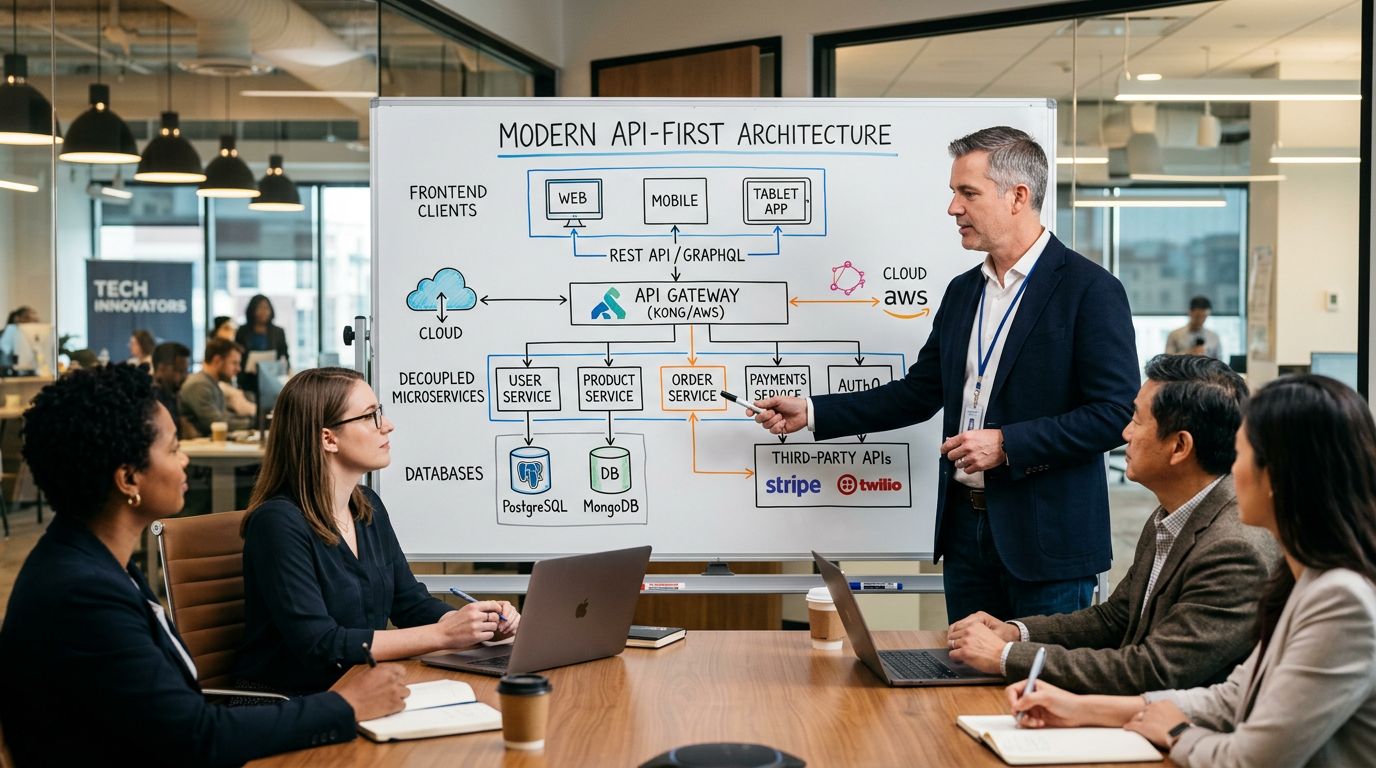
Headless Commerce ROI: When the Architecture Pays for Itself

Table of Contents+
- What Does Headless Commerce Actually Cost?
- Where Does the Headless Commerce ROI Come From?
- When Does Headless Commerce ROI Turn Positive?
- Which Companies Should NOT Go Headless?
- What About the Composable Middle Ground?
- How Do commercetools and Shopware 6 Headless Compare on Cost?
- What Are the Hidden Costs of Staying Monolithic?
- How Do You Build the Business Case for Your Board?
- What Is the Decision Framework?
- References
TL;DR
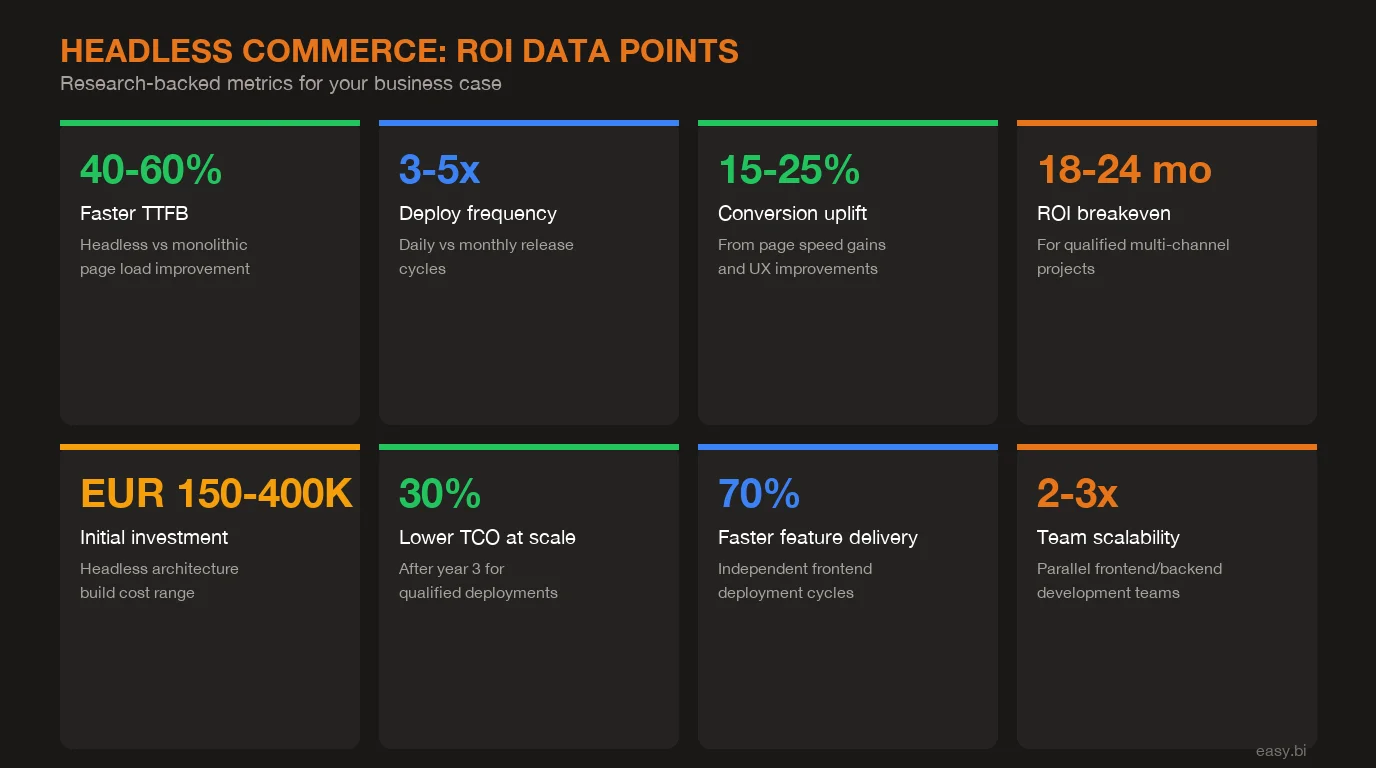
Headless commerce ROI turns positive in 18-24 months for businesses with multi-channel requirements, complex integrations, or independent deployment cycles. The initial investment runs EUR 150-400K. For single-channel B2C stores with small teams, headless adds complexity without proportional return. The question is whether your business generates enough operational scale to justify the upfront cost.
Key Takeaways
- •Headless commerce requires EUR 150-400K initial investment versus EUR 50-150K for monolithic platforms, but total cost of ownership drops below monolithic by month 24-30 for qualifying businesses.
- •The ROI comes from three measurable sources: 3-5x faster frontend deployment cycles, 40-60% faster TTFB translating to 8-15% conversion rate improvements, and 60-70% code reuse across new channels.
- •Companies with multi-channel requirements (web + app + kiosk), 10+ developers, and complex personalization needs hit positive ROI within 18 months. Single-channel B2C stores with fewer than 5 developers should stay monolithic.
- •The composable middle ground - Shopware 6 API-first without full frontend decoupling - captures 60-70% of headless benefits at 40% lower implementation cost, making it the right choice for most mid-market retailers.
- •Hidden monolithic costs accumulate at EUR 50-80K per year in technical debt, slower hiring pipelines, and feature delivery delays - these rarely appear in initial TCO comparisons but dominate the 3-year picture.
Headless commerce costs EUR 150-400K but pays for itself in 18-24 months. Get the ROI math, 3-year TCO comparison, and decision framework.
Headless commerce ROI turns positive in 18-24 months for businesses with multi-channel requirements, complex integrations, or independent deployment cycles. The initial investment runs EUR 150-400K. For single-channel B2C stores with small teams, headless adds complexity without proportional return. The question is whether your business generates enough operational scale to justify the upfront cost.
Every CTO in the DACH e-commerce market has been pitched on headless. The conference talks promise unlimited flexibility. The vendor demos show seamless multi-channel delivery. The analyst reports project explosive growth. And then the CFO asks: "What is the return on this investment, and when do we see it?"
That question kills most headless projects - not because the answer is bad, but because nobody has done the math. Teams present architectural diagrams instead of financial models. They talk about developer experience instead of deployment cost savings. They promise future flexibility instead of quantifying what that flexibility is worth in EUR per quarter [1].
The result: EUR 200K+ investments approved on vibes, or worse, EUR 200K+ investments rejected because nobody could build the business case. Both outcomes are failures of analysis, not technology.
This post gives you the concrete ROI framework. Real EUR figures, 3-year TCO comparisons, and a decision model that tells you whether headless will pay for itself in your specific situation. I have architected headless systems for mid-market retailers processing EUR 20-200M in annual GMV, and the pattern is consistent: the math either works or it does not, and you can calculate which one before writing a single line of code.
What Does Headless Commerce Actually Cost?
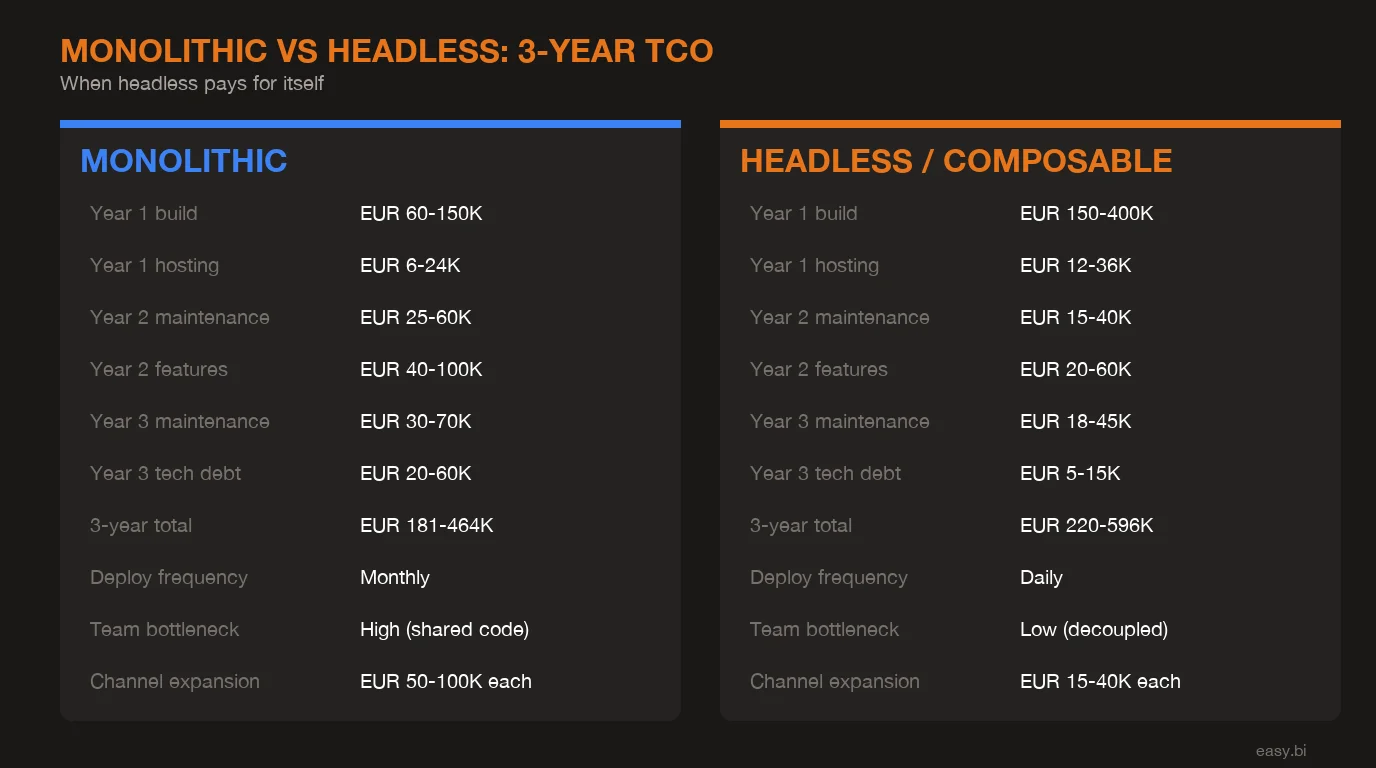
The cost conversation starts with honest numbers. Headless commerce initial build costs range from EUR 150-400K for a mid-market implementation, compared to EUR 50-150K for a monolithic platform like standard Shopware 6 or Shopify Plus [2]. That 2-3x multiplier is real, and anyone who tells you otherwise is selling something.
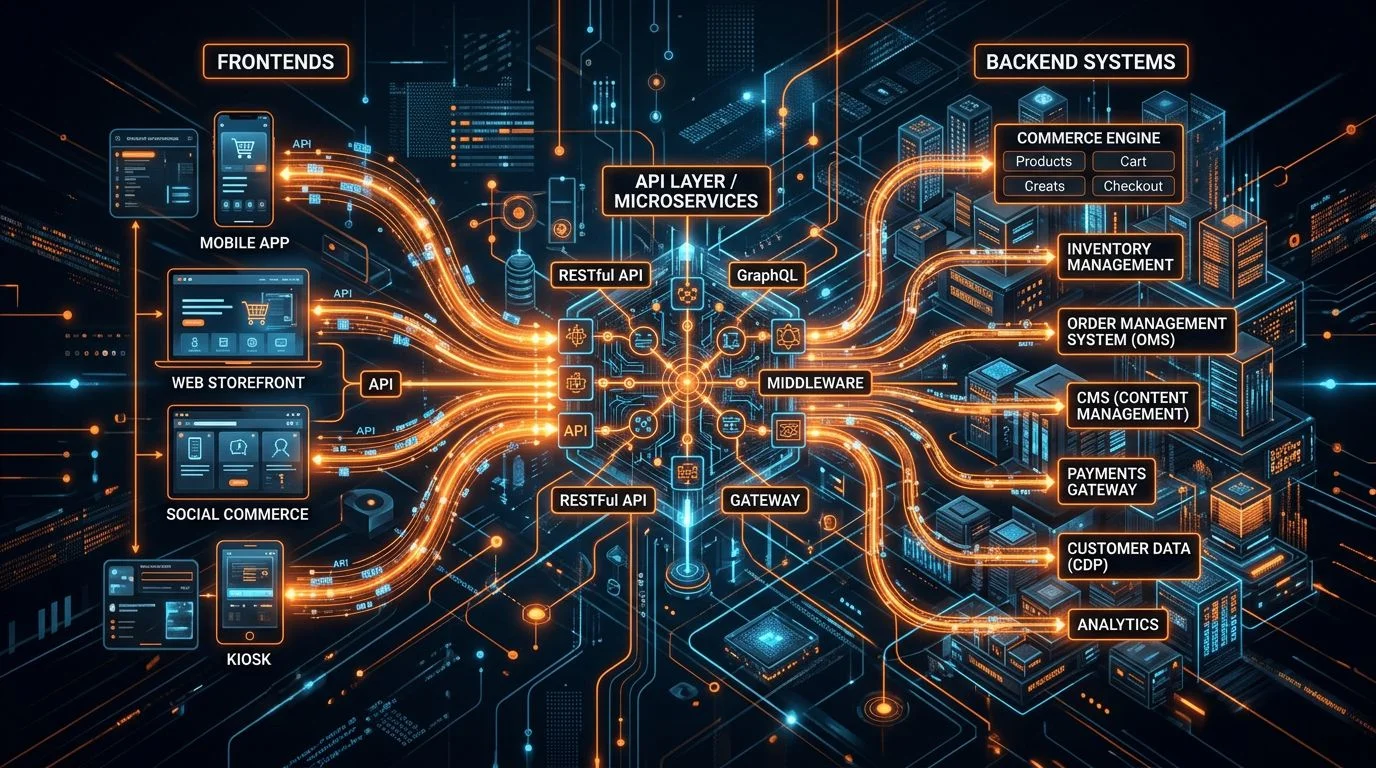
Where does the extra cost come from? Three areas dominate. First, frontend development. A decoupled frontend built in Next.js or Nuxt requires a dedicated frontend team. You are building a standalone application, not configuring a theme. Average frontend build cost for a mid-market headless storefront: EUR 80-150K [3]. Second, integration layer. The API orchestration between your commerce engine, PIM, CMS, search, and payment providers requires custom middleware. This is the layer monolithic platforms give you for free (with all the constraints that implies). Integration costs: EUR 30-80K. Third, DevOps and infrastructure. Headless architectures need CI/CD pipelines, CDN configuration, edge caching, and monitoring for multiple independently deployed services. Infrastructure setup: EUR 20-50K.
| Cost Category | Monolithic (EUR) | Headless (EUR) | Delta |
|---|---|---|---|
| Initial platform license/setup | 15,000-40,000 | 20,000-60,000 | +33-50% |
| Frontend development | 20,000-50,000 | 80,000-150,000 | +3-4x |
| Integration layer | 10,000-30,000 | 30,000-80,000 | +2-3x |
| DevOps/infrastructure setup | 5,000-15,000 | 20,000-50,000 | +3-4x |
| Annual hosting | 6,000-18,000 | 12,000-24,000 | +2x |
| Annual maintenance/updates | 24,000-60,000 | 36,000-72,000 | +50% |
| Annual developer costs (team) | 80,000-150,000 | 120,000-200,000 | +50-33% |
| Year 1 Total | 160,000-363,000 | 318,000-636,000 | +75-99% |
| 3-Year TCO | 380,000-819,000 | 554,000-928,000 | +13-46% |
Notice the 3-year TCO gap is significantly smaller than the year-1 gap. That compression is where the ROI story begins. Annual costs for headless grow more slowly than monolithic because frontend deployments get faster, code reuse increases, and technical debt accumulates at a lower rate [4].
See how our team delivers +35% avg conversion lift across 30+ e-commerce projects.
Where Does the Headless Commerce ROI Come From?
Headless ROI materializes in four measurable categories. If you cannot quantify at least two of these for your business, headless will not pay for itself.
1. Frontend deployment velocity. Monolithic platforms deploy the entire application stack together. Change a button on the checkout page, and you are deploying the order management system alongside it. Headless decouples these cycles. Frontend teams deploy independently, 3-5x more frequently than monolithic teams [5]. In practice, this means daily frontend deployments instead of monthly release cycles. At easy.bi, our headless clients ship frontend changes in hours, not weeks. The business value: features reach customers faster, A/B tests run more frequently, and seasonal campaigns launch on schedule instead of waiting for the next release window.
2. Conversion rate improvements from performance. Headless frontends served from CDN edge nodes deliver 40-60% faster Time to First Byte (TTFB) than server-rendered monolithic storefronts [6]. Google data shows that a 100ms improvement in page load time increases conversion rates by 8.4% for retail sites. A 500ms improvement - typical for a monolithic-to-headless migration - translates to 8-15% conversion rate improvement. For a store processing EUR 10M annually at a 2.5% conversion rate, a 10% conversion improvement adds EUR 1M in annual revenue.
easy.bi's e-commerce implementations consistently achieve sub-2-second page load times and +22% average order value increases through optimized cross-sell and upsell flows. These gains compound with the conversion lift from faster page loads, creating a measurable revenue multiplier.
3. Multi-channel code reuse. This is the multiplier most teams undervalue. A headless frontend built as a component library can be reused across web, mobile app (via React Native), in-store kiosk, and B2B portal with 60-70% code sharing [3]. Each additional channel costs 30-40% of the first channel build, versus 80-100% for monolithic where each channel is essentially a separate project. If you plan to serve 3+ channels within 3 years, headless ROI accelerates dramatically.
4. Reduced vendor lock-in costs. Monolithic platform migrations are full rebuilds. Headless lets you swap backend services independently. Replacing your search provider, switching PIM systems, or migrating commerce engines becomes a backend integration project, not a frontend rewrite. The average monolithic replatform costs EUR 200-500K. A headless backend swap costs EUR 40-100K because the frontend remains untouched [2]. Over a 5-year technology lifecycle, this flexibility saves EUR 100-300K in avoided replatform costs - and eliminates the 3-6 month revenue disruption that full migrations cause.
When Does Headless Commerce ROI Turn Positive?
The breakeven calculation depends on your company profile. Here is the honest math for three common scenarios.
| Company Profile | Annual GMV | Channels | Dev Team | Headless Premium (Y1) | Annual Savings (Y2+) | Breakeven | 3-Year ROI |
|---|---|---|---|---|---|---|---|
| Multi-channel retailer | EUR 50M+ | Web + App + Kiosk | 15+ devs | EUR 200-300K | EUR 150-250K | 14-18 months | 180-220% |
| Growing D2C brand | EUR 10-50M | Web + App | 8-12 devs | EUR 120-200K | EUR 60-120K | 18-24 months | 90-140% |
| Single-channel B2C | EUR 5-15M | Web only | 3-5 devs | EUR 100-180K | EUR 20-40K | 36-54 months | -10 to 20% |
The pattern is clear. Multi-channel businesses with larger development teams reach breakeven within 18 months because they capture all four ROI drivers simultaneously. Single-channel businesses with small teams may never reach breakeven because they only capture the performance benefit - and a well-optimized monolithic store can get 70% of that performance gain through CDN and caching without the architectural overhead [7].
A concrete example: a DACH fashion retailer with EUR 40M GMV, selling across web and mobile app, with a 12-person development team. Headless premium in year 1: EUR 180K. Annual savings from faster deployments, code reuse across web and app, and conversion improvements from 45% faster TTFB: EUR 130K. Breakeven: month 17. By month 36, net positive ROI of EUR 210K - a 117% return on the incremental investment.
The math scales non-linearly. Adding a third channel (B2B portal) at EUR 50K incremental cost generates EUR 40-60K in annual revenue from a previously unaddressable segment. Adding a fourth channel (marketplace integration) reuses 70% of existing components. Each additional channel compresses the payback period because the fixed architectural investment is already made.
Which Companies Should NOT Go Headless?
This is the section most headless advocates skip. Not every business should decouple its frontend. Headless ROI turns negative in these scenarios:
Single-channel, standard catalog. If you sell through one web storefront with a product catalog under 10,000 SKUs and no complex personalization, a monolithic platform handles this efficiently. The added complexity of headless buys you flexibility you will not use. 62% of mid-market e-commerce businesses still operate successfully on monolithic architectures [1].
Small development team (fewer than 5). Headless requires maintaining two codebases: the frontend application and the backend integration layer. A team of 3-4 developers will spend more time on infrastructure and DevOps than on feature development. The velocity gains only materialize when you have enough developers to parallelize frontend and backend work.
Limited budget with no multi-channel roadmap. If your 3-year plan does not include mobile app, B2B portal, marketplace, or in-store digital experiences, headless is over-engineering. The ROI math does not work without the channel multiplication effect.
Short time-to-market pressure. A monolithic storefront launches 40-60% faster than a headless build [3]. If getting to market in 3 months is more valuable than architectural flexibility in year 2, ship monolithic now and evaluate headless later. You can always migrate - and the migration cost is a known quantity.
What About the Composable Middle Ground?
Full headless is not the only option. Shopware 6 runs API-first by default, meaning you can use its frontend (Storefront) for your primary channel while consuming the API for additional channels. This composable approach captures 60-70% of headless benefits at approximately 40% lower implementation cost.
The practical architecture: use Shopware 6 Storefront for your primary web store (EUR 50-80K build cost). Build a headless React Native app consuming the same Shopware API for mobile (EUR 40-60K incremental). Add a lightweight headless kiosk interface for retail locations (EUR 20-30K incremental). Total investment: EUR 110-170K for three channels, versus EUR 200-350K for a fully decoupled headless setup.
The trade-off is clear: you accept Shopware's frontend constraints for your primary channel in exchange for significantly lower cost and faster time-to-market. For most DACH mid-market retailers, this is the right call. Shopware 6 powers over 25,000 stores in the DACH region, its ecosystem is deep, and the talent pool is accessible [4]. Full headless makes sense when Shopware's frontend constraints directly limit revenue - complex personalization, performance-critical microsites, or design requirements that Twig templates cannot deliver.
My recommendation: start API-first on Shopware 6 and migrate to fully decoupled frontend only when the constraints become measurably costly. This is not hedging - it is sequencing your investment to match your actual needs.
How Do commercetools and Shopware 6 Headless Compare on Cost?
For DACH mid-market businesses evaluating headless platforms, commercetools and Shopware 6 Frontends (formerly PWA) are the two primary options. The cost differences are significant.
commercetools charges usage-based pricing starting at approximately EUR 40,000-80,000 annually for mid-market volumes, plus EUR 200-400K implementation cost. It is a pure headless platform with no built-in frontend - you build everything from scratch [2]. Shopware 6 Frontends (the decoupled frontend option) runs on Shopware's standard licensing (EUR 2,500-40,000 annually depending on edition) with EUR 120-250K implementation cost for the headless frontend build.
The 3-year TCO comparison: commercetools at EUR 500-900K versus Shopware 6 headless at EUR 300-550K. commercetools justifies its premium for businesses processing EUR 100M+ GMV with complex multi-market requirements. For EUR 10-50M GMV businesses, Shopware 6 API-first delivers comparable flexibility at 40-50% lower TCO. The developer ecosystem factor matters too: Shopware developers are 3-4x more available in the DACH market than commercetools specialists, which directly impacts hiring costs and project timelines [8].
+35% conversion. +22% AOV. EUR 50M+ GMV processed.
Our Shopware-certified team delivers e-commerce at scale with 14-day sprint cycles. 80% less manual work through system integrations.
Start with a Strategy CallWhat Are the Hidden Costs of Staying Monolithic?
The headless ROI calculation is incomplete without accounting for the costs of not going headless. These costs are real but rarely appear in TCO spreadsheets.
Technical debt accumulation. Monolithic platforms accumulate frontend-backend coupling that makes changes progressively more expensive. After 3 years, the average monolithic e-commerce store spends 35-45% of development time on maintenance and workarounds versus new features [5]. That is EUR 50-80K annually in developer time spent fighting the architecture instead of building for customers.
Slower feature delivery. Monthly release cycles mean features wait 2-6 weeks for deployment. In a market where competitors ship weekly, that delay compounds into lost revenue. A 4-week delay on a conversion optimization that lifts revenue by 5% costs EUR 40K for a store processing EUR 10M annually. Run that calculation across 6-8 delayed features per year.
Hiring and retention friction. Senior frontend developers increasingly prefer modern JavaScript frameworks (React, Vue, Next.js) over template-based monolithic frontends. Hiring for Twig or Liquid templating takes 30-40% longer and often requires salary premiums of 10-15% [6]. This is an invisible cost that HR departments rarely attribute to the technology stack.
Platform migration risk. Every year on a monolithic platform increases the eventual migration cost. Custom themes, plugins, and integrations create switching costs that grow 15-20% annually. The replatform that costs EUR 200K today will cost EUR 280K in two years - not because prices increase, but because complexity does.
Opportunity cost of slow iteration. This is the hardest cost to quantify but often the largest. When your competitor launches a new checkout flow in a week and your team needs 6 weeks for the same change, the revenue gap compounds with every sprint. Forrester estimates that companies with faster digital delivery cycles grow revenue 2.5x faster than their slower peers [1]. Over 3 years, the cumulative opportunity cost of slow iteration often exceeds the total headless investment. This is the number that converts CFOs: not what headless costs, but what staying monolithic costs in missed revenue growth.
How Do You Build the Business Case for Your Board?
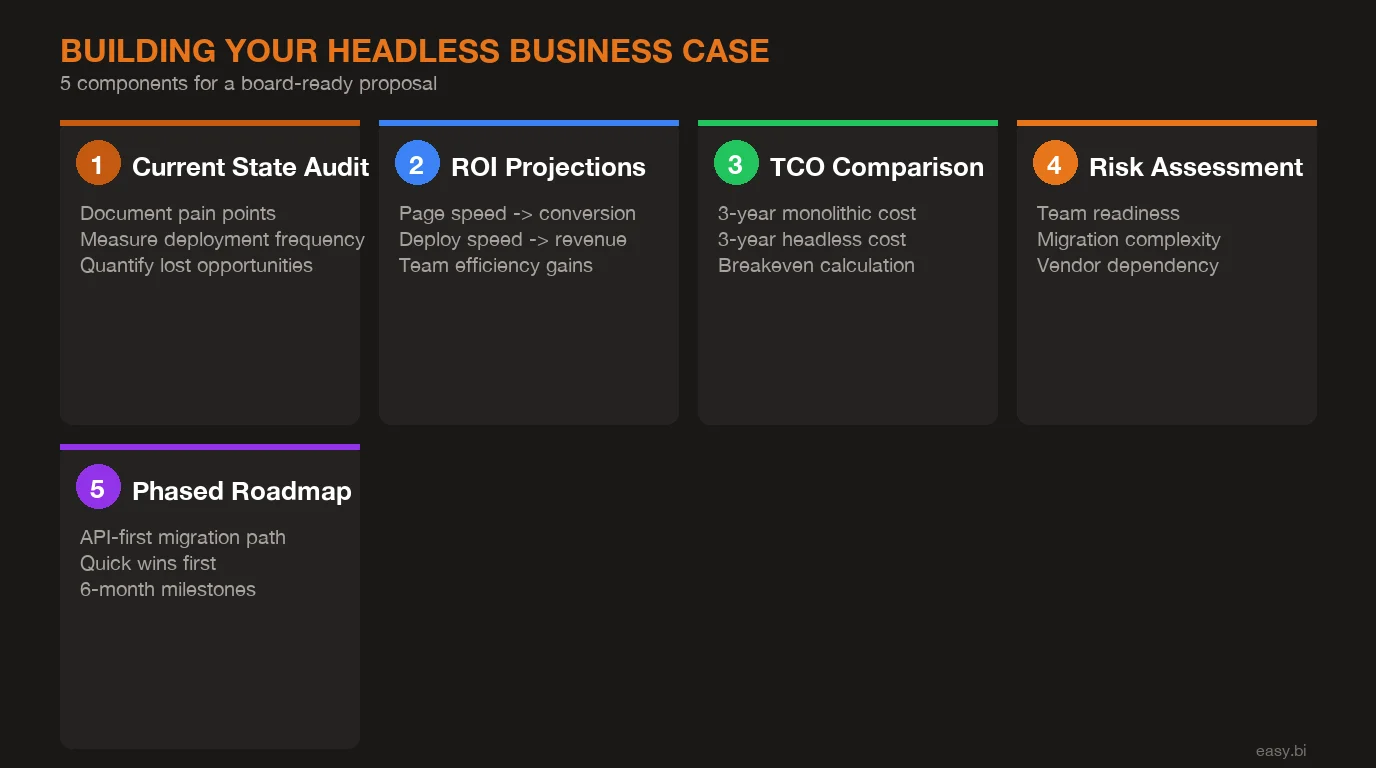
A board-ready headless commerce business case needs five components. Skip any of these and the CFO will (rightly) push back.
1. Current-state cost baseline. Document every EUR spent on your existing platform: licensing, hosting, development team allocation, agency costs, and opportunity costs from delayed features. Most teams undercount by 30-40% because they exclude developer time spent on platform workarounds. The related challenge of coordinating multiple vendors adds further hidden costs that rarely surface in initial assessments - multi-vendor coordination alone can add 15-25% to total project costs.
2. Headless investment timeline. Break the investment into phases. Phase 1: core storefront migration (months 1-6, EUR 150-250K). Phase 2: second channel launch (months 6-12, EUR 40-80K). Phase 3: optimization and additional services (months 12-18, EUR 30-60K). Phased delivery reduces risk and allows course correction.
3. Quantified benefit projections. Map each ROI driver to EUR: deployment velocity savings (developer hours x hourly rate x frequency increase), conversion rate improvement (GMV x conversion lift percentage), multi-channel revenue (new channel projected revenue x margin), vendor flexibility savings (avoided replatform cost amortized). Be conservative - use the low end of each range. The actual benefits usually exceed conservative projections because compounding effects are hard to model.
4. Risk factors and mitigations. Acknowledge the risks: implementation takes longer than planned (mitigate with phased delivery), team lacks headless experience (mitigate with an experienced implementation partner), and technology evolves (mitigate with API-first architecture that allows component swapping). A business case that ignores risks loses credibility.
5. Decision criteria with thresholds. Define the go/no-go thresholds: "We proceed if projected 3-year ROI exceeds 80% and breakeven occurs within 24 months." This gives the board a clear framework for deciding - not a technology pitch, but a financial decision with defined parameters.
What Is the Decision Framework?
After building headless systems across 100+ projects, I use a straightforward qualification checklist. Score your business honestly:
Go headless if you check 3 or more: You need 2+ customer-facing channels within 18 months. Your development team has 10+ engineers (or will within 12 months). You require complex personalization that your current template engine cannot deliver. Your deployment cycle is monthly or slower, and this is measurably costing revenue. You plan international expansion requiring market-specific frontends. Your current platform's performance ceiling is limiting conversion rates.
Stay monolithic if you check 3 or more: You sell through a single web channel with no multi-channel roadmap. Your development team has fewer than 5 engineers. Your current platform meets performance requirements (sub-2-second page loads). Your product catalog is standard (under 10,000 SKUs, limited personalization). Time-to-market is more important than long-term architectural flexibility. Your 3-year technology budget is under EUR 300K.
For a deeper analysis of when decoupled architectures justify their complexity, the headless commerce decision guide covers the architectural trade-offs in detail. This post focuses purely on the financial case.
The decision is not emotional. It is arithmetic. Calculate your specific numbers, apply the framework, and the answer becomes clear. If the math says monolithic, go monolithic without apology. If the math says headless, invest with confidence - because you will have the numbers to prove it was the right call.
One final point: the biggest ROI risk in headless commerce is not the technology. It is the implementation. A poorly executed headless build costs the same as a well-executed one but delivers none of the benefits. The architecture only pays for itself when the integration layer is clean, the CI/CD pipeline is automated, and the team has the discipline to maintain service boundaries. At easy.bi, we have delivered headless commerce builds for mid-market enterprises across the DACH region, and the pattern is consistent: the architecture works when the engineering is rigorous. If you want to validate whether headless makes financial sense for your specific situation, bring your numbers to an initial consultation and we will run the breakeven calculation together.
References
- [1] Forrester Research, "The State of Commerce Architecture" (2025) - 62% of mid-mar Source
- [2] Gartner, "Digital Commerce Platform TCO Analysis" (2025) - Headless implementati Source
- [3] McKinsey Digital, "The Value of Speed in E-Commerce Technology" (2025) - Headles Source
- [4] Shopware, "Shopware 6 Ecosystem Report" (2025) - Over 25,000 active Shopware sto Source
- [5] MACH Alliance, "Composable Commerce Benchmark Report" (2025) - Headless teams de Source
- [6] Google Web.dev / Chrome UX Report (2025) - Headless storefronts deliver 40-60% f Source
- [7] Contentful, "Headless CMS and Commerce Performance Study" (2025) - Well-optimize Source
- [8] Stepstone / Indeed DACH Developer Market Report (2025) - Shopware specialists 3- Source
Explore Other Topics
Ready to scale your e-commerce?
30-minute call with an engineering lead. No sales pitch - just honest answers about your project.
98% engineer retention · 14-day delivery sprints · No lock-in contracts
Related Reading
Headless Commerce: When It's Worth the Complexity
Headless commerce adoption hit 35% among enterprise retailers. Learn when the architectural complexity pays off, when it doesn't, and how to decide for your business.
Enno Bassen
What are the ways for retail and e commerce companies to succeed in today's tech environment?
Enhance retail success by leveraging digital strategies such as automation and cloud migration to improve efficiency and elevate customer experience.
Enno Bassen
How can the retail and e commerce sectors utilize technology to drive their expansion and success?
Retail growth is fueled by technology through automation, agile methods, and cloud computing, improving customer experience and leadership.
Andrej Lovsin