The 5 AI Use Cases That Actually Pay for Themselves in Year 1

Table of Contents+
- Which AI Use Cases Deliver the Highest ROI for Mid-Market Companies?
- How Does Intelligent Document Processing Pay for Itself?
- What Makes Predictive Maintenance a Reliable ROI Generator?
- How Is Customer Service Automation Delivering 148-200% ROI?
- What ROI Can Mid-Market Companies Expect from Demand Forecasting?
- How Does Code Generation Assistance Deliver ROI Beyond Developer Speed?
- How Should Mid-Market Companies Prioritize These Use Cases?
- Frequently Asked Questions
- References
TL;DR
Five AI use cases deliver proven first-year ROI for mid-market enterprises: intelligent document processing (300-400% ROI), predictive maintenance (10:1 return ratio), customer service automation (148-200% ROI), demand forecasting (142% ROI on initial phases), and code generation assistance (3-6 month payback). Each requires EUR 30,000-150,000 investment with documented annual savings of EUR 80,000-500,000.
Key Takeaways
- •Five AI use cases consistently deliver positive ROI within 12 months for mid-market enterprises: intelligent document processing, predictive maintenance, customer service automation, demand forecasting, and code generation assistance - each with documented payback periods under 9 months.
- •The median payback period on AI tooling investments dropped to 4.2 months in 2025, down from 7.8 months in 2024, meaning the financial risk of a well-scoped AI pilot is now comparable to a standard software subscription.
- •Mid-market companies (EUR 20M-500M revenue) see an average 2.8x blended AI ROI, but only when they start with a specific business problem rather than a technology exploration - the 80% of AI projects that fail share one trait: they started with the tool, not the pain.
- •Implementation cost for each use case ranges from EUR 30,000-150,000 for a production-grade pilot, with annual savings of EUR 80,000-500,000 depending on the volume of the process being automated.
- •The biggest risk is not failed AI - it is delayed AI. Every month a mid-market company postpones a high-ROI use case, a competitor captures the efficiency gap first.
5 AI use cases with proven first-year ROI for mid-market enterprises. Real cost vs. savings data for document processing, predictive maintenance, customer service automation, demand forecasting, and code generation.
Most AI ROI discussions fall into two categories: breathless vendor claims about 1,000% returns, or academic disclaimers that "results may vary." Neither helps a mid-market CTO deciding where to allocate next quarter's budget.
Here is what actually works. After evaluating AI implementations across dozens of mid-market enterprises, five use cases consistently pay for themselves within 12 months. Not in theory. Not in a McKinsey slide deck. In production, with real cost data.
The median payback period on AI tooling investments dropped to 4.2 months in 2025, down from 7.8 months in 2024.[1] That is not a rounding error. The tools matured, the integration patterns stabilized, and the cost of inference dropped by 80% in 18 months. The financial risk of a well-scoped AI pilot is now comparable to a standard SaaS subscription.
But 80% of AI projects still fail to reach meaningful production.[2] The difference between success and failure is not the technology. It is whether you started with a business problem or a technology demo.
Here are the 5 use cases where the business problem is clear, the savings are measurable, and the implementation path is proven.
Which AI Use Cases Deliver the Highest ROI for Mid-Market Companies?
Before diving into specifics, here is the landscape. Mid-market enterprises (EUR 20M-500M revenue) see an average 2.8x blended AI ROI, compared to 3.4x for large enterprises and 2.3x for SMBs.[1] The gap exists because mid-market companies often lack the data infrastructure and AI expertise that large enterprises have, but they have more process volume and budget than SMBs.
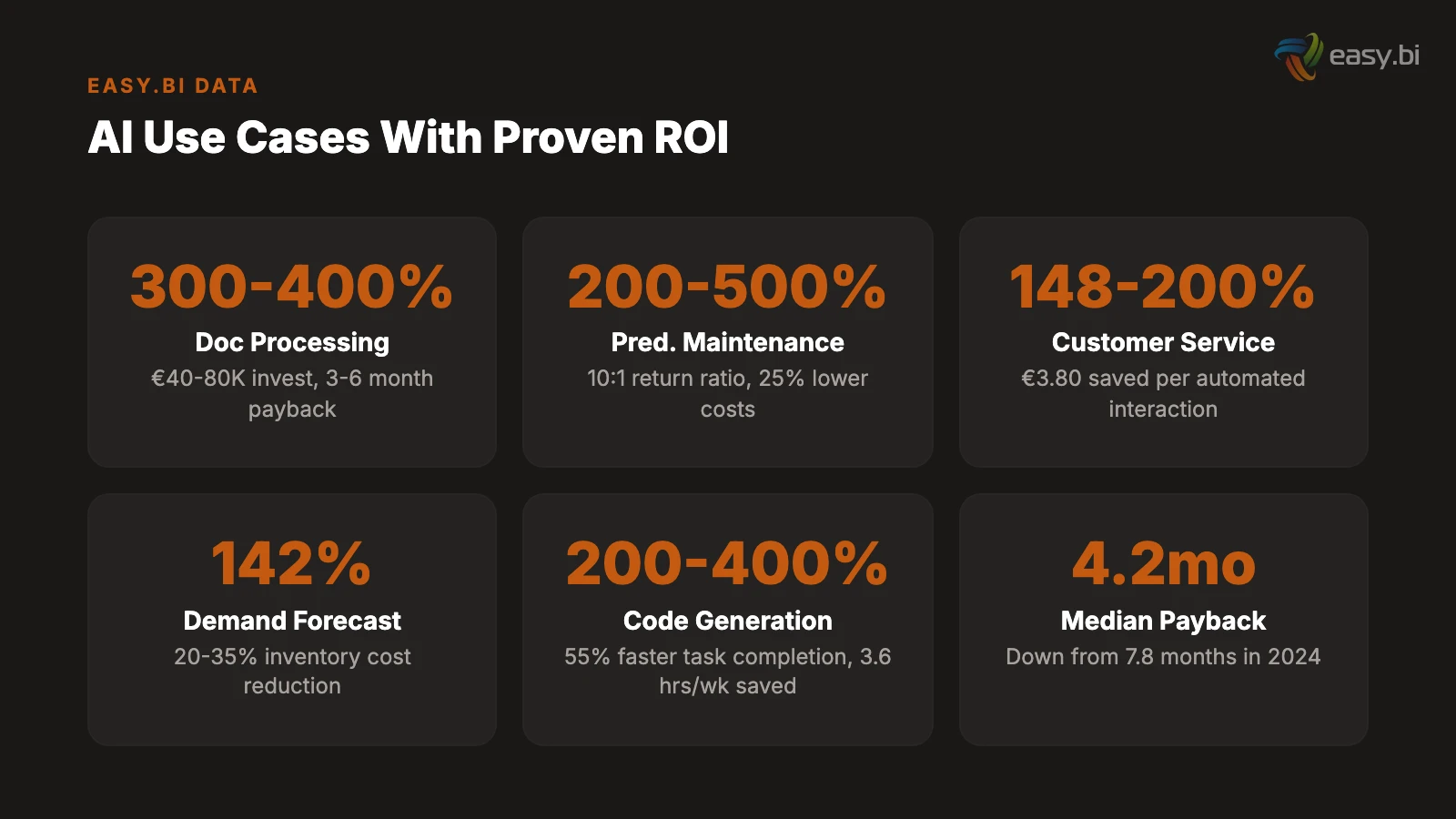
The 5 use cases below share three traits: they target high-volume, repetitive processes; they have well-understood accuracy requirements; and they integrate with existing systems without requiring a data warehouse rebuild.
| Use Case | Typical Investment (EUR) | Annual Savings (EUR) | Payback Period | First-Year ROI |
|---|---|---|---|---|
| Intelligent Document Processing | 40,000-80,000 | 120,000-350,000 | 3-6 months | 300-400% |
| Predictive Maintenance | 80,000-150,000 | 200,000-500,000 | 4-8 months | 200-500% |
| Customer Service Automation | 30,000-70,000 | 90,000-250,000 | 3-5 months | 148-200% |
| Demand Forecasting | 60,000-120,000 | 150,000-400,000 | 5-9 months | 142-250% |
| Code Generation Assistance | 15,000-40,000 | 80,000-200,000 | 2-4 months | 200-400% |
These ranges reflect mid-market implementations - not enterprise-scale deployments with dedicated ML teams, and not free-tier experiments that never reach production.
See how ebiCore accelerates development.
How Does Intelligent Document Processing Pay for Itself?
Every mid-market company has a document processing bottleneck. Invoices, purchase orders, shipping documents, contracts, compliance forms - humans read them, extract data, enter it into systems, and verify the results. The process is slow, error-prone, and expensive.
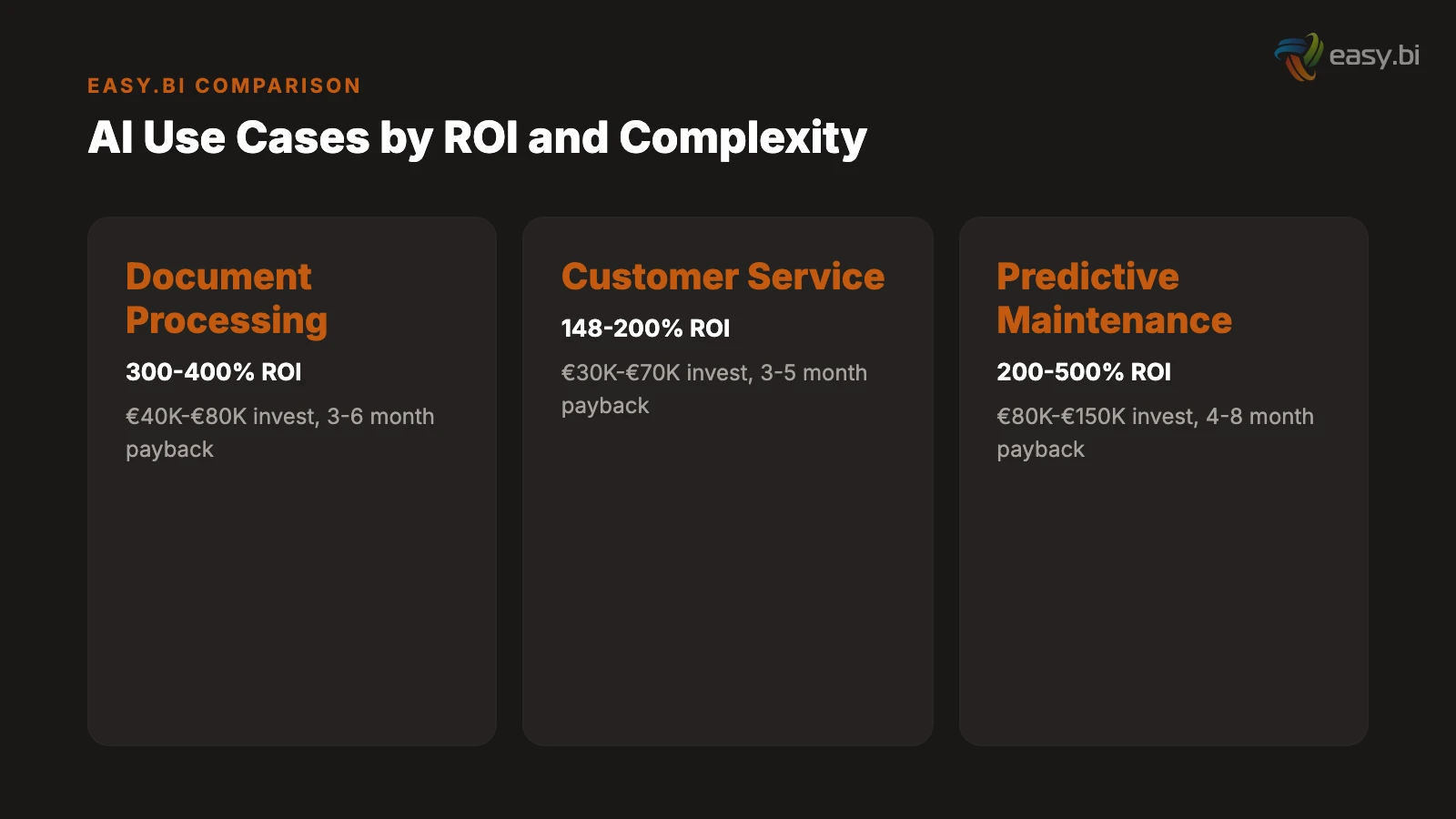
Manual document processing costs EUR 23-35 per document when you factor in labor, error correction, and processing delays. Intelligent document processing (IDP) reduces that to EUR 0.50-2.00 per document.[3] For a company processing 3,000 documents monthly, the math is straightforward: EUR 69,000-105,000 in monthly manual costs versus EUR 1,500-6,000 with IDP.
From my experience as CTO, the implementation pattern that works is this: start with a single document type (invoices are the most common), train the extraction model on 200-500 samples, deploy with human-in-the-loop verification for the first 30 days, then gradually reduce human oversight as accuracy stabilizes above 95%.
The technology stack is mature. Cloud-based IDP platforms from AWS (Textract), Google (Document AI), and Microsoft (Document Intelligence) handle extraction. A custom integration layer maps extracted fields to your ERP or accounting system. Total implementation time: 4-8 weeks for a single document type.
Companies processing 5,000+ documents monthly achieve payback in 3-4 months. Those processing 1,000-5,000 documents see returns within 6-9 months. Below 1,000 documents monthly, the ROI case weakens unless the documents are high-value (contracts, compliance filings) where error costs are significant.
A logistics company we worked with processed 4,200 shipping documents monthly with a 6-person data entry team. After deploying IDP, they reduced the team to 2 people focused on exception handling, saving EUR 180,000 annually on an implementation investment of EUR 55,000. Payback: 3.7 months.
What Makes Predictive Maintenance a Reliable ROI Generator?
Predictive maintenance is the oldest AI use case on this list, and for good reason: the cost of unplanned downtime is enormous and precisely measurable. Manufacturing facilities lose an average of EUR 240,000 per hour of unplanned downtime.[4] Even reducing downtime incidents by 30% translates to hundreds of thousands in annual savings.
The ROI formula for predictive maintenance is unusually clear. AI-powered predictive maintenance delivers 10:1 to 30:1 return ratios within 12-18 months of implementation, with typical results including 25% lower maintenance costs, 10-20% higher uptime, and 50% fewer downtime incidents.[4]
For mid-market manufacturers and logistics companies, the implementation path has three phases:
Phase 1 - Sensor data collection (weeks 1-4): Install IoT sensors on critical equipment or connect to existing sensor infrastructure. Most modern industrial equipment already generates vibration, temperature, and pressure data - it just is not being analyzed.
Phase 2 - Baseline and model training (weeks 5-10): Collect 6-8 weeks of operational data to establish baselines. Train anomaly detection models on normal operating patterns. The models do not predict specific failures initially - they identify deviations from normal behavior.
Phase 3 - Alert integration and refinement (weeks 11-16): Connect predictive alerts to your maintenance scheduling system. Refine alert thresholds to reduce false positives. Build a feedback loop where maintenance technicians confirm or dismiss alerts, improving model accuracy over time.
The investment is higher than document processing (EUR 80,000-150,000 for a mid-market deployment) because of the sensor infrastructure and integration work. But the savings scale with the cost of your downtime. A facility with EUR 2.5 million in annual downtime costs saving 32% through predictive maintenance recovers EUR 800,000 annually.[4]
I have seen two common failure modes with predictive maintenance. First, companies try to predict specific failure modes before they have enough failure data - start with anomaly detection, not failure prediction. Second, companies deploy sensors on non-critical equipment where downtime costs are low. Focus on the 3-5 machines where an hour of downtime costs the most.
How Is Customer Service Automation Delivering 148-200% ROI?
Customer service automation has matured faster than any other AI use case. In 2023, chatbots were frustrating keyword matchers. In 2026, LLM-powered support systems resolve 30% of inquiries autonomously and reduce first response times from over 6 hours to under 4 minutes.[5]
The ROI comes from three sources:
Direct cost reduction: Each automated interaction saves an estimated EUR 3.80 compared to a human-handled interaction.[5] For a mid-market company handling 5,000 support tickets monthly, automating 30% of those interactions saves EUR 68,400 annually.
Agent productivity gains: Support agents using AI tools handle 13.8% more inquiries per hour.[5] For a 10-person support team, that is the equivalent output of 1.4 additional agents without the hiring cost.
Revenue recovery: Faster response times reduce customer churn. A Freshworks study found that AI-assisted support teams see 15-22% lower churn rates compared to teams without AI tools.
The implementation cost is the lowest on this list: EUR 30,000-70,000 for a production-grade deployment. The reason is that the core AI capability (LLM-powered response generation) is available as an API. The implementation work is in integration: connecting the AI to your knowledge base, building escalation workflows, and training the system on your product-specific language.
| Metric | Before AI | After AI | Improvement |
|---|---|---|---|
| First Response Time | 6+ hours | Under 4 minutes | 98% reduction |
| Resolution Time | 32 hours | 32 minutes | 87% reduction |
| Tickets Resolved Autonomously | 0% | 30% | 30 percentage points |
| Agent Inquiries Per Hour | Baseline | +13.8% | 13.8% improvement |
| Cost Per Interaction | EUR 5.20 | EUR 1.40 | 73% reduction |
Gartner projects an USD 80 billion reduction in contact center labor costs by 2026,[5] driven primarily by AI automation in tier-1 support. Mid-market companies that deploy now capture these savings before the competitive advantage disappears.
The critical success factor is knowledge base quality. An LLM-powered support system is only as good as the information it can access. Companies that invest 2-3 weeks in structuring their knowledge base before deploying AI support see 40-60% higher autonomous resolution rates than those that deploy first and optimize later.
What ROI Can Mid-Market Companies Expect from Demand Forecasting?
Demand forecasting is the highest-complexity use case on this list, but also one of the highest-value for companies with significant inventory or supply chain operations. AI-powered demand forecasting reduces inventory costs by 20-35% and prevents 65% of stockouts through pattern recognition that humans cannot replicate.[6]
The ROI calculation centers on two metrics: carrying cost reduction and lost-sale prevention.
Carrying cost reduction: Mid-market retailers and manufacturers typically carry 15-25% more inventory than optimal because their forecasting is based on historical averages and manual adjustments. AI-powered forecasting reduces this excess by 20-30%, translating to working capital improvements of EUR 15-20 per thousand euros of revenue.[6]
Lost-sale prevention: Stockouts cost 2-4% of annual revenue for most mid-market retailers. A 15% reduction in stockouts through better forecasting recovers EUR 30,000-120,000 annually for a company with EUR 10M-40M in retail revenue.
The implementation approach that works for mid-market companies: start with 15-20% of your product assortment - specifically, the SKUs with the highest revenue impact and the most volatile demand patterns. Companies that start with this focused approach achieve 83% higher project success rates and realize an average 142% ROI on initial implementation phases.[6]
The investment is EUR 60,000-120,000, with the higher end including integration with ERP and warehouse management systems. Implementation takes 8-14 weeks, with the first 4-6 weeks focused on data preparation and the remainder on model training and system integration.
The biggest trap: companies try to forecast demand for every SKU from day one. The data requirements scale with product breadth. Start narrow, prove the model on high-impact products, then expand gradually.
Our AI framework cuts development time in half
ebiCore is our proprietary agentic AI framework that accelerates innovation and reduces cost.
Start with a Strategy CallHow Does Code Generation Assistance Deliver ROI Beyond Developer Speed?
Code generation is the newest use case on this list and the most counterintuitive in terms of ROI calculation. The headline stat is compelling: developers using AI coding assistants complete tasks 55% faster.[7] But the real ROI comes from where that time goes.
GitHub Copilot and similar tools now generate an average of 46% of code written by users, with Java developers reaching 61%.[7] Most enterprises report positive ROI within 3 to 6 months. Analytics across more than 135,000 developers suggest that AI coding tools save an average of 3.6 hours per week per developer.[7]
For a mid-market engineering team of 15 developers at an average fully-loaded cost of EUR 85,000 per year, saving 3.6 hours weekly per developer equals EUR 193,000 in recaptured annual capacity. The investment: EUR 15,000-40,000 annually for enterprise-tier licenses and setup.
But the ROI is not just about typing speed. The secondary benefits matter more:
Reduced context switching: Developers spend less time searching documentation and Stack Overflow. The AI assistant provides relevant code patterns inline, keeping developers in flow state longer.
Faster onboarding: New team members ramp up faster when AI assistants help them navigate unfamiliar codebases. One observation from our engineering team: junior developers using AI coding assistants reach productive output levels 30-40% faster than those without.
Higher code review throughput: When AI generates boilerplate code, code reviewers can focus on business logic and architectural decisions rather than syntax and formatting.
The one caveat: independent code analyses found approximately 1.7x more issues in AI-coauthored pull requests. AI-generated code requires disciplined review processes. The productivity gain disappears if your team blindly accepts every suggestion.
90% of Fortune 100 companies have adopted GitHub Copilot.[7] But adoption does not equal effective use. It takes approximately 11 weeks for developers to fully realize productivity gains from AI coding tools. Companies that skip the training and onboarding period see 40-60% lower ROI than those that invest in structured adoption.
How Should Mid-Market Companies Prioritize These Use Cases?
Not every use case applies to every company. The prioritization framework is straightforward:
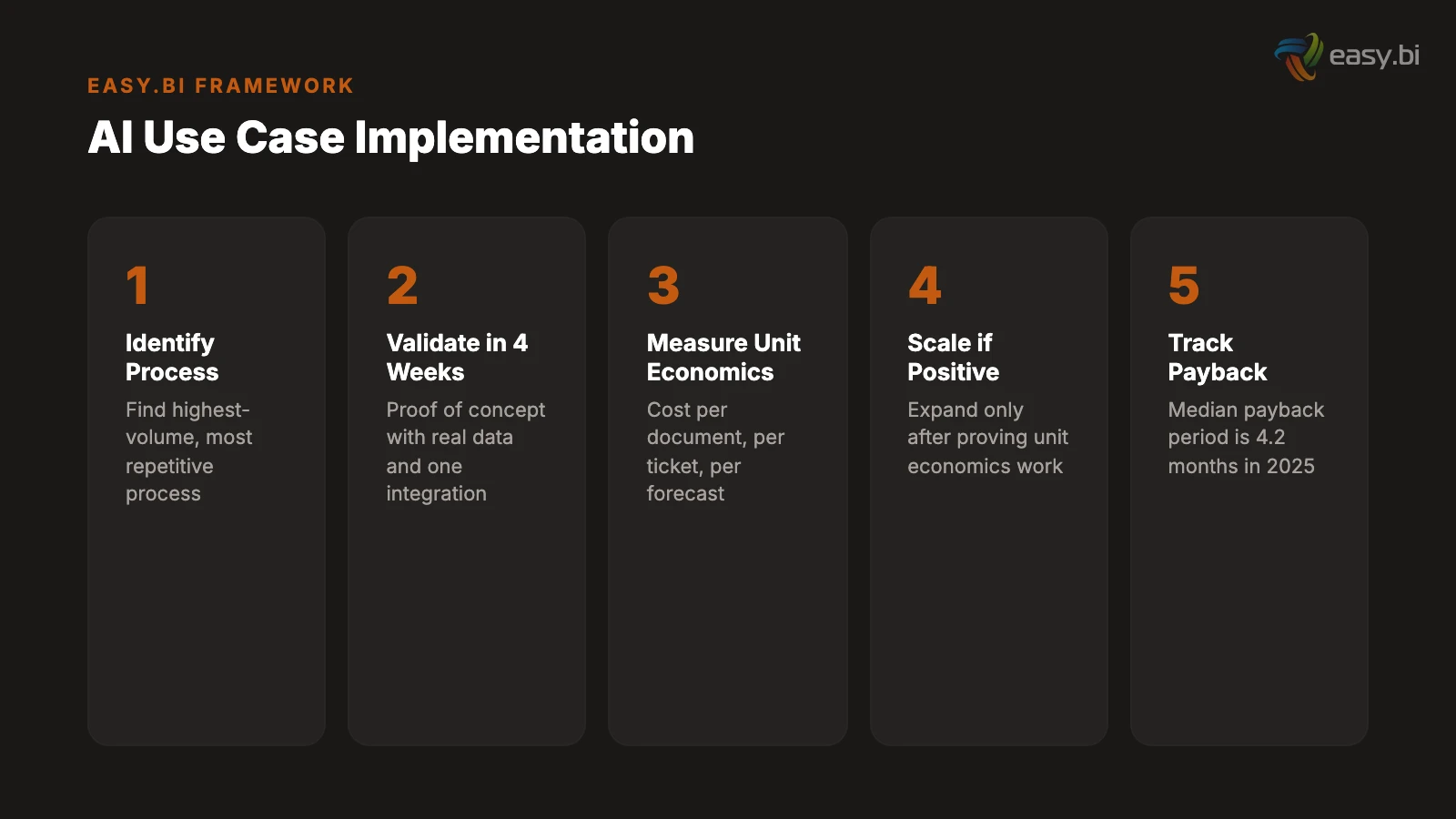
Start with the use case where you have the highest-volume repetitive process. If you process thousands of documents monthly, start with IDP. If you run manufacturing equipment with expensive downtime, start with predictive maintenance. If you handle thousands of support tickets, start with customer service automation.
Validate with a 4-week proof of concept. Every use case on this list can be validated in 4 weeks with a focused team. The proof of concept should process real data, integrate with at least one production system, and produce a measurable baseline for ROI calculation.
Scale only after proving unit economics. The proof of concept tells you the cost per unit (per document, per maintenance alert, per support ticket, per forecast, per developer hour). If the unit economics are positive, scale. If not, iterate on the model before expanding.
The biggest risk for mid-market companies is not failed AI. It is delayed AI. Every month you postpone a high-ROI use case, a competitor captures the efficiency gap. The median payback period is 4.2 months. That means most companies recoup their investment before the next budget cycle.
For the complete perspective on integrating AI into enterprise software - including the architectural patterns that make these use cases production-grade - read our guide on AI in enterprise software. For practical frameworks on deciding what to build versus buy, see AI build vs. buy models. And for governance guardrails that keep these deployments compliant without slowing them down, explore our AI governance guide for mid-market.
If you are evaluating which AI use case to pilot first, explore our AI Impact Assessment. We identify the top 3 AI-powered efficiency gains in your business with projected ROI - so you go to your board with a funded initiative, not a slide deck.
Frequently Asked Questions
What is the minimum company size to see positive ROI from AI in year 1?
Companies with EUR 10M+ revenue and at least one high-volume repetitive process typically see positive ROI within 12 months. The key factor is not company size but process volume. A 50-person company processing 5,000 invoices monthly will see faster payback than a 500-person company processing 200. The threshold is process volume, not headcount or revenue.
How much does a production-grade AI pilot cost for mid-market companies?
A well-scoped AI pilot for mid-market enterprises costs EUR 30,000-150,000 depending on use case complexity. Document processing and customer service automation sit at the lower end because they leverage mature cloud APIs with minimal custom infrastructure. Predictive maintenance and demand forecasting require more sensor integration and data pipeline work, placing them at the higher end.
Which AI use case has the fastest payback period?
Customer service automation and intelligent document processing deliver the fastest payback, typically 3-6 months. Customer service automation saves an estimated EUR 3.80 per automated interaction, and document processing saves EUR 21-35 per document compared to manual handling. High-volume operations see returns within weeks of deployment.
What is the biggest reason AI projects fail to deliver ROI?
The primary reason is starting with technology instead of a business problem. 80% of failed AI projects began with "we should use AI" rather than "we spend EUR 400,000 annually on manual invoice processing." Successful implementations identify a specific, measurable cost center and apply AI to reduce it. The technology selection comes after the problem definition, not before.
References
- [1] McKinsey (2025). "The state of AI in 2025: Agents, innovation, and transformatio mckinsey.com
- [2] Pertama Partners (2026). "AI Project Failure Rate 2026: 80% Fail. pertamapartners.com
- [3] Docsumo (2025). "50 Key Statistics and Trends in Intelligent Document Processing docsumo.com
- [4] F7i (2026). "Predictive Maintenance Cost Savings: The 2026 CFO Guide. f7i.ai
- [5] Freshworks (2025). "How AI is unlocking ROI in customer service. freshworks.com
- [6] Net Solutions (2025). "AI in Retail Demand Forecasting. netsolutions.com
- [7] Panto (2026). "GitHub Copilot Statistics 2026. getpanto.ai
- [8] NVIDIA (2026). "How AI Is Driving Revenue, Cutting Costs and Boosting Productivi blogs.nvidia.com
Explore Other Topics
Ready to accelerate with AI?
30-minute call with an engineering lead. No sales pitch - just honest answers about your project.
98% engineer retention · 14-day delivery sprints · No lock-in contracts
Related Reading

How might the use of automation, in the field of IT change energy and environmental services?
Explore how automation in IT enhances efficiency and sustainability in energy and environmental services, focusing on modernization and future trends.
Andrej Lovsin
Transforming Business Management Through the Use of Cloud Based Services.
Cloud services enhance business innovation by improving efficiency, decision-making, and modernization, providing flexibility and cost savings.
Filip Kralj
How can online retail companies use technology to expand their business?
Learn how e-commerce businesses can use technology to drive growth and stay competitive in a rapidly changing market.
Filip Kralj